
1
Towards multicaloric effect with ferroelectrics
Yang Liu1,*, GuangZu Zhang1, Qi Li1, Laurent Bellaiche2, James F. Scott3, Brahim Dkhil4, Qing Wang1
1
Department of Materials Science and Engineering, The Pennsylvania State University, University Park, Pennsylvania 16802, USA
2Physics Department and Institute for Nanoscience and Engineering, University of Arkansas,
Fayetteville, 72701 Arkansas, USA
3
School of Chemistry and School of Physics and Astronomy, University of St Andrews, St Andrews, Scotland, United Kingdom
4
Laboratoire Structures, Propriétés et Modélisation des Solides, Université Paris-Saclay, CentraleSupélec, CNRS, Grande Voie des Vignes, Châtenay-Malabry Cedex 92295, France
Email:[email protected] Abstract
Utilizing thermal changes in solid state materials strategically offers caloric-based alternatives to replace current vapor-compression technology. To make full use of multiple forms of the entropy and achieve higher efficiency for designs of cooling devices, the multicaloric effect appears as a cutting-edge concept encouraging researchers to search for multicaloric materials with outstanding caloric properties. Here we report the multicaloric effect in BaTiO3 single
2 1. Introduction
The term Caloric Effect refers to the reversible thermal changes (adiabatic change in the temperature or isothermal change in the entropy) in solids driven by external stimuli, which is usually largest near their phase transitions.[1] Solid-state refrigeration based on the caloric
effect offers novel environmentally friendly and energy-efficient solutions to displace current cooling technology mainly based on vapor compression.[2] It is known that the caloric effect mainly involves magnetocaloric, electrocaloric and mechanocaloric (elastocaloric and barocaloric) types, corresponding respectively to magnetic, electric and mechanical field (uniaxial stress and hydrostatic pressure).[1,2] Recently the multicaloric effect appears to be a
promising concept to take advantage of the multiple forms of the entropy and higher energy efficiency.[3] Driven either by a single stimulus[3-5] or by multiple stimuli acting in concerted sequence,[1,6] the multicaloric effect may yield larger caloric response compared to the caloric effect induced by a single stimulus. This leads to an enthusiastic search for multicaloric materials and encourages fast-growing research activities in this field.[1,7] For instance, recent
experimental work demonstrates that a dual-stimulus magnetic-electric multicaloric cycle can not only overcome the irreversibility existing in the pure magnetocaloric cycle but also creates greater caloric response in multiferroic FeRh/BaTiO3 heterostructures.[6]
3
multicaloric effect over individual caloric responses is not quite clear so far. This requires detailed comparison about the sensitivity of multicaloric effects with respect to different stimuli (electric field, uniaxial stress and pressure) that is basically unknown.
In this work we present a thermodynamic study of multicaloric effects specifically in single crystals of BaTiO3 (which is a prototype of all ferroelectrics) under simultaneous
electric and mechanical fields (uniaxial stress or hydrostatic pressure). Taking into account recent experimental evidences and theoretical developments, we provide critical insights into the use of ferroelectric materials for potential multicaloric cooling. Our findings address the dominant role of mechanical field in manipulating the multicaloric behavior in ferroelectrics and reveal the upper bound for multicaloric response near the Curie temperature. Our results show that uniaxial stress rather than hydrostatic pressure is the optimum mechanical stimulus to drive the multicaloric effect. In addition, we make comparison between the multicaloric effect and mechanically (electrially) - mediated electrocaloric (mechanocaloric) effect.
2 Thermodynamic model
On the basis of previous phenomenological efforts[11,12,24,31] we can deduce the caloric behavior in normal ferroelectric simply in terms of its order parameter, i.e., polarization. The principle idea is to “transform” the lattice entropy change due to structural transition into polar contributions. This treatment can provide reasonable estimations of caloric behaviors: mechanocaloric entropy change exists only if structural changes are induced by uniaxial stress or hydrostatic pressure, which is always accompanied by a change of a polar degree of freedom, since the ferroelectric phase transition is of a structural nature. Therefore, the key assumption used here is that the total entropy can be divided into a lattice part, which is field-independent, and a polar part which depends strongly on external stimulus.[11] The
4
other non-polar modes and to phonons at nonzero wavevector, away from the Brillouin zone center. These contribute to the specific heat but not to the macroscopic polarization. As a result, based on a Landau-type free-energy model, the caloric response can be calculated without employing the Maxwell relations, which may be questionable for first-order phase transitions.[11,31] By carrying out these kinds of calculations we could at least obtain qualitative information about the multicaloric effect, which acts as an important guide to future experimental studies. Moreover, previous results[11,12,24,31] based on this model appear to be compatible with the recent developments from both first-principles predictions and experimental data.[21,22,26,30]
Considering simultaneous application of electric field E and uniaxial stress 3 (denoted as in the following) along polarization z-direction or hydrostatic pressure p adiabatically on BaTiO3 single crystals, the multicaloric temperature change T T2 T1 can be obtained through the following relation[11]
2 2
2 1 1 2 2 1 1 1
latt
1
exp{ [ ( ) ( or , , ) ( ) (0, 0, )]},
2 ( )
T T a T P p E T a T P T
C T
(1)
where P is the polarization and Clatt( )T is the lattice contribution to the total heat capacity, which is field-independent.[11] Moreover, a1d1/ 2dT , with 1 being a temperature-dependent Landau free energy expansion coefficient. Here we are particularly interested in the transition from cubic phase (P1P2 P3 0) to tetragonal phase (P1 P2 0, PP3 0). The temperature dependence of polarization under different electric and mechanical fields
( , , )
P p E T or P( , , ) E T can be deduced by solving for the Gibbs free energy under the condition of thermodynamic and mechanical equilibrium G/ P 0. Specifically, Gibbs free energy under hydrostatic pressure and electric field can be expressed as[35]
2 4 6 8
p 1 11 111 1111
2 2
11 12 11 12
2
( 3 ) ( 2 ) ,
3
G P P P P
S S p p Q Q P EP
5
where Smn are the elastic compliances and Qmn are the electrostrictive coefficients. For the mechanical boundary conditions under uniaxial stress, G can be written as[35]
2 4 6 8 2 2
1 11 111 1111 11 11
1
, 2
G P P P P S Q P EP (3)
The Landau coefficients, electrostrictive coefficients, and elastic compliances of BaTiO3
at room temperature we used are the same as in previous works.[24,31] Clatt( )T can be obtained by fitting the experimental results with a linear relation such that
3
latt( )=(0.157 10 +0.85 )
C T T where is the mass density.[12]
3. Result and Discussion
3.1 Tuning of the Curie temperature
The tuning of the Curie temperature under different stimuli is shown in Fig. 1. In normal ferroelectrics such as BaTiO3 the long-range-ordered ferroelectric phase can be stabilized by
external electric field even in the paraelectric phase above the Curie temperature, which is accompanied by the ordering of electrical dipoles. This leads to the reduction of entropy under isothermal condition or heating of ferroelectrics under adiabatic condition, which is known as the positive (conventional) electrocaloric effect, indicated by a positive T peak near the Curie temperature.[7,36] Similarly, the mechanocaloric effect (elastocaloric and barocaloric)
6
hydrostatic pressure is negative,[31] which is consistent with experimental results.[33] In addition, 0.05 GPa pressure or stress can fully drive the narrow first-order phase transition (~2.5 K, as reported in Ref. 14).
Fig. 1 indicates that the phase transition from cubic to tetragonal in BaTiO3 is most
sensitive to tensile stress compared to hydrostatic pressure and electric field for realistic values of stress, pressure and electric field. This highlights the promising potential to develop the mechanocaloric effect, especially the elastocaloric effect, in ferroelectric materials, compared with the electrocaloric effect. As it will be shown later, it is indeed found that the optimized multicaloric behavior is mostly dominated by the mechanical stimuli, whereas the electric field has relatively weak influences on the total caloric response.
3.2. Multicaloric effect under mechanical and electric fields
7
These results may yield a negative indication about the use of multicaloric effect, in addition to the fact that the existence of elastic heating due to elastic deformation makes the total thermal behavior more complex.[38,39] In our model the lattice heat capacity Clatt( )T is assumed to be field-independent, whereas the elastic heating[38,39] (that is usually linearly dependent on the pressure or stress) is not taken into account. The elastic heating at 0.2 GPa uniaxial stress results in heating of only 0.03 K estimated from the Maxwell relation, which contributes about 1% of the elastocaloric temperature change. This implies that Eq. (1) is reasonable in describing the multicaloric effect using uniaxial stress. However, in the case of hydrostatic pressure, recent calorimetry measurements on BaTiO3 ceramics reported a
reduction of barocaloric response with increasing pressure p (Ref. 33) due to elastic heating.[32] The elastic heating, acting as a competing effect with barocaloric cooling, as we predict, limits its performances, especially at high pressure.
In the spirit of the recent experimental demonstration of negative pressure in ferroelectrics,[40,41] we exploit the multicaloric effect under negative pressure and electric field. Negative hydrostatic pressure in real experiments is generally provided by chemical substitution of slightly larger ions; a good example is replacement of Ca or Sr by Y.[40] In addition, recent experimental results demonstrated that negative pressure as low as -4 GPa can be realized by the transformation between a lower-density crystal structure and perovskite phase in freestanding PbTiO3 nanowires.[41] Although the elastic heating would probably exist
8
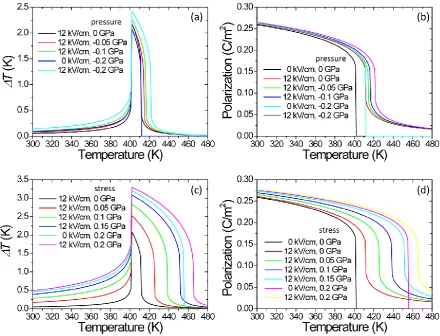
the maximum T from 2.08 K to 2.42 K by a factor of nearly 16%, as shown in Fig. 2a; this is unlikely to overcome the elastic cooling which tends to reduce the total temperature change by roughly the same amount as implied from the experiments.[33]
The existence of negative pressure has been shown to stabilize ferroelectric order,[41]
9
negative pressure.[42] As a result, Fig. 2d presents much larger polarization change in a wider temperature range in Multi2 compared to Multi1.
The multicaloric effect (Multi2) was also studied in PbTiO3 bulk by
first-principles-based calculations using significantly larger tensile uniaxial stress and electric fields.[22] The
caloric strength is about 0.25 K cm/kV GPa at 630 K (E=195 kV/cm and =0.4 GPa), which is much smaller than that (1.37 K cm/kV GPa) in BaTiO3 at 402 K. This unexpected
smaller caloric strength in PbTiO3 may be understood by the much stronger strain-sensitivity
of BaTiO3 compared to PbTiO3.[43] The profiles of multicaloric behavior were found to be
qualitatively similar to our findings in lead-free BaTiO3, while the dominant role of
mechanical field as analyzed later is not revealed in the previous work of Ref. 22. In electrocalorics, including mechanically mediated electrocalorics, all the interaction between stress and polarization is via strain, i.e. piezoelectricity (which is usually large and well studied) and electrostriction. Both works address the important role of piezoelectricity in achieving enhanced multicaloric effect in ferroelectric electrocalorics.[22,24] The analogous situation does not arise in magnetocalorics, which often does not distinguish piezomagnetism[44,45] and magnetostriction.
3.3. Insights into the multicaloric effect in normal ferroelectrics
10
mechanical field due to its high sensitivity in tuning the phase transition (Fig. 1), which is further confirmed in Fig. 3d. Fig. 3d shows that the difference in the largest temperature change between multicaloric effect |TE,m| (or |TEp,m|) and electrocaloric effect |TE,m|
increases much more significantly compared to the difference between multicaloric effect and mechanocaloric effect. Specifically, the contribution from the electric field to the total temperature change remains nearly constant for Multi1 while it decreases considerably for Multi2. In addition, the operational temperature window for Multi2 is expanded by about 10 K towards higher temperatures compared to the pure elastocaloric effect (Fig. 2c). As a result, the advantage of using multicaloric effects is to enhance significantly the electrocaloric effect, although it seems to compete with the mechanocaloric effect, except for a relatively narrow high-temperature range. For instance, in the temperature above ~455 K, the multicaloric response is superior – significantly larger than either electrocaloric or elastocaloric effects (Fig. 2c).
Our results also demonstrate that the multicaloric response (|TE,m| or |TEp,m|) near the Curie temperature cannot be larger than the sum of individual caloric response
,m
|TE |+|T,m| (or |TE,m|+|Tp,m|). This finding further imposes an upper bound for the multicaloric effect in normal ferroelectrics which can be understood as follows. As long as the phase transition can be triggered either by multiple stimuli or by a single stimulus, the largest polarization difference between P p E T( , , ) [or P( , , ) E T ] and P(0, 0, )T remains at almost the same level, i.e., around 0.2 C/m2 in BaTiO3 (see Figs. 2b and 2d). The polarization will
saturate under large enough stimulus, and there is thus very limited space for further inducing a significant variation in the magnitude of polarization. For instance, reaching this upper limit requires at least three times enhancement in the induced polarization (about 0.8 C/m2), according to Eq. (1), which is unrealistic for BaTiO3. This may result from that mechanical
11
polarization. We also note that the limit imposed on bulk ferroelectrics here is in contrast to recent theoretical results in ferroelectric thin films, which can overcome this limit due to the so-called piezoelectrocaloric effect.[34] This may be due to the change in the mechanical boundary conditions leading to secondary contributions.[46]
The multicaloric effect does not significantly exceed the elastocaloric effect near (and below) the Curie temperature, which further implies that elastocaloric effect alone may be strong enough to develop elastocaloric-based devices. However, this does not necessarily mean that multicaloric effect is not useful in ferroelectrics, since Fig. 2c shows that in the high temperature range (above 455 K), the multicaloric response exceeds both electrocaloric and elastocaloric effect by several orders of magnitude.
Finally, we focus on the comparison between multicaloric effect and mechanically-mediated electrocaloric effect or electrically-mechanically-mediated elastocaloric effect. The stimulus-mediated caloric effects refer to the caloric properties tuned by another external stimulus. For instance, the mechanically-mediated electrocaloric effect can be obtained by fixing the samples strained already by a mechanical field and then applying an electric field to trigger only the electrocaloric response of interest. The stimulus-mediated caloric effect has attracted much more attention since the additional stimulus applied on the samples may help to optimize the caloric properties such as the tuning of phase transition temperature (thus the working temperature) and to modify the largest caloric response.[24-27,31] A typical result is
12 4. Conclusion
In summary, we have studied the multicaloric effect in ferroelectrics by systematic comparisons between multicaloric effect and individual or stimulus-mediated caloric effect. For the selection of mechanical stimulus, our results suggest that uniaxial stress is particularly favored due to higher caloric strength and nearly no elastic thermal changes compared to pressure. We also reveal the existence of an upper limit imposed on multicaloric response near the Curie temperature. Our findings demonstrate exciting perspectives of multicaloric effect and offer opportunities for developing multicaloric concept using ferroelectric perovskites for future cooling applications.
Acknowledgements
13 Reference
[1] X. Moya, S. Kar-Narayan, and N. D. Mathur, Nat. Mater. 13, 439 (2014). [2] A. Kitanovski, J. Tušek, U. Tomc, U. Plaznik, M. Ozbolt, and A. Poredoš, Magnetocaloric energy conversion: from theory to applications, Springer International Publishing, Switzerland (2015).
[3] M. M. Vopson, Solid State Commun. 152, 2067 (2012); M. M. Vopson, J. Phys. D: Appl. Phys. 46, 345304 (2013); M. M. Vopson, D. Zhou, and G. Caruntu, Appl. Phys. Lett. 107, 182905 (2015).
[4] Ch. Binek and V. Burobina, Appl. Phys. Lett. 102, 031915 (2013).
[5] A. Planes, T. Castán, and A. Saxena, Philosophical Magazine 94, 1893 (2014). [6] Y. Liu, L. C. Phillips, R. Mattana, M. Bibes, A. Barthélémy, and B. Dkhil, Nat. Commun. 7, 11614 (2016).
[7] Y. Liu, J. F. Scott, and B. Dkhil, APL Materials 4, 064109 (2016).
[8] A. S. Mischenko, Q. Zhang, J. F. Scott, R. W. Whatmore, and N. D. Mathur, Science 311, 1270 (2006).
[9] B. Neese, B. Chu, S. G. Lu, Y. Wang, E. Furman, and Q. M. Zhang, Science 321, 821 (2008).
[10] S. Prosandeev, I. Ponomareva, and L. Bellaiche, Physical Review B 78, 052103 (2008).
[11] R. Pirc, Z. Kutnjak, R. Blinc, and Q. M. Zhang, J. Appl. Phys. 110, 074113 (2011). [12] N. Novak, R. Pirc, and Z. Kutnjak, EPL (Europhysics Letters) 103, 47001 (2013). [13] Y. Bai, X. Han, X.-C. Zheng, and L. J. Qiao, Sci. Rep. 3, 2895 (2013).
[14] X. Moya, E. Stern-Taulats, S. Crossley, D. González-Alonso, S. Kar-Narayan, A. Planes, L. Mañosa, and N. D. Mathur, Adv. Mater. 25, 1360 (2013).
14
[16] G. Zhang, Q. Li, H. Gu, S. Jiang, K. Han, M. R. Gadinski, M. A. Haque, Q. M. Zhang, and Q. Wang, Adv. Mater. 27, 1450 (2015).
[17] X. S. Qian, H. J. Ye, T. Yang, W. Z. Shao, L. Zhen, E. Furman, L. Q. Chen, and Q. M. Zhang, Adv. Func. Mater. 25, 5134 (2016).
[18] G. Zhang, X. Zhang, H. Huang, J. Wang, Q. Li, L. Q. Chen, and Q. Wang, Adv. Mater. 28, 4811 (2016).
[19] F. Weyland, M. Acosta, J. Koruza, P. Breckner, J. Rödel, and N. Novak, Adv. Func. Mater. (2016) DOI: 10.1002/adfm.201602368
[20] Y. Liu, B. Dkhil, and E. Defay, ACS Energy Lett. 1, 521 (2016). [21] S. Lisenkov and I. Ponomareva, Phys. Rev. B 86, 104103 (2012).
[22] S. Lisenkov, B. K. Mani, C.-M. Chang, J. Almand, and I. Ponomareva, Phys. Rev. B, 87, 224101 (2013).
[23] Y. Liu, I. C. Infante, X. J. Lou, L. Bellaiche, J. F. Scott, and B. Dkhil, Adv. Mater. 26, 6132 (2014).
[24] Y. Liu, J. Wei, P.-E. Janolin, I. C. Infante, J. Kreisel, X. J. Lou, and B. Dkhil, Phys. Rev. B 90, 104107 (2014).
[25] Y. Liu, J. Wei, X. J. Lou, L. Bellaiche, J. F. Scott, and B. Dkhil, Appl. Phys. Lett. 106, 032901 (2015).
[26] A. Chauhan, S. Patel, and R. Vaish, Appl. Phys. Lett. 106, 172901 (2015). [27] A. Chauhan, S. Patel, and R. Vaish, Acta Materialia 89, 384 (2015).
[28] S. Patel, A. Chauhan, R. Vaish, and P. Thomas, Appl. Phys. Lett. 108, 072903 (2016). [29] E. Mikhaleva, I. Flerov, V. S. Bondarev, M. V. Gorev, A. D. Vasilliev, and T. N. Davydova, Phys. Solid State 53, 478 (2011).
15
[31] Y. Liu, J. Wei, P.-E. Janolin, I. C. Infante, X. J. Lou, and B. Dkhil, Appl. Phys. Lett. 104, 162904 (2014).
[32] P. Lloveras, E. Stern-Taulats, M. Barrio, J.-Ll. Tamarit, S. Crossley, W. Li, V. Pomjakushin, A. Planes, Ll. Mañosa, N. D. Mathur, and X. Moya, Nat. Commun. 6, 8801 (2015).
[33] E. Stern-Taulats, P. Lloveras, M. Barrio, A. Planes, E. Defay, M. Egilmez, J.-Ll. Tamarit, Ll. Mañosa, N. D. Mathur, and X. Moya, APL Materials 4, 091102 (2016). [34] I. A. Starkov and A. S. Starkov, International Journal of Solids and Structures 100, 187 (2016).
[35] J. J. Wang, P. P. Wu, X. Q. Ma, and L. Q. Chen, J. Appl. Phys. 108, 114105 (2010). [36] Y. Liu, J. F. Scott, and B. Dkhil, Applied Physics Review 3, 031102 (2016).
[37] G. A. Samara, Ferroelectrics 2, 277 (1971).
[38] K. Alex Müller, F. Fauth, S. Fischer, M. Koch, A. Furrer, and P. Lacorre, Appl. Phys. Lett. 73, 1056 (1998).
[39] T. Strässle, A. Furrer, Z. Hossain, and Ch. Geibel, Phys. Rev. B 67, 054407 (2003). [40] S. Rayaprol and E. V. Sampathkumaran, Pramana-J. Phys. 65, 491 (2005).
[41] J. Wang, B. Wylie-van Eerd, T. Sluka, C. Sandu, M. Cantoni, X.-K. Wei, A. Kvasov, L. J. McGilly, P. Gemeiner, B. Dkhil, A. Tagantsev, J. Trodahl, and N. Setter, Nat. Mater. 14, 985 (2010).
[42] S. Tinte, K. M. Rabe, and D. Vanderbilt, Phys. Rev. B 68, 144105 (2003). [43] N. A. Pertsev and B. Dkhil, Appl. Phys. Lett. 93, 122903 (2008).
[44] I. E. Dzialoshinskii, Soviet Phys. JETP 6, 621 (1958). [45] A. S. Borovik-Romanov, Soviet Phys. JETP 11, 786 (1960).
16
Fig. 1. The Curie temperature of BaTiO3 single crystals under different external stimuli
[image:16.595.84.510.148.489.2]17
[image:17.595.79.520.169.505.2]18
19
[image:19.595.89.507.219.527.2]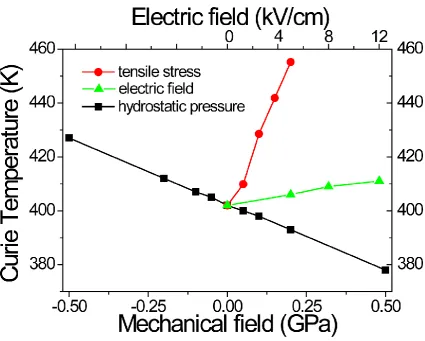
![Fig. 4. Comparison of adiabatical temperature between multicaloric effect (red line) and mechanically(electrically)-mediated electrocaloric (elastocaloric) effect [blue(green) line]](https://thumb-us.123doks.com/thumbv2/123dok_us/8992009.396025/19.595.89.507.219.527/comparison-adiabatical-temperature-multicaloric-mechanically-electrically-electrocaloric-elastocaloric.webp)
