doi:10.4236/jwarp.2010.27071 Published Online July 2010 (http://www.SciRP.org/journal/jwarp)
Chesapeake Bay Tidal Characteristics
Yi Xiong1, Charlie R. Berger2
1Department of Civil and Environmental Engineering, Mississippi State University, Starkville, USA 2US Army Corps of Engineers, Coastal and Hydraulics Laboratory–ERDC, Vicksburg, USA
E-mail: [email protected]
Received January 23, 2010; revised March 19, 2010; accepted May 7, 2010
Abstract
The basic knowledge of tidal characteristics in Chesapeake Bay is a prerequisite to understand the tidal processes in Chesapeake Bay. The tidal characteristics in Chesapeake Bay were assessed in this paper using basic tidal hydraulic analysis. Tidal elevation, currents and salinity data of Chesapeake Bay from National Oceanic and Atmospheric Administration (NOAA) were retrieved, and analyzed to understand Chesapeake Bay tide. General knowledge of location, geometry, tides, freshwater inputs, wind, salinity, etc in Chesa-peake Bay was described. Sediment distribution of ChesaChesa-peake Bay was briefly described and discussed. Amplitude and phase of the selected major constituent, form factor, phase difference between tide elevations and currents at a few tidal elevation stations within Chesapeake Bay were calculated. Tidal prism was fig-ured out using cubature method. The analysis approach could also be used as a source of reference for basic tidal study in other tide-affected field.
Keywords:Chesapeake Bay, Tidal Characteristics
1. Introduction
Chesapeake Bay encountered a severe environmental suffering during past a few decades, due to nitrogen, phosphorus and sediment pollution. It has been recog-nized that environmental quality factors are directly de-pendent on the tides in the Bay [1].
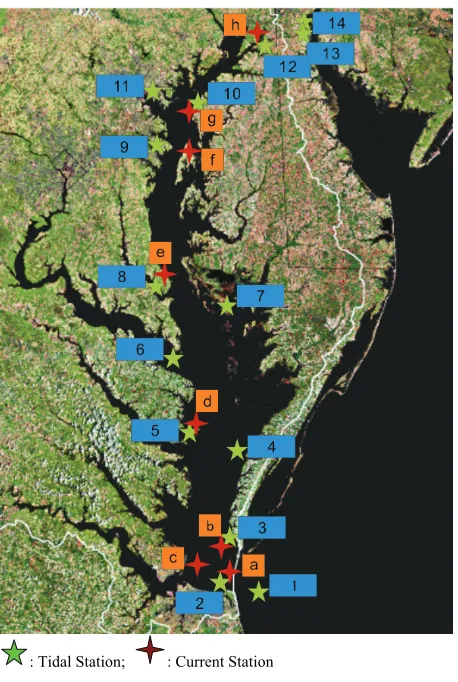
Chesapeake Bay is the largest bay in US. The Chesa-peake Bay and its tributaries are the best studied estuar-ies in the world [2]. The Chesapeake Bay “main stem”, defined by tidal zones, is approximately 195 mi (315 km) long and 3.5 to 35 mi (5.6 to 56 km) wide, and has a sur-face area of nearly 4,400 mi2 (11,601 km2). The main stem is entirely within Maryland and Virginia. Nearly 50 rivers, with thousands of tributary streams and creeks, drain the approximately 64,000 mi2 (166,000 km2) form-ing the Chesapeake Bay Basin. The basin contains more than 150,000 stream miles (241,500 km) in the District of Columbia and parts of six states: New York, Pennsyl-vania, Maryland, Virginia, West Virginia, and Delaware [3]. Figure 1 shows the location of Chesapeake Bay in accordance with “NOAA Tides and Currents”. In addi-tion, the fourteen tidal elevation stations and seven tidal current stations are indicated (see Table 1 for details).
The Chesapeake estuary is a drowned river and it is partially mixed. The depths are relatively shallow, so that
mixing of at least moderate magnitude extends to the depths. In the total estuary approximately 50% of the system is less than 20 ft (6 m) deep, 35% has depths greater than 30 ft (9 m), 18% greater than 40 ft (12 m), and only 8% greater than 60 ft (18.3 m) [2].
Tides and freshwater inputs from the various tributar-ies of the Chesapeake Bay control the hydraulics of the bay [1]. National Research Council (2004) mentioned that three main factors influencing Chesapeake Bay’s circulation: freshwater inflow, the geometry of the basin, and tidal strength. Due to its small depth-length ratio, Chesapeake Bay accommodates slightly more than one semidiurnal tidal wave at all times, which results in a special tidal characteristics within Chesapeake Bay. Al-though the Bay has more than 50 tributary rivers, only 3
: Tidal Station; : Current Station
Figure 1. Chesapeake bay map.
duced by snow melt and spring rains; low flows in late summer and early fall, followed by moderate flows through-out the remainder of the year [4]. Fresh water in Chesapeake Bay has a mean residence time of 7 months [5].
Wind is also reported as an important energy input in Chesapeake Bay. Zhong and Li [6] proposed that tidal and wind forcing appears to have nearly equal impor-tance in Chesapeake Bay. Chesapeake Bay is classified as a partially–stratified estuary [7].
The main channel is of 5 to 7 km (4.4 mi) width and 23 m (75 ft) depth at the mouth of the Chesapeake Bay [8]. Bathymetries in the Upper Chesapeake Bay are char-acterized by a steep east-west slope and a relatively gen-tle north-south slope. A narrow and deep navigation channel exceeding 9 m (30 ft) follows the contour of the eastern coast, bounded to the west by broad banks [9]. The Chesapeake & Delaware Canal runs 14 miles long, 450 feet wide and 35 feet deep across Maryland and Delaware, connecting the Delaware River with the Chesapeake Bay and the Port of Baltimore. The C&D Canal is owned and operated by the U.S. Army Corps of Engineers, Philadelphia District.
The mean tidal range decreases from 0.9 m (3 ft) at the
Bay’s entrance (Chesapeake BBT) to a minimum of 0.3 m (1.0 ft) at Annapolis, then rises to 0.7 m (2.3 ft) at the head. Average tidal current amplitudes decrease from a maximum of 1.03 m/s (3.38 ft/s) at the mouth to a mini-mum of 0.13 m/s (0.43 ft/s) in the middle Bay, but in-crease to 0.59 m/s (1.94 ft/s) at Baltimore in the upper Bay [6].
The tidal and current range on the eastern shore is generally higher than that on the corresponding western shore, which is mostly explained as the result of earth rotation. However, Wang and Chao [9] proposed that the deep channel is the root cause of the current intensifica-tion, while the earth’s rotation does not play a crucial role.
The salinity increases from zero at the head of the es-tuary to nearly that of seawater at the mouth. In the upper Chesapeake Bay and in each tributary estuary there are considerable seasonal variations in salinity which dimin-ish in magnitude in magnitude toward the mouths of these estuaries [2].
Figures 2 and 3 are one-month and three-day tides at Chesapeake Light (8638979), respectively. These two plots reveal that the tide is predominantly driven by semidiurnal constituent. The magnitudes of Spring and Neap tide ranges are approximately 1.7 m (5.6 ft) and 0.7 m (2.3 ft), respectively, as shown in Figure 2. Also, the mean tide range is around 1.2 m (3.9 ft).
The understanding of tidal characteristics is the prem-ise to learn tidal and sediment transport processes in es-tuarine areas. Investigation on hydrodynamic environ-ment of the bay is in favor of comprehending pollutant transport and mechanism of deep water zone maintaining [10]. Therefore, it is desirable to perform a general basic tidal study in Chesapeake Bay in order to further under-stand the tidal characteristic in Chesapeake Bay. In addi-tion, the basic tidal analysis approaches can be optionally used in other estuaries.
2. Tidal Characteristics within Chesapeake
Bay
2.1. Stations and General Issues
621
Table 1. Tidal characteristics at water elevation stations.
Station Station ID Latitude (N) Latitude (W) location
Chesapeake
Light Tower 8638979 36°54.3' 75°41.8' Ocean Chesapeake
BBT 8638863 36°58.0' 76°6.8' Kiptopeke 8632200 37°9.9' 75°59.3'
Rappahammock
Light 8632837 37°32.3' 76°0.9' Windmill Point 8636580 37°36.9' 76°17.4'
Lower bay
Lewisetta 8635750 37°59.8' 76°27.9'
Bishops Head 8571421 38°13.2' 76°2.3'
Solomons Isand 8577330 38°19.0' 76°27.1'
Mid bay
Annapolis 8575512 38°59.0' 76°28.9'
1tolchester
Beach 8573364 39°12.8' 76°14.7' Baltimore** 8574680 39°16.0' 76°34.7'
Upper bay
Chesapeake
City 8573927 39°31.6' 75°48.6' Reedy Point 8551910 39°33.5' 75°34.4'
Delaware City 8551762 39°34.9' 75°35.3'
C&d canal
Note: * For C&D canal tide analysis only; ** For salinity discussion only
1.5 2.0 2.5 3.0 3.5 4.0
9/30/98 0:00 10/5/98 0:00 10/10/98 0:00
10/15/98 0:00
10/20/98 0:00
10/25/98 0:00
10/30/98 0:00
Date/Time
H
ei
g
h
t r
el
ate
to
S
tn
D
tm
(m
)
Figure 2. One-month ocean tide at chesapeake light.
1.5 2.0 2.5 3.0 3.5 4.0
10/29/98 0:00 10/30/98 0:00 10/31/98 0:00 11/1/98 0:00
Date/Time
H
ei
g
h
t r
el
ate to
S
tn
D
tm
(m
)
Figure 3. Three-day ocean tide at chesapeake light.
Table 3 gives the Chesapeake Bay current stations from Chesapeake Bay Port (See Figure 1 for the loca-tions).
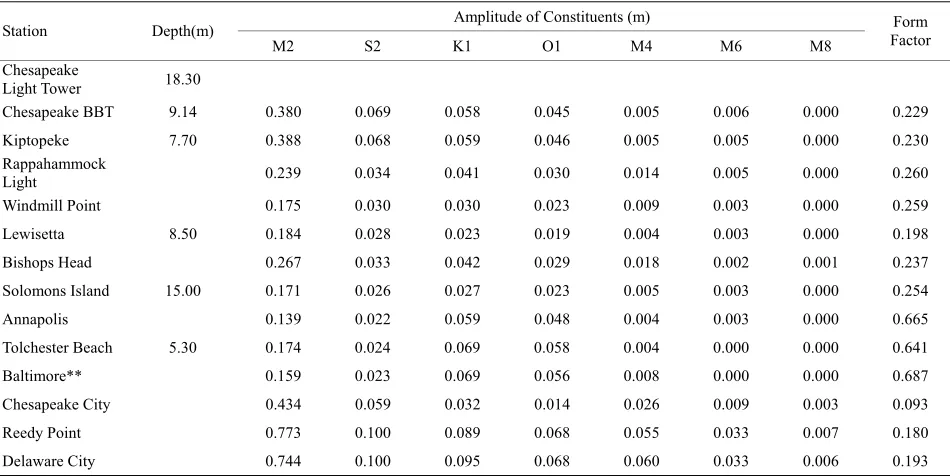
The relative importance of the diurnal and semidiurnal tidal constituents and tide classification can be expressed in terms of form factor as shown in Table 2 [12], which is defined as,
1 1
2 2
K O
F
M S
where K1, O1, M2, and are the amplitudes of the corresponding tidal constituents. In terms of the form factor, F, the tides may be roughly classified as shown in
Table 4.
2
S
The calculated form factors reveal that semidiurnal tide is almost throughout Chesapeake Bay except for the standing wave in three upper Bay stations (Annapolis, Tolchester Beach, and Baltimore) with higher latitudes.
The natural fundamental period can be calculated as below,
n T
2 n
s T
g h
where s is the length of Chesapeake Bay, 320 km; g is the gravity acceleration, 9.81m/s2, is the mean depth of Chesapeake Bay, 5 m [13]. The calculated natural fundamental period Tn, 25.38 hours, is closer to the diur-nal tidal period, thus, amplification of diurdiur-nal tide could be observed. In accordance with Schwartz [14], the di-urnal tide could be amplified at near the semididi-urnal nodal area where semidiurnal tide range is small (see
Figure 4). In accordance with Figure 4, Windmill Point is located near the semidiurnal nodal area, around –230 km (–149 mi) from the upstream end. The form factor at Windmill Point, representing mixed mainly semidiurnal tide, is slightly higher than those at adjacent stations with semidiurnal tide as shown in Table 2. Consequently, approximate nodal area locations of Windmill Point might be a reason for the observed a little bit amplifica-tion of diurnal signal at Windmill Point. Referring to Huang et al. [9], as Rappahammock Light and Bishop Head have higher M4/M2 than other stations within Chesapeake Bay, shallower tidal wave would be as-sumed at these two locations. Therefore, more attentions might have to be paid to there due to probable significant sediment transport processes around these two stations.
h
Table 2. Tidal characteristics at water elevation stations.
Amplitude of Constituents (m) Station Depth(m)
M2 S2 K1 O1 M4 M6 M8 Form Factor
Chesapeake
Light Tower 18.30
Chesapeake BBT 9.14 0.380 0.069 0.058 0.045 0.005 0.006 0.000 0.229 Kiptopeke 7.70 0.388 0.068 0.059 0.046 0.005 0.005 0.000 0.230 Rappahammock
Light 0.239 0.034 0.041 0.030 0.014 0.005 0.000 0.260 Windmill Point 0.175 0.030 0.030 0.023 0.009 0.003 0.000 0.259 Lewisetta 8.50 0.184 0.028 0.023 0.019 0.004 0.003 0.000 0.198 Bishops Head 0.267 0.033 0.042 0.029 0.018 0.002 0.001 0.237
Solomons Island 15.00 0.171 0.026 0.027 0.023 0.005 0.003 0.000 0.254 Annapolis 0.139 0.022 0.059 0.048 0.004 0.003 0.000 0.665 Tolchester Beach 5.30 0.174 0.024 0.069 0.058 0.004 0.000 0.000 0.641
Baltimore** 0.159 0.023 0.069 0.056 0.008 0.000 0.000 0.687 Chesapeake City 0.434 0.059 0.032 0.014 0.026 0.009 0.003 0.093 Reedy Point 0.773 0.100 0.089 0.068 0.055 0.033 0.007 0.180 Delaware City 0.744 0.100 0.095 0.068 0.060 0.033 0.006 0.193
Note: * For C&D canal tide analysis only; ** For salinity discussion only The depths data at the stations are excerpted from Salas-Monreal and Valle-Levinson (2008).
Table 3. Chesapeake bay current stations.
Station Station ID Location a. Cape Henry LB '2CH' cb0102
b. York Spit LBB 22 cb0201 c. Thimble Shoal LB '18' cb0301
Lower Bay
d. Rappahannock Shoal Channel
LBB '60' cb0801 e. Cove Point LNG Pier cb1001
Mid Bay
f. Chesapeake Channel LBB '92' cb1101
g. Tolchester Front Range cb1201 Upper Bay
h. Chesapeake City cb1301 C&D Ca-nal
the M2 constituent amplitude of the progressive wave at the entrance, m; K is wave number, m-1; is wave angular frequency, s-1. Therefore, the M2 constituent am-plitude within Chesapeake Bay is,
s x s x kx
A
aM2 exp exp cos2 Both the M2 constituent amplitudes at CBBT (0.380 m at –320 km) and Tolchester Beach (0.174 m at –40 km) are used to figure out the damping coefficient, 1.65 × 10⁻⁶, which adjusts the amplitudes of both incident and reflective waves along the travel distance. Similar to Boon [13], Figure 4 represent that two minimum tidal amplitudes occur at around –80 km (–50 mi) and –230 km (–143 mi) from the upstream end, which approxi-mately corresponding to somewhere close to Annapolis and Windmill Point, respectively. The amplitudes at both Windmill Point and Annapolis are relative low compar-ing with other stations, which matches the result as shown in Figure 4. Because of friction and energy dissi-pation, the amplitude at the upper Bay is generally lower even with the effect of reflection in accordance with Ta-ble 2 and Figure 4, although the M2 constituent ampli-tude at upper Bay might be overestimated in Figure 4
[image:4.595.58.287.387.625.2]due to the assumed constant damping coefficient, μ. In brief, there are two areas with lower M2 constituent am-plitude, and a generally decrease of the amplitude of the dominant M2 constituents, as tide moves upstream. Standing wave characteristics and narrowness at Chesa-peake City result in higher M2 tide there.
Table 4. Tide classification.
Form Factor, F Types of Tide 0~0.25 Semidiurnal
0.25~1.50 Mixed Mainly Semidiurnal 1.50~3.00 Mixed Mainly Diurnal
>3.00 Diurnal
position of the incident and reflective waves can be ex-pressed as,
2
( , ) cos( )
{exp( ( ))cos( ) exp( ( ))cos( )}
M
t x a t kx
A s x t kx s x t kx
where ( , )t x is water surface profile for the integrated
623 and the salinity decreases gradually from the mouth (~22
ppt at CBBT) up to the upper Chesapeake Bay (~6 ppt at Baltimore). The salinity at CBBT is more sensitive to the tidal elevation, while the salinities at Lewisetta and Bal-timore are almost constant in this short time period. The peak salinity at CBBT is in response to the water surface elevation to some extent in accordance with Figure 5.
For this partially mixing Bay, seasonal-varied fresh-water flow might be most influencing factor affecting salinity distribution in Chesapeake Bay.
The deep channel, along with earth rotation and fresh-water effects (due to predominant freshfresh-water from West-ern Shore), might make a lower salinity on westWest-ern shore. Stronger stratification could be observed at upper end with lower tidal velocity. Vertical stratification is not discussed in detail for data deficiency.
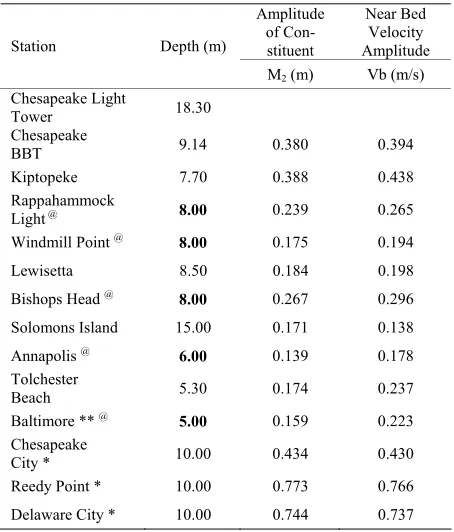
In recent decades, Chesapeake Bay has had wide-spread water quality problems due to fine sediment. Sediment distribution is usually dominated by hydraulic condition and material origin [10]. Tidal current, fresh-water, wind, etc could be the factors affecting the process of sediment transport and the distribution of sediment. Without considering freshwater input, Table 5 shows the calculated near bed velocity amplitude of tidal stations based on dominant M2 constituent. The near bed velocity amplitude can be expressed as
2 1
cosh( ) M
b
a gk V
kh
[image:5.595.58.284.378.528.2]
Figure 4. Calculated M2 constituent tidal amplitudes in
chesapeake bay with friction.
0.0 5.0 10.0 15.0 20.0 25.0 30.0 35.0
3/17/2009 0:00
3/17/2009 12:00
3/18/2009 0:00
3/18/2009 12:00
3/19/2009 0:00
3/19/2009 12:00
3/20/2009 0:00
3/20/2009 12:00
3/21/2009 0:00
Date/Time
S
al
in
ity
(P
S
U
)
-0.4 -0.3 -0.2 -0.1 0 0.1 0.2 0.3 0.4 0.5
Ti
da
l E
le
va
ti
on
(
m
)
CBBT_Salinity Lewisetta_Salinity Baltimore_Salinity CBBT_Tide Lewisetta_Tide
Figure 5. Salinity in chesapeake bay
where V is near bed velocity amplitude at the location of the station, m/s; h is water depth, m. The higher the ve-locity amplitude, the more important the sediment proc-ess at the station. In accordance with the criteria, the sediment process at both lower Bay and C&D Canal is significant. Table 5 also depicts that velocity amplitude at the bed on the eastern shore is generally higher than that on the corresponding western shore due to the higher amplitude of M2 constituent. Therefore, the gradient of bottom shear stress from eastern shore to western shore could be assumed for a general sediment transport esti-mate.
Freshwater brings great amount of fine sediment, while the force resulting from freshwater flow is in both local scale and lower magnitude. Therefore, tidal force could be more important in the general sediment trans-port and re-distribution at Chesapeake Bay. Tidal current dominate the process of sediment transport, controlling the distribution of sediment and development of seabed [10]. The long-term annual average of suspended mate-rial contributed by the Chesapeake Bay basins is ap-proximately 4.3 million tons per year. About 90 percent of this material came from the three largest rivers (Sus-quehanna, Potomac, and James). It was assumed that the great majority of the sediment supplied from the fresh-water flow is fine-grained silts and clays [3]. More fine sediment is supposed to be accumulated at western shore, as freshwater inflows are located mostly close to western shore.
Consequently, differentiating sediment transport & distribution in western shore from that in eastern shore is necessary in both water quality modeling and the fol-lowing restoration practice.
Sediment distribution along the length of Chesapeake Bay is even more elusive due to complex interactions among tide, freshwater input, wind, bathymetry, etc. Data indicated that the greatest sediment volume is asso-ciated with the bay mouth, which further suggests that the continental shelf has been more significant source of sediment to the Bay with high tidal velocity (see Table 5) than the Susquehanna River and other watershed tribu-taries [3]. Although sand is the predominant sediment type in the lower Bay, part is composed of clay and silt-sized material and there also is good evident for its significant net up estuary transport [3]. Therefore, a quantification of northward Bay fine sediment transport determines the water quality in both lower Bay and other tidal-affected area. In another word, controlling the fine sediment movement in lower Bay could be an important step to improve water quality in the Bay.
2.2. Tide at Entrance (Chesapeake BBT)
[image:5.595.56.280.566.707.2]at the entrance of Chesapeake Bay (See Figure 6).
2.3. Tidal Currents
Figure 7 shows the general currents within Chesapeake Bay at current stations as shown in Figure 1. Not solely related to the tidal elevation, the magnitude of current at each station is affected but multi-factors such as cross area, freshwater flow, etc. Phase difference is noticed in accordance with Figure 7. Although there is no observed data at current station cb1001, which is close to narrow-ing Solomons Island, higher velocity could be the fact at this station for the smaller cross section.
Figure 8 shows both the tidal elevation at Chesapeake BBT and current at cb0102. Since cb0102 is rather close to Chesapeake BBT, so the current at cb0102 could be approximately used for Chesapeake BBT. Generally, not much phase difference is observed between the tide and current, which matches the result of in-phase generated by Whitford [8]. However, wind might be the primary reason for the discrepancy during 03/18/2009 12:00-
03/19/2009 06:00.
Excluding the effect of wind, Figure 9 depicts tidal elevation at Chesapeake BBT, currents at both cb0102 and cb0301 during the period of 09/21/2008 16:00-
09/22/2008 13:00 (wind speed is nearly zero). An ap-proximate in-phase result is observed in Figure 9, which matches the accepted mainly progressive wave at the entrance.
The characteristics of mainly standing waves are ob-viously observed at both Annapolis and Tolchester Beach as shown in Figures 10 and 11, respectively. Lower tidal velocity occurs at Tolchester Beach with the standing wave.
In accordance with Figures 10 and 11, more saw- toothed pattern tides in upper Bay indicate more upland tides.
2.4. Phase Aspect of the Tide Elevation in Chesa-peake Bay
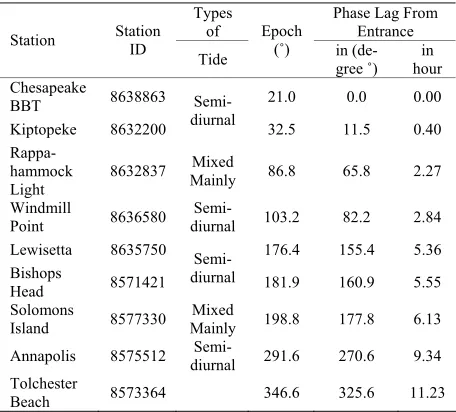
NOAA Predicted tidal elevations at 9 stations within Chesapeake Bay are shown in Figure 12. The changes of the tidal amplitudes are observed along the main channel seem to be a consequence of the interaction between the tide and the Bay morphology as well as the wave reflec-tion, and are described by the law of energy conservation [16]. It is observed that the whole bay experienced a low tide on January, 9, 2009. Comparing the tidal phase lag for M2 constituent from the entrance against the plots in
Figure 12, it is not dif ficult to find that they are in good agreement.
Table 6 lists the tidal phase lag from the entrance (Chesapeake BBT) in terms of the dominated M2 con-stituent. Table 7 lists the tidal phase lag from the en-
-1.0 -0.5 0.0 0.5 1.0 1.5
2/21/09 0:00 2/25/09 0:00 3/1/09 0:00 3/5/09 0:00 3/9/09 0:00 3/13/09 0:00 3/17/09 0:00 3/21/09 0:00
Date/Time
A
m
p
li
tu
d
e R
elat
ive t
o
M
S
L
(
m
)
Figure 6. Observed spring and neap tide cycle at entrance (chesapeake BBT).
-1.50 -1.00 -0.50 0.00 0.50 1.00
3/17/2009 12:00
3/18/2009 0:00 3/18/2009 12:00
3/19/2009 0:00 3/19/2009 12:00
3/20/2009 0:00 3/20/2009 12:00
3/21/2009 0:00
Date/Time
S
pe
ed (
knot
)
cb0102 cb0201 cb0301 cb0801 cb1101 cb1201
Figure 7. Observed tidal currents within chesapeake bay.
-1.5 -1.0 -0.5 0.0 0.5 1.0
3/17/09 0:00
3/17/09 12:00
3/18/09 0:00
3/18/09 12:00
3/19/09 0:00
3/19/09 12:00
3/20/09 0:00
3/20/09 12:00
3/21/09 0:00
Date/Time
Wa
te
r S
u
rfa
ce E
levat
io
n
(m
)
-2.000 -1.500 -1.000 -0.500 0.000 0.500 1.000 1.500 2.000 2.500
C
ur
re
nt
(
kno
t)
CBBT Tide cb0102 Current
Figure 8. Tide and current at the entrance with wind effect (chesapeake BBT).
625
2.5. Tide Prism
Cubature method is employed to calculate the tidal prism (03/18/2009) of Chesapeake Bay in accordance with the tide on 03/18/2009 in Figure 12. The identification of subareas is shown in Figure 13, and the tidal prism is calculated as shown in Table 8.
The tidal prism is about for M2 constituent is around 1.25 × 10⁹ m3 (4.41 × 1010 ft3) as shown in Table 8. Fresh- water flow is around 4,250 m3/s (150,000 ft3/s) in March in accordance with USGS.
Table 5. Near bed velocity amplitude of tidal stations based on M2.
Amplitude of Con-stituent Near Bed Velocity Amplitude Station Depth (m)
M2 (m) Vb (m/s) Chesapeake Light
Tower 18.30
Chesapeake
BBT 9.14 0.380 0.394
Kiptopeke 7.70 0.388 0.438 Rappahammock
Light @ 8.00 0.239 0.265 Windmill Point @ 8.00 0.175 0.194
Lewisetta 8.50 0.184 0.198 Bishops Head @ 8.00 0.267 0.296 Solomons Island 15.00 0.171 0.138
Annapolis @ 6.00 0.139 0.178 Tolchester
Beach 5.30 0.174 0.237 Baltimore ** @ 5.00 0.159 0.223 Chesapeake
City * 10.00 0.434 0.430 Reedy Point * 10.00 0.773 0.766
Delaware City * 10.00 0.744 0.737
Note: @ Depth Data are assumed with uncertainty
-1.5 -1.0 -0.5 0.0 0.5 1.0
9/21/08 0:00 9/21/08 12:00 9/22/08 0:00 9/22/08 12:00 9/23/08 0:00
Date/Time Wa te r S u rf ace E leva ti o n ( m ) -2 -1.5 -1 -0.5 0 0.5 1 1.5 C u rr en t (k n o t)
[image:7.595.312.537.77.251.2]CBBT Tide cb0102 Current cb0301 Current
Figure 9. Tide and current at the entrance (chesapeake BBT).
-1.5 -1.0 -0.5 0.0 0.5 1.0
9/21/08 0:00 9/21/08 12:00 9/22/08 0:00 9/22/08 12:00 9/23/08 0:00
Date/Time W at er S u rf ac e E lev at io n ( m ) -1.5 -1 -0.5 0 0.5 1 1.5 C ur re nt ( knot )
[image:7.595.59.286.245.511.2]Annapolis Tide cb1101 Current
Figure 10. Tide and current at annapolis.
-1.5 -1.0 -0.5 0.0 0.5 1.0
9/21/08 0:00 9/21/08 12:00 9/22/08 0:00 9/22/08 12:00 9/23/08 0:00
Date/Time W at er S u rf ace E lev at io n (m ) -1 -0.8 -0.6 -0.4 -0.2 0 0.2 0.4 0.6 0.8 C u rr en t (k no t)
Tolechester Beach Tide cb1201 Current
Figure 11. Tide and current at tolchester beach.
[image:7.595.312.538.258.604.2]-0.4 -0.3 -0.2 -0.1 0 0.1 0.2 0.3 0.4 3/17/09 0:00 3/17/09 12:00 3/18/09 0:00 3/18/09 12:00 3/19/09 0:00 3/19/09 12:00 3/20/09 0:00 3/20/09 12:00 3/21/09 0:00 Date/Time A m p lit ud e R ela ti ve t o M LL W CBBT Kiptopeke Rappa. Windmill Lewisetta Bishops Solomons Annapolis Tolchester
Figure 12. Predicted tides elevations within chesapeake bay.
[image:7.595.58.285.535.700.2]Table 6. Tidal phase lag for M2 from the entrance
(chesa-peake BBT).
Types of
Phase Lag From Entrance Station Station ID
Tide
Epoch
(˚) in (de-gree ˚)
in hour Chesapeake
BBT 8638863 21.0 0.0 0.00 Kiptopeke 8632200
Semi-diurnal
32.5 11.5 0.40
Rappa-hammock Light
8632837 MainlyMixed 86.8 65.8 2.27
Windmill
Point 8636580 diurnalSemi- 103.2 82.2 2.84 Lewisetta 8635750 176.4 155.4 5.36 Bishops
Head 8571421
Semi-diurnal 181.9 160.9 5.55
Solomons
Island 8577330
Mixed
Mainly 198.8 177.8 6.13 Annapolis 8575512 diurnalSemi- 291.6 270.6 9.34 Tolchester
[image:8.595.58.286.103.309.2]Beach 8573364 346.6 325.6 11.23
Table 7. Tidal phase lag for K1 from the entrance
(chesa-peake BBT).
Types of From EntrancePhase Lag Station Station ID
Tide
Epoch (˚) in
(de-gree ˚)
in hour
Chesapeake
BBT 8638863 184.9 0 0.00 Kiptopeke 8632200
Semidi-urnal 193.4 8.5 0.57
Rappaham-mock Light 8632837
Mixed
Mainly 222.4 37.5 2.49 Windmill
Point 8636580
Semidi-urnal 226.7 41.8 2.78 Lewisetta 8635750 276.2 91.3 6.07 Bishops
Head 8571421
Semidi-urnal 283.3 98.4 6.54
Solomons
Island 8577330 Mainly Mixed 315.6 130.7 8.69 Annapolis 8575512 Semidi-urnal 356.7 171.8 11.42 Tolchester
Beach 8573364 3.3 178.4 11.86
2.6. C&D Canal Analysis
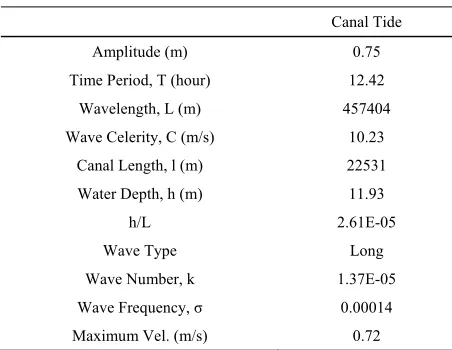
The Canal could be regarded as open to Chesapeake Bay (Left end open). Figure 14 shows the observed tidal ele-vations at Chesapeake City and Reedy Point located on C&D Canal. M2 constituent is the dominant constituent at both these two stations in accordance with Table 2. Consequently, information on the progressive wave in C&D Canal is summarized in Table 9. Ideally, the tidal elevation at Chesapeake City would be nearly zero for its location on node, and the standing waves at both stations are in phase. However, some distortions on both ampli-
[image:8.595.57.287.352.558.2]Figure 13. Subarea map
Table 8. Tidal prism calculation using cubature method
Phase
Range Range Phase Entering Volume
Su-barea
Area
Fraction Contour
1 Contour 2 Phase
Range or Leaving (km3) A 0.10 0.61 0.62 0.62 0.71
B 0.12 0.62 0.17 0.40 0.55 C 0.16 0.17 0.06 0.12 0.21 D 0.12 0.06 -0.14 -0.04 -0.06 E 0.12 -0.14 -0.08 -0.11 -0.15
F 0.08 -0.08 -0.26 -0.17 -0.16 G 0.06 -0.26 -0.15 -0.21 -0.14 H 0.06 -0.15 -0.04 -0.10 -0.07
I 0.06 -0.04 0.05 0.01 0.00 J 0.06 0.30 0.15 0.23 0.16 K 0.06 0.35 0.18 0.27 0.18
Tidal Prism 1.25
tude and phase occur due to the imperfect reflection re-sulting from Upper Chesapeake Bay’s morphology.
[image:8.595.306.539.437.647.2]627
-1.00 -0.50 0.00 0.50 1.00
2/26/09 0:00 2/26/09 12:00
2/27/09 0:00 2/27/09 12:00
2/28/09 0:00 2/28/09 12:00
3/1/09 0:00
Date/Time
Wa
te
r S
u
rfa
ce E
levat
io
n
(m
)
[image:9.595.60.285.80.236.2]Chesapeak City Reedy Point
Figure 14. Observed tidal elevations in chesapeake bay & delaware bay canal.
-1.5 -1.0 -0.5 0.0 0.5 1.0
9/21/08 0:00 9/21/08 12:00 9/22/08 0:00 9/22/08 12:00 9/23/08 0:00
Date/Time
W
at
er
S
u
rf
ace E
lev
at
io
n
(m
)
-2.5 -2 -1.5 -1 -0.5 0 0.5 1 1.5 2 2.5
Cu
rr
en
t (
kn
o
t)
[image:9.595.59.285.279.450.2]Chesapeake City Tide cb1301 Current
Figure 15. Tide and current at chesapeake city.
Table 9. Progressive wave in C&D canal.
Canal Tide
Amplitude (m) 0.75 Time Period, T (hour) 12.42
Wavelength, L (m) 457404 Wave Celerity, C (m/s) 10.23
Canal Length, l (m) 22531
Water Depth, h (m) 11.93
h/L 2.61E-05 Wave Type Long
Wave Number, k 1.37E-05
Wave Frequency, σ 0.00014 Maximum Vel. (m/s) 0.72
3. Conclusions
This paper performs basic tidal analyses of Chesapeake
Bay so as to represent a basic tidal analysis approach and provide tidal information for the understanding of tide, sediment transport, and other processes in Chesapeake Bay.
The general distributions of tidal and current ranges, salinity probably result from deep channel, earth rotation, and freshwater discharge. A brief description of general sediment distribution in Chesapeake Bay was repre-sented in this paper in accordance with tidal characteris-tics and Langland and Cronin [3]. Wind has a significant impact on the tides in Chesapeake Bay.
Taking friction into considered, dominant semidiurnal M2 constituent tidal elevations within Chesapeake Bay were computed to compare against the actual M2 ampli-tudes, and they are found in good agreement. Higher M2 amplitude was observed at Chesapeake City due to stan- ding wave and the narrowing of C&D Canal.
Removing the effect of wind, mainly progressive wave at the entrance and mainly standing waves are at upper Chesapeake Bay were observed.
The changes of the tidal amplitudes are the conse-quence of the interaction between the tide and the bay morphology as well as the wave reflection.
4. References
[1] G. Walters and F. Klein, “Modeling Tides in the Chesa-peake Bay,” Project Report.
[2] R. Patrick, “Rivers of the United States: Estuaries,” John Wiley and Sons, 1994.
[3] M. Langland and T. Cronin, “A Summary Report of Sediment Processes in Chesapeake Bay and Watershed,” Water-Resources Investigations Report 03-4123, U.S. Department of the Interior & U.S. Geological Survey, 2003.
[4] P. D. Curtin, G. S. Brush and G. W. Fisher, “Discovering the Chesapeake: The History of An Ecosystem,” JHU Press, Baltimore, 2001.
[5] National Research Council (USA), Committee on Nonna-tive Oysters in the Chesapeake Bay, United States, 2004. [6] L. Zhong and M. Li, “Tidal Energy Fluxes and
Dissipa-tion in the Chesapeake Bay,” Continental Shelf Research, Vol. 26, No. 6, 2006, pp. 752-770.
[7] H. V. Wang and S. Chao, “Intensification of Subtidal Surface Currents over a Deep Channel in the Upper Chesapeake Bay,” Estuarine, Coastal and Shelf Science, Vol. 42, No. 6, 1996, pp. 771-785.
[8] D. J. Whirford, “Observations of Current Flow through the Mouth of the Chesapeake Bay,” Estuarine, Coastal and Shelf Science, Vol. 49, No. 2, 1999, pp. 209-220. [9] H. V. Wang and B. H. Johnson, “Validation and
[image:9.595.58.284.496.671.2][10] S. Huang, H. Lou, Y. Xie and J. Hu, “Hydrodynamic Environment and is Effects in the Xiangshan Bay,” In-ternational Conference on Estuaries and Coasts, Hang-zhou, 9-11 November 2003.
[11] D. Salas-Monreal and A. Valle-Levinson, “Sea-Level Slopes and Volume Fluxes Produced by Atmospheric Forcing in Estuaries: Chesapeake Bay Case Study,” Jour-nal of Coastal Research, Vol. 24, No. sp2, 2008, pp. 208- 217.
[12] D. T. Pugh, “Changing Sea Levels,” Cambridge Univer-sity Press, Cambridge, 2004.
[13] M. L. Schwartz, “Encyclopedia of Coastal Science,” Springer, Berlin, 2005.
[14] A. T. Ippen, “Estuary and Coastline Hydrodynamics,” McGraw-Hill Book Company, Inc., New York, 1966.
[15] J. D. C. Boon, “Secrets of the Tide: Tide and Tidal Cur-rent Analysis and Applications, Storm Surges and Sea Level Trends.” Horwood Publishing, Chichester, 2004. [16] S. Canhanga and J. M. Dias, “Tidal Characteristics of
Maputo Bay, Mozambique,” Journal of Marine Systems, Vol. 58, No. 3-4, 2005, pp. 83-97.
[17] Z. Ji, “Estuary Hydrodynamics and Water Quality: Mod-eling Rivers, Lakes, and Estuaries,” John Wiley & Sons, Inc., Hoboken, 2008.