Robust Learning, Smoothing, and
Parameter Tying on Syntactic Ambiguity
Resolution
Tung-Hui Chiang*
National Tsing Hua University
Keh-Yih Su*
National Tsing Hua University
Yi-Chung
Lin *t
National Tsing Hua University
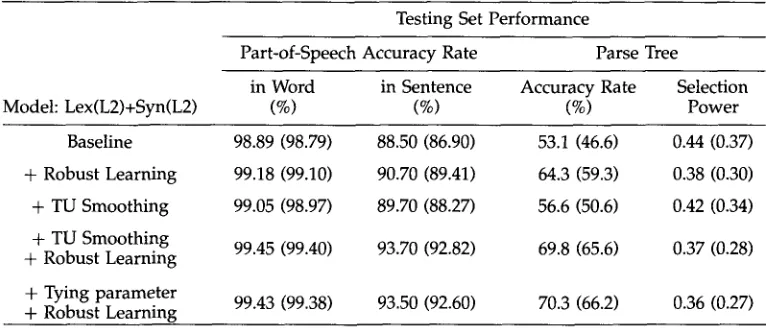
Statistical approaches to natural language processing generally obtain the parameters by using the maximum likelihood estimation (MLE ) method. The MLE approaches, however, may fail to achieve good performance in difficult tasks, because the discrimination and robustness issues are not taken into consideration in the estimation processes. Motivated by that concern, a discrimination- and robustness-oriented learning algorithm is proposed in this paper for minimizing the error rate. In evaluating the robust learning procedure on a corpus of 1,000 sentences, 64.3% of the sentences are assigned their correct syntactic structures, while only 53.1% accuracy rate is obtained with
the MLE approach.
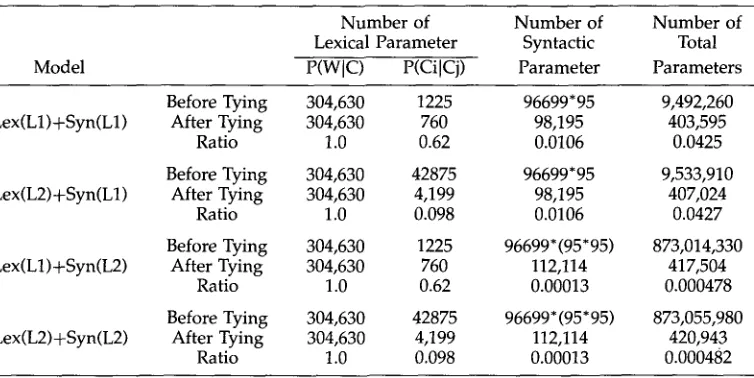
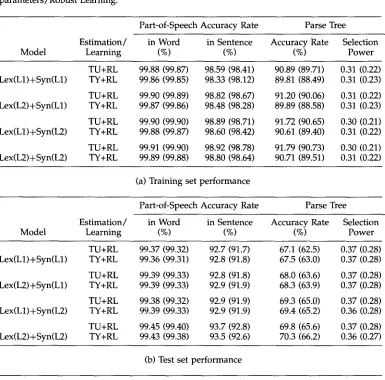
In addition, parameters are usually estimated poorly when the training data is sparse. Smooth- ing the parameters is thus important in the estimation process. Accordingly, we use a hybrid approach combining the robust learning procedure with the smoothing method. The accuracy rate of 69.8% is attained by using this approach. Finally, a parameter tying scheme is proposed to tie those highly correlated but unreliably estimated parameters together so that the parameters can be better trained in the learning process. With this tying scheme, the number of parameters is reduced by a factor of 2,000 (from 8.7 x 10⁸ to 4.2 x lOS), and the accuracy rate for parse tree selection is improved up to 70.3% when the robust learning procedure is applied on the tied parameters.
1. I n t r o d u c t i o n
Resolution of syntactic ambiguity has been a focus in the field of natural language processing for a long time. Both rule-based and statistics-based approaches have been proposed to attack this problem in the past. For rule-based approaches, knowledge is induced by linguistic experts and is encoded in terms of rules. Since a huge amount of fine-grained knowledge is usually required to solve ambiguity problems, it is quite difficult for a rule-based approach to acquire such kinds of knowledge. In addition, the maintenance of consistency among the inductive rules is by no means easy. Therefore, a rule-based approach, in general, fails to attain satisfactory performance for large-scale applications.
In contrast, a statistical approach provides an objective measuring function to eval- uate all possible alternative structures in terms of a set of parameters. Generally, the
Computational Linguistics Volume 21, Number 3
statistics of parameters are estimated from a training corpus by using well-developed statistical theorems. The linguistic
uncertainty
problems can thus be resolved on a solid mathematical basis. Moreover, the knowledge acquired by a statistical method is al- waysconsistent
because all the data in the corpus are jointly considered during the acquisition process. Hence, compared with a rule-based method, the time required for knowledge acquisition and the cost needed to maintain consistency among the ac- quired knowledge sources are significantly reduced by adopting a statistical approach. Among the statistical approaches, Su and Chang (1988) and S u e t al. (1991) pro- posed a unified scoring function for resolving syntactic ambiguity. With that scoring function, various knowledge sources can be unified in a uniform formulation. Previous work has demonstrated that this scoring function is able to provide high discrimina- tion power for a variety of applications (Su, Chiang, and Lin 1992; Chen et al. 1991; Su and Chang 1990). In this paper, we start with a baseline system based on this scoring function, and then proceed with different proposed enhancement methods. A test set of 1,000 sentences, extracted from technical manuals, is used for evaluation. A performance of 53.1% accuracy rate for parse tree selection is obtained for the base- line system, when the parameters are estimated by using the maximum likelihood estimation (MLE) method.Note that it is the
ranking
of competitors, instead of the likelihood value, that directly affects the performance of a disambiguation task. Maximizing the likelihood values on the training corpus, therefore, does not necessarily lead to the minimum error rate. In addition, the statistical variations between the training corpus and real tasks are usually not taken into consideration in the estimation procedure. Thus, min- imizing the error rate on the training corpus does not imply minimizing the error rate in the task we are really concerned with.To deal with the problems described above, a variety of discrimination-based learn- ing algorithms have been adopted extensively in the field of speech recognition (Bahl et al. 1988; Katagiri et al. 1991; Su and Lee 1991, 1994). Among those approaches, the robustness issue was discussed in detail by Su and Lee (1991, 1994) in particular, and encouraging results were observed. In this paper, a discrimination oriented adaptive learning algorithm is first derived based on the scoring function mentioned above and probabilistic gradient descent theory (Amari 1967; Katagiri, Lee, and Juang 1991). The parameters of the scoring function are then learned from the training corpus us- ing the discriminative learning algorithm. The accuracy rate for parse tree selection is improved to 56.4% when the discriminative learning algorithm is applied.
In addition to the discriminative learning algorithm described above, a robust learning procedure is further applied in order to consider the possible statistical vari- ations between the training corpus and the real task. The robust learning process continues adjusting the parameters even though the input training token has been correctly recognized, until the score difference between the correct candidate and the top competitor exceeds a preset threshold. The reason for this is to provide a tolerance zone with a large margin for better preserving the correct ranking orders for data in real tasks. An accuracy rate of 64.3% for parse tree selection is attained after this robust learning algorithm is used.
Tung-Hui Chiang et al. Robust Learning, Smoothing, and Parameter Tying
smoothed parameters. This result demonstrates that a better initial estimate of the pa- rameters gives the robust learning procedure a chance to obtain better results when many local maximal points exist.
Finally, a parameter tying scheme is proposed to reduce the number of parameters. In this approach, some less reliably estimated but highly correlated parameters are tied together, and then trained through the robust learning procedure. The probabilities of the events that never appear in the training corpus can thus be trained more reliably. This hybrid (tying + robust learning) approach reduces the number of parameters by a factor of 2,000 (from 8.7 x 10⁸ to 4.2 x 10⁵) and achieves 70.3% accuracy rate for parse tree selection.
This paper is organized as follows. A unified scoring function used for integrating knowledge from lexical and syntactic levels is introduced in Section 2. The results of using the unified scoring function are summarized in Section 3. In Section 4, the discrimination- and robustness-oriented learning algorithm is derived. The effects of the parameter smoothing techniques on the robust learning procedure are investigated in Section 5. Next, the parameter tying scheme used to enhance parameter training and reduce the number of parameters is described in Section 6. Finally, we discuss our conclusions and describe the direction of future work.
2. A Unified Probabilistic Score Function
Linguistic knowledge, including knowledge of lexicon, syntax, and semantics, is es- sential for resolving syntactic ambiguities. To integrate various knowledge sources in a uniform formulation, a unified probabilistic scoring function was proposed by Su et al. (1991). This scoring function has been successfully applied to resolve ambiguity prob- lems in an English-to-Chinese machine translation system (BehaviorTran) (Chen et al. 1991) and a spoken language processing system (Su, Chiang, and Lin 1991; 1992). The unified probabilistic scoring function derived for the syntactic disambiguation task is summarized in the following sections.
2.1 Definition
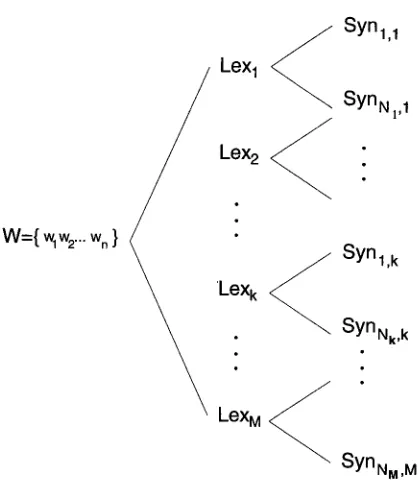
An illustration of syntactic ambiguities for an input sentence W (= w~ = {wl, w2 . . .
Wn})
is shown in Figure 1, wherewi
(i = 1, n) stands for the ith word of the input sentence. In this figure,LeXk
(1 < k ~ m) stands for the kth lexical sequence out of M possible sequences.Synj,k
(1~ j < Nk)
is the jth alternative syntactic structure corresponding toLeXk,
andNk
is the number of possible syntactic structures associated withLeXk.
The disambiguation process is formulated as the process of finding the most plausible syntactic structureSynj,~
for the input word sequence. In other words, this process is to find the index (d, k) such thatP(Synj, k, Lex~ I w~)
represents the maximum value among different syntactic structures, as shown in Equation 1:(j, lc) = argmax{P(Synj,k, LeXk
I w~)} (1)j,k
The
integrated scoring function
for the syntactic structureSynj,k
is defined asScore( Synj,k ) = P(Synj,k, LeXklW~)
= P(Synj,k I LeXk, W~) x P(LeXk I w~)
= Ssyn(Synj,k) x Slex(LeXk)
Computational Linguistics Volume 21, Number 3
W={ wlwz.. Wr, }
LeXl ~
Synl'l
SynN~j
Lex2
Lexk
~ Synl'kSynNk,k
LeXM
~
SynNu,M
Figure 1
An illustration of the syntactic ambiguities for an input word sequence W.
where
Ssyn(Synj,k)
(=P(Synj,k I LeXk, W~) )
denotes thesyntactic scoring function,
andSle x (LeXk) (= P(LeXk I w~) )
denotes thelexical scoring function.
In the following derivation, we assume that little additional information can be provided by the words w~ to the syntactic structure
Synj,k
after the lexical sequenceLeXk
is given. 1 The syntactic scoring function is thus approximated as the following equation:Ssyn(Synj,k) = P(Synj,k l LeXk, W~) ~, P(Synj,k l LeXk)
(3) Accordingly, the integrated scoring functionP(Synj,k, LeXk [ W~)
is represented as fol- lows:P(Synj,k, LeXk I w~) ~, P(Synj,k I LeXk) x P(LeXk I w~).
(4) Detailed discussion of the lexical and syntactic scoring functions is given in the fol- lowing sections.2.2 Lexical Score F u n c t i o n
The
lexical score
for the kth lexical sequenceLeXk
associated with the input word se- quence w~ is expressed as follows (Chiang, Lin, and Su 1992):Slex(LeXk) = P(LeXk I w~) = P (c~i~ l w~)
[image:4.468.131.340.63.304.2]Tung-Hui Chiang et al. Robust Learning, Smoothing, and Parameter Tying
ok, n
,
)
= P(w ) (5)
_
Slex(LeXk)
P(wD
where
Ck,i
stands for the part of speech assigned towi.
SinceP(w~)
is the same for all possible lexical sequences, it can be ignored without affecting the final results. Therefore, we useSTyx(. )
instead ofSlex(')
in the following derivation.Like the standard tagging procedures (Garside, Leech, and Sampson 1987; Church 1989; Merialdo 1991), the probability terms
P(w~ I
Ck3 )
k,n
andP(c~i~)
in Equation 5 can be approximated as follows, respectively:n n
P (w~ I C~:1) ~- I-[ P ( wi I i-1 £~:1) ~ I-[ P ( wi I gk, i)
W 1 •
i=1 i=1
(6)
(kn)
[9 Ckll
n
IIP(ck, i ck'i-l~
k,1 ]i=1
{ ~.~lP(Ck, i ICk, i-1),
I-[ P(Ck, i ] Ck, i-1, Ck,i-2),
i=1
bigram model
trigram model
(7)
Therefore, the lexical score
Slex(LeXk)
is expressed as:;l
*
k,i-l"~ P(wilCk, i)
S'ex(Lexk) ~
I-[ P (Ck, i [ Ck, , ) X
i=1
n
I-[ P(Ck,i l Ck,i_l) X P(wi [ £k,i),
bigram modelin1
1-I P(ck,i ]
Ck,i-l,Ck, i-2) X
P(wi l Ck, i),
trigram modeli=1
(8)
2.3 Syntactic Scoring Function
Conventional stochastic context-free grammar (CFG) approaches (Wright and Wrigley 1991) evaluate the likelihood probability of a syntactic tree by computing the product of the probabilities associated with the grammar rules being applied. Such a formu- lation implies that the application of a rule is both independent of the applications of the other rules, and independent of the context under which a context-free rule is applied. However, a language that can be expressed with a CFG does not imply that the associated rules can be applied in an independent and context-free manner, as im- plicitly assumed by a stochastic context-free grammar approach. To include contextual information and consider the relationship among the grammar rules, in this paper we follow the formulation in S u e t al. (1989, 1991) for syntactic score evaluation.
Computational Linguistics Volume 21, Number 3
A
L8={ A
}
/ ' N ~ L T = { B C }
B C
L s = { B F c 4 }
D E F G L4= { B c 3 c 4 }
I t,
It,,
I t,
c,,}
cl c2 c3 c4 L 2 = { D c 2 c a c 4 }
L 1 = { c 1 c 2 c 3 c 4 }
A C T I O N
[image:6.468.59.412.65.239.2]R E D U C E S H I F T
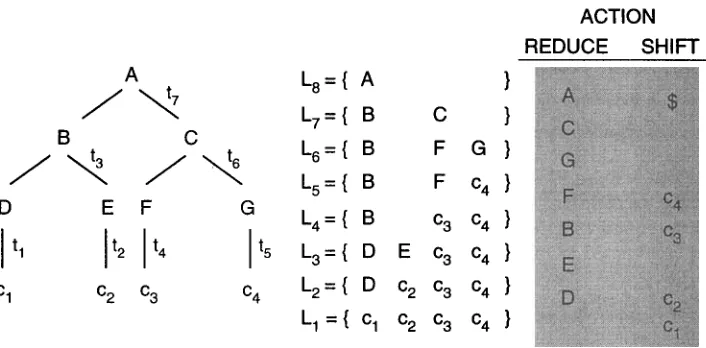
Figure 2
The decomposition of a given syntactic tree X into different phrase levels.
steps. First, the tree is decomposed into a number of
phrase levels,
such asL1, L2,..., L8
in Figure 2. A phrase level is a sequence of symbols (terminal or nonterminal) that acts as an intermediate result in parsing the input sentence, and is also called a
senten-
tial form
informal language theory
(Hopcroft and Ullman 1974). In the second step, we formulate the transition between phrase levels as acontext-sensitive
rewriting process. With the formulation, each transition probability between two phrase levels is calcu- lated by consulting a finite-length window that comprises the symbols to be reduced and their left and right contexts.Let the label
ti
in Figure 2 be the time index for the ith state transition, which corresponds to a reduce action, andLi
be the ith phrase level. Then the syntactic score of the tree in Figure 2 is defined as:Ssyn ( Treex ) =- P(L8, L7 . . . . ,L2
ILl)= P(L8 I L7,...,L1)
xP(L7 ] L 6 , . . . , L D x ... x P(L2
I L1)P(L8 I L7) x
P(L7
I L6) x . . . xP(L2
ILl). (9)The transition probability between two phrase levels, say
P(L7 I
C6), is the product of the probabilities of two events. TakingP(L7 I
L6) as an example, the first probability corresponds to the event that {F, G} are the constituents to be reduced, and the sec- ond probability corresponds to the event that they are reduced to C. The transition probability can thus be expressed as follows:P(L7 I
L6) =P(F,G arereduced I input is {B,F,G})
x P(C *-- FG I F, G are reduced; input is
{B,F, G}).(lO)
According to the results of our experiments, the first term is equal to one in most cases, and it makes little contribution to discriminating different syntactic structures. In addition, to simplify the computation, we approximate the full context
{B,F,G}
Tung-Hui Chiang et al. Robust Learning, Smoothing, and Parameter Tying
function can thus be expressed as follows:
Ssyn ( Treex )
P(A r (O},B,C, ($}) x P(C f {B},F,6, {$})
X''" X P(D I {0},c1,(c2,c3,c4})
P(A ]17,B,C, r7) x P(C ]16,F,G, r6) x ... x P(D ] ll,Cl, rl),
(11)where
Tree×
is the parse tree X, $ and 0 correspond to the end-of-sentence marker and the null symbol, respectively; andli
andri
represent the left and right contexts to be consulted in the ith phrase level) respectively. In the above equation, it is assumed that each phrase level is highly correlated with its immediately preceding phrase level but less correlated with other preceding phrase levels. In other words, the inter-level cor- relation is assumed to be a first-order Markov process. In addition, for computational feasibility, only a finite number of left and right contextual symbols are considered in the formulation. If M left context symbols and N right context symbols are consulted in evaluating Equation 9, the model is said to operate in the LMRN mode.Notice that the last formula in Equation 9 corresponds to the rightmost deriva- tion sequence in a generalized LR parser
with left and right contexts
taken into account (Su et al. 1991). Such a formulation is particularly useful for a generalized LR pars- ing algorithm, in which context-sensitive processing power is desirable. Although the context-sensitive model in the above equation provides the ability to deal withintra-
level context-sensitivity,
it fails to catchinter-level correlation.
In addition, the formulation of Equation 9 will result in thenormalization problem
(Suet al. 1991; Briscoe and Carroll 1993) when various syntactic trees have different number of nodes. An alternative for- mulation, which compacts the highly correlated phrase levels into a single one, was proposed by S u e t al. (1991) to resolve the normalization problem. For instance, for the syntactic tree in Figure 2, the syntactic score for the modified formulation is expressed as follows:Ssyn(Treex) ~
P(Ls, L7,L6 I L5) x P(L5
[L4) xP(L4,L3
I L2) xP(L2 ILl)
~, P(L8
]L5) ×P(L5
]L4) xP(L4
]L2) xP(L2
]L1). (12)Each pair of phrase levels in the above equation corresponds to a change in the LR parser's stack before and after an input word is consumed by a
shift
operation. Because the total number of shift actions, equal to the number of product terms in Equation 12, is always the same for all alternative syntactic trees, the normalization problem is resolved in such a formulation. Moreover, the formulation in Equation 12 provides a w a y to consider bothintra-level context-sensitivity
andinter-level correlation
of the underlying context-free grammar. With such a formulation, the capability ofcontext-
sensitive parsing
(in probabilistic sense) can be achieved with acontext-free grammar.
Computational Linguistics Volume 21, Number 3
state, in general, can indicate part of the past parsing history (i.e., the left context) from which the current reduced symbol follows.
However, because of the implicit encoding of the parsing history, a state may fail to distinguish some left contextual environments correctly. This is not surprising, because the LR parsing table generator would merge certain states according to the context-free grammar and the closure operations on the sets of items. Therefore, there are cases in which the same string is reduced, under
different
left contexts, to the same symbol at the same state and return to the same state after reduction. For instance, if several identical constructs, e.g., [X --* a], are allowed in a recursive structure X ~, and the input contains a Y followed by three (or more) consecutive Xs, e.g., "YXXX," then the reduction of the second and third Xs will return to the same state after the same rule is applied at that state. Under such circumstances, the associated probabilities for these two REDUCE actions will be identical and thus will not reflect the different preferences between them.In our framework, it is easy to tell that the first REDUCE action is applied when the two left context symbols are {Y,X}, and the second REDUCE is applied when the left context is two Xs under an L2R1 mode of operation. Because such recursion is not rare, for example, in groups of adjectives, nouns, conjunction constructs, prepositional phrases in English, the estimated scores will be affected by such differences. In other words, we use context symbols explicitly and directly to evaluate the probabilities of a substructure instead of using the parsing state to implicitly encode past history, which may fail to provide a sufficient characterization of the left context. In addition, explicitly using the left context symbols allows easy use of smoothing techniques, such as deleted interpolation (Bahl, Jelinek, and Mercer 1983), clustering techniques (Brown et al. 1992), and model refinement techniques (Lin, Chiang, and Su 1994) to estimate the probabilities more reliably by changing the w i n d o w sizes of the context and weighting the various estimates dynamically. This kind of improvement is desirable when the training data is limited.
Furthermore, Briscoe and Carroll (1993) use the geometric mean of the probabil- ities, not their product, as the preference score, to avoid biasing their procedure in favor of parse trees that have a smaller number of nodes (i.e., a smaller number of rules being applied.) The geometric mean, however, fails to fit into the probabilis- tic framework for disambiguation. In our approach, such a normalization problem is avoided by considering a group of highly correlated phrase levels as a single phrase level and evaluating the sequence of transitions for such phrase levels between the SHIFT actions. Alternatively, it is also possible to consider each group of highly corre- lated phrase levels as a joint event for evaluating its probability when enough data is available. The optimization criteria are thus not compromised by the topologies of the parse trees, because the number of SHIFT actions (i.e., the number of input tokens) is fixed for an input sentence.
3. Baseline Model
To establish a benchmark for examining the power of the proposed algorithms, we begin with a baseline system, in which the parameters are estimated by using the MLE method. Later, we will show how to improve the baseline model with the proposed enhancement mechanisms.
3.1 Experimental Setup
Tung-Hui Chiang et al. Robust Learning, Smoothing, and Parameter Tying
D e s i g n C o r p o r a t i o n (BDC), w e r e collected. T h e d o m a i n for this c o r p u s is c o m p u t e r m a n u a l s a n d d o c u m e n t s . The correct p a r t s of s p e e c h a n d p a r s e trees for the collected sentences w e r e verified b y linguistic experts. The c o r p u s w a s t h e n r a n d o m l y parti- tioned into a training set of 9,000 sentences a n d a test set of the r e m a i n i n g 1,000 sentences to eliminate possible s y s t e m a t i c biases. The a v e r a g e n u m b e r of w o r d s p e r sentence for the training set a n d the test set w e r e 13.9 a n d 13.8, respectively. In the training set, there w e r e 1,030 u n a m b i g u o u s sentences, while 122 sentences w e r e u n - a m b i g u o u s in the test set. O n the a v e r a g e , there w e r e 34.2 alternative p a r s e trees p e r sentence for the training set, a n d 31.2 for the test set. If w e e x c l u d e d those u n a m b i g u - o u s sentences, there w e r e 38.49 a n d 35.38 alternative syntactic structures p e r sentence for the training set a n d the test set, respectively.
3.1.1 Lexicon and Phrase Structure Rules. In the c u r r e n t s y s t e m , there are 10,418 distinct lexicon entries, extracted f r o m the 10,000-sentence corpus. The g r a m m a r is c o m p o s e d of 1,088 p h r a s e structure rules that are e x p r e s s e d in t e r m s of 35 t e r m i n a l s y m b o l s (parts of speech) a n d 95 n o n t e r m i n a l symbols.
3.1.2 L a n g u a g e M o d e l s . Usually, a m o r e c o m p l e x m o d e l requires m o r e p a r a m e t e r s ; hence it f r e q u e n t l y introduces m o r e e s t i m a t i o n error, a l t h o u g h it m a y lead to less m o d e l i n g error. To investigate the effects of m o d e l c o m p l e x i t y a n d e s t i m a t i o n error on the d i s a m b i g u a t i o n task, the following m o d e l s , w h i c h a c c o u n t for v a r i o u s lexical a n d syntactic contextual i n f o r m a t i o n , w e r e evaluated:
.
.
.
4.
Lex(L12) + Syn(L1): this m o d e l uses a b i g r a m m o d e l in c o m p u t i n g lexical scores a n d the L1 m o d e of o p e r a t i o n in c o m p u t i n g syntactic scores. The n u m b e r of p a r a m e t e r s required is (10,418 x 35) + (35 x 35) +
(96, 699 x 95) -- 9, 492, 260. 3
Lex(L2)+Syn(L1): this m o d e l uses a t r i g r a m m o d e l in c o m p u t i n g lexical scores a n d the L1 m o d e of o p e r a t i o n in c o m p u t i n g syntactic scores. The n u m b e r of p a r a m e t e r s required is (10,418 x 35) + (35 x 35 x 35) + (96,699 x 95) = 9,533,910.
Lex(L1)+Syn(L2): this m o d e l uses a b i g r a m m o d e l in c o m p u t i n g lexical scores a n d the L2 m o d e of o p e r a t i o n in c o m p u t i n g syntactic scores. The n u m b e r of p a r a m e t e r s required is (10, 418 x 35) + (35 x 35) +
(96, 699 x 95 x 95) = 873, 014, 330.
Lex(L2)+Syn(L2): this m o d e l uses a t r i g r a m m o d e l in c o m p u t i n g lexical scores a n d the L2 m o d e of o p e r a t i o n in c o m p u t i n g syntactic scores. The n u m b e r of p a r a m e t e r s required is (10,418 x 35) + (35 x 35 x 35) + (96, 699 x 95 x 95) = 873, 055, 980.
2 L1 means to consult one left-hand side part of speech, and L2 means to consult two left-hand side parts of speech.
Computational Linguistics Volume 21, Number 3
3.1.3 Performance Evaluations. We will evaluate the above-mentioned models in two measures:
accuracy rate
andselection power.
The measure ofaccuracy rate
of parse tree selection has been widely used in the literature. However, this measure is unable to identify which model is better if the average number of alternative syntactic structures in various tasks is different. For example, a language model with 91% accuracy rate for a task with an average of 1.1 alternative syntactic structures per sentence, which corresponds to the performance of random selection, is by no means better than the language model that attains 70% accuracy rate when there are an average of 100 alternative syntactic structures per sentence. Therefore, a measure, namely Selection Power (SP), is proposed in this paper to give additional information for evaluation. SP is defined as the averageselection factor (SF)
of the disambiguation mechanism on the task of interest. The selection factor for an input sentence is defined as the least proportion of all possible alternative structures that includes the selected syntactic structure. 4 A smaller SP value would, in principle, imply better disambiguation power. Formally,SP
is expressed as1~-~
l ~ ri
(13)sd(i) = N
n-i
S P - E[SF] ~ ~ i=1 =
ri
where
sf(i)
= G is the selection factor for the ith sentence;ni
is the total number of alternative syntactic structures for the ith sentence;ri
is the rank of the most preferred candidate. The selection power for a disambiguation mechanism basically serves as an indicator of the selection ability that includes the most preferred candidate within a particular (N-best) region. A mechanism with a smaller SP value is more likely to include the most preferred candidate for some given N-best hypotheses.In general, the measures of accuracy rate and the selection power are highly cor- related. But it is more informative to report performance with both accuracy rate and selection power. Selection power supplements accuracy rate when two language mod- els to be compared are tested on different tasks.
3.2 Summary of Baseline Results
The performances of the various models in terms of accuracy rate and selection power are shown in Table 1; the values in the parentheses correspond to performance exclud- ing unambiguous sentences. Table 1 shows that better performance (both in terms of accuracy rate and selection power) can be attained when more contextual informa- tion is consulted (or when more parameters are used). The improvement in resolution- of syntactic ambiguity by using more lexical contextual information, however, is not statistically significant s when the consulted contextual information in the syntactic models is fixed. For instance, the test set performance for the Lex(L1)+Syn(L2) model is 52.8%, while the performance for the Lex(L2)+Syn(L2) model is only 53.1%. With this small performance difference, we cannot reject the hypothesis that the performance of the Lex(L1)+Syn(L2) model is the same as that of the Lex(L1)+Syn(L2) model. On the other hand, if the consulted lexical contexts are fixed, the performance of the syntactic disambiguation process is improved significantly by using more syntactic contextual
4 The term "most preferred candidate" means the syntactic structure most preferred by people even w h e n there is more than one arguably correct syntactic structure. However, throughout this paper, both the expressions "most preferred syntactic structure" and "correct syntactic structure" refer to the syntactic structure most preferred by our linguistic experts.
Tung-Hui Chiang et al. Robust Learning, Smoothing, and Parameter Tying
Table 1
The baseline performance: (a) training set; (b) test set. Values in parentheses correspond to performance excluding unambiguous sentences.
Part-of-Speech Accuracy Rate Parse Tree
in Word in Sentence Accuracy Rate Selection
Model (%) (%) (%) Power
Lex(L1)+Syn(L1) 99.62 (99.59) 95.6 (95.0) 75.4 (72.3) 0.34 (0.26) Lex(L2)+Syn(L1) 99.64 (99.61) 95.9 (95.4) 75.8 (72.7) 0.34 (0.26) Lex(L1)+Syn(L2) 99.67 (99.64) 96.1 (95.6) 78.7 (75.9) 0.34 (0.25) Lex(L2)+Syn(L2) 99.69 (99.67) 96.5 (96.0) 79.0 (76.4) 0.33 (0.25)
(a) Training set performance
Part-of-Speech Accuracy Rate Parse Tree
in Word in S e n t e n c e Accuracy Rate Selection
Model (%) (%) (%) Power
Lex(L1)+Syn(L1) 98.89 (98.80) 88.7 (87.13) 49.3 (42.3) 0.45 (0.38) Lex(L2)+Syn(L1) 98.93 (98.84) 88.9 (87.36) 49.7 (42.7) 0.45 (0.38) Lex(L1)+Syn(L2) 98.82 (98.71) 88.0 (86.33) 52.8 (46.2) 0.44 (0.37) Lex(L2)+Syn(L2) 98.89 (98.79) 88.5 (86.90) 53.1 (46.6) 0.44 (0.37)
(b) Test set performance
information. For example, a 53.1% accuracy rate is attained for the Lex(L2)+Syn(L2) model, while the accuracy rate is 49.7% for the Lex(L2)+Syn(L1) model. This result indicates that the context-free assumption adopted by most stochastic parsers might not hold.
4. Discrimination- and Robustness-Oriented Learning
Although MLE possesses many nice properties (Kendall and Stuart 1979), the criterion of maximizing likelihood value is not equivalent to that of minimizing the error rate in a training set. The maximum likelihood approach achieves
disambiguation
indirectly and implicitly through the estimation procedure. However, correct disambiguation only depends on the ranks, rather than the likelihood values, of the candidates. In other words, correct recognition will still be obtained if the score of the correct candidate is the highest, even though the likelihood values of the various candidates are estimated poorly. Motivated by this concern, a discrimination-oriented learning procedure is proposed in this paper to adjust the parameters iterafively such that the correct ranking orders can be achieved.Computational Linguistics Volume 21, Number 3
than the number of parameters (based on our experience). Overtuning the training set performance usually causes performance on the test set to deteriorate. Hence, the
robustness
issue, which concerns the possible statistical variations between the training set and the test set, must be taken into consideration when we adopt an adaptive learning procedure. In this section, we start with a learning algorithm derived from the probabilistic descent procedure (Katagiri, Lee, and Juang 1991). The robust learn- ing algorithm explored by Su and Lee (1991, 1994) is then introduced to enhance the robustness of the system.4.1 Discrimination-Oriented Learning
To link the syntactic disambiguation process with the learning procedure, a discrim-
• W n
ination function, namely
gj,k(1),
for the syntactic treeSynj,k,
corresponding to the lexical sequenceLeXk
and the input sentence (or word sequence) w~, is defined asgj,k(W~) -- logP(Synj,k, LeXk I w~)
(14)Since log(.) is a monotonic increasing function, we can rewrite the criterion for syn- tactic disambiguation in Equation 1 as the following equation:
(d, 1() =
argmax{gj,k
(w~) } (15)j,k
According to Equation 2, Equation 8, and Equation 12, the discrimination function can be further derived as follows:
gj,k(W~)
= logSsyn (Synj) +
logSlex(LeXk)
~ _ _ _ (
~ [-logP (hj, i n h;, 1 )] -}-
j,i--1
~ [ _ l o g P ( C k , i l C k , l , 1 } j
k,i-1 wn'~]
}
i = 1 i = 1 ~ - - - n • q - x r l
i = 1
= -I[ j,kll 2 (16)
_k,i-1 . ,,~11/2. Asy,~(j,i)
= [- log P(Lj,i I -j,1 jj • ~j,k = whereAlex(k,i) = [--logP(Ck,i l C-k,1 ,wlJ~
,
1J'i-1~]1/2
[&syn (J, 1),
~Zex (k, 1),..., "~s~,n (,J, n), Alex (k,
n)] is regarded as a parameter vector composed of the lexical and syntactic score components, andII,~j,kll
is defined as the Euclidean norm of the vector'I~j,k.
However, in such a formulation, the lexical scores as well as the syntactic scores are assumed to contribute equally to the disambiguation process. This assumption is inappropriate because different linguistic information may contribute differently to various disambiguation tasks. Moreover, the preference scores related to various types of linguistic information may have different dynamic ranges. Therefore, different scores should be assigned different weights to account for both the contri- bution in discrimination and the dynamic ranges. The discrimination function is thus modified into the following form:gj,k (W~) = -- Wsyn
A2y, (j, i) +
Wle x
~ex
(k, i)
i = 1 i = 1
~j,k 2
Tung-Hui Chiang et al. Robust Learning, Smoothing, and Parameter Tying
where
Wtex
andWsyn
stand for the lexical and syntactic weights, respectively; they are set to 1.0 initially,q~j,k
corresponds to a transformation of the original vectorq~j,k
and is represented as the following equation:^
~,k
: [ ~l Wsyn~syn , (J'l) ,Wlex.~lex , ~1 (k 1) , . . . , W s y n ~ s y n ~1 (j'n) • ,Wle x lex , n ~A1 ( k ) ]:
[As~n(j, 1),Alex(k, 1) .... ,Asyn(j,n),Alex(k,n)]
(18)The whole parameter set, denoted by A, thus includes the lexical weight,
Wtex,
the syntactic weight,Wsyn,
the lexical parametersAlex = {Atex(i,j)}vi,j
and the syntacticparameters
Asyn ={ Asyn(i,j) }vi,j;
i.e.,A = {Wlex, Wsyn } U Alex U Asyn
(19)The decision rule for the classifier to select the desired output, according to Eq. (17), is represented as follows:
(j, i) =
argmaxgj,k(W~)
o r
j,k
( d , k ) : a r g m a x l - }j,k 2}. (20)
j,k k
Let the correct syntactic structure associated with the input sentence be
Syn,~,~.
Then the misclassification distance, denoted by d~, k, for selecting the syntactic structure
Synj, k
as the final output is defined by the following equation:A)
= [--go~,fl ( W l ) ] 2 -I
--gd,~(Wl(21)
Such a definition makes the distance be the difference of the lengths (or norms) of the score vectors in the parameter space. Furthermore, d j, k is differentiable with respect to the parameters. Note that according to the definition in Equation 21, an error will occur if
ddz
> 0, i.e.,114.,~ll > 114'j,~[I.
Next, similar to the probabilistic-descent approach (Amari 1967), a loss function Ij,~(A) is defined as a nondecreasing and differentiable function of the misclassification distance; i.e., lj,k(A) =
l(dj,k(w~;
A)). To approximate thezero-one
loss function defined for the minimum-error-rate classification, the loss function, as in Amari (1967), is de- fined as{ t a n - l ( ~ ) d d , k > 0 (22)
l(d;,~) =
0
otherwise
where do is a small positive constant. It has been proved by Amari (1967) that the average loss function will decrease if the adjustments in the learning process satisfy the following equation:
At+l = At q-
6At,
Computational Linguistics Volume 21, Number 3
w h e r e e(t) is a positive function, which usually decreases with time, to control the convergence speed of the learning process; U is a positive-definite matrix, which is assumed to be an identity matrix in the current implementation, and 27 is the gradient operator. Hence, it follows from Equation 23 that the ith syntactic parameter compo- x(t+l) (a, i), corresponding to the correct candidate, S y n ~ , ~ in the (t + 1)-th iteration, nent ,,syn
w o u l d be adjusted according to the following equation:
{ ~(t+l)(a,i)
(t) • (t) •,,syn ~ - - / ~ s y n ( O G l ) - } - A ) ~ s y n ( ~ , l ) ,
ifl14~,~[I
>114j,~ll,
k ( t + l ) ( O Gi)
)~syn ( a, O, (t) • otherwise,~syrl
(24)
w h e r e A,~!~)n (a, i) is the a m o u n t of adjustment and is c o m p u t e d as follows:
x(t) (a, i)
(t) • do -,syn
A)~sy n (oz, l) -~ - e ( t ) " d2 ^ + d2 • Wsy, "
a,k
114.,,11
(25)Meanwhile, the syntactic parameter c o m p o n e n t corresponding to the top incorrect can-
didate w o u l d be adjusted according to the following formulae:
. ( t + l ) / ^
asyn (3, i) = Asyn(3, . ( t ) , ^ i ) - - A , ~ s y n ( 3 , i), (t) ^
ifl[q~,,,~ll
>114~,~11,
.(t+l), ^ )~sy, (3, O, otherwise,
asyn (3, i) (t) ^ •
(26)
. ( t ) ,^ i)
( t ) ^ do A s y n (3,
A)~svn(3, i) = - e ( t ) . 2 2 " Wsyn •
d~ + d o
114j,~ll
The learning rules for adjusting the lexical parameters can be represented in a similar manner:
. For the lexical parameters corresponding to the correct candidates:
- - ( t q - 1 ) . . . . (t) • (t) •
= A/~lex(fl, t), [14j,kl[,
Ale x (~,1) "~lex(fl, l) --
/f 114~,~11
>( t + l ) :~ (t) •
)~lex (fl, l),
)~tex (fl, , ) otherwise,
(27)
.
do x(t) t~ i) "'lex k t~"
AA}te)x(fl, i)
= - e ( t ) .d2^j,k
q- d2 " Wlex " --II ~ a , f l IIFor the lexical parameters corresponding to the top candidate:
(t+l) ^ = / ~ l e x ( k , O _ A / k t e x ( k , O , ifll~,~,fl[ I > [14d,kl[ '
"~lex (k, i) (t) ^ . (t) ^ •
k ( t + l ) { ~ i) (t) ^ •
"'lex w , )~lex ( k, O, otherwise,
(28)
(t) ^ -
do Ale x (k, z)
A )~}te)x ([¢, i) = - e ( t ) " d 2 ^ 7 9 " W l e x " -
Tung-Hui Chiang et al. Robust Learning, Smoothing, and Parameter Tying
In addition, the syntactic and lexical weights are adjusted as follows:
( t + l ) ,(t) A , (t)
Wsyn -~ ~syn q-~wsyn,
ifll'i',~,~ll > [14'j,~ll,
_ (t+l) , (t) o t h e r w i s eWsyn ~syn,
(29)
[~=l,~2yn(~__
,i)
sy,0,i)
n 2 ^A ,(t) ¢(t) do i=1
~-.~syn = - - ~ " 2 2 " ]'
d + d o
II& , ll
114'pll
L
.(t+l) . (t) A,(t)
' % = W ex + tex'
ifl14 , ll > 114 , 11,
_ ( t + l ) ,(t) o t h e r w i s e ,
Wle x ~ Wle x,
)~2ex(fl, i) ~ "~2ex(k,i)
A , (t) ¢(t) do i=1
~ l e x = 2 d 2 ^ + d 2
/
114j ll
5,k
I
(3o)
As the parameters are adjusted according to the learning rules described above, the score of the correct candidate will increase and the score of the incorrect candidate will decrease from iteration to iteration until the correct candidate is selected.
The ratio of the syntactic weight to the lexical weight, i.e., Wsyn/Wlex, finally turns out to be 1.3 for the Lex(L2)+Syn(L2) model after the discriminative learning procedure is applied. This ratio varies with the adopted language models, but is always larger than 1.0. This result matches our expectation, because the syntactic score should pro- vide more discrimination power than the lexical score in the syntactic disambiguation task.
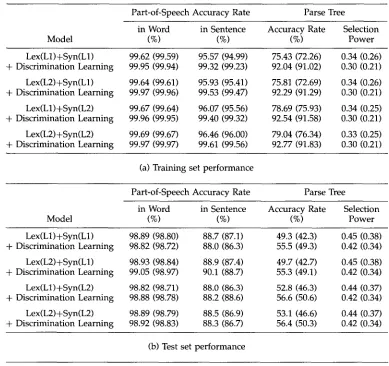
The experimental results of using the discriminative learning procedure with 20 iterations are shown in Table 2. For comparison, the corresponding results before learning, i.e., the baseline results, are repeated in the upper row of each table entry. For the Lex(L2)+Syn(L2) model, the accuracy rate for parse tree disambiguation in the trairting set is improved from 79.04% to 92.77%, which corresponds to a 65.5% error reduction rate. However, only a 7.03% error reduction rate is observed in the test set, from 53.10% to 56.40%. Similar tendencies are also observed for the other models.
Since the discriminative learning procedure only aims at minimizing the error rate in the training set, the training set performance can usually be tuned very closely to 100% when a large number of parameters are available. However, the performance improvement for the test set is far less than that for the training set, since the statistical variations between the training set and the test set are not taken into consideration in the learning procedure. For investigating robustness issues in more detail, a robust learning procedure and the associated analyses are provided in the following section.
4.2 Robust Learning
Computational Linguistics Volume 21, Number 3
Table 2
Performance with discriminative learning: (a) training set; (b) test set. Values in parentheses correspond to performance excluding unambiguous sentences.
Part-of-Speech Accuracy Rate Parse Tree in Word in Sentence Accuracy Rate Selection
Model (%) (%) (%) Power
Lex(L1)+Syn(L1) 99.62 (99.59) + Discrimination Learning 99.95 (99.94) Lex(L2)+Syn(L1) 99.64 (99.61) ÷ Discrimination Learning 99.97 (99.96) Lex(L1)+Syn(L2) 99.67 (99.64) + Discrimination Learning 99.96 (99.95) Lex(L2)+Syn(L2) 99.69 (99.67) + Discrimination Learning 99.97 (99.97)
95.57 (94.99) 75.43 (72.26) 0.34 (0.26) 99.32 (99.23) 92.04 (91.02) 0.30 (0.21) 95.93 (95.41) 75.81 (72.69) 0.34 (0.26) 99.53 (99.47) 92.29 (91.29) 0.30 (0.21) 96.07 (95.56) 78.69 (75.93) 0.34 (0.25) 99.40 (99.32) 92.54 (91.58) 0.30 (0.21) 96.46 (96.00) 79.04 (76.34) 0.33 (0.25) 99.61 (99.56) 92.77 (91.83) 0.30 (0.21)
(a) Training set performance
Part-of-Speech Accuracy Rate Parse Tree
Model
in Word in Sentence Accuracy Rate Selection
(%) (%) (%) Power
Lex(L1)+Syn(L1) 98.89 (98.80) + Discrimination Learning 98.82 (98.72) Lex(L2)+Syn(L1) 98.93 (98.84) + Discrimination Learning 99.05 (98.97) Lex(L1)+Syn(L2) 98.82 (98.71) + Discrimination Learning 98.88 (98.78) Lex(L2)+Syn(L2) 98.89 (98.79) + Discrimination Learning 98.92 (98.83)
88.7 (87.1) 49.3 (42.3) 0.45 (0.38) 88.0 (86.3) 55.5 (49.3) 0.42 (0.34) 88.9 (87.4) 49.7 (42.7) 0.45 (0.38) 90.1 (88.7) 55.3 (49.1) 0.42 (0.34) 88.0 (86.3) 52.8 (46.3) 0.44 (0.37) 88.2 (88.6) 56.6 (50.6) 0.42 (0.34) 88.5 (86.9) 53.1 (46.6) 0.44 (0.37) 88.3 (86.7) 56.4 (50.3) 0.42 (0.34)
(b) Test set performance
a real application. This over-tuning p h e n o m e n o n happens m a i n l y because of the lack of sufficient sampling data a n d the possible statistical variations between the training set a n d the test set.
[image:16.468.44.433.88.454.2]Tung-Hui Chiang et al. Robust Learning, Smoothing, and Parameter Tying
this robust learning procedure to recognize the alphabet of E-set in English (Su and Lee 1991, 1994).
To enhance robustness, the learning rules from Equation 24 to Equation 30 are modified as follows. Following the notations in the previous section, the correct syn- tactic structure is denoted by Syn~,fl, and the syntactic structure of the strongest com- petitor is denoted by Synj, k, whose score may either rank first or second.
. For the syntactic and lexical parameters corresponding to the correct candidate:
. ( t + l ) /
a~y.
ta, i) = A~y. (a, .(t),i)
+ A ~ y . (a, i), (t). ( t + l ) :
Asy n (0~, i) (t) •
if (l14j- 114~,zll) <
(31)otherwise
(t) •
~(t+l)
lex . . . . ( / ~ , I ) ~- .~ (t){R lexV-'" i) + A,~lex(fl, l),. ( t + l ) . . . . (t)
%x
tP, z) = ~lex(fl, i),
if(ll'i'~,kll- 114~,~11) <
(32)otherwise
. For the syntactic and lexical parameters corresponding to the strongest competitor:
. ( t + l ) . . . . ,~(t) : ^ i ' (t) ^
Asyn ~,J,l) m syn(,3, ) - - A / ~ s y n ( 3 , i ) ,
,(t+l) . . . . (t) ^ • Asy,, U,z)
~sy.(3,z),
if(ll4~,kll- 114~,:11) <
6,
otherwise (33)
{ A}et:l)(~:,i) =
A (t):f"
lex \'~l i) - - AiSle x(t)(k,i),
. ( t + l ) : f .\ /~(t) (~, i),
Ale x ~K, 1) lex
i/(ll4pll- 114~:11)
<
6,
otherwise
(34)
The learning rules of the syntactic and lexical weights are modified as follows:
,(t+l) _ ,(t) A (t)
w s y n - - w s y n T t - / . A W s y n
(t+l) . (t)
w s y n : ~ V s y n ,
i f ( l l 4 J -
[14~,~11) < 6,
otherwise
(35)
{ • (t+l) ~ (t) A (t)
~lJle x z ~lJle x -F L-~Wle x ,
. ( t + l ) =
w(t)
tV lex lex '
i f ( l l ~ J -
114~,~11) < e~,
otherwise
(36)
The margin 6 in the above equations can be assigned either absolutely or relatively, as suggested in Su and Lee (1991, 1994). Currently, the relative mode with a 30% passing rate (i.e., 30% of the training tokens pass through the margin) is used in our implementation.
Computational Linguistics Volume 21, Number 3
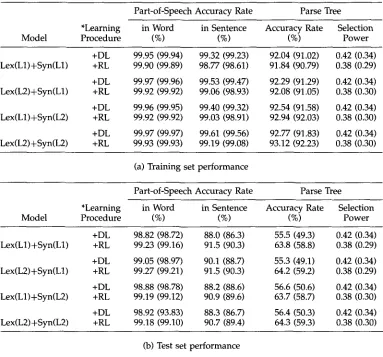
Table 3
Performance with robust learning: (a) training set; (b) test set. Values in parentheses correspond to performance excluding unambiguous sentences.
Part-of-Speech Accuracy Rate Parse Tree *Learning in Word in Sentence Accuracy Rate Selection
Model Procedure (%) (%) (%) Power
+DL 99.95 (99.94) 99.32 (99.23) 92.04 (91.02) 0.42 (0.34) Lex(L1)+Syn(L1) +RL 99.90 (99.89) 98.77 (98.61) 91.84 (90.79) 0.38 (0.29) +DL 99.97 (99.96) 99.53 (99.47) 92.29 (91.29) 0.42 (0.34) Lex(L2)+Syn(L1) +RL 99.92 (99.92) 99.06 (98.93) 92.08 (91.05) 0.38 (0.30) +DL 99.96 (99.95) 99.40 (99.32) 92.54 (91.58) 0.42 (0.34) Lex(L1)+Syn(L2) +RL 99.92 (99.92) 99.03 (98.91) 92.94 (92.03) 0.38 (0.30) +DL 99.97 (99.97) 99.61 (99.56) 92.77 (91.83) 0.42 (0.34) Lex(L2)+Syn(L2) +RL 99.93 (99.93) 99.19 (99.08) 93.12 (92.23) 0.38 (0.30)
(a) Training set performance
Part-of-Speech Accuracy Rate Parse Tree *Learning in Word in Sentence Accuracy Rate Selection
Model Procedure (%) (%) (%) Power
+DL 98.82 (98.72) 88.0 (86.3) 55.5 (49.3) 0.42 (0.34) Lex(L1)+Syn(L1) +RL 99.23 (99.16) 91.5 (90.3) 63.8 (58.8) 0.38 (0.29) +DL 99.05 (98.97) 90.1 (88.7) 55.3 (49.1) 0.42 (0.34) Lex(L2)+Syn(L1) +RL 99.27 (99.21) 91.5 (90.3) 64.2 (59.2) 0.38 (0.29) +DL 98.88 (98.78) 88.2 (88.6) 56.6 (50.6) 0.42 (0.34) Lex(L1)+Syn(L2) +RL 99.19 (99.12) 90.9 (89.6) 63.7 (58.7) 0.38 (0.30) +DL 98.92 (93.83) 88.3 (86.7) 56.4 (50.3) 0.42 (0.34) Lex(L2)+Syn(L2) +RL 99.18 (99.10) 90.7 (89.4) 64.3 (59.3) 0.38 (0.30)
(b) Test set performance
~DL and RL denote "Discriminative Learning" and "Robust Learning," respectively
5. Parameter Smoothing for Sparse Data
Tung-Hui Chiang et al. Robust Learning, Smoothing, and Parameter Tying
ing techniques are first summarized in the following section. The investigation for the smoothing/robust learning hybrid approach is presented next.
5.1 The Smoothing Procedures
5.1.1 Turing's Formula. Let N be the sample size (the number of training tokens) and
nr
be the number of events that occur exactly r times. Then the following equation holds:N = y'~r. nr
(37)r
The
maximum likelihood estimate PML
for the probability of an event e occurring r timesis defined as follows: r
PML(e)
= ~ (38)The estimate based on Turing's formula (Good 1953) is given by the following equation:
r •
PTU(e)
= ~ (39)where
r* = (r + 1) nr+l (40)
Hr
The total probability estimate, using Turing's formula, for all the events that actu- ally occurred in the sample space is equal to
PTU(e)
= 1 nl (41) Ne:C(e)>0
where
C(e)
stands for the frequency count of the event e in the sample. This, in turn, leads to the following equation:nl (42)
~_~ PTLI(e)=
e:C(e)=0
According to Turing's formula, the probability mass
n l / N
is then equally distributed over the events that never occur in the sample.5.1.2 Back-off Procedure. Katz (1987) proposed a
back-off
procedure to estimate pa- rameters for an m-gram model, i.e., the conditional probability of a word given the (m-l) preceding words. This procedure is summarized as follows:PTU(Wm
I w~n-1),PBF(Wm I m - - 1
Wl
) =
O~(W~-I)PBF( wm I
PBF( wm I Warn-l)
m - 1
W2 )
if C ( w D > o
if C(w"~)
= 0, andC(w~) > O,
if C(wV) = o
Wm
(43)
where
Ol(W~ n-1 ) =
1 -
Y~
PBF(Wm
]W~ n-l)w~:C(wD>O
1 -
~_~
PBF(Wm
]w~ '-1)
w,.:C(wD>O
Computational Linguistics Volume 21, Number 3
is a normalized factor such that
PBF(Wm I WT) +
Z
PBF(Wm
I WT) = 1 (45)wm:C(wD>0 wm:C(wT)=0
Compared with Turing's formula, the probability for an m-gram that does not occur in the sample is "backed off" to refer to its corresponding (m-1)-gram probability.
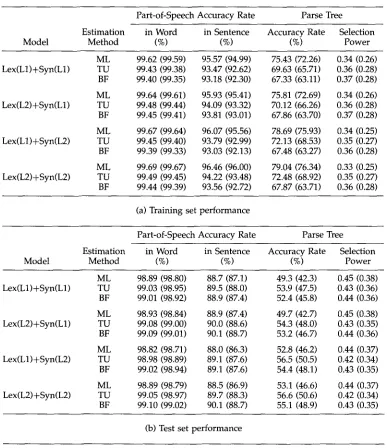
Table 4 gives the experimental results for using the m a x i m u m likelihood (ML), Tur- ing (TU) and back-off (BF) estimation procedures. The results show that smoothing the unreliable parameters degrades the training set performance; however, it improves the performance for the test set. Among the estimators, the m a x i m u m likelihood estimator provides the best results for the training set, but it is the worst on the test set. Both Turing's and the back-off procedures perform better than the m a x i m u m likelihood procedure. This means that smoothing unreliable parameters is absolutely essential if only limited training data are available.
Compared with Turing's procedure, the back-off procedure is 1 ~ 2% worse in all cases. After examining the estimated parameters by using these two smoothing procedures, we found that some syntactic parameters for null events were assigned very large values by the Back-Off procedure, while they were assigned small proba- bilities by Turing's formula. A typical example is shown as follows. The reduce action "n quan --* NLM*" given the left contexts [P*, N2] never occurred in the training set. But, the probability of P( n quan --~ NLM* [ [n quan] reduced; L2=P*, LI=N2) is finally replaced by the probability of P( n quan ~ NLM* I In quan] reduced) in the Back-Off estimation procedure. Since the probability P( n quan --+ NLM* I [n quan] reduced) has a large value (= 0.25), the probability P( n quan ~ NLM* I [n quan] are reduced; L2=P*, LI=N2) is accordingly large also. From the estimation point of view, the parameters for null events may be assigned better estimated values by using the Back-Off method; however, these parameters do not necessarily guarantee that the discrimination power will be better improved. Take the sentence "A
stack ofpinfeed paper three inches high may
be placed underneath it"
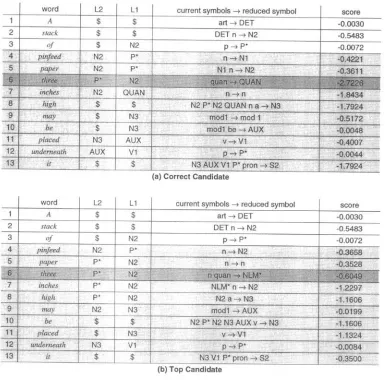
as an example. The decomposed phrase levels and the corre- sponding syntactic scores for the correct and the top candidate are shown in Table 5 (a) and (b), respectively. We find that the main factor affecting the tree selection is the sixth phrase level, which corresponds to the reduce action % quan --* NLM*" with the left two contextual symbols P* and N2 for the top candidate. As described above, the probability P( n quan --* NLM* I [n quan] reduced; L2=P*, LI=N2) is assigned a large value in the Back-Off estimation procedure. However, to correctly select the right syn- tactic structure in this example, P( quan ~ QUAN I [quan] reduced; L2=P*, LI=N2) should be greater than P( n quan ~ NLM* I [n quan] reduced; L2=P*, LI=N2). This requirement may not be met by any estimation procedure, since the above two prob- abilities are estimated from two different outcome spaces (one conditioned on [quan], and the other conditioned on [n, qua n]). Therefore, even though the Back-Off procedure m a y give better estimates for the parameters, it cannot guarantee that the recognition result can be improved. The comparison between Turing's procedure and the Back- Off procedure thus varies in different cases. In fact, the Back-Off estimation did show better results in our previous research (Lin, Chiang, and Su 1994). Nevertheless, we will show in the next section that the selection of a smoothing method is not crucial after the robust learning procedure has been applied.Tung-Hui Chiang et al. Robust Learning, Smoothing, and Parameter Tying
Table 4
Performance for lexical and syntactic disambiguation with various estimators. Values in parentheses correspond to performance excluding unambiguous sentences. (ML: Maximum Likelihood estimator; TU: TUring's formula; BF: Back-Off technique.)
Part-of-Speech Accuracy Rate Parse Tree Estimation in Word in Sentence Accuracy Rate Selection
Model Method (%) (%) (%) Power
ML 99.62 (99.59) 95.57 (94.99) 75.43 (72.26) 0.34 (0.26) Lex(L1)+Syn(L1) TU 99.43 (99.38) 93.47 (92.62) 69.63 (65.71) 0.36 (0.28) BF 99.40 (99.35) 93.18 (92.30) 67.33 (63.11) 0.37 (0.28) ML 99.64 (99.61) 95.93 (95.41) 75.81 (72.69) 0.34 (0.26) Lex(L2)+Syn(L1) TU 99.48 (99.44) 94.09 (93.32) 70.12 (66.26) 0.36 (0.28) BF 99.45 (99.41) 93.81 (93.01) 67.86 (63.70) 0.37 (0.28) ML 99.67 (99.64) 96.07 (95.56) 78.69 (75.93) 0.34 (0.25) Lex(L1)+Syn(L2) TU 99.45 (99.40) 93.79 (92.99) 72.13 (68.53) 0.35 (0.27) BF 99.39 (99.33) 93.03 (92.13) 67.48 (63.27) 0.36 (0.28) ML 99.69 (99.67) 96.46 (96.00) 79.04 (76.34) 0.33 (0.25) Lex(L2)+Syn(L2) TU 99.49 (99.45) 94.22 (93.48) 72.48 (68.92) 0.35 (0.27) BF 99.44 (99.39) 93.56 (92.72) 67.87 (63.71) 0.36 (0.28)
(a) Training set performance
Part-of-Speech Accuracy Rate Parse Tree Estimation in Word in Sentence Accuracy Rate Selection
Model Method (%) (%) (%) Power
ML 98.89 (98.80) 88.7 (87.1) 49.3 (42.3) 0.45 (0.38) Lex(L1)+Syn(L1) TU 99.03 (98.95) 89.5 (88.0) 53.9 (47.5) 0.43 (0.36) BF 99.01 (98.92) 88.9 (87.4) 52.4 (45.8) 0.44 (0.36) ML 98.93 (98.84) 88.9 (87.4) 49.7 (42.7) 0.45 (0.38) Lex(L2)+Syn(L1) TU 99.08 (99.00) 90.0 (88.6) 54.3 (48.0) 0.43 (0.35) BF 99.09 (99.01) 90.1 (88.7) 53.2 (46.7) 0.44 (0.36) ML 98.82 (98.71) 88.0 (86.3) 52.8 (46.2) 0.44 (0.37) Lex(L1)+Syn(L2) TU 98.98 (98.89) 89.1 (87.6) 56.5 (50.5) 0.42 (0.34) BF 99.02 (98.94) 89.1 (87.6) 54.4 (48.1) 0.43 (0.35) ML 98.89 (98.79) 88.5 (86.9) 53.1 (46.6) 0.44 (0.37) Lex(L2)+Syn(L2) TU 99.05 (98.97) 89.7 (88.3) 56.6 (50.6) 0.42 (0.34) BF 99.10 (99.02) 90.1 (88.7) 55.1 (48.9) 0.43 (0.35)
(b) Test set performance
crimination capability r a t h e r t h a n m e r e l y i m p r o v i n g e s t i m a t i o n process, achieves a better result. Since the p h i l o s o p h i e s of p e r f o r m a n c e i m p r o v e m e n t for these t w o al- g o r i t h m s are different (one f r o m the estimation p o i n t of v i e w a n d the other f r o m the
[image:21.468.34.421.93.541.2]Computational Linguistics Volume 21, Number 3
Table 5
The decomposed phrase levels associated with the sentence "A stack ofpinfeed paper three inches
high may be placed underneath it," and the corresponding scores with the Back-Off estimation
method for (a) the correct candidate and (b) the top candidate. The shaded rows indicate the different patterns between the two parse trees.
word current symbols ~ reduced symbol score
1 A $ $ art -~ DET -0.0030
2 stack $ $ DET n --~ N2 -0.5483
3 of $
4 pinfeed N 2
N2 p ~ P* -0.0072
r . n ---," " " ~ '
P" - N1 . , - 0 A 2 2 1
I ~ " N l n ~ , N 2 - • ; " "~Q,3611
5 paper • N2 P*
7 i ~ e s N2
[image:22.468.45.430.121.501.2], , , , , !
... , i ,- h/gh $
... 9 may ... $ ,,
. . . . I 0 ! b ~ . . . $
11 placed " N3
i 2 underneath A U X V"
. 1 3 it • ~$ $
Q U A N ' rl ~ n • " ' - I , 8 4 3 4
' $ } N2 P N2 Q U N n a ~ NO * " ! A t " - t 7 9 2 4 :
N3 m o d l - ) m o d l - -0;5172
N 3 mode'be ~ A U X ~ . ', . ~ o o 4 8
A U X ' . v ~ V l , " ' " - O . ~ 7
N 3 A U X V l P" pron:-~ $ 2
(a) Correct Candidate
-1~.7~4
word
1 A $ $
2 stack $ $
3 of $ N2
4 pin feed N2 P*
5 paper P* N2
current symbols --) reduced symbol score
art --) DET -0.0030
DET n --~ N2 -0,5483
p -~ P* -0.0072
n ~ N 2 : , ~ 0 3 6 5 8
n -~ n ~0.3528
7 inches P* N2
.... 8 high P" N2
... 9 may N2 N3
.... 1 0 , ... ~ $ " $
p~ced $ N3
underneath N3 V l
~3 . $ I i $,
N L M * n - ~ N2 ' ~1~2297
. . . N 2 a ~ N3 . . . ; ... ~ 6 0 6
m0d~--~ AUX i , ;;001;99;
N2 P ' N2 N 3 A U X v ~ N 3 ~! !60;6
v ~ V I
t
• , N3 vl P': p r o . - , s2
(b) T o p Candidate
5.2 R o b u s t Learning o n the S m o o t h e d Parameters
Tung-Hui Chiang et al. Robust Learning, Smoothing, and Parameter Tying
Table 6
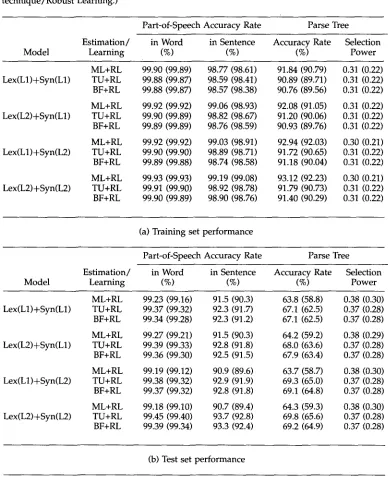
Performance with the smoothing/robust learning hybrid approach. Values in parentheses correspond to performance excluding unambiguous sentences. (ML+RL: Maximum Likelihood estimator/Robust Learning; TU+RL: TUring's formula/Robust Learning; BF+RL" Back-Off technique/Robust Learning.)
Part-of-Speech Accuracy Rate Parse Tree Estimation/ in Word in Sentence Accuracy Rate Selection
Model Learning (%) (%) (%) Power
ML+RL 99.90 (99.89) 98.77 (98.61) 91.84 (90.79) 0.31 (0.22) Lex(L1)+Syn(L1) TU+RL 99.88 (99.87) 98.59 (98.41) 90.89 (89.71) 0.31 (0.22) BF+RL 99.88 (99.87) 98.57 (98.38) 90.76 (89.56) 0.31 (0.22) ML+RL 99.92 (99.92) 99.06 (98.93) 92.08 (91.05) 0.31 (0.22) Lex(L2)+Syn(L1) TU+RL 99.90 (99.89) 98.82 (98.67) 91.20 (90.06) 0.31 (0.22) BF+RL 99.89 (99.89) 98.76 (98.59) 90.93 (89.76) 0.31 (0.22) ML+RL 99.92 (99.92) 99.03 (98.91) 92.94 (92.03) 0.30 (0.21) Lex(L1)+Syn(L2) TU+RL 99.90 (99.90) 98.89 (98.71) 91.72 (90.65) 0.31 (0.22) BF+RL 99.89 (99.88) 98.74 (98.58) 91.18 (90.04) 0.31 (0.22) ML+RL 99.93 (99.93) 99.19 (99.08) 93.12 (92.23) 0.30 (0.21) Lex(L2)+Syn(L2) TU+RL 99.91 (99.90) 98.92 (98.78) 91.79 (90.73) 0.31 (0.22) BF+RL 99.90 (99.89) 98.90 (98.76) 91.40 (90.29) 0.31 (0.22)
(a) Training set performance
Part-of-Speech Accuracy Rate Parse Tree Estimation/ in Word in Sentence Accuracy Rate Selection
Model Learning (%) (%) (%) Power
ML+RL 99.23 (99.16) 91.5 (90.3) 63.8 (58.8) 0.38 (0.30) Lex(L1)+Syn(L1) TU+RL 99.37 (99.32) 92.3 (91.7) 67.1 (62.5) 0.37 (0.28) BF+RL 99.34 (99.28) 92.3 (91.2) 67.1 (62.5) 0.37 (0.28) ML+RL 99.27 (99.21) 91.5 (90.3) 64.2 (59.2) 0.38 (0.29) Lex(L2)+Syn(L1) TU+RL 99.39 (99.33) 92.8 (91.8) 68.0 (63.6) 0.37 (0.28) BF+RL 99.36 (99.30) 92.5 (91.5) 67.9 (63.4) 0.37 (0.28) ML+RL 99.19 (99.12) 90.9 (89.6) 63.7 (58.7) 0.38 (0.30) Lex(L1)+Syn(L2) TU+RL 99.38 (99.32) 92.9 (91.9) 69.3 (65.0) 0.37 (0.28) BF+RL 99.37 (99.32) 92.8 (91.8) 69.1 (64.8) 0.37 (0.28) ML+RL 99.18 (99.10) 90.7 (89.4) 64.3 (59.3) 0.38 (0.30) Lex(L2)+Syn(L2) TU+RL 99.45 (99.40) 93.7 (92.8) 69.8 (65.6) 0.37 (0.28) BF+RL 99.39 (99.34) 93.3 (92.4) 69.2 (64.9) 0.37 (0.28)
(b) Test set performance
errors b y using these m e t h o d s does not directly i m p r o v e the discrimination capabil- ity. Experimental results using this h y b r i d a p p r o a c h are s h o w n in Table 6, w h e r e the results using the (ML+RL) m o d e are also listed for reference.
[image:23.468.35.423.94.575.2]