Using Corpus Statistics and WordNet
Relations for Sense Identification
Claudia Leacock*
Educational Testing ServiceGeorge
A. Millers
Princeton University
Martin Chodorow t
Hunter College of CUNYCorpus-based approaches to word sense identification have flexibility and generality but suffer from a knowledge acquisition bottleneck. We show how knowledge-based techniques can be used to open the bottleneck by automatically locating training corpora. We describe a statistical classifier that combines topical context with local cues to ident~y a word sense. The classifier is used to disambiguate a noun, a verb, and an adjective. A knowledge base in the form of WordNet's lexical relations is used to automatically locate training examples in a general text corpus. Test results are compared with those from manually tagged training examples.
1. Introduction
An impressive array of statistical methods have been developed for word sense identi- fication. They range from dictionary-based approaches that rely on definitions (V~ronis and Ide 1990; Wilks et al. 1993) to corpus-based approaches that use only word co- occurrence frequencies extracted from large textual corpora (Sch~itze 1995; Dagan
and
Itai 1994). We have drawn on these two traditions, using corpus-based co-occurrence and the lexical knowledge base that is embodied in the WordNet lexicon.The two traditions complement each other. Corpus-based approaches have the advantage of being generally applicable to new texts, domains, and corpora without
needing costly and
perhaps error-prone parsing or semantic analysis. They require only training corpora in which the sense distinctions have been marked, but therein lies their weakness. Obtaining training materials for statistical methods is costly and time- consuming--it is a "knowledge acquisition bottleneck" (Gale, Church, and Yarowsky 1992a). To open this bottleneck, we use WordNet's lexical relations to locate unsuper- vised training examples.Section 2 describes a statistical classifier, TLC (Topical/Local Classifier), that uses topical context (the open-class words that co-occur with a particular sense), local con- text (the open- and closed-class items that occur within a small w i n d o w around a word), or a combination of the two. The results of combining the two types of context to disambiguate a noun (line), a verb (serve), and an adjective (hard) are presented. The following questions are discussed: When is topical context superior to local context (and vice versa)? Is their combination superior to either type alone? Do the answers to these questions depend on the size of the training? Do they depend on the syntactic category of the target?
• Division of Cognitive and Instructional Science, Princeton, NJ 08541; e-mail: [email protected]. The work reported here was done while the author was at Princeton University.
Computational Linguistics Volume 24, Number 1
Manually tagged training materials were used in the development of TLC and the experiments in Section 2. The Cognitive Science Laboratory at Princeton Univer- sity, with support from NSF-ARPA, is producing textual corpora that can be used in developing and evaluating automatic methods for disambiguation. Examples of the different meanings of one thousand common, polysemous, open-class English words are being manually tagged. The results of this effort will be a useful resource for train- ing statistical classifiers, but what about the next thousand polysemous words, and the next? In order to identify senses of these words, it will be necessary to learn how to harvest training examples automatically.
Section 3 describes WordNet's lexical relations and the role that monosemous "relatives" of polysemous words can play in creating unsupervised training materials. TLC is trained with automatically extracted examples, its performance is compared with that obtained from manually tagged training materials.
2. Corpus-based Statistical Sense Identification
Work on automatic sense identification from the 1950s onward has been well summa- rized by Hirst (1987) and Dagan and Itai (1994). The discussion below is limited to work that is closely related to our research.
2.1 Some Recent Work
Hearst (1991) represents local context with a shallow syntactic parse in which the context is segmented into prepositional phrases, noun phrases, and verb groups. The target noun is coded for the word it modifies, the word that modifies it, and the prepositions that precede and follow it. Open-class items within ±3 phrase segments of the target are coded in terms of their relation to the target (modifier or head) or their role in a construct that is adjacent to the target. Evidence is combined in a manner similar to that used by the local classifier component of TLC. With supervised training of up to 70 sentences per sense, performance on three homographs was quite good (88-100% correct); with fewer training examples and semantically related senses, performance on two additional words was less satisfactory (73-77% correct).
Gale, Church, and Yarowsky (1992a) developed a topical classifier based on Bayesian decision theory. The only information the classifier uses is an unordered list of words that co-occur with the target in training examples. No other cues, such as part-of-speech tags or word order, are used. Leacock, Towell, and Voorhees (1993) compared this Bayesian classifier with a content vector classifier as used in information retrieval and a neural network with backpropagation. The classifiers were compared using different numbers of senses (two, three, or six manually tagged senses of
line)
and different amounts of training material (50, 100, and 200 examples). On the six- sense task, the classifiers averaged 74% correct answers. Leacock, Towell, and Voorhees (1993) found that the response patterns of the three classifiers converged, suggesting that each of the classifiers was extracting as much data as is available in purely top- ical approaches that look only at word counts from training examples. If this is the case, any technique that uses only topical information will not be significantly more accurate than the three classifiers tested.
Leacock, Towell, and Voorhees (1996) showed that performance of the content vector topical classifier could be improved with the addition of local templates-- specific word patterns that were recognized as being indicative of a particular sense-- in an extension of an idea initially suggested by Weiss (1973). Although the templates proved to be highly reliable when they occurred, all too often, none were found.
Leacock, Chodorow, and Miller Corpus Statistics and WordNet Relations
cators of sense. H e located collocations b y looking at adjacent w o r d s or at the first w o r d to the left or right in a given part of speech a n d f o u n d that, w i t h b i n a r y ambi- guity, a w o r d has only one sense in a given collocation with a probability of 90-99%. 1 H o w e v e r , he h a d an average of only 29% recall (i.e., the collocations w e r e f o u n d in only 29% of the cases). W h e n local i n f o r m a t i o n occurred it was highly reliable, b u t all too often, it did not occur.
Bruce and Wiebe (1994a, 1994b) h a v e d e v e l o p e d a classifier that represents local context b y m o r p h o l o g y (the inflection on the target word), the syntactic category of w o r d s within a w i n d o w of ± 2 w o r d s from the target, a n d collocation-specific items f o u n d in the sentence. The collocation-specific items are those d e t e r m i n e d to be the most informative, w h e r e an item is considered informative if the m o d e l for i n d e p e n - dence b e t w e e n it and a sense tag p r o v i d e d a p o o r fit to the training data. The relative probabilities of senses, available from the training corpus, are u s e d in the decision process as p r i o r probabilities. For each test example, the evidence in its local context is c o m b i n e d in a Bayesian-type m o d e l of the probability of each sense, a n d the most probable sense is selected. P e r f o r m a n c e ranges from 77-84% correct on the test words, w h e r e a l o w e r b o u n d for p e r f o r m a n c e based on always selecting the m o s t frequent sense for the same w o r d s (i.e., the sense with the greatest prior probability) w o u l d yield 53-80% correct.
Yarowsky (1994), building on his earlier work, designed a classifier that looks at w o r d s within :kk positions from the target; l e m m a forms are obtained t h r o u g h mor- phological analysis; a n d a coarse part-of-speech assignment is p e r f o r m e d b y dictionary lookup. Context is r e p r e s e n t e d b y collocations based on w o r d s or parts of speech at specific positions within the w i n d o w or, less specifically, in a n y position. Also c o d e d are some special classes of words, such as WEEKDAY, that m i g h t serve to distinguish a m o n g w o r d senses. For each type of local-context e v i d e n c e f o u n d in the corpus, a log-likelihood ratio is constructed, indicating the strength of the evidence for one form of the h o m o g r a p h versus the other. These ratios are then a r r a n g e d in a sorted decision list with the largest values (strongest evidence) first. A decision is m a d e for a test sentence b y scanning d o w n the decision list until a m a t c h is found. Thus, only the single best piece of evidence is used. The classifier was tested on disambiguating the h o m o g r a p h s that result from accent r e m o v a l in Spanish and French (e.g., seria, serfa).
In tests with the n u m b e r of training examples ranging from a few h u n d r e d to several thousand, overall accuracy was high, a b o v e 90%.
Clearly, sense identification is an active area of research, and considerable ingenu- ity is apparent. But despite the p r o m i s i n g results r e p o r t e d in this literature, the reality is that there still are n o large-scale, operational systems for tagging the senses of w o r d s in text.
2.2 Topical/Local Classifier (TLC)
The statistical classifier, TLC, uses topical context, local context, or a c o m b i n a t i o n of the two, for w o r d sense identification. TLC's flexibility in using b o t h forms is an i m p o r t a n t asset for o u r investigations.
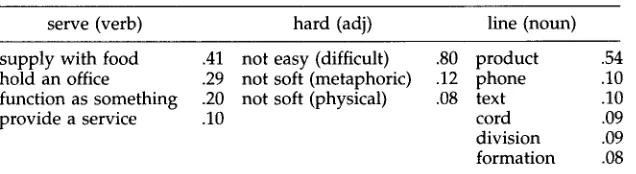
A n o u n , a verb, a n d an adjective were tested in this study. Table 1 p r o v i d e s a s y n o n y m or brief gloss for each of the senses used. Training c o r p o r a a n d testing c o r p o r a were collected as follows:
1. Examples for serve, hard, a n d line, in base or inflected form, w e r e located in on-line corpora. Examples containing line and serve were taken from the 1987-89 LDC
Computational Linguistics Volume 24, Number 1
Table 1
Word senses used in the experiment and their relative frequencies.
serve (verb) hard (adj) line (noun)
supply with food .41 not easy (difficult) .80 product .54 hold an office .29 not soft (metaphoric) .12 phone .10 function as something .20 not soft (physical) .08 text .10
provide a service .10 cord .09
division .09 formation .08
Wall Street Journal c o r p u s and from the A m e r i c a n Printing H o u s e for the Blind corpus. 2 Examples for hard w e r e taken from the LDC San Jose Mercury News (SJM) corpus. Each consisted of the sentence containing the target a n d one sentence p r e c e d i n g it. The resulting strings h a d an a v e r a g e length of 49 items.
2. Examples w h e r e the target was the h e a d of an u n a m b i g u o u s collocation w e r e r e m o v e d from the files. Being u n a m b i g u o u s , t h e y do not n e e d to be disambiguated. These collocations, for example, product line a n d hard candy w e r e f o u n d using WordNet. In Section 3, w e consider h o w they can be u s e d for u n s u p e r v i s e d training. Examples w h e r e the target was part of a p r o p e r n o u n w e r e also r e m o v e d ; for example, Japan Air Lines was not taken as an e x a m p l e of line.
3. Each occurrence of the target w o r d was m a n u a l l y t a g g e d with a W o r d N e t sense until a large n u m b e r of examples was obtained for six senses of line, four senses of serve, a n d three senses of hard. In the process of collecting a n d m a n u a l l y tagging examples, it was possible to d e t e r m i n e the relative frequencies of the senses of each word. The less frequent senses, w h i c h d o not a p p e a r in Table 1, o c c u r r e d too rarely for us to collect the m i n i m u m n u m b e r of examples n e e d e d to p e r f o r m the e x p e r i m e n t described in the next section.
4. Three sets of materials w e r e p r e p a r e d b y partitioning the examples for each sense into training a n d test sets. 3 The size of the training set was v a r i e d b y taking the first 25, 50, 100, a n d 200 examples of the least frequent sense, a n d examples f r o m the other senses in n u m b e r s that reflected their relative frequencies in the corpus. As an illustration, in the smallest training set for hard, there w e r e 25 examples of the least frequent sense, 37 examples of the second most frequent sense, a n d 256 e x a m p l e s of the most frequent sense. The test sets w e r e of fixed size: each contained 150 of the least frequent sense a n d examples of the other senses in n u m b e r s that reflected their relative frequencies.
The o p e r a t i o n of TLC consists of preprocessing, training, a n d testing. D u r i n g pre- processing, examples are tagged with a part-of-speech tagger (Brill 1994); special tags are inserted at sentence breaks; a n d each open-class w o r d f o u n d in W o r d N e t is re- placed with its base form. This step n o r m a l i z e s across m o r p h o l o g i c a l variants w i t h o u t
2 This 25-million-word c o r p u s is archived at IBM's T. J. Watson Research Center; it consists of stories and articles from b o o k s and general circulation magazines.
[image:4.468.48.366.89.176.2]Leacock, Chodorow, and Miller Corpus Statistics and WordNet Relations
resorting to the more drastic measure of stemming. Morphological information is not lost, since the part-of-speech tag remains unchanged.
Training consists of counting the frequencies of various contextual cues for each sense. Testing consists of taking a new example of the polysemous word and comput- ing the most probable sense, based on the cues present in the context of the new item. A comparison is made to the sense assigned by a human judge, and the classifier's decision is scored as correct or incorrect.
TLC uses a Bayesian approach to find the sense
si
that is the most probable given the cues q contained in a context window of ±k positions around the polysemous target word. For eachsi,
the probability is computed with Bayes' rule:p(si I C-k . . . Ck) ~- P(C-k . . . . "Ck [ si)p(si)
p(C-k, . . .,Ck)
As Golding (1995) points out, the term
p(c-k,..., Ck I Si)
is difficult to estimate because of the sparse data problem, but if we assume, as is often done, that the occurrence of each cue is independent of the others, then this term can be replaced with:k
p(C-k .... 'Ck l Si) = H p(Cj I si)
j=-kIn TLC, we have made this assumption and have estimated
p(cj I si)
from the training. Of course, the sparse data problem affects these probabilities too, and so TLC uses the Good-Turing formula (Good 1953; Chiang, Lin, and Su 1995), to smooth the values of p(cj Isi),
including providing probabilities for cues that did not occur in the training.TLC actually uses the mean of the Good-Turing value and the training-derived value for p(cj I
si).
When cues do not appear in training, it uses the mean of the Good- Turing value and the global probability of the cue p(cj), obtained from a large text corpus. This approach to smoothing has yielded consistently better performance than relying on the Good-Turing values alone.TLC uses: (1) topical cues consisting of open-class words found in a wide window that includes the sentence in which the target is located plus the preceding sentence; (2) local open-class words found in a narrow window around the target; (3) local closed-class items; (4) local part-of-speech tags. The procedures for estimating p(cj I
si)
and p(cj) differ somewhat for the various types of cue.1. The counts for open-class words (nouns, verbs, adjectives, and adverbs) from which the topical cue probabilities
p(cj I si)
andp(cj)
are calculated are not sensitive to position within the wide window (the "bag-of-words" method). By contrast, the local cue probabilities do take into account position relative to the target.2. For open-class words found in the three positions to the left of the target (i.e., j = -3, - 2 , -1), p(cj I
si)
is the probability that word cj appears in any of these positions. This permits TLC to generalize over variations in the placement of premodifiers, for example. In a similar manner, there is generalization over the three positions to the right of the target. The local window does not extend beyond a sentence boundary. A window size of ±3 was chosen on empirical grounds; a preliminary study using parts of the Brown corpus that had been manually tagged with senses in WordNet (Landes, Leacock, and Tengi 1998) and a version of TLC that looked only at local open-class words performed best with this width when tested on a large number of nouns, verbs, and adjectives.Computational Linguistics Volume 24, Number 1
tuation. For this cue type,
p(cj ] si)
is the probability that itemcj
appears precisely at location j for sensesi.
Positions j = - 2 , - 1 , 1 , 2 are used. The global probabilities, for examplep(the_l),
are based on counts of closed-class items f o u n d at these positions relative to the n o u n s in a large text corpus. The local w i n d o w w i d t h of ±2 was selected after pilot testing on the semantically tagged Brown corpus. As in (2) above, the local w i n d o w does not extend b e y o n d a sentence boundary.4. Part-of-speech tags in the positions j = - 2 , - 1 , 0,1, 2 are also used as cues. The probabilities for these tags are c o m p u t e d for specific positions (e.g.,
p(DT_i
] si),p(DT_i))
in a m a n n e r similar to that described in (3) above.W h e n TLC is configured to use only topical information, cue type (1) is employed. W h e n it is configured for local information, cue types (2), (3), a n d (4) are used. Finally, in combined mode, the set of cues contains all four types.
2.3 Results
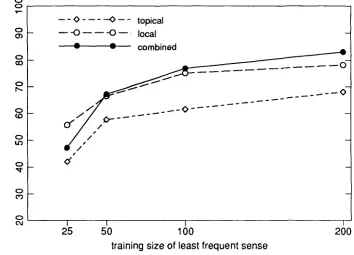
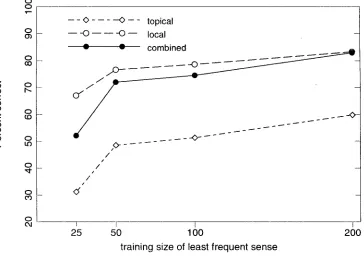
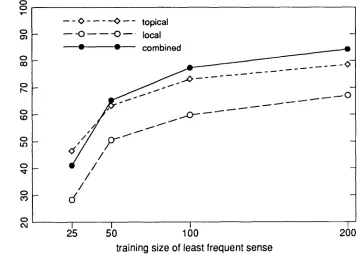
Figures 1 to 3 show the accuracy of the classifier as a function of the size of the training set w h e n using local context, topical context, a n d a combination of the two, averaged across three runs for each training set. To the extent that the w o r d s used are representative, some clear differences appear as a function of syntactic category. With the verb
serve,
local context was more reliable than topical context at all levels of training (78% versus 68% with 200 training examples for the least frequent sense). The combination of local a n d topical context s h o w e d i m p r o v e m e n t (83%) over either form alone (see Figure 1). With the adjectivehard,
local context was m u c h more reliable as an indicator of sense than topical context for all training sizes (83% versus 60% with 200 training examples) a n d the combined classifier's performance (at 83%) was the same as for local (see Figure 2). In the case of the n o u nline,
topical was slightly better than local at all set sizes, but w i t h 200 training examples, their combination yielded 8.4% accuracy, greater t h a n either topical (78%) or local (67%) alone (see Figure 3).To summarize, local context was more reliable t h a n topical context as an indicator of sense for this verb a n d this adjective, b u t slightly less reliable for this noun. The combination of local and topical context s h o w e d i m p r o v e d or equal performance for all three words. Performance for all of the classifiers i m p r o v e d w i t h increased training size. All classifiers p e r f o r m e d best w i t h at least 200 training examples per sense, b u t the learning curve t e n d e d to level off b e y o n d a m i n i m u m 100 training examples.
These results are consistent with those of Yarowsky (1993), based on his exper- iments with p s e u d o w o r d s , h o m o p h o n e s , a n d h o m o n y m s (discussed below). He ob- served that performance for verbs a n d adjectives d r o p p e d sharply as the w i n d o w h~creased, while distant context remained useful for nouns. Thus one is t e m p t e d to conclude that n o u n s d e p e n d more on topic than do verbs a n d adjectives. But such a conclusion is probably an overgeneralization, i n a s m u c h as some n o u n senses are clearly nontopical. Thus, Leacock, Towell, a n d Voorhees (1993) f o u n d that some senses of the n o u n
line
are not susceptible to disambiguation w i t h topical context. For exam- ple, the 'textual' sense ofline
can appear w i t h a n y topic, whereas the 'product' sense ofline
cannot. W h e n it h a p p e n s that a nontopical sense accounts for a large proportionof occurrences (in our study, all senses of
hard
are nontopical), then a d d i n g topical context to local will have little benefit a n d m a y even reduce accuracy.Leacock, Chodorow, and Miller Corpus Statistics and WordNet Relations
0 0
8
c2 (3_
0 O~
0
O0
0
0
0 CO
0 0,1
- - - 0 - - - - . - 0 - - t o p i c a l
- - - 0 - - - - - 0 - - . l o c a l
= = c o m b i n e d
L ~ - 0 . . . .
d
I I I
25 50 1 O0 200
[image:7.468.58.412.69.324.2]t r a i n i n g s i z e o f l e a s t f r e q u e n t s e n s e
Figure 1
Classifier performance on four senses of the verb serve. Percentage accounted for by most frequent sense = 41%.
searched through 7,000 sentences containing line and found 1,470 sentences contained line as the head of a monosemous collocation in WordNet, i.e., line could be correctly disambiguated in some 21% of those 7,000 sentences simply on the basis of the Word- Net entries in which it occurred. In other words, if these sentences had been included in the experiment--and had been identified by automatic lookup--overall accuracy would have increased from 83% to 87%.
Using topical context alone, TLC performs no worse than other topical classifiers. Leacock, Towell, and Voorhees (1993) report that the three topical classifiers tested averaged 74% accuracy on six senses of the noun line. With these same training and testing data, TLC performed at 73% accuracy. Similarly, when the content vector and neural network classifiers were run on manually tagged training and testing examples of the verb serve, they averaged 74% accuracy--as did TLC using only topical context. When local context is combined with topical, TLC is superior to the topical classifiers compared in the Leacock, Towell, and Voorhees (1993) study.
2.4 Improving the Precision of Sense Identification
Computational Linguistics Volume 24, Number 1
0 O
0
E P_
O
O
O
0
0
O
- - 0 - - - - - - 0 - - t o p i c a l
- - - 0 - - - - - 0 - - local
# c o m b i n e d
/ / ¢ / /
2 5 5 0 1 O0 2 0 0
t r a i n i n g s i z e o f l e a s t f r e q u e n t s e n s e
Figure 2
Classifier performance on three senses of the adjective hard. Percentage accounted for by most frequent sense = 80%.
the difference b e t w e e n the p r o b a b i l i t y of this sense a n d that of the s e c o n d h i g h e s t is relatively small, the classifier's choice is often incorrect. O n e w a y to i m p r o v e the precision of the classifier, t h o u g h at the price of r e d u c e d recall, is to identify these situations a n d allow it to r e s p o n d do not know r a t h e r t h a n forcing a decision.
W h a t is n e e d e d is a m e a s u r e of the difference in the probabilities of the t w o senses. Following the a p p r o a c h of D a g a n a n d Itai (1994), w e u s e the log of the ratio of the probabilities ln(pl/p2) for this p u r p o s e . Based on this value, a t h r e s h o l d O can be set to control w h e n the classifier selects the m o s t p r o b a b l e sense. For e x a m p l e , if O = 2, then ln(pl/p2) m u s t be 2 or g r e a t e r for a decision to be m a d e . D a g a n a n d Itai (1994) also describe a w a y to m a k e the t h r e s h o l d d y n a m i c so that it adjusts for the a m o u n t of e v i d e n c e u s e d to e s t i m a t e pl a n d p2. The basic idea is to create a one-tailed confidence interval so that w e can state w i t h probability 1 - o~ that the true v a l u e of the difference m e a s u r e is g r e a t e r t h a n 0. W h e n the a m o u n t of e v i d e n c e is small, the v a l u e of the m e a s u r e m u s t be larger in o r d e r to insure that O is i n d e e d exceeded.
[image:8.468.62.426.63.319.2]Leacock, Chodorow, a n d Miller Corpus Statistics a n d WordNet Relations
0 0
~ = ~ 0
8
E
Q. 1 , - -
0 O~
0 O0
0
0
0
0 _
¢0
0 OJ
- - 0 - - - ~ - - t o p i c a l J - . 0 - - - - - 0 - - . l o c a l
= = c o m b i n e d
/ / /
I I I I
25 50 1 O0 200
training size of least frequent sense
F i g u r e 3
Classifier performance on six senses of the n o u n line. Percentage accounted for by most frequent sense = 54%.
T a b l e 2
Recall a n d precision at various levels of the threshold for one test sample, following training with 200 examples of each sense.
ThresholdValue serve hard line
for ln(pl/P2) Recall (%) Precision (%) Recall (%) Precision (%) Recall (%) Precision (%)
0 100 78 100 77 100 76
.25 99 78 97 78 97 78
.5 97 79 95 79 92 80
1 94 80 90 80 88 82
2 88 82 79 82 77 86
4 72 89 62 88 61 91
8 45 94 39 98 38 97
16 14 98 18 100 14 100
Most
Frequent Sense 41 80 54
.030, a n d .029 for p r e c i s i o n , a n d .053, .068, a n d .041 for recall. T h i s d e m o n s t r a t e s t h a t it is p o s s i b l e to p r o d u c e a c c u r a t e p r e d i c t i o n s of p r e c i s i o n a n d recall as a f u n c t i o n of (9 for n e w test sets.
[image:9.468.54.414.63.322.2] [image:9.468.36.414.417.546.2]Computational Linguistics Volume 24, Number 1
In summary, the results obtained with TLC support the following preliminary conclusions: (a) improvement with training levels off after about 100 training examples for the least frequent sense; (b) the high predictive power of local context for the verb and adjective indicate that the local parameters effectively capture syntactically mediated relations, e.g., the subject and object or complement of verbs, or the noun that an adjective modifies; (c) nouns may be more "topical" than verbs and adjectives, and therefore benefit more from the combination of topical and local context; (d) the precision of TLC can be considerably improved at the price of recall, a trade-off that may be desirable in some interactive NLP applications.
A final observation we can make is that when topical and local information is combined, what we have called "nontopical senses" can reduce overall accuracy. For example, the 'textual' sense of line is relatively topic-independent. The results of the
line experiment were not affected too adversely because the nontopical sense of line
accounted for only 10% of the training examples. The effects of nontopical senses will be more serious when most senses are nontopical, as in the case of many adjectives and verbs.
The generality of these conclusions must, of course, be tested with additional words, which brings us to the problem of obtaining training and testing corpora. On one hand, it is surprising that a purely statistical classifier can "learn" h o w to identify a sense of a polysemous word with as few as 100 example contexts. On the other hand, anyone who has manually built such sets knows that even collecting 100 examples of each sense is a long and tedious process. The next section presents one w a y in which the lexical knowledge in WordNet can be used to extract training examples automatically.
3. Unsupervised Training
Corpus-based word sense identifiers are data hungry--it takes them mere seconds to digest all of the information contained in training materials that take months to prepare manually. So, although statistical classifiers are undeniably effective, they are not fea- sible until we can obtain reliable unsupervised training data. In the Gale, Church, and Yarowsky (1992a) study, training and testing materials were automatically acquired using an aligned French-English bilingual corpus by searching for English words that have two different French translations. For example, English tokens of sentence were translated as either peine or phrase. They collected contexts of sentence translated as peine
to build a corpus for the judicial sense, and collected contexts of sentence translated as
phrase to build a corpus for the grammatical sense. One problem with relying on bilin- gual corpora for data collection is that bilingual corpora are rare, and aligned bilingual corpora are even rarer. Another is that since French and English are so closely related, different senses of polysemous English words often translate to the same French word. For example, line is equally polysemous in French and English--and most senses of
line translate into French as ligne.
Leacock, Chodorow, and Miller Corpus Statistics and WordNet Relations
right (e.g., spoken language systems or corrupted transmissions), the resulting materi- als do not generalize to the acquisition of tagged training for real polysemous or even homographic words. The results of disambiguation strategies reported for pseudo- words and the like are consistently above 95% overall accuracy, far higher than those reported for disambiguating three or more senses of polysemous words (Wilks et al. 1993; Leacock, Towell, and Voorhees 1993).
Yarowsky (1992) used a thesaurus to collect training materials. He tested the un- supervised training materials on 12 nouns with almost perfect results on homonyms (95-99%), 72% accuracy for four senses of
interest,
and 77% on three senses ofcone.
The training was collected in the following manner. Take aRoget's
category--his examples were TOOL and ANIMAL--and collect sentences from a corpus (in this case,Grolier's
Encyclopedia)
using the words in each category. Consider the nouncrane,
which appearsin both the
Roget's
categories TOOL and ANIMAL. To represent the TOOL category, Yarowsky extracted contexts fromGrolier's Encyclopedia.
For example, contexts with the wordsadz, shovel, crane, sickle,
and so on. Similarly he collected sentences with names of animals from the ANIMAL category. In these samples,crane
anddrill
appeared under both categories. Yarowsky points out that the resulting noise will be a prob- lem only when one of the spurious senses is salient, dominating the training set, and he uses frequency-based weights to minimize these effects. We propose to minimize spurious training by using monosemous words and collocations--on the assumption that, if a word has only one sense in WordNet, it is monosemous.Sch~itze (1995) developed a statistical topical approach to word sense identification that provides its own automatically extracted training examples. For each occurrence t of a polysemous word in a corpus, a context vector is constructed by summing all the vectors that represent the co-occurrence patterns of the open-class words in t's context (i.e., topical information is expressed as a kind of second-order co-occurrence). These context vectors are clustered, and the centroid of each cluster is used to repre- sent a "sense." When given a new occurrence of the word, a vector of the words in its context is constructed, and this vector is compared to the sense representations to find the closest match. Schi~tze has used the method to disambiguate pseudowords, homographs, and polysemous words. Performance varies depending, in part, on the number of clusters that are created to represent senses, and on the degree to which the distinctions correspond to different topics. This approach performs very well, es- pecially with pseudowords and homographs. However, there is no automatic means to map the sense representations derived from the system onto the more conventional word senses found in dictionaries. Consequently, it does not provide disambiguated examples that can be used by other systems.
Yarowsky (1995) has proposed automatically augmenting a small set of experi- menter-supplied seed collocations (e.g.,
manufacturing plant
andplant life
for two dif- ferent senses of the nounplant)
into a much larger set of training materials. He resolved the problem of the sparseness of his collocations by iteratively bootstrapping acquisi- tion of training materials from a few seed collocations for each sense of a homograph. He locates examples containing the seeds in the corpus and analyzes these to find new predictive patterns in these sentences and retrieves examples containing these patterns. He repeats this step iteratively. Results for the 12 pairs of homographs re- ported are almost perfect. In his paper, Yarowsky suggests WordNet as a source for the seed collocations--a suggestion that we pursue in the next section.Computational Linguistics Volume 24, Number 1
relevant training sentences in a corpus. For example, the n o u n suit is p o l y s e m o u s , b u t one sense of it has business suit as a m o n o s e m o u s d a u g h t e r a n d a n o t h e r has legal proceeding as a h y p e r n y m . By collecting sentences containing the u n a m b i g u o u s n o u n s
business suit a n d legal proceeding w e can build two c o r p o r a of contexts for the respective senses of the p o l y s e m o u s word. All the systems described in Section 2.1 c o u l d benefit from the additional training materials that m o n o s e m o u s relatives can provide.
3.1 WordNet: A Lexical Database for English
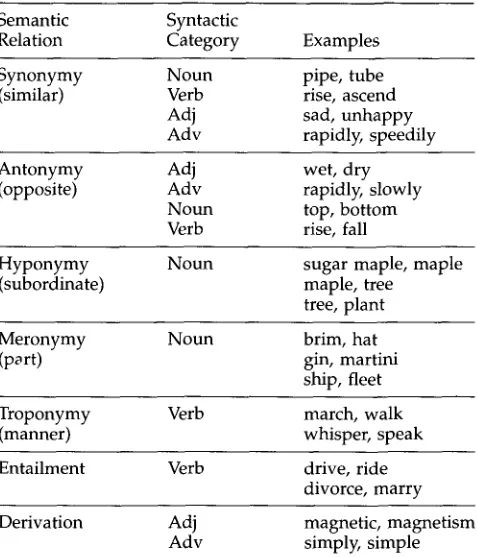
The W o r d N e t on-line lexical database (Miller 1990, 1995) has b e e n d e v e l o p e d at Prince- ton University over the past 10 years. 4 Like a s t a n d a r d dictionary, W o r d N e t contains the definitions of words. It differs from a s t a n d a r d dictionary in that, instead of be- ing o r g a n i z e d alphabetically, W o r d N e t is o r g a n i z e d conceptually. The basic unit in W o r d N e t is a s y n o n y m set, or synset, w h i c h represents a lexicalized concept. For ex- ample, W o r d N e t Version 1.5 distinguishes b e t w e e n two senses of the n o u n shot w i t h the synsets {shot, snapshot} a n d {shot, injection}. In the context, "The p h o t o g r a p h e r took a shot of Mary," the w o r d snapshot can be substituted for one sense of shot. In the context, "The n u r s e gave M a r y a flu shot," the w o r d injection can be substituted for a n o t h e r sense of shot.
N o u n s , verbs, adjectives, a n d a d v e r b s are each o r g a n i z e d differently in WordNet.
All are o r g a n i z e d in synsets, b u t the semantic relations a m o n g the synsets differ de- p e n d i n g o n the grammatical category, as can be seen in Table 3.
N o u n s are o r g a n i z e d in a hierarchical tree structure b a s e d on h y p e r n y m y / h y p o - nymy. The h y p o n y m of a n o u n is its subordinate, a n d the relation b e t w e e n a h y p o n y m and its h y p e r n y m is an is a kind off relation. For example, maple is a h y p o n y m of tree,
w h i c h is to say that a maple is a kind of tree. H y p e r n y m y (supername) a n d its inverse, h y p o n y m y (subname), are transitive semantic relations b e t w e e n synsets. M e r o n y m y (part-name), a n d its inverse h o l o n y m y (whole-name), are c o m p l e x semantic relations that distinguish c o m p o n e n t parts, substantive parts, a n d m e m b e r parts.
The verbal hierarchy is b a s e d on t r o p o n y m y , the is a manner of relation. For exam- ple, stroll is a t r o p o n y m of walk, w h i c h is to say that strolling is a m a n n e r of walking. Entailment relations b e t w e e n verbs are also c o d e d in WordNet.
The organization of attributive adjectives is b a s e d on the a n t o n y m y relation. W h e r e direct a n t o n y m s exist, adjective synsets p o i n t to a n t o n y m synsets. A h e a d adjective is one that has a direct a n t o n y m (e.g., hot versus cold or long v e r s u s short). M a n y adjec- tives, like sultry, h a v e n o direct a n t o n y m s . W h e n an adjective has no direct a n t o n y m , its synset points to a h e a d that is semantically similar to it. Thus sultry a n d torrid are similar in m e a n i n g to hot, w h i c h has the direct a n t o n y m of cold. So, a l t h o u g h sultry
has n o direct a n t o n y m , it has cold as its indirect a n t o n y m .
Relational adjectives do not h a v e a n t o n y m s ; instead they p o i n t to nouns. C o n s i d e r the difference b e t w e e n a nervous disorder a n d a nervous student. In the former, nervous
pertains to a n o u n , as in nervous system, w h e r e a s the latter is defined b y its relation to other adjectives--its s y n o n y m s (e.g., edgy) a n d a n t o n y m s (e.g., relaxed).
A d v e r b s h a v e s y n o n y m y a n d a n t o n y m y relations. W h e n the a d v e r b is m o r p h o - logically related to an adjective ( w h e n an -ly suffix is a d d e d to an adjective) a n d semantically related to the adjective as well, the a d v e r b points to the adjective.
We h a v e h a d some success in exploiting W o r d N e t ' s semantic relations for w o r d sense identification. Since the m a i n p r o b l e m w i t h classifiers that use local context is
Leacock, Chodorow, and Miller Corpus Statistics and WordNet Relations
Table 3
Semantic relations in WordNet.
Semantic Syntactic
Relation Category Examples
Synonymy Noun pipe, tube
(similar) Verb rise, ascend
Adj sad, unhappy
Adv rapidly, speedily
Antonymy Adj wet, dry
(opposite) Adv rapidly, slowly
Noun top, bottom
Verb rise, fall
Hyponymy Noun sugar maple, maple
(subordinate) maple, tree
tree, plant
Meronymy Noun brim, hat
(port) gin, martini
ship, fleet
Troponymy Verb march, walk
(manner) whisper, speak
Entailment Verb drive, ride
divorce, marry
Derivation Adj magnetic, magnetism
Adv simply, simple
the sparseness of the training data, Leacock and C h o d o r o w (1998) used a proximity measure on the h y p e r n y m relation to replace the subject a n d complement of the verb
serve in the testing examples with the subject a n d complement from training examples that were "closest" to them in the n o u n hierarchy. For example, one of the test sen- tences was "Sauerbraten is usually served with dumplings," where neither sauerbraten
nor dumpling appeared in a n y training sentence. The similarity measures on WordNet f o u n d that sauerbraten was most similar to dinner in the training, a n d dumpling to bacon.
These n o u n s were substituted for the novel ones in the test sets. Thus the sentence
"Dinner is usually served with bacon" was substituted for the original sentence. Aug- mentation of the local context classifier with WordNet similarity measures s h o w e d a small but consistent i m p r o v e m e n t in the classifier's performance. The i m p r o v e m e n t was greater with the smaller training sets.
Resnik (1992) uses an information-based measure, the most informative class, on the WordNet taxonomy. A class consists of the s y n o n y m s f o u n d at a n o d e a n d the s y n o n y m s at all the nodes that it dominates (all of its h y p o n y m s ) . Based on verb/object pairs collected from a corpus, Resnik found, for example, that the objects for the verb
open fall into two classes: receptacle and oral communication. Conversely, the class of a verb's object could be used to determine the appropriate sense of that verb.
[image:13.468.34.273.87.366.2]Computational Linguistics Volume 24, Number 1
Table 4
Training materials and their frequencies for five senses of
line.
product formation text cord phone
product line 95 picket line 46 headline 52 rope 28 hot line business line 5 line of punch line 23 ropes 27 phone line
succession 10 opening line 10 clothesline 12 private line bread line 7 tag line 7 fishing line 11 toll line single file 7 line of poetry 4 shoelaces 4
conga line 7 newspaper twine 3
reception line 3 headline 2 dental floss 2 ticket line 3 gag line 2 high wire 2
chow line 2 jump rope 2
rivet line 1 lasso 2
single files 1 lead line 1
trap line 1 mooring line 1
48 48 2 2
onyms, i m m e d i a t e h y p o n y m s (i.e., daughters), a n d i m m e d i a t e h y p e r n y m s (parents), w e f o u n d that a b o u t 64% (15,400) h a v e m o n o s e m o u s relatives attested in the cor- pus. With larger c o r p o r a (e.g., w i t h text obtained b y Web crawling) a n d m o r e lexical relations (e.g., m e r o n y m y ) , this p e r c e n t a g e can be e x p e c t e d to increase.
3.2 Training o n W o r d N e t ' s M o n o s e m o u s R e l a t i v e s
The a p p r o a c h w e h a v e u s e d is related to that of Yarowsky (1992) in that training ma- terials are collected using a k n o w l e d g e base, b u t it differs in other respects, n o t a b l y in the selection of training and testing materials, the choice of a k n o w l e d g e base, a n d use of b o t h topical a n d local classifiers. Yarowsky collects his training a n d testing ma- terials from a specialized corpus,
Grolier's Encyclopedia.
It remains to be seen w h e t h e r a statistical classifier trained on a topically o r g a n i z e d c o r p u s such as an e n c y c l o p e d i a will p e r f o r m in the same w a y w h e n tested on general unrestricted text, such as news- papers, periodicals, a n d books. One of o u r goals is to d e t e r m i n e w h e t h e r automatic extraction of training examples is feasible using general corpora. In his e x p e r i m e n t , Yarowsky uses an u p d a t e d on-line version ofRogeFs Thesaurus
that is not generally available to the research community. The only generally available version ofRoget's
is the 1912 edition, w h i c h contains m a n y lexical gaps. We are using WordNet, w h i c h can be obtained via a n o n y m o u s ftp. Yarowsky's classifier is p u r e l y topical, b u t w e also examine local context. Finally, w e h o p e to a v o i d inclusion of s p u r i o u s senses b y using m o n o s e m o u s relatives. [image:14.468.52.443.87.238.2]Leacock, Chodorow, and Miller Corpus Statistics and WordNet Relations
Table 5
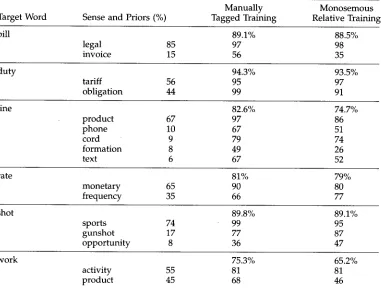
TLC's performance when training on (1) manually tagged data and (2) monosemous relatives of polysemous words.
Manually Monosemous
Target Word Sense and Priors (%) Tagged Training Relative Training
bill 89.1% 88.5%
legal 85 97 98
invoice 15 56 35
duty 94.3% 93.5%
tariff 56 95 97
obligation 44 99 91
line 82.6% 74.7%
product 67 97 86
phone 10 67 51
cord 9 79 74
formation 8 49 26
text 6 67 52
rate 81% 79%
monetary 65 90 80
frequency 35 66 77
shot 89.8% 89.1%
sports 74 99 95
gunshot 17 77 87
opportunity 8 36 47
work 75.3% 65.2%
activity 55 81 81
product 45 68 46
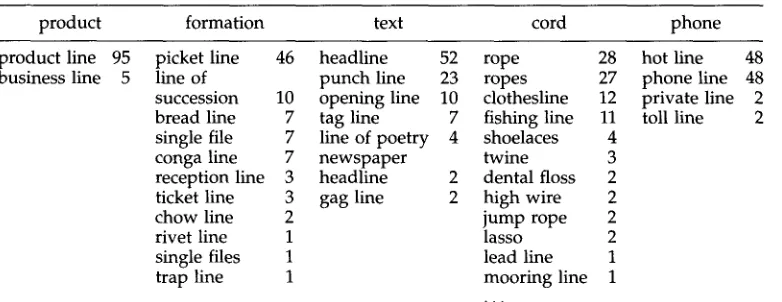
the r e m a i n d e r of the t a r g e t ' s m o n o s e m o u s relatives are inspected in the order: all other daughters; h y p o n y m collocations that contain the target; all other h y p o n y m s ; h y p e r - n y m s ; and, finally, sisters. AutoTrain takes as b r o a d a s a m p l i n g as possible across the c o r p u s a n d n e v e r takes m o r e t h a n o n e e x a m p l e f r o m an article. The n u m b e r of ex- a m p l e s for each relative is b a s e d on the relative p r o p o r t i o n of its occurrences in the corpus. Table 4 s h o w s the m o n o s e m o u s relatives that w e r e u s e d to train five senses of the n o u n l i n e - - t h e m o n o s e m o u s relatives of the sixth sense in the original study, line as an abstract division, are n o t attested in the SJM corpus.
The p u r p o s e of the e x p e r i m e n t w a s to see h o w well TLC p e r f o r m e d u s i n g u n - s u p e r v i s e d training and, w h e n possible, to c o m p a r e this w i t h its p e r f o r m a n c e w h e n training on the m a n u a l l y t a g g e d m a t e r i a l s b e i n g p r o d u c e d at P r i n c e t o n ' s C o g n i t i v e Sci- ence Laboratory. s W h e n a sufficient n u m b e r of e x a m p l e s for t w o or m o r e senses w e r e available, 100 e x a m p l e s of each sense w e r e set aside to use in training. The r e m a i n d e r w e r e u s e d for testing. O n l y the topical a n d local open-class cues w e r e used, since pre- l i m i n a r y tests s h o w e d that p e r f o r m a n c e declined w h e n u s i n g local closed-class a n d p a r t - o f - s p e e c h cues o b t a i n e d f r o m the m o n o s e m o u s relatives. This is not surprising, as m a n y of the relatives are collocations w h o s e local syntax is quite different f r o m that
[image:15.468.41.422.101.390.2]Computational Linguistics Volume 24, Number 1
Table 6
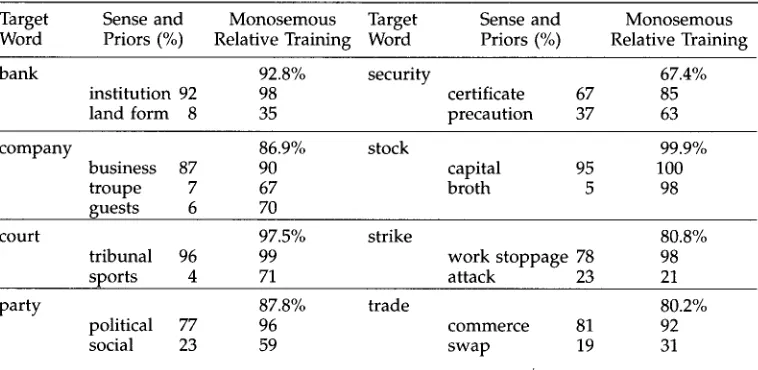
TLC's performance when training on monosemous relatives of polysemous words. (Manually tagged data were used for scoring but there were not enough examples to train on.)
Target Sense and Monosemous Target Sense and Monosemous
Word Priors (%) Relative Training Word Priors (%) Relative Training
bank 92.8% security 67.4%
institution 92 98 certificate 67 85
land form 8 35 precaution 37 63
company 86.9% stock 99.9%
business 87 90 capital 95 100
troupe 7 67 broth 5 98
guests 6 70
court 97.5% strike 80.8%
tribunal 96 99 work stoppage 78 98
sports 4 71 attack 23 21
party 87.8% trade 80.2%
political 77 96 commerce 81 92
social 23 59 swap 19 31
of the p o l y s e m o u s w o r d in its typical usage. For example, the ' f o r m a t i o n ' sense of line
is often followed b y an 0f-phrase as in a line of children, b u t its relative, picket line, is not. Prior probabilities for the sense w e r e taken from the m a n u a l l y t a g g e d materials.
Table 5 shows the results w h e n TLC was trained on m o n o s e m o u s relatives a n d on m a n u a l l y t a g g e d training materials. Baseline p e r f o r m a n c e is w h e n the classifier always chooses the m o s t frequent sense. Eight additional w o r d s h a d a sufficient n u m b e r of m a n u a l l y tagged examples for testing b u t not for training TLC. These are s h o w n in Table 6.
For four of the examples in Table 5, training w i t h relatives p r o d u c e d results within 1% or 2% of m a n u a l l y tagged training. Line a n d work, h o w e v e r , s h o w e d a substantial decrease in p e r f o r m a n c e . In the case of line, this m i g h t be d u e to o v e r l y specific training contexts. Almost half of the training examples for the ' f o r m a t i o n ' sense of line c o m e from one relative, picket line. In fact, all of the m o n o s e m o u s relatives, except for rivet line a n d trap line, are h u m a n formations. This m a y h a v e s k e w e d training so that the classifier p e r f o r m s p o o r l y on other uses of line as formation.
In o r d e r to c o m p a r e o u r results with those r e p o r t e d in Yarowsky (1992), w e trained and tested on the same t w o senses of the n o u n duty that Yarowsky h a d tested ('obliga- tion' a n d 'tax'). H e r e p o r t e d that his t h e s a u r u s - b a s e d a p p r o a c h y i e l d e d 96% precision with 100% recall. TLC used training examples b a s e d o n m o n o s e m o u s W o r d N e t rela- tives a n d correctly identified the senses with 93.5% precision at 100% recall.
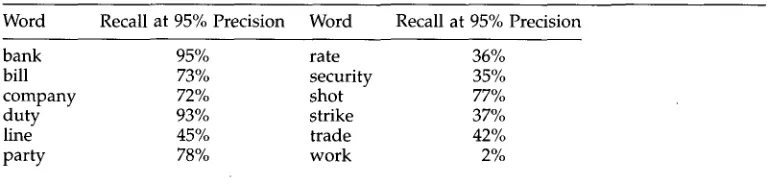
Table 6 shows TLC's p e r f o r m a n c e on the other eight w o r d s after training with m o n o s e m o u s relatives a n d testing on m a n u a l l y tagged examples. P e r f o r m a n c e is a b o u t the same as, or only slightly better than, the highest prior probability. In part, this is d u e to the rather high probability of the m o s t f r e q u e n t sense for this set.
[image:16.468.47.426.101.286.2]Leacock, Chodorow, and Miller Corpus Statistics and WordNet Relations
Table 7
Percentage of recall when the precision is 95%.
Word Recall at 95% Precision Word Recall at 95% Precision
bank 95% rate 36%
bill 73% security 35%
company 72% shot 77%
duty 93% strike 37%
line 45% trade 42%
party 78% work 2%
high precision. This is a particularly g o o d w a y to find clear cases of the m o s t frequent sense.
The results also s h o w that not all w o r d s are well suited to this kind of operation. Little can be gained for a w o r d like work, w h e r e the two senses, 'activity' a n d ' p r o d u c t , ' are closely related and therefore difficult for the classifier to distinguish, d u e to a high degree of overlap in the training contexts. Problems of this sort can be detected e v e n before testing, b y c o m p u t i n g correlations b e t w e e n the vectors of open-class w o r d s for the different senses. The cosine correlation b e t w e e n the 'activity' and ' p r o d u c t ' senses of work is r = .49, indicating a high degree of overlap. The m e a n correlation b e t w e e n pairs of senses for the other w o r d s in Table 7 is r = .31.
4. C o n c l u s i o n
O u r evidence indicates that local context is superior to topical context as an indicator of w o r d sense w h e n using a statistical classifier. The benefits of a d d i n g topical to local context alone d e p e n d on syntactic category as well as on the characteristics of the individual word. The three w o r d s studied yielded three different patterns; a substantial benefit for the n o u n line, slightly less for the verb serve, and n o n e for the adjective
hard. Some w o r d senses are simply not limited to specific topics, a n d a p p e a r freely in m a n y different d o m a i n s of discourse. The existence of nontopical senses also limits the applicability of the " o n e sense per discourse" generalization of Gale, Church, a n d Yarowsky (1992b), w h o o b s e r v e d that, within a d o c u m e n t , a r e p e a t e d w o r d is almost always used in the same sense. Future w o r k should be directed t o w a r d d e v e l o p i n g m e t h o d s for d e t e r m i n i n g w h e n a w o r d has a nontopical sense. One a p p r o a c h to this p r o b l e m is to look for a w o r d that appears in m a n y m o r e topical d o m a i n s than its total n u m b e r of senses.
Because the s u p p l y of m a n u a l l y tagged training data will always be limited, we p r o p o s e a m e t h o d to obtain training data automatically using c o m m o n l y available materials: exploiting W o r d N e t ' s lexical relations to harvest training examples from LDC c o r p o r a or e v e n the World Wide Web. We f o u n d this m e t h o d to be effective, a l t h o u g h not as effective as using m a n u a l l y tagged training. We h a v e p r e s e n t e d the c o m p o n e n t s of a system for acquiring u n s u p e r v i s e d training materials that can be used with a n y statistical classifier.
[image:17.468.36.422.88.182.2]Computational Linguistics Volume 24, Number 1
a n d ' p r o d u c t ' senses of work. In s o m e cases, the contexts for the t w o closely related senses m a y be c o m b i n e d .
Since the frequencies of the m o n o s e m o u s relatives do n o t correlate w i t h the fre- quencies of the senses, p r i o r probabilities m u s t b e e s t i m a t e d for classifiers that use them. In the e x p e r i m e n t s of Section 3.2, these w e r e e s t i m a t e d f r o m the testing m a t e - rials. T h e y can also be e s t i m a t e d f r o m a small m a n u a l l y t a g g e d s a m p l e , s u c h as the p a r t s of the B r o w n c o r p u s that h a v e b e e n t a g g e d w i t h senses in W o r d N e t .
W h e n the t h r e s h o l d is set to m a x i m i z e precision, the results are highly reliable a n d can be u s e d to s u p p o r t an interactive application, such as m a c h i n e - a s s i s t e d translation, w i t h the goal of r e d u c i n g the a m o u n t of interaction.
A l t h o u g h w e h a v e l o o k e d at o n l y a f e w e x a m p l e s , it is clear that, g i v e n W o r d N e t a n d a large e n o u g h corpus, the m e t h o d s o u t l i n e d for training on m o n o s e m o u s relatives can be g e n e r a l i z e d to b u i l d training m a t e r i a l s for t h o u s a n d s of p o l y s e m o u s w o r d s .
Acknowledgments
We are indebted to the other members of the WordNet group who have provided advice and technical support: Christiane Fellbaum, Shari Landes, and Randee Tengi. We are also grateful to Paul Bagyenda, Ben Johnson-Laird and Joshua Schecter. We thank Scott Wayland, Tim Allison and Jill Hollifield for tagging the serve and hard
corpora. Finally we are grateful to the three anonymous CL reviewers for their
comments and advice.
This material is based upon work supported in part by the National Science Foundation under NSF Award No. IRI95- 28983 and by the Defense Advanced Research Projects Agency, Grant No. N00014-91-1634.
References
Brill, Eric. 1994. Some advances in rule-based part of speech tagging. In
Proceedings of the Twelfth National Conference on Artificial Intelligence, Seattle. AAAI. Bruce, Rebecca and Janyce Wiebe. 1994a. A
new approach to word sense
disambiguation. In Proceedings of the ARPA Workshop on Human Language Technology,
San Francisco, CA, Morgan Kaufman. Bruce, Rebecca and Janyce Wiebe. 1994b.
Word-sense disambiguation using
decomposable models. In Proceedings of the 32nd Annual Meeting, Las Cruces, NM. Association for Computational Linguistics.
Chiang, T-H., Y-C. Lin, and K-Y Su. 1995. Robust learning, smoothing, and parameter tying on syntactic ambiguity resolution. Computational Linguistics,
21 (3):321-349.
Dagan, Ido and Alon Itai. 1994. Word sense disambiguation using a second language monolingual corpus. Computational
Linguistics, 20(4).
Gale, William, Kenneth W. Church, and David Yarowsky. 1992a. A method for disambiguating word senses in a large corpus. Computers and the Humanities, 26. Gale, William, Kenneth W. Church, and
David Yarowsky. 1992b. One sense per discourse. In Proceedings of the Speech and Natural Language Workshop, San Francisco, CA, Morgan Kaufmann.
Golding, Andrew. 1995. A Bayesian hybrid method for context-sensitive spelling correction. In Proceedings of the Third Workshop on Very Large Corpora,
Cambridge, MA. ACL.
Good, I. E 1953. The population frequencies of species and the estimation of
population parameters. Biometrica,
40:237-264.
Hearst, Marti A. 1991. Noun homograph disambiguation using local context in large text corpora. In Proceedings of the Seventh Annual Conference of the UW Centre for the New OED and Text Research: Using
Corpora, pages 1-22, Oxford.
Hirst, Graeme. 1987. Semantic Interpretation and the Resolution of Ambiguity. Cambridge University Press, Cambridge, MA. Landes, Shari, Claudia Leacock, and Randee
Tengi. 1998. Building semantic concordances. In Christiane Fellbaum, editor, WordNet: A Lexical Reference System and its Application. MIT Press, Cambridge, MA.
Leacock, Claudia and Martin Chodorow. 1998. Combining local context with WordNet similarity for word sense identification. In Christiane Fellbaum, editor, WordNet: A Lexical Reference System and its Application. MIT Press, Cambridge, MA.
Leacock, Chodorow, and Miller Corpus Statistics and WordNet Relations
of the ARPA Workshop on Human Language Technology, San Francisco, CA, Morgan Kaufman.
Leacock, Claudia, Geoffrey Towell, and Ellen M. Voorhees. 1996. Towards building contextual representations of word senses using statistical models. In Branimir Boguraev and James
Pustejovsky, editors, Corpus Processing for Lexical Acquisition. MIT Press, Cambridge, MA.
Miller, George A., editor, 1990. WordNet: An On-Line Lexical Database. Volume 3(4) of the International Journal of Lexicography.
Oxford University Press.
Miller, George A. 1995. WordNet: An on-line lexical database. Communications of the ACM, 38(11).
Resnik, Philip. 1992. WordNet and distributional analysis: A class-based approach to lexical discovery. In Workshop on Statistically-Based
Natural-Language-Processing Techniques, San Jose, July.
Schfitze, Hinrich. 1995. Ambiguity and Language Learning: Computational and Cognitive Models. Ph.D. thesis, Stanford University.
V~ronis, Jean and Nancy Ide. 1990. Word sense disambiguation with very large neural networks extracted from machine
readable dictionaries. In Proceedings of COLING-90.
Weiss, Stephen. 1973. Learning to disambiguate. Information Storage and Retrieval, 9.
Wilks, Yorick, Dan Fass, Cheng Ming Guo, James E. McDonald, Tony Plate, and Brian M. Slator. 1993. Machine tractable dictionary tools. In James Pustejovsky, editor, Semantics and the Lexicon. Kluwer, Dordrecht.
Yarowsky, David. 1992. Word-sense
disambiguation using statistical models of Roget's categories trained on large corpora. In Proceedings of COLING-92,
Nantes, France.
Yarowsky, David. 1993. One sense per collocation. In Proceedings of the ARPA Workshop on Human Language Technology,
San Francisco, CA, Morgan Kaufman. Yarowsky, David. 1994. Decision lists for
lexical ambiguity resolution: Application to accent restoration in Spanish and French. In Proceedings of the 32nd Annual Meeting. Las Cruces, NM. Association for Computational Linguistics.