Cem Bozsahin
∗Middle East Technical University
Grammars that expect words from the lexicon may be at odds with the transparent projection of syntactic and semantic scope relations of smaller units. We propose a morphosyntactic framework based on Combinatory Categorial Grammar that provides flexible constituency, flexible category consistency, and lexical projection of morphosyntactic properties and attachment to grammar in order to establish a morphemic grammar-lexicon. These mechanisms provide enough expressive power in the lexicon to formulate semantically transparent specifications without the necessity to confine structure forming to words and phrases. For instance, bound morphemes as lexical items can have phrasal scope or word scope, independent of their attachment characteristics but consistent with their semantics. The controls can be attuned in the lexicon to language-particular properties. The result is a transparent interface of inflectional morphology, syntax, and semantics. We present a computational system and show the application of the framework to English and Turkish.
1. Introduction
The study presented in this article is concerned with the integrated representation and processing of inflectional morphology, syntax, and semantics in a unified grammar ar-chitecture. An important issue in such integration is mismatches in morphological, syntactic, and semantic bracketings. The problem was first noted in derivational mor-phology. Williams (1981) provided examples from English; the semantic bracketings in (1a–2a) are in conflict with the morphological bracketings in (1b–2b).
(1) a.
hydro electric
-ity b. hydro
electric -ity
(2) a.
G¨odel number
-ing b. G¨odel
number -ing
If the problem were confined to derivational morphology, we could avoid it by making derivational morphology part of the lexicon that does not interact with gram-mar. But this is not the case. Mismatches in morphosyntactic and semantic bracketing
also abound. This article addresses such problems and their resolution in a computa-tional system.1
M ¨uller (1999, page 401) exemplifies the scope problem in German prefixes. (3a) is in conflict with the bracketing required for the semantics of the conjunct (3b).
(3) a. Wenn[Ihr Lust] und [noch nichts anderes vor-]habt,
if you pleasure and yet nothing else intend
k¨onnen wir sie ja vom Flughafen abholen
can we them PARTICLE from.the airport pick up
’If you feel like it and have nothing else planned, we can pick them up at the airport.’
b. Ihr Lust habt UND noch nichts anderes vorhabt
Similar problems can be observed in Turkish inflectional suffixes. In the coordi-nation of tensed clauses, the tense attaches to the verb of the rightmost conjunct (4a) but applies to all conjuncts (4b). Delayed affixation appears to apply to all nominal inflections (4c–e).
(4) a. Zorunlu deprem sigortası [y ¨ur ¨url ¨u ˘ge girmi¸s] ama
mandatory earthquake insurance effect enter-ASP but
[tam anlamıyla uygulanamamı¸s]-tı
exactly apply-NEG-ASP-TENSE
’Mandatory earthquake insurance had gone into effect, but it had not been enforced properly.’
b. y ¨ur ¨url ¨u ˘ge girmi¸s-ti ama tam anlamıyla uygulanamamı¸s-tı
c. Adam-ın [araba ve ev]-i
man-GEN car and house-POSS
’the man’s house and car’
d. Araba-yı [adam ve ¸cocuk]-lar-a g¨oster-di-m
Car-ACC man and child-PLU-DAT show-TENSE-PERS1 ’(I) showed the car to the men and the children.’
e. Araba-yı sen-in [dost ve tanıdık]-lar-ın-a g¨oster-di-m Car-ACC you-GEN friend and acq.-PLU-POSS-DAT showed ’(I) showed the car to the your friends and acquaintances.’
1 Our use of the termmorphosyntaxneeds some clarification. Some authors, (e.g., Jackendoff 1997), take it to mean the syntax of words, in contrast to the syntax of phrases. By morphosyntax we mean those aspects of morphology and syntax that collectively contribute to grammatical meaning composition. This is more in line with the inflectional-morphology-is-syntax view. In this respect, we will not address problems related to derivational morphology; its semantics is notoriously
Phrasal scope of inflection can be seen in subordination and relativization as well. In (5a), the entire nominalized clause marked with the accusative case is the object of want. In (5b), the relative participle applies to the relative clause, which lacks an object. The object’s case is governed by the subordinate verb, whose case requirements might differ from that of the matrix verb (5c). As we show later in this section, the coindexing mechanisms in word-based unification accounts of unbounded extraction face a conflict between the local and the nonlocal behavior of the relativized noun, mainly due to applying the relative participle-di˘g-ito the verbal stem verrather than the entire relative clause. A lexical entry for -di˘g-i would resolve the conflict and capture the fact that it applies to nonsubjects uniformly.
(5) a. Can [Ay¸se’nin kitab-ı oku-ma-sı]-nı iste-di
C.NOM A.-GEN book-ACC read-INF-AGR-ACC want-TENSE ’Can wanted Ay¸se to read the book.’
lit. ’Can wanted Ay¸se’s-reading-the-book.’
b. Ben [Mehmet’in ¸cocu˘g-a/*-u ver]-di˘g-i kitab-ı oku-du-m
I.NOM M-GEN child-DAT/*ACC give-REL.OP book-ACC read-TENSE-PERS1
’I read the book that Mehmet gave to the child.’
c. Ben [Mehmet’in kitab-ı ver]-di˘g-i ¸cocu˘g-u/*-a g¨or-d ¨u-m
I.NOM M-GEN book-ACC give-REL.OP child-ACC/*DAT see-TENSE-PERS1
’I saw the child to whom Mehmet gave the book.’
The morphological/phrasal scope conflict of affixes is not particular to morpho-logically rich languages. Semantic composition of affixes in morphomorpho-logically simpler
languages poses problems with word (narrow) scope of inflections. For instance, fake
trucks needs the semantics (plu(fake truck)), which corresponds to the surface brack-eting [fake truck]-s, because it denotes the nonempty nonsingleton sets of things that are not trucks but fake trucks (Carpenter 1997).Four trucks, on the other hand, has the semantics(four(plu truck)), which corresponds tofour[truck]-s, because it denotes the subset of nonempty nonsingleton sets of trucks with four members.
The status of inflectional morphology among theories of grammar is far from settled, but, starting with Chomsky (1970), there seems to be an agreement that deriva-tional morphology is internal to the lexicon. Lexical Funcderiva-tional Grammar (LFG) (Bresnan 1995) and earlier Government and Binding (GB) proposals e.g. (Anderson 1982) consider inflectional morphology to be part of syntax, but it has been del-egated to the lexicon in Head-Driven Phase Structure Grammar (HPSG) (Pollard and Sag 1994, page 35) and in the Minimalist Program (Chomsky 1995, page 195). The representational status of the morpheme is even less clear. Parallel develop-ments in computational studies of HPSG propose lexical rules to model inflectional morphology (Carpenter and Penn 1994). Computational models of LFG (Tomita 1988) and GB (Johnson 1988; Fong 1991), on the other hand, have been noncommittal re-garding inflectional morphology. Finally, morphosyntactic aspects have always been a concern in Categorial Grammar (CG) (e.g., Bach 1983; Carpenter 1992; Dowty 1979; Heylen 1997; Hoeksema 1985; Karttunen 1989; Moortgat 1988b; Whitelock 1988), but the issues of constraining the morphosyntactic derivations and re-solving the apparent mismatches have been relatively untouched in computational studies.
the issues raised so far. For convenience, we call a grammar that expects words from
the lexicon alexemicgrammar and a grammar that expects morphemes amorphemic
grammar. A lexemic PSG provides a lexical interface for inflected words (X0s) such
that a regular grammar subcomponent handles lexical insertion at X0.2 In (4d), the
right conjunct ¸cocuk-lar-a is analyzed as N0 → ¸cocuk-PLU-DAT (or N0 → N0 -DAT,
N0 →N0 -PLU, N0 →Stem, as a regular grammar). Assuming a syncategorematic
coordination schema, that is, X → X and X, the N0 in the left and right conjuncts
of this example would not be of the same type. Revising the coordination schema such that only the root features coordinate would not be a solution either. In (4e), the relation of possession that is marked on the right conjunct must be carried over
to the left conjunct as well. What is required for these examples is that the
syntac-tic constituent X in the schema be analyzed as X-PLU(-POSS)-DAT, after N0and N0
coordination.
What we need then is not a lexemic but a morphemic organization in which brack-eting of free and bound morphemes is regulated in syntax. The lexicon, of course, must now supply the ingredients of a morphosyntactic calculus. This leads to a the-ory in which semantic composition parallels morphosyntactic combination by virtue
of bound morphemes’ being able to pick their domains just like words (above X0,
if needed). A comparison of English and Turkish in this regard is noteworthy. The
English relative pronouns that/whom and the Turkish relative participle -di˘g-i would
have exactly the same semantics when the latter is granted a representational status in the lexicon (see Section 6).
Furthermore, rule-based PSGs project a rigid notion of surface constituency. Steed-man (2000) argued, however, that syntactic processes such as identical element dele-tion under coordinadele-tion call for flexible constituency, such as SO (subject-object) in the SVO & SO gapping pattern of English and SV (subject-verb) constituency in the OSV & SV pattern of Turkish. Nontraditional constituents are also needed in specifying semantically transparent constituency of words, affixes, clitics, and phrases.
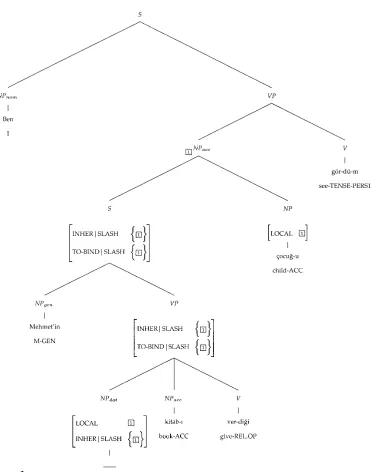
Constraint-based PSGs such as HPSG appeal to coindexation and feature passing via unification, rather than movement, to deal with such processes. HPSG also makes the commitment that inflectional morphology is internal to the lexicon, handled either by lexical rules (Pollard and Sag 1994) or by lexical inheritance (Miller and Sag 1997). We look at (5c) to highlight a problem with the stem-and-inflections view. As words en-ter syntax fully inflected, the sign of the verbver-di˘g-iin the relative clause (5c) would be as in (6a), in which the SUBCAT list of the verb stem is, as specified in the lexi-cal entry forver, unsaturated. The participle adds coindexation in MOD| · · · |INDEX. The HPSG analysis of this example would be as in Figure 1. Although passing the agreement features of the head separately (Sehitoglu 1996) solves the case problem
alluded to in (5c), however, structure sharing of the NPdat with the SLASH, INDEX,
and CONTENT features ofver-di˘g-iis needed for semantics (GIVEE), but this conflicts with the head features of the topmost NPacc in the tree. The relative participle as a
lexical entry (e.g., (6b)) would resolve the problem with subcategorization because its SUBCAT list is empty (like the relative pronounthatin English), hence there would be no indirect dependence of the nonlocal SLASH feature and the local SUBCAT feature via semantics (CONTENT). Such morphemic alternatives are not considered in HPSG, however, and require a significant revision in the theory. Furthermore, HPSG’s lexical
assignment for trace introduces phonologically null elements into the lexicon, which, as we show later, is not necessary.
(6) a. ver-di ˘g-i :=
LOCAL CAT HEAD AGR PERSON third NUMBER sing CASE dat
SUBCAT <3 NP[gen],2 NP[acc],1 NP[dat]>
MOD|MODSYN|LOCAL|CONT|INDEX 1
CONTENT RELN give GIVER 3 GIVEE 1 GIFT 2
NONLOCAL|TO-BIND|SLASH 1
b. -di ˘g-i :=
LOCAL CAT
HEAD nounacc or dat
SUBCAT <>
CONTENT nproINDEX 1
NONLOCAL|INHER|SLASH 1
MCGs (Hepple 1990a; Morrill 1994; Moortgat and Oehrle 1994) allow different modes of combination in the grammar. In addition to binary modes such as wrapping and commutative operations, unary modalities provide finer control over the cate-gories. Heylen (1997, 1999) uses unary modalities as a way of regulating morphosyn-tactic features such as case, number, and person for economy in lexical assignments. For instance,Frauhas the category✷case✷fem✷sg✷3p✷declN, which underspecifies it for
case and declension. Underspecification is dealt with in the grammar using inclusion postulates (e.g., (7)). The interaction of different modalities is regulated by distribution postulates.
(7) ✷caseΓX
✷nomΓX
✷caseΓX
✷accΓX
Lexical assignments to inflected words carry unary modalities:boys has the type
✷plN, in contrast to ✷sgN for boy. Although such regulation of inflectional features
successfully mediates, for example, subject-verb agreement or NP-internal case agree-ment (as in German), it is essentially word-based, because type assignagree-ments are to inflected forms; morphemes do not carry types. This reliance on word types neces-sitates a lexical rule–based approach to some morphosyntactic processes that create indefinitely long words, such aski-relativization in Turkish (see Section 6.5). But lexical rules for such processes risk nontermination (Sehitoglu and Bozsahin 1999). Our main point of departure from MCG accounts is the morphemic versus lexemic nature of the lexicon: The morphosyntactic and attachment modalities originate from the lexicon; they are not properties of the grammar (we elaborate more on this later). This paves the way to the morphemic lexicon by licensing type assignments to units smaller than words.
Mul-Figure 1
HPSG analysis of (5c).
[image:6.612.114.486.79.551.2]2. Syntactic Types
CG is a theory of grammar in which the form-meaning relation is conceived as a transparent correspondence between the surface-syntactic and semantic combinatorics (Jacobson 1996). A CCG sign can be represented as a triplet π−σ:µ, where π is the
prosodic element, σ is its syntactic type, and µ its semantic type. For instance, the
lexical assignment for readis (8).3
(8) read :=read−(S\NP)/NP:λx.λy.readxy
Definition (Syntactic Types)
• The set of basic syntactic categories:As={N,NP,S,S−t,S+t}
• The set of complex syntactic categories:Bs
— As⊆ Bs
— IfX∈ Bs andY∈ Bs, thenX\YandX/Y∈ Bs
The classical Ajdukiewicz/Bar-Hillel (AB) CG is weakly equivalent to Context-Free Grammars (Bar-Hillel, Gaifman, and Shamir 1960). It has function application rules, defined originally in a nondirectional fashion. The directional variants and their associated semantics are as follows:
(9) Forward Application (>):4 X/Y:f Y:a ⇒ X:fa
Backward Application (<): Y:a X\Y:f ⇒ X:fa
CCG (Steedman 1985, 1987, 1988; Szabolcsi 1983, 1987) is an extended version of AB that includes function composition (10), substitution, and type raising (11). These extensions make CCGs mildly context sensitive.
(10) Forward Composition (>B): X/Y:f Y/Z:g ⇒ X/Z:λx.f(gx)
Backward Composition (<B): Y\Z:g X\Y:f ⇒ X\Z:λx.f(gx)
(11) Forward Type Raising (>T):5 X:a ⇒ T/(T\X):λf.f[a] Backward Type Raising (<T): X:a ⇒ T\(T/X):λf.f[a]
Type raising is an order-preserving operation. For instance, Lambek’s (1958)
cat-egory S/(S\NP) is a positional encoding of the grammatical subject as a function
3 We takeπto be the surface string for simplicity. We use the “result-first” convention for CG. For instance, transitive verbs of English are written as(S\NP)/NP, which translates to(NP\S)/NPin the “result-on-top” convention.
4 We omit the prosodic element for ease of exposition. For instance, the complete definition of forward application iss1−X/Y:f s2−Y:a ⇒ s1•s2−X:fa, where•is prosodic combination andfais the application off toa. The•will play a crucial role in the lexicalization of attachment later on. 5 The lambda termf[a]denotes internal one-stepβ-reduction offona. In parsing, we achieve the same
looking for a VP (=S\NP) to the right to becomeS. The reversal of directionality such as topicalization (e.g., This book, I recommend) requires another schema. The reversal
is with respect to the position of the verb, which we shall call contraposition and
formulate as in (12).6 (<XP) is leftward extraction of a right constituent, and (>XP) is rightward extraction of a left constituent, both of which are marked constructions. Directionally insensitive types such as T|(T|X)cause the collapse of directionality in surface grammar (Moortgat 1988a).
(12) Leftward Contraposition (<XP): X:a ⇒ S+t/(S/X):λf.f[a]
S+t/(S+t/X):λf.f[a]
Rightward Contraposition (>XP): X:a ⇒ S−t\(S\X):λf.f[a]
S−t\(S−t\X):λf.f[a]
The semantics of contraposition depends on discourse properties as well. We leave this issue aside by (1) noting that it is related to type raising in changing the function-argument relation and (2) categorizing the sentence asS+t(topicalized) orS−t
(detopi-calized), which are not discourse equivalent to S. Syntactic characterization as such
also helps a discourse component do its work on syntactic derivations.
CCG’s notion of interpretation is represented in the Predicate-Argument Structure (PAS). Its organization is crucial for our purposes, since the bracketing in the PAS is the arbitrator for reconciling the bracketings in morphology and syntax via proper lexical type assignments. It is the sole level of representation in CCG (Steedman 1996, page 89).7 It is the level at which the conditions on objects of interpretation, such as binding and control, are formulated. For instance, Steedman (1996) defines c-command and binding conditions A, B, and C over the PAS. The PAS also reflects the obliqueness order of the arguments:
Predicate . . . Tertiary-Term Secondary-Term Primary-Term
Assuming left associativity for juxtaposition, this representation yields the brack-eting in (13) for the PAS. Having the primary argument as the outermost term is motivated by the observations on binding asymmetries between subjects and comple-ments in many languages (e.g.,*Himself saw John, *heself).
(13)
3. Morphosyntactic Types
A syntactic type such as N does not discriminate morphosyntactically. A finer
dis-tinction can be made as singular nouns, plural nouns, case-marked nouns, etc. For
6 In fact, topicalization of nonperipheral arguments (This book, I would give to Mary) requires that (12) be finitely schematized over valencies, such asS,S/NP,S/PP(Steedman 1985).
n-relbase n-root n-num
s-caus
s-reflex (x) s-recip
(r) (n)
n-poss n-comp (m)
n-case (c) free
(a)
s-tense
s-abil
s-neg
s-imp
s-pass (s)
(m)
(t)
(g)
(i)
(p)
s-tense
n-base s-base
(b)
(t)
(v) (b)
(n) s-person
s-modal
n-num (f)
(a)
(c)
s-base (v) (l)
n-base (b)
(o)
(u)
[image:9.612.116.434.80.348.2]free (f)
Figure 2
The lattice of diacritics for (a) Turkish and (b) English.
instance, the set of number-marked nouns can be represented as ✶nN, where ✶ is a
morphosyntactic modality (“equals”) andnis a diacritic (fornumber).Booksis of type
n
✶N, but bookis not. The type for books can be obtained morphosyntactically by as-signing-s(-PLU) the functor type ✶nN\✶bN, wherebstands for base. A syntactic type such as N\Novergenerates.
Another modality,< (“up to and equals”), allows wider domains in
morphosyn-tactic typing. For instance, <n N represents the set of nouns marked on number or
any other diacritic that is lower than number in a partial order (e.g., Figure 2). The inflectional paradigm of a language can be represented as a partial ordering
us-ing the modalities.8 For instance, if the paradigm is Base-Number-Case, we have
υ(<b N) ⊆ υ(<n N) ⊆ υ(<c N), where υ(τ) is the valuation function from the mor-phosyntactic typeτ to the set of strings that have the typeτ. The✶modality is more strict than< to provide finer control; althoughυ(<n N)⊆υ(<c N),υ(✶nN)⊆υ(✶c N), because a noun can be number marked but not case marked or vice versa. Also,
υ(✶i N)⊆υ(<i N)for any diacriticisince, for instance, the set of nouns marked up to and including case includes case-marked, number-marked, and unmarked nouns.
The lattice consistency condition is imposed on the set of diacritics to ensure category unity.9In other words, the syntactic typeXcan be viewed as an abbreviation
for the morphosyntactic type <X where is the universal upper bound. It is the
8 See Heylen (1997) on use of unary modalities for a similar purpose in lexemic MCG.
9 In a latticeL,x≤y(morphosyntactically,x<y) is equivalent to the consistency propertiesx∧y=x
most underspecified category ofXwhich subsumes all morphosyntactically decorated versions of X. Figure 2 shows the lattice for English and Turkish.
Definition (Morphosyntactic Types)
• D=finite set of diacritics • Join semilatticeL= (D,≤,=)
• The set of basic morphosyntactic types:Ams.
— <i X∈ Ams and i
✶X∈ Ams ifi∈ DandX∈ As (see definition of
syntactic types forAs)
— (✶corresponds to lattice condition =)
— (< corresponds to lattice condition≤)
• The set of complex morphosyntactic types:Bms
— Ams⊆ Bms
— IfX∈ Bms andY∈ Bms, thenX\YandX/Y∈ Bms
For instance, the infinitive marker -ma in (14a) can be lexically specified to look for untensed VPs—functions onto <a S—to yield a complex noun base (14b), which, as
a consequence of nominalization (result typeN), receives case to become an argument
of the matrix verb. The adjective in fake trucks can be restricted to modify unmarked
Ns to get the bracketing [fake truck]-s(14c).
(14) a. Mehmet [ [kitab-ı oku]-ma]-yı istiyor
M.NOM book-ACC read-INF-ACC wants ’Mehmet wants to read the book.’
b. -INF := ma−<b N\(<a S\<f NPnom):λf.f
c. fake :=fake−<b N/<b N:λx.fakex
Different attachment characteristics of words, affixes, and clitics must be factored into the prosodic domain as a counterpart of refining the morphosyntactic description. In Montague Grammar, every syntactic rule is associated with a certain mode of at-tachment, and this tradition is followed in MCG; attachment types are related with the slash (e.g.,/wfor wrapping), which is a grammatical modality.10In the present frame-work, however, attachment is projected from the lexicon to the grammar as a prosodic
property of the lexical items.11 The grammar is unimodal in the sense that / and \
simply indicate the function-argument distinction in adjacent prosodic elements. The lexical projection of attachment further complements the notion of morphemic lexicon so that bound morphemes are no longer parasitic on words but have an independent
10 See Dowty (1996) and Steedman (1996) for a discussion of bringing nonconcatenative combination into grammar.
11 There is a precedent of associating attachment characteristics with the prosodic element rather than the slash in CG (Hoeksema and Janda 1988). In Hoeksema and Janda’s notation, arguments can be constrained on phonological properties and attachment. For instance, the English articleahas itsNP/N
Table 1
Attachment properties of some Turkish morphemes.
uzun (long) := ◦s uzun −<b N/<b N uzun yol
long road
’long road’
oku (read) := ◦s oku −<v S\<f NPnom\ f
<NPacc adam kitab-ı oku-du
man book-ACC read-TENSE
’the man read the book.’
-EMPH := ◦c de −X\X Ben de yaz-ar-ım
I too write-TENSE-PERS
’I write too.’
-LOC := ◦a de −<c N\<o N Ben-de kalem var
I-LOC pen exist
’I have a pen.’
representational status of their own. We write ◦isto denote the attachment modality i(affixation,syntactic concatenation,cliticization) of the prosodic elements.
Table 1 shows some lexical assignments for Turkish (e.g., the sign ◦as−X\Y:µ
characterizes a suffix). The morphosyntactic calculus of CCG is defined with the ad-dition of morphosyntactic types and attachment modalities as follows (similarly, for other combinatory rules):
(15) Forward Application (>): ◦is1−X/
α1
✷1Y:f
j
◦s2−
α2
✷2Y:a
>
k
◦(s1 k
•s2)−X:fa
ifα2✷1α1 in latticeL, for: ✷1,✷2∈ {✶,<},
α1,α2∈ DinL, i,j,k∈ {a,s,c},
i
◦ ◦ j a k
◦ Forward Composition (>B): ◦is1−X/
α1
✷1Y:f
j
◦s2−
α2
✷2Y/Z:g
>B
k
◦(s1 k
•s2)−X/Z:λx.f(gx)
if α2✷1α1 in latticeL, for: ✷1,✷2∈ {✶,<},
α1,α2∈ DinL, i,j,k∈ {a,s,c},
i
◦ ◦ j a k
◦
The main functor’s argument specification (✷1 of
α1
✷1 Y in (15)) determines the lattice condition in derivations.12 Hence the morphosyntactic decoration in lexical as-signments propagates its lattice condition to grammar as inα2✷1α1(cf. Heylen [1997], in which the grammar rule imposes afixedpartial order, e.g.,X/Ycombines withZif
Z≤Y). This is another prerequisite that must be fulfilled for the morphemic lexicon to project the lexical specification of scope.
The grammar is not fixed on the attachment modality either (unlike a lexemic grammar, which is fixed on combination of words). Hence another requirement is the propagation of attachment to grammar. This is facilitated by the lexical types m◦s−σ:µ,
wheremis an attachment type. The attachment calculus ◦i ◦ j a k
◦ in (15), which reads “attachment typesiandjyield typek,” relates attachment to prosodic combination in the grammar.13 It can be attuned to language-particular properties.
We can specify some prosodic properties of the attachment calculus for Turkish as follows (´xindicates stress on the prosodic element x):
syntactic concatenation ´x•s´y = ´x´y affixation ´x•ay = x´y cliticization ´x•cy = ´x´y
4. Morpheme-Based Parsing
To contrast lexemic and morphemic processing, consider the Turkish example in (16a). We show some stages of the derivation to highlight prosodic combination (•) as well. Every item in the top row is a lexical entry. Allomorphs, such as that of tense, have the same category in the lexicon (16b). Vowel harmony, voicing, and other phonological restrictions are handled as constraints on the prosodic element. Constraint checking can be switched off during parsing to obtain purely morphosyntactic derivations.
(16) a. Can Ay¸se nin kitab ı oku ması nı iste di
C.NOM -GEN(agr) book -ACC read -SUB1G -ACC want -TENSE
b
N bN cNPgen\oNbNcNacc\oN vS\fNPnom oN\fNPgen cN\oN TV (tS\fNP) \fNPacc \(aS\fNPnom) \(aS\fNP)
. . .
iste•adi− t S\fNPnom
kitab•aı•soku−vS\fNPnom \fNPacc
(kitab•aı•soku)•aması−oN\fNPgen .
. .
((ay¸se•anin)•s(kitab•aı•soku)•aması)•anı−(tS\fNPnom)/(tS\fNPnom\fNPacc) .
. .
can•s(ay¸se•anin•skitab•aı•soku•aması•anı)•s(iste•adi)−tS
:want(read book ay¸se)can
’Can wanted Ay¸se to read the book.’
b. -TENSE := ◦adı|di|du|d ¨u|tı|ti|tu|t ¨u−(<t S\<f NP)\(<a S\<f NP):λf.f
The lexicalization of attachment modality helps to determine the prosodic domain of postconditions. For instance, for Turkish, vowel harmony does not apply over word boundaries, which can be enforced by applying it when the modality is ◦a and ◦c, but not ◦s. Voicing applies to ◦a and ◦s, but not to ◦c.
The basic categoriesN, NP, S, S+t, andS−t carry agreement features of fixed arity
(e.g., tense and person forS, S+t, andS−t, and case, number, person, and gender forN
andNP). Positional encoding of such information as in Pulman (1996) allows efficient term unification for the propagation of these features.14 Term unification also handles
the matching of complex categories in the CCG schema. For instance,α1
✷1A/(
α2
✷2B\
α3
✷3C) combines withβ2
✷4B\
β3
✷5Cvia (>) forB,C∈ As, ifβ2✷2α2,β3✷3α3(✷i∈ {<,✶}). Apart
from the matching of syntactic types and agreement, unification does no linguistic work in this framework, in contrast to structure-sharing in HPSG and slash passing in Unification CG (Calder, Klein, and Zeevat 1988).
CCG is worst-case polynomially parsable (Vijay-Shanker and Weir 1993). This re-sult depends on the finite schematization of type raising and bounded composition. Assuming a maximum valence of four in the lexicon (Steedman 2000a), composition (Bn) is bounded by n ≤ 3. The refinement of the type raising schema (11) for finite schematization is shown in (17).
(17) a. Revised Forward Type Raising (>T): NP:a ⇒ T/(T\NP):λf.f[a]
b. Revised Backward Type Raising (<T): NP:a ⇒ T\(T/NP):λf.f[a]
T∈ {S,S\NP, S\NP\NP, S\NP\NP\NP}.
The finite schematization of type raising suggests that it can be delegated to the lexicon, for example, by a lexical rule that value-raises all functions onto NPto their type-raised variety, such as NP/N to (S/(S\NP))/N. But this move presupposes the presence of such functions in the lexicon, that is, a language with determiners. To be transparent with respect to the lexicon, we make type raising and other unary schema (contraposition) available in the grammar. Since both are finite schemas in the revised formulation, the complexity result of Vijay-Shanker and Weir still holds. Checking the lattice condition as in (15) incurs a constant factor with a finite lattice.
Type raising and composition cause the so-called spurious-ambiguity problem (Wittenburg 1987): Multiple analyses of semantically equivalent derivations are pos-sible in parsing. This is shown to be desirable from the perspective of prosody; for example, different bracketings are needed to match intonational phrasing with syn-tactic structure (Steedman 1991). From the parsing perspective, the redundancy of
analyses can be controlled by (1)grammar rewriting (Wittenburg 1987), (2) checking
the chart for PAS equivalence (Karttunen 1989; Komagata 1997),(3)making the
proces-sor parsimonious on using long-distance compositions (Pareschi and Steedman 1987),
or(4)parsing into normal forms (Eisner 1996; Hepple 1990b; Hepple and Morrill 1989;
K ¨onig 1989; Morrill 1999). We adopt Eisner’s method, which eliminates chains of com-positions inO(1)time via tags in the grammar, before derivations are licensed. There is a switch that can be turned off during parsing to obtain all surface bracketings.
There is also a switch for checking the PAS equivalence, with the warning that the equivalence of two lambda expressions is undecidable.
[image:14.612.114.379.466.682.2]The parser is an adaptation of the Cocke-Kasami-Younger (CKY) algorithm (Aho and Ullman 1972, page 315), modified to handle unary rules as well: In thekth iteration of the CKY algorithm to build constituents of lengthk, the unary rules apply to the CKY table entries T[αi,αi+k],i=0, 1,. . .,n−k; that is, k-length results of binary rules are
input to potential unary constituents of lengthk. In practice, this allows, for instance,
a nominalized clause to be type-raised after it is derived as a category of type N.
The remaining combinatory schema is already in Chomsky Normal Form, as required by CKY. The finite schematization of CCG rules and constant costs incurred by the normal form and lattice checking provide a straightforward extension of CKY-style context-free parsing for CCG. Komagata (1997) claims that the average complexity of CCG parsing isO(n3)even without the finite schematization of type raising (based on
the parsing of 22 sentences consisting of around 20 words, with a lexicon of 200 entries and no derivation of semantics in the grammar; a morphological analyzer provided five analyses per second to the parser). Statistical techniques developed for lexicalized grammars (e.g., Collins 1997), readily apply to CCG to improve the average parsing performance in large-scale practical applications (Hockenmaier, Bierner, and Baldridge 2000). Both Collins and Hockenmeier, Bierner, and Baldridge used section 02-21 of the Wall Street Journal Corpus of Penn Treebank for training, which contains 40,886 words (70,151 lexical entries). A recent initiative (Oflazer, et al. 2001) aims to provide such a resource of around one million words for Turkish. It encodes in the Treebank surface-syntactic relations and the morphological breakdown of words. The latter is invaluable for training morphemic grammars and lexicons.
In morpheme-based parsing, lattice conditions help eliminate the permutation problem in endotypic categories. Such categories are typical of inflectional morphemes. For instance, assume that three morphemesm1,m2, andm3have endotypic categories
(sayN\N), that they can appear only in this order, and that they are all optional. The
categorization ofmias
κi
<N\<κiNsuch thatκi≤κifor alli, andκj−1≤κj forj=1, 2, 3 allows omissions (18a–b) but rules out the permutations (18c–d).15
(18) a. stem m1 m2 m3
κ0
<N κ
1
<N\κ<1N κ
2
<N\κ<2N κ
3
<N\κ<3N
< κ1
<N becauseκ0≤κ1
< κ2
<N becauseκ1≤κ2
< κ3
<N becauseκ2≤κ3
b. stem m3
< κ3
<N becauseκ0≤κ3
c. *stem m2 m1 m3
< κ2
<N becauseκ0≤κ2
*** <
κ2≤κ1 becauseκ1< κ1 ≤κ2< κ2
d. *stem m1 m3 m2
< κ1
<N becauseκ0≤κ1
< κ3
<N becauseκ1 ≤κ3
*** <
κ3≤κ2 becauseκ2< κ2 ≤κ3< κ3
The lattice and its consistency condition on derivability offer varying degrees of
flexibility. A lattice with only and the relation ≤ would undo all the effects of
parameterization; it would be equivalent to a syntactic grammar in which every basic
category Xstands for <X. To enforce a completely lexemic syntax, a lattice with andfree would define all functional categories as functions over free forms.
Morphological processing seems inevitable for languages like Turkish, and mor-phological and lexical ambiguity such as that shown in (19) must be passed on to syntax irrespective of how inflectional morphology is processed (isolated from or in-tegrated with syntax). For the verbal paradigm, Jurafsky and Martin (2000) reports Oflazer’s estimation that inflectional suffixes alone create around 40,000 word forms per root. In the nominal paradigm, iterative processes such as ki-relativization (Sec-tion 6.5) can create millions of word forms per nominal root (Hankamer 1989).
(19) a. kazma-ları pickaxe-POSS3p ’their pickaxe’
b. kazma-lar-ı
pickaxe-PLU-POSS3p ’their pickaxes’
c. kazma-lar-ı
pickaxe-PLU-POSS3s ’his/her pickaxes’
d. kaz-ma-ları dig-SUB-AGR ’their digging’
The questions that need to be answered related to processing are(1)What should a (super)linear fragment of processing for morphology deliver to (morpho)syntax? and
(2) Is the syntax lexemic or morphemic? The problems with lexemic syntax, which
interpretation syntax and kazma
kaz
kazma−POSS3p kazma−PLU−POSS3p kazma−PLU−POSS3s kaz−SUB−AGR
kazma kaz
kazma−POSS3p kazma−PLU−POSS3p kazma−PLU−POSS3s kaz−SUB−AGR
pairs
root lexicon
affix lexicon −ma −lar −i −lari
kaz kazma −lar −i −lari root lexicon
morpheme− semantics matching morphological
parsing
lexicon root and affix
morphological
parsing interpretation syntax and
(a) Lexemic syntax and lexicon
(b) Morphemic syntax and split lexicon
(c) Morphemic syntax and lexicon
pairs
interpretation syntax and
−ma
PF−LF PF−LF
pairs
PF−LF
Phonological Form (PF)
[image:16.612.101.467.77.377.2]Logical Form (LF)
Figure 3
The processing ofkazmalarıin three different architectures (see Example (19) for glosses).
words, a lexemic grammar (e.g., Figure 3a) is computationally nontransparent when interpretation is a component of an NLP system.
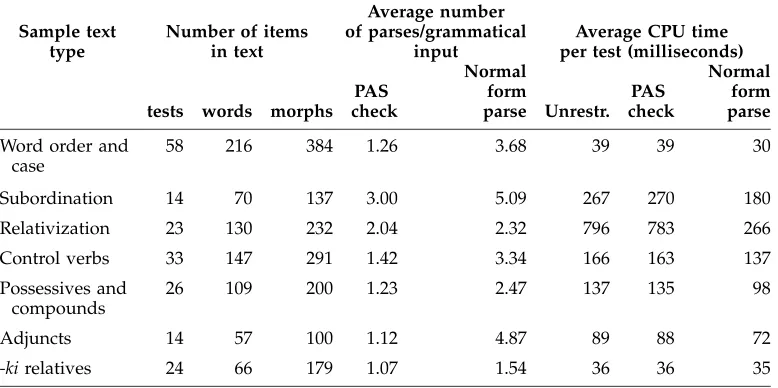
Table 2
Parsing performance.
Average number
Sample text Number of items of parses/grammatical Average CPU time
type in text input per test (milliseconds)
Normal Normal
PAS form PAS form
tests words morphs check parse Unrestr. check parse
Word order and 58 216 384 1.26 3.68 39 39 30
case
Subordination 14 70 137 3.00 5.09 267 270 180
Relativization 23 130 232 2.04 2.32 796 783 266
Control verbs 33 147 291 1.42 3.34 166 163 137
Possessives and 26 109 200 1.23 2.47 137 135 98
compounds
Adjuncts 14 57 100 1.12 4.87 89 88 72
-kirelatives 24 66 179 1.07 1.54 36 36 35
Note: CPU times are for a Sun UltraSparc-4 running SICStus Prolog; lexical items include stems and inflec-tional affixes.
by -POSS, in which -POSS is not interpreted with the semantics of possession but that of agreement marking). Not knowing how many of the syntactic distinctions are han-dled by the morphological analyzer, a subsequent interpreter may need to reconsult the grammar if scoping problems arise.
The architecture in Figure 3c describes the current implementation of the pro-posal. Bound morphemes are fed to the parser along with their interpretation. This model is preferred over that presented in Figure 3b for its simplicity in design and extendibility.16 The price is lesser efficiency due to context-free processing of inflec-tional morphology. By one estimate (Oflazer, Gocmen, and Bozsahin 1994), Turkish has 59 inflectional morphemes out of a total of 166 bound morphemes, and Oflazer (personal communication) notes that the average number of bound morphemes per word in unrestricted corpora is around 2.8, including derivational affixes. In a news corpus of 850,000 words, the average number of inflections per word is less than two (Oflazer et al. 2001). This is tolerable for sentences of moderate length in terms of the extra burden it puts on the context-free parser. Table 2 shows the results of our tests with a Prolog implementation of the system on different kinds of constructions. The test cases included 10 lexical items on average, with an average parsing time of 0.32 seconds per sentence. A relatively long sentence (12 words, 21 morphemes) took 2.9 seconds to parse. The longest sentence (20 words, 37 morphemes) took 40 seconds. The lexicon for the experiment included 700 entries; 139 were free morphemes and 561 were bound morphemes compiled out of 105 allomorphic representations (includ-ing all the ambiguous interpretations of bound morphemes and the results of lexical rules). For a rough comparison with an existing NLP system with no disambiguation
aids, G ¨ung ¨ord ¨u and Oflazer (1995) reported average parsing times of around 10 sec-onds per sentence for a lexicon of 24,000 free morphemes, and their morphological analyzer delivered around two analyses per second to a lexemic grammar. Oflazer’s later (1996) morphological analyzer contained an abstract morphotactic component of around 50 states for inflections, which resulted in compilation to 30,000 states and 100,000 transitions when the morphophonemic rules were added to the system.
In conclusion, we note that the current proposal for a morphemic lexicon and grammar is compatible with both a separate morphological component (Figure 3b) and syntax-integrated inflectional morphology (Figure 3c). The architecture in Figure 3b may in fact be more suitable for inflecting languages (e.g., Russian) in which the surface forms of bound morphemes are difficult to isolate (e.g.,m´este, locative singular ofm´esto) but can be delivered as a sequence of morpheme labels by a morphological
analyzer (e.g. m´esto-SING-LOC) to be matched with the lexical type assignments to
-SING and -LOC for grammatical interpretation.
It might be argued that in computational models of the type in Figure 3b, the lattice is not necessary, because the morphological analyzer embodies the tactical component. But not only tactical problems (cf. Example (18) and its discussion) but also transparent scoping in syntax and semantics is regulated by the use of lattice in type assignments, and that is our main concern. We show examples of such cases in the remainder of the article. Thus the nonredundant role of the lattice decouples the morphemic grammar– lexicon from the kind of morphological analysis performed in the back end.
5. Case Study: The English Plural
In this section, we present a morphosyntactic treatment of the English plural mor-pheme. The lattice for English is shown in Figure 2b. We follow Carpenter (1997) in categorizing numerical modifiers and intersective adjectives as plural noun modifiers: four boysis interpreted asfour(plu boy) andgreen boxesasgreen(plu box). This bracketing reflects the “set of sets” interpretation of the plural noun;four(plu boy) denotes the set of nonempty nonsingleton sets of boys with four members. The type assignments in (20) correctly interpret the interaction of the plural and these modifiers (cf. 21a–b). The endotypic category of the plural also allows phrase-internal number agreement
for languages that require it; the agreement can be regulated over the category N
before the specifier is applied to the noun group to obtainNP.
(20) -PLU := ◦as− <n N\<b N:λx.plux four := ◦sfour− <n N/✶nN:λx.fourx green := ◦sgreen− <n N/<n N:λx.greenx
(21) a. four boy -s
n
<N/✶nN <b N <n N\<b N
<
n
<N: plu boy
>
n
b. four boy -s
*** >
n
<N:four boy <n N\<b N
because n-base=n-num
***
n
<N:* plu(four boy)
Carpenter (1997) points out that nonintersective adjectives (e.g,toy, fake, alleged) are unlike numerical modifiers and intersective adjectives in that their semantics requires phrasal (wide) scope for -PLU, corresponding to the “set of things” interpretation of the plural noun. Thus, toy guns is interpreted as plu(toy gun) because the plural outscopes the modification. It denotes a nonempty nonsingleton set of things that are not really guns but toy guns. *toy(plu gun) would interpretpluover guns. The situation is precisely the opposite of (21); we need the second derivational pattern to go through and the first one to fail. The following category for nonintersective adjectives derives the wide scope for -PLU but not the narrow scope:
(22) toy := ◦stoy−<b N/<b N:λx.toyx
(23) a. toy gun -s
<
b
<N/<b N <n N:plu gun
***
n
<N:*toy(plu gun)
because n-num≤n-base
b. toy gun -s
b
<N/<b N <b N <n N\<b N
>
b
<N:toy gun
<
n
<N:plu(toy gun)
Carpenter (1997) avoided rebracketing because of the plural through lexical type assignments to plural nouns and a phonologically null lexical entry to obtain differ-ent semantic effects of the plural. In our formulation, there is no lexical differ-entry for inflected forms and no phonologically null type assignment to account for the dis-tinction in different types of plural modification; there is only one (phonologically realized) category for -PLU.17The modifiers differ only in the kind and degree of mor-phosyntactic control. Strict control (✶) onfour disallowsfour boy, and flexible control (<) ongreenalso handlesgreen box.Four green boxesis interpreted asfour(green(plu box)),
not as *four(plu(green box)), and four toy gunsis interpreted as four(plu(toy gun)), not as *plu(four(toy gun)). These derivations preserve the domain of the modifiers and the plural without rebracketing.
6. Case Study: Turkish Morphosyntax
There have been several computational studies to model morphology–syntax inter-action in Turkish. These unification-based approaches represent varying degrees of integration. G ¨ung ¨ord ¨u and Oflazer (1995) isolates morphology from syntax by having separate modules (a finite-state transducer for the former, and an LFG component for the latter), that is, the syntax is lexemic. The morphological component is expected to handle all aspects of morphology, including inflections and derivations. In Sehitoglu and Bozsahin (1999), lexical rules implement inflectional morphology, and derivations are assumed to take place in the lexicon. Hoffman’s (1995) categorial analysis of Turk-ish is also lexemic; all lexical entries are fully inflected. Interpretive components of these systems face the aforementioned difficulties because of their commitment to lex-emic syntax. Inflectional morphology is incorporated into syntax in another categorial approach (Bozsahin and G ¨o¸cmen 1995), but morphotactic constraints are modeled with nonmonotonic unification, such as nonexistence checks for features and overrides. The system cannot make finer distinctions in morphosyntactic types either. The result is an overgenerating and nontransparent integration of morphology and syntax because of the possibility of rebracketing and the unresolved representational basis of the lexicon. In this section, we outline the application of the proposed framework to Turkish. We analyze a large fragment of the language, without any claims for a comprehensive grammar. The phenomena modeled here exhibit particular morphosyntactic problems described in the preceding sections. We assume the binding theory in Steedman (1996), which is predicated over the PAS. In each section, we provide a brief empirical observa-tion about the phenomenon, propose lexical type assignments, exemplify derivaobserva-tions of the parser, and briefly discuss the constraints imposed by morphosyntactic types. Because of space considerations, we sometimes use abbreviated forms in derivations such as the genitive affix’s (N/(N\N))\N category for (<o N/(✶oNpn\
o
✶Npn))\ o
<Npn,
but the parser operates on full morphosyntactic representations.
6.1 Case Marking and Word Order
Turkish is regarded as a free constituent order language; all permutations of the predicate and its arguments are grammatical in main clauses, being subject to con-straints on discourse and semantic properties such as definiteness and referentiality of the argument and topic–focus distinctions. The mapping of surface functions to grammatical relations is mediated by case marking. Word order variation has lesser functionality in embedded clauses because embedded arguments are less accessible to surface discourse functions like topic and focus. Embedded clauses are verb fi-nal.
the arguments are determined not by directionality but by case in such languages. The categoryS\NPnom\NPacc resolves the ambiguity (24b–c).
(24) a. IV = S\NP
TV = S\NP\NP DV = S\NP\NP\NP
b. sev (like) := ◦s sev− <v S\<f NPnom\ f
<NPacc:λx.λy.likexy
c. ver (give) := ◦s ver−<v S\<f NPnom\ f
<NPdat\ f
<NPacc:λx.λy.λz.giveyxz
d. <v S\<f NPnom\ f
<NPacc :λx.λy.likexy⇒ v
<S\<f NP+accref\ f
<NPnom :λy.λx.likexy
e. -ACC := ◦a i|ı|u|¨u|yi|yı|yu|y ¨u−<c Nacc\ o
<N:λf.f
f. -LOC := ◦a de|da|te|ta−(<αS/<αS)\<o N:λx.λf.atfx
Gapping behavior seems to indicate that Turkish is verb final, not just SOV. SO and OS syntactic types must be distinguished to account for SO & SOV, OS & OSV, *SO & OSV and *OS & SOV. The OS & OSV pattern requires the lexical category S\NPacc\NPnom for the verb (Bozsahin 2000b). SOV and OSV base orders can be
cap-tured uniquely in the lexicon in set-CCG notation as S\{NPacc,NPnom}. Set-CCG is
strongly equivalent to CCG (Baldridge 1999). We distinguish SOV and OSV lexically, however, because OSV requires referential objects (25a–b). OSV is generated from SOV by a lexical rule (24d). This is genuine lexical ambiguity, because the two related entries differ in semantics (referentiality).
(25) a. Kitab-ı adam oku-du
Book-ACC man.NOM read-TENSE ’The man read the book.’
b. *Kitap adam oku-du
Book man.NOM read-TENSE
Regarding the relationship between case and the specifiers, it is questionable whether Turkish has a discernible syntactic category for determiners. There is no lex-ical functor that takes anNand yields anNP. The only article, the indefinitebir (’a’), makes a distinction in discourse properties (26). Specifying case as a determiner (e.g., NP\N) does not alleviate the problem, either. Ignoring the problem of case stacking for a moment, zero marking of the surface subject and the indefinite object takes us back to where we started.
(26) ¸Cocuk ye¸sil bir elma/elma/elma-yı ye-mi¸s
child.NOM green an apple/apple/apple-ACC eat-TENSE
Making the nouns lexically ambiguous (NorNP) would also require that all func-tions onto nouns be ambiguous (N\NandNP\NPfor inflections,N/NandNP/NPfor adjectives, etc.). Redundancy of this kind in the lexicon is not desirable, since it is in-troduced purely for formal reasons with no distinction in meaning. We accommodate these concerns by positing a special case of type raising for Turkish (27). Similarly, contraposition turns Ns into functors looking for NPs.
(27) Type Raising for Turkish: Nagr:a ⇒ T/(T\ f
<NPagr):λf.f[a]
⇒ T\(T/<f NPagr):λf.f[a]
T∈ {S,S\NP,S\NP\NP, S\NP\NP\NP}
The noun that is type raised can be a syntactically derived noun (28). SO (and OS) constituency required for gapping is provided by >Tand >B.
(28) Mehmet k ¨u¸c ¨uk ye¸sil kitab-ı, ¸cocuk da yeni gelen dergi-yi oku-du
M.NOM little green book-ACC child-COORD new come mag.-ACC read-TENSE
Nnom Nacc Nnom Nacc S\NPnom\NPacc
>T >T
S/(S\NPnom) (S\NP) /(S\NP\NPacc)
. . .
>B >B
S/(S\NPnom\NPacc) S/(S\NPnom\NPacc)
&
S/(S\NPnom\NPacc)
>
S
’Mehmet read the little green book, and the child, the newly arrived magazine’.
Our lexical type assignment to case morphemes (24e–f) departs from other CCG analyses of case (e.g., Steedman 1985, 1991a, Bozsahin 1998). These studies correlate morphological case with type raising of arguments, in the case of Bozsahin (1998), via a value-raised category assignment to case morphemes. Evidence from NP-internal case agreement and case stacking (Kracht 1999) challenges the type-raising approach. Agreement phenomena require that case (which can be marked on articles, adjectives,
and nouns) be regulated as an agreement feature within the category N before the
case-marked argument looks for the verb via type raising. Kracht observes that, in case stacking, there may be other morphemes between two case morphemes. Thus, treating the two cases as composite affixes for the purpose of type raising is not feasible. If the first case type-raises the noun to say,T/(T\NP), the second case would require a category,(T/(T\NP))\(T/(T\NP)); that is, it is endotypic. Hence, an endotypic category for case (like other inflections in the paradigm) subsumes the type-raising analysis of case provided that type raising is available in the grammar, not necessarily anchored to case.
We analyze case as an endotypic functor of type N\N (24e)—hence allow for
can account for free word order and gapping facts with fully directional syntactic types (Bozsahin 2000a).
6.1.2 Derivations. The wide scope of case is captured by treating its argument type as non-case-marked N (<o N) and the type of noun modifiers as functions onto
non-case-marked nouns of a particular domain, for example, <b Nfor nonintersective adjectives and <n N for intersective adjectives (29a). The same strategy in type assignments to other nominal inflections allows them to outscope nominal modification, for exam-ple, (29b).
(29) a. Mehmet [ [oyuncak araba] -lar] -ı sev-er
M.NOM toy car -PLU -ACC like-TENSE
<B
b
<Nnom b
<N/<b N <b N <n N\<b N <c Nacc\ o
<N <t S\<f NPnom
:mehmet :λx.toyx :car :λx.plux :λf.f \<f NPacc >T
S/(S\<f NPnom) :λx.λy.likexy
:λf.f[mehmet]
> b
<N:toy car
< n
<N:plu(toy car)
< c
<Nacc:plu(toy car)
>T
(S\NP)/(S\NP\<f NPacc):λg.g[plu(toy car)]
> t
<S\<f NPnom:λy.like(plu(toy car))y
>
S:like(plu(toy car))mehmet ’Mehmet likes toy cars.’
b. Adam-ın [k ¨u¸c ¨uk kırmızı araba]-sı
Man-GEN little red car-POSS
’the man’s little red car’ =poss(little(red car))man
word-based modification. The morphosyntactic categories, however, are transparent to the scope of nominal modification (cf. (29a) and (30b)).
(30) a. oyuncak [ [araba] -lar] -ı
toy car -PLU -ACC
N/N N N\N Nacc\N
:λx.toyx :car :λx.plux :λf.f
<
N:plu car
<
Nacc:plu car
>
N:∗toy(plu car)
b. [ye¸sil [araba] -lar] -ı
green car -PLU -ACC
n
<N/<n N <b N <n N\<b N <c Nacc\ o
<N :λx.greenx :car :λx.plux :λf.f
<
n
<N:plu car
>
n
<N:green(plu car)
<
c
<Nacc:green(plu car)
Surface case annotations on categories enable the grammar to capture the correct PAS in all permutations of S, O, and V while maintaining the discourse-relevant dis-tinctions (31). Verb-final subordinate clauses are enforced by the directionality of the subordination morphemes in the lexicon.
(31) a. S O V
>T >T
S/(S\<f NPnom) (S\NP)/(S\NP\ f
<NPacc) S\NPnom\NPacc
>
S\NPnom
>
S
b. O S V
>T >T
S/(S\<f NPacc) (S\NP)/(S\NP\ f
<NPnom) S\NPacc\NPnom
>
S\NPacc
>
c. O V S
>T >XP
(S\NP)/(S\NP\<f NPacc) S\NPnom\NPaccS−t\(S\NPnom)
>
S\NPnom
<
S−t
d. S V O
>T >XP
(S\NP)/(S\NP\<f NPnom) S\NPacc\NPnomS−t\(S\NPacc)
>
S\NPacc
<
S−t
e. V S O
>XP >XP S\NPnom\NPaccS−t\(S\NPnom) S−t\(S−t\NPacc)
<B
S−t\NPacc
<
S−t
f. V O S
>XP >XP S\NPacc\NPnomS−t\(S\NPacc) S−t\(S−t\NPnom)
<B
S−t\NPnom
<
S−t
6.2 Subordination
Subordinate clauses can be classified as unmarked clauses (32a), infinitival clauses (32b), verbal nouns (32c), and nominalizations (32d). The latter two types require a genitive embedded subject, which agrees with the subordinate verb.
(32) a. Mehmet [ ¸cocuk ev-e git-ti ]san-dı
M.NOM child.NOM house-DAT go-TENSE assume-TENSE
’Mehmet assumed that the child went home.’
b. ¸Cocuk [kız-a kalem-i ver-me ]-yi unut-tu child.NOM girl-DAT pen-ACC give-SUB1i -ACC forget-TENSE ’The child forgot to give the pen to the girl.’
c. [ ¸Cocu˘g-un araba-da uyu-ma-sı] Mehmet’i kız-dır-dı
d. Deniz [ ¸cocu˘g-un uyu-du˘g-u] -na inan-m-ıyor
D.NOM child-GEN sleep-SUB2g-POSS -DAT believe-NEG-TENSE
’Deniz does not believe the child’s sleeping.’
(33) a. Denizi [kendisi-niniuyu-ma-dı˘g-ı]-nı s¨oyle-di
D.NOM self-GEN sleep-NEG-SUB2g-POSS-ACC2 say-TENSE
’Denizisaid that hei did not sleep.’
b. *kendisii[Deniz’iniuyu-ma-dı˘g-ı]-nı s¨oyle-di
c. Denizi adam-ıj [kendii/jarkada¸s-ı-nın g¨or-d ¨u ˘g- ¨u]-ne inan-ıyor
D.NOM man-ACC self friend-POSS see-SUB2g-POSS-DAT2 believe-TENSE ’Denizi believes that hisi/j friend saw the manj.’
d. Denizi adam-aj [kendii/∗jkitab-ı-nı oku-du˘g-u]-nu s¨oyle-di
D.NOM man-DAT self book-POSS-ACC2 read-SUB2g-POSS-ACC2 say-TENSE
’Denizi told the manj that he read hisi/∗jbook.’
6.2.1 Lexical Types. The asymmetries in (33) show that the obliqueness order in bind-ing relations is preserved in subordination. This suggests the followbind-ing bracketbind-ing, in which the embedded clause’s position in the PAS of the matrix predicate is determined by its grammatical function.
Matrix-Pred. . . Matrix-Argument. . . Embedded-Clause. . . Matrix-Argument
(34) -SUB1i (-ma) := ◦a ma−<b N\(<a S\<f NPnom):λf.f
(infinitive)
-SUB1g (-ması) := ◦a ması−<o N\<f NPagr\( a
<S\<f NPnom):λf.f
(verbal noun)
-SUB2g (-dı ˘gı) := ◦a dı˘gı−<o Ncase=obl\
f
<NPagr\( a
<S\<f NPnom):λf.f (nominalization)
The wide scope of case markers on subordinate clauses implies that the subor-dinate markers themselves must have phrasal scope as well. Since case is a nominal
inflection, the category of a subordinate marker must be a function onto N. Its
ar-gument is IVfor infinitives and NPagr\IV for others, which require genitive subjects
(34). This yields two families of functors for subordination. The verb-final characteris-tics of the embedded clauses is ensured by the backward-looking main functor of the subordinate marker.
control on the verb. For subject raising, the result may undergo any nominal inflection
(<b N).
Word order variation within the subordinate clause is constrained by the subject on the left and the verb on the right. This constraint is achieved by categorizing the embedded subjects asNPagrand having a result category ofNfor all subordinate
mark-ers. If there were any contraposed elementNPin the embedded clause, the category
of the clause would beS\NP, and the clause could not combine with the contraposed
category such as S−t\(S\NP) on the right because the extraction category combines
with a subordinate marker first, which is onto N, notS\NP, hence composition (<B) could not take place.
6.2.2 Derivations. Example (35a) is the derivation of subject raising (we use N↑ as
an abbreviation for a type-raisedNwhen space is limited). We use Steedman’s (1996)
ana function to denote the binding of the embedded subject. Infinitive -SUB1i has
phrasal scope in this example; theDV must be reduced to anIVbefore the infinitive
can apply. Hence the subordination of intransitive clauses is only a special case in which the morphological scope of the infinitive works without rebracketing. Subject raising and coindexation with the matrix subject are made explicit in the raising
cate-gory of unut. The systematic relationship between the raised and nonraised category
of such verbs can be captured by a lexical rule, for example, TV:λx.λy.forgetxy ⇒ TV:λf.λy.forget(f[anay])y.
(35b–c) contrast subject and nonsubject nominalizations. The difference is cap-tured with the case distinction of the result type (<o N) for -SUB1g and -SUB2g. These examples also show the possibility of affix composition in the lexicon. For instance,
we write -masıin (35b), which marks subordination and agreement together, instead
of -ma-sı. Otherwise, -ma (SUB1g) would have to look to the right as a functor to enforce agreement, and the verb-final property of subordination could not be as-sured.
(35) a. ¸Cocuk kız-a kalem-i ver -me -yi unut-tu
child.NOM girl-DAT pen-ACC give -SUB1i -ACC forgot
>T >T >T <B
N↑nom N
↑ dat N
↑
acc DV
b
<N\(<a S\<f NPnom) c <Nacc\
o <N TV
:λf.f[child]:λg.g[girl]:λh.h[pen] :λx.λy.λz. :λf.f :λf.f :λf.λx.
giveyxz forget
(f[anax])x
> v
<S\<f NPnom\ f <NPdat
> v
<S\<f NPnom
< b
<N
< c
<Nacc
>T
(S\NP)/(S\NP\<f NPacc)
> t
<S\<f NPnom
> t
<S:forget(give girl pen(ana child))child
b. ¸Cocu˘g-un uyu -ması Mehmet’i kızdır-dı
child-GEN sleep -SUB1g M-ACC anger-TENSE
>T >T <B
NPagr IV N\NPagr\IV IV/TV TV
< >
N\NPagr IV
<
N
>T
S/IV
>
S:anger(sleep child)mehmet ’The child’s sleeping angered Mehmet.’
c. *¸Cocu˘g-un uyu-du˘gu Mehmet’i kızdır-dı sleep-SUB2g
6.3 The Morphosyntax of Control
The control verb’s controlled argument is marked by the infinitive -ma, and the
re-sulting nominalized embedded clause can undergo nominal inflections (36a–b). The infinitive -mahas the lexical type in (34). A potential conflict between an object con-trol verb’s subcategorization and PAS is resolved by case decoration:zorla’force’ and tavsiye et’recommend’ differ in their case requirements and what is controlled (36b–c). tavsiye et’s infinitive complement is accusative, whereas zorla’s is dative.
(36) a. ¸Cocuk [kitab-ı oku-ma]-ya ¸calı¸s-tı
child.NOM book-ACC read-SUB1i-DAT try-TENSE ’The childitried [to iread the book].’
b. Mehmet ¸cocu˘g-u [kitab-ı oku-ma]-ya zorla-dı M.NOM child-ACC book-ACC read-SUB1i-DAT force-TENSE ’Mehmetjforced the childi [to i/∗jread the book].’
c. Mehmet ¸cocu˘g-a/*-u [kitab-ı oku-ma]-yı/*-ya tavsiye et-ti
M.NOM child-DAT/ACC book-ACC read-SUB1i-ACC/DAT recommend-TENSE ’Mehmet recommended the childi[to i read the book].’
6.3.1 Lexical Types. Subject control verbs (e.g.,¸calı¸s’try’;s¨oz ver’promise’) and object control verbs (e.g., zorla;tavsiye et) have the control property indicated in their PAS (37). The nonraising variety of these verbs is obtained via a lexical rule.
(37) ¸calı¸s := ◦s ¸calı¸s−TV:λq.λz.try(q[anaz])z
s ¨oz ver := ◦s s¨oz ver−DV:λq.λz.λw.promisez(q[anaw])w zorla := ◦s zorla−DV:λz.λq.λw.force(q[anaz])zw


![table entries T[i,i+k ], i 0, 1, , n − k; that is, k-length results of binary rules areinput to potential unary constituents of length k](https://thumb-us.123doks.com/thumbv2/123dok_us/1272883.655363/14.612.114.379.466.682/entries-length-results-binary-areinput-potential-constituents-length.webp)