1
Abstract—There are sheer volume of rich web resources such as digital newspaper, e-forum, blogs, Facebook and Twitter. Mining the digital text resources may reveal interesting knowledge to respective individuals or organizations. Text mining and sentiment mining or analysis are parts of a new area in sentiment research. Sentiment mining for Malay Newspaper (SAMNews) is constructed based on the artificial immune system called negative selection algorithm which is able to classify the sentiment in newspaper’s sentences into the polarity (positive, negative or neutral) intelligently. The sentiment analysis in this project utilized 1000 sentences from newspapers to evaluate the average accuracy. The research used 900 sentences from newspapers as the training data and another 100 as the testing data. The accuracy is achieved at 88.5%. In the future, a comparative study on Artificial Immune System and other techniques or algorithms can be carried out to enhance the performance of the sentiment classification model.
Index Terms— artificial immune system, negative selection algorithm (NSA), text mining, sentiment analysis, sentiment mining, digital text.
I. INTRODUCTION
The advancement of internet technology contributes to the rapid development of knowledge from different part of fields. Hence, there are sheer volume of rich web resources such as digital newspaper, e-forum, blogs, Facebook and Twitter [14]. Mining the text resources may reveal interesting knowledge to respective individuals or organizations. Text mining and sentiment mining are areas in sentiment research [31][6] which have grown as essential methods of knowledge discovery from general and business documents. Currently, one of the active researches on mining is sentiment mining of the textual data.
Sentiment is important in social behavior and it is a way to stimulate cognitive processes in decision making and to
1
This research is supported in part by Fundamental Research Grant Scheme (FRGS) under the ninth Malaysian Plan (RMK-9), Ministry of Higher Education (MOHE) Malaysia. The grant no is 600-RMI/ST/FRGS 5/3/Fst (208/2010).
F. Mazidah Puteh is with Universiti Teknologi MARA (UiTM). She is now in Computer Science Department, UiTM Terengganu, 23000 Dungun, Terengganu, Malaysia. (corresponding author: phone: 6019-9316631; fax:
609-8400288; e-mail: [email protected] ).
S. Norulhidayah Isa is with Universiti Teknologi MARA (UiTM) . She is now in Computer Science Department, UiTM Terengganu, 23000 Dungun, Terengganu, Malaysia. (e-mail: [email protected] ).
T. Sayani Puteh is with Universiti Kuala Lumpur (UniKL). She is now in Computer Science Department, MIIT, UniKL, 1016 Jalan Sultan Ismail, 50250 Kuala Lumpur, Malaysia (email: [email protected])
4th. Nur Amalina Redzuan is with Universiti Teknologi MARA. She is now in Computer Science Department, UiTM Terengganu, 23000 Dungun, Terengganu, Malaysia.
carry out strategies in handling situations [9]. Sentiment mining systems are being applied in almost every business and social domain because opinions are central to almost all human activities. For this reason, when we need to make decision, we seek out the opinions of others [5].
Many people like to read, they also like to give comments in many kinds of reading materials such as newspapers, magazines, letters, blogs, and others. Their comments can be considered as bad or sometimes neutral [21]. Experts notice the significances that they can get from the comments. Various analyses have been done in order to investigate about it further.
Recently, many types of analyses have been done to categorize the comments by researchers around the world using personal views on the internet such as Facebook, Twitter, and personal blogs. There are also many kinds of researches about text classification that classify the sentiments, people expression and others. There are many kinds of sentiments and they are hard to analyze because the sentiment have been expressed in symbols such as ‘like’ and ‘unlike’ [6]. It is commonly used by people that like to express their emotions or feelings while chatting with their friends. Usually we can see those expressions in social networks likes Facebook, Twitter, MySpace and Friendster.
In sentiment mining system, the researcher can use journals, magazines, newspaper and other kind textual information format to get the sentiment mining data. The aim of the research is to classify the sentiment value in Malay Newspaper using Artificial Immune System (AIS) technique that focuses on Negative Selection Algorithm (NSA).
The organization of the paper is as follows: section II explains related works of sentiment mining and artificial immune system. Section III explains the experiment that has been carried out. Section IV discusses result and section V concludes the findings.
II. RELATEDWORKS A. Text Mining and Sentiment mining
Text mining can be loosely described as looking for patterns in a text that contains high-quality information which refers to novelty, relevance and interestingness of the way to write the text. The phrase “text mining” is generally used to denote any system that analyzes large quantities of natural language text and detects lexical or linguistic usage patterns in an attempt to extract probably useful information [13]. Normally, the extraction of the information is clearly specified in the text which means it is not hidden. People can easily understand the message or the information from the text that has been written by the author. However, it is
Sentiment Mining of Malay Newspaper
(SAMNews) Using Artificial Immune System
difficult for a computer to understand and it needs some intelligent ways to make the information be understood.
In order to process this kind of text, it requires the process of structuring the input text such as parsing the text, adding some linguistic features and removing other linguistic features followed by inserting the text into the database.
Sentiment mining is one of the tasks in text mining. The task of sentiment mining is easily described as the classification task that produces the category which represents the sentiment [6]. It is one of the applications of natural language processing, computational linguistics and text analytics that is used to recognize and excerpt some kind of information from the sources [30].
Sentiment mining is a way to enable the computer to recognize and classify the sentiment of some information of what people think automatically [15]. This kind of analysis can make people know whether the comment that has been given by the speaker or the writer is a positive, neutral or negative comment. Comments can consist of judgment or evaluation that is related to the sentiment of a writer during the writing of a document or the sentiment of a respondent when answering a question from an interviewer.
One of the basic tasks in sentiment mining is identifying the polarity of a given existing text in the document, sentence or word. Some studies have used different methods in order to identify the polarity of the existing text [23][1]. Another task that is related to sentiment mining is document-level-sentiment-classification. This task is usually used to classify the whole document that contains opinion as a positive or negative opinion which can be seen in [4]. Other subtask in sentiment mining is classifying messages as opinionated/subjective or factual/objective [1].
B. Machine Learning Algorithm
Many researchers have been using machine learning algorithm to do classification on sentiment mining such as Naïve Bayes and Support Vector Machine (SVM). This is because the performances of the two algorithms are better than other algorithm based on the accuracy [11][29][16].
In the computer science field, SVM is used as a concept to analyze data and recognize pattern that are related to supervised learning methods [22][2].
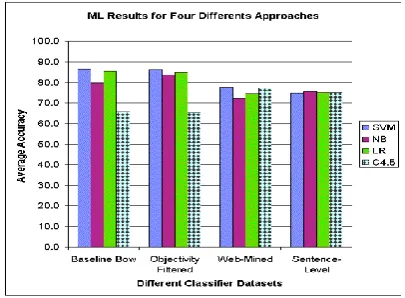
This kind of machine learning methods has shown a good result in most of the tasks to classify sentiment. Figure 1 shows the comparison of different classifiers that used different kinds of data set.
Preprocessing Technique
Preprocessing is a process to perform a preliminary processing on raw data to prepare it for another processing procedure. It is commonly used as a preliminary sentiment mining practice, data preprocessing transforms the data into a format that will be easily and effectively processed computationally. Data preprocessing consists of the method of cleaning the raw data in order to transform the noisy data into clean ones [10]. Two important techniques that are performed in sentiment mining are stop word removal and stemming.
Stop Word Removal
Stop word removal is the process of removing words that have high frequency which are not important to the sentiment of the sentence. Words such as; ‘a', ‘the', ‘or' are likely to be considered as stop words which have been listed in [7].
There are some stop word studies that have been done in various areas such as sentiment mining, web mining and information retrieval [25][12][13]. The list of stop words that have been identified by the researcher in detecting the sentence-level novelty in Malay words is shown in [3]. Stemming
Stemming or lemmatization is the process of removing the suffixes from a word. In simpler terms, it maps the different “versions” of the word by reducing it to its stem, root or base form. Consider the words; “process”, “processes”, “processing”, “processed”. Such related words may all be grouped into a single root term, “process”, by removing their suffixes.
This preprocessing technique has been used in broad area such as information retrieval that aims to study about how to determine and retrieve a stored information from a corpus, [28]. Although stemming has been studied for English, it also has been utilized in many kinds of languages like Latin [26] and Arabic [18].
One of the algorithms that been used for stemming is called Porter Stemming. Porter stemming is about removing any prefixes, suffixes, or infixes that are contained in the words. [24] For example, the algorithm will remove the prefixes that are usually attached at the beginning of the word likes ‘pre’, suffixes that are attached at the end of the word likes ‘sing’ and infixes that are attached in the middle of the word which came from the word ‘preprocessing’. Table I shows the example of porter algorithm on Malay language.
C. Artificial Immune System
[image:2.595.69.272.606.755.2]In computer science, Artificial Immune Systems (AIS) is a computational intelligent system inspired by the principles and processes of the vertebrate immune system. The algorithms typically exploit the immune system's characteristics of learning and memory to solve a problem
TABLE I
AFFIXES REMOVAL USING STEMMING ALGORITHM
Prefix ‘ber’, ‘per’, ‘ter’, ‘mem’, ‘pem’, ‘menge’, ‘penge’, ‘meng’, ‘peng’,
‘men’, ‘pen’, ‘me’, ‘pe’, ‘be’, ‘ke’, ‘se’, ‘te’, ‘di’ Suffix ‘nya’, ‘kan’, ‘an’, ‘i’, ‘kah’, ‘lah’, ‘pun’, ‘ita’, ‘man’,
‘wan’, ‘wati’, ‘ku’, ‘mu’ infix ‘el’, ‘er’,’em’, ‘in’, Prefix and
suffix
‘ber…an’, ‘per…an’, ‘ter…kan’, ‘mem…kan’, ‘pem…an’, ‘pen…an’,
‘men…i’, ‘meng…i’, ‘menge…kan’, ‘penge…an’, ‘peng…an’
Two or more affixes
‘diper…’, ‘…kannya’, ‘memper…i’, ‘berke…an’, ‘men…inya’,
‘di…kannya’
[19][20]. The fundamental concepts of AIS are based on how the lymphocytes which are B-cells and T-cells are matured, adapted, reacted and learn in response to a foreign antigen [8]. There are many models have utilized the idea of immune system in AIS such as negative selection, clonal selection, immune network and danger theory.
Negative Selection Algorithm (NSA)
Negative selection algorithm is used to protect against self-reactive lymphocytes. It has the ability to detect any unknown antigens while not reacting to self-cell. Receptors are made through a pseudo-random genetic rearrangement process during the generation of T-cells in the thymus gland. In the thymus, if there are T-cells that react against self-proteins then it will be destroyed. Only cells that do not drag to self-proteins are allowed to leave the thymus. The T-cells that have matured will circulate all over the body in order to perform immunological functions that will hence protect the body from any foreign antigens [17].
[image:3.595.311.533.245.695.2]NSA is one of the techniques in AIS. It is a supervised learning algorithm that have been introduced by Forrest et al [27]. This algorithm has been popular in many areas such as computer security, network security and anomalies detection problems [32].
Fig. 2 Negative Selection algorithm [27]
In this algorithm, there are two phases which are censoring and monitoring. In the censoring phase, a set of detector is generated where each of the detectors is a string that does not match any of the protected data. While in the second
phase, the protected data will be monitored by comparing them with the existing detector. If a detector is ever activated, a change is known to have occurred. Figure 2 shows the overview of the NSA algorithm that has been used in the system.
III. METHODOLOGY
This research will concentrate on sentiment mining on textual data collected from newspapers. The methodology includes:
A. Data Preparation
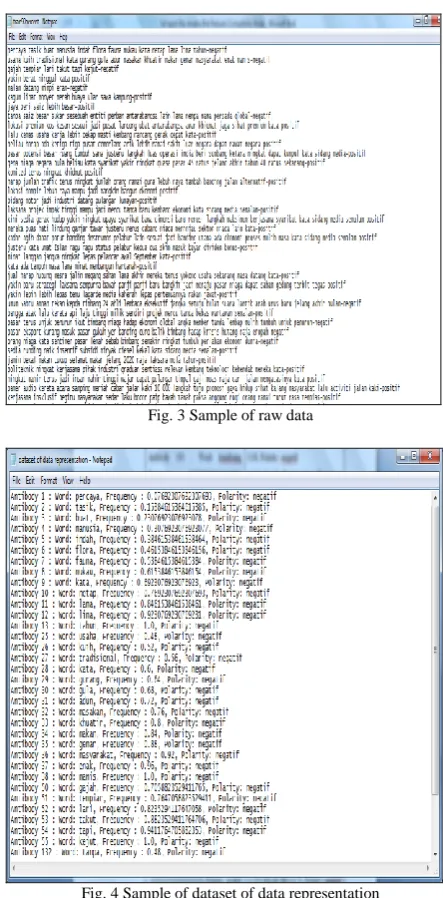
The activities consisted in this phase is data collection and data representation. This project used data collection from newspapers that were stored in text file document.
Fig. 3 Sample of raw data
Fig. 4 Sample of dataset of data representation
[image:3.595.74.259.533.727.2]B. Preprocessing of Data
In this phase, the research used the technique proposed by [46], as follows:
Stemming
Stemming is the act of trimming the words to their base word. This research will use Reversed Porter algorithm during this process of preprocessing phase.
Stop Word Removal
Stop Word Removal is a process to eliminate any non-sentiment valued words from the data.
Word Tokenizer
Word Tokenizer is a process to make some groups of the same word in each sentence and finds their frequency of occurrences.
C. Reverse Porter Algorithm
The basic idea of this algorithm is to reverse the whole process of Porter algorithm in order to get the result. The main concept of Porter Algorithm is to use a reduction technique where the given words will be reduced to its root form, which can be presented as, w – w’ = rW. w is word, w’ is suffixes, and rW is root word.
Contradiction to Porter algorithm; the Reverse Porter algorithm is presented as, ArW + Aw’ = rS; rS = gW?. ArW is all root words, Aw’ is all suffixes, rS are result Word and gW is given word. The process was only done once; the resulting words will be stored in a library so that the engine will not have to repeat all over if it encounters the same word hence reducing computational times greatly.
The first process is adding postfix; the engine will repeat all root words from dictionary and combines the words with all suffixes available. Then, each of the resulting word will be compared with the given word. If there is a match, the engine will return the result. If there is none, the engine will proceed to second sub process which is adding prefixes.
In the second process, the engine will repeat what it has done before with the exception that it will combine all the root words with prefixes instead of suffixes. Then the resulting words will be compared against the given word and if it is a match, the engine will return the result. Otherwise, the engine will proceed to the following sub-process, first letter modification.
In the third process, first letter modification process is unique to Malay language because there are some words that will change when combined with prefixes. For example, word “kering” when combined with prefix “me” will transform into “mengering” instead of a direct combination of both words, “mekering”.
Pseudo code of Reverse Porter Algorithm:
Start: get the word from the input (clean data) ( Ex. “memakan”).
Compare with the Library of Generated Word (LGW).
False.
Add suffixes/prefixes/infixes to the library of Root Words (LRW)(Ex. “me + lari, me+makan” )
Compare the result with the word again. Repeat until a match is found.
Add the matched words to the LGW (Ex, {makan,memakan}).
True: return the root word.
End.
D. Stop Word Removal Algorithm
Stop word removal is a process to find all the words that does not have any sentiment value and remove them from the input. This is because as the research objective is to find sentiment value which is positive or negative from the sentences and if there is no sentiment value word is inserted, it will not bring any effect to the outcome, so it will only increase the time and space costs.
E. Word Tokenizer Algorithm
Word tokenizer algorithm is to discover the occurrence of each word in a sentence. It is a simple method that needs an identifying process of any repeating words and then reducing it to one word with the number of occurance.
Table II and Table III show the data before and after the preprocessing process.
TABLE II BEFORE PREPROCESSING
TABLE III AFTER PREPROCESSING
F. Negative Selection Algorithm (NSA)
After preprocessing, the data is divided into the training and testing dataset. The data is trained using the learning algorithm NSA. The data representation for NSA is constructed into suitable form in a vector space of words as shown below:
Data = {word, frequency, polarity) Example of data representation;
Word: syukur, Frequency: 0.13333333333333333, Polarity: positif
The first parameter represents the real word. The second parameter represents the frequency of occurrence of the word in a particular sentence and the last parameter represents the polarity of the sentence that the word belongs to. The data is represented as follows: The sentence “makan coklat sedap suka”, has been preprocessed from original sentence, “Kami makan coklat sedap. Kami suka coklat itu”. Data representation was;
Word1 {makan,1, positif}
Word3 {sedap,1, positif } Word4 {suka,1, positif }
[image:5.595.310.539.105.304.2]Then, all these data representations are used as the training dataset. The basic idea of the algorithm is to generate a number of detection that is used to identify the self and non-self-data.
Fig. 5 Steps of Training Process in Negative Selection Algorithm
Figure 5 shows the detail steps in NSA that is used to generate the antibody (detector word) as described below: 1. Define the libraries for positive and negative categories.
The words that are clearly defined as positive and classified as positive words will be the library for positive and it will be the same way with negative sentences. The libraries are created so that the keywords or detectors that fit in the positive class will not become the detectors in the negative class. The libraries of both positive and negative categories that have been defined will be matched to the sentences in data training that followed the corpus of Malay word. If a negative word matches one in the positive library, then the word is removed from the sentences. This process will also be implemented with positive sentences where each word in the sentences will be compared with both libraries. 2. Training process continues with training the remaining
words in positive and negative sentences so it will become as detectors for positive and negative categories. This detector is called antibody where the first word in the first sentence will be the first detector. After that, the first word is compared to the second word; if they match then the second word is removed and its occurrence is counted; otherwise the second word will be the next detector.
3. This flow will keep running until there are no other antigens that match the memory cell (database of antibody).
IV. RESULTDISCUSSION
This research operated 900 newspaper’s sentences in developing the sentiment classification model during
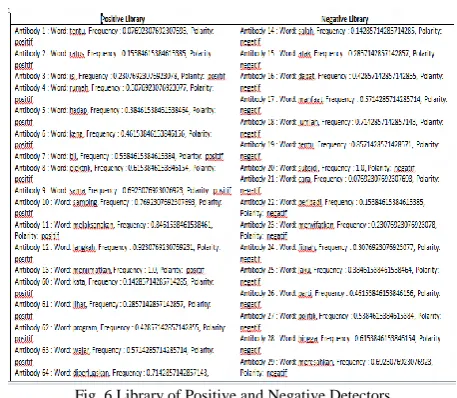
training process. This experiment has produced 16, 348 detector words which contains 23, 221 detector words for the positive category and 7, 979 detector words for the negative category.
Fig. 6 Library of Positive and Negative Detectors
Sample of detectors that have been produced can be seen in Figure 6. The performance accuracy of SAMNews is shown in Table IV.
TABLE IV
SAMPLE RESULT OF TESTING FOR ENDING POSITION IN EXPERIMENT III
V. CONCLUSION
Negative selection algorithm is suitable to categorize the sentences into the sentiments of positive, negative and neutral polarity. The algorithm only recognized and kept words from the newspaper that do not exist in the library yet. The word that existed in the memory cell will be skipped and the process will keep running until there no other words are detected.
One obstacle with this sentiment mining is that the newspaper’s data must be in standard language. Some problems will occur in defining an important detector word when the data does not use a standard language. Furthermore, NSA sentiment mining model also needs a clean data to be operated accurately. The strength of the classification model can be enhanced by making some adjustments and improvements.
A comparative study on artificial immune system and other techniques or algorithms is needed to enhance the performance of the sentiment mining classification model.
Total of training and testing Newspaper’s sentences
900:100
Number of correctly classify(%) 88.46
Number of incorrectly classify(%) 11.54
Accuracy of testing Newspaper’s sentences (%)
88.46 1. Initialize random candidate of newspaper’s data
called as antigen
2. Antigen presentation: for each antigen, do;
a) Compare the word and polarity with antibody,
i. if it is false then the antigen will be added as a new antibody (detector) in memory cell ii. (match) with the antibody, do
affinity measurement (AM) b) Affinity Measurement (AM)
Find antibody that match with the word, polarity and frequency of the antigen;
i. antibody will be skipped
ii. Otherwise, add the antigen as the new antibody and store into memory cell
REFERENCES
[1] A. Abbasi, H. Chen, and A. Salem, (2006). “Sentiment Analysis in Multiple Languages : Feature Selection for Opinion Classification in Web Forums,” ACM Transactions on Information System, vol. 3, pp.2-5.
[2] A. Kennedy, (2006, May). “Sentiment classification of movie
reviews using contextual valence shifters,” Computational
Intelligence, vol. 22, no. 2, pp. 110–125.
[3] A. T. Kwee, F. S. Tsai, and W. Tang, (2009). “Sentence-Level
Novelty Detection in English and Malay,” Nanyang Technology
University, pp. 40–51.
[4] B. Liu, (2010). “Sentiment analysis and subjectivity,” Handbook of
Natural Language Processing,, pp. 1–38.
[5] B. Liu, (2012). “Sentiment analysis and Opinion Mining,” Morgan & Claypool Publishers.
[6] B. Pang and L. Lee, (2002). “Thumbs up?: sentiment classification
using machine learning techniques,” Conference on Empirical
methods.
[7] C. D. Manning, P. Raghavan, and H. Schütze, (2009). "An
Introduction to Information Retrieval", Working Paper on
Cambridge UP, pp. 3- 26.
[8] D. Aickelin, U & Dasgupta, (2003). “Artificial Immune System and Their Application,.” in Proceedings of the International Conference on Artificial Immune Systems (ICARIS), pp. 7-10.
[9] D. Consoli (n. d.). “TEXTUAL EMOTIONS RECOGNITION WITH AN INTELLIGENT SOFTWARE OF SENTIMENT ANALYSIS,”
Word Journal Of The International Linguistic Association, pp. 997–
1009.
[10] D. Pyle, (1999). “Data Preprocessing Techniques for Data Mining,” Winter Schools on "Data Mining Techniques and Tools for Knowledge Discovery in Agricultural Datasets”, pp. 139-144. [11] D. Zhang, S. Li, C. Zhu, and X. Niu, (2010). “A comparison study of
multi-class sentiment classification for Chinese reviews,” Fuzzy
Systems and Knowledge Discovery, pp. 2433–2436.
[12] E. Dragut, F. Fang, P. Sistla, C. Yu, and W. Meng, (2009). “Stop word and related problems in web interface integration,” Proceedings
of the VLDB Endowment, vol. 2, no. 1, pp. 349–360.
[13] F. Sebastiani, “Machine learning in automated text categorization,”
ACM Computing Surveys, vol. 34, no. 1, pp. 1–47, Mar. 2002.
[14] G. Vinodhini and RM. Chandrasekaran, (2012). “Sentiment Analysis
and Opinion Mining: A Survey,” Interpretation Journal Of Advance
Research in COmputer Science and Software Engineering, Vol 2,
issues 6, pp282-292.
[15] J. Prager, (2006). “Open-Domain Question–Answering,”
Foundations and Trends® in Information Retrieval, vol. 1, no. 2, pp.
91–231.
[16] L. Alvim, P. Vilela, E. Motta, and R. L. Milidiú, (n. d.). “Sentiment of Financial News : A Natural Language Processing Approach,”
Learning, pp. 1–3.
[17] L. N. D. Castro and J. Timmis, (2002). “An Artificial Immune Network for Multimodal Function Optimization,” in Proceedings of IEEE Congres on Evolutionary Computation, vol. 1, pp. 699-674. [18] M. A. H. Omer, (2009). “STEMMING ALGORITHM TO CLASSIFY
ARABIC DOCUMENTS,” Symposium on Progress in Information & Communication Technology, pp. 111–115.
[19] M. Puteh, A.R. Hamdan, K.Omar dan A.Abu Bakar 2008. Flexible Immune Network for Mining Heterogeneous Data. LNCS 5132, hlm 232-241 @ Springer-Verlag Berlin Heidelberg.
[20] M. Puteh, A.R. Hamdan, K.Omar dan M.T.H. Mohd Tajuddin 2010. Artificial Immune Network: Classification on Heterogeneous Data, Machine Learning, InTech, ISBN: 978-953-307-033-9
[21] N. Godbole and S. Skiena, (2007). “Large-Scale Sentiment Analysis for News and Blogs,” Interpretation A Journal Of Bible And
Theology, pp. 765–770.
[22] N. Samsudin and M. Puteh, (2011). “Bess or xbest: Mining the Malaysian online reviews,” in 2011 3rd Conference on Data Mining
and Optimization (DMO), pp.38-43.
[23] P. Turney, (2002). “Thumbs up or thumbs down?: semantic orientation applied to unsupervised classification of reviews,”
Proceedings of the 40th Annual Meeting, pp. 2-5.
[24] P. Willett, (2006). “The Porter stemming algorithm: then and now,”
Program: electronic library and information systems, vol. 40, no. 3,
pp. 219–223.
[25] R. M. R. Liebregts, (2008, July). “Evaluation of a University-wide Expert Search Engine,”, Thesis for Humanities Department, Tilburg
University. pp. 70-81.
[26] R. Schinke, M. Greengrass, A. M. Robertson, and P. Willett, (1993). “Journal of Documentation Emerald Article : A STEMMING
ALGORITHM FOR LATIN TEXT DATABASES,” Journal of
Documentation, vol. 52, no. 2, pp. 172-187.
[27] S. Forrest, L. Allen, and A. S. Perelson, (1994). “Self-Nonself
Discrimination in a Computer,” in Proceedings of the IEEE
Symposium on Research in Security and Privacy (in press), pp. 3-5.
[28] T. M. T. Sembok, I. I. H. Uman, and I. N. Rocessing, (2005). “Word Stemming Algorithms and Retrieval Effectiveness in Malay and Arabic Documents Retrieval Systems,” Cognitive Psychology, vol. 10, pp. 95–97.
[29] W. Fan, S. Sun, and G. Song, (2011, Apr.). “Sentiment Classification for Chinese Netnews Comments Based on Multiple Classifiers
Integration,” 2011 Fourth International Joint Conference on
Computational Sciences and Optimization, pp. 829–834.
[30] W. Wang, (2010.). “Sentiment Analysis of Online Product Reviews with Semi-supervised Topic Sentiment Mixture Model,” Science, vol. 5, no. Fskd, pp. 2385–2389.
[31] Y. Mejova, (2009). “Sentiment Analysis : An Overview". Comprehensive Exam Paper, vol. 1, pp. 3-6.