Efficient and Secure Access Control Mechanism on
Time Sensitive Data Set in Cloud
Nalla Jyothi1, G.Thirupathia2 1
M.Tech Student, CSE, SVS Group of Institutions, Warangal, TS 2
Associate.Prof, CSE, SVS Group of Institutions, Warangal, TS
Abstract: The new perspective of outsourcing data to the cloud is a twofold edged sword. On one side, it approves data proprietors from the specific organization, and is less requesting for the data proprietors to confer their data to arranged recipients when data are secured in the cloud. On the contrary side, it understands new troubles about protection and security assurance. To secure information secrecy against the legitimate however inquisitive cloud owner organization, different literary works have been proposed to help fine-grained data get the chance to control. Regardless, till now, no capable plans can give the circumstance of fine-grained get the chance to control together with the point of confinement of time-sensitive data circulating. In this paper, by embedding the instrument of facilitated release encryption into CP-ABE (Cipher text-Policy Attribute-based Encryption), we propose TAFC: some other time and trademark components merged access control on time sensitive data set away in cloud. Expansive security and execution examination exhibits that our proposed plot is extremely profitable and satisfies the security essentials for time-unstable data accumulating out in the open cloud.
Keywords: Cloud Computing, TAFC, Data privacy, Encryption
I. INTRODUCTION
Distributed storage benefit has critical points of interest on both advantageous information sharing and cost lessening. Be that as it may, this new perspective of data amassing accomplishes new troubles about data mystery confirmation. Data are no longer in data proprietor's trusted in space, and he/she can't trust in the cloud server to coordinate Stay data get the opportunity to control. Along these lines, the ensured get to control Issue has transformed into a testing issue in dispersed capacity. There have been different works [1– 5] on security protecting data sharing in cloud in light of various cryptographic locals, in which the plans [1– 3] in light of CP-ABE [6] pull in wide contemplations, since they can guarantee data proprietor fine-grained and versatile access control of his/her own data.
Regardless, these plans choose customer's passageway advantage just in light of his/her inherent attributes with no other fundamental edges, for instance, the time factor. In all actuality, the time factor for the most part assumes an imperative part in managing timesensitive information [7] (e.g. to distribute a most recent electronic magazine, to uncover an organization's future strategy for success). While transferring time-touchy information to the cloud, the information proprietor may need diverse clients to get to the substance after various time.
Nonetheless, to the best of our insight, existing CP-ABE based plans can't meet such necessity. To handle the above issue of coordinated discharge, it is important to present a successful plan, which won't discharge the information get to benefit to proposed client until the point when relating predefined time. An immaterial game plan is to leave data proprietors to physically release the time-delicate data: The proprietor exchanges the mixed data under different methodologies at each release time, along these lines arranged customers can't get to the data until the point that the relating time arrives. In any case, such game plan restrains the proprietor to be online to again and again exchange the different encryption interpretations of comparative data, which makes the data proprietoror in a bad position.
II. OVERVIEW OF THE SYSTEM
A. The Primary Commitments Of This Paper Can Be Abridged As Takes After
To the best of our insight, this paper is the primary that proposes two factors(time and properties) blend based access control plot I cloud storage,which can all the while accomplish the highlights of fine granularity and coordinated discharge.
1) We plan a viable engineering to understand our plan, in which we update a substance (the focal expert, CA) to be in charge of the coordinated discharge work. Other than disseminating property related private keys, CA just needs to intermittently distribute widespread time-related tokens to discharge get to benefits. Such design involves just a little measure of cost to give our required access control conspire, which is sensible and commendable.
2) For the capacity of planned discharge, there is no utilization of a safe passage amongst CA and the information proprietor. Hence, the extra overhead is lightweight.
III. SYSTEM ANALYSIS
The traditional way to deal with address protection in this setting is to scramble delicate information before outsourcing it and run all calculations on the customer side. Anyway this forces unsuitable customer overhead, as information should ceaselessly be downloaded, decoded, handled, and safely re-transferred. Numerous applications can't adapt to this overhead, especially on the web and portable applications working over extensive datasets, for example, picture stores with CBIR administrations. A more reasonable approach is outsource calculations and perform tasks over the scrambled information on the server side. Existing recommendations in this space remain generally unconventional, specifically those requiring completely homomorphism encryption, which is still computationally excessively costly.
A. Disadvantages
1) Less capacity previous architecture
2) Over load on both computation and communication
3) Time process
IV. METHODOLOGY
A. Encryption Algorithm
In cryptography, a key is a small piece of data (a parameter) that decides the useful yield of a cryptographic calculation or figure. Without a key, the calculation would deliver no helpful outcome. In encryption, a key determines the specific change of plaintext into figure content, or the other way around along with extrication.
Security Hash Algorithm: The Secure Hash Algorithm is a family of cryptographic hash functions:
B. Advantages 1) High capacity
2) Reducing Time consuming
3) Computation and communication will be high
V. RELETED WORKS
From the perspective of cryptography, the goal of composed release can be expert by Timed-Release Encryption (TRE). Rivest et al. [8] have proposed an intense TRE plan, and it has been likewise brought into different perspectives, for instance, available encryption [9], intermediary re-encryption [10], restrictive unaware exchange [11]. In a TRE-based structure, a trust time administrator, rather than data proprietor, can reliably release the passageway advantage at each predefined time. Androulaki et al. [12] have made an approach to manage recognize time-fragile data get the chance to control in cloud. While, this approach needs fine granularity, which may leave the data proprietors a terrible weight in a tremendous scale system. Fan et al. [13] have proposed composed release predicate encryption for conveyed figuring. In their arrangement, each datum report can be set apart with only a solitary release time point, which can't release the passageway advantage of one record to different arranged customers at different time. How to accomplish the limit of both planned discharge and fine-grained get to control in distributed storage? A direct yet innocent strategy is to deal with time as a characteristic [12]. Notwithstanding, unendurable number of time-related keys will be issued to every client at each comparing time, and this will achieve substantial overhead on both calculation and correspondence. In existing written works, Qin et al. [10] have made a starter endeavor to coordinate time with properties. It just tends to the issue that the properties' life time of every client might be constrained by time. In any case, a more down to earth plot is that: every client with various trait sets will have diverse discharge time for similar information record. Accordingly, the plan in [10] can't meet this vital necessity.
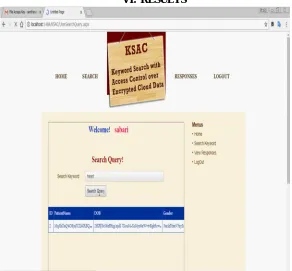
[image:3.612.161.453.448.719.2]VI. RESULTS
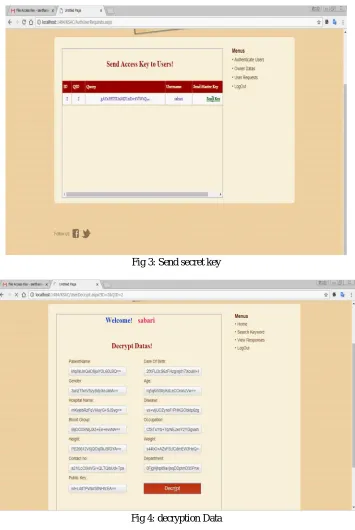
Fig 3: Send secret key
Fig 4: decryption Data
VII. CONCLUSION
REFERENCES
[1] Z. Wan, J. Liu, and R. H. Deng, “HASBE: A hierarchic attribute-based resolution for versatile and climbable access management in cloud computing,” IEEE Transactions on info Forensics and Security, vol. 7, no. 2, pp. 743–754, 2012.
[2] K. Yang, X. Jia, K. Ren, B. Zhang, and R. Xie, “DAC-MACS: Effective knowledge access management for multi-authority cloud storage systems,” IEEE Transactions on info Forensics and Security, vol. 8, no. 11, pp. 1790–1801, 2013.
[3] M. Li, S. Yu, Y. Zheng, K. Ren, and W. Lou, “Scalable and secure sharing of non-public health records in cloud computing victimization attribute-based secret writing,” IEEE Transactions on Parallel and Distributed Systems, vol. 24, no. 1, pp. 131–143, 2013.
[4] Z. Zhou, H. Zhang, Q. Zhang, Y. Xu, and P. Li, “Privacypreserving granular knowledge retrieval indexes for outsourced cloud knowledge,” in Proceedings of the 2014 IEEE world Communications Conference (GLOBECOM2014), pp. 601–606, IEEE, 2014.
[5] Q. Liu, C. C. Tan, J. Wu, and G. Wang, “Reliable re-encryption in unreliable clouds,” in Proceedings of the 2011 IEEE world Communications Conference (GLOBECOM2011), pp. 1–5, IEEE, 2011.
[6] J. Bethencourt, A. Sahai, and B. Waters, “Ciphertext-policy\ attribute-based secret writing,” in Proceedings of the twenty eighth IEEE conference on Security and Privacy (S&P2007), pp. 321–334, IEEE, 2007.
[7] E. Bertino, P. A. Bonatti, and E. Ferrari, “TRBAC: A temporal role-based access management model,” ACM Transactions on info and System Security, vol. 4, no. 3, pp. 191–233, 2001.
[8] R. L. Rivest, A. Shamir, and D. A. Wagner, “Time-lock puzzles and timed-release crypto,” tech. rep., Massachusetts Institute of Technology, 1996.
[9] K. Yuan, Z. Liu, C. Jia, J. Yang, and S. Lv, “Public key timed-release searchable secret writing,” in Proceedings of the 2013 Fourth International rising Intelligent knowledge and internet Technologies (EIDWT2013), pp. 241–248, IEEE, 2013.