Marco Kuhlmann
∗ Link ¨oping UniversityAlexander Koller
∗∗ University of PotsdamGiorgio Satta
† University of PaduaThe weak equivalence of Combinatory Categorial Grammar (CCG) and Tree-Adjoining Gram-mar (TAG) is a central result of the literature on mildly context-sensitive gramGram-mar formalisms. However, the categorial formalism for which this equivalence has been established differs sig-nificantly from the versions of CCG that are in use today. In particular, it allows restriction of combinatory rules on a per grammar basis, whereas modern CCG assumes a universal set of rules, isolating all cross-linguistic variation in the lexicon. In this article we investigate the formal significance of this difference. Our main result is that lexicalized versions of the classical CCG formalism are strictly less powerful than TAG.
1. Introduction
Since the late 1970s, several grammar formalisms have been proposed that extend the power of context-free grammars in restricted ways. The two most prominent members of this class of “mildly context-sensitive” formalisms (a term coined by Joshi 1985) are Tree-Adjoining Grammar (TAG; Joshi and Schabes 1997) and Combinatory Categorial Grammar (CCG; Steedman 2000; Steedman and Baldridge 2011). Both formalisms have been applied to a broad range of linguistic phenomena, and are being widely used in computational linguistics and natural language processing.
In a seminal paper, Vijay-Shanker and Weir (1994) showed that TAG, CCG, and two other mildly context-sensitive formalisms—Head Grammar (Pollard 1984) and Linear Indexed Grammar (Gazdar 1987)—all characterize the same class of string languages. However, when citing this result it is sometimes overlooked that the result applies to a version of CCG that is quite different from the versions that are in practical use today.
∗Department of Computer and Information Science, Link ¨oping University, 581 83 Link ¨oping, Sweden. E-mail:[email protected].
∗∗Department of Linguistics, Karl-Liebknecht-Str. 24–25, University of Potsdam, 14476 Potsdam, Germany. E-mail:[email protected].
†Department of Information Engineering, University of Padua, via Gradenigo 6/A, 35131 Padova, Italy. E-mail:[email protected].
Submission received: 4 December 2013; revised submission received: 26 July 2014; accepted for publication: 25 November 2014.
The goal of this article is to contribute to a better understanding of the significance of this difference.
The difference between “classical” CCG as formalized by Vijay-Shanker and Weir (1994) and the modern perspective may be illustrated with the combinatory rule of backward-crossed composition. The general form of this rule looks as follows:
Backward-crossed composition, general form:
Y/Z X / Y ⇒ X/Z (<B×)
This rule is frequently used in the analysis of heavy NP shift, as in the sentenceKahn blocked skillfully a powerful shot by Rivaldo (example from Baldridge 2002). However, backward crossed composition cannot be universally active in English as this would cause the grammar to also accept strings such as*a powerful by Rivaldo shot, which is witnessed by the derivation in Figure 1. To solve this problem, in the CCG formal-ism of Vijay-Shanker and Weir (1994), one may restrict backward-crossed composition to instances where X and Y are both verbal categories—that is, functions into the category S of sentences (cf. Steedman 2000, Section 4.2.2). With this restriction the unwanted derivation in Figure 1 can be blocked, anda powerful shot by Rivaldois still accepted as grammatical. Other syntactic phenomena require other grammar-specific restrictions, including the complete ban of certain combinatory rules (cf. Steedman 2000, Section 4.2.1).
Over the past 20 years, CCG has evolved to put more emphasis on supporting
fully lexicalizedgrammars (Baldridge and Kruijff 2003; Steedman and Baldridge 2011), in which as much grammatical information as possible is pushed into the lexicon. This follows the tradition of other frameworks such as Lexicalized Tree-Adjoining Grammar (LTAG) and Head-Driven Phrase Structure Grammar (HPSG). Grammar-specific rule restrictions are not connected to individual lexicon entries, and are therefore avoided. Instead, recent versions of CCG have introduced a new, lexicalized control mechanism in the form of modalities orslash types. The basic idea here is that combinatory rules only apply if the slashes in their input categories have the right types. For instance, the modern version of backward-crossed composition (Steedman and Baldridge 2011) takes the following form, where×is a slash type that allows crossed but not harmonic composition:
Backward-crossed composition, modalized form:
Y/×Z X / ×Y ⇒ X/×Z (<B×)
Figure 1
The derivation in Figure 1 can now be blocked by assigning the slash in the category ofpowerfula type that is incompatible with×, and thus cannot feed into type-aware backward-crossed composition as an input category. This “modalization” of grammati-cal composition, which imports some of the central ideas from the type-logigrammati-cal tradition of categorial grammar (Moortgat 2011) into the CCG framework, is attractive because it isolates the control over the applicability of combinatory rules in the lexicon. Quoting Steedman and Baldridge (2011, p. 186):
Without typed slashes, language-specific restrictions or even bans on some combinatory rules are necessary in order to block certain ungrammatical word orders. With them, the combinatory rules are truly universal: the grammar of every language utilizes exactly the same set of rules, without modification, thereby leaving all cross-linguistic variation in the lexicon. As such, CCG is afullylexicalized grammar formalism.
The stated goal is thus to express all linguistically relevant restrictions on the use of combinatory rules in terms of lexically specified, typed slashes. But to what extent can this goal actually be achieved? So far, there have been only partial answers—even when, as in the formalism of Vijay-Shanker and Weir (1994), we restrict ourselves to the rules of composition, but exclude other rules such as type-raising and substitution. Baldridge and Kruijff (2003) note that the machinery of their multi-modal formalism can be simulated by rule restrictions, which shows that this version of lexicalized CCG isat most as expressiveas the classical formalism. At the other end of the spectrum, we have shown in previous work that a “pure” form of lexicalized CCG with neither rule restrictions nor slash types isstrictly less expressive(Kuhlmann, Koller, and Satta 2010). The general question of whether “classical” CCG (rule restrictions) and “modern” CCG (slash types instead of rule restrictions) are weakly equivalent has remained open.
In this article, we answer this question. Our results are summarized in Figure 2. After setting the stage (Section 2), we first pinpoint the exact type of rule restrictions that make the classical CCG formalism weakly equivalent to TAG (Section 3). We do so by focusing on a class of grammars that we callprefix-closed. Unlike the “pure” grammars that we studied in earlier work, prefix-closed grammars do permit rule restrictions (under certain conditions that seem to be satisfied by linguistic grammars). We show that the generative power of prefix-closed CCG depends on its ability to expresstarget restrictions, which are exactly the functions-into type of restrictions that are needed to block the derivation in Figure 1. We prove that the full class of prefix-closed CCGs is weakly equivalent to TAG, and the subclass that cannot express target restrictions is strictly less powerful. This result significantly sharpens the picture of the generative capacity of CCG.
In a further step (Section 4), we then prove that for at least one popular incar-nation of modern, lexicalized CCG, slash types are strictly less expressive than rule
Weakly equivalent to TAG Strictly less powerful than TAG
VW-CCG
Prefix-closed VW-CCG Prefix-closed VW-CCG
with target restrictions (Theorem 2) without target restrictions (Theorem 3)
O-CCG (Theorem 4) Figure 2
restrictions. More specifically, we look at a variant of CCG consisting of the composition rules implemented in OpenCCG (White 2013), the most widely used development platform for CCG grammars. We show that this formalism is (almost) prefix-closed and cannot express target restrictions, which enables us to apply our generative capacity result from the first step. The same result holds for (the composition-only fragment of) the formalism of Baldridge and Kruijff (2003). Thus we find that, at least with existing means, the weak equivalence result of Vijay-Shanker and Weir cannot be obtained for lexicalized CCG. We conclude the article by discussing the implications of our results (Section 5).
2. Background
In this section we provide the technical background of the article. We introduce the basic architecture of CCG, present the formalism of Vijay-Shanker and Weir (1994), and set the points of reference for our results about generative capacity.
2.1 Basic Architecture of CCG
The two central components of CCG are alexiconthat associates words withcategories,
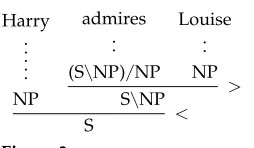
and rulesthat specify how categories can be combined. Taken together, these compo-nents give rise toderivations,such as the one shown in Figure 3.
Lexicon.Acategoryis a syntactic type that identifies a constituent as either “complete” or “incomplete.” The categories of complete constituents are taken to be primitives; the categories of incomplete constituents are modeled as (curried) functions that specify the type and the direction of their arguments. Every category is projected from the lexicon, which is a finite collection of word–category pairs. To give examples (taken from Steedman 2012), an English intransitive verb such as walks has a category that identifies it as a function seeking a (subject) noun phrase to its left (indicated by a backward slash) and returning a complete sentence; and a transitive verb such asadmires
has a category that identifies it as a function seeking an (object) noun phrase to its right (indicated by a forward slash) and returning a constituent that acts as an intransitive verb. We denote lexical assignment using the “colon equals” operator:
walks:=S / NP admires:=(S / NP)/NP
Formally, the setC(A) of categories is built over a finite setAof atomic categories, the primitive syntactic types. It is the smallest set such that
1. ifA∈AthenA∈C(A);
Harry .. .. . NP
admires .. (S / NP)/NP
Louise .. NP
S / NP >
[image:4.486.49.176.568.642.2]S <
Figure 3
2. ifX,Y∈C(A) thenX/Y∈C(A) andX / Y∈C(A).
We use the letters A,B,C to denote atomic categories, the letters X, Y,Z to denote arbitrary categories, and the symbol | to denote slashes (forward or backward). We treat slashes as left-associative operators and omit unnecessary parentheses. By this convention, every categoryXcan be written in the form
X = A|mXm· · · |1X1
where m≥0, A is an atomic category that we call the target of X, and the |iXi are
slash–category pairs that we call theargumentsofX. Intuitively, the target ofXis the atomic category that is obtained afterXhas been applied to all of its arguments. We use the Greek lettersα,β,γto denote (potentially empty) sequences of arguments. The numbermis called thearityof the categoryX.
Rules.Categories can combine under a number of rules; this gives rise to derivations such as the one shown in Figure 3. Each rule specifies an operation that assembles two input categories into an output category. The two most basic rules of CCG are the directed versions of function application:
X/Y Y ⇒ X (forward application) (>)
Y X / Y ⇒ X (backward application) (<)
Formally, a rule is a syntactic object in which the lettersX,Y,Zact as variables for cat-egories. Arule instanceis obtained by substituting concrete categories for all variables in the rule. For example, the derivation in Figure 3 contains the following instances of function application. We denote rule instances by using a triple arrow instead of the double arrow in our notation for rules.
(S / NP)/NP NP S / NP and NP S / NP S
Application rules give rise to derivations equivalent to those of context-free gram-mar. Indeed, versions of categorial grammar where application is the only mode of combination, such as AB-grammar (Ajdukiewicz 1935; Bar-Hillel, Gaifman, and Shamir 1960), can only generate context-free languages. CCG can be more powerful because it also includes other rules, derived from the combinators of combinatory logic (Curry, Feys, and Craig 1958). In this article, as in most of the formal work on CCG, we restrict our attention to the rules of (generalized) composition, which are based on the Bcombinator.1
The general form of composition rules is shown in Figure 4. In each rule, the two input categories are distinguished into oneprimary(shaded) and onesecondaryinput category. The number n of outermost arguments of the secondary input category is called thedegreeof the rule.2 In particular, for n=0 we obtain the rules of function
1 This means that we ignore other rules required for linguistic analysis, in particular type-raising (from the Tcombinator), substitution (from theScombinator), and coordination.
Figure 4
[image:6.486.51.281.173.258.2]General form of composition rules (primary input category shaded), wheren≥0 and|i∈ {/, / }.
Figure 5
Schematic definition of the set of derivation trees of a grammarG.
application. In contexts where we refer to both application and composition, we use the latter term for composition rules with degreen>0.
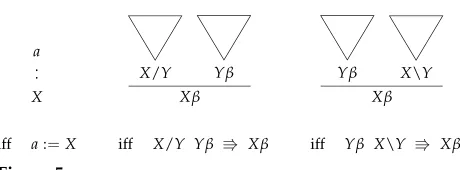
Derivation Trees.Derivation trees can now be schematically defined as in Figure 5. They contain two types of branchings: unary branchings correspond to lexicon entries; binary branchings correspond to rule instances. Theyieldof a derivation tree is the left-to-right concatenation of its leaves.
2.2 Classical CCG
We now define the classical CCG formalism that was studied by Vijay-Shanker and Weir (1994) and originally introduced by Weir and Joshi (1988). As mentioned in Section 1, the central feature of this formalism is its ability to impose restrictions on the applicability of combinatory rules. Specifically, arestricted ruleis a rule annotated with constraints that
(a) restrict the target of the primary input category; and/or
(b) restrict the secondary input category, either in parts or in its entirety.
Every grammar lists a finite number of restricted rules (where one and the same base rule may occur with several different restrictions). Avalid rule instanceis an instance that is compatible with at least one of the restricted rules.
Example 1
sentences, S. Writing targetfor the function that returns the target of a category, the restricted rule can be written as
Y/Z X / Y ⇒ X/Z (backward crossed composition) (<B×)
wheretarget(X)=S andtarget(Y)=S
In the following definition we writeεfor the empty string.
Definition 1
Acombinatory categorial grammarin the sense of Vijay-Shanker and Weir (1994), or VW-CCG for short, is a structure
G = (Σ,A, :=,R,S)
whereΣis a finite vocabulary,A is a finite set of atomic categories, the lexicon :=is a finite relation between the setsΣε= Σ∪ {ε}andC(A),Ris a finite set of (possibly)
restricted rules, andS∈Ais a distinguished atomic category.
A derivation tree ofGconsists of lexicon entries and valid instances of rules fromR. The grammarGgeneratesa stringwif there exists a derivation tree whose yield isw
and whose root node is labeled with the distinguished atomic categoryS. Thelanguage L(G) generated byGis the set of all generated strings.
Example 2
We specify a VW-CCGG1=(Σ1,A1, :=1,R1,S1) that generates the language
L1 ={anbncn|n≥1}.
LetΣ1 ={a,b,c},A1={A,B,C,S},S1 =S, and let :=1consist of the entries
a:=1 A, b:=1S/C, b:=1S/C/B, b:=1B/C, b:=1 B/C/B, c:=1 C / A
Finally, letR1consist of the following rules:
1. Forward and backward application.
2. Forward and backward composition of degree 1.
3. Forward and backward composition of degree 2.
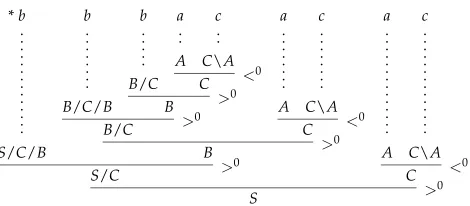
Each of these rules is restricted to instances where the target of the primary input category isS. A sample derivation ofG1 is shown in Figure 6. By contrast, Figure 7 shows a derivation that is not valid inG1because it uses application rules in which the target of the primary input category isBorC(rather thanS).
Example 3
Figure 6
A sample derivation of the grammarG1from Example 2.
Figure 7
A derivation rendered ungrammatical by the rule restrictions inG1.
rule restrictions.3Every AB-grammar can therefore be written as a VW-CCG that allows all instances of application, but no other rules.
The following lemmas establish two fundamental properties of VW-CCG that we shall use at several places in this article. Both of them are minor variants of lemmas proved by Vijay-Shanker and Weir (1994) (Lemma 3.1 and Lemma 3.2) and were previ-ously stated by Weir and Joshi (1988).
Lemma 1
The set of arguments that occur in the derivations of a VW-CCG is finite.
Proof
No composition rule creates new arguments: Every argument that occurs in an output category already occurs in one of the input categories. Therefore, every argument must come from some word–category pair in the lexicon, of which there are only finitely many.
Lemma 2
The set of secondary input categories that occur in the derivations of a VW-CCG is finite.
[image:8.486.51.286.251.354.2]Proof
Every secondary input category is obtained by substituting concrete categories for the variables that occur in the non-shaded component of one of the rules specified in Figure 4. After the substitution, all of these categories occur as part of arguments. Then, with Lemma 1, we deduce that the substituted categories come from a finite set. At the same time, each grammar specifies a finite set of rules. This means that there are only finitely many ways to obtain a secondary input category.
When specifying VW-CCGs, we find it convenient sometimes to provide an explicit list of valid rule instances, rather than a textual description of rule restrictions. For this we use a special type of restricted rule that we calltemplates. A template is a restricted rule that simultaneously fixes both
(a) the target of the primary input category of the rule, and
(b) the entire secondary input category.
We illustrate the idea with an example.
Example 4
We list the templates that correspond to the rule instances in the derivation from Figure 6. (The grammar allows other instances that are not listed here.) We use the symbol as a placeholder for that part of a primary input category that is uncon-strained by rule restrictions, and therefore may consist of an arbitrary sequence of arguments.
A S / A S (1)
S/C C / A S / A (2)
S/B B/C S/C (3)
S/B B/C/B S/C/B (4)
For example, template (1) characterizes backward application (<0) where the target of the primary input category isSand the secondary input category isA, and template (4) characterizes forward composition of degree 2 (>2) where the target of the primary input category isSand the secondary input category isB/C/B.
2.3 Tree-Adjoining Grammar
In this article we are interested in the generative power of CCG, in particular in its re-lation to that of Tree-Adjoining Grammar. We therefore provide a compact introduction to TAG. For more details, we refer to Joshi and Schabes (1997).
Elementary Trees. Tree-Adjoining Grammar is a formalism for generating trees. These trees can be characterized as rooted, ordered trees in which internal nodes are labeled with nonterminal symbols—including a distinguishedstart symbolS—and leaf nodes are labeled with nonterminals, terminals, or the empty string. Every grammar specifies a finite set of such trees; these are called elementary trees. There are two types: ini-tial trees andauxiliary trees. They differ in that auxiliary trees have a distinguished nonterminal-labeled leaf node, called foot node; this node is conventionally marked with an asterisk. An elementary tree whose root node is labeled with a nonterminalA
is called anA-tree.
Substitution and Adjunction.New trees may be derived by combining other trees using two operations called substitution and adjunction. Substitution replaces some leaf node of a given tree with an initial tree (or a tree derived from an initial tree). Adjunction replaces some internal nodeuof a given tree with an auxiliary tree (or a tree derived from an auxiliary tree); the subtree with rootureplaces the foot node of the auxiliary tree. All replacements are subject to the condition that the node being replaced and the root of the tree that replaces it are labeled with the same nonterminal.
Generated Languages.Thetree languagegenerated by a TAG is the set of all trees that can be derived from its initialS-trees. Derivations are considered complete only if they satisfy additional, node-specific constraints. In particular, substitution is obligatory at every node where it is possible, and adjunction may be specified as either obligatory (OA, Obligatory Adjunction) or forbidden (NA, Null Adjunction) at a given node. In derived trees corresponding to complete derivations, all leaf nodes are labeled with terminal symbols. The left-to-right concatenation of these symbols forms theyieldof the tree, and the yields of all trees in the tree language form thestring languagegenerated by the TAG.
Example 5
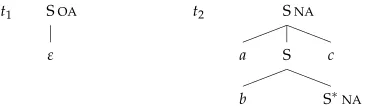
[image:10.486.49.232.582.635.2]Figure 8 shows a TAG that generates the language L1={anbncn|n≥1} defined in Example 2. Derivations start with adjoining the auxiliary treet2at the root of the initial treet1. New trees can be derived by repeatedly adjoiningt2at an S-node.
Figure 8
2.4 Generative Capacity of Classical CCG
Vijay-Shanker and Weir (1994) proved the following:
Theorem 1
VW-CCG and TAG are weakly equivalent.
The inclusion of the VW-CCG languages in the TAG languages follows from a chain of inclusions that connects VW-CCG and TAG via Linear Indexed Grammar (LIG; Gazdar 1987) and Head Grammar (HG; Pollard 1984). All of these inclusions were proved by Vijay-Shanker and Weir (1994). Here we sketch a proof of the inclusion of the TAG languages in the VW-CCG languages. Our proof closely follows that of Weir (1988, Section 5.2.2), whose construction we shall return to when establishing our own results.
Lemma 3
The TAG languages are included in the VW-CCG languages.
Proof (Sketch)
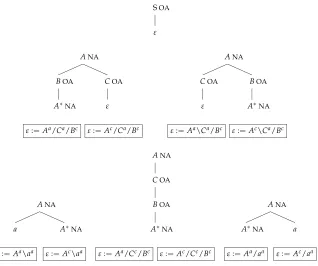
We are given a TAGGand construct a weakly equivalent VW-CCGG. The basic idea is to make the lexical categories ofGcorrespond to the elementary trees ofG, and to set up the combinatory rules and their restrictions in such a way that the derivations ofG
correspond to derivations ofG.
Vocabulary, Atomic Categories.The vocabulary of G is the set of all terminal symbols of G; the set of atomic categories consists of all symbols of the form At, where
ei-therA is a nonterminal symbol of G and t∈ {a,c}, or A is a terminal symbol of G
andt=a. The distinguished atomic category ofG isSa, whereS is the start symbol ofG.
Lexicon.One may assume (cf. Vijay-Shanker, Weir, and Joshi 1986) thatGis in the normal form shown in Figure 9. In this normal form there is a single initial S-tree, and all remaining elementary trees are auxiliary trees of one of five possible types. For each such tree, one constructs two lexicon entries for the empty string ε as specified in Figure 9. Additionally, for each terminal symbolxofG, one constructs a lexicon entry
x:=xa.
Figure 9
Correspondence between elementary trees and lexical categories in the proof of Lemma 3.
lexicon. Second, categories cannot be combined in arbitrary orders. The rule restric-tions are:
1. Forward and backward application are restricted to instances where both the target of the primary input category and the entire secondary input category take the formAa.
2. Forward and backward composition are restricted to instances where the target of the primary input category takes the formAaand the target of the secondary input category takes the formAc.
Using our template notation, the restricted rules can be written as in Figure 10.
Figure 10
Restricted rules used in the proof of Lemma 3. We writeVfor the union of the nonterminal symbols and terminal symbols of the TAGG, and letVt={At|A∈ V},t∈ {a,c}.
3. Relevance of Target Restrictions in Prefix-Closed CCG
In this section we present the central technical results of this article. We study a class of VW-CCGs that we callprefix-closedand show that for this class, weak equivalence with TAG stands and falls with the ability to specify target restrictions.
3.1 Prefix-Closed Grammars
Rule restrictions are important tools in grammars for natural language; but not all of their potential uses have obvious linguistic motivations. For instance, one could write a grammar that permits all compositions with a functional categoryA/Bas the secondary input category, but rules out application with the “shorter” categoryA. Such constraints do not seem to be used in linguistically motivated grammars; for example, none of the grammars developed by Steedman (2000) needs them. In prefix-closed grammars, this use of rule restrictions is explicitly barred.
Definition 2
A VW-CCG isprefix-closedif it satisfies the following implication:
if X/Y Y|nYn· · · |1Y1 X|nYn· · · |1Y1 is a valid rule instance
then so is X/Y Y|nYn· · · |kYk X|nYn· · · |kYk for anyk≥1
and similarly for backward rules.
Note that prefix-closed grammars still allow some types of rule restrictions. The crucial property is that, if a certain combinatory rule applies at all, then it also applies to combinations where the secondary input category has already been applied to some (k≤n) or even all (k>n) of its arguments.
Example 6
We illustrate prefix-closedness using some examples:
1. Every AB-grammar (when seen as a VW-CCG) is trivially prefix-closed; in these grammars,n=0.
3. The grammarG1from Example 2 is prefix-closed.
4. The grammars constructed in the proof of Lemma 3 are not prefix-closed; they do not allow the following instances of application, where the secondary input category is of the formBc(rather thanBa):
Aa/Bc Bc Aa where A,B∈V Bc Aa / Bc Aa where A,B∈V
Example 7
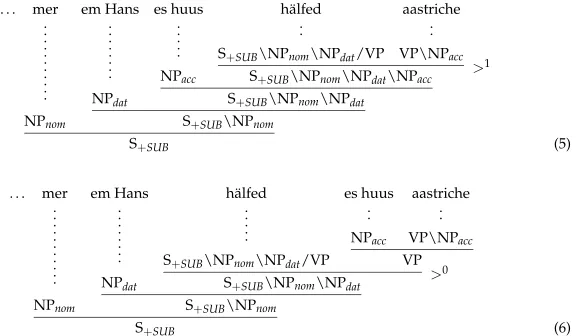
The linguistic intuition underlying prefix-closed grammars is that if such a grammar allows us to delay the combination of a functor and its argument (via composition), then it also allows us to combine the functor and its argument immediately (via ap-plication). To illustrate this intuition, consider Figure 11, which shows two deriva-tions related to the discussion of word order in Swiss German subordinate clauses (Shieber 1985):
. . . mer em Hans es huus h¨alfed aastriche
. . . we Hansdat the houseacc helped paint
“. . . we helped Hans paint the house”
[image:14.486.49.339.466.634.2]Derivation (5) (simplified from Steedman and Baldridge 2011, p. 201) starts by com-posing the tensed verbh¨alfedinto the infinitiveaastricheand then applies the resulting category to the accusative argument of the infinitive, es huus. Prefix-closedness im-plies that, if the combination of h¨alfedand aastricheis allowed when the latter is still waiting for es huus, then it must also be allowed if es huus has already been found.
Figure 11
Thus prefix-closedness predicts derivation (6), and along with it the alternative word order
. . . mer em Hans h¨alfed es huus aastriche
. . . we Hansdat helped the houseacc paint
This word order is in fact grammatical (Shieber 1985, pp. 338–339).
3.2 Generative Capacity of Prefix-Closed Grammars
We now show that the restriction to prefix-closed grammars does not change the gen-erative capacity of VW-CCG.
Theorem 2
Prefix-closed VW-CCG and TAG are weakly equivalent.
Proof
Every prefix-closed VW-CCG is a VW-CCG, therefore the inclusion follows from The-orem 1. To show that every TAG language can be generated by a prefix-closed VW-CCG, we recall the construction of a weakly equivalent VW-CCG for a given TAG that we sketched in the proof of Lemma 3. As already mentioned in Example 6, the grammarG constructed there is not closed. However, we can make it prefix-closed by explicitly allowing the “missing” rule instances:
Aa/Bc Bc Aa where A,B∈V
Bc Aa / Bc Aa where A,B∈V
We shall now argue that this modification does not actually change the language generated by G. The only categories that qualify as secondary input categories of the new instances are atomic categories of the formBc where B is a nonterminal of
the TAG G. Now the lexicalcategories of G either are of the form xa (where x is a
terminal symbol) or are non-atomic. Categories of the formBcare not among thederived
categories of G either, as the combinatory rules only yield output categories whose targets have the form Ba. This means that the new rule instances can never be used in a complete derivation ofG, and therefore do not change the generated language. Thus we have a construction that turns a TAG into a weakly equivalent prefix-closed VW-CCG.
3.3 Prefix-Closed Grammars Without Target Restrictions
Definition 3
A VW-CCG iswithout target restrictionsif it satisfies the following implication:
if X/Y Yβ Xβ is a valid rule instance
then so is X¯/Y Yβ X¯β for any category ¯Xof the grammar
and similarly for backward rules.
Example 8
1. Every AB-grammar is without target restrictions; it allows forward and backward application for every primary input category.
2. The grammarG1from Example (2) isnotwithout target restrictions, because its rules are restricted to primary input categories with targetS.
Target restrictions on the primary input category are useful in CCGs for natural languages; recall our discussion of backward-crossed composition in Section 1. As we shall see, target restrictions are also relevant from a formal point of view: If we require VW-CCGs to be without target restrictions, then we lose some of their weak generative capacity. This is the main technical result of this article. For its proof we need the following standard concept from formal language theory:
Definition 4
Two languages LandL areParikh-equivalentif for every stringw∈L there exists a permuted versionwofwsuch thatw∈L, and vice versa.
Theorem 3
The languages generated by prefix-closed VW-CCG without target restrictions are prop-erly included in the TAG languages.
Proof
Every prefix-closed VW-CCG without target restrictions is a VW-CCG, so the inclusion follows from Theorem 1. To see that the inclusion is proper, consider the TAG language
L1={anbncn|n≥1}from Example 5. We are interested in sublanguagesL⊆L1 that are Parikh-equivalent to the full languageL1. This property is trivially satisfied byL1 itself. Moreover, it is not hard to see thatL1is in fact theonlysublanguage ofL1that has this property. Now in Section 3.4 we shall prove a central lemma (Lemma 6), which asserts that, if we assume that L1 is generated by a prefix-closed VW-CCG without target restrictions, then at least one of the Parikh-equivalent sublanguages ofL1must be context-free. BecauseL1is the only such sublanguage, this would give us proof thatL1 is context-free; but we know it is not. Therefore we conclude thatL1is not generated by a prefix-closed VW-CCG without target restrictions.
Before turning to the proof of the central lemma (Lemma 6), we establish two other results about the languages generated by grammars without target restrictions.
Lemma 4
Proof
Inclusion follows from the fact that AB-grammars (which generate all context-free lan-guages) are prefix-closed VW-CCGs without target restrictions. To see that the inclusion is proper, consider a grammarG2that is likeG1but does not have any rule restrictions. This grammar is trivially prefix-closed and without target restrictions; it is actually “pure” in the sense of Kuhlmann, Koller, and Satta (2010). The languageL2=L(G2) contains all the strings inL1 ={anbncn|n≥1}, together with other strings, including the stringbbbacacac, whose derivation we showed in Figure 7. It is not hard to see that all of these additional strings have an equal number ofas,bs, andcs. We can therefore writeL1 as an intersection ofL2 and a regular language:L1=L2∩a∗b∗c∗. To obtain a contradiction, suppose thatL2 is context-free; then because of the fact that context-free languages are closed under intersection with regular languages, the languageL1would be context-free as well—but we know it is not. Therefore we conclude that L2 is not context-free either.
Lemma 5
The class of languages generated by prefix-closed VW-CCG without target restrictions is not closed under intersection with regular languages.
Proof
If the class of languages generated by prefix-closed VW-CCG without target restrictions was closed under intersection with regular languages, then with L2 (the language mentioned in the previous proof) it would also include the languageL1=L2∩a∗b∗c∗. However, from the proof of Theorem 3 we know thatL1is not generated by any prefix-closed VW-CCG without target restrictions.
3.4 Proof of the Main Lemma for VW-CCG
We shall now prove the central lemma that we used in the proof of Theorem 3.
Lemma 6 (Main Lemma for VW-CCG)
For every languageLthat is generated by some prefix-closed VW-CCG without target restrictions, there is a sublanguageL⊆Lsuch that
1. LandLare Parikh-equivalent, and 2. Lis context-free.
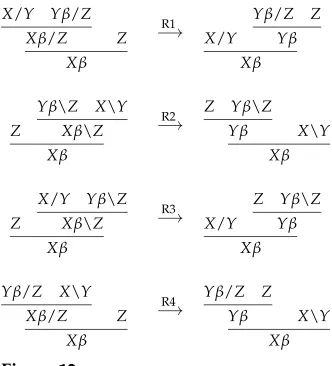
Throughout this section, we letGbe some arbitrary prefix-closed VW-CCG without target restrictions. The basic idea is to transform the derivations ofGinto a certain spe-cial form, and to prove that the transformed derivations yield a context-free language. The transformation is formalized by the rewriting system in Figure 12.4 To see how the rules of this system work, consider rule R1; the other rules are symmetric. Rule R1 rewrites an entire derivation into another derivation. It states that, whenever we have a situation where a category of the formX/Yis combined with a category of the form
Yβ/Z by means of composition, and the resulting category is combined with a cate-goryZby means of application, then we may just as well first combineYβ/ZwithZ, and then use the resulting category as a secondary input category together withX/Y.
Figure 12
Rewriting rules used in the transformation.
Note that R1 and R2 produce a new derivation for the original sentence, whereas R3 and R4 produce a derivation that yields a permutation of that sentence: The order of the substrings corresponding to the categoriesZandX/Y(in the case of rule R3) or
X / Y(in the case of rule R4) is reversed. In particular, R3 captures the relation between the two derivations of Swiss German word orders shown in Figure 11: Applying R3 to derivation (5) gives derivation (6). Importantly though, while the transformation may reorder the yield of a derivation, every transformed derivation still is a derivation ofG.
Example 9
If we take the derivation in Figure 6 and exhaustively apply the rewriting rules from Figure 12, then the derivation that we obtain is the one in Figure 7. Note that although the latter derivation is not grammatical with respect to the grammarG1from Example 2, itisgrammatical with respect to the grammarG2from the proof of Lemma 4, which is without target restrictions.
It is instructive to compare the rewriting rules in Figure 12 to the rules that establish the normal form of Eisner (1996). This normal form is used in practical CCG parsers to solve the problem of “spurious ambiguity,” where one and the same semantic interpre-tation (which in CCG takes the form of a lambda term) has multiple syntactic derivation trees. It is established by rewriting rules such as the following:
X/Y Yβ/Z
Xβ/Z † Zγ
Xβγ
−→ X/Y Yβ/YZ Zβγ γ
Xβγ ††
(5)
preserves yields. Second, our rules decrease the degrees of the involved composition operations, whereas Eisner’s rules may in factincreasethem. To see this, note that the left-hand side of derivation (7) involves a composition of degree|β|+1 (†), whereas the right-hand side involves a composition of degree |β|+|γ| (††). This means that rewriting will increase the degree in situations where |γ|>1. In contrast, our rules only fire in the case where the combination with Z happens by means of an appli-cation, that is, if |γ|=0. Under this condition, each rewrite step is guaranteed to decrease the degree of the composition. We will use this observation in the proof of Lemma 7.
3.4.1 Properties of the Transformation. The next two lemmas show that the rewriting system in Figure 12 implements a total function on the derivations ofG.
Lemma 7
The rewriting system is terminating and confluent: Rewriting a derivation ends after a finite number of steps, and different rewriting orders all result in the same output.
Proof
To argue that the system is terminating, we note that each rewriting step decreases the arity of one secondary input category in the derivation by one unit, while all other secondary input categories are left unchanged. As an example, consider rewriting under R1. The secondary input categories in the scope of that rule are Yβ/Z and Z
on the left-hand side and Yβ and Z on the right-hand side. Here the arity of Yβ
equals the arity ofYβ/Z, minus one. Because the system is terminating, to see that it is also confluent, it suffices to note that the left-hand sides of the rewrite rules do not overlap.
Lemma 8
The rewriting system transforms derivations ofGinto derivations ofG.
Proof
We prove the stronger result that every rewriting step transforms derivations ofGinto derivations ofG. We only consider rewriting under R1; the arguments for the other rules are similar. Assume that R1 is applied to a derivation ofG. The rule instances in the scope of the left-hand side of R1 take the following form:
X/Y Yβ/Z Xβ/Z (8)
Xβ/Z Z Xβ (9)
Turning to the right-hand side, the rule instances in the rewritten derivation are
Yβ/Z Z Yβ (10)
X/Y Yβ Xβ (11)
instance (11) is valid as well. Similarly, the relation between instances (9) and (10) is the characteristic relation of grammars without target restrictions (Definition 3): If in-stance (9) is valid, then becauseGis without target restrictions, instance (10) is valid as well. We conclude that if R1 is applied to a derivation ofG, then the result is another derivation ofG.
Combining Lemma 7 and Lemma 8, we see that for every derivation d of G, exhaustive application of the rewriting rules produces another uniquely determined derivation ofG. We shall refer to this derivation asR(d). Atransformed derivationis any derivationdsuch thatd=R(d) for some derivationd.
3.4.2 Language I nclusion and P arikh-Equivalence
Lemma 9
The yields of the transformed derivations are a subset of and Parikh-equivalent toL(G).
Proof
LetYbe the set of yields of the transformed derivations. Every stringw∈Yis obtained from a string w∈L(G) by choosing some derivation dof w, rewriting this derivation into the transformed derivationR(d), and taking the yield. Inclusion then follows from Lemma 8. Because of the permuting rules R3 and R4, the stringswandwwill in general be different. What we can say, however, is thatwandwwill be equal up to permutation. Thus we have established thatYandL(G) are Parikh-equivalent.
What remains in order to prove Lemma 6 is to show that the yields of the trans-formed derivations form a context-free language.
3.4.3 Context-Freeness of the Sublanguage.In a derivation tree, every node except the root node is labeled with either the primary or the secondary input category of a combina-tory rule. We refer to these two types of nodes asprimary nodesandsecondary nodes, respectively. To simplify our presentation, we shall treat the root node as a secondary node. We restrict our attention to derivation trees for strings in L(G); in these trees, the root node is labeled with the distinguished atomic categoryS. For a leaf nodeu, theprojection pathof uis the path that starts at the parent ofuand ends at the first secondary node that is encountered on the way towards the root node. We denote a projection path as a sequenceX1,. . .,Xn(n≥1), whereX1is the category at the parent ofuand Xnis the category at the secondary node. Note that the categoryX1 is taken from the lexicon, while every other category is derived by combining the preceding category on the path with some secondary input category (not on the path) by means of some combinatory rule.
Example 10
A projection pathX1,. . .,Xnissplitif it can be segmented into two parts
X1,. . .,Xs and Xs,. . .,Xn (1≤s≤n)
such that the first part only uses application rules and the second part only uses composition rules. Note that any part may consist of a single category only, in which case no combinatory rule is used in that part. Ifn=1, then the path is trivially split. All projection paths in Figures 6 and 7 are split, except for the path of the firstbin Figure 6, which alternates between composition (withC / A) and application (withA).
Lemma 10
In transformed derivations, every projection path is split.
Proof
We show that as long as a derivationd contains a projection path that is not split, it can be rewritten. A projection path that is not split contains three adjacent categories
U,V,W, such thatVis derived by means of acompositionwith primary inputU, andW
is derived by means of an application with primary input V. Suppose that both the composition and the application are forward. (The arguments for the other three cases are similar.) ThenUcan be written asX/Yfor some categoryXand argument /Y,V
can be written asXβ/Z for some argument/Zand some (possibly empty) sequence of argumentsβ, andW can be written asXβ. We can then convince ourselves that d
contains the following configuration, which matches the left-hand side of rewriting rule R1:
X/Y Yβ/Z
Xβ/Z Z
Xβ
Lemma 11
The set of all categories that occur in transformed derivations is finite.
Proof
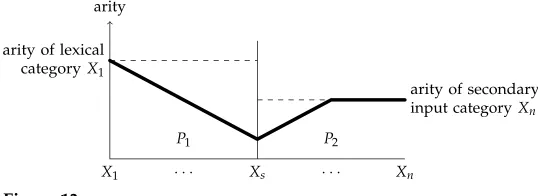
Every category that occurs in transformed derivations occurs on some of its projection paths. Consider any such path. By Lemma 10 we know that this path is split; its two parts, here calledP1andP2, are visualized in Figure 13. We now reason about the arities of the categories in these two parts.
1. BecauseP1only uses application, the arities in this part get smaller and smaller until they reach their minimum atXs. This means that the arities
ofP1are bounded by the arity of the first category on the path, which is a category from the lexicon.
2. BecauseP2only uses composition, the arities in this part either get larger or stay the same until they reach a maximum atXn. This means that the
Figure 13
Illustration of the argument used in the proof of Lemma 11.
Thus the arities of our chosen path are bounded by the maximum of three grammar-specific constants: the maximal arity of a lexical category, the arity of S(which is 0), and the maximal arity of a secondary input category. The latter value is well-defined because there are only finitely many such categories (by Lemma 2). Let k be the maximum among the three constants, and let K be the set of all categories of the
form A|mXm· · · |1X1 where A is an atomic category of G, m≤k, and each|iXi is an
argument that may occur in derivations of G. The set K contains all categories that occur on some projection path, and therefore all categories that occur in transformed derivations, but it may also include other categories. As there are only finitely many atomic categories and finitely many arguments (Lemma 1), we conclude that the setK, and hence the set of categories that occur in transformed derivations, are finite as well.
Lemma 12
The transformed derivations yield a context-free language.
Proof
We construct a context-free grammarHthat generates the setY of yields of the trans-formed derivations. To simplify the presentation, we first construct a grammarHthat generates a superset ofY.
Construction of H.The construction of the grammarHis the same as the construction in the classical proof that showed the context-freeness of AB-grammars, by Bar-Hillel, Gaifman, and Shamir (1960): The production rules ofHare set up to correspond to the valid rule instances ofG. The reason that this construction is not useful for VW-CCGs in general is that these may admit infinitely many rule instances, whereas a context-free grammar can only have finitely many productions. The set of rule instances may be infinite because VW-CCG has access to composition rules (specifically, rules of degrees greater than 1); in contrast, AB-grammars are restricted to application. Crucially though, by Lemma 11 we know that as long as we are interested only intransformedderivations it is sufficient to use a finitenumber of rule instances—more specifically those whose input and output categories are included in the setKof arity-bounded categories. Thus for every instanceX/Y Yβ Xβwhere all three categories are inK, we construct a production
and similarly for backward rules. (We enclose categories in square brackets for clarity.) In addition, for every lexicon entryσ:=Xin Gwe add toH a production [X]→σ. As the terminal alphabet of H we choose the vocabulary of G; as the nonterminal alphabet we choose the setK; and as the start symbol we choose the distinguished atomic categoryS. Every transformed derivation ofGcorresponds (in an obvious way) to some derivation inH, which proves that Y⊆L(H). Conversely, every derivation ofH represents a derivation ofG(though not necessarily a transformed derivation), thusL(H)⊆L(G).
Construction of H. The chain of inclusions Y⊆L(H)⊆L(G) is sufficient to prove Lemma 6: BecauseY and L(G) are Parikh-equivalent (which we observed at the be-ginning of Section 3.4.2), so areL(H) and L(G), which means thatL(H) satisfies all of the properties claimed in Lemma 6, even though this does not suffice to prove our current lemma. However, onceHis given, it is not hard to also obtain a grammarHthat generatesexactlyY. For this, we need to filter out derivations whose projection paths do not have the characteristic property of transformed derivations that we established in Lemma 10. (It is not hard to see that every derivation thatdoeshave this property is a transformed derivation.) We annotate the left-hand side nonterminals in the produc-tions ofHwith a flagt∈ {a,c}to reflect whether the corresponding category has been derived by means of application (t=a) or composition (t=c); the value of this flag is simply the type of combinatory rule that gave rise to the production. The nonterminals in the right-hand sides are annotated in all possible ways, except that the following combinations are ruled out:
[X]a→[X/Y]c[Y]t and [X]a→[Y]t[X Y/ ]c t∈ {a,c}
These combinations represent exactly the cases where the output category of a compo-sition rule is used as the primary input category of an application rule, which are the cases that violate the “split” property that we established in Lemma 10.
This concludes the proof of Lemma 6, and therefore the proof of Theorem 3.
3.5 Discussion
Theorem 3 pinpoints the exact mechanism that VW-CCG uses to achieve weak equiv-alence to TAG: At least for the class of prefix-closed grammars, TAG equivequiv-alence is achieved if and only if we allow target restrictions. Although target restrictions are frequently used in linguistically motivated grammars, it is important and perhaps surprising to realize that they are indeednecessaryto achieve the full generative capacity of VW-CCG.
In the grammar formalisms folklore, the generative capacity of CCG is often at-tributed to generalized composition, and indeed we have seen (in Lemma 4) that even grammars without target restrictions can generate non-context-free languages such as
Figure 6), while transformed derivations are characterized by projection paths without such alternations (Lemma 10).
We can sharpen the picture even more by observing that the target restrictions that are crucial for the generative capacity of VW-CCG are not those on generalized composition, but those on function application. To see this we can note that the proof of Lemma 8 goes through also only if application rules such as (9) and (10) are without target restrictions. This means that we have the following qualification of Theorem 1.
Lemma 13
Prefix-closed VW-CCG is weakly equivalent to TAG only because it supports target restrictions on forward and backward application.
This finding is unexpected indeed—for instance, no grammar in Steedman (2000) uses target restrictions on the application rules.
4. Generative Capacity of Multimodal CCG
After clarifying the mechanisms that “classical” CCG uses to achieve weak equivalence with TAG, we now turn our attention to “modern,” multimodal versions of CCG (Baldridge and Kruijff 2003; Steedman and Baldridge 2011). These versions emphasize the use of fully lexicalized grammars in which no rule restrictions are allowed, and instead equip slashes withtypesin order to control the use of the combinatory rules. Our central question is whether the use of slash types is sufficient to recover the expressiveness that we lose by giving up rule restrictions.
We need to fix a specific variant of multimodal CCG to study this question formally. Published works on multimodal CCG differ with respect to the specific inventories of slash types they assume. Some important details, such as a precise definition of gener-alized composition with slash types, are typically not discussed at all. In this article we define a variant of multimodal CCG which we call O-CCG. This formalism extends our definition of VW-CCG (Definition 1) with the slash inventory and the composition rules of the popular OpenCCG grammar development system (White 2013). Our technical result is that the main Lemma (Lemma 6) also holds for O-CCG. With this we can conclude that the answer to our question is negative: Slash types arenotsufficient to replace rule restrictions; O-CCG is strictly less powerful than TAG. Although this is primarily a theoretical result, at the end of this section we also discuss its implications for practical grammar development.
4.1 Multimodal CCG
We define O-CCG as a formalism that extends VW-CCG with the slash types of OpenCCG, but abandons rule restrictions. Note that OpenCCG has a number of ad-ditional features that affect the generative capacity; we discuss these in Section 4.4.
Slash Types.Like other incarnations of multimodal CCG, O-CCG uses an enriched notion of categories where every slash has atype. There are eight such types:5
core types: ∗ × · left types: × right types: ×
Figure 14
Compatibility of slash types with combinatory rules.
The basic idea behind these types is as follows. Slashes with type∗can only be used to instantiate application rules. Type also licenses harmoniccomposition rules, and type×also licenses crossedcomposition rules. Type · is the least restrictive type and can be used to instantiate all rules. The remaining types refine the system by incorpo-rating a dimension of directionality. The exact type–rule compatibilities are specified in Figure 14.
Inertness.O-CCG is distinguished from other versions of multimodal CCG, such as that of Baldridge and Kruijff (2003), in that every slash not only has a type but also an inertness status. Inertness was introduced by Baldridge (2002, Section 8.2.2) as an im-plementation of the “antecedent government” (ANT) feature of Steedman (1996), which is used to control the word order in certain English relative clauses. It is a two-valued feature. Arguments whose slash type has inertness status+are calledactive; arguments whose slash type has inertness status− are called inert. Only active arguments can be eliminated by means of combinatory rules; however, an inert argument can still be consumed as part of a secondary input category. For example, the following instance of application is valid because the outermost slash of the primary input category has inertness status+:
X/+(Y/−Z) Y/−Z X
We use the notations /s
t and / st to denote the forward and backward slashes with
slash typetand inertness statuss.
Rules.All O-CCG grammars share a fixed set of combinatory rules, shown in Figure 15. Every grammar uses all rules, up to some grammar-specific bound on the degree of generalized composition. As mentioned earlier, a combinatory rule can only be in-stantiated if the slashes of the input categories have compatible types. Additionally, all composition rules require the slashes of the secondary input category to have a uniform direction. This is a somewhat peculiar feature of OpenCCG, and is in contrast to VW-CCG and other versions of CCG, which also allow composition rules with mixed directions.
Composition rules are classified intoharmonicandcrossedforms. This distinction is based on the direction of the slashes in the secondary input category. If these have the same direction as the outermost slash of the primary input category, then the rule is called harmonic; otherwise it is called crossed.6
Figure 15
The rules of O-CCG. For a rule to apply, all slashes in the scope of the rule must have one of the specified compatible types (cf. Figure 14). The predicates left(t)/right(t) are true if and only iftis equal to either a left/right type or one of the four undirected core types.
When a rule is applied, in most cases the arguments of the secondary input category are simply copied into the output category, as in VW-CCG. The one exception happens for crossed composition rules if not all slash directions match the direction of their slash type (left or right). In this case, the arguments of the secondary input category become inert. Thus the inertness status of an argument may change over the course of a derivation—but only from active to inert, not back again.
Definition 5
Amultimodal combinatory categorial grammarin the sense of OpenCCG, or O-CCG for short, is a structure
G=(Σ,A, :=,d,S)
whereΣis a finite vocabulary,Ais a finite set of atomic categories, :=is a finite relation betweenΣand the set of (multimodal) categories overA,d≥0 is the maximal degree of generalized composition, andS∈Ais a distinguished atomic category.
4.2 Generative Capacity
We now investigate the generative capacity of O-CCG. We start with the (unsurprising) observation that O-CCG can describe non-context-free languages.
Lemma 14
The languages generated by O-CCG properly include the context-free languages.
Proof
Inclusion follows from the fact that every AB-grammar can be written as an O-CCG with only application (d=0). To show that the inclusion is proper, we use the same argument as in the proof of Lemma 4. The grammarG2 that we constructed there can be turned into an equivalent O-CCG by decorating each slash with·, the least restrictive type, and setting its inertness status to+.
What is less obvious is whether O-CCG generates the same class of languages as VW-CCG and TAG. Our main result is that this is not the case.
Theorem 4
The languages generated by O-CCG are properly included in the TAG languages.
O-CCG without Inertness.To approach Theorem 4, we set inertness aside for a moment and focus on the use of the slash types as a mechanism for imposing rule restrictions. Each of the rules in Figure 15 requires all of the slash types of thenoutermost arguments of its secondary input category to be compatible with the rule, in the sense specified in Figure 14. If we now remove one or more of these arguments from a valid rule instance, then the new instance is clearly still valid, as we have reduced the number of potential violations of the type–rule compatibility. This shows that the rule system is prefix-closed. As none of the rules is conditioned on the target of the primary input category, the rule system is even without target restrictions. With these two properties established, Theorem 4 can be proved by literally the same arguments as those that we gave in Section 3. Thus we see directly that the theorem holds for versions of multi-modal CCG without inertness, such as the formalism of Baldridge and Kruijff (2003).
O-CCG with Inertness.In the general case, the situation is complicated by the fact that the crossed composition rules change the inertness status of some argument categories if the slash types have conflicting directions. This means that the crossed composition rules in O-CCG are not entirely prefix-closed, as illustrated by the following example.
Example 11
Consider the following two rule instances:
X/+×Y Y +/ ×Z2 / +×Z1 X / −×Z2 / −×Z1 (12)
X/+×Y Y / +×Z2 X / −×Z2 (13)
therefore the inertness status of / +×Z2is not changed, but is carried over to the output category.
We therefore have to prove that the following analogue of Lemma 6 holds for O-CCG:
Lemma 15 (Main Lemma for O-CCG)
For every languageLgenerated by some O-CCG there is a sublanguageL⊆Lsuch that
1. LandLare Parikh-equivalent, and 2. Lis context-free.
This lemma implies that the languageL1={anbncn|n≥1}from Example 2 cannot be generated by O-CCG (but by prefix-closed VW-CCG with target restrictions, and by TAG). The argument is the same as in the proof of Theorem 3.
4.3 Proof of the Main Lemma for O-CCG
The proof of Lemma 15 adapts the rewriting system from Figure 12. We simply let each rewriting step copy the type and inertness status of each slash from the left-hand side to the right-hand side of the rewriting rule. With this change, it is easy to verify that the proofs of Lemma 7 (termination and confluence), Lemma 10 (projection paths in transformed derivations are split), Lemma 11 (transformed derivations contain a finite number of categories), and Lemma 12 (transformed derivations yield a context-free language) go through without problems. The proof of Lemma 8, however, is not straightforward, because of the dynamic nature of the inertness statuses. We therefore restate the lemma for O-CCG:
Lemma 16
The rewriting system transforms O-CCG derivations into O-CCG derivations.
Proof
As in the proof of Lemma 8 we establish the stronger result that the claimed property holds for every single rewriting step. We only give the argument for rewriting under R3, which involves instances of forward crossed composition. The argument for R4 is anal-ogous, and R1 and R2 are simpler cases because they involve harmonic composition, where the inertness status does not change.
Suppose that R3 is applied to a derivation of some O-CCG. In their most general form, the rule instances in the scope of the left-hand side of R3 may be written as follows, where the functionσis defined as specified in Figure 15:
X/+t0Y Y / sn
tnZn· · · /
s2
t2Z2 /
s1
t1Z1 X /
σ(sn)
tn Zn· · · /
σ(s2)
t2 Z2 / σ(s1)
t1 Z1 (14)
Z1 X / σtn(sn)Zn· · · /
σ(s2)
t2 Z2 / +
t1Z1 X /
σ(sn)
tn Zn· · · /
σ(s2)
Here instance (14) is an instance of forward-crossed composition, so each of the typesti
is compatible with that rule. Because the two marked arguments are identical, we have σ(s1)= +. This is only possible if the inertness statuses of the slashes / stii do not change in the context of derivation (14), that is, if σ(si)=si for all 1≤i≤n. Note that in
this case,t0 is either a right type or one of the four undirected core types, and each t1,. . .,tnis either a left type or a core type. We can now alternatively write instances (14)
and (15) as
X/+t0Y Y / sn
tnZn· · · /
s2
t2Z2 / +
t1Z1 X /
sn
tnZn· · · /
s2
t2Z2 / +
t1Z1 (14
)
Z1 X / stnnZn· · · /
s2
t2Z2 / +
t1Z1 X /
sn
tnZn· · · /
s2
t1Z2 (15
)
Then the rule instances in the rewritten derivation can be written as follows:
Z1 Y / stnnZn· · · /
s2
t2Z2 / +
t1Z1 Y /
sn
tnZn· · · /
s2
t2Z2 (16)
X/+t 0Y Y /
sn
tnZn· · · /
s2
t2Z2 X /
sn
tnZn· · · /
s2
t2Z2 (17)
Here instance (16) is clearly a valid instance of backward application. Based on our earlier observations about thetiand their compatibility with crossed composition, we
also see that instance (17) is a valid instance of forward crossed composition (ifn>1), or of forward application (ifn=1).
This completes the proof of Lemma 15. To finish the proof of Theorem 4 we have to also establish the inclusion of the O-CCG languages in the TAG languages. This is a known result for other dialects of multimodal CCG (Baldridge and Kruijff 2003), but O-CCG once again requires some extra work because of inertness.
Lemma 17
The O-CCG languages are included in the TAG languages.
Proof (Sketch)
It suffices to show that the O-CCG languages are included in the class of languages generated by LIG (Gazdar 1987); the claim then follows from the weak equivalence of LIG and TAG. Vijay-Shanker and Weir (1994, Section 3.1) present a construction that transforms an arbitrary VW-CCG into a weakly equivalent LIG. It is straightforward to adapt their construction to O-CCG. As we do not have the space here to define LIG, we only provide a sketch of the adapted construction.
As in the case of VW-CCG, the valid instances of an O-CCG rule can be writ-ten down using our template notation. The adapted construction converts each such template into a production rule of a weakly equivalent LIG. Consider for instance the following instance of forward crossed composition from Example 11:
This template is converted into the following LIG rule. We adopt the notation of Vijay-Shanker and Weir (1994) and write◦◦for the tail of a stack of unbounded size.
A[◦◦ / −×Z2 ×−/ Z1] → A[◦◦/+×Y] Y[ / +×Z2 / +×Z1]
In this way, every O-CCG can be written as a weakly equivalent LIG.
4.4 Discussion
In this section we have shown that the languages generated by O-CCG are properly included in the languages generated by TAG, and equivalently, in the languages gen-erated by VW-CCG. This means that the multimodal machinery of OpenCCG is not powerful enough to express the rule restrictions of VW-CCG in a fully lexicalized way. The result is easy to obtain for O-CCG without inertness, which is prefix-closed and without target restrictions; but it is remarkably robust in that it also applies to O-CCG with inertness, which is not prefix-closed. As we have already mentioned, the result carries over also to other multimodal versions of CCG, such as the formalism of Baldridge and Kruijff (2003).
Our result has implications for practical grammar development with OpenCCG. To illustrate this, recall Example 7, which showed that every VW-CCG without target restrictions for Swiss German that allows cross–serial word orders as in derivation (5) also permits alternative word orders, as in derivation (6). By Lemma 15, this remains true for O-CCG or weaker multimodal formalisms. This is not a problem in the case of Swiss German, where the alternative word orders are grammatical. However, there is at least one language, Dutch, where dependencies in subordinate clausesmustcross. For this case, our result shows that the modalized composition rules of OpenCCG are not powerful enough to write adequate grammars. Consider the following classical example:
. . . ik Cecilia de paarden zag voeren
. . . I Cecilia the horses saw feed
“. . . I saw Cecilia feed the horses”
The straightforward derivation of the cross–serial dependencies in this sentence (adapted from Steedman 2000, p. 141) is exemplified in Figure 16. It takes the same form as derivation (5) for Swiss German: The verbs and their NP arguments lie on a single, right-branching path projected from the tensed verbzag. This projection path is not split; specifically, it starts with a composition that produces a category which acts as the primary input category of an application. As a consequence, the derivation can be transformed (by our rewriting rule R3) in exactly the same way as instance (5) could be transformed into derivation (6). The crucial difference is that the yield of the trans-formed derivation,*ik Cecilia zag de paarden voeren, is not a grammatical clause of Dutch. To address the problem of ungrammatical word orders in Dutch subordinate clauses, the VW-CCG grammar of Steedman (2000) and the multimodal CCG grammar of Baldridge (2002, Section 5.3.1) resort to combinatorial rules other than composi-tion. In particular, they assume that all complement noun phrases undergoobligatory
Figure 16
Straightforward derivation of Dutch cross–serial dependencies.
Figure 17
Derivation of Dutch cross–serial dependencies with type-raised noun complements.
now is a secondary rather than a primary input category. As a consequence, this grammar is capable of enforcing the obligatory cross-serial dependencies of Dutch. However, it is important to note that it requires type-raising over arbitary categories with target S (observe the increasingly complex type-raised categories for the NPs). This kind of type-raising is allowed in many variants of CCG, including the full for-malism underlying OpenCCG. VW-CCG and O-CCG, however, are limited to gen-eralized composition, and can only support derivations like the one in Figure 17 if all the type-raised categories for the noun phrases are available in the lexicon. The unbounded type-raising required by the Steedman–Baldridge analysis of Dutch would translate into an infinite lexicon, and so this analysis is not possible in VW-CCG and O-CCG.
[image:31.486.54.436.212.302.2]