Embedding Words and Senses Together
via Joint Knowledge-Enhanced Training
Massimiliano Mancini*, Jose Camacho-Collados*, Ignacio Iacobacci and Roberto Navigli Department of Computer Science
Sapienza University of Rome [email protected]
{collados,iacobacci,navigli}@di.uniroma1.it
Abstract
Word embeddings are widely used in Nat-ural Language Processing, mainly due to their success in capturing semantic infor-mation from massive corpora. However, their creation process does not allow the different meanings of a word to be auto-matically separated, as it conflates them into a single vector. We address this issue by proposing a new model which learns word and sense embeddings jointly. Our model exploits large corpora and knowl-edge from semantic networks in order to produce a unified vector space of word and sense embeddings. We evaluate the main features of our approach both qual-itatively and quantqual-itatively in a variety of tasks, highlighting the advantages of the proposed method in comparison to state-of-the-art word- and sense-based models.
1 Introduction
Recently, approaches based on neural networks which embed words into low-dimensional vector spaces from text corpora (i.e. word embeddings) have become increasingly popular (Mikolov et al.,
2013;Pennington et al.,2014). Word embeddings have proved to be beneficial in many Natural Lan-guage Processing tasks, such as Machine Transla-tion (Zou et al., 2013), syntactic parsing (Weiss et al., 2015), and Question Answering (Bordes et al., 2014), to name a few. Despite their suc-cess in capturing semantic properties of words, these representations are generally hampered by an important limitation: the inability to discrimi-nate among different meanings of the same word.
Authors marked with an asterisk (*) contributed equally.
Previous works have addressed this limita-tion by automatically inducing word senses from monolingual corpora (Sch¨utze, 1998; Reisinger and Mooney,2010;Huang et al.,2012;Di Marco and Navigli,2013;Neelakantan et al.,2014;Tian et al., 2014; Li and Jurafsky, 2015; Vu and Parker, 2016;Qiu et al., 2016), or bilingual par-allel data (Guo et al.,2014;Ettinger et al.,2016;
ˇSuster et al., 2016). However, these approaches learn solely on the basis of statistics extracted from text corpora and do not exploit knowl-edge from semantic networks. Additionally, their induced senses are neither readily interpretable (Panchenko et al., 2017) nor easily mappable to lexical resources, which limits their application. Recent approaches have utilized semantic net-works to inject knowledge into existing word rep-resentations (Yu and Dredze,2014;Faruqui et al.,
2015;Goikoetxea et al.,2015;Speer and Lowry-Duda,2017;Mrksic et al.,2017), but without solv-ing the meansolv-ing conflation issue. In order to ob-tain a representation for each sense of a word, a number of approaches have leveraged lexical resources to learn sense embeddings as a result of post-processing conventional word embeddings (Chen et al., 2014; Johansson and Pina, 2015;
Jauhar et al.,2015;Rothe and Sch¨utze,2015; Pile-hvar and Collier,2016;Camacho-Collados et al.,
2016).
Instead, we propose SW2V (Senses and Words to Vectors), a neural model that exploits knowl-edge from both text corpora and semantic net-works in order to simultaneously learn embed-dings for both words and senses. Moreover, our model provides three additional key features: (1) both word and sense embeddings are represented in the same vector space, (2) it is flexible, as it can be applied to different predictive models, and (3) it is scalable for very large semantic networks and text corpora.
2 Related work
Embedding words from large corpora into a low-dimensional vector space has been a popular task since the appearance of the probabilistic feed-forward neural network language model ( Ben-gio et al., 2003) and later developments such as word2vec (Mikolov et al.,2013) and GloVe ( Pen-nington et al.,2014). However, little research has focused on exploiting lexical resources to over-come the inherent ambiguity of word embeddings.
Iacobacci et al.(2015) overcame this limitation by applying an off-the-shelf disambiguation sys-tem (i.e. Babelfy (Moro et al., 2014)) to a cor-pus and then using word2vec to learn sense em-beddings over the pre-disambiguated text. How-ever, in their approach words are replaced by their intended senses, consequently producing as out-put sense representations only. The representation of words and senses in the same vector space proves essential for applying these knowledge-based sense embeddings in downstream applica-tions, particularly for their integration into neural architectures (Pilehvar et al.,2017). In the litera-ture, various different methods have attempted to overcome this limitation.Chen et al. (2014) pro-posed a model for obtaining both word and sense representations based on a first training step of conventional word embeddings, a second disam-biguation step based on sense definitions, and a fi-nal training phase which uses the disambiguated text as input. Likewise,Rothe and Sch¨utze(2015) aimed at building a shared space of word and sense embeddings based on two steps: a first train-ing step of only word embeddtrain-ings and a second training step to produce sense and synset em-beddings. These two approaches require multiple steps of training and make use of a relatively small resource like WordNet, which limits their cov-erage and applicability. Camacho-Collados et al.
(2016) increased the coverage of these WordNet-based approaches by exploiting the complemen-tary knowledge of WordNet and Wikipedia along with pre-trained word embeddings. Finally,Wang et al. (2014) and Fang et al. (2016) proposed a model to align vector spaces of words and en-tities from knowledge bases. However, these ap-proaches are restricted to nominal instances only (i.e. Wikipedia pages or entities).
In contrast, we propose a model which learns both words and sense embeddings from a single joint training phase, producing a common vector
space of words and senses as an emerging feature.
3 Connecting words and senses in context
In order to jointly produce embeddings for words and senses, SW2V needs as input a corpus where words are connected to senses1in each given
con-text. One option for obtaining such connections could be to take a sense-annotated corpus as input. However, manually annotating large amounts of data is extremely expensive and therefore imprac-tical in normal settings. Obtaining sense-annotated data from current off-the-shelf disambiguation and entity linking systems is possible, but generally suffers from two major problems. First, supervised systems are hampered by the very same prob-lem of needing large amounts of sense-annotated data. Second, the relatively slow speed of current disambiguation systems, such as graph-based ap-proaches (Hoffart et al.,2012;Agirre et al.,2014;
Moro et al.,2014), or word-expert supervised sys-tems (Zhong and Ng,2010;Iacobacci et al.,2016;
Melamud et al.,2016), could become an obstacle when applied to large corpora.
This is the reason why we propose a simple yet effective unsupervised shallow word-sense con-nectivity algorithm, which can be applied to vir-tually any given semantic network and is linear on the corpus size. The main idea of the algorithm is to exploit the connections of a semantic network by associating words with the senses that are most connected within the sentence, according to the underlying network.
Shallow word-sense connectivity algorithm.
Algorithm 1Shallow word-sense connectivity Input: Semantic network(S, E)and textTrepresented as a
bag of words
Output: Set of connected words and sensesT∗⊂T×S 1: Set of synsetsST← ∅
2: for eachwordw∈T
3: ST←ST∪Sw(Sw: set of candidate synsets ofw) 4: Minimum connections thresholdθ←|ST|+|T|
2δ 5: Output set of connectionsT∗← ∅
6: for eachw∈T
7: Relative maximum connectionsmax= 0 8: Set of senses associated withw,Cw← ∅ 9: for eachcandidate synsets∈Sw 10: Number of edgesn=|s0 ∈S
T : (s, s0)∈E & ∃w0∈T :w06=w & s0∈S
w0| 11: ifn≥max & n≥θthen
12: ifn > maxthen
13: Cw← {(w, s)}
14: max←n
15: else
16: Cw←Cw∪ {(w, s)} 17: T∗←T∗∪C
w
18: return Output set of connected words and sensesT∗
same word (lines 5 to 10). Finally, each word is associated with its top candidate synset(s) accord-ing to its/their number of connections in context, provided that its/their number of connections ex-ceeds a thresholdθ = |ST|+|T|
2δ (lines 11 to17).2 This parameter aims to retain relevant connectivity across senses, as only senses above the threshold will be connected to words in the output corpus.θ
is proportional to the reciprocal of a parameterδ,3
and directly proportional to the average text length and number of candidate synsets within the text.
The complexity of the proposed algorithm is
N + (N ×α), whereN is the number of words of the training corpus andα is the average poly-semy degree of a word in the corpus according to the input semantic network. Considering that non-content words are not taken into account (i.e. pol-ysemy degree 0) and that the average polpol-ysemy degree of words in current lexical resources (e.g. WordNet or BabelNet) does not exceed a small constant (3) in any language, we can safely assume that the algorithm is linear in the size of the train-ing corpus. Hence, the traintrain-ing time is not signif-icantly increased in comparison to training words 2As mentioned above, all unigrams, bigrams and trigrams present in the semantic network are considered. In the case of overlapping instances, the selection of the final instance is performed in this order: mention whose synset is more con-nected (i.e.nis higher), longer mention and from left to right. 3Higher values ofδlead to higher recall, while lower val-ues ofδincrease precision but lower the recall. We set the value of δ to 100, as it was shown to produce a fine bal-ance between precision and recall. This parameter may also be tuned on downstream tasks.
only, irrespective of the corpus size. This enables a fast training on large amounts of text corpora, in contrast to current unsupervised disambiguation algorithms. Additionally, as we will show in Sec-tion5.2, this algorithm does not only speed up sig-nificantly the training phase, but also leads to more accurate results.
Note that with our algorithm a word is allowed to have more than one sense associated. In fact, current lexical resources like WordNet (Miller,
1995) or BabelNet (Navigli and Ponzetto, 2012) are hampered by the high granularity of their sense inventories (Hovy et al.,2013). In Section6.2we show how our sense embeddings are particularly suited to deal with this issue.
4 Joint training of words and senses
The goal of our approach is to obtain a shared vector space of words and senses. To this end, our model extends conventional word embedding models by integrating explicit knowledge into its architecture. While we will focus on the Con-tinuous Bag Of Words (CBOW) architecture of word2vec (Mikolov et al., 2013), our extension can easily be applied similarly to Skip-Gram, or to other predictive approaches based on neural net-works. The CBOW architecture is based on the feedforward neural network language model ( Ben-gio et al.,2003) and aims at predicting the current word using its surrounding context. The architec-ture consists of input, hidden and output layers. The input layer has the size of the word vocabulary and encodes the context as a combination of one-hot vector representations of surrounding words of a given target word. The output layer has the same size as the input layer and contains a one-hot vec-tor of the target word during the training phase.
Our model extends the input and output layers of the neural network with word senses4 by
Figure 1: The SW2V architecture on a sample training instance using four context words. Dotted lines represent the virtual link between words and associated senses in context. In this example, the input layer consists of a context of two previous words (wt−2,wt−1) and two subsequent words (wt+1,wt+2) with
respect to the target wordwt. Two words (wt−1,wt+2) do not have senses associated in context, while
wt−2,wt+1have three senses (s1t−1,s2t−1,s3t−1) and one sense associated (s1t+1) in context, respectively.
The output layer consists of the target wordwt, which has two senses associated (s1
t,s2t) in context.
fer to the set of senses connected to a given word within the specific context as itsassociated senses. Formally, we define a training instance as a se-quence of words W = wt−n, ..., wt, ..., wt+n (being wt the target word) and S =
St−n, ..., St, ...., St+n, where Si = s1i, ..., skii is the sequence of all associated senses in context ofwi ∈ W. Note that Si might be empty if the word wi does not have any associated sense. In our model each target word takes as context both its surrounding words and all the senses associated with them. In contrast to the original CBOW architecture, where the training criterion is to correctly classify wt, our approach aims to predict the word wt and its set St of associated senses. This is equivalent to minimizing the following loss function:
E =−log(p(wt|Wt, St))− X
s∈St
log(p(s|Wt, St))
where Wt = wt−n, ..., wt−1, wt+1, ..., wt+n and
St = S
t−n, ..., St−1, St+1, ..., St+n. Figure 1 shows the organization of the input and the out-put layers on a sample training instance. In what follows we present a set of variants of the model on the output and the input layers.
4.1 Output layer alternatives
Both words and senses. This is the default case explained above. If a word has one or more associated senses, these senses are also used as target on a separate output layer.
Only words. In this case we exclude senses as target. There is a single output layer with the size of the word vocabulary as in the original CBOW model.
Only senses. In contrast, this alternative excludes words, using only senses as target. In this case, if a word does not have any associated sense, it is not used as target instance.
4.2 Input layer alternatives
Both words and senses. Words and their associ-ated senses are included in the input layer and contribute to the hidden state. Both words and senses are updated as a consequence of the backpropagation algorithm.
Only senses. Words are excluded from the input layer and the target is predicted only from the senses associated with the surrounding words. The weights of the words are updated through the updates of the associated senses, in contrast to the only-words alternative.
5 Analysis of Model Components
In this section we analyze the different compo-nents of SW2V, including the nine model configu-rations (Section5.1) and the algorithm which gen-erates the connections between words and senses in context (Section 5.2). In what follows we de-scribe the common analysis setting:
• Training model and hyperparameters.For evaluation purposes, we use the CBOW model of word2vec with standard hyperpa-rameters: the dimensionality of the vectors is set to 300 and the window size to 8, and hi-erarchical softmax is used for normalization. These hyperparameter values are set across all experiments.
• Corpus and semantic network. We use a 300M-words corpus from the UMBC project (Han et al., 2013), which contains English paragraphs extracted from the web.5 As
se-mantic network we use BabelNet 3.06, a large
multilingual semantic network with over 350 million semantic connections, integrating re-sources such as Wikipedia and WordNet. We chose BabelNet owing to its wide coverage of named entities and lexicographic knowledge. • Benchmark. Word similarity has been one of the most popular benchmarks forin-vitro evaluation of vector space models ( Penning-ton et al., 2014; Levy et al., 2015). For the analysis we use two word similarity datasets: the similarity portion (Agirre et al.,
2009, WS-Sim) of the WordSim-353 dataset (Finkelstein et al.,2002) and RG-65 ( Ruben-stein and Goodenough, 1965). In order to compute the similarity of two words using our sense embeddings, we apply the standard closest senses strategy (Resnik, 1995; Bu-danitsky and Hirst,2006;Camacho-Collados
5http://ebiquity.umbc.
edu/blogger/2013/05/01/
umbc-webbase-corpus-of-3b-english-words/
6http://babelnet.org
et al.,2015), using cosine similarity (cos) as comparison measure between senses:
sim(w1, w2) = max
s∈Sw1,s0∈Sw2cos(~s1,~s2) (1)
whereSwirepresents the set of all candidate
senses ofwiand~sirefers to the sense vector representation of the sensesi.
5.1 Model configurations
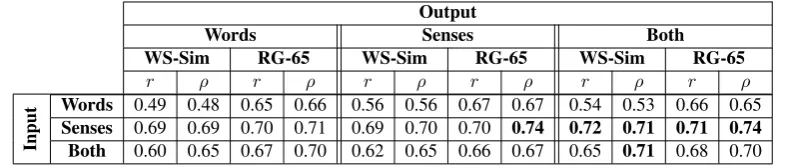
In this section we analyze the different configu-rations of our model in respect of the input and the output layer on a word similarity experiment. Recall from Section 4that our model could have words, senses or both in either the input and output layers. Table1shows the results of all nine config-urations on the WS-Sim and RG-65 datasets.
As shown in Table1, the best configuration ac-cording to both Spearman and Pearson correla-tion measures is the configuracorrela-tion which has only senses in the input layer and both words and senses in the output layer.7In fact, taking only senses as
input seems to be consistently the best alternative for the input layer. Our hunch is that the knowl-edge learned from both the co-occurrence infor-mation and the semantic network is more balanced with this input setting. For instance, in the case of including both words and senses in the input layer, the co-occurrence information learned by the network would be duplicated for both words and senses.
5.2 Disambiguation / Shallow word-sense connectivity algorithm
In this section we evaluate the impact of our shal-low word-sense connectivity algorithm (Section
3) by testing our model directly taking a pre-disambiguated text as input. In this case the net-work exploits the connections between each word and its disambiguated sense in context. For this comparison we used Babelfy8(Moro et al.,2014),
a state-of-the-art graph-based disambiguation and entity linking system based on BabelNet. We com-pare to both the default Babelfy system which 7In this analysis we used the word similarity task for optimizing the sense embeddings, without caring about the performance of word embeddings or their interconnectivity. Therefore, this configuration may not be optimal for word embeddings and may be further tuned on specific applica-tions. More information about different configurations in the documentation of the source code.
Output
Words Senses Both
WS-Sim RG-65 WS-Sim RG-65 WS-Sim RG-65
r ρ r ρ r ρ r ρ r ρ r ρ
Input
Words 0.49 0.48 0.65 0.66 0.56 0.56 0.67 0.67 0.54 0.53 0.66 0.65
[image:6.595.101.494.62.146.2]Senses 0.69 0.69 0.70 0.71 0.69 0.70 0.70 0.74 0.72 0.71 0.71 0.74 Both 0.60 0.65 0.67 0.70 0.62 0.65 0.66 0.67 0.65 0.71 0.68 0.70
Table 1: Pearson (r) and Spearman (ρ) correlation performance of the nine configurations of SW2V
WS-Sim RG-65
r ρ r ρ
Shallow 0.72 0.71 0.71 0.74
[image:6.595.94.271.191.259.2]Babelfy 0.65 0.63 0.69 0.70 Babelfy* 0.63 0.61 0.65 0.64
Table 2: Pearson (r) and Spearman (ρ) correla-tion performance of SW2V integrating our shal-low word-sense connectivity algorithm (default), Babelfy, or Babelfy*.
uses theMost Common Sense(MCS) heuristic as a back-off strategy and, following (Iacobacci et al.,
2015), we also include a version in which only instances above the Babelfy default confidence threshold are disambiguated (i.e. the MCS back-off strategy is disabled). We will refer to this latter version as Babelfy* and report the best configura-tion of each strategy according to our analysis.
Table 2 shows the results of our model using the three different strategies on RG-65 and WS-Sim. Our shallow word-sense connectivity algo-rithm achieves the best overall results. We believe that these results are due to the semantic connec-tivity ensured by our algorithm and to the pos-sibility of associating words with more than one sense, which seems beneficial for training, mak-ing it more robust to possible disambiguation er-rors and to the sense granularity issue (Erk et al.,
2013). The results are especially significant con-sidering that our algorithm took a tenth of the time needed by Babelfy to process the corpus.
6 Evaluation
We perform a qualitative and quantitative evalua-tion of important features of SW2V in three dif-ferent tasks. First, in order to compare our model against standard word-based approaches, we eval-uate our system in the word similarity task (Sec-tion 6.1). Second, we measure the quality of our sense embeddings in a sense-specific application:
sense clustering (Section 6.2). Finally, we evalu-ate the coherence of our unified vector space by measuring the interconnectivity of word and sense embeddings (Section6.3).
Experimental setting. Throughout all the ex-periments we use the same standard hyperparam-eters mentioned in Section 5 for both the origi-nal word2vec implementation and our proposed model SW2V. For SW2V we use the same opti-mal configuration according to the analysis of the previous section (only senses as input, and both words and senses as output) for all tasks. As train-ing corpus we take the full 3B-words UMBC web-base corpus and the Wikipedia (Wikipedia dump of November 2014), used by three of the compari-son systems. We use BabelNet 3.0 (SW2VBN) and WordNet 3.0 (SW2VWN) as semantic networks.
Comparison systems. We compare with the publicly available pre-trained sense embeddings of four state-of-the-art models:Chen et al.(2014)9
and AutoExtend10 (Rothe and Sch¨utze, 2015)
based on WordNet, and SensEmbed11 (Iacobacci et al., 2015) and NASARI12 (Camacho-Collados et al.,2016) based on BabelNet.
6.1 Word Similarity
In this section we evaluate our sense represen-tations on the standard SimLex-999 (Hill et al.,
2015) and MEN (Bruni et al., 2014) word simi-larity datasets13. SimLex and MEN contain 999
and 3000 word pairs, respectively, which consti-tute, to our knowledge, the two largest
similar-9http://pan.baidu.com/s/1eQcPK8i
10We used the AutoExtend code (http://cistern.
cis.lmu.de/˜sascha/AutoExtend/) to obtain sense vectors using W2V embeddings trained on UMBC (GoogleNews corpus used in their pre-trained models is not publicly available). We also tried the code to include BabelNet as lexical resource, but it was not easily scalable (BabelNet is two orders of magnitude larger than WordNet).
11http://lcl.uniroma1.it/sensembed/ 12http://lcl.uniroma1.it/nasari/
SimLex-999 MEN
System Corpus r ρ r ρ
Senses
SW2VBN UMBC 0.49 0.47 0.75 0.75
SW2VWN UMBC 0.46 0.45 0.76 0.76
AutoExtend UMBC 0.47 0.45 0.74 0.75 AutoExtend Google-News 0.46 0.46 0.68 0.70 SW2VBN Wikipedia 0.47 0.43 0.71 0.73 SW2VWN Wikipedia 0.47 0.43 0.71 0.72 SensEmbed Wikipedia 0.43 0.39 0.65 0.70 Chen et al. (2014) Wikipedia 0.46 0.43 0.62 0.62
Words
[image:7.595.130.470.64.283.2]Word2vec UMBC 0.39 0.39 0.75 0.75 RetrofittingBN UMBC 0.47 0.46 0.75 0.76 RetrofittingWN UMBC 0.47 0.46 0.76 0.76 Word2vec Wikipedia 0.39 0.38 0.71 0.72 RetrofittingBN Wikipedia 0.35 0.32 0.66 0.66 RetrofittingWN Wikipedia 0.47 0.44 0.73 0.73
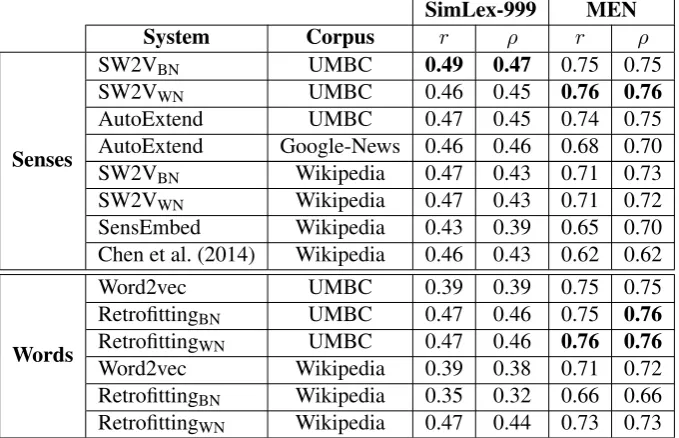
Table 3: Pearson (r) and Spearman (ρ) correlation performance on the SimLex-999 and MEN word similarity datasets.
ity datasets comprising a balanced set of noun, verb and adjective instances. As explained in Sec-tion 5, we use the closest sense strategy for the word similarity measurement of our model and all sense-based comparison systems. As regards the word embedding models, words are directly compared by using cosine similarity. We also in-clude aretrofittedversion of the original word2vec word vectors (Faruqui et al.,2015, Retrofitting14)
using WordNet (RetrofittingWN) and BabelNet (RetrofittingBN) as lexical resources.
Table3shows the results of SW2V and all com-parison models in SimLex and MEN. SW2V con-sistently outperforms all sense-based comparison systems using the same corpus, and clearly per-forms better than the original word2vec trained on the same corpus. Retrofitting decreases the perfor-mance of the original word2vec on the Wikipedia corpus using BabelNet as lexical resource, but sig-nificantly improves the original word vectors on the UMBC corpus, obtaining comparable results to our approach. However, while our approach provides a shared space of words and senses, Retrofitting still conflates different meanings of a word into the same vector.
Additionally, we noticed that most of the score divergences between our system and the gold stan-dard scores in SimLex-999 were produced on
14https://github.com/mfaruqui/
retrofitting
antonym pairs, which are over-represented in this dataset: 38 word pairs hold a clear antonymy re-lation (e.g. encourage-discourage orlong-short), while 41 additional pairs hold some degree of antonymy (e.g.new-ancientorman-woman).15 In
contrast to the consistently low gold similarity scores given to antonym pairs, our system varies its similarity scores depending on the specific na-ture of the pair16. Recent works have managed
to obtain significant improvements by tweaking usual word embedding approaches into provid-ing low similarity scores for antonym pairs (Pham et al.,2015;Schwartz et al.,2015;Nguyen et al.,
2016;Mrksic et al.,2017), but this is outside the scope of this paper.
6.2 Sense Clustering
Current lexical resources tend to suffer from the high granularity of their sense inventories (Palmer et al., 2007). In fact, a meaningful clustering of their senses may lead to improvements on down-stream tasks (Hovy et al., 2013; Flekova and Gurevych,2016;Pilehvar et al.,2017). In this sec-tion we evaluate our synset representasec-tions on the Wikipedia sense clustering task. For a fair parison with respect to the BabelNet-based com-15Two annotators decided the degree of antonymy between word pairs:clear antonyms,weak antonymsorneither.
Accuracy F-Measure
SW2V 87.8 63.9
SensEmbed 82.7 40.3
NASARI 87.0 62.5
Multi-SVM 85.5
-Mono-SVM 83.5
[image:8.595.89.275.64.161.2]-Baseline 17.5 29.8
Table 4: Accuracy and F-Measure percentages of different systems on the SemEval Wikipedia sense clustering dataset.
parison systems that use the Wikipedia corpus for training, in this experiment we report the results of our model trained on the Wikipedia corpus and us-ing BabelNet as lexical resource only. For the eval-uation we consider the two Wikipedia sense clus-tering datasets (500-pair and SemEval) created by
Dandala et al.(2013). In these datasets sense clus-tering is viewed as a binary classification task in which, given a pair of Wikipedia pages, the system has to decide whether to cluster them into a single instance or not. To this end, we use our synset em-beddings and cluster Wikipedia pages17 together
if their similarity exceeds a thresholdγ. In order to set the optimal value of γ, we follow Dandala et al. (2013) and use the first 500-pairs sense clus-tering dataset for tuning. We set the threshold γ
to 0.35, which is the value leading to the highest F-Measure among all values from 0 to 1 with a 0.05 step size on the 500-pair dataset. Likewise, we set a threshold for NASARI (0.7) and SensEm-bed (0.3) comparison systems.
Finally, we evaluate our approach on the Se-mEval sense clustering test set. This test set con-sists of 925 pairs which were obtained from a set of highly ambiguous words gathered from past SemEval tasks. For comparison, we also in-clude the supervised approach of Dandala et al.
(2013) based on a multi-feature Support Vector Machine classifier trained on an automatically-labeled dataset of the English Wikipedia (Mono-SVM) and Wikipedia in four different languages (Multi-SVM). As naive baseline we include the system which would cluster all given pairs.
Table4 shows the F-Measure and accuracy re-sults on the SemEval sense clustering dataset. SW2V outperforms all comparison systems ac-cording to both measures, including the sense rep-17Since Wikipedia is a resource included in BabelNet, our synset representations are expandable to Wikipedia pages.
resentations of NASARI and SensEmbed using the same setup and the same underlying lexical re-source. This confirms the capability of our system to accurately capture the semantics of word senses on this sense-specific task.
6.3 Word and sense interconnectivity
In the previous experiments we evaluated the ef-fectiveness of the sense embeddings. In contrast, this experiment aims at testing the interconnec-tivity between word and sense embeddings in the vector space. As explained in Section2, there have been previous approaches building a shared space of word and sense embeddings, but to date lit-tle research has focused on testing the semantic coherence of the vector space. To this end, we evaluate our model on a Word Sense Disambigua-tion (WSD) task, using our shared vector space of words and senses to obtain aMost Common Sense (MCS) baseline. The insight behind this experi-ment is that a semantically coherent shared space of words and senses should be able to build a rel-atively strong baseline for the task, as the MCS of a given word should be closer to the word vector than any other sense. The MCS baseline is generally integrated into the pipeline of state-of-the-art WSD and Entity Linking systems as a back-off strategy (Navigli, 2009;Jin et al.,2009;
Zhong and Ng,2010;Moro et al.,2014;Raganato et al., 2017) and is used in various NLP applica-tions (Bennett et al., 2016). Therefore, a system which automatically identifies the MCS of words from non-annotated text may be quite valuable, especially for resource-poor languages or large knowledge resources for which obtaining sense-annotated corpora is extremely expensive. More-over, even in a resource like WordNet for which sense-annotated data is available (Miller et al.,
1993, SemCor), 61% of its polysemous lemmas have no sense annotations (Bennett et al.,2016).
Given an input wordw, we compute the cosine similarity betweenwand all its candidate senses, picking the sense leading to the highest similarity:
MCS(w) = argmax
s∈Sw
cos(~w,~s) (2)
SemEval-07 SemEval-13
SW2V 39.9 54.0
AutoExtend 17.6 31.0
[image:9.595.89.275.62.113.2]Baseline 24.8 34.9
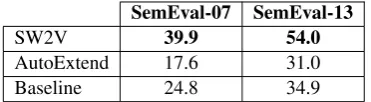
Table 5: F-Measure percentage of different MCS strategies on the 2007 and SemEval-2013 WSD datasets.
12) (Navigli et al.,2013) WSD datasets. Note that our model using BabelNet as semantic network has a far larger coverage than just WordNet and may additionally be used for Wikification ( Mihal-cea and Csomai, 2007) and Entity Linking tasks. Since the versions of WordNet vary across datasets and comparison systems, we decided to evaluate the systems on the portion of the datasets covered by all comparison systems18(less than 10% of
in-stances were removed from each dataset).
Table 5 shows the results of our system and AutoExtend on the 2007 and SemEval-2013 WSD datasets. SW2V provides the best MCS results in both datasets. In general, AutoEx-tend does not accurately capture the predominant sense of a word and performs worse than a base-line that selects the intended sense randomly from the set of all possible senses of the target word.
In fact, AutoExtend tends to create clusters which include a word and all its possible senses. As an example, Table6shows the closest word and sense19embeddings of our SW2V model and
Au-toExtend to themilitaryandfishsenses of, respec-tively, company and school. AutoExtend creates clusters with all the senses ofcompanyandschool and their related instances, even if they belong to different domains (e.g., firm2
nor business1nclearly concern thebusiness sense ofcompany). Instead, SW2V creates a semantic cluster of word and sense embeddings which are semantically close to the correspondingcompany2
nandschool7nsenses.
7 Conclusion and Future Work
In this paper we proposed SW2V (Senses and Words to Vectors), a neural model which learns vector representations for words and senses in a joint training phase by exploiting both text corpora and knowledge from semantic networks. Data (in-18We were unable to obtain the word embeddings ofChen et al.(2014) for comparison even after contacting the authors.
19Following Navigli (2009),wordp
n is the nth sense of
wordwith part of speechp(using WordNet 3.0).
company2
n(military unit) school7n(group of fish) AutoExtend SW2V AutoExtend SW2V
company9
n battalion1n school schools7n company battalion school4
n sharks1n company8
n regiment1n school6n sharks company6
n detachment4n school1v shoals3n company7
n platoon1n school3n fish1n company1
v brigade1n elementary dolphins1n firm regiment schools pods3
n business1
n corps1n elementary3a eels firm2
n brigade school5n dolphins company1
n platoon elementary1a whales2n Table 6: Ten closest word and sense embeddings to the sensescompany2
n(military unit) andschool7n (group of fish).
cluding the preprocessed corpora and pre-trained embeddings used in the evaluation) and source code to apply our extension of the word2vec ar-chitecture to learn word and sense embeddings from any preprocessed corpus are freely avail-able at http://lcl.uniroma1.it/sw2v. Unlike previous sense-based models which re-quire post-processing steps and use WordNet as sense inventory, our model achieves a semantically coherent vector space of both words and senses as an emerging feature of a single training phase and is easily scalable to larger semantic networks like BabelNet. Finally, we showed, both quantita-tively and qualitaquantita-tively, some of the advantages of using our approach as against previous state-of-the-art word- and sense-based models in various tasks, and highlighted interesting semantic prop-erties of the resulting unified vector space of word and sense embeddings.
As future work we plan to integrate a WSD and Entity Linking system for applying our model on downstream NLP applications, along the lines of
Pilehvar et al.(2017). We are also planning to ap-ply our model to languages other than English and to study its potential on multilingual and cross-lingual applications.
Acknowledgments
The authors gratefully acknowledge the support of the ERC Consolidator Grant MOUSSE No. 726487.
[image:9.595.316.521.63.201.2]References
Eneko Agirre, Enrique Alfonseca, Keith Hall, Jana Kravalova, Marius Pas¸ca, and Aitor Soroa. 2009. A study on similarity and relatedness using distribu-tional and WordNet-based approaches. In Proceed-ings of NAACL. pages 19–27.
Eneko Agirre, Oier Lopez de Lacalle, and Aitor Soroa. 2014. Random walks for knowledge-based word sense disambiguation. Computational Linguistics 40(1):57–84.
Yoshua Bengio, R´ejean Ducharme, Pascal Vincent, and Christian Janvin. 2003. A Neural Probabilistic Lan-guage Model.The Journal of Machine Learning Re-search3:1137–1155.
Andrew Bennett, Timothy Baldwin, Jey Han Lau, Di-ana McCarthy, and Francis Bond. 2016. Lexsemtm: A semantic dataset based on all-words unsupervised sense distribution learning. InProceedings of ACL. pages 1513–1524.
Antoine Bordes, Sumit Chopra, and Jason Weston. 2014. Question answering with subgraph embed-dings. InProceedings of EMNLP. pages 615–620. Elia Bruni, Nam-Khanh Tran, and Marco Baroni. 2014.
Multimodal distributional semantics. J. Artif. Intell. Res.(JAIR)49(1-47).
Alexander Budanitsky and Graeme Hirst. 2006. Evalu-ating WordNet-based measures of Lexical Semantic Relatedness. Computational Linguistics32(1):13– 47.
Jos´e Camacho-Collados, Mohammad Taher Pilehvar, and Roberto Navigli. 2015. A Unified Multilingual Semantic Representation of Concepts. In Proceed-ings of ACL. Beijing, China, pages 741–751. Jos´e Camacho-Collados, Mohammad Taher Pilehvar,
and Roberto Navigli. 2016. Nasari: Integrating ex-plicit knowledge and corpus statistics for a multilin-gual representation of concepts and entities. Artifi-cial Intelligence240:36–64.
Xinxiong Chen, Zhiyuan Liu, and Maosong Sun. 2014. A unified model for word sense representation and disambiguation. InProceedings of EMNLP. Doha, Qatar, pages 1025–1035.
Bharath Dandala, Chris Hokamp, Rada Mihalcea, and Razvan C. Bunescu. 2013. Sense clustering using Wikipedia. In Proc. of RANLP. Hissar, Bulgaria, pages 164–171.
Antonio Di Marco and Roberto Navigli. 2013. Cluster-ing and diversifyCluster-ing web search results with graph-based word sense induction. Computational Lin-guistics39(3):709–754.
Katrin Erk, Diana McCarthy, and Nicholas Gaylord. 2013. Measuring word meaning in context. Com-putational Linguistics39(3):511–554.
Allyson Ettinger, Philip Resnik, and Marine Carpuat. 2016. Retrofitting Sense-Specific Word Vectors Us-ing Parallel Text. In Proceedings of NAACL-HLT. pages 1378–1383.
Wei Fang, Jianwen Zhang, Dilin Wang, Zheng Chen, and Ming Li. 2016. Entity disambiguation by knowledge and text jointly embedding. In Proceed-ings of CoNLL. pages 260–269.
Manaal Faruqui, Jesse Dodge, Sujay K. Jauhar, Chris Dyer, Eduard Hovy, and Noah A. Smith. 2015. Retrofitting word vectors to semantic lexicons. In Proceedings of NAACL. pages 1606–1615.
Lev Finkelstein, Gabrilovich Evgeniy, Matias Yossi, Rivlin Ehud, Solan Zach, Wolfman Gadi, and Rup-pin Eytan. 2002. Placing search in context: The con-cept revisited. ACM Transactions on Information Systems20(1):116–131.
Lucie Flekova and Iryna Gurevych. 2016. Supersense embeddings: A unified model for supersense inter-pretation, prediction, and utilization. InProceedings of ACL. pages 2029–2041.
Josu Goikoetxea, Aitor Soroa, Eneko Agirre, and Basque Country Donostia. 2015. Random walks and neural network language models on knowledge bases. InProceedings of NAACL. pages 1434–1439.
Jiang Guo, Wanxiang Che, Haifeng Wang, and Ting Liu. 2014. Learning sense-specific word embed-dings by exploiting bilingual resources. In Proceed-ings of COLING. pages 497–507.
Lushan Han, Abhay Kashyap, Tim Finin, James Mayfield, and Jonathan Weese. 2013. UMBC EBIQUITY-CORE: Semantic textual similarity sys-tems. In Proceedings of the Second Joint Confer-ence on Lexical and Computational Semantics. vol-ume 1, pages 44–52.
Felix Hill, Roi Reichart, and Anna Korhonen. 2015. Simlex-999: Evaluating semantic models with (gen-uine) similarity estimation. Computational Linguis-tics.
Johannes Hoffart, Stephan Seufert, Dat Ba Nguyen, Martin Theobald, and Gerhard Weikum. 2012. Kore: keyphrase overlap relatedness for entity dis-ambiguation. InProceedings of CIKM. pages 545– 554.
Eduard H. Hovy, Roberto Navigli, and Simone Paolo Ponzetto. 2013. Collaboratively built semi-structured content and Artificial Intelligence: The story so far. Artificial Intelligence194:2–27.
Ignacio Iacobacci, Mohammad Taher Pilehvar, and Roberto Navigli. 2015. Sensembed: Learning sense embeddings for word and relational similarity. In Proceedings of ACL. Beijing, China, pages 95–105. Ignacio Iacobacci, Mohammad Taher Pilehvar, and
Roberto Navigli. 2016. Embeddings for Word Sense Disambiguation: An Evaluation Study. In Proceed-ings of ACL. pages 897–907.
Sujay Kumar Jauhar, Chris Dyer, and Eduard Hovy. 2015. Ontologically grounded multi-sense represen-tation learning for semantic vector space models. In Proceedings of NAACL.
Peng Jin, Diana McCarthy, Rob Koeling, and John Car-roll. 2009. Estimating and exploiting the entropy of sense distributions. In Proceedings of NAACL (2). pages 233–236.
Richard Johansson and Luis Nieto Pina. 2015. Embed-ding a semantic network in a word space. In Pro-ceedings of NAACL. pages 1428–1433.
Omer Levy, Yoav Goldberg, and Ido Dagan. 2015. Im-proving distributional similarity with lessons learned from word embeddings. TACL3:211–225.
Jiwei Li and Dan Jurafsky. 2015. Do multi-sense em-beddings improve natural language understanding? InProceedings of EMNLP. Lisbon, Portugal. Oren Melamud, Jacob Goldberger, and Ido Dagan.
2016. context2vec: Learning Generic Context Em-bedding with Bidirectional LSTM. In Proc. of CONLL. pages 51–61.
Rada Mihalcea and Andras Csomai. 2007. Wikify! Linking documents to encyclopedic knowledge. In Proceedings of the Sixteenth ACM Conference on Information and Knowledge management. Lisbon, Portugal, pages 233–242.
Tomas Mikolov, Kai Chen, Greg Corrado, and Jeffrey Dean. 2013. Efficient estimation of word represen-tations in vector space.CoRRabs/1301.3781. George A Miller. 1995. Wordnet: a lexical database for
english. Communications of the ACM 38(11):39– 41.
George A. Miller, Claudia Leacock, Randee Tengi, and Ross Bunker. 1993. A semantic concordance. In Proceedings of the 3rd DARPA Workshop on Human Language Technology. Plainsboro, N.J., pages 303– 308.
Andrea Moro, Alessandro Raganato, and Roberto Nav-igli. 2014. Entity Linking meets Word Sense Disam-biguation: a Unified Approach. TACL2:231–244.
Nikola Mrksic, Ivan Vuli´c, Diarmuid ´O S´eaghdha, Ira Leviant, Roi Reichart, Milica Gai, Anna Korhonen, and Steve Young. 2017. Semantic Specialisation of Distributional Word Vector Spaces using Monolin-gual and Cross-LinMonolin-gual Constraints. TACL.
Roberto Navigli. 2009. Word Sense Disambiguation: A survey.ACM Computing Surveys41(2):1–69.
Roberto Navigli, David Jurgens, and Daniele Vannella. 2013. SemEval-2013 Task 12: Multilingual Word Sense Disambiguation. InProceedings of SemEval 2013. pages 222–231.
Roberto Navigli and Simone Paolo Ponzetto. 2012. BabelNet: The automatic construction, evaluation and application of a wide-coverage multilingual se-mantic network. AIJ193:217–250.
Arvind Neelakantan, Jeevan Shankar, Alexandre Pas-sos, and Andrew McCallum. 2014. Efficient non-parametric estimation of multiple embeddings per word in vector space. In Proceedings of EMNLP. Doha, Qatar, pages 1059–1069.
Kim Anh Nguyen, Sabine Schulte im Walde, and Ngoc Thang Vu. 2016. Integrating distributional lexical contrast into word embeddings for antonym-synonym distinction. InProceedings of ACL. pages 454–459.
Martha Palmer, Hoa Dang, and Christiane Fellbaum. 2007. Making fine-grained and coarse-grained sense distinctions, both manually and automatically. Natural Language Engineering13(2):137–163.
Alexander Panchenko, Eugen Ruppert, Stefano Faralli, Simone Paolo Ponzetto, and Chris Biemann. 2017. Unsupervised does not mean uninterpretable: The case for word sense induction and disambiguation. InProceedings of EACL. pages 86–98.
Jeffrey Pennington, Richard Socher, and Christopher D Manning. 2014. GloVe: Global vectors for word representation. In Proceedings of EMNLP. pages 1532–1543.
Nghia The Pham, Angeliki Lazaridou, and Marco Ba-roni. 2015. A multitask objective to inject lexical contrast into distributional semantics. In Proceed-ings of ACL. pages 21–26.
Mohammad Taher Pilehvar, Jose Camacho-Collados, Roberto Navigli, and Nigel Collier. 2017. Towards a Seamless Integration of Word Senses into Down-stream NLP Applications. InProceedings of ACL. Vancouver, Canada.
Mohammad Taher Pilehvar and Nigel Collier. 2016. De-conflated semantic representations. In Proceed-ings of EMNLP. Austin, TX.
Sameer Pradhan, Edward Loper, Dmitriy Dligach, and Martha Palmer. 2007. SemEval-2007 task-17: En-glish lexical sample, SRL and all words. In Pro-ceedings of SemEval. pages 87–92.
Alessandro Raganato, Jose Camacho-Collados, and Roberto Navigli. 2017. Word Sense Disambigua-tion: A Unified Evaluation Framework and Empir-ical Comparison. In Proceedings of EACL. pages 99–110.
Joseph Reisinger and Raymond J. Mooney. 2010. Multi-prototype vector-space models of word mean-ing. InProceedings of ACL. pages 109–117.
Philip Resnik. 1995. Using information content to evaluate semantic similarity in a taxonomy. In Pro-ceedings of IJCAI. pages 448–453.
Sascha Rothe and Hinrich Sch¨utze. 2015. AutoEx-tend: Extending Word Embeddings to Embeddings for Synsets and Lexemes. In Proceedings of ACL. Beijing, China, pages 1793–1803.
Herbert Rubenstein and John B. Goodenough. 1965. Contextual correlates of synonymy. Commun. ACM 8(10):627–633.
Hinrich Sch¨utze. 1998. Automatic word sense discrim-ination. Computational linguistics24(1):97–123.
Roy Schwartz, Roi Reichart, and Ari Rappoport. 2015. Symmetric pattern based word embeddings for im-proved word similarity prediction. InProceedings of CoNLL. pages 258–267.
Robert Speer and Joanna Lowry-Duda. 2017. Con-ceptnet at semeval-2017 task 2: Extending word em-beddings with multilingual relational knowledge. In Proceedings of the 11th International Workshop on Semantic Evaluation (SemEval-2017). pages 76–80.
Simon ˇSuster, Ivan Titov, and Gertjan van Noord. 2016. Bilingual learning of multi-sense embeddings with discrete autoencoders. In Proceedings of NAACL-HLT. pages 1346–1356.
Fei Tian, Hanjun Dai, Jiang Bian, Bin Gao, Rui Zhang, Enhong Chen, and Tie-Yan Liu. 2014. A probabilis-tic model for learning multi-prototype word embed-dings. InProceedings of COLING. pages 151–160. Thuy Vu and D Stott Parker. 2016. K-embeddings:
Learning conceptual embeddings for words using context. In Proceedings of NAACL-HLT. pages 1262–1267.
Zhen Wang, Jianwen Zhang, Jianlin Feng, and Zheng Chen. 2014. Knowledge graph and text jointly em-bedding. InProceedings of EMNLP. pages 1591– 1601.
David Weiss, Chris Alberti, Michael Collins, and Slav Petrov. 2015. Structured training for neural network transition-based parsing. In Proceedings of ACL. Beijing, China, pages 323–333.
Mo Yu and Mark Dredze. 2014. Improving lexical em-beddings with semantic knowledge. InProceedings of ACL (2). pages 545–550.
Zhi Zhong and Hwee Tou Ng. 2010. It Makes Sense: A wide-coverage Word Sense Disambiguation system for free text. InProc. of ACL System Demonstra-tions. pages 78–83.