Beyond Prefix-Based Interactive Translation Prediction
Jes´us Gonz´alez-Rubio Daniel Ortiz-Mart´ınez
Webinterpret Inc.
{jesus.g,daniel.o}@webinterpret.com
Jos´e Miguel Bened´ı Francisco Casacuberta
PRHLT Research Center Univ. Polit`ecnica de Val`encia {jbenedi,fcn}@prhlt.upv.es
Abstract
Current automatic machine translation systems require heavy human proof-reading to produce high-quality transla-tions. We present a new interactive ma-chine translation approach aimed at pro-viding a natural collaboration between hu-mans and translation systems. As such, we grant the user complete freedom to vali-date and correct any part of the translations suggested by the system. Our approach is then designed according to the require-ments placed by this unrestricted proof-reading protocol. In particular, the ability of the system to suggest new translations coherent with the set of potentially disjoint translation segments validated by the user. We evaluate our approach in a user-simulated setting where reference transla-tions are considered the output desired by a human expert. Results show important reductions in the number of edits in com-parison to decoupled post-editing and con-ventional prefix-based interactive transla-tion predictransla-tion. Additransla-tionally, we provide evidence that it can also reduce the cogni-tive overload reported for interaccogni-tive trans-lation systems in previous user studies. 1 Introduction
Research in the field ofmachine translation(MT) aims at developing computer systems that re-duce the effort required to generate translations, whether by assisting human translators or by di-rectly replacing them. However, most research in MT has focused on the development of fully auto-matic MT approaches. Despite that, except for a handful of very constrained domains, current au-tomatic MT technology still only achieves results
that are not satisfactory in practice; automatic MT still require heavy human proof-reading to pro-duce human-quality translations.
We present a new computer-assisted translation approach that integrates human translators and au-tomatic MT into a tight feedback loop. In our ap-proach, the user1 and the MT system collaborate
to generate translations through a series of inter-actions. At each interaction, the system proposes its best translation for the given input sentence. If the user finds it correct, then it is accepted and the process goes on with the next input sentence. Oth-erwise, the user makes some corrections that the system takes into account to improve the proposed translation. The rationale behind this interactive translation prediction (ITP) approach is to com-bine the accuracy provided by the human expert with the efficiency of the MT system in contrast to decoupled post-editing (PE). Previous works, e.g. (Barrachina et al., 2009), have explored this paradigm; however their practical implementation limits this general proof-reading approach to a prefix-based interaction where the user is forced to correct the errors in the sentence strictly according to the reading order.
Our main contribution, described in Section 3, is a new proof-reading protocol focused on pro-viding a more natural interaction between the user and the system. Specifically, we give complete freedom to the user to validate or to correct any part of the translation at any given interaction. As such, the user is no longer bound to correct the errors following the reading order as in previous prefix-based ITP works (Barrachina et al., 2009; Gonz´alez-Rubio et al., 2013; Green et al., 2014). Preffix-based interaction can be a frustrating and cognitively demanding limitation for the user, and may be a factor in the somehow disappointing 1We use the terms “human expert”, “human translator”, and ‘user” indistinctly.
results of prefix-based ITP with users (Koehn, 2009; Underwood et al., 2014; Green et al., 2014; Sanchis-Trilles et al., 2014). We design our ap-proach to meet the requirements placed by the un-restricted proof-reading protocol, not the opposite way. The most significant new feature is condi-tioned decoding, for translation generation coher-ently to a set of segments validated by the user.
An evaluation involving human users is most desirable to study the impact of any proof-reading protocol. However, such a study is expensive, time-consuming and it will require to take into account additional sources of variation, namely the human factor, that may obscure the compari-son between different approaches. Therefore, we chose to follow previous works, for instance (Bar-rachina et al., 2009), and carry out our experi-ments on a simulated setting intended to provide a direct and, more importantly, objective compar-ison to previous approaches (Section 4). Regard-ing evaluation, we propose a new metric to auto-matically estimate the cognitive load of potential users working on the different ITP environments. To the best of our knowledge, this is the first pro-posal at this respect. Results in Section 5 confirm the soundness of the proposed ITP approach. Re-ported figures show important reductions in both the number of corrections typed by the user and her estimated cognitive load.
2 Related Work
Common proof-read MT protocols implement a decoupled PE process in which, first, the MT sys-tem returns a translation of a whole given docu-ment. Next, a human reads it correcting, in any order, the possible mistakes made by the system.
Interactive approaches (Isabelle and Church, 1998; Langlais and Lapalme, 2002; Tom´as and Casacuberta, 2006) were proposed as a more so-phisticate way of taking advantage of MT technol-ogy. Barrachina et al., (Barrachina et al., 2009) presented a prefix-based ITP approach in which the user is assumed to proof-read each automatic translation correcting each time the first error, if any, in the usual reading order. This can be a reasonable assumption in text or speech transcrip-tion (Toselli et al., 2007; Rodr´ıguez et al., 2007) where the output sequence is generated monoton-ically respect to the input data. However, it has al-ways be an important handicap for translation due to the intrinsic reordering involved in the process.
ITP is a fruitful research field with diverse con-tributions for multiple authors: (Gonz´alez-Rubio et al., 2010; Alabau et al., 2013; Koehn et al., 2014) among others. We share with (Sanchis-Trilles et al., 2008) the idea of making a more sophisticated use of the mouse actions performed by the user while interacting with the system, and with (Gonz´alez-Rubio et al., 2013) the common ITP formulation for both phrase-based and hierar-chical MT models. In particular, we significantly modify the prefix-based ITP implementation pre-sented in the latter work to support the proposed unrestricted proof-reading protocol.
User studies of prefix-based ITP versus PE have shown that while users tend to make less corrections, overall translation time tend to be higher (Koehn, 2009; Underwood et al., 2014; Green et al., 2014; Sanchis-Trilles et al., 2014). Coherently with these results, users also perceive prefix-based ITP as a more cognitive demanding task than PE. This is not surprising given that users are asked to proof-read one new translation (suffix) after each individual correction, which in-creases significantly the amount of text to be pro-cessed to generate a single translation. This is par-ticularly frustrating when the user observes how a correct translation is rewritten with a wrong one by the next suffix suggested by the system. Given that PE do not suffer from this effect, it provides a comprehensive explanation of the somehow dis-appointing results reported for prefix-based ITP.
To the best of our knowledge, the only alterna-tive to prefix-based proof-reading was proposed in the context of text recognition. Serrano et al., (2014) implement a constrained search proce-dure that profits from the monotonic alignment be-tween input image, search states and user correc-tions, to limit the set of possible transcriptions to those coherent with a set of (disjoint) user correc-tions. We apply a similar idea in a translation con-text and provide solutions to cope with the non-monotonicity inherent to the task.
3 Beyond Prefix-Based ITP
source(s): No era el hombre m´as honesto ni el m´as piadoso , pero era un hombre valiente .
desired translation(t): He was not the most honest or pious of men , but he was courageous .
BEGINMT: It was not the most honest and the most pious man , but it was a brave man .
IT-1
User: Itwas not the most honestand the mostpious of man, butitwasa brave man. MT: Hewas not the most honestorpious ofmen, butitwasa brave man.
IT-2
User: He was not the most honest or pious of men , butitwas courageous . MT: He was not the most honest or pious of men , buthewas courageous .
ENDUser: He was not the most honest or pious of men , but he was courageous .
Figure 1: Interactive translation of a Spanish sentence into English. First, the system suggests an initial translation. At iteration 1, the user validates the parts of the suggestions she considers to be right and introduces a correction by typing a word: “of”. This defines a new user feedback with five segments: {“was not the most honest”, “pious of”, “, but”, “was”, “.”}. Then, the system suggests a new translation
that contains these segments in the given order. Iteration 2 is similar; the user validates words “He”
and “or”, and she types a new correction: “courageous ”. The process ends when the user accepts the
translation suggested by the system in the last step. Only two edits are required. In comparison, PE would have needed 10 edits.
system takes into account this feedback to suggest a new translation that contains the segments vali-dated by the user as well as the typed corrections. Such process is repeated until the user validates the whole suggested translation. An example of this process is shown in Figure 1.
The crucial MT feature is the generation of a new translation coherent to the segments already validated by the user. Formally, we represent such user feedback as a sequence of disjoint segments
f = ˜f1, . . . ,˜fk, . . . ,˜f|f|, where each ˜fk is a
se-quence of consecutive target language words. For example, user feedback at iteration one in Figure 1 is composed of five disjoint segments: ˜f1 = “was
not the most honest”, ˜f2 = “pious of”, ˜f3 = “, but”,
˜f4 = “was” and ˜f5 = “.”. Segments in f do not overlap and do not necessarily cover the whole sentence. Prefix-based feedback in conventional ITP is a special case of this with only one segment starting at the beginning of the sentence.
Next, we describe the statistical formalization of our approach, the models actually used to im-plement such formalization, and the search proce-dures required to efficiently generate translations coherent with this generalized user feedback.
3.1 Statistical Framework
Our problem can be stated as follows: given a source sentences=s1. . . s|s|and some user feed-backf, we must find the best target language
trans-lationt=t1. . . t|t|ofscoherent withf:
ˆt= arg max
t Pr(t|s,f)
We can make the na¨ıve Bayes’ assumption that
s and f are statistically independent variables givent. This results in the basic equation for ITP with error correction (Ortiz-Mart´ınez, 2011):
ˆ
t= arg max
t Pr(t|s)·Pr(f |t) (1) where, as we will see in Section 3.2, distribution
Pr(t|s)can be approximated by a machine trans-lation model, andPr(f |t)by an error correction model that measures the degree of compatibility betweenfandt.
Note that by using a probability distribution
Pr(f | t), any translation is compatible with a given user feedback to some degree. As a con-sequence, the translation returned by Equation (1) may still not contain the segments validated by the user; we need to identify the sub-string of the re-turned sentence that corresponds to the each of the segments validated by the user. To solve this prob-lem, we define an alignmenta = a1, . . . , a|f| be-tween the user-validated segmentsf = ˜f1, . . . ,˜f|f| and a list of segments˜t= ˜t1, . . . ,˜t|f|, where each
˜tk = tki. . . tkj is a sub-sequence of words in t. Each alignment linkak = ˜tkindicates the
particu-lar segment intthat should be replaced by thekth user-validated segment˜fkto maketcoherent tof.
completes the gaps in between the user-validated segments inf (Gonz´alez-Rubio et al., 2013). The alignment also must be monotonic to preserve the order of the user-validated segments. Formally, for every pair of alignment links: ak = ˜tk and ak0 = ˜tk0,k < k0 ⇐⇒ kj < ki0.
After including alignment in Equation (1) and following a maximum approximation, we arrive to our final formulation of ITP with error correction:
(ˆt,ˆa) = arg max
t,a Pr(t|s)·Pr(f,a|t) (2) In practice, we combine the probability distri-butions in Equation (2) in a log-linear fashion as it is typically done in MT (Och and Ney, 2002). 3.2 Models
Equation (2) includes two probability distribu-tions: Pr(t|s)andPr(f,a|t). The first one can be modeled by any of the multiple machine trans-lation models that have been proposed in the liter-ature; (Koehn, 2009) for example provide a good description of them. We will focus our exposition in the latter distribution, Pr(f,a | t), that evalu-ates the compatibility between a translationtand some user feedbackf through alignmenta.
Following (Gonz´alez-Rubio et al., 2013), we model Pr(f,a | t) as an error correction model based on the edit distance (Levenshtein, 1966). Given a candidate string and the corresponding reference string, we model edit distance as a Bernoulli process where each word of the candi-date has a probability pe of being edited. Under
this interpretation, the number of editsδ observed in a candidate of lengthnis a random variable that follows a binomial distribution,δ ∼B(n, pe). By
assuming independence between each alignment link, we can model error-correction probability as:
Pr(f,a|t)≈
|a|
Y
k=1
PE(˜fk, ak)
=
|a|
Y
k=1
nk δk
pδk
e (1−pe)(nk−δk)
wherePE(˜fk, ak)is the error correction
probabil-ity for thek-th alignment link whose value is given by the probability mass function of the binomial distribution, nk = |˜fk| is the length in words of
the k-th segment validated by the user (˜fk), and δkis the edit distance between˜fkand the segment ak= ˜tkoftaligned to it according toa.
6
1
5
I saw a man with a telescope
2
3
4
[image:4.595.323.503.60.171.2]I saw a man with a telescope I saw with a telescope a man
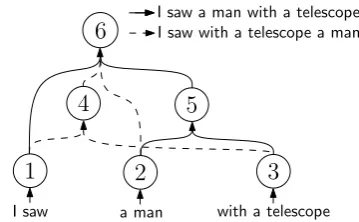
Figure 2: Example of a hypergraph encoding two different translations for the Spanish sentence: “Vi a un hombre con un telescopio”.
The probability of editing pe is the single free
parameter of this model. Alternatively, we can use a model based on a multinomial distribution as-signing different probabilities to different edit op-erations. Nevertheless, we adhere to the binomial approximation due to its simplicity.
3.3 Search
Next, we address the problem posed by the max-imization in Equation (2). Following (Barrachina et al., 2009), we split search into a two step pro-cess. Given a source language sentence, we first generate a graph-based representation that con-tains its most probable translations. Then, we search for the optimal translation and alignment on it according to Equation (2). In particular, we usehypergraphsto represent such search space.
One important advantage of this approach, is that it separates the proof-read step from the MT engine used to generate the initial translations. As such it provides an unified framework that ac-cepts both the use of phrase-based and hierarchi-cal/syntax translation models.
3.3.1 Hypergraphs
A hypergraph (Gallo et al., 1993) is a generaliza-tion of the concept of graph where the edges (now called hyperedges) may connect several nodes (hypernodes) at the same time. Formally, a hy-pergraph is a weighted acyclic graph represented by a pairH =<V,E>, where V is a set of hy-pernodes andE is a set of hyperedges. Each hy-peredgeε ∈ E connects a set of tail hypernodes
T(ε) ={τ1. . . τ|T(ε)|}τl ∈ V, to a head
represents the rule applied to generate the partial solution in the head from the partial solutions in the tail hypernodes, as such it has an associated probabilityP(ε). Figure 2 shows an example hy-pergraph2. Two alternative translations are
con-structed from the leaf hypernodes (1, 2 and 3) up to the root hypernode (6). Hypergraphs provide a compact representation of the translation space that allows us to derive efficient search algorithms. Hypergraphs are the natural representation for hierarchical MT models (Chiang, 2005; Zollmann and Venugopal, 2006). Note, however, that word-graphs (Ueffing et al., 2002), which are used to represent the search space for phrase-based mod-els (Koehn et al., 2003), are a special case of hy-pergraphs in which hyperedges have at most one tail hypernode.
3.3.2 Search on hypergraphs
We formalize the maximization in Equation (2) as a bottom-up search problem. Starting from the leaf hypernodes, we keep track of the best solu-tions (partial translation and alignment) achievable at each hypernode. We defineQ(ν,[m, n])as the probability of the most likely partial translation derivable from hypernodeνaligned to (accounting for) user-validated segments fromm-th ton-th, we will refer to this interval as the coverage of the partial solution. Given a nodeν and a coverage, we compute its score from its ingoing hyperedges. Specifically,Q(ν,[m, n])will be equal to the max-imum score of the partial solutions computed from any ingoing hyperedge. Partial solutions from an ingoing hyperedge εare defined as combinations of partial solutions on its tail hypernodes under the constrain that the concatenation of their coverages equals[m, n]. Formally, given an ingoing hyper-edgeε, a combinationc ={Q(τl,[ml, nl])}|Tl=1(ε)| is valid if it holds the following four conditions:
1. m1 =m 2. n|T(ε)|=n 3. ∀l, τl ∈ T(ε)
4. ∀l: 1< l≤ |T(ε)|, ml=nl−1+ 1
Q(ν,[m, n])can be computed efficiently via the following dynamic programming recursion:
Q(ν,[m, n]) = max
ε∈I(ν) c∈C(ε,[m,n])
P(ε) Y
Q(τl,[ml,nl])∈c
Q(τl,[ml, nl])
2For simplicity, we do not show hyperedge probabilities.
EU corpus (Es/En)
train tune test
Sentences 214K 400 800
[image:5.595.317.519.66.123.2]Tokens 5.9M / 5.2M 12K / 10K 23K / 20K Vocabulary 97K / 84K 3K / 3K 5K / 4K
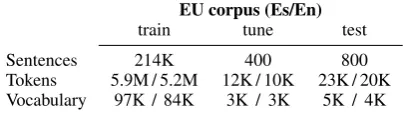
Table 1: Main figures of the EU corpus. K and M stand for thousands and millions of elements.
whereI(ν)are the ingoing hyperedges ofν,P(ε)
is the probability of hyperedge ε, C(ε,[m, n]) is the set of valid combinations for hyperedgeεand coverage [m, n], and c ∈ C(ε,[m, n]) is one of such valid combinations
Leaf hypernodes represent the base cases for this recursion. For simplicity, we restrict them to be fully-aligned to at most one user-validated seg-ment3. That is, given a leaf hypernodeλ∈ V:
Q(λ,[m, n])=
PMT(λ)PE(w(λ),˜fm) if m=n
0 otherwise.
where PMT(λ) is the MT probability (language plus translation model) ofλ, andPE(w(λ),˜fm)is
the error correction probability between the target text covered by the leaf hypernode,w(λ), and the m-th user-validated segment inf.
The score of the optimal solution is given by
Q(α,[1,|f|]), whereα ∈ Vis the root hypernode. We can recover(ˆt,ˆa)through backtracking.
The process described above loops over all hyperedges and coverages (bounded by |E||f|2), evaluating all valid combinations (bounded by the coverage partitions). It can be implemented by an algorithm with a complexity inO(|E||f|2τ), where τ is the average number of tail hypernodes per hyperedge (usually set to 2). In practice, our ap-proach has a complexity inO(|E||f|4).
4 Experimental Setup 4.1 Corpus and MT systems
We tested the proposed methods in the Spanish-to-English (Es–En) partition of theBulletin of the European Union (EU) corpus (Barrachina et al., 2009; Gonz´alez-Rubio et al., 2013). We tokenized the corpus keeping the real case of the sentences. Table 1 shows the main figures of the corpus.
the Moses toolkit (Koehn et al., 2007). Log-linear weighs were estimated by minimum error-rate training (Och, 2003) on the tune partition. Then, we automatically translated tune and test partitions using the optimized model to obtain the corresponding hypergraphs. Next, we optimized the single free parameter pe of the error
correc-tion model (see Seccorrec-tion 3.2) on the tune particorrec-tion. Finally, we interactively translated both partitions according to the unrestricted ITP approach pro-posed in Section 3.
4.2 User Simulation
ITP evaluation with human translators is simply to slow and expensive to be applied on a frequent and ongoing basis during system development. In-stead, we carried out an automatic evaluation with simulated users which is faster and cheaper.
At each ITP iteration (see Figure 1), we have to decide which segments in the suggested trans-lation should be validated, and which error should be corrected. To do that, we considered the ref-erence translations in the corpus as the output that a human expert would want to obtain. Then, we align the suggested translation and the refer-ence via edit distance: words aligned to itself are marked as valid, while edited words are potential corrections to be typed by the simulated user.
Without loss of generality, we introduced two restrictions: (1) we restrict users to validate seg-ments only at the first iteration, and (2) the sim-ulated user always corrected the first (in reading order) error in the suggested translation. We are aware that the results obtained with this user simu-lation will be pessimistic since it forbids behaviors that may improve user productivity, e.g. validat-ing segments at each iteration or correctvalidat-ing more promising parts of the suggested translation. Our goal is not to match the behavior of a human trans-lator, but to allow for a meaningful comparison against conventional ITP. Note that prefix-based proof-reading is a particular case of our user sim-ulation with no segment validation.
4.3 Evaluation Metrics
ITP systems are evaluated according to the effort needed to generate the desired translations. This effort is usually estimated as the number of actions performed by the user while interacting with the system. In our user simulation, we describe two different actions: segment-validation, and word-correction. Each segment validation involves the
user to “click” on the initial and final words of the segment4. Each correction corresponds to an edit
operation performed by the user. Specifically, we used the following measures in our experiments:
Word stroke ratio (WSR): Proposed in (Tom´as and Casacuberta, 2006) as the quotient between the number of words edited by the user (word-strokes), and the number of words in the final translation. Word-strokes are considered as sin-gle actions with constant cost independently of the length of the edited word.
Mouse action ratio (MAR): Proposed in (Bar-rachina et al., 2009) as the quotient between the number of “clicks” made by the user (mouse-actions), and the number of words in the final translation. In addition to the “clicks” for seg-ment validation, we count one more mouse ac-tion per sentence accounting for the final accep-tance of the suggested translation.
Conceptually (Macklovitch et al., 2005), MAR can be seen as accounting for the cognitive part of the supervision process: undertanding the transla-tion and identifying the errors in it, while WSR accounts for the actual physical effort required to type the corrections. As such, both metrics are complementary to express the total human effort involved in proof-reading a document.
We also evaluated the quality of the initial auto-matic translations generated by the system:
Bilingual evaluation understudy (BLEU): Proposed in (Papineni et al., 2002), it is based on the precision of n-grams between the suggested translation and the reference; it also includes a brevity penalty to penalize short translations. This score ranges between 0 and
100, with100denoting a perfect translation. Translation edit rate (TER): Proposed
in (Snover et al., 2006), it measures the number of edit operations (substitution, inser-tion and deleinser-tion of single words, and swap of word sequences) divided by the number of words in the reference.
In addition to be an MT quality metric, TER can also be seen as a human-effort measure in PE sce-narios. Therefore, we can use TER and WSR to compare human effort between PE and ITP.
AUTOMATICTRANSLATION
tune test
BLEU[%](⇑) TER[%](⇓) BLEU[%](⇑) TER[%](⇓)
38.9±1.4 47.2±1.4 44.2±1.3 41.1±1.2
COMPUTER-ASSISTEDTRANSLATION
TER[%](⇓) TER[%](⇓)
Post-editing 47.2±1.4 41.1±1.2
MAR[%](⇓) WSR[%](⇓) MAR[%](⇓) WSR[%](⇓)
prefix-based ITP 11.2±0.4 45.8±2.0 10.3±0.3 54.5±1.4
[image:7.595.304.526.299.518.2]Our approach 33.9±1.2 30.5±1.6 35.4±0.9 35.1±1.1
Table 2: Results of different approaches when interactively translating the tune and test partitions of the EU corpus. We compare decoupled PE, prefix-based ITP and the unrestricted ITP approach proposed in this work. Automatic translation results are shown to indicate the difficulty of the task. Results in bold indicate the lowest human effort (typing) achievable by the different scenarios.
Finally, in order to assess the statistical signif-icance of the results, we also provide 95% con-fidence intervals for their values. These inter-vals were computed via pair-wise bootstrap re-sampling as proposed in (Zhang and Vogel, 2004).
5 Results
This section presents the results of the experiments performed to assess the unrestricted ITP approach proposed in Section 3. First, we compare our ITP approach to the prefix-based ITP scenario de-scribed in (Barrachina et al., 2009) and the decou-pled PE approach. Then, we further study our approach investigating the relationship between segment-validation and typing effort. Finally, we provide evidence that the proposed unrestricted proof-reading protocol allows to reduce the cogni-tive overload produced by the changing translation completions of prefix-based ITP approaches.
Table 2 displays user-effort results for the pro-posed ITP approach against prefix-based ITP (Bar-rachina et al., 2009)5 and a decoupled PE
base-line approach. Automatic translation results are also displayed to give an idea of the difficulty of the task. We can observe how our approach clearly outperformed both prefix-based ITP and PE in terms of user typing effort as measured by WSR and TER respectively. According to these results, a human translator assisted by our ITP sys-tem would only need to correct only about one third of the words to generate the correct transla-tions. In comparison, PE would require to type 5For prefix-based ITP, MAR accounts for the prefixes val-idated by the user while proof-reading the translations.
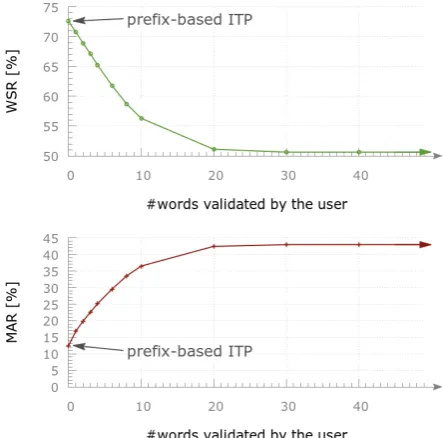
Figure 3: WSR and MAR as a function of the max-imum number of words validated by the simulated user in our ITP approach. No changes were ob-served for more than 40 validated words.
∼41% of the words (17% more) while prefix-based ITP would require to correct more that half of them (55%more). Additionally, we can observe that prefix-based ITP was not better than the PE baseline in all cases. This result, coherent with previous works e.g. (Gonz´alez-Rubio et al., 2013; Green et al., 2014), exemplifies the potential limi-tations of prefix-based ITP.
Next, we focused on the differences between prefix-based and our approach. To do that, we car-ried out different experiments allowing the sim-ulated user to validate an increasing number of words from zero to infinity (corresponding respec-tively to the results of prefix-based ITP and our ap-proach in Table 2). Figure 3 shows WSR (top) and MAR (bottom) for the Test partition as a function of the maximum number or words allowed to be validated by the user.
As we allowed the simulated user to validate more words, the amount of words to be corrected (WSR) decreased dramatically. For example, we obtained a 10% relative reduction in WSR when we allowed the user to validate a maximum of
4 words. A similar trend (but in the opposite direction) can be observed for MAR: as we al-lowed the user to validate more words, the num-ber of mouse actions increased until stabilization. In other words, our ITP approach allows to reduce user typing effort at the expense of an increase in the number of mouse actions. As we have said before, WSR and MAR account for different phe-nomena and thus have different cost from a hu-man point of view (Macklovitch et al., 2005). It may seem that we have simply exchanged typing effort for cognitive effort. However, two consid-erations allow us to consider this a beneficial ex-change. On the one hand, from a pure mechanistic point of view, typying a whole word usually re-quires more effort than “clicking” on it. On the other hand, from a cognitive point of view, the user has to read, understand, and evaluate the sug-gested translation in both prefix-based ITP and our approach. Hence, the difference in cognitive effort between these two approaches approaches is most probably negligible. Nevertheless, these consid-erations should be tested with actual human users before reaching categorical conclusions.
Average response time of our Python prototype was below3seconds6. Obviously, it does not
qual-ify as real-time. However, we expect an important reduction in response time after implementing our approach in a more efficient language.
We performed a final analysis to evaluate to which extent our proposal alleviates the main an-noying effect inherent to prefix-based ITP, namely correct words in a given suffix overwritten by the next suggested suffix. This common effect, ob-served in several user studies, make human users
[image:8.595.305.526.69.172.2]6The test machine was an Intel i5 CPU at 3.4 GHz.
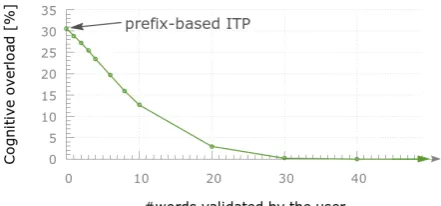
Figure 4: Percentage of words suggested by the system that were correct but overwritten in subse-quent translation suggestions, as a function of the number of words validated by the simulated user. This ratio can be seen as a measure of the user cognitive overload.
feel that cognitive effort invested in evaluating each suggested translation was wasted.
To do that, we measured the number of correct words that were modified by subsequent transla-tion suggestransla-tions, normalized by the total number of suggested words. Figure 4 displays this per-centage as a function of the maximum number of words that can be validated by the simulated user. We can observe how for prefix-based ITP (zero value in the x-axis), this cognitive overload is a very important phenomena; more than30%of the words suggested by the system were correct but modified by following suffix suggestions. As we allowed more words to be fixed, this percentage steadily decreased down to zero. This indicates that our ITP proposal actually provides a mecha-nism to overcome the cognitive overload inherent to prefix-based ITP.
6 Summary
We have presented a new ITP approach where the user is not longer bound to interact with the system in a prefix-based fashion (Barrachina et al., 2009). The proposed ITP approach gives the user com-plete freedom to validate and correct any part of the suggested translations thus providing a more natural working environment for human transla-tors. We formalize the problem as a MT model with error correction which, in practice, is imple-mented as a constrained search on hypergraphs.
reduction in typing effort came at the expense of a larger amount of mouse actions required to val-idate correct segments of the suggested transla-tions. However, since mouse actions are cheaper than typing full words, we can expect this ex-change to reduce overall user effort. Nevertheless, this expectation should be confirmed in future ex-periments with actual human users. Finally, in ad-dition to reduce user effort, we also provide evi-dence indicating that the proposed ITP approach can reduce the cognitive overload commonly re-ported by humans using prefix-based ITP systems. Acknowledgments
Work supported by the Generalitat Valenciana un-der grant ALMAMATER (PrometeoII/2014/030).
References
Vicent Alabau, Jes´us Gonzlez-Rubio, Luis A. Leiva, Daniel Ortiz-Mart´ınez, Germ´an Sanchis-Trilles, Francisco Casacuberta, Bartolom´e’ Mesa-Lao, Rag-nar Bonk, Michael Carl, and Mercedes Garc´ıa-Mart´ınez. 2013. User evaluation of advanced in-teraction features for a computer-assisted translation workbench. In Proceedings of the XIV Machine Translation Summit, pages 361–368.
Sergio Barrachina, Oliver Bender, Francisco Casacu-berta, Jorge Civera, Elsa Cubel, Shahram Khadivi, Antonio Lagarda, Hermann Ney, Jes´us Tom´as, En-rique Vidal, and Juan-Miguel Vilar. 2009. Sta-tistical approaches to computer-assisted translation. Computational Linguistics, 35:3–28, March. David Chiang. 2005. A hierarchical phrase-based
model for statistical machine translation. In Pro-ceedings of the 43rd Annual Meeting of the Associa-tion for ComputaAssocia-tional Linguistics, pages 263–270. Giorgio Gallo, Giustino Longo, Stefano Pallottino, and Sang Nguyen. 1993. Directed hypergraphs and applications. Discrete Applied Mathematics, 42(2-3):177–201, April.
Jes´us Gonz´alez-Rubio, Daniel Ortiz-Mart´ınez, and Francisco Casacuberta. 2010. Balancing user effort and translation error in interactive machine transla-tion via confidence measures. InProceedings of the 48th Annual Meeting of the Association for Compu-tational Linguistics, pages 173–177.
Jes´us Gonz´alez-Rubio, Daniel Ort´ız-Martinez, Jos´e-Miguel Bened´ı, and Francisco Casacuberta. 2013. Interactive machine translation using hierarchical translation models. In Proceedings of the confer-ence on Empirical Methods in Natural Language Processing, pages 244–254.
Spence Green, Sida I. Wang, Jason Chuang, Jeffrey Heer, Sebastian Schuster, and Christopher D. Man-ning. 2014. Human effort and machine learnability in computer aided translation. InProceedings of the conference on Empirical Methods in Natural Lan-guage Processing, pages 1225–1236.
Pierre Isabelle and Ken Church. 1998. Special issue on: New tools for human translators, volume 12. Kluwer Academic Publishers, January.
Philipp Koehn, Franz Josef Och, and Daniel Marcu. 2003. Statistical phrase-based translation. In Pro-ceedings of the the North American Chapter of the Association for Computational Linguistics on Hu-man Language Technology, pages 48–54.
Philipp Koehn, Hieu Hoang, Alexandra Birch, Chris Callison-Burch, Marcello Federico, Nicola Bertoldi, Brooke Cowan, Wade Shen, Christine Moran, Richard Zens, Chris Dyer, Ondrej Bojar, Alexandra Constantin, and Evan Herbst. 2007. Moses: Open Source Toolkit for Statistical Machine Translation. In Proceedings of the 45th Annual Meeting of the Association for Computational Linguistics.
Philipp Koehn, Chara Tsoukala, and Herve Saint-Amand. 2014. Refinements to interactive transla-tion predictransla-tion based on search graphs. In Proceed-ings of the 52nd Annual Meeting of the Association for Computational Linguistics, pages 574–578. Philipp Koehn. 2009. A process study of
computer-aided translation. Machine Translation, 23(4):241– 263.
Philippe Langlais and Guy Lapalme. 2002. TransType: development-evaluation cycles to boost translator’s productivity. Machine Translation, 17(2):77–98, September.
Vladimir Levenshtein. 1966. Binary codes capable of correcting deletions, insertions and reversals. Soviet Physics Doklady, 10(8):707–710, February.
Elliot Macklovitch, Nam-Trung Nguyen, and Roberto Silva. 2005. User evaluation report. Technical report, Universit´e de Montr´eal. TransType2 (IST-2001-32091).
Franz Josef Och and Hermann Ney. 2002. Discrimina-tive training and maximum entropy models for sta-tistical machine translation. In Proceedings of the 40th Annual Meeting on Association for Computa-tional Linguistics, pages 295–302.
Franz Och. 2003. Minimum error rate training in sta-tistical machine translation. In Proceedings of the 41st Annual Meeting on Association for Computa-tional Linguistics, pages 160–167.
Kishore Papineni, Salim Roukos, Todd Ward, and Wei-Jing Zhu. 2002. BLEU: a method for automatic evaluation of machine translation. In Proceedings of the 40th Annual Meeting on Association for Com-putational Linguistics, pages 311–318.
Luis Rodr´ıguez, Francisco Casacuberta, and Enrique Vidal. 2007. Computer assisted transcription of speech. In Proceedings of the 3rd Iberian Confer-ence on Pattern Recognition and Image Analysis, volume 4477 ofLecture Notes in Computer Science, pages 241–248.
Germ´an Sanchis-Trilles, Daniel Ortiz-Mart´ınez, Jorge Civera, Francisco Casacuberta, Enrique Vidal, and Hieu Hoang. 2008. Improving Interactive Machine Translation via Mouse Actions. In Proceedings of the Conference on Empirical Methods in Natural Language Processing, pages 485–494.
Germ´an Sanchis-Trilles, Vicent Alabau, Christian Buck, Michael Carl, Francisco Casacuberta, Mer-cedes Garc´ıa-Mart´ınez, Ulrich Germann, Jes´us Gonz´alez-Rubio, Robin L. Hill, Philipp Koehn, Luis A. Leiva, Bartolom´e Mesa-Lao, Daniel Ortiz-Mart´ınez, Herve Saint-Amand, and Chara Tsoukala. 2014. Interactive translation prediction versus con-ventional post-editing in practice: a study with the casmacat workbench. Machine Translation, 28(3-4):217–235, December.
Nicols Serrano, Adri Gimnez, Jorge Civera, Alberto Sanchis, and Alfons Juan. 2014. Interactive hand-writing recognition with limited user effort. Inter-national Journal on Document Analysis and Recog-nition, 17:47–59.
Matthew Snover, Bonnie Dorr, Richard Schwartz, Lin-nea Micciulla, and John Makhoul. 2006. A study of translation edit rate with targeted human annotation. InProceedings of Association for Machine Transla-tion in the Americas, pages 223–231.
Jes´us Tom´as and Francisco Casacuberta. 2006. Statis-tical phrase-based models for interactive computer-assisted translation. InProceedings of the 21st In-ternational Conference on Computational Linguis-tics and 44th Annual Meeting of the Association for Computational Linguistics, pages 835–841.
Alejando H. Toselli, Ver´onica Romero, Luis Ro-driguez, and Eenrique Vidal. 2007. Computer as-sisted transcription of handwritten text images. In 9th International Conference on Document Analysis and Recognition, volume 2, pages 944–948. Nicola Ueffing, Franz J. Och, and Hermann Ney. 2002.
Generation of word graphs in statistical machine translation. InProceedings of the conference on Em-pirical Methods in Natural Language Processing, pages 156–163.
Nancy Underwood, Bartolom´e Mesa-Lao, Mer-cedes Garc´ıa Martinez, Michael Carl, Vicent Al-abau, Jes´us Gonz´alez-Rubio, Luis A. Leiva, Germ´an Sanchis-Trilles, Daniel Ort´ız-Martinez, and Fran-cisco Casacuberta. 2014. Evaluating the effects of interactivity in a post-editing workbench. In Proceedings of the 9th International Conference on Language Resources and Evaluation, pages 553– 559.
Ying Zhang and Stephan Vogel. 2004. Measuring con-fidence intervals for the machine translation evalu-ation metrics. In Proceedings of the 10th Interna-tional Conference on Theoretical and Methodologi-cal Issues in Machine Translation, pages 85–94. Andreas Zollmann and Ashish Venugopal. 2006.