A Novel Adaptive Grey Wolf Optimizer for Global
Numerical Optimization
Naveen Sihag
Ph.D. Scholar, Department of Computer Engineering, Rajasthan Technical University Kota, Rajasthan 324002, India
Abstract: A novel bio-inspired optimization algorithm based on the hunting process of wolves in nature called the Grey wolf optimizer (GWO) Algorithm in contrast to meta-heuristics; main feature is randomization having a relevant role in both exploration and exploitation in optimization problem. A novel randomization technique termed adaptive technique is integrated with GWO and exercised on unconstraint test benchmark function. GWO algorithm has quality feature that it uses simple mathematical equation to update position of grey wolf towards targeted prey or towards optimal solution over the end of maximum iteration limit. Integration of new randomization adaptive technique provides potential that AGWO algorithm to attain global optimal solution and faster convergence with less parameter dependency. Adaptive GWO (AGWO) solutions are evaluated and results shows its competitively better performance over standard GWO optimization algorithms.
Keywords: Meta-heuristic; Grey wolf optimizer; Adaptive technique; Global optimal; Hunting.
I. INTRODUCTION
A novel nature –inspired, Grey wolf optimizer algorithm [1] based on the hunting mechanism. Wolves are member of a troop in which number of grey wolf is the population size or wolves that takes part in hunting. Wolves in a troop are separated according to their leadership quality.
Troop consists of four types of wolfs alpha, beta delta and omega. Alpha wolfs have higher dominance and decision maker in the troop and rest of wolfs have their dominance decreasing sequentially as name above written.
In the meta-heuristic algorithms, randomization play a very important role in both exploration and exploitation where more strengthen randomization techniques are Markov chains, Levy flights and Gaussian or normal distribution and new technique is adaptive technique. So meta-heuristic algorithms on integrated with adaptive technique results in less computational time to reach optimum solution, local minima avoidance and faster convergence.
In past, many optimization algorithms based on gradient search for solving linear and non-linear equation but in gradient search method value of objective function and constraint unstable and multiple peaks if problem having more than one local optimum. Population based GWO is a meta-heuristic optimization algorithm has an ability to avoid local optima and get global optimal solution that make it appropriate for practical applications without structural modifications in algorithm for solving different constrained or unconstraint optimization problems. GWO integrated with adaptive technique reduces the computational times for highly complex problems.
Paper under literature review are: Adaptive Cuckoo Search Algorithm (ACSA) [2] [3], QGA [4], Acoustic Partial discharge (PD) [5] [6], HGAPSO [7], PSACO [8], HSABA [9], PBILKH [10], KH-QPSO [11], IFA-HS [12], HS/FA [13], CKH [14], HS/BA [15], HPSACO [16], CSKH [17], HS-CSS [18], PSOHS [19], DEKH [20], HS/CS [21], HSBBO [22], CSS-PSO [23] etc.
Recently trend of optimization is to improve performance of meta-heuristic algorithms [24] by integrating with chaos theory, Levy flights strategy, Adaptive randomization technique, Evolutionary boundary handling scheme, and genetic operators like as crossover and mutation.
Popular genetic operators used in KH [25] that can accelerate its global convergence speed. Evolutionary constraint handling scheme is used in Interior Search Algorithm (ISA) [26] that avoid upper and lower limits of variables.
II. GREY WOLF OPTIMIZER
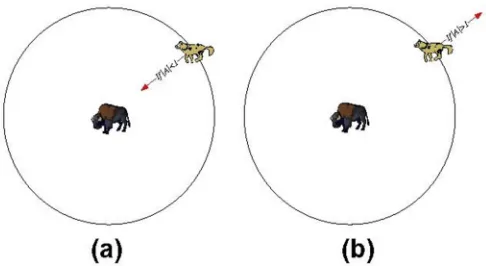
[image:2.612.88.528.122.435.2]Grey wolf optimizer (GWO) [1] based on natural hunting process of grey wolves. Hunting process and dominance of wolves in troops shown top to bottom in figure.
[image:2.612.188.431.467.600.2]Fig. 1 Hunting process of wolves / principle of GWO
Fig. 2 Wolves in a troop (top (highest dominant) to bottom (lowest dominant))
Fig. 3 Boundary condition of attack and diverge
1) When | | ≥1 diverge away from the prey and
2) When | ̅| ≤1 suitable position ready to attack on the prey for target archive.
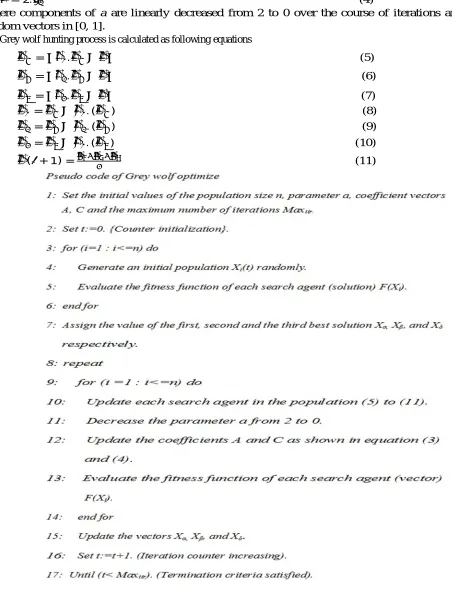
During the hunting, the grey wolves encircle prey. The mathematical model of the encircling behavior is presented in the following equations.
⃗=⃒ ⃗. ⃗ ( )− ⃗( )⃒ (1)
⃗( + 1) = ⃗ ( )− ⃗. ⃗ (2)
Tracking
Chasing
Approaching
Encircling
Pursuing
Harassing
Attack
α
δ
Where t is the current iteration, A and C are coefficient vectors, Xp is the position vector of the prey, and X indicates the position vector of a grey wolf. The vectors A and C are calculated as follows:
⃗= 2⃗.⃗ − ⃗ (3)
⃗= 2.⃗ (4)
Where components of a are linearly decreased from 2 to 0 over the course of iterations and r1, r2 are random vectors in [0, 1]. 3) Grey wolf hunting process is calculated as following equations ⃗ =⃒ ⃗ . ⃗ − ⃒⃗ (5)
⃗ =⃒ ⃗ . ⃗ − ⃒⃗ (6)
⃗ =⃒ ⃗ . ⃗ − ⃒⃗ (7)
⃗ = ⃗ − ⃗ . (⃗ ) (8)
⃗ = ⃗ − ⃗ . ( ⃗ ) (9)
⃗ = ⃗ − ⃗ . ( ⃗ ) (10)
[image:3.612.59.511.127.716.2]⃗( + 1) = ⃗ ⃗ ⃗ (11)
III. ADAPTIVE GWO ALGORITHM
In the meta-heuristic algorithms, randomization play a very important role in both exploration and exploitation where more randomization techniques are Markov chains, Levy flights and Gaussian or normal distribution and new technique is adaptive technique. Adaptive technique used by Pauline Ong in Cuckoo Search Algorithm (CSA) [2] and shows improvement in results of CSA algorithms. The Adaptive technique [3] includes best features like it consists of less parameter dependency, not required to define initial parameter and step size or position towards optimum solution is adaptively changes according to its functional fitness value o15ver the course of iteration. So mete-heuristic algorithms on integrated with adaptive technique results in less computational time to reach optimum solution, local minima avoidance and faster convergence.
((
( )
( )) (
( )
( )))
1
1
bestf t
fi t
bestf t
worstf t
t
X
i
t
(12)Where
1
t
X
i
Step size of i-th dimension in t-th iteration
f t
( )
is the fitness value [image:4.612.65.548.305.730.2]IV. SIMULATION RESULTS FOR UNCONSTRAINT TEST BENCHMARK FUNCTION
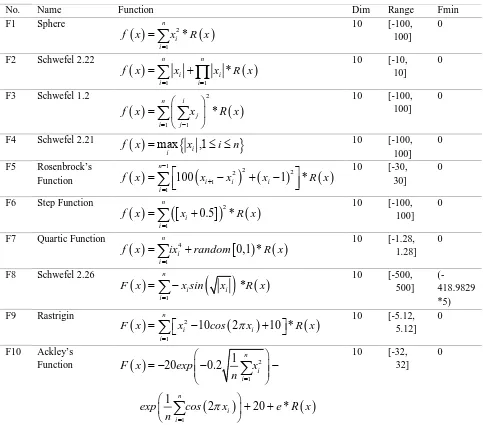
Table 1: Benchmark Test functions
No. Name Function Dim Range Fmin
F1 Sphere
2
1
*
n
i i
f x
x
R x
10 [-100, 100] 0F2 Schwefel 2.22
1 1*
n n i i i if x
x
x
R x
10 [-10, 10] 0F3 Schwefel 1.2
2 1 1*
n i j i jf x
x
R x
10 [-100,
100] 0
F4 Schwefel 2.21
max
,1
i i
f x
x
i
n
10 [-100,100] 0
F5 Rosenbrock’s
Function
1
2 2 2
1 1
100
1
*
n
i i i
i
f x
x
x
x
R x
10 [-30, 30]0
F6 Step Function
2
1
0.5
*
n
i i
f x
x
R x
10 [-100, 100] 0F7 Quartic Function
4
1
0,1 *
n
i i
f x
ix
random
R x
10 [-1.28, 1.28] 0F8 Schwefel 2.26
1*
n i i iF x
x sin
x
R x
10 [-500, 500] (-418.9829*5) F9 Rastrigin
2
1
10
2
10 *
n
i i
i
F x
x
cos
x
R x
10 [-5.12, 5.12] 0F10 Ackley’s
Function
21
1
20
0.2
n i iF x
exp
x
n
11
2
20
*
n
i i
exp
cos
x
e R x
n
10 [-32,
F11 Griewank
Function
2
1 1
1
1*
4000
n n i i i ix
F x
x
cos
R x
i
10 [-600, 600]0
F12 Penalty 1
1 2 1 1 2 2 1
1 0 1
1 1 0 1
n i i
i n
s i n y y
F x
n
s i n y y
1
1
4
i ix
y
,
( , , , ) 0
m i i i i m i i
k x a x a
u x a k m a x a
k x a x a
10 [-50,
50]
0
F13 Penalty 2
2 2 1 1 2 2 2 3 1
0 . 1 1 3 1
1 1 2
n i i i
n n
s i n x x
F x s i n x
x s i n x
1, 5,100, 4 *
n
i i
u x
R x
10 [-50,
50] 0
F14 De Joung (Shekel’s
Foxholes)
1 25 6 2 1 11
1
500
j i ij iF x
j
x
a
2 [-65.536,
65.536] 1
F15 Kowalik’s
Function
2 2
11
2 2
1 3 4
i i i
i
i i i
x b
b x
f x
a
b
b x
x
4 [-5,5] 0.00030
F16 Shekel
10 1
1
T
i i i
i
f x
X
a
X
a
c
4 [0,10] -10.5363F17 Cube function
3 2 22 1 1
100(
)
(1
)
f x
x
x
x
30 [-100,100
0
F18 Matyas function 2 2
1 2 1 2
( )
0.26(
) 0.48
f x
x
x
x x
30 [-30,30]
0
F19 Powell function 2 2 2
1 1 2
4 4
1 1 1 2
(
10 )
5(
)
( )
(
2
)
10(
)
D
i i i i
i i i i i
x
x
x
x
f x
x
x
x
x
4 [-30,
30]
0
F20 Beale Function
1
2 2 2
1 2 1 1 2 2
3 1 1 2
1.5
2.25
( )
2.625
x
x x
x
x x
f x
x
x x
30 [-100,
100]
0
F21 levy13 function
2
2 2
1 1 2
2 2
2 2
sin 3 1 1 sin 3
( )
1 1 sin 2
x x x
f x x x
30 [-10,
10]
Table 2: Internal Parameters
Parameter Name Search Agents no. Max. Iteration no. No. of Evolution
F1-F21 30 500 20-30
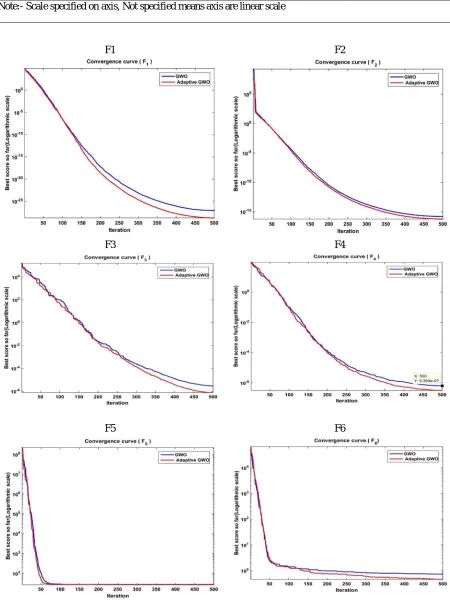
Note:- Scale specified on axis, Not specified means axis are linear scale
F1 F2
F3 F4
F7 F8
F9 F10
F13 F14
F15 F16
F19 F20
[image:9.612.72.539.74.697.2]F21
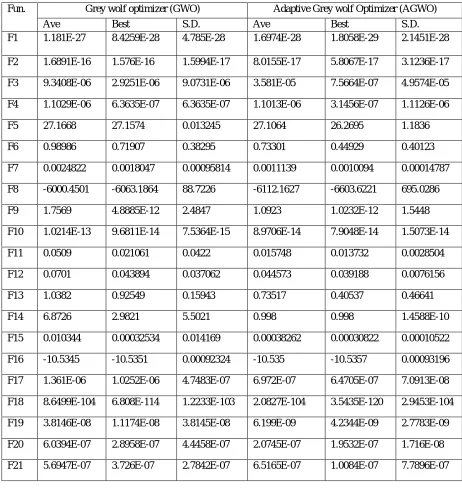
Table 3: Result for benchmark functions
Fun. Grey wolf optimizer (GWO) Adaptive Grey wolf Optimizer (AGWO)
Ave Best S.D. Ave Best S.D.
F1 1.181E-27 8.4259E-28 4.785E-28 1.6974E-28 1.8058E-29 2.1451E-28
F2 1.6891E-16 1.576E-16 1.5994E-17 8.0155E-17 5.8067E-17 3.1236E-17
F3 9.3408E-06 2.9251E-06 9.0731E-06 3.581E-05 7.5664E-07 4.9574E-05
F4 1.1029E-06 6.3635E-07 6.3635E-07 1.1013E-06 3.1456E-07 1.1126E-06
F5 27.1668 27.1574 0.013245 27.1064 26.2695 1.1836
F6 0.98986 0.71907 0.38295 0.73301 0.44929 0.40123
F7 0.0024822 0.0018047 0.00095814 0.0011139 0.0010094 0.00014787
F8 -6000.4501 -6063.1864 88.7226 -6112.1627 -6603.6221 695.0286
F9 1.7569 4.8885E-12 2.4847 1.0923 1.0232E-12 1.5448
F10 1.0214E-13 9.6811E-14 7.5364E-15 8.9706E-14 7.9048E-14 1.5073E-14
F11 0.0509 0.021061 0.0422 0.015748 0.013732 0.0028504
F12 0.0701 0.043894 0.037062 0.044573 0.039188 0.0076156
F13 1.0382 0.92549 0.15943 0.73517 0.40537 0.46641
F14 6.8726 2.9821 5.5021 0.998 0.998 1.4588E-10
F15 0.010344 0.00032534 0.014169 0.00038262 0.00030822 0.00010522
F16 -10.5345 -10.5351 0.00092324 -10.535 -10.5357 0.00093196
F17 1.361E-06 1.0252E-06 4.7483E-07 6.972E-07 6.4705E-07 7.0913E-08
F18 8.6499E-104 6.808E-114 1.2233E-103 2.0827E-104 3.5435E-120 2.9453E-104
F19 3.8146E-08 1.1174E-08 3.8145E-08 6.199E-09 4.2344E-09 2.7783E-09
F20 6.0394E-07 2.8958E-07 4.4458E-07 2.0745E-07 1.9532E-07 1.716E-08
F21 5.6947E-07 3.726E-07 2.7842E-07 6.5165E-07 1.0084E-07 7.7896E-07
V. CONCLUSION
Grey Wolf Optimizer have an ability to find out optimum solution with constrained handling which includes both equality and inequality constraints. While obtaining optimum solution constraint limits should not be violated. Randomization plays an important role in both exploration and exploitation. Adaptive technique causes faster convergence, randomness, and stochastic behavior for improving solutions. Adaptive technique also used for random walk in search space when no neighboring solution exits to converse towards optimal solution. The AGWO result of various unconstrained problems proves that it is also an effective method in solving challenging problems with unknown search space.
VI. ACKNOWLEDGMENT
REFERENCES
[1] Seyedali Mirjalili, Seyed Mohammad Mirjalili, Andrew Lewis , “Grey Wolf Optimizer”, “Advances in Engineering Software”, 69 (2014) pages 41-61. http://dx.doi.org/10.1016/j.advengsoft.2013.12.007.
[2] P. Ong, “Adaptive Cuckoo search algorithm for unconstrained optimization,” The Scientific World Journal, Hindawi Publication, vol. 2014, pp.1-8, 2014. [3] Manoj Kumar Naik, Rutupaparna Panda, “A novel adaptive cuckoo search algorithm for intrinsic discriminant analysis based face recognition”, in Elsevier
journal, “Applied Soft Computing” http://dx.doi.org/10.1016/j.asoc.2015.10.039.
[4] Hua-Long Liu, “Acoustic partial discharge localization methodology in power transformers employing the quantum genetic algorithm” in Elsevier journal, “Applied Acoustics” http://dx.doi.org/10.1016/j.apacoust.2015.08.011.
[5] Liu HL, Liu HD. Partial discharge localization in power transformers based on the sequential quadratic programming-genetic algorithm adopting acoustic emission techniques. Eur Phys J Appl Phys 2014;68(01):10801.
[6] Yang Y, Wang BB. Application of unconstrained optimization in ultrasonic locating of transformer partial discharge. Mod Electron Techn 2007; 2007 (3):100– 4.
[7] A. Kaveh, S. Malakouti Rad “Hybrid Genetic Algorithm and Particle Swarm Optimization for the Force Method-Based Simultaneous Analysis and Design” Iranian Journal of Science & Technology, Transaction B: Engineering, Vol. 34, No. B1, PP 15-34.
[8] A. Kaveh and S. Talatahari, A Hybrid Particle Swarm and Ant Colony Optimization for Design of Truss Structures, Asian Journal of Civil Engineering (Building And Housing) Vol. 9, No. 4 (2008) Pages 329-348.
[9] Iztok Fister Jr., Simon Fong, Janez Brest, and Iztok Fister, A Novel Hybrid Self-Adaptive Bat Algorithm, Hindawi Publishing Corporation the Scientific World Journal Volume 2014, Article ID 709738, 12 pages http://dx.doi.org/10.1155/2014/709738.
[10] Gai-Ge Wang, Amir H. Gandomi, Amir H. Alavi, Suash Deb, A hybrid PBIL-based Krill Herd Algorithm, December 2015.
[11] Gai-Ge Wang, Amir H. Gandomi, Amir H. Alavi, Suash Deb, A hybrid method based on krill herd and quantum-behaved particle swarm optimization, Neural Computing and Applications, 2015, doi: 10.1007/s00521-015-1914-z.
[12] A. Tahershamsi, A. Kaveh, R. Sheikholeslami and S. Kazemzadeh Azad, An improved _rey algorithm with harmony search scheme for optimization of water distribution systems, Scientia Iranica A (2014) 21(5), 1591{1607.
[13] Lihong Guo, Gai-Ge Wang, Heqi Wang, and Dinan Wang, An Effective Hybrid Firefly Algorithm with Harmony Search for Global Numerical Optimization, Hindawi Publishing Corporation The ScientificWorld Journal Volume 2013, Article ID 125625, 9 pages doi.org/10.1155/2013/125625.
[14] Gai-Ge Wang, Lihong Guo, Amir Hossein Gandomi, Guo-Sheng Hao, Heqi Wang. Chaotic krill herd algorithm. Information Sciences, Vol. 274, pp. 17-34, 2014.
[15] GaigeWang and Lihong Guo, A Novel Hybrid Bat Algorithm with Harmony Search for Global Numerical Optimization, Hindawi Publishing Corporation Journal of Applied Mathematics Volume 2013, Article ID 696491, 21 pages http://dx.doi.org/10.1155/2013/696491.
[16] A. Kaveh and S. Talatahari “Hybrid Algorithm of Harmony Search, Particle Swarm and Ant Colony for Structural Design Optimization” Z.W. Geem (Ed.): Harmony Search Algo. For Structural Design Optimization, SCI 239, pp. 159–198.
[17] Gai-Ge Wang, Amir H. Gandomi, Xin-She Yang, Amir H. Alavi, A new hybrid method based on krill herd and cuckoo search for global optimization tasks. Int J of Bio-Inspired Computation, 2012, in press.
[18] Ali Kaveh / Omid Khadem Hosseini, A hybrid HS-CSS algorithm for simultaneous analysis, design and optimization of trusses via force method, Civil Engineering 56/2 (2012) 197–212 doi: 10.3311/pp.ci.2012-2.06 web: http://www.pp.bme.hu/ ci Periodica Polytechnica 2012.
[19] A. Kaveh, and A. Nasrollahi , Engineering Design Optimization Using A Hybrid PSO And HS Algorithm, Asian Journal Of Civil Engineering (Bhrc) Vol. 14, No. 2 (2013) Pages 201-223.
[20] Gai-Ge Wang, Amir Hossein Gandomi, Amir Hossein Alavi, Guo-Sheng Hao. Hybrid krill herd algorithm with differential evolution for global numerical optimization. Neural Computing & Applications, Vol. 25, No. 2, pp. 297-308, 2014.
[21] Gai-Ge Wang, Amir Hossein Gandomi, Xiangjun Zhao, HaiCheng Eric Chu. Hybridizing harmony search algorithm with cuckoo search for global numerical optimization. Soft Computing, 2014. doi: 10.1007/s00500-014-1502-7.
[22] Gaige Wang, Lihong Guo, Hong Duan, Heqi Wang, Luo Liu, and Mingzhen Shao, Hybridizing Harmony Search with Biogeography Based Optimization for Global Numerical Optimization, Journal of Computational and Theoretical Nanoscience Vol. 10, 2312–2322, 2013.
[23] S. Talatahari, R. Sheikholeslami, B. Farahmand Azar, and H. Daneshpajouh, Optimal Parameter Estimation for Muskingum Model Using a CSS-PSO Method, Hindawi Publishing Corporation Advances in Mechanical Engineering Volume 2013, Article ID 480954, 6 pages doi.org/10.1155/2013/480954.
[24] A.H. Gandomi, X.S. Yang, S. Talatahari, A.H. Alavi, Metaheuristic Applications in Structures and Infrastructures, Elsevier, 2013.