Comparative Study of Improvements in Multiple
Effect Vapor Absorption Systems using Loop Heat
Pipes
Ankit Dwivedi
1, R S Mishra
21, 2
Dept. of Mechanical Engineering, Delhi Technological University, Delhi
Abstract: The research work is based on the research done on the modification of vapor absorption refrigeration systems (VARS) by incorporating Loop Heat Pipes (LHP). A comparison of the performance enhancements of different effect systems namely single, double, half and triple effect systems is performed in this research work. The modification in the systems is brought in by replacing the condenser of the VARS systems by LHPs. It’s shown through the simulations that intra cycle heat
exchange increases with the change in design, materials of the LHP and operating temperatures. The COP I and COP II are
maximum for triple effect system whereas the percentage increase in the performance is highest in double effect system 78% & 28%. Higher the generator temperature, higher is the heat utilization factor for the LHPs. The system becomes concise and flexible at the same time.
Keywords: Loop Heat Pipes, Vapor Absorption Refrigeration System, Half Effect, Double Effect, Triple Effect, Double Effect
I. INTRODUCTION
The performance parameters of different Vapor absorption systems have been studied. The systems have been modified by removal of condenser from the original system. The advantages in the new systems have been discussed earlier, this research work happens to be comparing all the aspects.
II. LITERATURE REVIEW
©IJRASET: All Rights are Reserved
1030
III. SYSTEMS DESCRIPTION
[image:2.612.125.484.161.682.2]The following Fig.1 Shows the modification made by Ankit Dwivedi et. al. [42] in the simple single effect VARS operating between 373K & 273K . The system is able to reduce the waste of heat very effectively. Fig. Shows the changes made by Ankit Dwivedi et. al. [44] in Double effect VARS operating between 403K and 277K . The system operates without the presence of condenser. Also the heat exchange has improved with the use of LHP between low temperature generator and absorber. The LHP works on a very constant temperature, that reduces the exergy loss due to heat transfer through a large temperature difference.
Fig.1: Modified VARS with a LHP [42].
Fig.2: Modified Double Effect VARS with a LHP [44]
[image:2.612.143.487.170.356.2]Fig.3: Modified Half Effect VARS with a LHP [43]
Triple effect system is modified by using 2 LHPs as can be seen in the Fig. 3 Mixture from the absorber is pumped directly through the LHPs. With the help of these LHPs, heat exchange at two levels is arranged. This system operates between 433K and 276 K. These designed systems in Fig. 4 are obtained by removing condensers by LHPs. The design is flexible and intra-cycle heat exchange is achieved, heat loss to the environment is reduced, reducing the entropy generation.
©IJRASET: All Rights are Reserved
1032
The following tables contain the parameters used in the systems explained above in order to obtain the required simulations.Table1: Terms Used in Simulation of Single Effect VARS [46].
Terms Abbreviations
Refrigeration Effect in kW RE (kW)
Heat rejected in absorber in kW Qa (kW)
Heat supplied in generator in kW Qg (kW)
Heat rejected in condenser of LHP in kW Qcond (kW)
Heat absorbed in evaporator of LHP in kW Qeva (kW)
Absorber Temperature in K Ta,TA (K)
Generator Temperature in K Tg, TG (K)
Condenser Temperature in K Tc (K)
Evaporator Temperature in K TE,Te (K)
Heat Rejected in Condenser in kW QC (kW)
First Law Coefficient of Performance COP I
Second Law Coefficient of Performance COP II
Heat Leaked from the LHP in kW QLeak (kW)
Percentage Improvement in First Law Coefficient of Performance
%COP Iimp
Percentage Improvement in Second Law Coefficient of Performance
%COP II imp
Improvement in First Law Coefficient of Performance
COP I imp
Improvement in Second Law Coefficient of Performance
COP II imp
Table2: Terms Used in Simulation of Double Effect VARS[44]
Terms Abbreviations
Refrigeration Effect in kW RE (kW)
Heat rejected in absorber in kW Qa (kW)
Heat supplied in generator in kW Qg (kW)
Heat rejected in condenser of LHP in kW Qcond (kW)
Heat absorbed in evaporator of LHP in kW Qeva (kW)
Absorber Temperature in °C TLa,THa (°C)
Generator Temperature in °C THg, TLG (°C)
LHP Condenser Temperature in °C Tc (°C)
Evaporator Temperature in °C TE,Te (°C)
Heat Rejected in Condenser in kW QC (kW)
First Law Coefficient of Performance COP I
Second Law Coefficient of Performance COP II
Heat Leaked from the LHP in kW QLeak (kW)
Percentage Improvement in First LawCoefficient of Performance %COP Iimp
Percentage Improvement in Second LawCoefficient of Performance %COP II imp
Improvement in First Law Coefficient ofPerformance COP I imp
Improvement in Second Law Coefficient of Performance COP II imp
Low Pressure Generator LPG
Table3: Terms Used in Simulation of Half Effect VARS [43]
Terms Abbreviations
Refrigeration Effect in kW RE (kW)
Heat rejected in absorber in kW Qa (kW)
Heat supplied in generator in kW Qg (kW)
Heat rejected in condenser of LHP in kW Qcond (kW)
Heat absorbed in evaporator of LHP in kW Qeva (kW)
Absorber Temperature in °C TLa,THa (°C)
Generator Temperature in °C THg, TLG (°C)
LHP Condenser Temperature in °C Tc (°C)
Evaporator Temperature in °C TE,Te (°C)
Heat Rejected in Condenser in kW QC (kW)
First Law Coefficient of Performance COP I
Second Law Coefficient of Performance COP II
Heat Leaked from the LHP in kW QLeak (kW)
Percentage Improvement in First Law Coefficient of Performance
%COP Iimp
Percentage Improvement in Second Law Coefficient of Performance
%COP II imp
Improvement in First Law Coefficient of COP I imp
Performance
Improvement in Second Law Coefficient of Performance
COP II imp
Table4: Terms Used in Simulation of Triple Effect VARS [45]
Terms Abbreviations
Refrigeration Effect in kW RE (kW)
Heat rejected in absorber in kW Qa (kW)
Heat supplied in generator in kW Qg (kW)
Heat rejected in condenser of LHP in kW Qcond (kW)
Heat absorbed in evaporator of LHP in kW Qeva (kW)
Absorber Temperature in °C TLa,THa (°C)
Generator Temperature in °C THg, TLG,TMG (°C)
LHP Condenser Temperature in °C Tc (°C)
Evaporator Temperature in °C TE,Te (°C)
Heat Rejected in Condenser in kW QC (kW)
First Law Coefficient of Performance COP I
Second Law Coefficient of Performance COP II
Heat Leaked from the LHP in kW QLeak (kW)
Percentage Improvement in First Law Coefficient of Performance
%COP Iimp
Percentage Improvement in Second Law Coefficient of Performance
%COP II imp
Improvement in First Law Coefficient of Performance COP I imp
Improvement in Second Law Coefficient of Performance COP II imp
Low Temperature Generator, Condenser LG,LC
Medium Temperature Generator, Condenser MG, MC
©IJRASET: All Rights are Reserved
1034
IV. RESULTS AND DICSUSSIONS
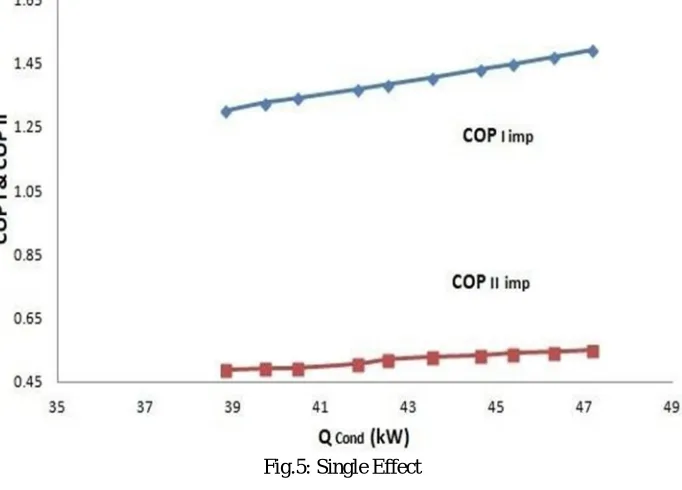
Based on the simulations this section revolves abounds the results obtained. The COPI, COPII are analysed with variations in QCond & TC . The performance enhancements in the above detailed systems are compared.
A. Comparison of Improvements in COPI & COPII with Varying Heat Input in Condenser of the Loop Heat Pipe (LHP)
[image:6.612.138.479.192.437.2]This section is based on the results obtained by varying the parameter Heat Exchange in the condenser of the LHP. It’s the energy that moves from the condensing strong refrigerant in the evaporator of the LHP. The idea is to transfer this energy to the mixture out of the absorber, to reduce the heat loss, improving both the COPs. Fig shows the COPs of single effect.
Fig.5: Single Effect
[image:6.612.144.467.488.714.2]Fig is the plot of COPs with QCond for the double effect system, whereas Fig is showing results for half effect system. The results of triple effect follows in fig .
Fig.7: Half Effect
Fig.8: Triple Effect
©IJRASET: All Rights are Reserved
1036
B. Comparison of Percentage Improvements in COPI & COPII with Varying Heat Input in Condenser of the Loop Heat Pipe(LHP)
The above section explains the values of the COPs for the modified systems, while in this section it will be clear about the percentage enhancement of the COPs compared to that of the conventional systems with varying QCond. Fig shows the average improvements in COPI & COPII for modified single effect system to be 68% and 23% respectively. Moreover Fig if showing the results for modified double effect system where average enhancement in COPI & COPII is 75.85% & 28.5 % respectively. Average increase in COPI & COPII is 64% & 27 % for the modified half effect system. The new triple effect system gets the improvement in COPI & COPII of about 61% and 25% as can be accessed from the Fig 9 to fig 12.
Fig.9: Single Effect
Fig.11: Half Effect
©IJRASET: All Rights are Reserved
1038
C. Comparison of Percentage Improvements in COPI & COPII with Varying Temperature in Condenser of the Loop Heat Pipe(LHP):
This section shows the results on performance parameters with varying TC for the systems. The percentage increases in the figure from Fig 13 to Fig 15 for double, half and triple effect respectively.
Fig.13: Double Effect
Fig.15: Triple Effect
D. Comparison of Percentage Improvements in COPI & COPII with Varying Generator Temperature: The variation with the TG can be seen from Fig 16 to Fig 18 for double, half and triple effect respectively.
Fig.16: Double Effect
©IJRASET: All Rights are Reserved
1040
Fig.18: Triple EffectV. CONCLUSIONS
Studies from the simulations have been presented in the previous sections. Following conclusions can be made from the results.
A. The intra cycle utilization of energy increases with the change in design, materials of the LHP and operating temperatures.
B. Maximum COPI can be observed in Triple effect system whereas the maximum percentage increase is observed in double effect
system as 78% from the initial value.
C. COPII is highest for triple effect system while the increase is found to be highest for double effect system to be 28%.
D. The size of the system is gets reduced and the parts having exergy loss are eliminated along with the enhanced flexibility of the system.
E. For the systems the COPII has a steeper rise over the range when compared to the COPI for the range of heat exchange in the condenser of LHP.
F. With increase in TG both COPI and COPII are increasing along with the TC sharply.
REFERENCES
[1] Korn, F., “Heat Pipes and its Applications” Project Report 2008 MVK160 Heat and Mass Transport May 07, 2008, Lund, Sweden.
[2] T.X. Li, R.Z. Wang , L.W. Wang, Z.S. Lu, C.J. Chen,” Performance study of a high efficient multifunction heat pipe type adsorption ice making system with novel mass and heat recovery processes” International Journal of Thermal Sciences Vol.46 (2007) 1267– 1274
[3] Rajashree, R., Rao, K.S., “A Numerical Study of the Performance of Heat Pipe” Indian Journal of Pure and Applied Mathematics, 21 (1): 95-108, January 1990.
[4] M.M. Talbi, B. Agnew,” Exergy analysis: an absorption refrigerator using lithium bromide and water as the working Fuids” Applied Thermal Engineering Vol. 20 (2000) 619-630.
[5] E. Kurem,” A comparison between Ammonia-water and Water-Lithium Bromide solutions in vapour absorption heat transformers “In. Comm. Heat Mass Transfer; Vol. 28, No. 3, pp. 421-438, 2001.
[6] S.A. Adewusi, Syed M. Zubair,” Second law based thermodynamic analysis of ammonia–water absorption systems” Energy Conversion and Management Vol. 45 (2004) 2355–2369.
[7] S. Arivazhagan , R. Saravanan , S. Renganarayanan ,” Experimental studies on HFC based two-stage half effect vapour absorption cooling system” Applied Thermal Engineering Vol. 26 (2006) 1455–1462.
[8] Rabah Gomri,” Second law comparison of single effect and double effect vapour absorption refrigeration systems” Energy Conversion and Management Vol. 50 (2009) 1279–1287.
[10] Gulshan Sachdeva, Ram Bilash,” Thermodynamic Analysis of a Vapor Absorption System Using Modified Gouy-Stodola Equation” International Journal of Computer, Electrical, Automation, Control and Information Engineering Vol:8, No:12, 2014.
[11] Ankit Dwivedi, R. S. Mishra, Manjunath K,” Optimization of Vapour Absorption System Using Heat Pipes” ISSN: 2321-9653 International Journal for Research in Applied Science & Engineering Technology (IJRASET), Volume 5 Issue VIII, August 2017,634- 639.
[12] Ankit Dwivedi, R. S. Mishra,” Performance Enhancement of Simple Vapour Absorption System Using Loop Heat Pipes” ISSN: 2321-9653 International Journal for Research in Applied Science & Engineering Technology (IJRASET), Volume 6 Issue I, January 2018, 865-873.
[13] Ankit Dwivedi, R. S. Mishra,” Study of Performance Enhancement of Half Effect Vapor Absorption System Using Loop Heat Pipes” ISSN: 2321-9653 International Journal for Research in Applied Science & Engineering Technology (IJRASET), Volume 6 Issue I, January 2018, 1147-1156.
[14] Ankit Dwivedi, R. S. Mishra,” Performance Enhancement Analysis of Double Effect Vapor Absorption System Using Loop Heat Pipes” ISSN: 2321-9653 International Journal for Research in Applied Science & Engineering Technology (IJRASET), Volume 6 Issue I, January 2018,1523-1533.
[15] A Dwivedi, Thermodynamic Analysis of Vapour Compression Refrigeration System Using a Heat Pipe, Master’s Degree in Delhi Technological University, 2015, 20-48
[16] Ankit Dwivedi, R. S. Mishra, Manjunath K,”Optimization of Vapour Absorption System Using Heat Pipes” ISSN: 2321-9653 International Journal for Research in Applied Science & Engineering Technology (IJRASET), Volume 5 Issue VIII, August 2017,634-639.
[17] AnkitDwivedi, R. S. Mishra,” Study of Performance Enhancement of Half Effect Vapor Absorption System Using Loop Heat Pipes” ISSN: 2321-9653 International Journal for Research in Applied Science & Engineering Technology (IJRASET), Volume 6 Issue I, January 2018, 1147-1156.
[18] Ankit Dwivedi, R. S. Mishra,” Performance Enhancement Analysis of Double Effect Vapor Absorption System Using Loop Heat Pipes” ISSN: 2321-9653 International Journal for Research in Applied Science & Engineering Technology (IJRASET), Volume 6 Issue I, January 2018,1523-1533.
![Fig.1: Modified VARS with a LHP [42].](https://thumb-us.123doks.com/thumbv2/123dok_us/1231488.648428/2.612.125.484.161.682/fig-modified-vars-with-a-lhp.webp)