Obstacle Sensing Walng Stick for Visually
Challenged People using Raspberry-PI
Mukund Patil1, Rohit Patil2, Radha Borikar3, V. V. Khatavakar4
1
P.G. Student, Electrical Department, Savitribai Phule Pune Univercity, Pune, India
2, 3
P.G. Control And Automation Department, VIT Univercity, Vellore, India
4
Ast. Professor, ME., Electrical Department, Modern College Of Engineering, Pune, India
Abstract: Smart stick could be a sophisticated stick that's vogue for visually disabled people to spice up navigation with
advanced technology. The great stick contains unsounded device at the aspect of light-weight and water sensing. The planned paper defines smart stick that uses associate unsounded device to note obstacles ahead exploitation unsounded waves. The data of detected obstacle is provided to the microcontroller, then microcontroller methodology data and if associate obstacle is detected, it sends an indication to the buzzer and buzzer beeps. Throughout this paper, we tend to tend to superimposed some real-life objects e.g. car, dog, human etc. If any of the objects square measure detected, web camera captures the image of associate object and converts it into a label then that label is reborn into speech. If a condition device detects water, it beeps the buzzer. This smart stick in addition has light-weight detection feature, if a stick goes into the darkness then buzzer buzzes. The system has another advanced feature supported frequency module. This RF module are used as a far flung to look out the missing stick of visually human. This paper planned the navigation for visually disable people by exploitation image method and sensors.
Keywords: Image Processing, RF module, Light Sensor, Moisture Sensor, Ultrasonic Sensor.
I. INTRODUCTION
Visual disability is a very common issue in every country. In a human body, eye plays an important role. It is common that the visually impaired people always carry a hand stick with themselves whenever they need a support1. There may be an obstacle in their path but is not encountered by the blind person with the help of the stick. Thus, the people may get injured if the obstacle is big or dangerous. Thus we proposed a design which has been developed to assist blind people and provide them with a clear track [1].
There are many past works that had been done for visually impaired people.
But every system has their own limitation. Some devices which are using Different technologies like Radio-Frequency Identification technology. With the help of this technology, we can achieve the location of stick [2]. Also, there is another technology which uses dc motor along with microcontroller. They use a simple robot type guidance system which follows the position of the moving guide stick with the help of 2 encoders and ultrasonic sensors to decide whether the blind person moves safely [3]. There is another technology which uses GSM module, infrared sensor and LM358. That system applied in curved, straight and angle path [4]. The major disadvantage of the infrared sensor is its environment recognition.
II. SYSTEM DISCRIPTION
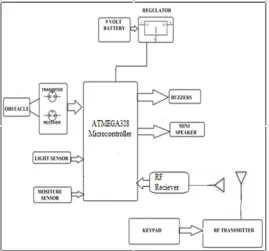
This project divided into two parts: Real-time embedded system and Image processing. The person using the stick has to carry both the units and navigate anywhere. The system alarms the user with the help of buzzer sounds so that the user can walk/navigate safely. If an obstacle comes in the view of the stick, the system sounds a buzzer in a pattern to let the blind user know that there is an obstacle in the front and keeps buzzing it till the obstacle is in view of the stick. The range of detection can be varied with the help of potentiometer mounted on the blind stick. The system alerts the user of the wet floor using wires attached at the bottom of the stick by alarming a pattern of buzzer till the stick is touching a wet floor. Figure 1 shows the overall block diagram of a blind walking stick with different features.
A. Real-time Embedded System
[image:2.612.178.447.276.527.2]In this type of system, we used a different type of sensors like Light Dependent Resistor (LDR), ultrasonic sensor and moisture sensor. The below block diagram shows the different sensors. The system senses the ambient lighting conditions to let the blind user know if the lighting conditions are normal or not. If there is light the user will know it, he/she can be seen by others and can wave for help in distress. The user can press a button on the stick that will sound a pattern of buzzer if there is darkness around else no buzzer sound is generated.
Fig. 1 Overall block diagram of the blind walking stick with different features
Also, there are chances that the stick might get lost. For such situation, a remote control unit is designed. On pressing a button on the remote, the stick will sound a buzzer in a pattern that will let the user know where the stick has been kept. When it's found, by pressing another button on the remote unit, the buzzer can be silenced. It should be noted that each of the buzzer patterns that is programmed for unique circumstances is also unique. It is done so that the user can distinguish between various alarm sounds and better predict his / her surroundings, this type technology completed with the help of C language.
B. Image Processing
III. HARDWARE COMPONANTS Below hardware description only describes the main components
A. ATMEGA328 Microcontroller
The ATMEGA328P is a 32K 8-bit microcontroller based on the AVR architecture. All instructions are executing at 20 MHz in a single clock cycle providing a throughput of almost 20 MIPS. The ATMEGA328-PU comes with PDIP 28 pin package and is suitable for 28 pin AVR development board. It is having 2x8 bit timer /counter each independent with pre scalar and compare modes, a single 16-bit timer /counter each dependent with pre scalar, compare and captured modes, real-time counter with independent oscillator and 10-bit,6 channel analog to digital converter [12].
B. Raspberry Pi
It is a single board computer of small series; it is latest Broadcom 2837 ARMv8 64-bit processors of raspberry Pi 3 model B which is faster and more powerful than other models. In model B board GPU allocates default 128MB memory in CPU. It has improved power management to support more powerful USB devices. The operating system for this model is Linux and programming is done in Python. It has some important feature like 1.2GHz 64bit quad-core ARMv8 CPU with 1GB RAM, Bluetooth 4.1 with low energy, wireless LAN with 10 to 100 Mbps speed and 4 USB port with 40 GPIO pins, full HDMI port [13].
C. Ultrasonic sensor
An ultrasonic sensor provides a very easy method and low-cost for distance measurement. This sensor is flawless for any applications that require you to perform measurements between stationary or moving objects [14]. The ultrasonic sensor measures distance using sonar. Ultrasonic module HC - SR04 is provided with 2cm-400cm non-contact measurement function, it has a ranging accuracy of approx. 3mm. This unit consists of the control circuit, ultrasonic transmitters, and receiver. The basic operating principle is when I/O is a trigger, it uses at least 10µs high-level signal, then 840 kHz signals are sent by the ultrasonic module and also detects whether there will be a pulse signal back or not. If a signal is coming back via high level, the time elapsed between ultrasonic sending and receiving is high I/O duration [15].
D. RF Communication Module
RF Module is an essential part of a control module and antenna. Its purpose is wireless identification. The working of the RF module is to send the energizing signal through the antenna. This module conveys a digital data stream and a clock signal for additional processing to its control unit or module. In addition to a field strength dependent, the digital output is attainable for synchronization purposes. The RF module having two parts is transmitter and receiver. The transmitter is mounted on the remote-controlled module and receiver is placed on the main module. In a system when the button is pressed, the signal is transmitted to main module and receiver receives the signal then buzzer operates. With the help of this process, we can find the missing stick [16].
E. LDR (Light Dependent Resistor)
A light-dependent resistor is basically a light-controlled variable resistor which works on the principle of photoconductivity. The resistance of a photocell decreases when increasing incident light intensity; also we can say that it exhibits photoconductivity [17].
F. Buzzer
A buzzer or beeper is an audio signalling device, which may be mechanical, piezoelectric or electromechanical. Typical applications of buzzers are alarm devices, timers, and confirmation of user input like a mouse click or keystroke [18].
IV. IMPLIMENTATION
A. Algorithm
Raspberry interfacing is done with the help of various software libraries which we have installed into raspberry pi.
After all, these steps check all the sensors whether they are working or not. First, check ultrasonic sensor whether it is detecting solid objects or not, LDR sensor whether it is detecting the ambient lights or not and moisture sensor whether it is detecting the water existence or not.
The RF-based module is designed with transmitter and receiver. This module is used for the transmitting and receiving signals to find the misplaced stick using RF remote.
B. Flowchart
The flow of system Operation is shown in figure 2.
V. RESULT AND DISCUSSION
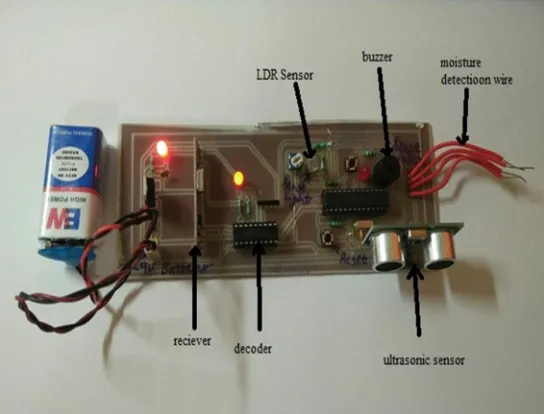
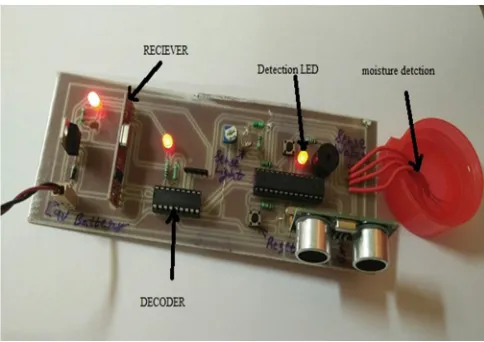
In Figure 3 shows the obstacle detecting sensor which consists of the ultrasonic module along with the LED and buzzer. The sensor measures the distance of the obstacle how much closer it is from the person. In figure 3 module, the potentiometer is available to vary the range. If the obstacle is not close enough to the person, the buzzer won't buzz otherwise it will start buzzing. Figure 4 shows the RF-based remote which is used to remind the misplaced stick. The blind person does not know where he kept his stick, if he unable to find his stick, so with the help of RF-based remote it is possible to find it. When the person presses the push button which is located on hardware module, the buzzer will keep buzzing until he gets the stick. Once he gets the stick, he can press another push button which is also located on the remote. Figure 5 shows the module which detects the moisture existence. If the obstacle is liquid in nature, then this feature is very useful. There are moisture wires which will locate at the bottom of the stick. Whenever liquid type obstacle came across the person, another buzzer will buzz having a different sound
[image:5.612.176.448.212.419.2].
[image:5.612.176.449.456.636.2]Fig.3 Obstacle detecting sensor
Fig.4 RF Based remote
Fig.5 Moisture detecting sensor
[image:6.612.177.424.484.639.2]Fig.6 Darkness detecting sensor
Fig.7 object recognition by image processing technique
VI. FUTURE SCOPE
In this paper, Image processing technique is used for object detection with colour detection technique, here we consider two or three colours like e.g. Red, green and black, each colour set to the specific object label. If one of the colours is detected then with respect to object label is converted into the speech. In the future scope purpose, we can use the image detection technique direct for this requirement we have to feed image as a dataset and depend upon object detection of the image, this image should be comparing dataset images. In this technique image comparing process are occurred in the form of an outer line of an image. This technique gives better response compared to colour based object detection.
VII. CONCLUSSION
The paper presented is very innovative and simple to use which is very useful for the blind person to navigate anywhere freely. In this project, we designed four features. It detects solid type obstacles like a car, cycle, dog, truck etc. by using ultrasonic sensor. It also detects liquid type obstacles like water, oil etc. by using moisture sensor. It also detects darkness to prevent dangerous location for the person by using LDR. Sometimes the blind person doesn't know which obstacle is coming to him. So to let him know exactly what is coming in front of him, we proposed image processing technique. For example, if a dog is coming, the image of dog will capture in web camera. The image will be converted into text ‘dog’ and text will be converted to speech. And the blind person will able to know the speech by earphones attached to the output of Raspberry Pi. Also, buzzer beeps different sound according to the type of object detection. The whole system is hardware as well as software based. It is very lightweight, not much expensive and very sensitive in nature. This project gives emphasis on making this system for visually impaired people of all the developing countries.
REFERENCES
[1] Nada A, Mashelly S, Fakhr M a, Seddik AF. Effective Fast Response Smart Stick for Blind People. 2015;(January 2016):1–7.
[2] Yadav A, Bindal L, Namhakumar V. Design and development of a smart assistive device for visually impaired people. Technol ([Internet]. 2016;1506–9. Available from: http://ieeexplore. ieee.org/abstract/document/7808083/
[3] Kang SJ, Kim YH, Moon IH. Development of an intelligent guide-stick for the blind. Proc - IEEE Int Conf Robot Autom. 2001;4:3208–13. [4] Alshbatat AIN. Automated mobility and orientation system for blind or partially sighted people. Int J Smart Sens Intell Syst. 2013;6(2):568–82. [5] Chaurasia S, Kavitha KVN. An electronic walking stick for blinds. 2014 Int Conf Inf Commun Embed Syst ICICES 2014. 2015;(978):1–5.
[6] Mahmud M, Saha R, Islam S. Smart walking stick-an electronic approach to assist visually disabled persons. IjserOrg [Internet]. 2013;4(10):111–4. Available from: c:%5CUsers%5Cjessica%5CBIBLIOTECA%5Cdesign%5CMetodologia experimental - Gui Bonsiepe.pdf
[7] Hashino S, Ghurchian R. A blind guidance system for street crossings based on ultrasonic sensors. 2010 IEEE Int Conf Inf Autom ICIA 2010. 2010;(3):476–81. [8] Gearhart C, Herold A, Self B, Birdsong C, Slivovsky L. Use of Ultrasonic sensors in the development of an Electronic Travel Aid. SAS 2009 - IEEE Sensors
Appl Symp Proc. 2009;275–80.
[9] Tech M. Mechanism to Read Smart Text from Image Using OCR and OpenCV with Raspberry PI 3.: 10–6.
[10] Oladayo OO. A Multidimensional Walking Aid for Visually Impaired Using Ultrasonic Sensors Network with Voice Guidance. Int J Intell Syst Appl [Internet]. 2014;6(8):53–9. Available from: http://www.mecs-press.org/ijisa/ijisa-v6-n8/v6n8-6.html
[11] Nexperia. BSH105 Datasheet. 1998;(February). Available from: http://assets.nexperia.com/documents/data-sheet/BSH 105.pdf [12] Atmel.ATmega48A/PA/88A/PA/168A/PA/328/ P DataSheet. AVR Microcontrollers. 2015;660.
[13] Pi R. DATASHEET Raspberry Pi Compute Module (CM1) Raspberry Pi Compute Module 3 (CM3) Raspberry Pi Compute Module 3 Lite (CM3L). 2016;3(October):0–21.
[14] Carullo A, Parvis M. An ultrasonic sensor for distance measurement in automotive applications. IEEE Sens J. 2001;1(2):143–7.
[15] Indoware. Ultrasonic Ranging Module HC - SR04. Datasheet [Internet]. 2013;1–4. Available from: http://www.micropik. com/PDF/HCSR04.pdf [16] Echostream I, En T, Rf XSS, En T, Inovonics T, Mesh C, et al. Why Inovonics Wireless is Best.
[17] Rs N. Light dependent resistors. 1997;12(651).