Data Priority Assignment Technique for
Opportunistic Routing
Neerbha Rani Chanu Thokchom1, Jagjit Singh2
1
Mtech Scholar, 2Assistant Professor, Doaba Group of Colleges, Kharrar, Mohali
Abstract: The wireless sensor networks have within them numerous nodes. These nodes include batteries within them which are of very small sizes. Also, the deployment of nodes in these networks is at far places and so the replacement of batteries is not an option here. Thus, the efficient utilization of battery within these networks is a major concern. In the base paper, technique of opportunistic based routing is proposed for data routing in wireless sensor networks. In the opportunistic type of routing the source node store the data on the intermediate node which will move near to the base station and deliver data to the base station. The data which is stored on the intermediate node also given the priority and data which has higher priority is delivered first to base station. The simulation is performed in NS2 and it has been analyzed that proposed technique performs well in terms of various parameters.
Keywords: WSN, Opportunistic, priority queue, gateway
I. INTRODUCTION
The networks that consist of various nodes within them which transmit important information amongst each other are known as wireless sensor networks (WSNs). The wireless sensor networks have within them numerous nodes. These nodes include batteries within them which are of very small sizes. Also, the deployment of nodes in these networks is at far places and so the replacement of batteries is not an option here. Thus, the efficient utilization of battery within these networks is a major concern. The overall of lifetime of the nodes and their deployment thus get affected which is also a major issue. The optimization algorithms are applied within these networks in order to help in controlling the energy consumption. Various time constraints are present within the detected and routing information sent across the WSNs. Before any alterations, the information can be utilized by the network [1]. For communicating the information across the network, the energy consumed is more as compared to the other executions. Thus, it is very important to address the energy conservation issue in the WSNs. In the wireless sensor networks the primary issue is constrained battery life utilized by sensor nodes.
The size of the sensor nodes is little so constraints are there like battery size, processors, stockpiling for data, these all are little as sensor nodes. So the fundamental spotlight on upgrading energy consumption in wireless sensor networks. In WSN a considerable measure of detected data and routing information must be sent which regularly have some time constraints so that the information can be used before any incident happens, e.g. industrial monitoring, hardware monitoring, and so on [2]. In WSN the energy power consumption is much higher in data communication than interior preparing. So energy conservation in WSN is should be addressed. Wireless Sensor Networks are prone to node failure because of power misfortune. Keeping in mind the end goal to give reliable service through the network, the network ought to act naturally adjusting and should have adaptable properties as required from time to time.
A bottleneck node may experience failure because of constrained battery life. In such case the network protocol ought to be sufficiently clever to handle such failures and keeps the network operational [3]. Generally sensor nodes rely on a battery with restricted lifetime, and their replacement is impractical because of physical constraints. Moreover the architecture and protocol of sensor networks must have the capacity to scale up any number of sensor nodes. Since the battery lifetime can be extended on the off chance that we figure out how to reduce the measure of communication, In the sensing subsystem energy consumption can be reduced by utilizing low power components. In power supply subsystem it consists of a battery, the lifetime of a battery can be increased by reducing the current definitely or notwithstanding turning it off. For sparing the energy of sensor nodes one of the clustering methodology is utilized.
cluster heads send aggregated data received from its individuals to a base station [4]. Since the cluster head regularly transmit data over longer separations, they lose more energy compared to part nodes. The clustering procedure is utilized to minimize the energy consumption. By utilizing clustering, it reduces the packet collision and channel contention it increases the network throughput under high load. Clustering enhance the network lifetime of the sensor networks. Lifetime is the essential element to assessing the execution of the sensor networks.
The clustering approaches can't directly apply to wireless sensor networks, in light of the fact that these networks has one of a kind deployment and operational qualities. Wireless sensor networks are sent in ad hoc way they have a bigger number of nodes. In ad hoc networks nodes are unaware of their locations. Hence, distributed clustering protocols that rely only on neighborhood information are preferred for WSNs (in any case, most studies in this area still expect that the network topology is known not centralized controller) [5].
There are many techniques that are used in clustering these are LEACH, and many more improved forms of LEACH like E- LEACH, LEACH-SM, multi-hop-LEACH, ENCM and so on. LEACH protocol contains two phases. Cluster set up phase is the stage in which every node portrays regardless of whether to wind up a cluster head for current round. Every one of the nodes pick a random number 0 or 1 for made a decision.
A threshold worth is setup, if the quantity of the node is not as much as threshold quality, then the node turns into a cluster head for current round [6]. The second stage is the steady stage in which the cluster head dole out time slots to its individuals for utilizing TDMA mode. The steady stage is isolated into frame, where nodes send their data to the cluster head at most once per frame amid their apportioned transmission slot.
RFID (Radio Frequency Identification) is a contactless automatic identification expertise that is based on radio frequency. There are typically two sorts of RFID according to the power source: active RFID and passive RFID. Active RFID is less advantageous than passive RFID in terms of its tag cost, size, and battery management, but more advantages in term of sensing nature, its nature, sensing rate ad sensing distance [7]. RFID is produced so that physical information can be stored and detected for a long time to enhance nature of the framework in addition of fundamental functions.
II. LITERATURE REVIEW
Arun K. Somani, et al. (2014) [8], presented in this paper there is a need of light weight and distributed type of computing required for performing clustering within the WSNs. There is a random clustering of the nodes done within these networks which can help in providing further efficiency to it.
There is no similarity of the sizes of nodes within these types of networks. With the help of various simulations, the performance of clustering can be enhanced. With the help of results achieved it can be seen that the nodes can be scheduled due to the random deployment and the limitation of communication range.
Ebin Deni Raj (2012) [9], presented in this paper the cluster head Gateway Switch Routing protocol (CGSR) method which uses the hierarchical network topology within it. As per their demands, the nodes are deployed within the clusters. As per the calculation provided in the network, the cluster head is chosen.
In order to select the cluster head within WSNs, the utilization of advance power consumption is done within most of the algorithms. On the basis of load balancing based algorithms, the communication cost of the network is reduced up to much extent. As per the simulation results achieved it can be seen that the proposed EDR LEACH algorithm helps in solving various problems arising within previous algorithms.
Maciej Nikodem et al. (2011) [10], concentrates on the theoretical parts of clustering in wireless sensor networks as intend to enhance network lifetime. We investigate whether clustering itself (without any data aggregation) can enhance network lifetime specifically application when compared to non-clustered networks.
We utilize integer linear programming to break down 1D and 2D networks, taking into record abilities of real-life nodes. Our results demonstrate that clustering itself can't enhance network lifetime so additional strategies and means are required to be utilized as a part of collaboration with clustering.
Degan Zhang et al. (2014) [11], presented in this paper a forward aware component (FAF-EBRM) method that helps in selection of hop node on the basis of the thickness and link weight factors. The proposed algorithm is compared with respect to various aspects against the LEACH and EEUC algorithms. As per the simulation results achieved it can be seen that various enhancements have been made in the work.
traffic thusly while still upgrade energy efficiency. The protocol makes the intersection to move far from the destination, getting nearer to the sources, allowing higher data aggregation and energy saving. It enhances the network life time 37% than exiting. Peyman Neamatollahi et al. (2017) [13], proposed a half and half clustering approach a cluster head reduce of its energy, it indirectly informs every other node and clustering is accustomed to beginning of the upcoming round. Clustering is performed on demand. To elaborate the efficiency of proposition, the distributed clustering protocol HEED (Hybrid Energy Efficient Distributed) half and half clustering calculation is utilized as baseline case.
Through simulation results, it demonstrates that HCA is roughly 30% more proficient in terms of network lifetime than the other protocol. The main reason is that the clustering is executed on demand.
III. RESEARCH METHODOLOGY
This work is based on the opportunistic type of routing in which source node stores the data on the intermediate node which change its location and deliver data to base station. The priority is assigned to the data and data which is urgent is delivered first to the base station.
The clocks of sensor nodes are not well synchronized which reduce network reliability. The time lay technique will be implemented in this work which provides strong clock synchronization between the sensor nodes. In the time lay technique cluster heads take initialization for the clock synchronization, the process of clock synchronization takes place until clocks of the all nodes get synchronized. The gateway nodes are deployed new the base station. The gateway nodes will pass the information to the base station according to their priority.
The packets which are stored on the gateway nodes first have higher priority. In this work, the novel technique is been proposed which synchronize the clocks of the sensor nodes. The proposed technique is based in the MAC time for the clock synchronization in the network.
The node which aggregated the data to cluster head will also the sent the current time header. The gateway when receives the packet will check the time of storage node when the time at the storage node and gateway node gets mismatched, then the data storage node will adjust the clock according to the current time. In the last step, of clock synchronization the storage nodes will adjust its clocks according to the gateway node time.
When the clocks of the sensor nodes get synchronized then the modes which are applied on each node will works efficiently and energy consumption in the network get reduced, also throughput increased at steady rate. This research leads to increase network performance in terms of network throughput, energy consumption and network lifetime.
A. Proposed Algorithm
1) Input: Sensor nodes with weak clock synchronization 2) Output: Sensor nodes with synchronized clocks
a) Deploy the sensor network with finite number of sensor nodes
b) Divide whole network into fixed size of zons
c) While (storage node selected)
Repeat for loop for each node in the network
If (energy (i)>energy(i+1) && distance (i)<distance(i+1)) Storage node=node(i)
End
d) The sensor nodes transmit data to the storage node
e) Check (MAC)
If (Mac time of the storage node !=cluster head time)
Storage node adjusts its clock according to gateway node time Else
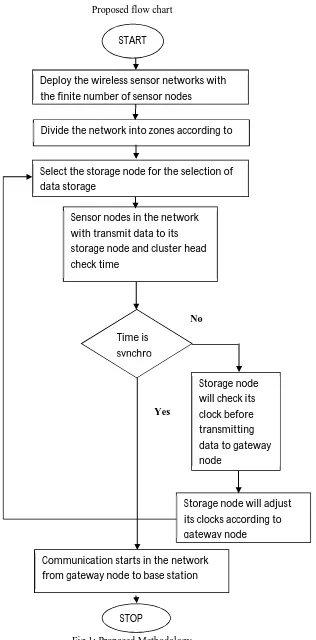
B. Proposed Flowchart
Proposed flow chart
No
Yes
Deploy the wireless sensor networks with the finite number of sensor nodes
Divide the network into zones according to their locations
Select the storage node for the selection of data storage
Sensor nodes in the network with transmit data to its storage node and cluster head check time
Time is synchro
Storage node will check its clock before transmitting data to gateway node
Storage node will adjust its clocks according to gateway node
Communication starts in the network from gateway node to base station
[image:4.612.174.490.87.727.2]IV. EXPERIMENTAL RESULTS
[image:5.612.177.438.112.383.2]The proposed algorithm is implemented in NS2 and the results are compared in terms of packet loss and throughput.
Fig 2: Packetloss Graph
As shown in figure 1, the packetloss comparisons are drawn between the normal scenario, packetloss scenario and proposed scenario. It has been analyzed that proposed scenario has least packetloss as compared to other scenarios.
Fig 3: Throughput Comparison
[image:5.612.206.411.422.679.2]V. CONCLUSION
In the wireless sensor networks, the sensors hubs are present which help in gathering all the important information gathered by the sensor nodes. The battery is present within the sensor nodes which is however of very limited size. The proposed technique is based in the MAC time for the clock synchronization in the network. The node which aggregated the data to cluster head will also the sent the current time header. The gateway when receives the packet will check the time header and when the time at the storage node and gateway node gets mismatched, then the data store node will adjust the clock according to the current time of gateway. In the last step, of clock synchronization the cluster heads will adjust its clocks according to the gateway node time.When the clocks of the sensor nodes get synchronized then the modes which are applied on each node will works efficiently and energy consumption in the network get reduced, also throughput increased at steady rate. This research leads to increase network performance in terms of network throughput, energy consumption and network lifetime.
REFERENCES
[1] S. Jerusha, K. Kulothungan & A. Kannan ,” Location aware cluster based routing in wireless sensor networks”, International Journal of Computer & Communication Technology ISSN, Volume 3, Issue 5, 2012
[2] Subramanian Ganesh and Ramachandran Amutha,” Efficient and Secure Routing Protocol for Wireless Sensor Networks through SNR Based Dynamic Clustering Mechanisms”, Journal of communications and networks, Volume 15, no.4, pp422-429, 2013
[3] Velmani Ramasamy, Kaarthick Balakrishnan,” An Efficient Cluster-Tree based Data Collection Scheme for Large Mobile Wireless Sensor Networks”, IEEE Sensor Journal, Volume 15, Issue 4, pp 2377-2390, 2015.
[4] Xiaofeng Han, Xiang Cao, Errol L. Lloyd, and Chien-Chung Shen,” Fault-Tolerant Relay Node Placement in Heterogeneous Wireless Sensor Networks”, IEEE Transaction on mobile computing, Volume 9, Issue 5, pp 643-656, 2010.
[5] Y. Li1 D. Jin, L. Su1 L. Zeng, H.F. Rashvand,” Performance evaluation of routing schemes for Energy-constrained delay/fault-tolerant mobile sensor network”, IET Wireless Sensor Systems, Vol. 2, Issue 3, pp. 262–271,2012.
[6] Ya. R. Faizulkhakov,” Time Synchronization Methods for Wireless Sensor Networks: A Survey”, Programming and Computer Software, Vol. 33, No. 4, pp. 214–226, 2007.
[7] Yan Sun, Hong Luo, and Sajal K. Das,” A Trust-Based Framework for Fault-Tolerant Data Aggregation in Wireless Multimedia Sensor Networks”, IEEE Transaction on dependable and secure computing, Vol. 9, Issue No. 6, 2012
[8] Arun K. Somani, Shubha Kher, Paul Speck, and Jinran Chen, “Distributed Dynamic Clustering Algorithm in Uneven Distributed Wireless Sensor Network”, 2014, Research gate net publication
[9] Ebin Deni Raj, “An Efficient Cluster Head Selection Algorithm for Wireless Sensor Networks –Edrleach”, 2012, IOSR Journal of Computer Engineering (IOSRJCE), Volume 2, Issue 2, pp.- 39-44
[10] Maciej Nikodem and Bartosz Wojciechowski, “Upper Bounds on Network Lifetime for Clustered Wireless Sensor Networks”, 2011, IEEE
[11] Degan Zhang, Guang Li, Ke Zheng, Xuechao Ming, and Zhao-Hua Pan, “An Energy-Balanced Routing Method Based on Forward-Aware Factor for Wireless Sensor Networks”, 2014, IEEE TRANSACTIONS ON INDUSTRIAL INFORMATICS, VOL. 10, NO. 1
[12] Nicolas Gouvy, Essia Hamouda, Nathalie Mitton and Dimitrios Zorbas, “Energy Efficient Multi-Flow Routing in Mobile Sensor Networks”, 2014, Research paper publications gate