2468
©IJRASET: All Rights are Reserved
Comparative Analysis of Seismic Behaviour of
Flat Slab and Conventional RC Framed Structure
Samruddhi Dhawale 1, Prof. Apoorva Kitey2
1Research Scholar, Structural Engineering, 2Assistant Professor, Civil Engineering Department
Guru Nanak Institute of Technology Nagpur, Maharashtra, India.
Abstract— Flat slab is called a beamless slab because it is supported directly by columns without use of beams. Flat slab structures have more advantages like the free design of space, economical aspects, less construction time, architectural – functional etc. Because of the beamless slab and shear wall, flat –slab structure is more flexible for lateral loads then conventional RC frame structure and that make the structure weak under seismic activities.In the case of a flat slab, large BM and SFdevelops around the column. Because of this, stress is developed essentially to cracks in concrete which possibly further responsible for the failure of slab. Therefore to avoid this, the flat slab is often provided with drop and column head or capitals.
Keywords— Flat Slab structure, Drop, ETABS, Seismic performance, conventional building
I. INTRODUCTION
Flat slab called a beamless slab is a slab carry directly by columns without beams. A part of slab restricted on four sides by the centre line of the column is known as the panel. The panel is divided into column strip and middle strip. The flat slab is thick near the supporting columns to give substantial strength in shear and to extract the amount of negative reinforcement in the support regions.
The thickened part is the projection beneath the slab is name as drop or drop panel. In some situation, the section of the column at the top as it forgathers the floor slab or drop panel is expanded to increase in the seminal state the perimeter of the critical section, for sheer and increasing the capacity of the slab for resisting two-way shear and to reduce –ve BM at the support. Similar extended or flared portion is called capital. The slabs which have a constant thickness and do not have drop panels or column capitals are called as flat plates. Flat slab systems are famous for use in office and residential buildings, hospitals, schools and hotels. They are rapid and easy to formwork and build. Deficiency of beams assents lower storey heights so as a result cost saving in vertical cladding, partition walls, mechanical systems, plumbing and a large number of other items of construction for medium and high rise buildings.
Flat slab is preferable by architects and clients because of its aesthetic and economic advantages. Though this form of reinforced concrete construction gives more advantages over frame structure, they also give some disadvantages because of brittle punching failure and large deformation. Many types of research said that flat slab may be designed to resist only gravity loads when it used in a high seismic zone and lateral loads may be carried by lateral resist in the system.
II. LITERATUREREVIEW
So many Research is carried out to know about the Seismic response of a flat slab structure from many years. Flat slab is suggested by architects and clients due to its aesthetic and economic advantages. Literature study for the seismic behavior of flat slab building is also covered.
K.S. Sable (2015) investigate the seismic behavior of building for different height to check which changes occur if the height of the conventional building and flat slab building changes. It was figure out that storey drifts in building with flat slab construction are expressively more as compared to conventional R.C.C buildings. So a result of this, more moments are developed. Therefore, such a column of buildings required to be designed by considering additional moment caused by the drift. R. P Apostolka et al (2008), take out the analysis for six types of the structural system for a prototype of a residential building in Skopje. To define the seismic behavior and resistance of a flat slab structural system, they considered B+GF+4 residential building. The analyses had been carried out using FEM and SAP 2000 version 10.0.9 software. From the analysis, they decide that the purely flat slab RCC structural are more flexible for the horizontal loads than other conventional RCC frame structure. Structural element transformation will develop the low bearing capacity and deformability and will also increase the seismic resistance of flat slab structure.
2469
©IJRASET: All Rights are Reserved
compared to flat slab structure. The storey drift and time period will also be more for flat slab than the grid slab.
Prof. P. S. Lande [2015] compare notes about flat slab structure is permeable to the seismic excitation so that careful analysis of flat slab is important. In this paper, the seismic analysis on the flat slab is accomplished and compared to the conventional RC building. To lift up the performance of flat slab building shear wall and beam at the periphery is applied and the seismic response of the same is determined and compared with the flat slab building.
V.K.Tilva [2011] examine cost comparison between flat slab panel with drop and without a drop in four storey lateral load resisting building for analysing punching effect due to lateral loads. On the basis of permissible criteria according to IS: 456-2000, the economical thickness of flat slab with drop and without drop are picked and the cost comparison is done by using S.O.R.
III. METHODOLGY
Dynamic analysis is performed to get the design seismic force, and to distribute along the height of the building in different levels, and in different lateral loads resisting element.
Dynamic analysis is performed by the Time history method
Response spectrum method
A. First Building Details
The entire document should be in Times New Roman or Times font. Type 3 fonts must not be used. Other font types may be used if needed for special purposes.
The Building is in Zone-III (moderate zone for Earthquake) Analysis of Conventional Slab of Building using ETABS. Building is designed as per IS 456:2000 & IS 1893:2002.
B. Second Building Details
Title must be
The Building in Zone-III (moderate zone for Earthquake) Analysis of Flat Slab of Building using ETABS.
All building designed as per IS 456:2000 & IS 1893:2002.
Base Shear, Story shear, and Performance of the structure undergoing the seismic behavior at zone-III of different story levels were obtained.
Comparison of conventional Slab structure and Flat Slab Structure has been done in order to determine the difference between performances of both Structure.
C. Description Of Modelling
No more than
The detailed description of the model considered for the analysis is as follows:
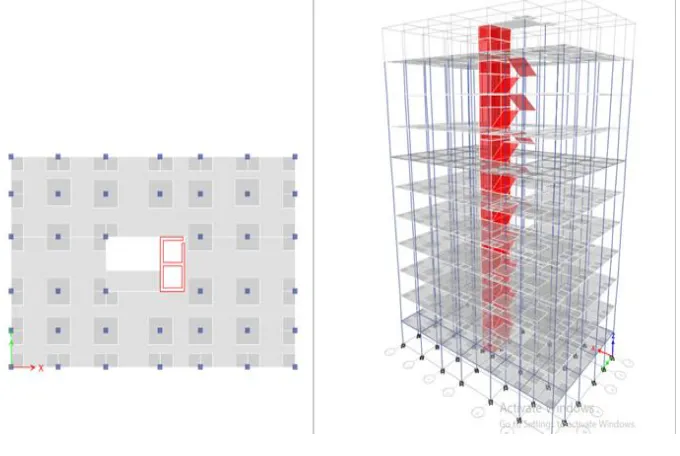
The conventional slab structure and flat slab Structure are considered to have the same geometrical data S.NO VARIABLE DATA 1 Number of stories G+8 2 Height of each storey 3.2m 3 Total Height of structure 32m
1) Preliminary data for the conventional slab:
S.N VARIABLE DATA
1 Type of structure Moment resisting frame 2 Live load 4 kN/m2
3 Floor finish load 1.0 kN/m2 4 Wall load (external) 12.88 kN/m2 5 Stair case load 12.588 kN/m2 6 Materials
2470
©IJRASET: All Rights are Reserved
7 Size of columns 400X400 8 Size of beams 230x300 9 Depth of slab 150mm thick 10
Specific weight of RCC
25 kN/m3 11 Zone IV 12 Type of soil Medium 13
Response reduction factor 5 14 Importance factor 1 15 Zone factor 0.24
2) Preliminary Data for Flat Slab:
S.NO VARIABLE DATA
1 Type of structure Moment resisting frame 2 Live load 4kN/m2
3 Floor finish load 1.0 kN/m2 4 Materials
Concrete (M25) and Reinforced with HYSD bars(Fe415)
5 Size of columns 400X400 6 Depth of slab 150mm thick 7 Depth of drop 150mm thick 8
Specific weight of RCC
25 kN/m3 9 Zone IV 10 Type of soil Medium 11
Response reduction factor 5 12 Importance factor 1 13 Zone factor 0.24
D. Building Models
Modelled plans of the buildings such as (i) Flat slab (ii) conventional slab using ETABS software are shown in Fig (a), Fig (b).
[image:3.612.151.491.489.717.2]2471
©IJRASET: All Rights are Reserved
Fig (b) conventional slab
IV. RESULTSANDDISCUSSION
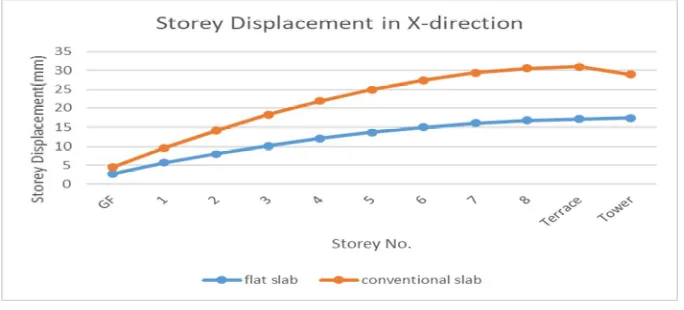
A. Storey Displacement
Displacement depends on height of structure and slenderness of the structure because structures are more vulnerable as height of building increases by becoming more flexible to lateral loads. Storey displacement is high at top storey and least at the base of the structures.
B. Storey Shear and Base Shear
The storey shear is maximum at ground level and keeps on decreasing towards the top storey of the structure.
From the above charts it was observed that storey shear and base shear of flat slab with drop building is more than conventional RC Framed building.
[image:4.612.136.478.368.523.2]2472
©IJRASET: All Rights are Reserved
C. Storey Acceleration
The storey acceleration are more at the top storey and least at the bottom storey for both flat slab with drop and conventional slab. Storey acceleration depends mainly on the amount of drift taking place in the building.
V. CONCLUSIONS
A. Storey displacement is high at top storey and least at bottom storey As the height of building increases the value of displacement also increases.
B. The base shear is maximum at ground level and keep on decreasing towards top storey of structure.Height of building increases the value of storey shear and base shear also increases.
C. The storey acceleration is more at top storey and least at bottom storey.for both flat slab with drop and conventional slab.
REFERENCES
[1] Prof. K. S Sable, Er. N. A Ghodechor, Prof. S. B Kandekar, “Comparative Study of Seismic Behavior of Multistorey Flat Slab and Conventional Reinforced Concrete Framed Structures”, International Journal of Computer Technology and Electronics Engineering.
[2] R. P. Apostolska, G. S. Necevska-Cvetanovska, and N. Mircic, “Seismic Performance of Flat Slab Building Structural Systems”, the 14th world Conference on Earthquake Engineering, October 12-17, Beijing, China.
[3] Salman I Khan and Ashok R Mundhada, “Comparative Study of Seismic Performance of Multistoried RCC Building with Flat Slab and Grid Slab”, International Journal of Current Engineering and Technology, Vol. 5,No. 3, June 2015.
[4] Prof. P. S. Lande Aniket B. Raut “Comparative Study of Flat Slab Building with Traditional Two Way Slab Building under the seismic Excitation” International Journal of Pure and Applied Research in Engineering and Technology.
[5] A.A. Sathawane, R.S. Deotale, “Analysis and design of flat slab and grid slab and their Cost comparison” International Journal of Engineering Research and Applications.