641
©IJRASET: All Rights are Reserved
Study on Behaviour of Coconut Shell Aggregate
using Super Absorbent Polymer
G. Vinoth Kanna1, S.Karthickeyan2, P.Anitha3 1
Assistant Professor, Department of Civil Engineering, S.A Engineering college, TN, India 2,Assistant Professor Department of Civil Engineering, Sriram Engineering college TN, India
3,
PG scholar, Department of Civil Engg, Vel Tech High Tech Dr. Rangarajan Dr. Sakunthala Engg College, TN, India
Abstract: The use of waste materials is one of the options for sustainable Construction. In this project the coconut shell waste is considered as coarse aggregate (After the same has been crushed) for preparing light weight concrete. The various material tests such as sieve analysis, specific gravity, water absorption, soundness, dry density, bulking of fine aggregate, impact test has been carried out. The other tests of Compressive strength, Flexural strength, Deflection, Stress, Strain, and Modulus of elasticity and Crack width of the concrete specimens are to be determined after curing of 28 days in the Phase II. The optimum quantity of super absorbent polymer on the compressive strength of concrete will be determined through experiments and reported in this project. In this study coconut shell is used as light weight aggregate in concrete. The properties of coconut shell and super absorbent polymer is studied. This study has partially replaced coconut shell waste for coarse aggregate in concrete of various percentage 0%, 25%, and 50%.concrete curing plays a vital roles in developing hydration process. Self- curing agents like super absorbent polymer (SAP) will increase water retention capacity as compared to the conventional concrete. Proper self-curing (or) internal curing increases the strength, durability and performances of concrete. In this study 0.5%, 1%, 1.5% and 2% of super absorbent polymer (SAP) is used for casting of various percentage of coconut shell. The coconut shell with 25% replacement with addition of 0.5% SAP is more efficient than the other percentage. It not only saved the cost of construction but it effectively increases the mechanical properties.
Keywords: Portland Cement, coconut shell, Super Absorbent Polymer
I. INTRODUCTION
642
©IJRASET: All Rights are Reserved
II. MATERIALS USED
The materials required to complete the experimental investigation are to be the materials required are
A. Cement
Cement is the binding material used in the preparation of concrete. The cement used for this study is ordinary Portland cement and is conforming to Indian standard is: 8112 of grade 53. Grades are made depending upon the strength of cement at 28 days. Cement in concrete acts as a binding material that harden after the addition of water. It plays an important role in construction sector. In this study the Ordinary Portland Cement (OPC) of 53 grade is used according to IS: 1489-1991.
B. Fine Aggregate (Sand)
The sand is collected from polar river bed. The Sand has been sieved in 4.75 mm sieve before it is used. The sieve analysis, specific gravity and water absorption test were conducted and the results. details of sieve analysis for fine aggregate are shown in table.3.2.the actual grading curve for fine aggregate belonging to zoneii of IS 383-1970 together with upper limit and lower limits for sieve analysis are shown in figure.3.3.
C. Coarse Aggregate (Crushed stone)
Crushed granite stone aggregate of maximum size is 20 mm is chosen as coarse aggregate as per IS: 2386 (Part I) 1963, surface texture characteristics of the aggregate as classified in IS: 383-1970. The material which is retained on BIS test sieve number 4 (4.75mm) is termed as coarse aggregate. The broken stone is generally used as a stone aggregate. Coarse aggregate used is locally available crushed angular aggregate of size 20mm and 10mm are used for this experimental work.
D. Water
Available potable water in university premises which was free from all impurities is used for the entire work whenever it is required. Ph. value of water was found to be 6.8. And the water was conforming to is 3035- 1987(part 1). Portable water is generally considered fit for making concrete. Water should be free from acids, oils, alkalies or other organic impurities. Water reacts chemically with the cement to form a cement paste in which inert aggregate are held in suspension until cement paste are hardened and it will also serve as a lubricant in the mixture of fine aggregates and cement.
E. Steel
Steel for reinforcement Fe 415was used. The steel was used 10 mm diameter of high strength deformed steel bars Conforming to be 1786-1985.the properties of steel were found and reported. The tensile strength of steel was found to be equal to 415 N/mm2.
F. Coconut Shell Aggregate
The freshly discarded coconut shell collected from a local oil mill was used in this study. Since the different species of coconut shell are processed together, the shells are found to have varying thicknesses of 2–8 mm. After crushing, the shells are flaky and irregularly shaped. For preparing coconut shell aggregates, a hammer was used. Since coconut shell is a flaky material, the sizes of coconut shell lengthwise are restricted to a maximum of 12 mm. To get enough workability with the concrete, the surface texture of the shell was fairly smooth on concave and rough on convex faces. The crushed edges were rough and spiky. Coconut shell aggregates have a relatively high-water absorption value nearly 24% compared to the conventional aggregate (0.5%) hence, to prevent water absorption by the concrete mix, it is necessary to mix at saturated surface dry condition (SSD) based on 24 h submersion in potable water. The Figure 3.2 shows coconut shell aggregate before crushed Figure. 3.3 shows coconut shell aggregate after SSD condition.
G. Super Absorbent Polymer
643
©IJRASET: All Rights are Reserved
III. RESULTSANDDISCUSSIONS
The following table contain the specific gravity for fine aggregate, coarse aggregate and coconut shell which is used in this experiment.
Table 1 Details of specific gravity
Materials Property Results
Fine Aggregate
Fineness modulus test 2.9
Specific gravity Test 2.6
Water absorption 1.2%
Coarse Aggregate (Crushed Stone)
Specific gravity 2.7
Water absorption 0.6%
Coconut Shell Aggregate Specific gravity 1.53
Water absorption 1.2%
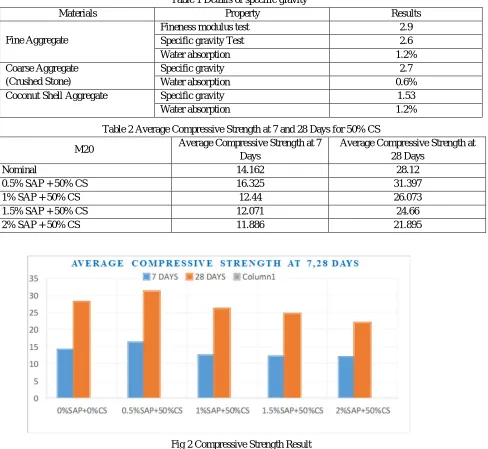
Table 2 Average Compressive Strength at 7 and 28 Days for 50% CS
M20 Average Compressive Strength at 7
Days
Average Compressive Strength at 28 Days
Nominal 14.162 28.12
0.5% SAP + 50% CS 16.325 31.397
1% SAP + 50% CS 12.44 26.073
1.5% SAP + 50% CS 12.071 24.66
2% SAP + 50% CS 11.886 21.895
[image:3.612.65.553.135.584.2] [image:3.612.75.544.607.704.2]Fig 2 Compressive Strength Result
Table 3 Average compressive strength at 7 and 28 Days for 25% CS
M20 Average Compressive
Strength at 7 Days
Average Compressive Strength at 28 Days
Nominal 14.162 28.12
0.5% SAP + 25% CS 17.14 32.59
1% SAP + 25% CS 13.93 27.63
1.5% SAP + 25% CS 12.07 25.47
644
[image:4.612.110.496.78.247.2]©IJRASET: All Rights are Reserved
[image:4.612.65.550.278.583.2]Fig 3. Average compressive strength at 7, 28 Days
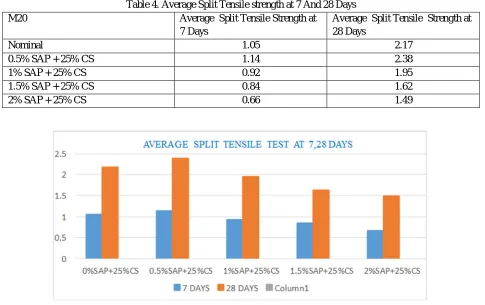
Table 4. Average Split Tensile strength at 7 And 28 Days
M20 Average Split Tensile Strength at
7 Days
Average Split Tensile Strength at 28 Days
Nominal 1.05 2.17
0.5% SAP + 25% CS 1.14 2.38
1% SAP + 25% CS 0.92 1.95
1.5% SAP + 25% CS 0.84 1.62
2% SAP + 25% CS 0.66 1.49
[image:4.612.72.546.622.721.2]Fig 4. Spilt Tensile Strength at 7 and 28 Days for 50% CS
Table 5. Average Spilt Tensile Strength at 7 And 28 Days For 50% CS
M20 Average Split Tensile
Strength at 7 Days
Average Split Tensile Strength at 28 Days
Nominal 1.05 2.17
0.5% SAP + 50 % CS 1.08 2.30
1% SAP + 50% CS 0.87 1.69
1.5% SAP + 50% CS 0.76 1.56
645
[image:5.612.134.479.80.255.2]©IJRASET: All Rights are Reserved
[image:5.612.59.553.290.711.2]Fig 5. Split tensile strength at 7 and 28 days for 25 % CS
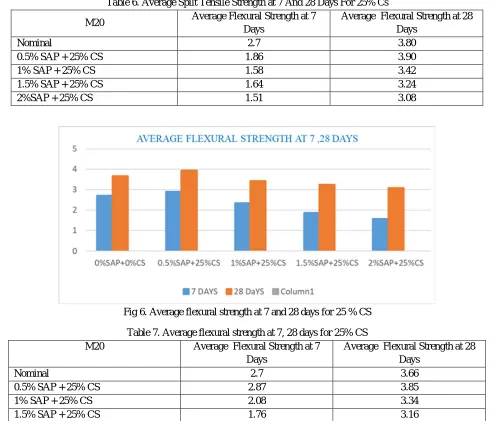
Table 6. Average Spilt Tensile Strength at 7 And 28 Days For 25% Cs
M20 Average Flexural Strength at 7
Days
Average Flexural Strength at 28 Days
Nominal 2.7 3.80
0.5% SAP + 25% CS 1.86 3.90
1% SAP + 25% CS 1.58 3.42
1.5% SAP + 25% CS 1.64 3.24
2%SAP + 25% CS 1.51 3.08
Fig 6. Average flexural strength at 7 and 28 days for 25 % CS
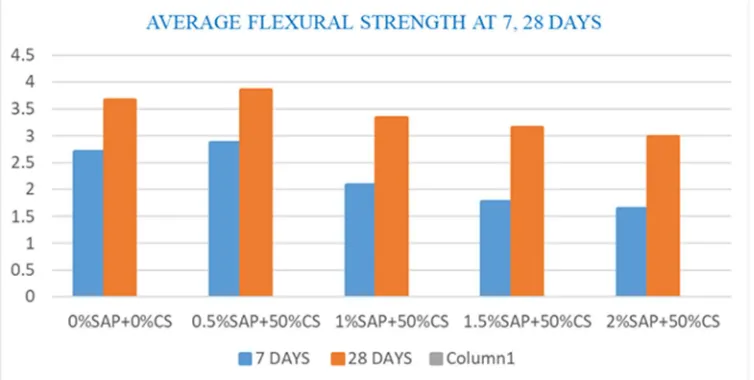
Table 7. Average flexural strength at 7, 28 days for 25% CS
M20 Average Flexural Strength at 7
Days
Average Flexural Strength at 28 Days
Nominal 2.7 3.66
0.5% SAP + 25% CS 2.87 3.85
1% SAP + 25% CS 2.08 3.34
1.5% SAP + 25% CS 1.76 3.16
646
©IJRASET: All Rights are Reserved
Fig 7. Average Flexural Strength at 7 And 28 Days for 50%CS
IV. CONCLUSIONS
A. The study on coconut shell aggregate by using super absorbent polymer was found to be effective in both strength and cost efficient.
B. The efficiency of the conventional concrete and coconut shell by super absorbent polymer concrete was compared.
C. M20 grade of concrete was used in both conventional concrete and polymer concrete.
D. Experimental result analysis for compressive strength, split tensile strength, flexural strength readings are the basis for conclusions enclosed.
E. Type h 25% coconut shell with 0.5% of super absorbent polymer gives more strength comparing to other concrete.
F. For the specimen with 0.5 % of curing agent the mix showed highest strength when compared to other mixes with the
self-curing agents like super absorbent polymer.
G. The mix with 0.5 % of sap showed compressive strength marginally equal to the compressive strength of conventional concrete.
H. Thus the test indicates the sample containing 0.5% of sap is the ideal mix which does not affect the workability, compressive
strength.
I. On comparing the values of conventional concrete and self-curing concrete the self-curing concrete shows higher compressive
strength than the conventional concrete.
REFERENCES
[1] Abdullah, Sabihahnad, Syed Aqeel Ahmed (2016), “Performance of waste coconut shell as partial replacement of naturalcoarse aggregate in concrete”, International Journal of science and engineering research, Vol.7, Issue 8, pp 424 -430.
[2] Afolayan J.O, Ejeh S.P, Amartey Y.D , Idris.A(2017), “Mechaniucal properties of coconut shell as coarse aggregate in light shell as coarse aggregate in light weigth concrete”, Asian Journal of science and technology, Vol.08,Issue 09, pp 5626 – 5633.
[3] Ahsansabbir.M.D, Ashfaqul.S.M. (2001), “Determination of tensile property of bamboo for using as potential reinforcement in the concrete”, IJCEE, Vol.11, Issue .5, pp 48-52.
[4] Amaranth Yerramala, Ramachandru (2012), “Properties of concrete with coconut shell as aggregate replacement”, International Journal of engineering inventions, Vol.1, Issue.6, pp21-31.
[5] Ankitdubey (2017), “Use of super absorbent polymer (SAPS) in concrete”, International Journal of research in engineering and applied science,Vol.6, Issue 3, pp 44 - 49.
[6] Avula Ganesh Reddy, Joshudaniel (2015), “Study on behavior of bamboo as reinforcement with coconut in compression member with different lengths”, International Journal of Innovative Research in Engineering and Management, (IJIREM) Vol.3, Issue.1, pp 06-13.
[7] Bart Craeye, Matthew Geirnaert and Geert De Schutter (2011), “Super absorbing polymers as an internal curing agent for mitigation of early-age cracking of high-performance concrete bridge decks”, Journal of construction and building materials Vol.25, Issue 13, pp 1–13.
[8] Daniel Yaw Osei (2013), ‘Experimental assessment on coconut shells as aggregate in concrete’, International journal of engineering science invention,Volume.2, Issue 5, pp 7-11.
[9] Duna Samson, Musa Abdullahi (2017), “Strength properties of concrete containing coconut shell as coarse aggregate replacement”, International Journal of scientific and engineering research,Vol.8, Issue.4, pp 27-31.
[image:6.612.119.496.79.269.2]