Universal dependencies for Scottish Gaelic: syntax
Colin Batchelor
Royal Society of Chemistry, Thomas Graham House, Cambridge, UK CB4 0WF [email protected]
Abstract
We present universal dependencies for Scottish Gaelic and a treebank of 1021 sentences (20 021 tokens) drawn from the Annotated Reference Corpus Of Scottish Gaelic (ARCOSG). The tokens are an-notated for coarse part-of-speech, fine-grained part-of-speech, syntactic features and dependency relations. We discuss how the annotations differ from the treebanks developed for two other Celtic languages, Irish and Breton, and in preliminary de-pendency parsing experiments we obtain a mean labelled attachment score of 0.792. We also discuss some difficult cases for future investigation, including cosubordi-nation. The treebank is available, along with documentation, from https:// universaldependencies.org/.
1 Introduction
Scottish Gaelic is an low-resourced language which has hitherto lacked a robust parser, despite the recent development of the Annotated Refer-ence Corpus of Scottish Gaelic (ARCOSG) (Lamb et al., 2016). Previous work (Batchelor, 2016) has leveraged ARCOSG to produce a medium-coverage categorial grammar but not a gold stan-dard corpus that would enable the grammar to be properly evaluated. In this work we fill this gap by creating a dependency treebank for Scottish Gaelic of similar size to the existing treebanks in Irish (Lynn, 2016) and (Lynn and Foster, 2016) and Breton (Tyers and Ravishankar, 2018). An
c
2019 The authors. This article is licensed under a Creative Commons 4.0 licence, no derivative works, attribution, CC-BY-ND.
important advantage of the dependency grammar approach is that the tools are better developed and less closely tied to English than for combinatory categorial grammar (CCG). Indeed, the universal dependencies (UD) framework has been developed to cover as wide a range of languages as possible, and recent CoNLL shared tasks have been explic-itly multilingual, for example the 2018 task which focussed on extracting universal dependencies for 82 treebanks in 57 languages (Zeman et al., 2018). Given a corpus in CoNLL format, the udpipe pack-age (Straka and Strakov´a, 2017) can be used to train a tokeniser, a POS tagger and a dependency parser. In this work we will concentrate on the last of these and present preliminary results.
2 Scottish Gaelic
Scottish Gaelic, hereafter Gaelic, is a Celtic lan-guage of the Goidelic family closely related to Irish and Manx. It is spoken mainly in the High-lands and isHigh-lands of Scotland, in the cities of the Central Belt and in Cape Breton in Canada. Its usage has been declining since the Middle Ages, when placename evidence attests its presence as far southeast as Fife and even East Lothian (Gul-lane, Innerwick and Ballencrieff all have Gaelic etymologies) and according to the UNESCO At-las of the World’s Languages in Danger it is “defi-nitely endangered” (Moseley, 2010). Lamb (2003) has published an accessible grammar of the lan-guage, but for a fuller account see Cox (2017) and for a short practical account focussing on contem-porary usage see Ross et al. (2019).
The main electronic corpora for the language are ARCOSG and Corpas na G`aidhlig ‘Corpus of Gaelic’, part of the Digital Archive of Scottish Gaelic (DASG) (University of Glasgow, 2019).
constructions are very common and in contrast to Irish the usual way of expressing that something is taking place in the present is to use the verbbi and the verbal noun, for example Tha mi a’ dol ‘I am at going’ for ‘I am going’. We will dis-cuss other differences from Irish, mainly that cer-tain constructions are much more common in one language than the other, in more depth later on. There are two genders (masculine and feminine), three numbers (singular, plural and a separate dual form for nouns) and four cases (nominative, voca-tive, genitive and dative). Like the other Celtic lan-guages Gaelic has conjugated prepositions such as agam ‘at me’ and oirnn ‘on us’. These were al-ready single words by the time of Old Irish (the 8th and 9th centuries CE) (Stifter, 2006). Both Irish and Scottish Gaelic exhibit cosubordination (Lamb, 2003). This is where the coordinatoragus is followed by a nominal subject and an adjecti-val predicate or a small clause. Usually in Scottish Gaelic the cosubordinated clause follows the main clause, but it is not unusual in Irish to see it fronted. We will discuss options for handling this later on. Lastly, it is very common to express psychologi-cal states by a combination of the verbbi, a noun and two prepositional phrases, for example ‘I love her’ isTha gaol agam oirre‘There is love at me on her’.
3 Related work
The first work on a dependency treebank for Gaelic was by Batchelor (2014) which predated the re-lease of ARCOSG and was built from a tiny collec-tion (82 sentences) of hand-picked sentences. At the same time Lamb and Danso presented a part-of-speech tagger for Gaelic based on ARCOSG (Lamb and Danso, 2014). Subsequently Tyers and Ravishankar (2018) have presented a Univer-sal Dependencies treebank for Breton.
4 Corpus
ARCOSG is a corpus of 76 texts from a variety of genres, including conversations, sports commen-tary, fiction and news. Part of the context for the development of ARCOSG is given in (Lamb, 1999) where Lamb describes the development of the news reports and the language used on Radio nan G`aidheal. The texts have been part-of-speech tagged by hand according to a tagging scheme de-scribed in (2014) and based on the PAROLE tagset used by U´ı Dhonnchadha (2009).
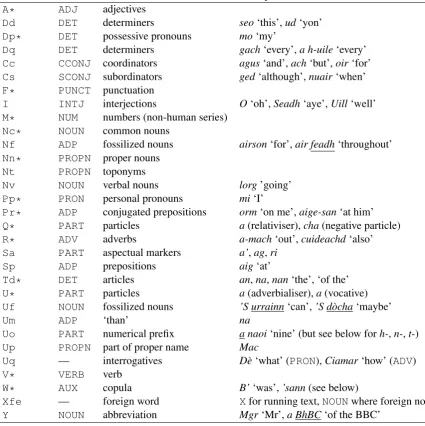
ARCOSG is made available in Brown Corpus format. This is converted into CoNLL-U format with a short Python script and the fine-grained part-of-speech tags mapped to the coarse-grained UD v2 tagset. A sample of the mapping is shown in Table 1. The LEMMA field in the treebank is populated using an extended version of the lem-matiser described in Batchelor (2016). TheFEATS field is populated in the conversion process, largely following the feature set for Irish (Lynn et al., 2017). The corpus is broken into sentences on full stops and sentence boundaries corrected in manual postprocessing.
We use the texts in the following subcorpora: narrative, news, fiction, formal prose and popu-lar writing. We have initially excluded the con-versation and interview subcorpora because of the large fraction of single-token utterances. We also exclude the sports subcorpus for the moment as it largely consists of highly paratactic football com-mentary. Table 2 gives an overview. 752 sen-tences (25 593 tokens) remain to be added to the corpus and 30 sentences (1043 tokens) are await-ing a better treatment of cosubordination. Lastly there are five sentences in the narrative subcorpus which have a total of 5092 tokens between them.
5 Annotation
In this section we describe the process and look at some special cases in the light of the Irish and Breton treebanks.
5.1 Guidelines
We use the generic Universal Dependencies guide-lines (Universal Dependencies contributors, 2016) and refer to the Irish UD corpus (Lynn and Foster, 2016) and our own list of special cases1in case of doubt. There is a single human annotator, an expe-rienced adult learner of Gaelic, but the tagset used in ARCOSG is extremely rich, with well over 200 POS tags and marks for tense, case, number and gender and hence does a great deal of disambigua-tion. We follow Lynn et al. (2013) in marking up a small portion of the corpus (around 1000 tokens in this case) by hand and then iteratively training MaltParser (Nivre et al., 2006) with the standard settings on an annotated/checked part of the cor-pus and using it to parse the unchecked part. We
1See guidelines.md and the documentation for the
ARCOSG UD Comments Examples A* ADJ adjectives
Dd DET determiners seo‘this’,ud‘yon’ Dp* DET possessive pronouns mo‘my’
Dq DET determiners gach‘every’,a h-uile‘every’ Cc CCONJ coordinators agus‘and’,ach‘but’,oir‘for’ Cs SCONJ subordinators ged‘although’,nuair‘when’
F* PUNCT punctuation
I INTJ interjections O‘oh’,Seadh‘aye’,Uill‘well’ M* NUM numbers (non-human series)
Nc* NOUN common nouns
Nf ADP fossilized nouns airson‘for’,air feadh‘throughout’ Nn* PROPN proper nouns
Nt PROPN toponyms
Nv NOUN verbal nouns lorg’going’ Pp* PRON personal pronouns mi‘I’
Pr* ADP conjugated prepositions orm‘on me’,aige-san‘at him’ Q* PART particles a(relativiser),cha(negative particle) R* ADV adverbs a-mach‘out’,cuideachd‘also’ Sa PART aspectual markers a’,ag,ri
Sp ADP prepositions aig‘at’
Td* DET articles an,na,nan‘the’, ‘of the’ U* PART particles a(adverbialiser),a(vocative) Uf NOUN fossilized nouns ’S urrainn‘can’,’S d`ocha‘maybe’
Um ADP ‘than’ na
Uo PART numerical prefix a naoi‘nine’ (but see below forh-,n-,t-)
Up PROPN part of proper name Mac
Uq — interrogatives D`e‘what’ (PRON),Ciamar‘how’ (ADV)
V* VERB verb
W* AUX copula B’‘was’,’sann(see below)
[image:3.595.79.505.83.510.2]Xfe — foreign word Xfor running text,NOUNwhere foreign noun Y NOUN abbreviation Mgr‘Mr’,a BhBC‘of the BBC’
Table 1:Mapping of the most important part-of-speech classes from ARCOSG to the UD coarse-grained tagset. The asterisk inA*, for example, indicates that all of the tags beginning withAmap on toADJ.
proofread the trees, add them to the training data, and iteratively improve the unchecked portion of the corpus. We keep trees which feature cosubor-dination in a separate file for future work.
5.2 Tokenisation
By and large we follow the tokenisation in AR-COSG but we do have to make some adjustments to match the UD scheme. Firstly, ARCOSG treats a number of multiword expressions such as place-names and the prepositionsann an,anns an, ‘in’, ‘in the’ and variants as a single token. We reto-kenise these on whitespace and assign, for the mo-ment, the same part-of-speech tag to all of them. Secondly the prefixes h-, n-and t-, which are
in-separable parts of the word written without a hy-phen in Irish, are treated as independent tokens with typeUo. These we unite with the tokens that follow them into a single token. There is a small number of multitoken compound prepositions that according to ARCOSG are three tokens, including a punctuation mark, for examplea-r`eir‘according to’, which we collapse into a single token.
Subcorpus # sentences Mean # tokens Longest Shortest
Fiction 397 17.0 61 2
Formal prose 120 24.9 113 5
News 167 22.2 52 7
Narrative 132 18.2 112 3
[image:4.595.143.457.73.154.2]Popular writing 205 20.4 59 4
Table 2:Overview of the subset of ARCOSG in the treebank.
ag before a verbal noun is indicated by ’, this is combined with the following token.
We make limited use of UD’s word–token dis-tinction at present. The Irish and Breton tree-banks differ on how to treat conjugated preposi-tions, with Breton dividing the single tokenganto ‘with them’ into two words,gantando, and Irish keepingorm‘on me’ as a single word rather than dividing it intoarandm´e. We follow the Irish ex-ample, but do divide tokens that have been tagged as fused tokens by ARCOSG. One example of this iscuimhneam‘memory at me’, which has the POS Ncsfn+Pr1s (singular feminine common noun and first person singular conjugated prepo-sition). In this case we divide it into the two words cuimhneandagam. There are currently ten exam-ples of this in the treebank.
5.3 Personal names
Th`ainig Mac an De`oir gu Arnol` VERB PROPN DET PROPN ADP NOUN
V-s Up Tdsmg Nn Sp Nt
came son of the Dewar to Arnol
nsubj flat flat
case obl
root
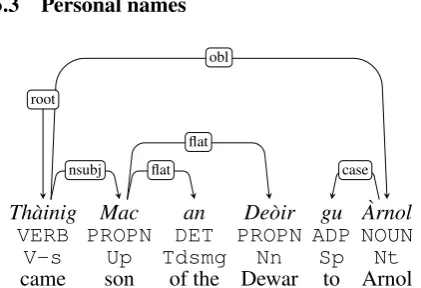
Figure 1: ‘Dewar came to Arnol’ (part of tree pw05 017), showing how compound proper names are handled.
We treat personal names, following the UD v2 guidelines, as a flat structure even in the case of surnames such asMac an De`oir‘Dewar’ that have internal grammatical structure (Fig. 1).
5.4 Copular constructions
An important use of thefixedrelation is for the ‘dummy’ pronounse andannin the copular con-structions’s e, b’ e,’s annandb’ ann, which are sometimes written as a single word. Two examples
are given in Fig. 2. ’S e(or in this case’S i) intro-duces an NP, and’S ann(or’Sann) is used for other sorts of constituent, herean `Ile, ‘in Islay’. The ex-pression that follows the dummy pronoun as being the root of the clause, and the expression that fol-lows that as the subject. It may be a definite NP, in which case we use the relationnsubj, or clausal, where we usecsubj:cop. This is broadly sim-ilar to the Irish treebank except that Irish does not usually have the dummy pronouns.
5.5 The verbal noun and inversion structures
The verbal noun is intermediate between an archetypal verb and an archetypal noun. In some ways it behaves like a noun. It can be qualified by an adjective preceding it, and in progressive tenses, the NPs governed by a verbal noun were historically always in the genitive, however Ross et al. (2019) say that the genitive ‘is no longer re-quired’ for indefinite singular nouns in these cases. Equally, it is part of a clause. In the Irish tree-bank verbal nouns are tagged asNOUNand treated as xcomp (externally-controlled clausal comple-ments) of the controlling verb. Conversely in the Breton treebank they are tagged asVERB and treated as the root, with what would be the con-trolling verb in Irish treated asaux(an auxiliary). The approach where the verbal noun is tagged as aNOUN and the controlling verb as AUX is disal-lowed by the validation script. We have chosen to follow the Irish scheme, though these contrast-ing approaches, shown in Figure 3, both have their merits.
[image:4.595.76.287.441.585.2]’S ann an `Ile rugadh mi AUX PRON ADP PROPN VERB PRON
Wp-i Pr3sm Sp Nt V-h Pp1s
COP DUMMY in Islay was born I
fixed case
root cop
csubj:cop nsubj
’S i M`orag a rinn a’ bhanais AUX PRON PROPN PART VERB DET NOUN Wp-i Pp3sf Nn-fn Qa Tdsf V-s Ncsfn
COP DUMMY Morag that did the wedding
cop
fixed
root
csubj:cop
mark
obj
[image:5.595.183.418.72.278.2]det
Figure 2:Dependency trees for ‘It was in Islay that I was born’ and ‘It was Morag who had the wedding’.
Lenn a reas Lenaig al levr VERB PART AUX PROPN DET NOUN vblex vpart vblex np det n
read PART AUX Lenaig the book
aux aux
nsubj obj
det root
Bha Lenaig a’ leughadh an leabhair
VERB PROPN PART NOUN DET NOUN
V-s Nn-fn Sa Nv Tdsmg Ncsmg
was Lenaig ASP reading the book
nsubj case
xcomp
obj
det root
Figure 3:Dependency trees for ‘Lenaig read the book’ in the Breton (sentence ID grammar.vislcg.txt:28:654) and ‘Lenaig was reading the book’ in the Gaelic approach.
English where the word ‘was’ is treated as an aux-iliary and the verb ‘found’ treated as the root, and of course from the Breton example above, but is identical to the other ‘inversion’ structures in Scot-tish Gaelic, where the object goes before the ver-bal noun (Ross et al., 2019), for example obliga-tion: Feumaidh mi cofaidh `ol ‘I must drink cof-fee’, or possibility: Is urrainn dhuinn an duine a chuideachadh‘We can help the person’.
Rugadh is thogadh mi
VERB CCONJ VERB PRON
V-h Cc V-h Pp1s
was born and was raised I
nsubj
[image:5.595.81.293.322.553.2]cc conj root
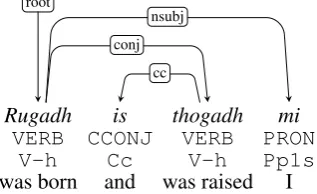
Figure 4:Dependency tree for ‘I was born and raised’ (ana-lytic passive).
5.6 Numbers
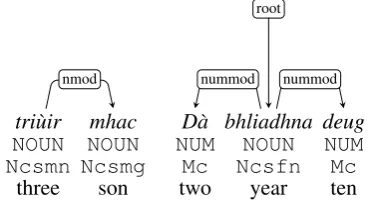
As in Irish, there are two sets of cardinal num-bers, one for people and the other for everything else. In ARCOSGtri`uir ‘three people’ is tagged as a noun (Ncsfn), and tri`uir mhac‘three sons’ asNcsfn Ncpmg. For this reason we treattri`uir as the content word andmhacas a modifier. This is one of the many non-possessive constructions in Gaelic where a noun in the genitive modifies an-other noun, so we do not follow Breton in using the nmod:poss relation in these cases. Cardi-nal numbers on the other hand are tagged as Mc and we treat them as modifying their nominal head (nummod) unless they are the subject, object or oblique argument. See Figure 7 for examples.
5.7 Cosubordination
[image:5.595.337.496.327.424.2]sen-Chaidh a’ nighean a lorg mu ochd uairean a-raoir
VERB DET NOUN PART VERB ADP NUM NOUN ADV
V-s Tdsf Ncsfn Ug Nv Sp Mc Ncpfd Rt
went the girl AGREEMENT found about eight o’ clock last night
mark xcomp
det
obj
obl root
case
[image:6.595.130.469.72.180.2]nummod advmod
Figure 5: Dependency tree for ‘The girl was found about eight o’ clock last night’ (analytic passive, simplified version of ns10 021 in the as-yet unchecked part of the corpus).
Feumaidh mi cofaidh `ol VERB PRON NOUN NOUN
V-f Pp1s Ncsmn Nv must I coffee drink
nsubj obj
xcomp root
Is urrainn dhuinn an duine a chuideachadh
AUX NOUN PRON DET NOUN PART NOUN
Wp-i Uf Pr1p Tdsmn Ncsmn Ug Nv
COP mus to-us the person AGREEMENT help
cop obl det
obj
mark xcomp
[image:6.595.146.452.226.453.2]root
Figure 6:Dependency trees for inversion structures (Ross et al., 2019): ‘I must drink coffee’ and ‘We can help the person’.
tri`uir mhac NOUN NOUN Ncsmn Ncsmg
three son
nmod
D`a bhliadhna deug
NUM NOUN NUM
Mc Ncsfn Mc
two year ten
nummod root
nummod
Figure 7: Contrasting treatments of personal numbers (left, from n05 009) and impersonal numbers (right, f08 036).
tence n05 004:Chaidh e air chall ann an ce`o, ’s e ’g iasgach. ‘He went missing in the fog when he was fishing’, or more literally ‘He went missing in the fog, and he fishing’.
We illustrate two approaches in Figure 8. The first one is to use the adnominal clause modifier (acl) relation as in the depictive example in the UD guidelines ‘She entered the room sad’. This
introduces a non-projective arc between the words e ‘he’ in each clause. The analogous sentence in English is projective because of SVO word order instead of VSO. It would perhaps be clearer to sub-class the pertinent relations asconj:cosuband acl:cosub. The second approach is to assume that the word bhahas been elided. This has two advantages: firstly clear UD guidelines, indicating that the correct thing to do is to treateas a conju-gate of the root verbChaidh‘went’ and connect it to the verbal noun with theorphanrelation, and secondly maintaining a projective structure. And yet it is not obvious that cosubordination actually is ellipsis. One argument that it isn’t is that while in Gaelic the cosubordinate clause usually appears after the main clause, it is not uncommon in Irish to see preposed cosubordinate clauses, for example the phraseAgus m´e ´og‘When I was young’.
[image:6.595.89.276.499.602.2]Chaidh e air chall ann an ce`o , ’s e ’g iasgach VERB PRON ADP NOUN ADP ADP NOUN PUNCT CCONJ PRON ADP NOUN
V-s Pp3sm Sa Nv Sp Sp Ncsmd Fi Cc Pp3sm Sa Nv
went he ASP lost in mist , and he ASP fishing
acl:cosub
case conj:cosub
punct obl
case
flat obl
case
nsubj cc
root
Chaidh e air chall ann an ce`o , ’s e ’g iasgach VERB PRON ADP NOUN ADP ADP NOUN PUNCT CCONJ PRON ADP NOUN
V-s Pp3sm Sa Nv Sp Sp Ncsmd Fi Cc Pp3sm Sa Nv
went he ASP lost in mist , and he ASP fishing
orphan
case conj
punct obl
case
flat obl
case
nsubj cc
[image:7.595.110.495.70.420.2]root
Figure 8:Two approaches to cosubordination. (above) Depictive (below) elliptical.
feel that it is better in terms both of representing the language as it is found in all registers, and in the specificity of the relation used:aclas opposed to the more genericorphan. A full investigation of how common non-projectivity is in the treebank as a whole should help decide how much weight to place on projectivity as a criterion for annotation choices.
6 Experiments
Transition system LAS
projective 0.796[0.752, 0.839] swap(non-projective) 0.789 [0.747, 0.825] link2(non-projective) 0.792 [0.750, 0.835]
Table 3: Labelled-attachment scores (LAS) for parsing the treebank with different transition systems for udpipe’s parsito parser. The LAS are the mean values from ten-fold cross-validation. There were 1021 sentences and 20 031 words.
In this section we examine briefly how learnable the annotation scheme is by a dependency parser and the effects of different parsing algorithms. A
fuller account awaits a larger treebank, which on average will have longer sentences. Because of the small size of the corpus we use ten-fold cross vali-dation. We use udpipe’s parsito parser and MaltE-val (Nilsson and Nivre, 2008), both with the de-fault settings. Table 3 gives the ten-fold cross-validated labelled-attachment scores (LAS) for the three transition systems, one projective and two non-projective. We find that the default, projec-tive transition system performs best, with a mean LAS of 0.796, but the three are very similar, and the scores may be flattered by the relatively short mean sentence length (19.6 words). These scores are comparable to the scores for much larger tree-banks given by Nivre and Fang (2017).
7 Conclusions and future work
the tokenisation scheme is different from that used in ARCOSG.
The treebank presented here is not quite ready for an official release, despite its passing the vali-dation script. Nonetheless a significant part of the treebanking process, annotating a part-of-speech corpus with lemmas, universal part-of-speech tags, syntactic features and dependency relations, has been achieved. A substantial part of ARCOSG has not been covered in this work—the conver-sation, sport and interview subcorpora, and five of the texts in the narrative subcorpus. There are also over 750 trees that are not yet in the treebank but they will be processed in due course. Lastly, given the close relation between the two languages and that the annotation scheme presented here is as close as possible to the Irish one, it would be very interesting to repeat the parsing experiments on a combined Irish and Scottish Gaelic corpus.
References
Batchelor, Colin. 2014. gdbank: The beginnings of a corpus of dependency structures and type-logical grammar in Scottish Gaelic. InProceedings of the
First Celtic Language Technology Workshop, pages
60–65, Dublin, Ireland, August. Association for Computational Linguistics and Dublin City Univer-sity.
Batchelor, Colin. 2016. Automatic derivation of cate-gorial grammar from a part-of-speech-tagged corpus in Scottish Gaelic. InActes de la conf´erence
con-jointe JEP-TALN-RECITAL 2016, volume 6 : CLTW,
Paris, France, July.
Cox, Richard A. V. 2017. Ge`arr-Ghr`amar na
G`aidhlig. Clann Tuirc, Tigh a’ Mhaide, Ceann
Drochaid, Alba.
Lamb, William and Samuel Danso. 2014. Develop-ing an Automatic Part-of-Speech Tagger for Scottish Gaelic. InProceedings of the First Celtic Language
Technology Workshop, pages 1–5, Dublin, Ireland,
August. Association for Computational Linguistics and Dublin City University.
Lamb, William, Sharon Arbuthnot, Susanna Naismith, and Samuel Danso. 2016. Annotated Reference Corpus of Scottish Gaelic (ARCOSG), 1997–2016 [dataset]. Technical report, University of Edin-burgh; School of Literatures, Languages and Cul-tures; Celtic and Scottish Studies. http://dx.
doi.org/10.7488/ds/1411.
Lamb, William. 1999. A diachronic account of Gaelic news-speak: The development and expansion of a register. Scottish Gaelic Studies, XIX:141–171.
Lamb, William. 2003. Scottish Gaelic, 2nd edn. Lin-com Europa, Munich, Germany.
Lynn, Teresa and Jennifer Foster. 2016. Universal De-pendencies for Irish. InActes de la conf´erence
con-jointe JEP-TALN-RECITAL 2016, volume 6 : CLTW,
Paris, France, July.
Lynn, Teresa, Jennifer Foster, and Mark Dras. 2013. Working with a small dataset - semi-supervised dependency parsing for Irish. In Proceedings of the Fourth Workshop on Statistical Parsing of
Morphologically-Rich Languages, pages 1–11,
Seat-tle, Washington, USA, October. Association for Computational Linguistics.
Lynn, Teresa, Jennifer Foster, and Mark Dras. 2017. Morphological Features of the Irish Universal De-pendency Treebank. InTLT 2017: Proceedings of the 15th International Workshop on Treebanks and Linguistic Theories, Aachen, Germany.
Lynn, Teresa. 2016. Irish Dependency Treebanking
and Parsing. Ph.D. thesis, Dublin City University
and Macquarie University.
Moseley, Christopher, editor. 2010. Atlas of the
World’s Languages in Danger. UNESCO
Publish-ing, Paris, 3rd edition.
Naismith, Susanna and William Lamb. 2014. Scot-tish Gaelic Part-of-Speech Annotation Guidelines. Celtic and Scottish Studies, University of Edinburgh.
Nilsson, Jens and Joakim Nivre. 2008. MaltEval: an evaluation and visualization tool for dependency parsing. InLREC 2008.
Nivre, Joakim and Chiao-Ting Fang. 2017. Univer-sal dependency evaluation. In Proceedings of the NoDaLiDa 2017 Workshop on Universal
Dependen-cies (UDW 2017), pages 86–95, Gothenburg,
Swe-den, May. Association for Computational Linguis-tics.
Nivre, Joakim, Johan Hall, and Jens Nilsson. 2006. MaltParser: A data-driven parser-generator for de-pendency parsing. In Proceedings of the Fifth In-ternational Conference on Language Resources and
Evaluation (LREC’06), Genoa, Italy, May. European
Language Resources Association (ELRA).
Ross, Susan, Mark McConville, Wilson McLeod, and Richard Cox. 2019. Sti`uireadh Gr`amair. https:
//dasg.ac.uk/grammar/grammar.pdf,
ac-cessed 23 May 2019.
(SQA), Scottish Qualifications Authority. 2009.Gaelic
Orthographic Conventions. Scottish Qualifications
Authority, Dalkeith.
Stifter, David. 2006. Sengoidelc: Old Irish for
be-ginners. Syracuse University Press, Syracuse, New
Straka, Milan and Jana Strakov´a. 2017. Tokenizing, pos tagging, lemmatizing and parsing ud 2.0 with udpipe. InProceedings of the CoNLL 2017 Shared Task: Multilingual Parsing from Raw Text to
Univer-sal Dependencies, pages 88–99, Vancouver, Canada,
August. Association for Computational Linguistics.
Tyers, Francis M. and Vinit Ravishankar. 2018. A pro-totype dependency treebank for Breton. InActes de la conf´erence Traitement Automatique de la Langue-Naturelle, TALN 2018 : Volume 1 : Articles longs,
articles courts de TALN, pages 197–204, Rennes,
France, May.
U´ı Dhonnchadha, Elaine. 2009. Part-of-speech tag-ging and partial parsing for Irish using finite-state
transducers and constraint grammar. Ph.D. thesis,
Dublin City University.
Universal Dependencies contributors. 2016. UD Guidelines, https:// universaldependencies.org/
guidelines.html. Accessed 9 July 2019.
University of Glasgow. 2019. Corpas na G`aidhlig, Dig-ital Archive of Scottish Gaelic (DASG),https:// dasg.ac.uk/corpus/. Accessed 9 July 2019.
Zeman, Daniel, Jan Hajiˇc, Martin Popel, Martin Pot-thast, Milan Straka, Filip Ginter, Joakim Nivre, and Slav Petrov. 2018. CoNLL 2018 shared task: Mul-tilingual parsing from raw text to universal depen-dencies. InProceedings of the CoNLL 2018 Shared Task: Multilingual Parsing from Raw Text to
Univer-sal Dependencies, pages 1–21, Brussels, Belgium,