Proceedings of the 13th International Workshop on Semantic Evaluation (SemEval-2019), pages 860–869 860
SemEval-2019 Task 8:
Fact Checking in Community Question Answering Forums
Tsvetomila Mihaylova,1Georgi Karadzhov,2Pepa Atanasova,3 Ramy Baly,4Mitra Mohtarami,4Preslav Nakov5
1Instituto de Telecomunicac¸˜oes, Lisbon, Portugal,2SiteGround Hosting EOOD, Bulgaria
3University of Copenhagen, Denmark
4MIT Computer Science and Artificial Intelligence Laboratory, Cambridge, MA
5Qatar Computing Research Institute, HBKU
{tsvetomila.mihaylova, georgi.m.karadjov}@gmail.com,
[email protected],{baly,mitram}@mit.edu,[email protected]
Abstract
We present SemEval-2019 Task 8 on Fact Checking in Community Question Answering Forums, which features two subtasks. Subtask A is about deciding whether a question asks for factual information vs. an opinion/advice vs. just socializing. Subtask B asks to pre-dict whether an answer to a factual question is true, false or not a proper answer. We re-ceived 17 official submissions for subtask A and 11 official submissions for Subtask B. For subtask A, all systems improved over the ma-jority class baseline. For Subtask B, all sys-tems were below a majority class baseline, but several systems were very close to it. The leaderboard and the data from the competition can be found athttp://competitions. codalab.org/competitions/20022.
1 Overview
The current coverage of the political landscape in both the press and in social media has led to an unprecedented situation. Like never before, a statement in an interview, a press release, a blog note, or a tweet can spread almost instanta-neously. The speed of proliferation leaves little time for double-checking claims against the facts, which has proven critical in politics, e.g., during the 2016 presidential campaign in the USA, which was dominated by fake news in social media and by false claims.
Investigative journalists and volunteers have been working hard to get to the root of a claim and to present solid evidence in favor or against it. Manual fact-checking is very time-consuming, and thus automatic methods have been proposed to speed-up the process, e.g., there has been work on checking the factuality/credibility of a claim, of a news article, or of an information source (Ba et al.,2016;Zubiaga et al.,2016;Ma et al.,2016; Castillo et al.,2011;Baly et al.,2018).
The process starts when a document is made pub-lic. First, an intrinsic analysis is carried out in which check-worthy text fragments are identified. Then, other documents that might support or re-but a claim in the document are retrieved from various sources. Finally, by comparing a claim against the retrieved evidence, a system can deter-mine whether the claim is likely true or likely false (or unsure, if no strong enough evidence either way could be found). For instance, Ciampaglia et al.(2015) do this using a knowledge graph de-rived from Wikipedia. The outcome could then be presented to a human expert for final judgement.1
For our two subtasks, we explore factuality in the context of Community Question Answering (cQA) forums. Forums such as StackOverflow, Yahoo! Answers, and Quora are very popular these days, as they represent effective means for communities around particular topics to share in-formation. However, the information shared by the users is not always correct or accurate. There are multiple factors explaining the presence of in-correct answers in cQA forums, e.g., misunder-standing of the question, ignorance or malicious-ness of the responder. Also, as a result of our dynamic world, the truth is time-sensitive: some-thing that was true yesterday may be false today. Moreover, forums are often barely moderated and thus lack systematic quality control.
Here we focus on checking the factuality of questions and answers in cQA forums. This aspect was ignored in recent cQA tasks (Ishikawa et al., 2010;Nakov et al., 2015, 2016a, 2017a), where an answer is considered GOOD if it addresses the question, irrespective of its veracity, accuracy, etc.
1
Q: HI ;; IF WIFE IS UNDER HER HUSBAND’S SPON-SORSHIP AND IS WILLING TO COME QATAR ON VISIT; HOW LONG SHE CAN STAY AFTER EX-TENDING THE VISA EVERY MONTH? I HAVE HEARD ITS NOT POSSIBLE TO EXTEND VISIT VISA MORE THAN 6 MONTHS? CAN U PLEASE ANSWER ME.. THANKZZZ...
a1: Maximum period is 9 Months....
a2: 6 months maximum
a3: This has been answered in QL so many times. Please do search for information regarding this. BTW answer is 6 months.
Figure 1: Example from theQatar Livingforum.
Figure1 presents an excerpt of an example from the Qatar Living Forum, with one question and three answers selected from a longer thread. Ac-cording to SemEval-2016 Task 3 (Nakov et al., 2016a), all three answers would be considered GOOD since they are formally answering the question. Nevertheless,a1 contains false
informa-tion, whilea2 anda3 are correct, as can be
estab-lished from an official government website.2 Checking the veracity of answers in a cQA fo-rum is a hard problem, which requires putting to-gether aspects of language understanding, mod-elling the context, integrating several information sources, uisng world knowledge and complex in-ference, among others. Moreover, high-quality automatic fact-checking would offer better expe-rience to users of cQA systems, e.g., the user could be presented with veracity scores, where low scores would warn the user not to completely trust the answer or to double-check it.
2 Related Work
Fact-checking of answers was not studied before in the context of community Question Answering, apart from our own recent work (Mihaylova et al., 2018). Yet, in the context of cQA and general QA, there has been work on credibility assessment, which has been modelled primarily at the feature level, with the goal of improving GOOD answer identification. A notable exception are (Nakov et al.,2017b;Mihaylov et al.,2018), where credi-bility was a task on its own right. However, credi-bilityis different fromveracity(our focus here) as it is a subjective perception about whether a state-ment is credible, rather than actually truthful.
2http://portal.moi.gov.qa/wps/portal/
MOIInternet/departmentcommittees/ visasentrypermeits/
Jurczyk and Agichtein(2007) modelled author au-thority using link analysis.Agichtein et al.(2008) looked for high-quality answers using PageRank and HITS, in addition to intrinsic content quality, e.g., punctuation and typos, syntactic and seman-tic complexity, and grammaseman-ticality.
Lita et al. (2005) studied three qualita-tive dimensions for answers: source credibility (e.g., does the document come from a govern-ment website), sentigovern-ment analysis, and contradic-tion compared to other answers. Su et al.(2010) looked for verbs and adjectives that cast doubt. Banerjee and Han(2009) used language modelling to validate the reliability of an answer’s source. Jeon et al.(2006) focused on non-textual features such as click counts, answer activity level, and copy counts. Pelleg et al. (2016) curated social media content using syntactic, semantic, and so-cial signals. Unlike this research, we (i) target fac-tuality rather than credibility, (ii) address it as a task in its own right, and on a specialised dataset.
Information credibility was also studied in so-cial computing. Castillo et al. (2011) modeledd user reputation. Canini et al.(2011) analyzed the interaction of content and social network structure. Morris et al. (2012) studied how Twitter users judge truthfulness.Lukasik et al.(2015) used tem-poral patterns to detect rumors, andZubiaga et al. (2016) focused on conversations.
Other authors have been querying the Web to gather support for accepting or refuting a claim (Popat et al., 2016;Karadzhov et al., 2017b). In social media, there has been research targeting the user, e.g., finding malicious users (Mihaylov and Nakov, 2016; Mihaylova et al., 2018; Mihaylov et al.,2018),sockpuppets(Maity et al.,2017), In-ternet water army(Chen et al.,2013), andseminar users(Darwish et al.,2017).
Finally, there has been work on credibility, trust, and expertise in news communities (Mukherjee and Weikum,2015). Dong et al.(2015) proposed that a trustworthy source is one that contains very few false claims. Recent work has also focused on evaluating the factuality of reporting of entire news outlets (Baly et al.,2018,2019).3 However, none of this work was about QA or cQA.
3
3 Subtasks and Data Description
SemEval-2019 Task 8 has two subtasks:
• Subtask A:Given a question from a cQA fo-rum, predict whether this question asks for factual information vs. opinion/advice vs. just socializing.
• Subtask B:Given a factual question from a cQA forum, together with its answer thread, predict whether each answer provides true vs. false vs. non-factual information as a re-sponse to the question.
3.1 Data and Resources
We retrieved the data from the Qatar Living web forum4. We then cleaned it and we annotated it with the labels described in Sections3.2and3.3.
For subtask A, we annotated the questions us-ing Amazon Mechanical Turk5. To ensure high quality of the annotation, we went through all an-notations and manually double-checked them.
For subtask B, we did not use an external anno-tation service, but instead we annotated all the data ourselves. Each answer was processed by three in-dependent annotators, and we made sure we had proof for the label from reliable sources on the Web. Then, the annotations were consolidated af-ter a discussion until agreement was achieved for each example.
All data is freely available under a Creative Commons Attribution 3.0 Unported (CC BY 3.0) license, and is accessible on the competition’s website6.
In addition to the provided annotated data, we also allowed the participants to use unlabelled data from the Qatar Living forum footnotehttp: //alt.qcri.org/semeval2016/task3/ data/uploads/QL-unannotated-data-subtaskA.xml.zip, as well as additional external resources, which they had to mention explicitly in their submissions.
Note that the class distribution in the training, development and test sets differs, especially for Subtask B. The reason for this is the way the data was prepared. The different datasets (training, de-velopment and test) were prepared on stages, be-cause of the very time-consuming data annotation process.
4http://www.qatarliving.com
5
http://www.mturk.com/
6http://competitions.codalab.org/
competitions/20022
For each dataset annotation stage, we had to choose between releasing all the available anno-tated data or aim at releasing sets with similar label distribution. At the end, we decided to release the available data, although we were aware that this would result in releasing sets with different distri-bution and, in some cases, unbalanced categories.
3.2 Training Data for Subtask A
To create the dataset for the task, we chose to aug-ment a pre-existing dataset for cQA with factuality annotations; this allowed us to stress the difference between (a) distinguishing a good vs. a bad an-swer, and (b) distinguishing a factually-true vs. a factually-false one. In particular, we added anno-tations for factuality to the CQA-QL-2016 dataset from SemEval-2016 Task 3 on Community Ques-tion Answering (Nakov et al.,2016a).
In CQA-QL-2016, the data is organized in question–answer threads (from the Qatar Living forum). Each question has a subject, a body, and meta information: question ID, date and time of posting, user name and ID, and cate-gory (e.g.,Computers and InternetandMoving to Qatar).
We analyzed the forum questions and we de-fined three categories, related to their factuality. We then annotated the questions using Amazon Mechanical Turk. The three factuality categories are as follows:
∗ FACTUAL: The question asks for factual
in-formation, which can be answered by check-ing various information sources, and it is not ambiguous (e.g., “What is Ooredoo customer service number?”).
∗ OPINION: The question asks for an opinion or an advice, not for a fact. (e.g., “Can any-one recommend a good Vet in Doha?”)
∗ SOCIALIZING: Not a real question, but rather socializing/chatting. This can also mean ex-pressing an opinion or sharing some informa-tion, without really asking anything of gen-eral interest. (e.g., “What was your first car?”)
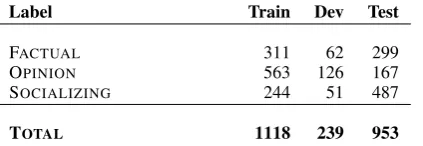
Label Train Dev Test
FACTUAL 311 62 299
OPINION 563 126 167
SOCIALIZING 244 51 487
[image:4.595.79.291.61.134.2]TOTAL 1118 239 953
Table 1: Subtask A:Distribution of the factuality la-bels for the questions.
3.3 Training Data for Subtask B
For subtask B, we annotated for veracity the an-swers to the questions with a FACTUAL label for subtask A. Note that in CQA-QL-2016, each an-swer has a subject, a body, meta information (an-swer ID, user name, and ID), the question that it answers, and a judgement about how well it an-swers the question of its thread (GOOD, BAD or POTENTIALLYUSEFUL).
We annotated the GOOD answers for factual-ity based on the assumption that a GOOD answer means it provides factual information, whether it is true or false. All BAD and POTENTIALLY
USEFULanswers are automatically considered as NON-FACTUAL. The factuality labels are
de-scribed as follows:
∗ FACTUAL – TRUE: The answer is True and
can be proven with an external resource. (Q:“I wanted to know if there were any spe-cific shots and vaccinations I should get be-fore coming over [to Doha].”;A:“Yes there are; though it varies depending on which country you come from. In the UK; the doctor has a list of all countries and the vaccinations needed for each.”).7
∗ FACTUAL– FALSE: The answer gives a fac-tual response, but it is False and this can be proven using an external resource. (Q:“Can I bring my pitbulls to Qatar?”;A:“Yes you can bring it but be careful this kind of dog is very dangerous.”).8
∗ FACTUAL – PARTIALLY TRUE: The answer contains more than one claim, and only some of these claims could be manually verified.
7The answer is factually true and this can be
seen at http://wwwnc.cdc.gov/travel/
destinations/traveler/none/qatar
8The answer is incorrect since pitbulls are included
in the list of breeds banned in Qatar. See http: //canvethospital.com/pet-relocation/ banned-dog-breed-list-qatar-2015/
Label Train Dev Test
TRUE 166 29 34
FALSE 135 31 45
NONFACTUAL 194 52 231
TOTAL 495 112 310
Table 2: Subtask B: Distribution of the factuality la-bels for the answers.
(Q: “I will be relocating from the UK to Qatar [...] is there a league or TT clubs / nights in Doha?”; A: “Visit Qatar Bowling Center during thursday and friday and you’ll find people playing TT there.”).9
∗ FACTUAL – CONDITIONALLY TRUE: The answer is True in some cases, and False in others, depending on some conditions that the answer does not mention. (Q:“My wife does not have NOC from Qatar Airways; but we are married now so can i bring her legally on my family visa as her husband?”;A:“Yes you can.”).10
∗ FACTUAL- RESPONDERUNSURE: The
per-son giving the answer is not sure about the veracity of his/her statement. (e.g., “Possible only if government employed. That’s what I heard.”)
∗ NON-FACTUAL: When the answer does not provide factual information to the question; it can be an opinion or an advice that cannot be verified. (e.g., “Its better to buy a new one.”).
We further discarded answers whose factual-ity was very time-sensitive and it makes no sense to check whether the statements are true or false (e.g., “It is Friday tomorrow.”, “It was raining last week.”).
Moreover, many answers are arguably some-what time-sensitive, e.g., “There is an IKEA in Doha.” is true only after IKEA opened, but not before that. In such cases, we just used the present situation as a point of reference. We further dis-carded the answers for which the annotators could not find any information.
9The place mentioned in the answer has table
tennis, but we do not know on which days. See
http://www.qatarbowlingfederation.com/ bowling-center/
10This answer can be true, but this depends upon some
[image:4.595.314.522.62.133.2]Ultimately, we consolidated the above fine-grained labels into the following coarse-fine-grained labels, which we used for subtask B:
∗ FACTUAL – TRUE: Contains answers with proven true, non-contradictory statements. This includes the answers with the label FAC -TUAL– TRUEfrom above. This label is used for answers one can trust as a true statement.
∗ FACTUAL – FALSE: Contains answers with
statements that are proven to be false or not completely true. This includes answers with the following fine-grained factuality la-bels: FACTUAL – FALSE, FACTUAL– PAR
-TIALLY FALSE, FACTUAL – CONDITION
-ALLY TRUE, FACTUAL – RESPONDER UN -SURE. We also use this label for answers that contain a statement for which the person giv-ing the answer expresses uncertainty in the claim.
∗ NON-FACTUAL: These are either non-factual statements or statements that could be fac-tual, but no information about them could be found, i.e., we could find no way to check whether the statement was true or false. This category also includes some statements that have been incorrectly annotated as a GOODanswer. It also includes the very
time-sensitive statements described before, such as ”It is Friday tomorrow?”. The BADand the POTENTIALLYUSEFULanswers from
CQA-QL-2016 also fall in this category.
As we have mentioned above, we have anno-tated the answers to the FACTUAL questions
se-lected from the Qatar Living forum. We targeted very high quality annotation, and thus we did not use crowd-sourcing, as a pilot experiment has shown that the task was very difficult and that it was not possible to guarantee that Turkers would do all the necessary verification and gather evi-dence from trusted sources. Instead, all examples were first annotated independently by three of us, and then, we carefully discussedeach exampleto come up with a final label. The distribution of the labels on the training, on the development, and on the testind dataset are shown in Table211.
11
Although not very big, our dataset is larger than datasets used for similar problems, e.g.,Ma et al.(2015) experimented with 226 rumors for rumor detection, andPopat et al.(2016) used 100 Wiki hoaxes for credibility assessment of textual claims.
3.4 Evaluation
Both subtasks are three-way classification prob-lems. In subtask A, the questions were to be clas-sified as FACTUAL, OPINION, or SOCIALIZING. Similarly, in subtask B there were also three tar-get categories for the answers: FACTUAL- TRUE, FACTUAL- FALSE, and NON-FACTUAL.
We further scored the submissions based on Ac-curacy, macro-F1, and average recall (AvgRec).12 For subtask B, we also report mean average pre-cision (MAP), where the FACTUAL - TRUE in-stances were considered to be positive, and the re-maining ones were negative. The official evalua-tion measure for both subtasks was Accuracy.
4 Participants and Results
We received 17 official submissions for Subtask A and 11 official submissions for Subtask B. Below we report the evaluation results.
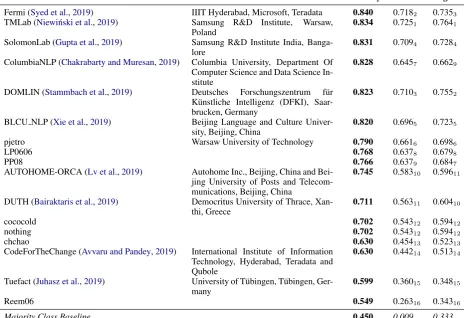
Table 3 presents the results for subtask A on question classification. The results are based the official submissions in the evaluation phase. In this subtask, all of the submitted systems man-aged to improve over the majority class baseline, and several teams achieved similarly good results. Whenever a number of teams achieve the same re-sult with respect to the main evaluation measure, i.e., Accuracy, we rank them according to the F1 score, and then by AvgRec if a tie still appears.
Table 4 presents the results based on the eval-uation phase on the test set for predicting answer factuality labels. This subtask was more difficult as the majority class baseline was very high due to label unbalance. No team managed to improve over that baseline, but several teams had results that were very close to it.
5 Discussion
In the evaluation phase of the competition, the par-ticipants had to specify one official submission and were allowed up to two contrastive submis-sions. In the post-evaluation phase, they could upload an unlimited number of contrastive sub-missions. Below, we will only discuss the offi-cial submissions. The contrastive submissions, the ablation studies, and the experiments with differ-ent techniques are described by the participants in their respective system description papers.
12Average recall has some attractive properties and has
Team ID Affiliation Accuracy F1 AvgRec
Fermi (Syed et al.,2019) IIIT Hyderabad, Microsoft, Teradata 0.840 0.7182 0.7353 TMLab (Niewi´nski et al.,2019) Samsung R&D Institute, Warsaw,
Poland
0.834 0.7251 0.7641
SolomonLab (Gupta et al.,2019) Samsung R&D Institute India, Banga-lore
0.831 0.7094 0.7284
ColumbiaNLP (Chakrabarty and Muresan,2019) Columbia University, Department Of Computer Science and Data Science In-stitute
0.828 0.6457 0.6629
DOMLIN (Stammbach et al.,2019) Deutsches Forschungszentrum f¨ur K¨unstliche Intelligenz (DFKI), Saar-brucken, Germany
0.823 0.7103 0.7552
BLCU NLP (Xie et al.,2019) Beijing Language and Culture Univer-sity, Beijing, China
0.820 0.6965 0.7235
pjetro Warsaw University of Technology 0.790 0.6616 0.6986
LP0606 0.768 0.6378 0.6798
PP08 0.766 0.6379 0.6847
AUTOHOME-ORCA (Lv et al.,2019) Autohome Inc., Beijing, China and Bei-jing University of Posts and Telecom-munications, Beijing, China
0.745 0.58310 0.59611
DUTH (Bairaktaris et al.,2019) Democritus University of Thrace, Xan-thi, Greece
0.711 0.56311 0.60410
cococold 0.702 0.54312 0.59412
nothing 0.702 0.54312 0.59412
chchao 0.630 0.45413 0.52313
CodeForTheChange (Avvaru and Pandey,2019) International Institute of Information Technology, Hyderabad, Teradata and Qubole
0.630 0.44214 0.51314
Tuefact (Juhasz et al.,2019) University of T¨ubingen, T¨ubingen, Ger-many
0.599 0.36015 0.34815
Reem06 0.549 0.26316 0.34316
[image:6.595.74.539.80.398.2]Majority Class Baseline 0.450 0.009 0.333
Table 3:Subtask A:Results for question classification based on the official submissions, evaluated on the test set. (Some teams did not submit system description papers, and thus we have no citations for their systems.)
Team ID Affiliation Accuracy F1 AvgRec MAP
AUTOHOME-ORCA Autohome Inc., Beijing, China and Beijing Uni-versity of Posts and Telecommunications, Beijing, China
0.815 0.5112 0.5122 0.1557
ColumbiaNLP Columbia University, Department Of Computer Science and Data Science Institute
0.791 0.5241 0.6351 0.1348
DOMLIN Deutsches Forschungszentrum f¨ur K¨unstliche Intel-ligenz (DFKI), Saarbrucken, Germany
0.718 0.4023 0.4453 0.2673
SolomonLab Samsung R&D Institute India, Bangalore 0.686 0.3754 0.4034 0.3332 CodeForTheChange International Institute of Information Technology,
Hyderabad, Teradata and Qubole
0.654 0.3255 0.3265 0.1566
BLCU NLP Beijing Language and Culture University, Beijing, China
0.611 0.2966 0.3176 0.2224
LP0606 0.548 0.2717 0.3417 0.1219
PP08 0.548 0.2717 0.3417 0.1219
Tuefact University of T¨ubingen, T¨ubingen, Germany 0.527 0.2608 0.3478 0.5711
cococold 0.439 0.1339 0.2419 0.2085
nothing 0.439 0.1339 0.2419 0.2085
Majority Class Baseline 0.830 0.285 0.333 0.156
Table 4:Subtask B:Results for answer classification based on the official submissions, evaluated on the test set.
The best system for Subtask A was by team Fermi (IIIT Hyderabad). They used Google’s Uni-versal Sentence representation (Cer et al., 2018), and XGBoost (Chen and Guestrin,2016).
[image:6.595.75.529.465.665.2]They achieved their best results by using an ensemble, and by also using question meta-information (category and subject) in addition to the question and the answer text. They con-catenated the category, the subject and the body of the questions into the first part separated by [SEP]. The replier’s username and statement were concatenated as the second part. The two parts separated by [SEP] were pushed into the BERT model for answer classification. Then, based on the sequential outputs of the BERT model, some variant methods such as average-pooling, and bi-LSTM were adopted to produce the final results. To tackle the problem with insufficient training data, they further used data augmentation based on translation with Google Translate: in particu-lar, they performed consecutive English-Chinese and Chinese-English translation to generate more synthetic training data.
Overall, the submitted systems for the two sub-tasks used a number of pre-processing steps to clean the text of the question and of the answer. As shown by the DOMLIN team, the pre-processing of the data turns out to be crucial. They reported up to 5% improvement in terms of accuracy when cleaning the unannotated forum data before fine-tuning a BERT model. Common preprocessing steps included removing or replacing the URLs, the numbers, the punctuation, the symbols, spell-checking, expansion of contractions, HTML tags, etc. DUTH also used lemmatization and stopword removal.
The submitted systems used a wide range of strategies for training their models. A sizable part of the systems used manually crafted features such as linguistic, syntactic, stylistic, and semantic fea-tures. Moreover, the systems used task-specific information such as answer ranking and rating. ColumbiaNLP also computed an average cosine similarity of one answer with respect to the other answers in the thread for subtask B, assuming that bad answers would differ substantially from the remaining answers.
While some of the approaches used charac-ter and word n-gram information, the teams also used word- and sentence-level embeddings. Code-ForTheChange evaluated different classification algorithms fed with Skip-Thought vectors, and ultimately found that neural networks performed best for both subtasks with either concatenation or averaging over the vectors of the available texts.
Fermi performed evaluation of different embed-ding models - InferSent, Concatenated Power Mean Word Embedding, Lexical Vectors, ELMo and The Universal Sentence Encoder, used in subtask A to feed an XGBoost classifier. ColumbiaNLP used ULMFiT, but performed addi-tional unsupervised tuning of the language model on questions, answers and question-answer pairs from the Qatar Living Forum. TMLab’s system used the Universal Sentence Encoder.
A common neural network architecture was LSTM, where YNU-HPCC combined LSTM with an attention mechanism. TueFact used comment chain embeddings. Other machine learning algo-rithms that participants tried include Random For-est, Adaboost, Perceptron, and SVM, inter alia.
While for question classification (subtask A), all the necessary information was contained in the question text and in the metadata, subtask B re-quired additional resources. Most teams used the provided additional unannotated forum data in or-der to pre-train their language models or to extract more data with weak supervision (DOMLIN). Fur-thermore, several teams used other means for data augmentation such as SQuAD (BLCU NLP) or ex-ternal Web information (SolomonLab).
6 Conclusion
We have described SemEval 2019 Task 8 on Fact Checking in Community Question Answering Fo-rums. We received 17 and 11 submissions for Sub-task A and B, respectively. Overall, subSub-task A (question classification) was easier and all submit-ted systems managed to improve over the majority class baseline. However, Subtask B (answer clas-sification) proved to be much more challenging, and no team managed to improve over the major-ity class baseline, even though several teams came very close. For this latter subtask, using external resources and preprocessing proved to be crucial.
Acknowledgments
This research is part of the Tanbih project,13which aims to limit the effect of “fake news”, propa-ganda and media bias by making users aware of what they are reading. The project is developed in collaboration between the Qatar Computing Research Institute (QCRI), HBKU and the MIT Computer Science and Artificial Intelligence Lab-oratory (CSAIL).
References
Eugene Agichtein, Carlos Castillo, Debora Donato, Aristides Gionis, and Gilad Mishne. 2008. Finding high-quality content in social media. InProceedings of the 2008 International Conference on Web Search and Data Mining, WSDM ’08, pages 183–194, Palo Alto, CA, USA.
Adithya Avvaru and Anupam Pandey. 2019. Code-ForTheChange at SemEval-2019 task 8: Skip-thoughts for fact checking in community question answering. In Proceedings of the International Workshop on Semantic Evaluation, SemEval ’19, Minneapolis, MN, USA.
Mouhamadou Lamine Ba, Laure Berti-Equille, Kushal Shah, and Hossam M Hammady. 2016. VERA: A platform for veracity estimation over web data. In Proceedings of the 25th International Conference Companion on World Wide Web, pages 159–162, Montreal, Canada.
Anastasios Bairaktaris, Symeon Symeonidis, and Avi Arampatzis. 2019. DUTH at SemEval-2019 task 8: Part-of-speech features for question classification. InProceedings of the International Workshop on Se-mantic Evaluation, SemEval ’19, Minneapolis, MN, USA.
Ramy Baly, Georgi Karadzhov, Dimitar Alexandrov, James Glass, and Preslav Nakov. 2018. Predict-ing factuality of reportPredict-ing and bias of news media sources. InProceedings of the 2018 Conference on Empirical Methods in Natural Language Process-ing, EMNLP ’18, pages 3528–3539, Brussels, Bel-gium.
Ramy Baly, Georgi Karadzhov, Abdelrhman Saleh, James Glass, and Preslav Nakov. 2019. Multi-task ordinal regression for jointly predicting the trustwor-thiness and the leading political ideology of news media. InProceedings of the 17th Annual Confer-ence of the North American Chapter of the Associ-ation for ComputAssoci-ational Linguistics: Human Lan-guage Technologies, NAACL-HLT ’19, Minneapo-lis, MN, USA.
Protima Banerjee and Hyoil Han. 2009. Answer credi-bility: A language modeling approach to answer val-idation. InProceedings of Human Language Tech-nologies: The 2009 Annual Conference of the North American Chapter of the Association for Compu-tational Linguistics, NAACL-HLT ’09, pages 157– 160, Boulder, CO, USA.
Kevin R. Canini, Bongwon Suh, and Peter L. Pirolli. 2011. Finding credible information sources in so-cial networks based on content and soso-cial structure. In Proceedings of the IEEE International Confer-ence on Privacy, Security, Risk, and Trust, and the IEEE International Conference on Social Comput-ing, SocialCom/PASSAT ’11, pages 1–8, Boston, MA, USA.
Carlos Castillo, Marcelo Mendoza, and Barbara Poblete. 2011. Information credibility on Twitter. In Proceedings of the 20th International Conference on World Wide Web, WWW ’11, pages 675–684, Hy-derabad, India.
Daniel Cer, Yinfei Yang, Sheng-yi Kong, Nan Hua, Nicole Limtiaco, Rhomni St John, Noah Constant, Mario Guajardo-Cespedes, Steve Yuan, Chris Tar, et al. 2018. Universal sentence encoder. arXiv preprint arXiv:1803.11175.
Tuhin Chakrabarty and Smaranda Muresan. 2019. ColumbiaNLP at SemEval-2019 task 8: The answer is language model fine-tuning. In Proceedings of the International Workshop on Semantic Evaluation, SemEval ’19, Minneapolis, MN, USA.
Cheng Chen, Kui Wu, Venkatesh Srinivasan, and Xudong Zhang. 2013. Battling the Internet Water Army: detection of hidden paid posters. In Proceed-ings of the 2013 IEEE/ACM International Confer-ence on Advances in Social Networks Analysis and Mining, ASONAM ’13, pages 116–120, Niagara, Canada.
Tianqi Chen and Carlos Guestrin. 2016. XGBoost: A scalable tree boosting system. InProceedings of the 22Nd ACM SIGKDD International Conference on Knowledge Discovery and Data Mining, KDD ’16, pages 785–794, San Francisco, California, USA.
Giovanni Luca Ciampaglia, Prashant Shiralkar, Luis M. Rocha, Johan Bollen, Filippo Menczer, and Alessandro Flammini. 2015. Computational fact checking from knowledge networks. PLOS ONE, 10(6):1–13.
Kareem Darwish, Dimitar Alexandrov, Preslav Nakov, and Yelena Mejova. 2017. Seminar users in the Arabic Twitter sphere. In Proceedings of the 9th International Conference on Social Informatics, SocInfo ’17, pages 91–108, Oxford, UK.
Jacob Devlin, Ming-Wei Chang, Kenton Lee, and Kristina Toutanova. 2019. BERT: Pre-training of deep bidirectional transformers for language under-standing. InProceedings of the 2019 Annual Con-ference of the North American Chapter of the As-sociation for Computational Linguistics, NAACL-HLT ’19, Minneapolis, MN, USA.
Xin Luna Dong, Evgeniy Gabrilovich, Kevin Murphy, Van Dang, Wilko Horn, Camillo Lugaresi, Shao-hua Sun, and Wei Zhang. 2015. Knowledge-based trust: Estimating the trustworthiness of web sources. Proc. VLDB Endow., 8(9):938–949.
Momchil Hardalov, Ivan Koychev, and Preslav Nakov. 2016. In search of credible news. InProceedings of the 17th International Conference on Artificial In-telligence: Methodology, Systems, and Applications, AIMSA ’16, pages 172–180, Varna, Bulgaria.
Daisuke Ishikawa, Tetsuya Sakai, and Noriko Kando. 2010. Overview of the NTCIR-8 Community QA Pilot Task (Part I): The Test Collection and the Task. InProceedings of NTCIR-8 Workshop Meet-ing, pages 421–432, Tokyo, Japan.
Jiwoon Jeon, W. Bruce Croft, Joon Ho Lee, and Soyeon Park. 2006. A framework to predict the quality of answers with non-textual features. InProceedings of the 29th Annual International ACM SIGIR Con-ference on Research and Development in Informa-tion Retrieval, SIGIR ’06, pages 228–235, Seattle, WA, USA.
Reka Juhasz, Franziska-Barbara Linnenschmidt, and Teslin Roys. 2019. TueFact at SemEval 2019 Task 8: Fact checking in community question answering forums: context matters. InProceedings of the In-ternational Workshop on Semantic Evaluation, Se-mEval ’19, Minneapolis, MN, USA.
Pawel Jurczyk and Eugene Agichtein. 2007. Discov-ering authorities in question answer communities by using link analysis. InProceedings of the Sixteenth ACM Conference on Conference on Information and Knowledge Management, CIKM ’07, pages 919– 922, Lisbon, Portugal.
Georgi Karadzhov, Pepa Gencheva, Preslav Nakov, and Ivan Koychev. 2017a. We built a fake news & click-bait filter: What happened next will blow your mind! In Proceedings of the International Conference on Recent Advances in Natural Language Processing, RANLP ’17, pages 334–343, Varna, Bulgaria.
Georgi Karadzhov, Preslav Nakov, Llu´ıs M`arquez, Al-berto Barr´on-Cede˜no, and Ivan Koychev. 2017b. Fully automated fact checking using external sources. InProceedings of the International Confer-ence on Recent Advances in Natural Language Pro-cessing, RANLP ’17, pages 344–353, Varna, Bul-garia.
Lucian Vlad Lita, Andrew Hazen Schlaikjer, We-iChang Hong, and Eric Nyberg. 2005. Qualitative dimensions in question answering: Extending the definitional QA task. InProceedings of the National Conference on Artificial Intelligence, volume 20 of AAAI ’05, pages 1616–1617, Pittsburgh, PA, USA.
Michal Lukasik, Trevor Cohn, and Kalina Bontcheva. 2015. Point process modelling of rumour dynam-ics in social media. In Proceedings of the 53rd Annual Meeting of the Association for Computa-tional Linguistics and the 7th InternaComputa-tional Joint Conference on Natural Language Processing, ACL-IJCNLP ’15, pages 518–523, Beijing, China.
Zhengwei Lv, Duoxing Liu, Haifeng Sun, Xiao Liang, Tao Lei, Zhizhong Shi, Feng Zhu, and Lei Yang. 2019. AUTOHOME-ORCA at SemEval-2019 task 8: Application of BERT for fact-checking in com-munity forums. InProceedings of the International Workshop on Semantic Evaluation, SemEval ’19, Minneapolis, MN, USA.
Jing Ma, Wei Gao, Prasenjit Mitra, Sejeong Kwon, Bernard J. Jansen, Kam-Fai Wong, and Meeyoung Cha. 2016. Detecting rumors from microblogs with recurrent neural networks. In Proceedings of the Twenty-Fifth International Joint Conference on Ar-tificial Intelligence, IJCAI ’16, pages 3818–3824, New York, NY, USA.
Jing Ma, Wei Gao, Zhongyu Wei, Yueming Lu, and Kam-Fai Wong. 2015. Detect rumors using time se-ries of social context information on microblogging websites. In Proceedings of the 24th ACM Inter-national on Conference on Information and Knowl-edge Management, CIKM ’15, pages 1751–1754, Melbourne, Australia.
Suman Kalyan Maity, Aishik Chakraborty, Pawan Goyal, and Animesh Mukherjee. 2017. Detection of sockpuppets in social media. InProceedings of the ACM Conference on Computer Supported Coopera-tive Work and Social Computing, CSCW ’17, pages 243–246, Portland, OR, USA.
Todor Mihaylov, Tsvetomila Mihaylova, Preslav Nakov, Llu´ıs M`arquez, Georgi Georgiev, and Ivan Koychev. 2018. The dark side of news community forums: Opinion manipulation trolls. Internet Re-search, 28(5):1292–1312.
Todor Mihaylov and Preslav Nakov. 2016. Hunting for troll comments in news community forums. In Pro-ceedings of the 54th Annual Meeting of the Associa-tion for ComputaAssocia-tional Linguistics, ACL ’16, pages 399–405, Berlin, Germany.
Tsvetomila Mihaylova, Preslav Nakov, Llu´ıs M`arquez, Alberto Barr´on-Cede˜no, Mitra Mohtarami, Georgi Karadjov, and James Glass. 2018. Fact checking in community forums. In Proceedings of the Thirty-Second AAAI Conference on Artificial Intelligence, AAAI ’18, pages 879–886, New Orleans, LA, USA.
Meredith Ringel Morris, Scott Counts, Asta Roseway, Aaron Hoff, and Julia Schwarz. 2012. Tweeting is believing?: Understanding microblog credibility perceptions. InProceedings of the ACM 2012 Con-ference on Computer Supported Cooperative Work, CSCW ’12, pages 441–450, Seattle, WA, USA.
Preslav Nakov, Doris Hoogeveen, Llu´ıs M`arquez, Alessandro Moschitti, Hamdy Mubarak, Timothy Baldwin, and Karin Verspoor. 2017a. SemEval-2017 task 3: Community question answering. In Proceedings of the 11th International Workshop on Semantic Evaluation, SemEval ’17, pages 27–48, Vancouver, Canada.
Preslav Nakov, Llu´ıs M`arquez, Walid Magdy, Alessan-dro Moschitti, Jim Glass, and Bilal Randeree. 2015. SemEval-2015 task 3: Answer selection in com-munity question answering. In Proceedings of the 9th International Workshop on Semantic Evaluation, pages 269–281, Denver, CO, USA.
Preslav Nakov, Llu´ıs M`arquez, Alessandro Moschitti, Walid Magdy, Hamdy Mubarak, Abed Alhakim Freihat, Jim Glass, and Bilal Randeree. 2016a. SemEval-2016 task 3: Community question answer-ing. InProceedings of the 10th International Work-shop on Semantic Evaluation, SemEval ’16, pages 525–545, San Diego, CA, USA.
Preslav Nakov, Tsvetomila Mihaylova, Llu´ıs M`arquez, Yashkumar Shiroya, and Ivan Koychev. 2017b. Do not trust the trolls: Predicting credibility in commu-nity question answering forums. InProceedings of the International Conference on Recent Advances in Natural Language Processing, RANLP ’17, pages 551–560, Varna, Bulgaria.
Preslav Nakov, Alan Ritter, Sara Rosenthal, Fabrizio Sebastiani, and Veselin Stoyanov. 2016b. SemEval-2016 task 4: Sentiment analysis in Twitter. In Pro-ceedings of the 10th International Workshop on Se-mantic Evaluation, SemEval ’16, pages 1–18, San Diego, CA, USA.
An T. Nguyen, Aditya Kharosekar, Matthew Lease, and Byron C. Wallace. 2018. An interpretable joint graphical model for fact-checking from crowds. In Proceedings of the Thirty-Second AAAI Conference on Artificial Intelligence, AAAI ’18, New Orleans, LA, USA.
Piotr Niewi´nski, Aleksander Wawer, Maria Pszona, and Maria Janicka. 2019. TMLab SRPOL at SemEval-2019 Task 8: Fact checking in commu-nity question answering forums. InProceedings of the International Workshop on Semantic Evaluation, SemEval ’19, Minneapolis, MN, USA.
Jeff Z. Pan, Siyana Pavlova, Chenxi Li, Ningxi Li, Yangmei Li, and Jinshuo Liu. 2018. Content based fake news detection using knowledge graphs. In Proceedings of the International Semantic Web Con-ference, ISWC ’18, pages 669–683, Monterey, CA, USA.
Dan Pelleg, Oleg Rokhlenko, Idan Szpektor, Eugene Agichtein, and Ido Guy. 2016. When the crowd is not enough: Improving user experience with social media through automatic quality analysis. In Pro-ceedings of the 19th ACM Conference on Computer-Supported Cooperative Work & Social Computing,
CSCW ’16, pages 1080–1090, San Francisco, CA, USA.
Ver´onica P´erez-Rosas, Bennett Kleinberg, Alexandra Lefevre, and Rada Mihalcea. 2018. Automatic de-tection of fake news. InProceedings of the 27th In-ternational Conference on Computational Linguis-tics, COLING ’18, pages 3391–3401, Santa Fe, NM, USA.
Kashyap Popat, Subhabrata Mukherjee, Jannik Str¨otgen, and Gerhard Weikum. 2016. Credi-bility assessment of textual claims on the web. In Proceedings of the 25th ACM International on Conference on Information and Knowledge Management, CIKM ’16, pages 2173–2178, Indianapolis, IN, USA.
Kashyap Popat, Subhabrata Mukherjee, Jannik Str¨otgen, and Gerhard Weikum. 2017. Where the truth lies: Explaining the credibility of emerging claims on the Web and social media. InProceedings of the 26th International Conference on World Wide Web Companion, WWW ’17, pages 1003–1012, Perth, Australia.
Sara Rosenthal, Noura Farra, and Preslav Nakov. 2017. SemEval-2017 task 4: Sentiment analysis in Twit-ter. InProceedings of the 11th Internationafon, Se-mEval ’17, pages 502–518, Vancouver, Canada.
Dominik Stammbach, Stalin Varanasi, and Guenter Neumann. 2019. DOMLIN at SemEval-2019 Task 8: Automated fact checking exploiting user ratings in community question answering forums. In Pro-ceedings of the International Workshop on Semantic Evaluation, SemEval ’19, Minneapolis, MN, USA.
Qi Su, Helen Kai yun Chen, and Chu-Ren Huang. 2010. Incorporate credibility into context for the best social media answers. In Proceedings of the 24th Pacific Asia Conference on Language, Informa-tion and ComputaInforma-tion, PACLIC ’10, pages 535–541, Sendai, Japan.
Bakhtiyar Syed, Vijayasaradhi Indurthi, Manish Shri-vastava, Manish Gupta, and Vasudeva Varma. 2019. Fermi at SemEval-2019 task 8: An elementary but effective approach to question discernment in community qa forums. In Proceedings of the In-ternational Workshop on Semantic Evaluation, Se-mEval ’19, Minneapolis, MN, USA.
Wanying Xie, Mengxi Que, Ruoyao Yang, Chunhua Liu, and Dong Yu. 2019. BLCU NLP at SemEval-2019 task 8: A contextual knowledge-enhanced GPT model for fact checking. In Proceedings of the International Workshop on Semantic Evaluation, SemEval ’19, Minneapolis, MN, USA.