1138
CodeForTheChange at SemEval-2019 Task 8: Skip-Thoughts for Fact
Checking in Community Question Answering
Adithya Avvaru1,3 and Anupam Pandey2,3 1Teradata India Pvt. Ltd, India
2Qubole, India
3International Institute of Information Technology, Hyderabad, India
{adithya.avvaru,anupam.pandey}@students.iiit.ac.in
Abstract
Community Question Answering (cQA) is one of the popular Natural Language Processing (NLP) problems being targeted by researchers across the globe. Couple of the unanswered questions in the domain of cQA are ‘can we label the questions/answers as factual or not?’ and ‘Is the given answer by the user to a par-ticular factual question is correct and if it is correct, can we measure the correctness and factuality of the given answer?’. We have participated in SemEval-2019 Task 8 which deals with these questions. In this paper, we present the features used, approaches followed for feature engineering, models experimented with and finally the results. Our primary sub-mission with accuracy (official metric for Se-mEval Task 8) of 0.65 in Subtask B (An-swer Classification) and 0.63 in Subtask A (Question Classification) stood at6thand16th
places respectively.
1 Introduction
Community Question Answering (cQA) forums such as Quora, StackOverflow, Yahoo! Answers, Qatar Living etc., now-a-days are fast and effec-tive means of getting answers for any question. But the answers may or may not be correct and factual always. The focus of cQA research, for the last few couple of years, is revolving around deter-mining the model which predicts the best answer for the question, given a question and a number of answers (might be hundreds or even thousands in number).
cQA is one of the popular problems being constantly in focus of SemEval organizers since 2015. The subtasks that were targeted earlier in-clude (i) classifying the answer to a particular question as good or potentially good or bad in 20151,(ii)three reranking subtasks i.e., Question-Comment Similarity, Question-Question Similar-ity and Question-External Comment SimilarSimilar-ity in
1http://alt.qcri.org/semeval2015/task3/
20162and(iii)Question Similarity (QS) to detect duplicate questions and Relevance Classification (RC) in 20173. Contrary to earlier tasks of Se-mEval focusing mainly on classification and sim-ilarity of questions and/or answers and/or com-ments, SemEval-2019 targets the factuality of the questions (whether the question is factual or not) and the factuality of the answers (whether the an-swers provided to the factual questions are factual or not). The tasks become more challenging as data have noisy (like !!!), and unstructured (like
Oh..) words.
SemEval-2019 Task 8 features the following two subtasks:
Subtask A (Question Classification) - determine whether a question asks for a factual informa-tion, an opinion/advice or is just socializing. Example from the “Qatar Living” forum given in competition page4 for this subtask is as follows:
Q:I have heard its not possible to extend visit visa more than 6 months? Can U please an-swer me.. Thankzzz...
answer 1:Maximum period is 9 Months.... answer 2:6 months maximum
answer 3: This has been answered in QL so many times. Please do search for information regarding this. BTW answer is 6 months.
This subtask aims at building models to de-tect true factual information in cQA forums.
Subtask B (Answer Classification) - determine whether an answer to a factual question is true, false, or does not constitute a proper an-swer.
This subtask aims at building models that classify the answers into the following three categories, given a factual question: a)
Fac-2
http://alt.qcri.org/semeval2016/task3/
3
http://alt.qcri.org/semeval2017/task3/
tual - Trueb)Factual - False andc) Non-Fac-tual. The examples for each of them are as follows:
• Factual - True:
Q: I wanted to know if there were any specific shots and vaccinations I should get before coming over [to Doha]. A: Yes there are; though it varies de-pending on which country you come from. In the UK; the doctor has a list of all countries and the vaccinations needed for each.
• Factual - False:
Q:Can I bring my pitbulls to Qatar? A: Yes you can bring it but be careful this kind of dog is very dangerous.
• Non-Factual:
Q: Which is suggested - buy a new car or an used one?
A:Its better to buy a new one.
We participated in both the subtasks of SemEval-2019 Task 8. For detailed description of the task, different approaches used by other partic-ipants and results obtained by all the particpartic-ipants, please refer the task description paper (Mihaylova et al.,2019).
The rest of the paper is organized as follows: Section 2 describes the related work. Section 3 describes the data used for this SemEval task. Sec-tions 4 and 5 elucidate the system architecture (feature extraction and model building) and exper-imentation details (along with the results) respec-tively. Section6 concludes the paper with focus on future research on this task.
2 Related Work
Some of the earlier works on cQA include the use of classification models - Support Vector Ma-chines(SVMs) (ˇSaina et al., 2017; Nandi et al.,
2017; Xie et al., 2017; Mihaylova et al., 2016;
Wang and Poupart,2016;Balchev et al.,2016) for Similarity tasks; Convolutional Neural Networks (CNNs) for Similarity tasks (ˇSaina et al., 2017;
Mohtarami et al., 2016) and for answer selection (Zhang et al., 2017); Long-Short Term Memory (LSTM) model for answer selection (Zhang et al.,
2017;Feng et al.,2017;Mohtarami et al., 2016); Random Forests (Wang and Poupart,2016); LDA topic language model to match the questions at both the term level and topic level (Zhang et al.,
2014); translation based retrieval models (Jeon et al., 2005; Zhou et al., 2011); XgBoost (Feng et al., 2017) and Feedforward Neural Network (NN) (Wang and Poupart,2016).
All of the above related works on cQA used the features such as Bag of Words (BoW) ( Franco-Salvador et al.,2016), Bag of vectors (BoV) ( Mo-htarami et al., 2016), Lexical features (for ex-ample, Cosine Similarity, Word Overlap, Noun Overlap, N-gram Overlap, Longest Common Sub-string/Subsequence, Keyword and Named Entity features etc.) (Franco-Salvador et al., 2016; Mo-htarami et al., 2016;Nandi et al., 2017); Seman-tic features (for eg, Distributed representations of text, Knowledge Graphs, Distributed word align-ments, Word Cluster Similarity, etc.) ( Franco-Salvador et al., 2016); Word Embedding Fea-tures (like Word2vec5 (Mikolov et al., 2013), GloVe6(Pennington et al.,2014) etc.) (Wang and Poupart, 2016; Mohtarami et al., 2016; Nandi et al., 2017); Metadata-based features (like user information, answer length, question length, ques-tion marks in answer, quesques-tion to comment length etc.) (Mohtarami et al., 2016; Mihaylova et al.,
2016;Xie et al.,2017).
Another related task to cQA is Fact Checking in Community Forums (Mihaylova et al., 2018). This work doesn’t involve classification of ques-tions/answers based on factuality but it determines the veracity of the answer given a particular ques-tion. This work is related to our task in a way that the data being used in our task is annotated and released to the research community by Tsvetomila Mihaylova and her team.
The fact that this research problem is rela-tively new, the strengths of the scalable gradi-ent tree boosting algorithm, XGBoost (Chen and Guestrin,2016) and distributed sentence encoder, Skip-Thought vectors (Kiros et al., 2015) are not explored yet. We tried to apply and combine these two effective methods for finding factual nature of the questions and answers.
3 Data Description
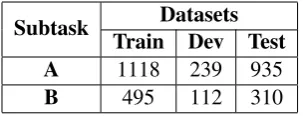
The data for both Question Classification - Sub-task A and Answer Classification - SubSub-task B, is organized into train, dev and test sets. The num-ber of samples in each of these datasets is shown in the Table1.
5
https://code.google.com/archive/p/word2vec/
Subtask Datasets Train Dev Test
A 1118 239 935
[image:3.595.106.258.62.122.2]B 495 112 310
Table 1: Dataset Description
The data, in Question Classification, has both subject and body for each question. Similarly, for Answer Classification, the data has question sub-ject, question body and an answer (as a comment text). The data of both the subtasks also have other information related to meta-data like user infor-mation, date and time of the question and answer post. The detailed description of data can be seen in task description paper (Mihaylova et al.,2019).
4 System Description 4.1 Feature Extraction
4.1.1 Data pre-processing
We have applied some basic preprocessing tasks like removing URLs, converting text to lowercase along with removing stopwords.
4.1.2 Extract Skip-Thought vectors
We choose Skip-Thought Vectors as word embed-dings for this task mainly because these are highly generic sentence representations unlike GloVe or Word2Vec which averages word embeddings of each individual word to calculate the word embed-ding for a complete sentence.
In subtask A, we have retrieved Skip-Thought vectors for question body and question subject. In subtask B, we extracted Skip-Thought vectors for question body, question subject and answer com-ment. For both the subtasks, we have used the code7 written by the Skip-Thought vectors’ au-thors.
4.2 Model Building
Once we have extracted Skip-Thought vectors, we used these vectors to train different models - AdaBoost Classifier (only in case of Subtask B), DecisionTree Classifier, RandomForest Clas-sifier, ExtraTrees ClasClas-sifier, XGBoost Classifier and Multi-layer Neural Network with dropout lay-ers in between, Adam optimizer and softmax ac-tivation in the final layer. The hyper-parameters
7https://github.com/ryankiros/Skip-Thoughts
of all the models is determined by applying Grid-Search with 10-fold cross-validation. The hyper-parameters are shown in the Table2.
Classifier Hyper-parameters Decision Tree min samples split = 2
Random Forest
n estimators = 25 min samples leaf = 1 min samples split = 2
Extra Trees n estimators = 20 max features = 37
XGBoost
learning rate = 0.1 n estimators = 100 max depth = 5
objective = ’multi:softprob’
Adaboost n estimators = 45 learning rate = 1.0
Table 2: Hyper-parameters used for models
5 Evaluation and Results
5.1 Subtask A (Question Classification)
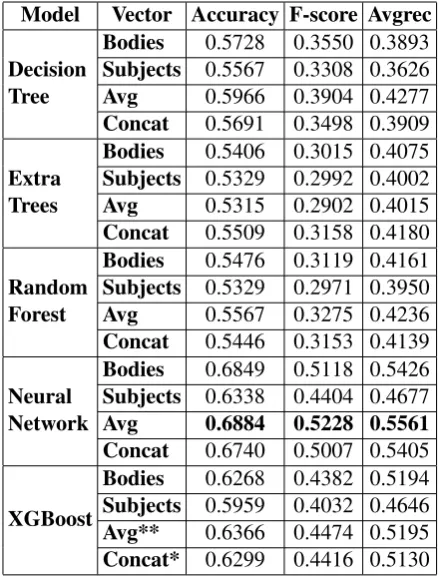
For this subtask, we extract Skip-Thought vectors as described in section4.1.2. Once we get these two vectors, we generated four different combina-tions of vectors -(i)question body only,(ii) ques-tion subject only, (iii) concatenation vector of both question body and question subject and(iv) average vector of both question body and question subject. We trained all the models mentioned in the section4.2with each one of these vectors. The evaluation scores for these models on test data are shown in the Table3.
5.2 Subtask B (Answer Classification)
For this subtask, we extract Skip-Thought vectors as described in section4.1.2. Once we get these three vectors, we generated two different combi-nations of vectors - (i) concatenation vector of question body, question subject & answer and(ii) average vector of question body, question subject & answer. We trained all the models mentioned in the section4.2using each one of these embedding vectors. The evaluation scores for these models (except MAP scores) on test data are shown in the Table4.
[image:3.595.309.522.115.296.2]Model Vector Accuracy F-score Avgrec
Decision Tree
Bodies 0.5728 0.3550 0.3893 Subjects 0.5567 0.3308 0.3626 Avg 0.5966 0.3904 0.4277 Concat 0.5691 0.3498 0.3909
Extra Trees
Bodies 0.5406 0.3015 0.4075 Subjects 0.5329 0.2992 0.4002 Avg 0.5315 0.2902 0.4015 Concat 0.5509 0.3158 0.4180
Random Forest
Bodies 0.5476 0.3119 0.4161 Subjects 0.5329 0.2971 0.3950 Avg 0.5567 0.3275 0.4236 Concat 0.5446 0.3153 0.4139
Neural Network
Bodies 0.6849 0.5118 0.5426 Subjects 0.6338 0.4404 0.4677 Avg 0.6884 0.5228 0.5561 Concat 0.6740 0.5007 0.5405
XGBoost
[image:4.595.71.291.62.351.2]Bodies 0.6268 0.4382 0.5194 Subjects 0.5959 0.4032 0.4646 Avg** 0.6366 0.4474 0.5195 Concat* 0.6299 0.4416 0.5130
Table 3: Evaluation scores for Subtask A
∗- marks the scores of our primary submission
∗∗- marks the scores of our contrastive submission Row in bold - post evaluation accuracy score (improved over actual submission)
concatenation of vectors of body, subject and an-swer/comment or average of vectors of body, sub-ject and answer/comment). On dev data set, XG-Boost Classifier with concatenated Skip-Thought vectors generated best scores for both subtasks. Hence, these are part of final submissions.
However, the rows which are marked in bold (in both subtasks) produced best accuracy score with Multi-layer Neural Network Classifier beating the best score of our CodaLab final submission. The Multi-layer Neural Network is designed to have an input layer,2hidden layers and an output layer with “relu” activations at input and hidden layers and “sigmoid” activation at output layer. All the layers are trained with50neurons except the out-put layer which has one neural node. This model counters overfitting problem by introduction of in-termittent Dropout layers.
Another interesting observation that we found is the models, surprisingly, performed better when URLs are kept in the text compared to when URLs were removed.
Model Vector Accuracy F-score Avgrec Decision
Tree
Avg 0.5354 0.2755 0.3791 Concat 0.5438 0.2843 0.3284 Extra
Trees
Avg 0.5763 0.2845 0.3229 Concat 0.6021 0.3150 0.3558 Random
Forest
Avg 0.6215 0.3068 0.3285 Concat 0.6172 0.2890 0.2943
Adaboost Avg 0.5570 0.2607 0.2813 Concat 0.5743 0.2612 0.2564 Neural
Network
Avg 0.6129 0.3434 0.4036 Concat 0.6752 0.3420 0.3559
[image:4.595.307.526.62.243.2]XGBoost Avg** 0.6150 0.3225 0.3529 Concat* 0.6537 0.3252 0.1555
Table 4: Evaluation scores for Subtask B
∗- marks the scores of our primary submission
∗∗- marks the scores of our contrastive submission Row in bold - post evaluation accuracy score (improved over actual submission)
6 Conclusion
The earlier works on cQA didn’t use Skip-Thought vectors, to the best of our knowledge. Hence, we used these vectors for both subtasks. We also have tried unique combinations of Skip-Thought vectors of question body, question sub-ject and comments/answers (only in case of Sub-task B) - either concatenation or average of vec-tors with different models. Out of all the mod-els, concatenated Skip-Thought vectors with XG-Boost Classifier generated best result out of all the combinations; as a result of which we stood 6th in Subtask B and 16th in Subtask A. How-ever, post-evaluation submission which used con-catenated Skip-Thought vectors with Neural Net-work classifier produced better accuracy score of 0.6752compared to0.6537(which is official best result for Task B) and0.6884compared to0.6299 (which is official best result for Task A). However, in future we would like to extend our work with other word embeddings like Word2vec, GloVe and BERT (Devlin et al.,2018) features and compare the results with current work using Skip-Thought vectors.
Acknowledgments
References
Daniel Balchev, Yasen Kiprov, Ivan Koychev, and Preslav Nakov. 2016. PMI-cool at SemEval-2016 Task 3: Experiments with PMI and Goodness Po-larity Lexicons for Community Question Answer-ing. In Proceedings of the 10th International Workshop on Semantic Evaluation (SemEval-2016), pages 844–850, San Diego, California. Association for Computational Linguistics.
Tianqi Chen and Carlos Guestrin. 2016. XGBoost: A Scalable Tree Boosting System. InProceedings of the 22nd ACM SIGKDD International Conference on Knowledge Discovery and Data mining, pages 785–794. ACM.
Jacob Devlin, Ming-Wei Chang, Kenton Lee, and Kristina Toutanova. 2018. BERT: Pre-training of Deep Bidirectional Transformers for Language Un-derstanding. arXiv preprint arXiv:1810.04805.
Wenzheng Feng, Yu Wu, Wei Wu, Zhoujun Li, and Ming Zhou. 2017. Beihang-MSRA at
SemEval-2017 Task 3: A Ranking System with Neural
Matching Features for Community Question
An-swering. InProceedings of the 11th International
Workshop on Semantic Evaluation (SemEval-2017), pages 280–286, Vancouver, Canada. Association for Computational Linguistics.
Marc Franco-Salvador, Sudipta Kar, Thamar Solorio, and Paolo Rosso. 2016. UH-PRHLT at SemEval-2016 Task 3: Combining Lexical and Semantic-based Features for Community Question Answer-ing. In Proceedings of the 10th International Workshop on Semantic Evaluation (SemEval-2016), pages 814–821, San Diego, California. Association for Computational Linguistics.
Jiwoon Jeon, W Bruce Croft, and Joon Ho Lee. 2005. Finding Similar Questions in Large Question and Answer Archives. InProceedings of the 14th ACM international conference on Information and knowl-edge management, pages 84–90. ACM.
Ryan Kiros, Yukun Zhu, Ruslan Salakhutdinov, Richard S Zemel, Antonio Torralba, Raquel Urta-sun, and Sanja Fidler. 2015. Skip-Thought Vectors.
arXiv preprint arXiv:1506.06726.
Tsvetomila Mihaylova, Pepa Gencheva, Martin Boy-anov, Ivana Yovcheva, Todor Mihaylov, Momchil Hardalov, Yasen Kiprov, Daniel Balchev, Ivan Koy-chev, Preslav Nakov, Ivelina Nikolova, and Galia Angelova. 2016. SUper Team at SemEval-2016 Task 3: Building a Feature-Rich System for
Com-munity Question Answering. InProceedings of the
10th International Workshop on Semantic Evalua-tion (SemEval-2016), pages 836–843, San Diego, California. Association for Computational Linguis-tics.
Tsvetomila Mihaylova, Georgi Karadzhov, Atanasova Pepa, Ramy Baly, Mitra Mohtarami, and Preslav
Nakov. 2019. SemEval-2019 task 8: Fact Check-ing in Community Question AnswerCheck-ing Forums. In
Proceedings of the International Workshop on Se-mantic Evaluation, SemEval ’19, Minneapolis, MN, USA.
Tsvetomila Mihaylova, Preslav Nakov, Lluis Marquez, Alberto Barron-Cedeno, Mitra Mohtarami, Georgi Karadzhov, and James Glass. 2018. Fact Check-ing in Community Forums. InThirty-Second AAAI Conference on Artificial Intelligence.
Tomas Mikolov, Ilya Sutskever, Kai Chen, Greg S Cor-rado, and Jeff Dean. 2013. Distributed Representa-tions of Words and Phrases and their Composition-ality. InAdvances in neural information processing systems, pages 3111–3119.
Mitra Mohtarami, Yonatan Belinkov, Wei-Ning Hsu, Yu Zhang, Tao Lei, Kfir Bar, Scott Cyphers, and Jim Glass. 2016. SLS at SemEval-2016 Task 3: Neural-based Approaches for Ranking in Community Ques-tion Answering. InProceedings of the 10th Interna-tional Workshop on Semantic Evaluation (SemEval-2016), pages 828–835, San Diego, California. Asso-ciation for Computational Linguistics.
Titas Nandi, Chris Biemann, Seid Muhie Yimam, Deepak Gupta, Sarah Kohail, Asif Ekbal, and Push-pak Bhattacharyya. 2017. IIT-UHH at SemEval-2017 Task 3: Exploring Multiple Features for Com-munity Question Answering and Implicit Dialogue Identification. InProceedings of the 11th Interna-tional Workshop on Semantic Evaluation (SemEval-2017), pages 90–97, Vancouver, Canada. Associa-tion for ComputaAssocia-tional Linguistics.
Jeffrey Pennington, Richard Socher, and Christo-pher D. Manning. 2014. GloVe: Global Vectors for
Word Representation. InEmpirical Methods in
Nat-ural Language Processing (EMNLP), pages 1532– 1543.
Filip ˇSaina, Toni Kukurin, Lukrecija Pulji´c, Mladen Karan, and Jan ˇSnajder. 2017. TakeLab-QA at SemEval-2017 Task 3: Classification Experiments
for Answer Retrieval in Community QA. In
Pro-ceedings of the 11th International Workshop on Se-mantic Evaluation (SemEval-2017), pages 339–343, Vancouver, Canada. Association for Computational Linguistics.
Hujie Wang and Pascal Poupart. 2016. Overfitting at SemEval-2016 Task 3: Detecting Semantically Sim-ilar Questions in Community Question Answering
Forums with Word Embeddings. InProceedings of
the 10th International Workshop on Semantic Eval-uation (SemEval-2016), pages 861–865, San Diego, California. Association for Computational Linguis-tics.
Yufei Xie, Maoquan Wang, Jing Ma, Jian Jiang, and Zhao Lu. 2017. EICA Team at SemEval-2017 Task 3: Semantic and Metadata-based Features for
11th International Workshop on Semantic Evalua-tion (SemEval-2017), pages 292–298, Vancouver, Canada. Association for Computational Linguistics.
Kai Zhang, Wei Wu, Haocheng Wu, Zhoujun Li, and Ming Zhou. 2014. Question Retrieval with High Quality Answers in Community Question An-swering. In Proceedings of the 23rd ACM In-ternational Conference on Conference on Informa-tion and Knowledge Management, pages 371–380. ACM.
Sheng Zhang, Jiajun Cheng, Hui Wang, Xin Zhang, Pei Li, and Zhaoyun Ding. 2017. FuRongWang at SemEval-2017 Task 3: Deep Neural Networks for Selecting Relevant Answers in Community Ques-tion Answering. InProceedings of the 11th Interna-tional Workshop on Semantic Evaluation (SemEval-2017), pages 320–325, Vancouver, Canada. Associ-ation for ComputAssoci-ational Linguistics.