704
NLP@UIOWA at SemEval-2019 Task 6: Classifying the Crass using
Multi-windowed CNNs
Jonathan Rusert and Padmini Srinivasan Department of Computer Science
University of Iowa Iowa City, IA, USA
{jonathan-rusert, padmini-srinivasan}@uiowa.edu
Abstract
This paper proposes a system for OffensEval (SemEval 2019 Task 6), which calls for a sys-tem to classify offensive language into several categories. Our system is a text based CNN, which learns only from the provided training data. Our system achieves 80 - 90% accu-racy for the binary classification problems (of-fensive vs not of(of-fensive and targeted vs untar-geted) and 63% accuracy for trinary classifica-tion (group vs individual vs other).
1 Introduction
Background. Social media (e.g. Twitter, Face-book) is widely used today. For example, 68% of all Americans report owning a Facebook account in 2018 (Smith and Anderson, 2018), while 71% of Americans (within the ages of 18-24) report us-ing Twitter. Online gamus-ing is a second popular use of the internet, reaching upwards of 80 - 100 million monthly users depending on game (Goslin, 2018). These uses demonstrate the internet as a way for humans to connect with others. How-ever, connecting with others can carry a downside. More than 1 in 3 young people have been cyber-bullied online (cyb,2018), this extends to around half of teens. Besides cyberbullying, offensive language, on a public forum, can cause users to stay away from certain platforms. Because of this, companies have increased their efforts to remove offensive language from their platforms (Terdi-man,2018). With the large amount of traffic these platforms see, a purely manual approach to detect-ing/removing offensive language is impossible, which means an automated approach is needed to help. OffensEval (Zampieri et al.,2019b) provides a community driven opportunity to build such sys-tems. We approach this problem of classifying of-fensive tweets with a CNN architecture trained on the provided training dataset.
2 Proposed Approach
Our system is a variation of a Convolutional Neu-ral Network (CNN), which was chosen since it has seen success previously with classification tasks
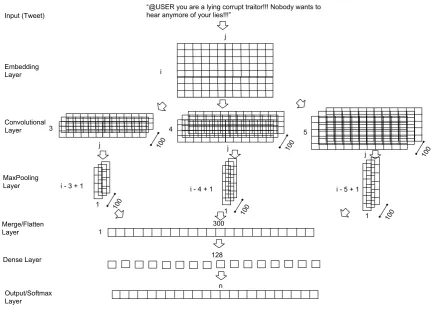
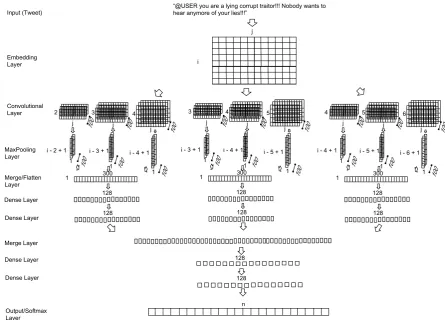
CNN Infrastructure. We experimented with two different Convolutional Neural Networks. The first whose architecture is based on the CNN originally proposed in (Kim, 2014) (CNN 1), and the second a combination of multiple CNNs (CNN 2). We further discuss each of these CNNs and their comparison on the training data. The vi-sual structure for CNN 1 and CNN 2 can be found in figure1and figure2respectively.
Preprocessing. Both CNN 1 and CNN 2 begin by preprocessing the text of the tweet. As noted in section3, URLs and user mentions are already denoted as URL and USER. Basic cleaning of the text is applied, includes removal of punctuation, converting text to lowercase, and filtering of stop-words via NLTK’s stopword list1. Finally, all sep-arated words are tokenized via nltk’s tokenize() function2.
Embedding Layer. CNN 1 and CNN 2 encode the text of a tweet as a word embedding with di-mensionj. We experimented with severalj arriv-ing at j = 100. Word embeddings for Non-Out of Vocabulary (OOV) words are obtained from Glove (Pennington et al., 2014) which has been trained on Twitter data3. Experiments were also conducted with Glove common crawl data, but no visible improvement was found. OOV words are randomly initialized as a word embedding. The embedding layer takes in i word embeddings of length j, where the i word embeddings are com-bined in the same sequential order as they appear in the tweet. We choose i as the length of the
1
nltk.org/api/nltk.corpus.html
2
nltk.org/api/nltk.tokenize.html
Embedding Layer
“@USER you are a lying corrupt traitor!!! Nobody wants to hear anymore of your lies!!!”
Input (Tweet)
i
j
Convolutional Layer 3
j
4
j
5
j
100 100
100
Merge/Flatten
Layer 1
300 MaxPooling
Layer i - 3 + 1 i - 4 + 1 i - 5 + 1
1
1
1 100
100
100
Dense Layer 128
Output/Softmax Layer
[image:2.595.90.522.64.373.2]n
Figure 1: CNN 1 ’s Architecture
longest tweet (i.e. number of words after prepro-cessing). Any tweets less thanilength are padded with zero embeddings at the end. CNN 1 and CNN 2 differ at this point and will be examined separately.
CNN 1 Convolutional Layer. CNN 1 applies
threek×jconvolutional windows to the embed-ding layer: a 3 xj, a 4 x j, and a 5 x jwindow. Applying each window to the embedding layer re-sults in a(i−k+ 1)×1output, where k ={3,4,5}
and corresponds to the length of the window. 100 filters of each window are applied to the embed-ding layer resulting in 100(i−k+ 1)×1outputs for eachk.
CNN 1 Max pooling/Merge Layer A max
pooling of size(i−k+ 1)×1is applied to each separate filter output from the convolutional layer. The resulting outputs from all three max pooling streams are merged together then flattened to a 300 neuron layer.
CNN 1 Dense Layer/Output Layer The
flat-tened layer is fed into a dense layer consisting of 128 neurons. ReLu is chosen as the activation function. Finally, the output of the dense layer is passed to the output layer of sizen wheren =
number of classes. The output layer uses a soft-max function as activation.
CNN 2 Convolutional Layer. CNN 2 applies
three sets of three convolution windows to the em-bedding layer, each window in the formatk×j. The first set of convolution windows are k = [2,3,4], the second arek= [3,4,5], and third are
k = [4,5,6]. Similar to CNN 1 , applying these filters results in a(i−k+ 1)×1output, and 100 filters exist for eachkfor each set of windows.
CNN 2Max pooling/Merge Layer. Max
pool-ing, in this instance, behaves similarly to CNN 1 . However, instead of merging all the pooled layers, only those in the same set are merged. This results in three separate flattened 300 neuron layers.
CNN 2Separate Dense layers The three sepa-rate merged layers are fed through two dense lay-ers consisting of 128 neurons each. ReLu activa-tion funcactiva-tion is used for all dense layers. Each merged layer is fed to their own respective dense layers. The second dense layers are finally merged together.
Embedding Layer
“@USER you are a lying corrupt traitor!!! Nobody wants to hear anymore of your lies!!!”
Input (Tweet)
i
j
Convolutional Layer 2
j 3
j 4
j
100 100
100
Merge/Flatten Layer
1 300 MaxPooling
Layer
i - 2 + 1 i - 3 + 1 i - 4 + 1 1
1
1
100 100
100
Dense Layer
128
Output/Softmax Layer
n 128
3 j
4 j
5
j
100 100
100
1 300
i - 3 + 1 i - 4 + 1 i - 5 + 1 1
1
1
100 100
100
128
128
4 j
5 j
6
j
100 100
100
1 300
i - 4 + 1 i - 5 + 1 i - 6 + 1 1
1
1
100 100
100
128
128 Dense Layer
Merge Layer
Dense Layer
Dense Layer
128
[image:3.595.71.517.64.384.2]128
Figure 2: CNN 2 ’s Architecture
fed to the output layer of sizenwith softmax acti-vation.
Hyperparameters/Training We experimented with different epochs and batch sizes and ended up finding epochs=30 and batch size = 50 worked best for our models. The only data trained on was the training data provided. More on this data in section 3. The system was implemented with Keras4and Tensorflow as the backend.
3 Dataset
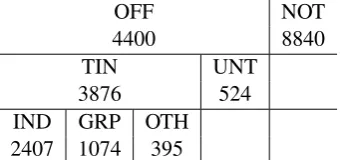
Training Set. The data collection methods used to compile the dataset provided in OffensEval is described inZampieri et al.(2019a). The training data set provided consists of 13,240 tweets. Each tweet, consists of up to three classifications, which correspond to subtasks further described in section 4. The classifications are as follows:
i. OFF - This post contains offensive language or a targeted (veiled or direct) offense
ii. NOT - This post does not contain offense or profanity.
4https://keras.io/
iii. TIN - A post containing an insult or threat to an individual, a group, or others
iv. UNT - A post containing non-targeted profan-ity and swearing.
v. IND - The target of the offensive post is an in-dividual: a famous person, a named individual or an unnamed person interacting in the con-versation.
vi. GRP - The target of the offensive post is a group of people considered as a unity due to the same ethnicity, gender or sexual orienta-tion, political affiliaorienta-tion, religious belief, or something else.
vii. OTH - The target of the offensive post does not belong to any of the previous two cate-gories (e.g., an organization, a situation, an event, or an issue)
OFF NOT
4400 8840
TIN UNT
3876 524
IND GRP OTH
[image:4.595.97.268.63.143.2]2407 1074 395
Table 1: A breakdown of frequency of labels of tweets, the classes underneath are further classifications of classes above (e.g. a tweet labeled IND is also labeled TIN and OFF)
Test Set. The test set provided follows the same classification rules as training and consists of 860 tweets. The 860 tweets can be classified into OFF or NOT, then 240 OFF tweets can be classified as TIN or UNT, and finally 213 TIN tweets can be classified as IND, GRP or OTH.
4 Subtasks
OffensEval divided the overall task of identify-ing/classifying offensive language into three sub-tasks, subtask A, B, and C.
Subtask A. Subtask A requires a system to clas-sify tweets as either offensive (OFF) or not offen-sive (NOT). An example of a tweet marked as OFF (in provided training):
@USER you are a lying corrupt traitor!!! No-body wants to hear anymore of your lies!!!.
An example of a tweet marked as NOT:
@USER Buy more icecream!!!.
A more expanded look at the training data can be found in section3.
Subtask A Results. As our system only trained on the provided gold standard, this data set was used to gauge the effectiveness of our two sys-tems. Five fold cross validation was used for pre-dicting training data. The results for subtask A on training data can be found in table2. CNN 1 and CNN 2 achieve similar results, an accuracy of 0.7468 and 0.7555, and a macro F1 score of 0.7130 and 0.7114, respectively. The results for our systems’ performance on OffensEval test data subtask A can be found in table 3. As with the training data, CNN 1 and CNN 2 perform simi-larly on this task, with CNN 1 achieving 0.8 ac-curacy and a macro F1 score of 0.73.
Subtask B. Subtask B requires further classifi-cation of OFF tagged into two categories, targeted (TIN) and untargeted (UNT). An example of un-targeted tweet is:
System Acc. Pr. Re. F1
CNN 1 0.7469 0.7145 0.7117 0.7130
CNN 2 0.7555 0.7256 0.7036 0.7114
Table 2: Subtask A Training Data Results, Pr.=Macro Precision, Re.=Macro Recall, F1=Macro F1 Score
System Acc. Pr. Re. F1
CNN 1 0.7988 0.7552 0.7175 0.7314
CNN 2 0.7767 0.7250 0.7379 0.7306
All NOT 0.7209 0.4189
All OFF 0.2790 0.2182
Table 3: Subtask A Test Results, Pr.=Macro Precision, Re.=Macro Recall, F1=Macro F1 Score. All OFF, NOT are baselines where that specific label was assigned to all tweets.
@USER @USER My favourite part of this is watching all the conservatives lose their minds as usual. Once again the Democrats a re being mean to us boo-hoo. LOL.
An example of targeted:
@USER You are a complete knob! It’s ppl like you who are messing up this country. More details on data in section3.
Subtask B Results. The results for cross valida-tion on subtask B’s training data are found in table 4. CNN 2 achieves a greater accuracy over CNN 1 on this subtask, 0.8723 compared to 0.8222, but still achieves a smaller macro F1 score of 0.5673 compared to 0.5827. Subtask B test results for our systems are found in table5. Similar to training, CNN 2 outperforms CNN 1 in accuracy, 0.8958 to 0.8750, but achieves a similar trend in macro F1 scores, 0.6511 and 0.6528.
Subtask C. Subtask C requires further classifi-cation of those tweets tagged are targeted (TIN), into three classes, Individual (IND), Group (GRP), and Other (OTH). Examples:
IND tweet -@USER You are a complete knob! It’s ppl like you who are messing up this country
GRP tweet - @USER Assuming liberals are unarmed would be a grave mistake by the de-plorables.
System Acc. Pr. Re. F1
CNN 1 0.8222 0.5815 0.5839 0.5827
CNN 2 0.8723 0.6442 0.5545 0.5673
[image:4.595.308.527.148.222.2]System Acc. Pr. Re. F1
CNN 1 0.8750 0.6732 0.6385 0.6528
CNN 2 0.8958 0.7478 0.6179 0.6511
All TIN 0.8875 0.4702
[image:5.595.68.294.61.136.2]All UNT 0.1125 0.1011
Table 5: Subtask B Test Results, Pr.=Macro Precision, Re.=Macro Recall, F1=Macro F1 Score. All TIN, UNT are baselines where that specific label was assigned to all tweets.
System Acc. Pr. Re. F1
CNN 1 0.6925 0.5372 0.5224 0.5282
CNN 2 0.6772 0.5147 0.5136 0.5140
Table 6: Subtask C Training Data Results, Pr.=Macro Precision, Re.=Macro Recall, F1=Macro F1 Score
OTH tweet - @USER Shooting in USA is so common no one is talking about gun control any more.
More details on subtask C data in section3.
Subtask C Results. The results for subtask C’s cross validation on training data can be found in table 6. CNN 1 slightly outperforms CNN 2 in this task, achieving an accuracy of 0.6925 over 0.6772 and a macro F1 score of 0.5282 over 0.5140. Subtask C’s test data results can be found in table 7. As subtask C is a three class prob-lem (compared to the two class probprob-lem of A, B), the accuracy and macro F1 scores are lower over-all. As with training, CNN 1 slightly outperforms CNN 2 in both accuracy, 0.6291 to 0.6197, and macro F1 score, 0.5061 to 0.4939.
5 Discussion
Systems outperform single labels. On test data, for all three subtasks, our system outperforms the baseline, provided by organizers, for assigning a
System Acc. Pr. Re. F1
CNN 1 0.6291 0.5513 0.5148 0.5061
CNN 2 0.6197 0.5079 0.5014 0.4939
All GRP 0.3662 0.1787
All IND 0.4695 0.2130
[image:5.595.343.490.62.116.2]All OTH 0.1643 0.0941
Table 7: Subtask C Test Results, Pr.=Macro Preci-sion, Re.=Macro Recall, F1=Macro F1 Score. All GRP, IND, OTH are baselines where that specific label was assigned to all tweets.
NOT OFF
Key NOT 559 61 620
OFF 112 128 240
System 860
Table 8: CNN 1 ’s Confusion matrix for subtask A
TIN UNT
Key TIN 201 12 213
UNT 18 9 27
[image:5.595.344.490.151.206.2]System 240
Table 9: CNN 1 ’s Confusion matrix for subtask B
single label for all tweets. Outperforming the best baseline (labeling tweets with highest frequent la-bel) in terms of F1 by 0.32 in subtask A, 0.18 in subtask B, and 0.29 in subtask C. Outperfor-mances in accuracy are seen in all three subtasks as well.
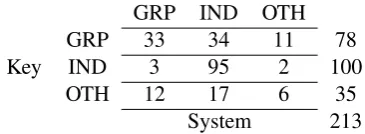
Results follow data distribution. The test con-fusion matrices for the higher scoring system (CNN 1), for subtask A, B, and C, can be found in table8, table 9, and table10 respectively. Train-ing data for OFF and NOT make up 67% and 33% respectively. For test data, the percentages are 28% for OFF and 78% for NOT. As expected, our system identifies better identifies NOT (559/620 tweets) compared to OFF (128/240 tweets). Sim-ilar results occur for subtask B, TIN (201/213) compared to UNT(9/27), and subtask C, GRP (33/78) compared to (95/100) compared to (6/35). These results all follow distribution of training data, which might point to lack of training data for poorer results for smaller classes since deep learn-ing systems depend on a good amount of trainlearn-ing data.
Added complexity of CNN 2 adds little to no improvement. Although CNN 2 shows greater performance in accuracy on the training data for subtasks A and B, the performance does not follow through in the test data, as CNN 1 outperformed CNN 2 in subtask A and C for accuracy and all
GRP IND OTH
Key
GRP 33 34 11 78
IND 3 95 2 100
OTH 12 17 6 35
[image:5.595.72.293.617.709.2]System 213
[image:5.595.324.507.673.740.2]three subtasks for macro F1 score. Although CNN 2 performs slightly worse, this may not be due to the structure itself, CNN 2 is currently trained the traditional way (updates all weights as once) but it may be necessary for the branches to be trained separately. This requires further testing in the fu-ture.
6 Related Work
Offensive language detection and classification has become increasingly relevant in recent years with the rise of social media. Subsequently, re-searchers have also begun to look at aggression, cyberbullying, hate speech, and abusive language identification.
Cyberbullying. Cyberbullying detection has been approach by several teams. Dinakar et al. (2011) show that binary classifiers for individual labels outperforms multi-label classifiers. Xu et al. (2012) demonstrate that social media is a rich environment for studying cyberbulling with NLP.Dadvar et al. (2013) show the effectiveness of including context around a comment.
Abusive Language. Abusive language has also seen increase in study. Nobata et al. (2016) construct a machine learning algorithm and test with different lexical features, outperforming at the time state-of-the-art methods. Mubarak et al. (2017) expand abusive language identification to Arabic social media. Fiˇser et al. (2017) propose a legal framework, dataset and anotation schema for abusive online language in Slovene. Su et al. (2017) propose a system which can not only de-tect, but also rephrase abusive language in Chi-nese.Waseem et al.(2017) propose breaking abu-sive language identification into further subtasks. Founta et al. (2018) leverage crowd sourcing to produce a large (80,000) annotated data set of abu-sive Twitter language.
Hate speech. Hate speech identification has come to the forefront for research as it deals with current hot button issues (e.g. racism, sexism). Schmidt and Wiegand (2017) and Fortuna and Nunes (2018) compile a surveys of current hate speech detection.
Other teams have brought to question how we view and handle hate speech. Ross et al. (2016) show the difficulty of annotating hate speech and propose handling classification as non-binary. Malmasi and Zampieri (2017) establish lexical baselines for hate speech detection by applying
supervised classification methods and Malmasi and Zampieri (2018) show the problems which can arise when distinguishing profanity from hate speech. ElSherief et al.(2018) further look to un-derstand hate speech by looking into the target of hate speech (i.e. at a individual or more general group).
Machine learning classifiers are leveraged in this field as well. Kwok and Wang (2013) em-ploy a machine learning classifier to identify racist tweets. Burnap and Williams (2015) test a ma-chine learning system on different n-gram fea-tures to identify hate speech on Twitter. Tulkens et al. (2016) use hate speech dictionaries along with support vector machines to identify racism on Dutch social media. Schofield and Davidson (2017) demonstrate three standard methods for producing features for text classification, targeting specifically the problem of automatic hate speech identification.
Subsequently, deep learning is seen in hate speech detection as well. Djuric et al. (2015) train and leverage comment embeddings to help identify hate speech.Gamb¨ack and Sikdar(2017) show the effectiveness of convolutional neural networks (CNN) when identifying hate speech. Zhang et al. (2018) identify hate speech using a convolution-GRU based deep neural network.
Offensive Language. Offensive language iden-tification aims to broaden the scope of negative language identification.Wiegand et al.(2018) pro-posed and ran a GermEval task similar to OffensE-val, which had participants classify offensive lan-guage as offensive or other, then further classify the offensive tagged language.
7 Conclusion/Future Work
We have proposed and tested two different CNN architectures for identifying offensive language. Future work would aim to improve the current CNN design by testing different word windows and training techniques. Furthermore, since deep learning performs better with large amounts of training data, increasing the training data, perhaps even with silver standards if not gold, should help further improve the system’s predictions.
References
Pete Burnap and Matthew L Williams. 2015. Cyber hate speech on twitter: An application of machine classification and statistical modeling for policy and decision making. Policy & Internet, 7(2):223–242.
Maral Dadvar, Dolf Trieschnigg, Roeland Ordelman, and Franciska de Jong. 2013. Improving cyberbul-lying detection with user context. In Advances in Information Retrieval, pages 693–696. Springer.
Karthik Dinakar, Roi Reichart, and Henry Lieberman. 2011. Modeling the detection of textual cyberbully-ing. InThe Social Mobile Web, pages 11–17.
Nemanja Djuric, Jing Zhou, Robin Morris, Mihajlo Gr-bovic, Vladan Radosavljevic, and Narayan Bhamidi-pati. 2015. Hate speech detection with comment embeddings. In Proceedings of the 24th Interna-tional Conference on World Wide Web Companion, pages 29–30. International World Wide Web Con-ferences Steering Committee.
Mai ElSherief, Vivek Kulkarni, Dana Nguyen, William Yang Wang, and Elizabeth Belding. 2018. Hate Lingo: A Target-based Linguistic Analysis of Hate Speech in Social Media. arXiv preprint arXiv:1804.04257.
Darja Fiˇser, Tomaˇz Erjavec, and Nikola Ljubeˇsi´c. 2017. Legal Framework, Dataset and Annotation Schema for Socially Unacceptable On-line Discourse Prac-tices in Slovene. In Proceedings of the Workshop Workshop on Abusive Language Online (ALW), Van-couver, Canada.
Paula Fortuna and S´ergio Nunes. 2018. A Survey on Automatic Detection of Hate Speech in Text. ACM Computing Surveys (CSUR), 51(4):85.
Antigoni-Maria Founta, Constantinos Djouvas, Despoina Chatzakou, Ilias Leontiadis, Jeremy Blackburn, Gianluca Stringhini, Athena Vakali, Michael Sirivianos, and Nicolas Kourtellis. 2018. Large Scale Crowdsourcing and Characterization of Twitter Abusive Behavior. arXiv preprint arXiv:1802.00393.
Bj¨orn Gamb¨ack and Utpal Kumar Sikdar. 2017. Using Convolutional Neural Networks to Classify Hate-speech. In Proceedings of the First Workshop on Abusive Language Online, pages 85–90.
A. Goslin. 2018. Fortnite has 78.3 million monthly players, according to Epic.
Yoon Kim. 2014. Convolutional neural net-works for sentence classification. arXiv preprint arXiv:1408.5882.
Irene Kwok and Yuzhou Wang. 2013. Locate the hate: Detecting Tweets Against Blacks. In Twenty-Seventh AAAI Conference on Artificial Intelligence.
Shervin Malmasi and Marcos Zampieri. 2017. Detect-ing Hate Speech in Social Media. InProceedings of the International Conference Recent Advances in
Natural Language Processing (RANLP), pages 467– 472.
Shervin Malmasi and Marcos Zampieri. 2018. Chal-lenges in Discriminating Profanity from Hate Speech. Journal of Experimental & Theoretical Ar-tificial Intelligence, 30:1–16.
Hamdy Mubarak, Darwish Kareem, and Magdy Walid. 2017. Abusive Language Detection on Arabic So-cial Media. InProceedings of the Workshop on Abu-sive Language Online (ALW), Vancouver, Canada.
Chikashi Nobata, Joel Tetreault, Achint Thomas, Yashar Mehdad, and Yi Chang. 2016. Abusive Language Detection in Online User Content. In
Proceedings of the 25th International Conference on World Wide Web, pages 145–153. International World Wide Web Conferences Steering Committee.
Jeffrey Pennington, Richard Socher, and Christo-pher D. Manning. 2014. Glove: Global vectors for word representation. InEmpirical Methods in Nat-ural Language Processing (EMNLP), pages 1532– 1543.
Bj¨orn Ross, Michael Rist, Guillermo Carbonell, Ben-jamin Cabrera, Nils Kurowsky, and Michael Wo-jatzki. 2016. Measuring the Reliability of Hate Speech Annotations: The Case of the European Refugee Crisis. In Proceedings of the Workshop on Natural Language Processing for Computer-Mediated Communication (NLP4CMC), Bochum, Germany.
Anna Schmidt and Michael Wiegand. 2017. A Sur-vey on Hate Speech Detection Using Natural Lan-guage Processing. InProceedings of the Fifth Inter-national Workshop on Natural Language Process-ing for Social Media. Association for Computational Linguistics, pages 1–10, Valencia, Spain.
Alexandra Schofield and Thomas Davidson. 2017. Identifying Hate Speech in Social Media. XRDS: Crossroads, The ACM Magazine for Students, 24(2):56–59.
A. Smith and M. Anderson. 2018. Social Media Use in 2018.
Huei-Po Su, Chen-Jie Huang, Hao-Tsung Chang, and Chuan-Jie Lin. 2017. Rephrasing Profanity in Chi-nese Text. In Proceedings of the Workshop Work-shop on Abusive Language Online (ALW), Vancou-ver, Canada.
D. Terdiman. 2018. Heres How Facebook Uses AI To Detect Many Kinds Of Bad Content.
Zeerak Waseem, Thomas Davidson, Dana Warmsley, and Ingmar Weber. 2017. Understanding Abuse: A Typology of Abusive Language Detection Subtasks. In Proceedings of the First Workshop on Abusive Langauge Online.
Michael Wiegand, Melanie Siegel, and Josef Rup-penhofer. 2018. Overview of the GermEval 2018 Shared Task on the Identification of Offensive Lan-guage. InProceedings of GermEval.
Jun-Ming Xu, Kwang-Sung Jun, Xiaojin Zhu, and Amy Bellmore. 2012. Learning from bullying traces in social media. InProceedings of the 2012 confer-ence of the North American chapter of the associa-tion for computaassocia-tional linguistics: Human language technologies, pages 656–666. Association for Com-putational Linguistics.
Marcos Zampieri, Shervin Malmasi, Preslav Nakov, Sara Rosenthal, Noura Farra, and Ritesh Kumar. 2019a. Predicting the Type and Target of Offensive Posts in Social Media. InProceedings of NAACL.
Marcos Zampieri, Shervin Malmasi, Preslav Nakov, Sara Rosenthal, Noura Farra, and Ritesh Kumar. 2019b. SemEval-2019 Task 6: Identifying and Cat-egorizing Offensive Language in Social Media (Of-fensEval). InProceedings of The 13th International Workshop on Semantic Evaluation (SemEval).
Ziqi Zhang, David Robinson, and Jonathan Tepper. 2018. Detecting Hate Speech on Twitter Using a Convolution-GRU Based Deep Neural Network. In