Exploring Lexical and Syntactic Features
for Language Variety Identification
Chris van der Lee
Dept. of Communication and Information Sciences Tilburg University
Tilburg, The Netherlands
Antal van den Bosch
Centre for Language Studies Radboud University, Nijmegen, and
Meertens Institute, Amsterdam, The Netherlands
Abstract
We present a method to discriminate be-tween texts written in either the Nether-landic or the Flemish variant of the Dutch language. The method draws on a feature bundle representing text statistics, syn-tactic features, and word n-grams. Text statistics include average word length and sentence length, while syntactic features include ratios of function words and part-of-speechn-grams. The effectiveness of the classifier was measured by classify-ing Dutch subtitles developed for either Dutch or Flemish television. Several ma-chine learning algorithms were compared as well as feature combination methods in order to find the optimal generalization performance. A machine-learning meta classifier based on AdaBoost attained the best F-score of 0.92.
1 Introduction
Language identification, the task of automatically determining the natural language used in a docu-ment, is considered to be an important first step for many applications. Automatically determin-ing a document’s language can be a fairly easy step in certain situations (McNamee, 2005). How-ever, some bottlenecks have been identified which leaves language identification unsolved as yet. It has been argued and demonstrated that one of the main bottlenecks is distinguishing between similar languages (Tiedemann and Ljubeˇsi´c, 2012). Lan-guages that are closely related such as Croatian and Serbian or Indonesian and Malay are very sim-ilar in their spoken and their written forms, which makes it difficult for automated systems to accu-rately discriminate between them. Recently, some advances have been achieved in the automated
dis-tinction between closely related languages, largely due to the Discriminating between Similar Lan-guages (DSL) shared task. In the DSL competi-tions accuracies of over 95% have been reported, mostly using character and word n-grams with various classification algorithms.
Despite the fact that the accuracy of systems discriminating between similar languages is in-creasing, there are still challenges when it comes to discriminating between varieties of the same language, e.g. Spanish from South America or Spain. It has been claimed that language variety identification is even more difficult than similar language identification (Goutte et al., 2016). Re-sults in the DSL competitions support this claim: only one system was able to score slightly above the 50% baseline when distinguishing between British and American English (Zampieri et al., 2014).
This work is related to recent studies that ap-plied text classification methods to discriminate between written texts in different language va-rieties or dialects (Lui and Cook, 2013; Maier and G´omez-Rodriguez, 2014; Malmasi and Dras, 2015; Malmasi et al., 2015; Zampieri et al., 2016). The aim of the current work is to explore lesser studied techniques and features that could be ben-eficial to the accuracy of language variety classi-fiers. As a case study, classifiers were built to dis-criminate between Netherlandic Dutch and Flem-ish Dutch subtitles.
2 Related work
2.1 Language varieties
Research on varieties of the same language is scarce and the existing body of research on the topic shows that discriminating between language varieties is an even bigger challenge compared to similar languages. Six systems were submitted
in the 2014 DSL shared task to discriminate be-tween British English and American English, and only one of those systems scored above the 50% baseline (Zampieri et al., 2014). However, it is possible that the poor results attained in the 2014 DSL shared task were due to problems in the data set. Some classifiers have been built outside of the DSL shared task with higher accuracy scores. Lui and Cook (2013) built a classifier to distinguish the British, Canadian, and Australian English lan-guage varieties and tested this classifier on various corpora. The obtained F-scores varied greatly be-tween the corpora: an F-score of over .9 was ob-tained in the best case, but scores were below the baseline in the worst cases.
Not only English language varieties have been studied. Maier and G´omez-Rodriguez (2014) developed a classifier to discriminate between five Spanish languages with tweets (short mes-sages posted on the Twitter.com social media plat-form) as input. They achieved an average F-score of 0.34, which is somewhat above base-line, though not particularly high. Furthermore, Malmasi and Dras (2015) distinguished Dari and Farsi news texts with an accuracy of 96%. Mal-masi et al. (2015) developed a classifier for mul-tiple Arabic dialects. They achieved accuracy scores as high as 94%, but the results were rel-atively worse when they classified more closely-related dialects such as Palestinian and Jordanian (76%). Similarly, Zampieri et al. (2016) ventured to classify Portuguese news articles published in Brazil, Macau, and Portugal with differing accu-racy scores. Macau versus European Portuguese was somewhat difficult (74%), while classifying Brazilian versus Macau Portuguese and Brazilian versus European Portuguese turned out to be sub-stantially easier (at accuracies of 90% and 88%, respectively).
Classifiers that distinguish Dutch language vari-eties have also been developed. Trieschnigg et al. (2012) developed a classifier to discriminate be-tween folktales written in Middle Dutch (the pre-decessor of modern Dutch, used in the Nether-lands between 1200 and 1500) and 17th century Dutch, 20th century Frisian, and a number of 20th century Dutch dialects using the Dutch folktale database as a corpus. The performance of the clas-sifier varied greatly per language variety: near-perfect to very good identification was achieved for some varieties (e.g. Frisian was identified with
an F-score of 0.99; Liemers 0.88; Gronings 0.83), while classification was very difficult for other va-rieties (e.g. Overijssels at an F-score of 0.09; Wa-terlands 0.16; Drents 0.31). Tulkens et al. (2016) used corpora containing texts from mixed media (newspapers, Wikipedia, internet, social media) to build a Dutch language variety classifier based on provinces, and attained a relatively high score on some language varieties (up to 85% accuracy for Brabantian as spoken in the Belgian province of Antwerp), but they also report scores of 0% for six language varieties and a very low score on two others.
2.2 Features
While some exceptions exist (Tulkens et al., 2016), most of the current research in similar languages and language varieties use the same types of features, namelyn-gram-based features. The results of the DSL shared task have shown that these approaches generally perform the best. However, scholars have argued that adding cer-tain underused feature types could help improve the accuracy of state-of-the-art classifiers (Cimino et al., 2013). With the present study we inves-tigate this claim by using two types of features in addition to word n-grams, namely text statis-tics (e.g. average word length, ratio of long/short words) and syntactic features (grammar-level fea-tures, e.g. PoS-tags).
Syntactic features have been used previously, though scarcely, in the context of language identi-fication. Lui and Cook (2013) and Lui et al. (2014) used PoS n-grams as features for a classifier to make a distinction between English language va-rieties, while Zampieri et al. (2013) used PoS n-grams to classify Spanish language varieties. All three studies report that using POSn-grams leads to above-baseline results. This lends support to the notion that systematic differences between lan-guage varieties can be found using syntactic fea-tures.
The usage of text statistics for the identifica-tion of languages is even more uncommon com-pared to syntactic features. However, text statistics have been successfully used for similar research domains. One of these domains is native language identification (Jarvis et al., 2013; Cimino et al., 2013).
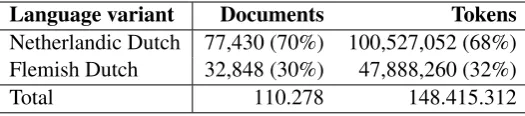
Language variant Documents Tokens
Netherlandic Dutch 77,430 (70%) 100,527,052 (68%) Flemish Dutch 32,848 (30%) 47,888,260 (32%)
[image:3.595.167.430.62.120.2]Total 110.278 148.415.312
Table 1: Document and token counts per language variety.
are systematic differences in stylistic choices be-tween languages. A study by Windisch and Csink (2005) is one of the few studies using text statis-tics features for language identification. The au-thors found that these features can indeed be used for language identification. However, it should be noted that they studied dissimilar languages. The effectiveness of text statistics features for similar languages, or language variety identification re-mains an understudied subject.
2.3 Current work
The current study will explore lesser used tech-niques in the domain of language variety identi-fication to see whether the current state-of-the art accuracy can be improved upon. This is done by using commonly used wordn-grams together with the more uncommon lexical and syntactic features. Various approaches for combining these different feature types will be explored to investigate the added benefit of an ensemble classifier.
The current study focuses on the discrimina-tion of Netherlandic Dutch (i.e. Dutch as spo-ken and written in the Netherlands) vs. Flem-ish Dutch (i.e. Dutch as spoken and written in the Dutch-speaking regions of Belgium). Speak-ers of Netherlandic Dutch and Flemish Dutch ad-here to the same standard language, but, even so, linguists have stated that there are differences be-tween Netherlandic and Flemish Dutch on every linguistic level, among which the lexical and syn-tactical level (De Caluwe, 2002). These differ-ences tend to be subtle. Some examples of dif-ferences found between the two language vari-eties are word choice preference (e.g.orange in Netherlandic Dutch: sinaasappel, Flemish Dutch:
appelsien), plural preference (e.g. teachers in Netherlandic Dutch: leraren, Flemish Dutch: ler-aars), and the order in which a particle and finite verb are preferably used (e.g. I don’t believe he
has come in Netherlandic Dutch: Ik geloof niet dat hijis gekomen, Flemish Dutch:Ik geloof niet dat hijgekomen is) (Schuurman et al., 2003).
Dutch language varieties have thus far remained
a scarcely studied topic of research, although re-searchers have shown an interest in it. A limita-tion to the study of these varieties has always been the lack of available data (Zampieri et al., 2014). However, the recent introduction of the SUBTIEL corpus offers a usable corpus for such research. The feasibility of using this corpus is further ex-plored in this work.
3 Method
3.1 Collection of the corpus
The SUBTIEL corpus contains over 500,000 sub-titles in Dutch and English. These subsub-titles were produced by a professional studio operating in several countries, among which The Netherlands and Belgium. The procedure for these countries is mostly the same: a single translator provides the subtitles for a series episode or a movie. The main focus of the studio are movies and television shows, and to a smaller degree documentaries.
After filtering out the English subtitles and the Dutch subtitles without information on whether they were intended for Dutch or Flemish televi-sion, 110.278 documents remain; cf. Table 1. A document in this context is the subtitles for one movie, or one episode of a television show. For the subtitles used in this study, a distinction is made between subtitles that were shown on a Dutch or a Flemish television network. In comparison to sim-ilar work (Trieschnigg et al., 2012; Tulkens et al., 2016), the number of documents and tokens that is used in the current study is relatively large.
Using an automated mining tool, the subtitles in the corpus were scanned for a match in the In-ternet Movie Database (IMDb)1, which provides
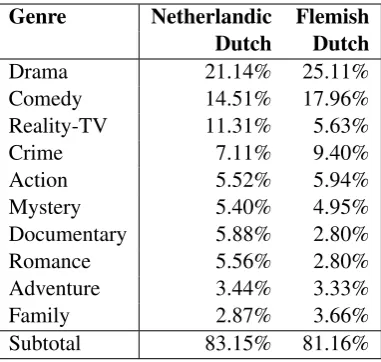
additional information about the show or movie (e.g. genre, year, actors). The main interest was genre, since a vastly different genre distribution per language variety could have an impact on clas-sification accuracy. An IMDb match was found for roughly half of the subtitles. The genre dis-tribution for these matches did show minor
Genre Netherlandic Flemish Dutch Dutch
Drama 21.14% 25.11%
Comedy 14.51% 17.96%
Reality-TV 11.31% 5.63%
Crime 7.11% 9.40%
Action 5.52% 5.94%
Mystery 5.40% 4.95%
Documentary 5.88% 2.80%
Romance 5.56% 2.80%
Adventure 3.44% 3.33%
Family 2.87% 3.66%
[image:4.595.204.395.61.242.2]Subtotal 83.15% 81.16%
Table 2: Distribution of the ten most frequent genres in the SUBTIEL corpus.
ferences between the language varieties, as can be seen in Table 2 For instance, the Netherlandic Dutch part of the corpus contained more subti-tles for Reality-TV, Documentaries and Romance, while the Flemish Dutch part of the corpus con-tained more Drama and Comedy. Overall, the dis-tribution of genres can be said to be reasonably similar.
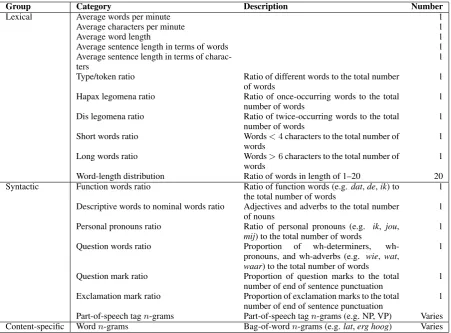
Various types of information from the text were extracted as features to feed machine learning classifiers; cf. Table 3. Features were adopted based on previous work by Abbasi and Chen (2008) and Huang et al. (2010). The extracted fea-tures can be clustered into three groups: text statis-tics, syntactic features, and content-specific fea-tures. Text statistics features are based on counts at various levels (e.g. sentence/word length and word length distributions); syntactic features rep-resent aspects of the syntactic patterns prep-resent in the data (e.g. the number of function words, punc-tuation and part-of-speech tagn-grams); content-specific features are any characters, character n-grams, words, or word n-grams that may be in-dicative of one particular language variant.
3.2 Classification methods
The five machine learning algorithms used in this study are AdaBoost with a decision tree core, C4.5, Naive Bayes, Random Forest Classifier, and Linear-kernel SVM. These types of algorithms have been used frequently for Language Identifi-cation tasks. SVM algorithms (Goutte et al., 2014; Malmasi and Dras, 2015; Jauhiainen et al., 2016) and Naive Bayes (King et al., 2014; Franco-Penya and Sanchez, 2016) are amongst the most
popu-lar algorithms. Decision tree approaches, which C4.5, AdaBoost, and Random Forest Classifier are examples of, have been used as well, but less fre-quently (Zampieri, 2013; Malmasi et al., 2016). The machine learning algorithms were deployed using the scikit-learn library (Pedregosa et al., 2011).
One of the challenges in the current study is to find an effective method of selecting the best combination of feature categories. One study on language variety classification has shown that an effective feature combination approach could increase classification accuracy (Malmasi et al., 2015). Three combination approaches are tested in the current study, namely the super-vector ap-proach, two rule-based meta-classifiers, and one algorithm-based meta-classifier:
Super-vector All features, regardless of feature category, are merged into a single vector to predict the language variety.
Sum-rule meta-classifier The probabilistic out-puts of the most accurate text statistics, syntactic, and content-specific classifier are summed, and the language variety with the highest sum is chosen.
Product-rule meta-classifier The product is cal-culated for the probabilistic outputs of the most accurate lexical, syntactic and content-specific classifier, and the language variety with the highest product is chosen.
Group Category Description Number
Lexical Average words per minute 1
Average characters per minute 1
Average word length 1
Average sentence length in terms of words 1
Average sentence length in terms of
charac-ters 1
Type/token ratio Ratio of different words to the total number
of words 1
Hapax legomena ratio Ratio of once-occurring words to the total
number of words 1
Dis legomena ratio Ratio of twice-occurring words to the total
number of words 1
Short words ratio Words<4characters to the total number of
words 1
Long words ratio Words>6characters to the total number of
words 1
Word-length distribution Ratio of words in length of 1–20 20 Syntactic Function words ratio Ratio of function words (e.g. dat,de,ik) to
the total number of words 1
Descriptive words to nominal words ratio Adjectives and adverbs to the total number
of nouns 1
Personal pronouns ratio Ratio of personal pronouns (e.g. ik, jou,
mij) to the total number of words 1 Question words ratio Proportion of wh-determiners,
wh-pronouns, and wh-adverbs (e.g. wie,wat, waar) to the total number of words
1
Question mark ratio Proportion of question marks to the total
number of end of sentence punctuation 1 Exclamation mark ratio Proportion of exclamation marks to the total
[image:5.595.74.526.61.394.2]number of end of sentence punctuation 1 Part-of-speech tagn-grams Part-of-speech tagn-grams (e.g. NP, VP) Varies Content-specific Wordn-grams Bag-of-wordn-grams (e.g.lat,erg hoog) Varies
Table 3: Features adopted in our experiments.
used to train a higher level classifier, which is subsequently used to predict the language variety.
The algorithms tested as algorithm-based meta-classifier are the same algorithms that are used for the individual feature categories (AdaBoost, C4.5, Naive Bayes, Random Forest Classifier, and Lin-ear SVM).
3.3 Processing and performance increases
Several preprocessing steps were undertaken. The goal for the content-specific classifier was to de-crease the number of features, thus increasing processing speed, while retaining the most use-ful information. This was done by removing stop words, number strings and punctuation from the corpus: tokens that appear frequently, while car-rying little meaning. Furthermore, words were normalized using lemmatization2 to decrease the
number of types for the content-specific features. Finally, words that did not appear more than 10 2Lemmatization was performed with Frog, https://languagemachines.github.io/frog/
times in the corpus were removed.
To get the syntactic information necessary for the syntactic features, Pattern (Smedt and Daele-mans, 2012) was applied to the texts, obtaining the part-of-speech tags. Part-of-speech tag n-grams that appeared less than 10 times in the corpus were removed.
After the frequency-based thresholding selec-tion, another feature selection step was performed based on the chi-square weights of all features. Ranking the features and starting from the features with the largest weight, the subset of features was selected at which a saturation point was reached in performance on held-out data. No more than 10% of the features in the syntactic and content-free category turned out to be selected.
Method Algorithm # of features Precision Recall F-score Accuracy
Lexical only AdaBoost 5 0.73 0.98 0.83 0.73
Syntactic only AdaBoost 392 0.83 0.92 0.87 0.81
Content-specific only Linear SVM 30,514 0.87 0.95 0.91 0.87
Lexical/Syntactic AdaBoost 407 0.83 0.92 0.87 0.81
Lexical/Content-specific AdaBoost 76.288 0.87 0.95 0.91 0.87 Syntactic/Content-specific AdaBoost 76.325 0.87 0.95 0.91 0.86
Supervector AdaBoost 76,325 0.86 0.94 0.90 0.86
Meta classifier (add) - - 0.87 0.96 0.91 0.87
Meta classifier (product) - - 0.87 0.96 0.91 0.87
[image:6.595.71.542.63.216.2]Meta classifier (ML) AdaBoost 6 0.88 0.96 0.92 0.88
Table 4: Classification performance.
4 Results
Table 4 lists the results obtained when classify-ing the Netherlandic Dutch and Flemish Dutch language varieties. Evaluation was done using 10-fold cross-validation and with precision, re-call, F-score (with β = 1) and accuracy as met-rics. Results range from a 73% accuracy score using lexical features only to 88% accuracy us-ing an algorithm-based meta classifier. Thus, sim-ilar to Malmasi et al. (2015), the results of this study show that the best results are obtained when combining different types of features, using an algorithm-based meta-classifier.
AdaBoost appeared to be the most effective al-gorithm for most feature categories, except for the content-specific feature type, where the Linear-kernel SVM algorithm was the most accurate al-gorithm. This is in line with most DSL Shared Task entries, where the most common and accu-rate classifiers are SVM classifiers with content-specific features.
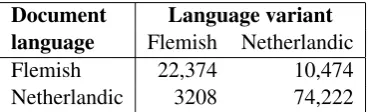
The recall values turn out to be particularly high, most of them above 0.95, while the preci-sion scores are slightly lower: most of the clas-sifiers obtained a score of around 0.85 for preci-sion. This is further illustrated in Table 5, where a confusion matrix for the algorithm-based meta-classifier is shown: the meta-classifier that obtained the highest performance.
The confusion matrix shows that Flemish Dutch documents were markedly harder to classify com-pared to Netherlandic Dutch documents. Nearly one third, 10,474 of the 32,848 Flemish docu-ments, were incorrectly classified as Netherlandic Dutch, while a substantially smaller proportion of Netherlandic Dutch documents were incorrectly
Document Language variant language Flemish Netherlandic
Flemish 22,374 10,474
Netherlandic 3208 74,222
Table 5: Confusion matrix for the algorithm-based meta-classifier.
classified as Flemish Dutch (3208 out of 77,430). This may be partly explained by the fact that the number of Flemish Dutch documents is about half the number of Netherlandic Dutch documents in the SUBTIEL corpus.
4.1 Important features
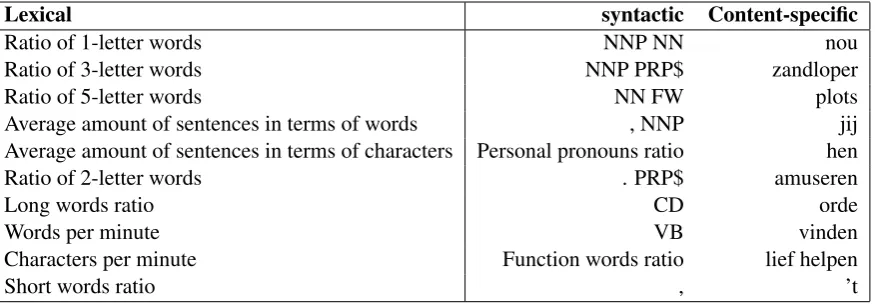
The most important features per feature category are presented in Table 6. These features could be an indication of fundamental differences between the Netherlandic Dutch and Flemish Dutch lan-guage varieties and may therefore be useful from a linguistic perspective. The selection of feature importance is based on Random Forest Classifica-tion.
At the text statistics level, it can be observed that the ratio of words, especially shorter words, highlights important differences between Nether-landic Dutch and Flemish Dutch. There is a higher ratio of 1-, 2- and 5-letter words in the Flem-ish subtitles, while an average Netherlandic Dutch document contains more 3-letter words compared to Flemish Dutch documents, surprisingly. Ad-ditionally, sentences in Netherlandic Dutch subti-tles contain more characters and words on average, and the ratio of words and characters per minute is higher in Netherlandic Dutch.
[image:6.595.325.510.259.315.2]Lexical syntactic Content-specific
Ratio of 1-letter words NNP NN nou
Ratio of 3-letter words NNP PRP$ zandloper
Ratio of 5-letter words NN FW plots
Average amount of sentences in terms of words , NNP jij Average amount of sentences in terms of characters Personal pronouns ratio hen
Ratio of 2-letter words . PRP$ amuseren
Long words ratio CD orde
Words per minute VB vinden
Characters per minute Function words ratio lief helpen
[image:7.595.83.521.62.216.2]Short words ratio , ’t
Table 6: Top 10 most important features per feature category.
category to discriminate Netherlandic Dutch from Flemish Dutch subtitles. Flemish subtitles have a higher ratio of sequences of singular proper nouns and singular nouns (NNP NN), singular proper nouns and possessive pronouns (NNP PRP$), and commas and singular proper nouns (, NNP). Fur-thermore, Flemish subtitles seem to contain a higher degree of singular nouns and foreign words (NN FW), periods and possessive pronouns (. PRP$), and commas (,), while Netherlandic Dutch subtitles contain more personal pronouns, cardinal numbers, and function words.
Some of the most important content-specific features indicate typical lexical differences be-tween language varieties. For instance, nou has been previously noted to be a word that is not used as much in Flemish as compared to Netherlandic Dutch,3andplotsis noted to be a word used more
in Flemish.4 No such categorical status is known
for the other important content-specific features, although amuseren andlief helpen may arguably be associated more with Flemish Dutch. Zand-loper, jij, hen, and orde also appeared more fre-quently in Flemish subtitles compared to Nether-landic Dutch, whilevindenand't appeared more in Netherlandic Dutch subtitles. The relative im-portance of some of these features in the current task could be due to hidden artifacts of the corpus. 5 Conclusion and future work
In this paper we presented language identification experiments carried out with five machine learning
3http://www.taaltelefoon.be/
standaardtaal-verschillen-tussen-belgie-en-nederland
4http://taaladvies.net/taal/advies/ vraag/665/plotsklaps_eensklaps_plots_ plotseling/
techniques (AdaBoost, C4.5, Naive Bayes, Ran-dom Forest Classifier, and Linear SVM), and three feature categories (text statistics, syntactic fea-tures, and content-specific features) focusing on the Netherlandic and Flemish variants of Dutch. Subtitles collected in the SUBTIEL corpus were used to train and test the classifiers on. With the exception of a few studies (Lui and Cook, 2013; Lui et al., 2014; Windisch and Csink, 2005; Zampieri et al., 2013), text statistics and syntac-tic features have rarely been explored in language identification tasks. Additionally, there are not many classification studies focusing on Dutch lan-guage varieties, exceptions being Trieschnigg et al. (2012) and Tulkens et al. (2016).
The highest accuracy score was obtained when using a meta-classifier approach with a machine-learning algorithm, AdaBoost. In this approach the probabilistic scores obtained from classifiers trained exclusively on text statistics features, syn-tactic features, and content-free classifiers respec-tively were used as input for training a higher-level classifier. This result is in agreement with the find-ings of Malmasi et al. (2015), where the best re-sults were also obtained using a meta classifier. This result suggests that a meta-classifier approach is a viable approach to language (variety) iden-tification, and also supports the claim by Cimino et al. (2013) that underused feature types such as text statistics and syntactic features could improve classification accuracy. Furthermore, most of the classifiers performed best using an AdaBoost al-gorithm with decision tree core.
clas-sifiers. Trieschnigg et al. (2012) obtained an F-score of 0.80 versus the F-F-score of 0.92 in this study, and Tulkens et al. (2016) achieved an av-erage accuracy of around 15% versus 88% in this study. Furthermore, the results seem to be on par with state-of-the-art methods: Zampieri et al. (2016) obtained accuracy scores between 74% and 90% in the binary classification of newspaper texts in variants of Portuguese, and Malmasi et al. (2015) obtained accuracy scores between 76% and 94% for binary classification of Arabic language varieties.
However, it is important to note that direct com-parison between the current work and previous language variety identification studies is likely to be misleading. In this study, the classification of language varieties was based on the country the subtitle was developed for. It was not based on the country the subtitle writer was originally from, since this information was not known. Fur-thermore, Zampieri et al. (2016) and Malmasi et al. (2015) have shown that classification accuracy could be markedly different depending on how closely related the language varieties are, Lui and Cook (2013) have shown that different corpora could result in different accuracy scores, and the amount of language varieties that a classifier dis-criminates between has an effect on the accuracy as well. Thus, the difference between this study and the studies of Trieschnigg et al. (2012) and Tulkens et al. (2016) could be a matter of different corpora, corpus size, and the fact that the classifier in this study discriminated between two language varieties while the classifiers of Trieschnigg et al. (2012) and Tulkens et al. (2016) between sixteen and ten varieties, respectively.
Therefore, it would be interesting to see how the current approach competes against other ap-proaches using the same corpus. When compet-ing in such a task, it would be interestcompet-ing to test whether the performance of the current approach could be further increased, for instance by in-cluding character-level features in the lexical and content-specific feature categories, since all the features in the current work reside at the word-level. Windisch and Csink (2005) have shown that character-level lexical features (word end-ings, character ratios, consonant congregations) are useful features for the classification of differ-ent languages, and character n-grams are one of the most popular features for language
classifica-tion (Zampieri, 2013). Furthermore, partial repli-cation of the current study could be interesting with modifications to the current corpus and al-gorithms. Accuracy scores could change if the Netherlandic Dutch and Flemish Dutch data are balanced and if proper names are removed from the corpus (Zampieri et al., 2015). There are also different types of meta-classifiers (e.g. a voting-based meta-classifier) and algorithms (e.g. XG-Boost, Multilayer Perceptron) that were not tested in the current study and that might improve clas-sification accuracy, which is worth further explo-ration.
The ranked list of most useful features found in this work could be a basis for future linguistic re-search on differences between Netherlandic Dutch (as spoken mainly in the Netherlands) and Flem-ish Dutch (as spoken mainly in Flanders). The findings for the lexical features suggest a differ-ence in text difficulty between Netherlandic Dutch and Flemish Dutch texts: Flemish subtitles con-tain a higher ratio of short words, shorter sentences and generally less text. We would like to stress that these results could be do to differences in the SUBTIEL corpus. More research would be nec-essary to investigate whether such a stylistic dif-ference between Netherlandic Dutch and Flemish Dutch exists outside of the SUBTIEL corpus.
References
Ahmed Abbasi and Hsinchun Chen. 2008. Writeprints: A stylometric approach to identity-level identification and similarity detection in cyberspace. ACM Transactions on Information Systems, 26(2):1–29.
Andrea Cimino, Felice Dell’Orletta, Giulia Venturi, and Simonetta Montemagni. 2013. Linguistic pro-filing based on general-purpose features and na-tive language identification. In Proceedings of the Eighth Workshop on Innovative Use of NLP for Building Educational Applications, pages 207–215, Stroudsburg, PA, June. Association for Computa-tional Linguistics.
Johan De Caluwe. 2002. InTaalvariatie en taalbeleid : bijdragen aan het taalbeleid in Nederland en Vlaan-deren. Garant.
and Dialects, pages 227–234, Stroudsburg, PA, De-cember. Association for Computational Linguistics.
Cyril Goutte, Serge L´eger, and Marine Carpuat. 2014. The NRC system for discriminating similar lan-guages. In Marcos Zampieri, Liling Tan, Nikola Ljubeˇsi´c, and J¨org Tiedemann, editors,Proceedings of the First Workshop on Applying NLP Tools to Sim-ilar Languages, Varieties and Dialects, pages 139– 145, Stroudsburg, PA, August. Association for Com-putational Linguistics.
Cyril Goutte, Serge L´eger, Shervin Malmasi, and Mar-cos Zampieri. 2016. Discriminating similar lan-guages: Evaluations and explorations. In Nico-letta Calzolari, Khalid Choukri, Thierry Declerck, Sara Goggi, Marko Grobelnik, Bente Maegaard, Joseph Mariani, H´el`ene Mazo, Asunci´on Moreno, Jan Odijk, and Stelios Piperidis, editors, Proceed-ings of the Tenth International Conference on Lan-guage Resources and Evaluation, pages 1800–1807, Paris, France, May. European Language Resources Association.
Chunneng Huang, Tianjun Fu, and Hsinchun Chen. 2010. Text-based video content classification for online video-sharing sites. Journal of the Ameri-can Society for Information Science and Technology, 61(5):891–906.
Scott Jarvis, Yves Bestgen, and Steve Pepper. 2013. Maximizing classification accuracy in native lan-guage identification. In Proceedings of The 8th Workshop on Innovative Use of NLP for Building Educational Applications, pages 111–118, Strouds-burg, PA, June. Association for Computational Lin-guistics.
Tommi Jauhiainen, Krister Lind´en, and Heidi Jauhi-ainen. 2016. HeLI, a word-based backoff method for language identification. In Preslav Nakov, Mar-cos Zampieri, Liling Tan, Nikola Ljubeˇsi´c, J¨org Tiedemann, and Shervin Malmasi, editors, Proceed-ings of the Third Workshop on NLP for Similar Languages, Varieties and Dialects, pages 153–162, Stroudsburg, PA, December. Association for Com-putational Linguistics.
Ben King, Dragomir Radev, and Steven Abney. 2014. Experiments in sentence language identification with groups of similar languages. In Marcos Zampieri, Liling Tan, Nikola Ljubeˇsi´c, and J¨org Tiedemann, editors,Proceedings of the First Work-shop on Applying NLP Tools to Similar Languages, Varieties and Dialects, pages 146–154, Stroudsburg, PA, August. Association for Computational Linguis-tics.
Marco Lui and Paul Cook. 2013. Classifying English documents by national dialect. In Sarvnaz Karimi and Karin Verspoor, editors,Proceedings of the Aus-tralasian Language Technology Association Work-shop 2013, pages 5–15, Stroudsburg, PA, December. Association for Computational Linguistics.
Marco Lui, Ned Letcher, Oliver Adams, Long Duong, Paul Cook, and Timothy Baldwin. 2014. Explor-ing methods and resources for discriminatExplor-ing similar languages. In Marcos Zampieri, Liling Tan, Nikola Ljubeˇsi´c, and J¨org Tiedemann, editors,Proceedings of the First Workshop on Applying NLP Tools to Sim-ilar Languages, Varieties and Dialects, pages 129– 138, Stroudsburg, PA, August. Association for Com-putational Linguistics.
Wolfgang Maier and Carlos G´omez-Rodriguez. 2014. Language variety identification in Spanish tweets. In Proceedings of the EMNLP’2014 Workshop on Language Technology for Closely Related Lan-guages and Language Variants, pages 25–35, Stroudsburg, PA, October. Association for Compu-tational Linguistics.
Shervin Malmasi and Mark Dras. 2015. Large-scale native language identification with cross-corpus evaluation. InProceedings of the 2015 Conference of the North American Chapter of the Association for Computational Linguistics: Human Language Technologies, pages 1403–1409, Stroudsburg, PA, June. Association for Computational Linguistics. Shervin Malmasi, Eshrag Refaee, and Mark Dras.
2015. Arabic dialect identification using a parallel multidialectal corpus. In Kˆoiti Hasida and Ayu Pur-warianti, editors,Proceedings of the Fourteenth In-ternational Conference of the Pacific Association for Computational Linguistics, pages 35–53, Singapore, May. Springer.
Shervin Malmasi, Marcos Zampieri, Nikola Ljubeˇsi´c, Preslav Nakov, Ahmed Ali, and J¨org Tiedemann. 2016. Discriminating between similar languages and Arabic dialect identification: A report on the third DSL shared task. In Preslav Nakov, Marcos Zampieri, Liling Tan, Nikola Ljubeˇsi´c, J¨org Tiede-mann, and Shervin Malmasi, editors, Proceedings of the Third Workshop on NLP for Similar Lan-guages, Varieties and Dialects, pages 1–14, Strouds-burg, PA, December. Association for Computational Linguistics.
Paul McNamee. 2005. Language identification: a solved problem suitable for undergraduate instruc-tion. Journal of Computing Sciences in Colleges, 20(3):94–101.
Fabian Pedregosa, Ga¨el Varoquaux, Alexandre Gram-fort, Vincent Michel, Bertrand Thirion, Olivier Grisel, Mathieu Blondel, Peter Prettenhofer, Ron Weiss, Vincent Dubourg, Jake Vanderplas, Alexan-dre Passos, David Cournapeau, Matthieu Brucher, Matthieu Perrot, and ´Edouard Duchesnay. 2011. Scikit-learn: Machine learning in Python. Journal of Machine Learning Research, 12:2825–2830. Ineke Schuurman, Machteld Schouppe, Heleen
Tom de Smedt and Walter Daelemans. 2012. Pattern for Python. Journal of Machine Learning Research, 13(Jun):2063–2067.
J¨org Tiedemann and Nikola Ljubeˇsi´c. 2012. Efficient discrimination between closely related languages. In Martin Kay, editor,Proceedings of the 24th Inter-national Conference on Computational Linguistics, pages 2619–2634, Stroudsburg, PA, May. Associa-tion for ComputaAssocia-tional Linguistics.
Dolf Trieschnigg, Djoerd Hiemstra, Mari¨et Theune, Franciska de Jong, and Theo Meder. 2012. An exploration of language identification techniques for the Dutch folktale database. In Petya Osenova, Ste-lios Piperidis, Milena Slavcheva, and Cristina Ver-tan, editors,Proceedings of the Workshop on Adap-tation of Language Resources and Tools for Process-ing Cultural Heritage, pages 47–51, May.
St´ephan Tulkens, Chris Emmery, and Walter Daele-mans. 2016. Evaluating unsupervised Dutch word embeddings as a linguistic resource. In Nico-letta Calzolari, Khalid Choukri, Thierry Declerck, Sara Goggi, Marko Grobelnik, Bente Maegaard, Joseph Mariani, H´el`ene Mazo, Asunci´on Moreno, Jan Odijk, and Stelios Piperidis, editors, Proceed-ings of the Tenth International Conference on Lan-guage Resources and Evaluation, pages 4130–4136, Paris, France, May. European Language Resources Association.
Gergely Windisch and L´aszl´o Csink. 2005. Language identification using global statistics of natural lan-guages. In Proceedings of the Second Romanian-Hungarian Joint Symposium on Applied Computa-tional Intelligence, pages 243–255, May.
Marcos Zampieri, Binyam Gebrekidan Gebre, and Sascha Diwersy. 2013. N-gram language models and POS distribution for the identification of Span-ish varieties. InProceedings of the Confrence sur le Traitement Automatique des Langues Naturelles 2013, pages 580–587, Stroudsburg, PA, June. Asso-ciation for Computational Linguistics.
Marcos Zampieri, Liling Tan, Nikola Ljubeˇsi´c, and J¨org Tiedemann. 2014. A report on the DSL shared task 2014. In Marcos Zampieri, Liling Tan, Nikola Ljubeˇsi´c, and J¨org Tiedemann, editors,Proceedings of the First Workshop on Applying NLP Tools to Sim-ilar Languages, Varieties and Dialects, pages 58– 67, Stroudsburg, PA, August. Association for Com-putational Linguistics.
Marcos Gebre Zampieri, Binyam Gebrekidan, Hernani Costa, and Josef van Genabith. 2015. Comparing approaches to the identification of similar languages. In Preslav Nakov, Marcos Zampieri, Petya Osenova, Liling Tan, Cristina Vertan, Nikola Ljubeˇsi´c, and J¨org Tiedemann, editors, Proceedings of the Sec-ond Workshop on NLP for Similar Languages, Va-rieties and Dialects, pages 66–72, Stroudsburg, PA, September. Association for Computational Linguis-tics.