Complex Verbs are Different: Exploring the Visual Modality in
Multi-Modal Models to Predict Compositionality
Maximilian Köper and Sabine Schulte im Walde Institut für Maschinelle Sprachverarbeitung
Universität Stuttgart, Germany
{maximilian.koeper,schulte}@ims.uni-stuttgart.de
Abstract
This paper compares a neural network DSM relying on textual co-occurrences with a multi-modal model integrating vi-sual information. We focus on nominal vs. verbal compounds, and zoom into lex-ical, empirical and perceptual target prop-erties to explore the contribution of the vi-sual modality. Our experiments show that (i) visual features contribute differently for verbs than for nouns, and (ii) images com-plement textual information, if (a) the tex-tual modality by itself is poor and appro-priate image subsets are used, or (b) the textual modality by itself is rich and large (potentially noisy) images are added. 1 Introduction
Distributional semantic models (DSMs) rely on the distributional hypothesis (Harris, 1954), that words with similar distributions have related meanings. They represent a well-established tool for modelling semantic relatedness between words and phrases (Bullinaria and Levy, 2007; Tur-ney and Pantel, 2010). In the last decade, stan-dard DSMs using bag-of-words or syntactic co-occurrence counts have been enhanced by inte-gration into neural networks (Baroni et al., 2014; Levy et al., 2015; Nguyen et al., 2016), or by inte-grating perceptual information (Silberer and Lap-ata, 2014; Bruni et al., 2014; Kiela et al., 2014; Lazaridou et al., 2015). While standard DSMs have been applied to a variety of semantic related-ness tasks such as word sense discrimination, se-lectional preferences, relation distinction (among others), multi-modal models have predominantly been evaluated on their general ability to model semantic similarity as captured bySimLex(Hill et al., 2015),WordSim(Finkelstein et al., 2002), etc.
In this paper, we compare a neural network DSM relying on textual co-occurrences with a multi-modal model extension integrating visual information. We focus on the prediction of com-positionality for two types of German multi-word expressions: noun-noun compounds and parti-cle verbs. Differently to most previous multi-modal approaches, we thus address a semantically specific task that was traditionally addressed by standard DSMs, mainly for English and German (Baldwin, 2005; Bannard, 2005; Reddy et al., 2011; Salehi and Cook, 2013; Schulte im Walde et al., 2013; Salehi et al., 2014; Bott and Schulte im Walde, 2014; Bott and Schulte im Walde, 2015; Schulte im Walde et al., 2016a). Furthermore, we zoom into factors that might influence the quality of predictions, such as lexical and empirical tar-get properties (e.g., ambiguity, frequency, compo-sitionality); and filters to optimise the visual space, such as dispersion and imageability filters (Kiela et al., 2014), and a novel clustering filter.
Our experiments demonstrate that the contribu-tions of the textual and the visual models differ for predictions across the nominal vs. verbal compo-sitions. The visual modality adds complementary features in cases where (a) the textual modality performs poorly, and images of the most imagin-able targets are added, or (b) the textual modal-ity performs well, and all available –potentially noisy– images are added. In addition, we demon-strate that perceptual features of verbs, such as ab-stractness and imageability, have a different influ-ence on multi-modality than for nouns, presum-ably because they are more difficult to grasp.
2 Data
Target Multi-Word Expressions (MWEs)
German noun-noun compounds represent two-part multi-word expressions where both
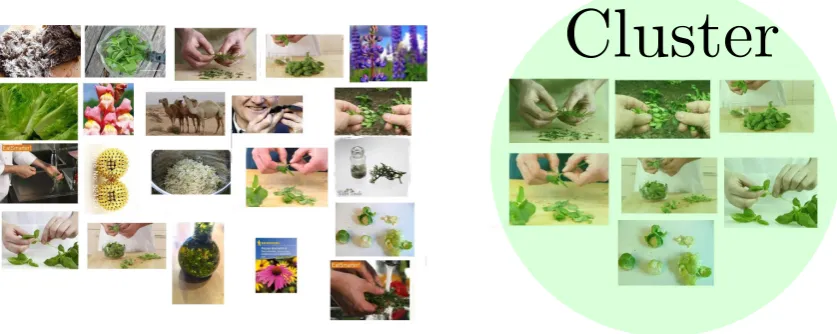
(a) Complete set of images.
Cluster
[image:2.595.77.496.71.238.2](b) Images in largest cluster.
Figure 1: Clustering filter forabzupfen’to pick’.
stituents are nouns, e.g., Feuerwerk ‘fire works’ is composed of the nominal constituents Feuer
‘fire’ andWerk‘opus’. German particle verbs are complex verbs such asanstrahlen’beam/smile at’ which are composed of a separable prefix particle (such as an) and a base verb (such as strahlen
’beam/smile’). Both types of German MWEs are highly frequent and highly productive in the lexicon. In addition, the particles are notoriously ambiguous, e.g., an has a partitive meaning in
anbeißen ’take a bite’, a cumulative meaning in
anhäufen ’pile up’, and a topological meaning in anbinden ’tie to’ (Springorum, 2011). We rely on two existing gold standards annotated with compositionality ratings: GS-NN, a set of 868 German noun-noun compounds (Schulte im Walde et al., 2016b), and GS-PV, a set of 400 particle verbs across 11 particle types (Bott et al., 2016).
Multi-Modal Vector Space Models For the tex-tual representation we used two sets of embed-dings. Based onword2vec(Mikolov et al., 2013), we obtained both representations using the skip-gram architecture with negative sampling. The sets differ with respect to window size (5 vs. 10) and dimensionality (400 vs. 500). As corpus re-source we relied on the lemmatized version of the
DECOW14AX, a German web corpus containing 12 billion tokens (Schäfer and Bildhauer, 2012).
The visual features rely on images downloaded from thebingsearch engine, following Kiela et al. (2016). We queried 25 images per word, and
con-verted all images into high-dimensional numerical representations by using the caffe toolkit (Jia et al., 2014) and pre-trained models. In the default set-ting, a word is represented in the visual space by the mean vector of its 25 image representations. As image-recognition neural network models, we used: (i) GoogLeNet (Szegedy et al., 2015), a 22-layer deep network; we obtained vectors by using the value of the last layer before the final softmax, containing 1024 elements (= dimensionality). (ii) AlexNet (Krizhevsky et al., 2012), a neural net-work with five convolutional layers (4,096-dim).
The multi-modal representations were com-bined by applying mid-fusion between textual and visual representation, i.e., concatenation of the L2-normalized representations (Bruni et al., 2014)1
3 Experiments
Predicting Compositionality For the prediction of compositionality, we represented the mean-ings of the multi-word expressions and their con-stituent words by textual, visual and textual+visual (i.e., multi-modal) vectors. The similarity of a compound–constituent vector pair as measured by the cosine was taken as the predicted degree of compound–constituent compositionality, and the overall ranking of pair similarities was compared to the gold standard compositionality ratings us-ing Spearman’s Rank-Order Correlation Coeffi-cientρ(Siegel and Castellan, 1988).
1Experiments with other fusion techniques showed that
GS-NN (heads) 0.50
0.55 0.60 0.65 0.70
0.65 0.67
0.63 0.64 0.64
Sp
earmans
ρ Text
Text+Vision DispFilter ImgFilter ClusterImgFilter
GS-PV 0.10
0.15 0.20 0.25 0.30
0.22
0.21 0.22 0.27
[image:3.595.84.523.66.194.2]0.25
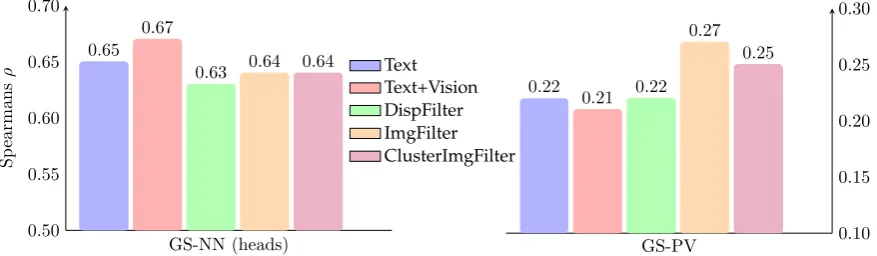
Figure 2: Overall prediction of compositionality for GS-NN (heads) and GS-PV.
Lexical, Empirical and Visual Filters The ex-periments compare the predictions of composi-tionality across all targets in the gold standards.2
Furthermore, we zoom into factors that might in-fluence the quality of predictions: (A) theimpact of lexical and empirical target properties, i.e., ambiguity (relying on the DUDEN dictionary3,
frequency (as provided by the gold standards), ab-stractness and imageability (as taken from Köper and Schulte im Walde (2016)); (B) optimisation of the visual space: (i) In accordance with hu-man concept processing (Paivio, 1990), including image representations should be more useful for words which are visual. We therefore apply the
dispersion-based filter suggested by Kiela et al. (2014). The filter decides whether to include per-ceptual information for a specific word or not, re-lying on a pairwise similarity between all images of a concept. The underlying idea is that highly visual concepts are visualised by similar pictures and thus trigger a high average similarity between the word’s images. Abstract concepts, on the other hand, are expected to provide a lower dispersion. For a given word, the filter decides about using only the textual representation, or both the textual and visual representations, depending on the dis-persion value and a predefined threshold (set to the median of all the dispersion values). (ii) We apply animageability filterbased on external imageabil-ity norms (Köper and Schulte im Walde, 2016), to successively include only images for the most imaginable target words. This filter is applied in the same way as dispersion. (iii) We suggest a novelclustering filter, that performs a clustering of the 25 images for a given concept, using the
algo-2We focus on the model with window 5 and 500
dimen-sions, and GoogLeNet as the overall best approach.
3www.duden.de
rithm from Apidianaki (2010), and includes only images from the largest image cluster, cf. Figure 1.
Results and Discussion Figure 2 present the prediction results for the two gold standards, GS-NN and GS-PV. For GS-GS-NN, we focus on predict-ing the compositionality for compound–head pairs (ignoring compound–modifier pairs), in order to have a more parallel setup to GS-PV, where the particle verb compositionality focuses on the con-tribution of the base verb. The figures show the re-sults across all targets. Note that the vertical axis, showing the range of Spearman’s ρ are different for both results.
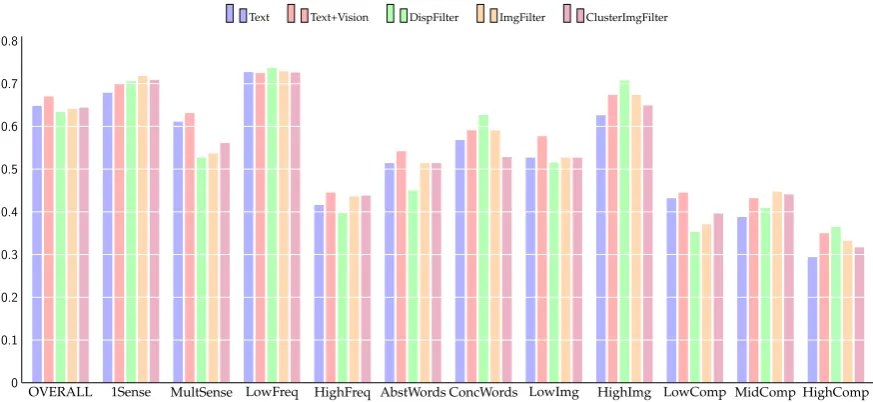
Figures 3 and 4 zoom into target subsets re-garding target ambiguity (one sense vs. mul-tiple senses), frequency, abstractness vs. con-creteness, imageability, and compositionality. The bars refer to the textual model, the multi-modal model (including all images for all targets), and the best results obtained when using the disper-sion/imageability/clustering4filters.
The plots demonstrate that overall the multi-modal model provides only a tiny gain for GS-NN in comparison to the text-only model, which is however significant using Steiger’s test (p <
0.001) (Steiger, 1980). All filters worsen the re-sults. For GS-PV, we also obtain a significant improvement by the multi-modal model, but only when applying the imageability or the clustering filter to the visual information. The main differ-ences in the overall noun and verb results are em-phasised in Figure 5, comparing the successive in-crease of images to the multi-modal model in com-parison to the textual model, based on the disper-sion and imageability filters. Note that the textual 4For the clustering filter, we focus on a combination with
OVERALL 1Sense MultSense LowFreq HighFreq AbstWords ConcWords LowImg HighImg LowComp MidComp HighComp
0 0.1 0.2 0.3 0.4 0.5 0.6 0.7 0.8
[image:4.595.82.519.86.287.2]Text Text+Vision DispFilter ImgFilter ClusterImgFilter
Figure 3: Prediction of compositionality for GS-NN heads.
OVERALL 1Sense MultSense LowFreq MidFreq HighFreq AbstWordsConcWords LowImg HighImg LowComp MidComp HighComp
−0.1
−0.05 0 0.05 0.1 0.15 0.2 0.25 0.3 0.35
[image:4.595.89.520.338.526.2]Text Text+Vision DispFilter ImgFilter ClusterImgFilter
Figure 4: Prediction of compositionality for GS-PV.
0 % 20 % 40 % 60 % 80 % 100 %
0.62 0.64 0.66 0.68
Sp
earman‘s
ρ
GS-NN (heads)
Text DispFilter ImgFilter
(Only Text) (Always T+V) 0 % 20 % 40 % 60 % 80 % 100 %
0.20 0.22 0.24 0.26 0.28
Sp
earman‘s
ρ
GS-PV
Text DispFilter ImgFilter
(Only Text) (Always T+V)
[image:4.595.81.522.590.709.2]model baselines are very different for the two gold standards, ρ = .65 for GS-NN and ρ = .22 for GS-PV. Regarding the nouns, the multi-modality improves the textual modality when adding the im-ages for the ≈35% most imaginable words, and when adding all images. Regarding the verbs, the multi-modality improves the textual modality in most proportions, reaching its maximum when adding images for ≈80% of the most imaginable verbs; when adding the ≈10% of the least imag-inable verbs, the model strongly drops in its per-formance. For the dispersion filter, the tendencies are less clear. We conclude that the visual infor-mation adds to the textual inforinfor-mation either by adding all (potentially noisy) images because the textual information is rich by itself; or by adding a selection of images (unless they are overly dissim-ilar to each other, or for non-imaginable targets), because the textual information by itself is poor.
Zooming into target subsets, the predictions for monosemous targets are better than those for am-biguous targets (significant for GS-NN), see Fig-ure 3; ditto for low-frequency vs. high-frequency targets. Taking frequency as an indicator of am-biguity, these differences are presumably due to the difficulty of distinguishing between multiple senses in vector spaces that subsume the features of all word senses within one vector, which applies to our textual and multi-modal models.
The gold standard predictions strongly differ re-garding the influence of target abstractness, im-ageability and compositionality. For GS-NN, the compositionality of concrete and imaginable tar-gets is predicted better than for abstract and less imaginable targets, as one would expect and has been shown by Kiela et al. (2014); for GS-PV, the opposite is the case. Similarly, while for GS-NN highly compositional targets are predicted worse than low- and mid-compositional targets, for GS-PV mid-compositional targets are predicted much worse than low- and high-compositional targets. These differences in results point to questions that have still been unsolved across research fields: while humans can easily grasp intuitions about the abstractness, imageability and compositionality of nouns, the categorisations are difficult to define for verbs (Glenberg and Kaschak, 2002; Brysbaert et al., 2014). Particle verbs add to this complexity, especially since compositionality (rating) is typi-cally reduced to the semantic relatedness between the complex verb and the base verb, ignoring the
particle that however contributes a considerable portion of meaning to the complex verb.
4 Conclusion
The paper demonstrated strong differences in the effect of adding visual information to a textual neural network model, when predicting the com-positionality for nominal vs. verbal MWE targets. The visual modality adds complementary features in cases where (a) the textual modality performs poorly, and images of the most imaginable tar-gets are added, or (b) the textual modality per-forms well, and all available –potentially noisy– images are added. Image filters relying on image-ability and a novel clustering filter positively affect the verbal but not the nominal perceptual feature spaces.
Acknowledgments
The research was supported by the DFG Col-laborative Research Centre SFB 732 (Maximil-ian Köper) and the DFG Heisenberg Fellowship SCHU-2580/1 (Sabine Schulte im Walde).
References
Marianna Apidianaki. 2010. An Algorithm for Cross-lingual Sense Clustering tested in a MT Evaluation
Setting. In Proceedings of the 7th International
Workshop on Spoken Language Translation, pages 219–226, Paris, France.
Timothy Baldwin. 2005. Deep Lexical Acquisition of
Verb–Particle Constructions.Computer Speech and
Language, 19:398–414.
Collin Bannard. 2005. Learning about the Meaning of
Verb–Particle Constructions from Corpora.
Com-puter Speech and Language, 19:467–478.
Marco Baroni, Georgiana Dinu, and Germán
Kruszewski. 2014. Don’t count, predict! A
Systematic Comparison of Context-counting and
Context-predicting Semantic Vectors. In
Proceed-ings of the 52nd Annual Meeting of the Association for Computational Linguistics, pages 238–247, Baltimore, MD.
Stefan Bott and Sabine Schulte im Walde. 2014. Opti-mizing a Distributional Semantic Model for the Pre-diction of German Particle Verb Compositionality. InProceedings of the 9th International Conference on Language Resources and Evaluation, pages 509– 516, Reykjavik, Iceland.
to Predict the Compositionality of German
Parti-cle Verbs. In Proceedings of the 11th Conference
on Computational Semantics, pages 34–39, London, UK.
Stefan Bott, Nana Khvtisavrishvili, Max Kisselew, and
Sabine Schulte im Walde. 2016. Ghost-PV: A
Rep-resentative Gold Standard of German Particle Verbs. InProceedings of the 5th Workshop on Cognitive As-pects of the Lexicon, pages 125–133, Osaka, Japan. Elia Bruni, Nam Khanh Tran, and Marco Baroni. 2014.
Multimodal Distributional Semantics. Journal of
Artificial Intelligence Research, 49(1):1–47. Marc Brysbaert, Amy Beth Warriner, and Victor
Ku-perman. 2014. Concreteness Ratings for 40
Thou-sand generally known English Word Lemmas.
Be-havior Research Methods, 64:904–911.
John A. Bullinaria and Joseph P. Levy. 2007. Ex-tracting Semantic Representations from Word
Co-Occurrence Statistics: A Computational Study.
Be-havior Research Methods, 39(3):510–526.
Lev Finkelstein, Evgeniy Gabrilovich, Yossi Matias, Ehud Rivlin, Zach Solan, Gadi Wolfman, and Ey-tan Ruppin. 2002. Placing Search in Context: The
Concept Revisited. ACM Transactions on
Informa-tion Systems, 20(1):116–131.
Arthur M. Glenberg and Michael P. Kaschak. 2002.
Grounding Language in Action. Psychonomic
Bul-letin & Review, 9(3):558–565.
Zellig Harris. 1954. Distributional structure. Word,
10(23):146–162.
Felix Hill, Roi Reichart, and Anna Korhonen. 2015. SimLex-999: Evaluating Semantic Models With
(Genuine) Similarity Estimation. Computational
Linguistics, 41(4):665–695.
Yangqing Jia, Evan Shelhamer, Jeff Donahue, Sergey Karayev, Jonathan Long, Ross Girshick, Sergio Guadarrama, and Trevor Darrell. 2014. Caffe: Con-volutional architecture for fast feature embedding. In Proceedings of the International Conference on Multimedia, pages 675–678, New York, NY, USA. Douwe Kiela, Felix Hill, Anna Korhonen, and Stephen
Clark. 2014. Improving Multi-Modal Representa-tions Using Image Dispersion: Why Less is
Some-times More. In Proceedings of the 52nd Annual
Meeting of the Association for Computational Lin-guistics, pages 835–841, Baltimore, MA.
Douwe Kiela, Anita L. Ver˝o, and Stephen Clark. 2016. Comparing Data Sources and Architectures for Deep Visual Representation Learning in Semantics. In
Proceedings of the Conference on Empirical Meth-ods in Natural Language Processing, Austin, TX. Maximilian Köper and Sabine Schulte im Walde.
2016. Automatically Generated Affective Norms of Abstractness, Arousal, Imageability and Valence
for 350 000 German Lemmas. In Proceedings
of the 10th International Conference on Language Resources and Evaluation, pages 2595–2598, Por-toroz, Slovenia.
Alex Krizhevsky, Ilya Sutskever, and Geoffrey E. Hin-ton. 2012. ImageNet Classification with Deep Con-volutional Neural Networks. In F. Pereira, C. J. C. Burges, L. Bottou, and K. Q. Weinberger, editors,
Advances in Neural Information Processing Systems
25, pages 1097–1105.
Angeliki Lazaridou, Nghia The Pham, and Marco Ba-roni. 2015. Combining Language and Vision with
a Multimodal Skip-gram Model. InProceedings of
the Conference of the North American Chapter of the Association for Computational Linguistics: Hu-man Language Technologies, pages 153–163, Den-ver, Colorado, USA.
Omer Levy, Yoav Goldberg, and Ido Dagan. 2015. Improving Distributional Similarity with Lessons
Learned from Word Embeddings. Transactions of
Computational Linguistics, 3:211–225.
Tomas Mikolov, Ilya Sutskever, Kai Chen, Greg S. Cor-rado, and Jeff Dean. 2013. Distributed Representa-tions of Words and Phrases and their
Composition-ality. InAdvances in Neural Information Processing
Systems 26, pages 3111–3119.
Kim-Anh Nguyen, Sabine Schulte im Walde, and Thang Vu. 2016. Integrating Distributional Lexi-cal Contrast into Word Embeddings for
Antonym-Synonym Distinction. In Proceedings of the 54th
Annual Meeting of the Association for Computa-tional Linguistics, pages 454–459, Berlin, Germany.
A. Paivio. 1990. Mental Representations: A Dual
Coding Approach. Oxford Psychology Series. Ox-ford University Press.
Siva Reddy, Diana McCarthy, and Suresh Manandhar. 2011. An Empirical Study on Compositionality in
Compound Nouns. In Proceedings of the 5th
In-ternational Joint Conference on Natural Language Processing, pages 210–218, Chiang Mai, Thailand. Bahar Salehi and Paul Cook. 2013. Predicting the
Compositionality of Multiword Expressions Using
Translations in Multiple Languages. InProceedings
of the 2nd Joint Conference on Lexical and Compu-tational Semantics, pages 266–275, Atlanta, GA. Bahar Salehi, Paul Cook, and Timothy Baldwin. 2014.
Using Distributional Similarity of Multi-way Trans-lations to Predict Multiword Expression
Composi-tionality. InProceedings of the 14th Conference of
the European Chapter of the Association for Com-putational Linguistics, pages 472–481, Gothenburg, Sweden.
Roland Schäfer and Felix Bildhauer. 2012. Building Large Corpora from the Web Using a New Efficient
Tool Chain. InProceedings of the 8th International
Sabine Schulte im Walde, Stefan Müller, and Stephen Roller. 2013. Exploring Vector Space Models to Predict the Compositionality of German Noun-Noun
Compounds. InProceedings of the 2nd Joint
Con-ference on Lexical and Computational Semantics, pages 255–265, Atlanta, GA.
Sabine Schulte im Walde, Anna Hätty, and Stefan Bott. 2016a. The Role of Modifier and Head Properties in Predicting the Compositionality of English and Ger-man Noun-Noun Compounds: A Vector-Space
Per-spective. InProceedings of the 5th Joint Conference
on Lexical and Computational Semantics (*SEM), pages 148–158, Berlin, Germany.
Sabine Schulte im Walde, Anna Hätty, Stefan Bott, and
Nana Khvtisavrishvili. 2016b. Ghost-NN: A
Rep-resentative Gold Standard of German Noun-Noun
Compounds. In Proceedings of the 10th
Interna-tional Conference on Language Resources and Eval-uation, pages 2285–2292, Portoroz, Slovenia.
Sidney Siegel and N. John Castellan. 1988.
Non-parametric Statistics for the Behavioral Sciences. McGraw-Hill, Boston, MA.
Carina Silberer and Mirella Lapata. 2014. Learn-ing Grounded MeanLearn-ing Representations with
Au-toencoders. In Proceedings of the Annual
Meet-ing of the Association for Computational LMeet-inguis-
Linguis-tics, pages 721–732, Baltimore, Maryland.
Sylvia Springorum. 2011. DRT-based Analysis of the
German Verb Particle "an". Leuvense Bijdragen,
97:80–105.
James H Steiger. 1980. Tests for Comparing Elements
of a Correlation Matrix. Psychological Bulletin.
Christian Szegedy, Wei Liu, Yangqing Jia, Pierre Sermanet, Scott Reed, Dragomir Anguelov, Du-mitru Erhan, Vincent Vanhoucke, and Andrew Ra-binovich. 2015. Going Deeper with Convolutions. InComputer Vision and Pattern Recognition. Peter D. Turney and Patrick Pantel. 2010. From
Fre-quency to Meaning: Vector Space Models of
Se-mantics. Journal of Artificial Intelligence Research,