Optimization of the magnetic properties of nanostructured Y-Co-Fe alloys for
permanent magnets
P. Tozman, M. Venkatesan, and J. M. D. Coey
Citation: AIP Advances 6, 056016 (2016); doi: 10.1063/1.4944071
View online: http://dx.doi.org/10.1063/1.4944071
View Table of Contents: http://aip.scitation.org/toc/adv/6/5
Optimization of the magnetic properties of nanostructured
Y-Co-Fe alloys for permanent magnets
P. Tozman, M. Venkatesan, and J. M. D. Coey
School of Physics and CRANN, Trinity College, Dublin 2, Ireland
(Presented 15 January 2016; received 20 November 2015; accepted 4 January 2016; published online 10 March 2016)
The structural and magnetic properties of ball-milled Fe-doped YCo5−xFex(0≤x
≤0.5) were investigated. The magnetization increases with Fe-doping up to the solid solubility limit, x=0.3 without destroying the crystal structure or degrad-ing the coercivity. A special magnet array is designed usdegrad-ing rdegrad-ing magnets for pressing the powders under magnetic field in order to achieve magnetic align-ment. A dramatic increase in magnetization is observed for magnetically aligned YCo4.8Fe0.2 pressed ingots. C 2016 Author(s). All article content, except where
otherwise noted, is licensed under a Creative Commons Attribution 3.0 Unported License.[http://dx.doi.org/10.1063/1.4944071]
I. INTRODUCTION
Permanent magnets are used in many applications in the electric, computer, green energy, auto-motive and domestic areas.1–3The main concern in the material choice is the energy product, which
quantifies the ability of the magnet to store magnetostatic energy and create flux in the surround-ing space.4 Improving extrinsic and intrinsic properties by nanostructuring and atomic
structur-ing (crystal structure, composition) is the way to maximize the energy product.5 The maximum
possible value (BH)MAX=1/4 µ0Ms2 is reached with a demagnetization factor N =1/2. It can be
approximated with a compact cylindrical magnet with height equal to radius (r≈h) that exhibits a rectangular M(H)loop. For thisHcmust be greater than Ms/2 where Msis related to the intrinsic
atomic and crystal structure and Hcoriginates from the magnetic anisotropyK. Typically its value
will not exceed 25% of the anisotropy field Ha=2K/µ0Ms.4,6Furthermore, Hcdepends on grain
size, microscopic defects and the thermal history of a sample. Usually it is inversely related to the grain size, and large coerciviy is obtained when the crystallites are small and single-domain.7This
can be understood by considering that smaller grains have fewer potential nucleation centres. In the case of sintered Nd-Fe-B magnets, coercivity is proportional to the inverse square root of the grain size.8Another way to maximize the energy product is to induce a texture to enhance the remanence
Mrby aligning the particles’ easy axes or by pressing the aligned powder to high density in order to
approachMrtoMs.7,9These will increase the ratioMr/Ms, which is≈0.5 for isotropically oriented,
magnetically uniaxial and non-interacting single domain particles.7
The challenge here is produce an optimized permanent magnets taking care of all the require-ments discussed above. Vacuum annealed and magnetically aligned YCo4.8Fe0.2 dry ball-milled
powder is a good candidate starting material with a 140 kJ/m3 maximum energy product for the
powder.10However the reproducibility of these ball-milled powders with controlled structure and
grain size distribution is important for large-scale production. Various effects such as the milling method, container, speed, time, powder to balls weight ratio for high-energy ball miling, extent of filling the milling vial, milling atmosphere and temperature all influence the milling process. The optimum grain size for maximum energy product can be obtained by thermal treatment to eliminate the defects associated with plastic deformation induced during milling.11,12
In this work, we will discuss the effect of rapid thermal annealing and vacuum annealing on grain size, crystal structure and magnetic properties of Fe- doped YCo5 ball-milled powders and
the reproducibility of ball-milling of YCo4.8Fe0.2. Also, pressing the powders with and without
056016-2 Tozman, Venkatesan, and Coey AIP Advances6, 056016 (2016)
magnetic field will be investing in order to obtain a hard magnet which will be in the gap between oriented ferrite (34 kJ/m3) and Nd-Fe-B (350 kJ/m3).
II. EXPERIMENT
YCo5−xFex(0≤x≤0.5)alloys were prepared by arc melting in high-purity argon. The ingots
were melted four times to ensure homogeneity. Milling was carried out under an Ar atmosphere for 4 h in a Spex 8000 mixer/mill with stainless steel balls and a ball to powder charge ratio of 15:1, which gives the highest maximum energy product of YCo5in the litterature.13The as-milled YCo5
powder was wrapped in Ta foil and then subjected to rapid thermal annealing under flowing Ar with an infrared lamp (Ulvac-Riko MILA-5000) at temperatures (Ta) between 800◦C and 1050◦C for
1–5 min and then cooled naturally. The iron-doped YCo5−xFex0≤x≤0.5 powder samples were
rapidly annealed at 800◦C for only 1-3 min in order to find best magnetic properties. Alternatively,
these samples were annealed in a tube furnace preheated at 800 and 850◦C for 2-3 minutes under
a vacuum of 10−6-10−7Torr, followed by quenching. Several ball-milled YCo
4.8Fe0.2powders were
prepared in order to investigate the reproducibility. The vacuum annealed YCo4.8Fe0.2 powders
were pressed in a 3 mm die with tungsten carbide pistons with and without applied field. Structural characterization was carried out by X-ray diffraction (XRD) with a PANalytical X’Pert Pro diff rac-trometer using Cu-Kαradiation. Rietveld analysis of the diffraction patterns was performed using
FullProf. The microstructure and composition were analysed with a scanning electron microscope (SEM Carl Zeiss Evo) for magnetically aligned ball-milled powder after vacuum annealing at 850◦C for 2 min. Powder samples for room temperature magnetic measurements were prepared by mixing the annealed powder with Lecoset 7007 cold-curing resin inside a 4 mm×4 mm cylindrical Perspex bucket and for pressed ingots, sample pieces were firmly placed between two gel caps. Some pow-ders were oriented in a 5 T field and all the magnetic measurements were carried out using a 5 T Quantum Design superconducting quantum interference device magnetometer.
III. RESULTS AND DISCUSSION
A. Ball-milled YCo5
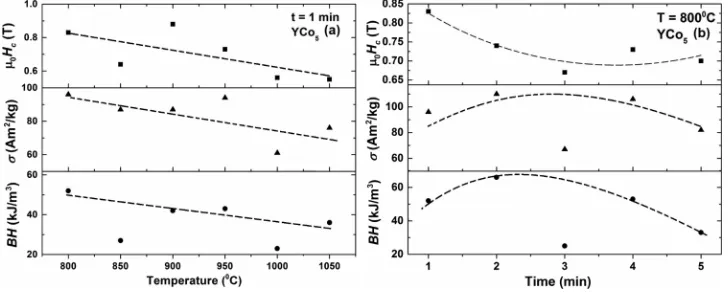
Achieving the optimum grain size is important in order to obtain highest coercivity. Grain size can be controlled by ball-milling time, powder to ball ratio, annealing temperature and annealing time. Rapid thermal annealing, heating the sample to high temperature in a few seconds at a heating rate 50◦C/sec, has been used.14–16Fig.1shows the influence of rapid thermal annealing temperature
and time on (BH)max,σmax andµ0Hcat room temperature. The highest value of µ0Hc, 0.88 T is
obtained for a sample annealed at 900◦C for 1 min. However
[image:3.594.116.480.560.706.2](BH)max=52 kJ/m3is obtained after
annealing at 800◦C for 1 min. Further increase of the annealing temperature leads to a drop in
(BH)max.
Increasing the annealing time decreases the maximum energy product overall and the maximum value of 66 kJ/m3is obtained for a 2 min annealed samples. Increasing the annealing time creates a step in demagnetization curve due to a small amount of a secondary soft ferromagnetic Y2Co17
phase which indicates ineffective exchange coupling and is unfavorable for energy product.17,18
B. Ball- milled Fe- doped YCo5
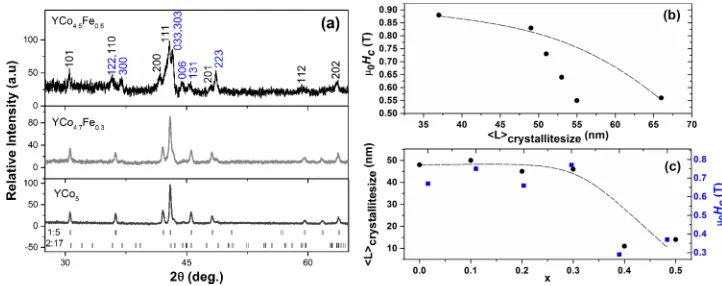
The XRD patterns of rapidly thermal annealed (800◦C for 3 min) YCo5−xFexfor 0≤x≤0.5
show that the main phase has the hexagonal CaCu5structure (P6/mmm) with a secondary
rhombo-hedral Th2Zn17phase (R3m). The secondary phase (300), (303), (006) and (223) peaks are separated
from the main phase for x=0 but they overlap with main phase with increasing Fe-doping. After reaching the solid solubility limit (x=0.3), the amount of the secondary phase increases as shown in Fig.2(a).
Grain growth controls the coercivity by annealing and grain size effect. Coercivity of rapid thermally annealed (800◦C -1050◦C for 1 min) YCo
5powders is proportional to the inverse of the
crystallite size<L>, computed from Scherrer broadening (Fig.2(b)), as it is for Nd-Fe-B magnets.8
On the other hand, the crystallite size and coercivity have the same dependence on Fe-doping x. After the solid solubility limit, the crystallite size and coercivity drop dramatically due to the increase of the amount of secondary phase.
The hysteresis curves show same trend up to x=0.3 after rapid thermal annealing at 800◦C for 1-3 min. However beyond x=0.3 the saturation magnetization increases, and coercivity decreases due to exchange coupling between soft (<L>≈25 nm) and hard (<L>≈15 nm) phases, which makes the demagnetizing curve more convex (Fig.3(a)).
Rapid thermal annealing of Fe-doped YCo5at 800◦C for 1 to 3 min decreases the coercivity
due to a decrease of anisotropy constant K1 and it increases saturation magnetization due to
presence of Fe.19 Maximum energy product was deduced assuming the crystallographic density
ρ=7560 kg m−3andN =1/3 for for rapid thermally annealed spherical ball-milled powders of
Fe-doped YCo5(800◦C for 1-3 min). In Fe-doped YCo5 samples up to the solid solubility limit
x=0.3, the maximum energy product is enhanced dramatically by magnetically aligning the pow-ders’ [001] easy axes, as is illustrated in Fig.3(b). The annealing time didn’t influence the energy product for x=0.1 and x=0.3, and the maximum energy product is obtained for 2 min rapid thermal annealing.
FIG. 2. (a) XRD pattern for ball-milled rapid thermal annealed at 800◦C for 3 min powders of YCo
5, YCo4.7Fe0.3and
YCo4.5Fe0.5. (b) The coercivity dependence on crystallite size for YCo5samples rapid thermally annealed from 800◦C to
1050◦C for 1 min and (c) crystallite size and coercivty dependence on Fe-doping x for rapid thermally annealed YCo5−xFex
[image:4.594.114.475.543.686.2]056016-4 Tozman, Venkatesan, and Coey AIP Advances6, 056016 (2016)
FIG. 3. (a) Room temperature hysteresis curves for rapid thermal annealed at 800◦C for 3 min YCo5, YCo4.7Fe0.3and (b)
maximum energy dependence on Fe-doping x for rapid thermal annealing samples in 1-3 min.
SEM images of spherical powders magnetically aligned under 1.2 T show that they are well aligned in the direction of applied field (Fig.4(a)) like SmCo5flakes.20The highest maximum
en-ergy product is obtained for YCo4.8Fe0.2after vacuum annealed at 850◦C for 2min.10The coercivity
of YCo5decreases from 0.99 T to 0.77 T with decreasing the temperature from 850◦C to 800◦C for
2 min. We successfully reproduced vacuum annealed YCo4.8Fe0.2(850◦C for 2 min) in 15 different
ball-milling process. The average coercivity and maximum magnetization are obtained 0.81 T and 100 Am2/kg respectively.
C. Pressed magnets
The powder of vacuum annealed YCo4.8Fe0.2powder was pressed into pellets using tungsten
carbide pistons with 84% and 66% of crystallographic density, without and with the 0.4 T applied field. The field is obtained with using seven NdFeB N52 magnet rings and one NdFeB Magnet N40 magnet cap with axial magnetization direction through the 3 mm and 10 mm bores, respectively, as is shown in Fig.4(b). This array was simulated by the MANIFEST program and the maximum field, 0.4 T is found for 15 mm ring height. The maximum energy product of powder ingot, pressed under magnetic field, is 61 kJ/m3(forN =1/2;ρ=5000 kg/m3; 66% of density andµ
0H=0.4 T) and it
increases from 52 kJ/m3(forN =1/2;ρ=6337 kg/m3; 84% of density andµ
0H=0). The increase
in maximum energy product can be attributed to the enhancement in magnetization (≈30%) under magnetic field alignment. Density of the field-aligned magnet was limited by the fragility of the tungsten pistons, but it should be quite possible to achieve higher values for denser magnets under magnetic field.
FIG. 4. (a) SEM image of vacuum annealed (850◦C for 2 min) and magnetically aligned YCo
4.8Fe0.2where arrow indicates
the field direction. (b) Magnet array around and top of die in order to obtain 0.4 T field in downward direction. (c) Hysteresis of vacuum annealed (850◦C, 2 min) pressed magnet YCo
[image:5.594.122.479.89.234.2] [image:5.594.115.480.584.695.2]IV. CONCLUSION
We successfully optimized the conditions to produce Y-Co-Fe powders and magnets. Iron substitution in YCo5up to x=0.3 increases the saturation magnetization by around 30% without
any deterioration of coercivity. Magnetization is dramatically improved up to 30% in magnets produced by pressing the anisotropic powders under a magnetic field produced by a specially de-signed magnet array. A maximum energy product of 61 kJ/m3, has been achieved in a magnet with
66% density and it should be quite possible to enhance(BH)maxwell over 100 kJ/m3in optimized
fully-dense magnets.
This work was supported by the EU FP7 ROMEO Project.
1I. A. Anderson, S. Constantinidies, M. J. Kramer, and R. W. McCallum,JOM64, 752 (2012).
2P. McGuiness, O. Akdogan, A. Asali, S. Bance, F. Bittner, J. M. D. Coey, N. M. Dempsey, J. Fidler, D. Givord, O. Gutfleisch,
M. Katter, D. Le Roy, S. Sanvito, T. Schrefl, L. Schultz, C. Schwöbl, M. Soderžnik, S. Šturm, P. Tozman, K. Üstüner, M. Venkatesan, T. G. Woodcock, K. Žagar, and S. Kobe,JOM67, 1306 (2015).
3J. M. D. Coey,Scripta Mater.67, 524 (2102).
4R. Skomski and J. M. D. Coey,Scripta Mater.112, 3 (2016).
5R. Skomski, P. Manchanda, P. Kimar, B. Balamurugan, A. Kashyap, and D. J. Sellmyer,IEEE Trans. Magn.49, 3215 (2013). 6J. M. D. Coey,IEEE Trans. Magn47, 4671 (2011).
7O. Gutfleisch, A. Bollero, A. Handstein, D. Hinz, A. Kirchner, A. Yan, K.-H. Müller, and L. Schultz,J. Magn. Magn. Mater.
242, 1277 (2002).
8R. Ramesh, G. Thomas, and B.M. Ma,J. Appl. Phys.64, 6416 (1988).
9B. Balamurugan, D. J. Sellmyer, G. C. Hadjipanayis, and R. Skomski,Scripta Mater.67, 542 (2012). 10P. Tozman, M. Venkatesan, G. A. Zickler, J. Fidler, and J. M. D. Coey,Appl. Phys. Lett.107, 032405 (2015). 11C. Suryanarayana,Prog. Mater. Sci.46, 1 (2001).
12M. Ullah, E. Ali, and S. B. A. Hamid, Rev. Adv. Mater. Sci.37, 1 (2013).
13N. Tang, Z. Chen, Y. Zhang, G. C. Hadjipanayis, and F. Yang,J. Magn. Magn. Mater.219, 173 (2000). 14K. Yano, V. Nandwana, N. Poudyol, C. B. Rong, and J. P. Liu,J. Appl. Phys.104, 013918 (2008). 15Z. Q. Jin, B. Z. Cui, J. P. Liu, Y. Ding, Z. L. Wang, and N. N. Thandhani,Appl. Phys. Lett.84, 4382 (2004). 16Z. Q. Jin and J. P. Liu,J. Phys. D: Appl. Phys.39, R227 (2006).
17J. T. Elizalde Galindo, C. E. Botez, F. Rivera Gomez, and J. A. Matutes Aquino,Phys. Lett. A366, 110 (2007). 18E. F. Kneller and R. Hawig,IEEE Trans. Magn.27, 3588 (1991).