INVESTIGATION
The Phenotypic Plasticity of Duplicated Genes in
Saccharomyces cerevisiae
and the Origin
of Adaptations
Florian Mattenberger,*,1Beatriz Sabater-Muñoz,*,†,1Christina Toft,‡,§and Mario A. Fares*,†,2
*Department of Abiotic Stress, Instituto de Biología Molecular y Celular de Plantas, Consejo Superior de Investigaciones Científicas, Universidad Politécnica de Valencia, 46022 Spain,†Department of Genetics, Smurfit Institute of Genetics, University of Dublin, Trinity College, Dublin 2, Ireland,‡Department of Genetics, University of Valencia, 46100 Burjassot, Spain, and§Departamento de Biotecnología, Instituto de Agroquímica y Tecnología de los Alimentos, Consejo Superior de Investigaciones Científicas, Valencia, 46980 Paterna, Spain
ORCID IDs: 0000-0002-2727-0284 (F.M.); 0000-0002-0301-215X (B.S.-M.); 0000-0003-1714-6703 (C.T.); 0000-0002-4345-3013 (M.A.F.)
ABSTRACT Gene and genome duplication are the major sources of biological innovations in plants and animals. Functional and transcriptional divergence between the copies after gene duplication has been considered the main driver of innovations . However, here we show that increased phenotypic plasticity after duplication plays a more major role than thought before in the origin of adaptations. We perform an exhaustive analysis of the transcriptional alterations of duplicated genes in the unicellular eukaryote Sac-charomyces cerevisiae when challenged withfive different environmental stresses. Analysis of the tran-scriptomes of yeast shows that gene duplication increases the transcriptional response to environmental changes, with duplicated genes exhibiting signatures of adaptive transcriptional patterns in response to stress. The mechanism of duplication matters, with whole-genome duplicates being more transcriptionally altered than small-scale duplicates. The predominant transcriptional pattern follows the classic theory of evolution by gene duplication; with one gene copy remaining unaltered under stress, while its sister copy presents large transcriptional plasticity and a prominent role in adaptation. Moreover, we find additional transcriptional profiles that are suggestive of neo- and subfunctionalization of duplicate gene copies. These patterns are strongly correlated with the functional dependencies and sequence divergence profiles of gene copies. We show that, unlike singletons, duplicates respond more specifically to stress, supporting the role of natural selection in the transcriptional plasticity of duplicates. Our results reveal the underlying transcriptional complexity of duplicated genes and its role in the origin of adaptations.
KEYWORDS evolutionary
biology gene function small-scale
duplicates whole-genome
duplicates transcriptional
profiles
Gene duplication has been a major driving force of biological innovation in plants (Cuiet al.2006; Carretero-Paulet and Fares 2012; Holub 2001; Lespinetet al.2002; Otto and Whitton 2000; Wendel 2000; Kimet al.
2004) and animals (Otto and Whitton 2000; Hoegg et al. 2004). Arguably, understanding how gene duplication gives origin to novel functions and adaptations is a fundamental aim of evolutionary biology. The functional and transcriptional divergence between the gene copies of a duplicated gene has been proposed to facilitate the origin of novel functions (Conant and Wolfe 2008; Lynch and Conery 2000; Ohno 1999, 1970). However, the tempo and mode of each divergence kind and the interplay between both remains largely unexplored.
Ohno proposed that after the duplication of a gene, the emerging genetic redundancy leads to relaxed selection against one of the gene copies while the other copy remains under strong purifying selection (Ohno 1970, 1999). The selectively relaxed gene copy explores novel genotypes, many of which will be deleterious and lead to the loss of the rapidly evolving gene copy (Lynch and Conery 2003). A less likely Copyright © 2017 Mattenbergeret al.
doi: 10.1534/g3.116.035329
Manuscript received September 7, 2016; accepted for publication October 23, 2016; published Early Online October 31, 2016.
This is an open-access article distributed under the terms of the Creative Commons Attribution 4.0 International License (http://creativecommons.org/ licenses/by/4.0/), which permits unrestricted use, distribution, and reproduction in any medium, provided the original work is properly cited.
Supplemental material is available online atwww.g3journal.org/lookup/suppl/ doi:10.1534/g3.116.035329/-/DC1.
1These authors contributed equally to this work.
2Corresponding author: Instituto de Biología Molecular y Celular de Plantas,
scenario is the preservation of both copies by purifying selection after a period of relaxed selection leading to novel functions in the form of sub- or neo-functionalization (Ohno 1970, 1999; Lynch and Conery 2003; Taylor and Raes 2004). Particular scenarios for this general model of the functional divergence of gene copies have been proposed (Des Marais and Rausher 2008; Forceet al.1999; Innan and Kondrashov 2010). Classic theory has also given credit to the expression divergence between gene copies as a prerequisite for the preservation of genes in duplicate and the eventualfinding of new functions (Ferris and Whitt 1979; Forceet al.1999; Ohno 1970). Moreover, previous studies have found a genome-wide transcriptional response of Saccharomyces cerevisiae to a wide range of environmental perturbations (Ferea
et al. 1999; Caustonet al.2001; Cormier et al.2010; Idekeret al.
2001; Landryet al.2006; Sternet al.2007).
The rapid evolution of gene expression after duplication (Liet al.
2005; Thompsonet al.2013) suggests an adaptive role for the tran-scriptional plasticity of duplicates. However, the question remains open whether duplicates follow the general response patterns to stresses that are shown by singleton genes or, alternatively, they have allowed the origin of stress-specific adaptations that have been favored by natural selection. It also remains obscure whether the transcriptional plasticity of duplicates has driven their functional specialization. Understanding this plasticity through studies like the one conducted here provides a much wider picture of the role of gene duplication in the origin of adaptations and ecological diversification.
Gene duplication in plants has been followed by rapid expression divergence between gene copies (Blanc and Wolfe 2004; Haet al.2007, 2009; Wanget al.2012). Since most duplicated genes are thought to mediate the interaction between the organism and environment, their expression changes have been suggested to be strongly linked to generating adaptations rather than responding to developmental perturbations (Haet al.2007). Most importantly, expression diver-gence has been seen to correlate with the sequence diverdiver-gence be-tween duplicate gene copies in plants (Blanc and Wolfe 2004) and, although less clearly (Wagner 2000a), in yeast (Guet al.2002). Two questions remain unexplored: (a) are duplicated genes more tran-scriptionally plastic than anticipated?; and (b) does transcriptional plasticity determine the functional fates of gene copies? Answering these questions would reveal the potential of gene duplicates to expedite adaptations.
The Baker’s yeast S. cerevisiae duplicated its genome roughly 100 MYA (Wolfe and Shields 1997) triggered by the possible hybrid-ization between different yeast species (Marcet-Houben and Gabaldon 2015; Wolfe 2015). Only 1120 pairs of duplicates have been retained, of which 554 belong to the whole-genome duplication event and the remaining are classified as duplications of small scale (Fareset al.
2013). Many of the yeast-duplicated genes enable the growth of
S. cerevisiaeunder stressful conditions, the genetic basis of which has enabled the exploitation of the biotechnological benefits of yeast in the multimillionaire wine industry. The genetic and bio-technological properties of this yeast offer a unique opportunity to study the role of gene duplication in innovation. In this study, we explore whether the transcriptional plasticity of duplicated genes in
S. cerevisiaehas contributed to the origin of adaptations to stress and functional specialization of duplicate gene copies. We address this question by exhaustively and extensively analyzing the expres-sion pattern dynamics of duplicated genes in the yeastS. cerevisiae
after subjecting it to a number of stress conditions. Here, wefind that not only duplicates are more transcriptionally polymorphic as concluded before (Haet al.2009) but that they are more transcrip-tionally plastic than singletons under environmental stress. This
transcriptional plasticity increases after gene duplication and it is strongly correlated with the functional divergence of duplicate gene copies. The study of the patterns of sequence divergence, functional interactions, and transcriptional plasticity of duplicates makes pos-sible the identification of stress-specific as well as general transcrip-tional response patterns. We show that, unlike singleton genes, duplicates have given origin to stress-specific adaptations. Our data describe a complex dynamic of transcriptional evolution following the gene and genome duplications of a simple eukaryotic organism and reveal the origins of yeast adaptations.
MATERIALS AND METHODS
Identification of duplicated genes
Paralog pairs of duplicated genes were identified as the resulting best reciprocal hits from all-against-all BLAST searches using BLASTP with an E-value cutoff of 1E-5 and a 50 bit score (Altschulet al.1997). Paralogs were then divided into two groups according to the mech-anism of their origin: whole-genome duplications (WGDs) and small-scale duplications (SSDs). WGDs are those extracted from the reconciled list provided by the Yeast Gene Order Browser (YGOB, http://wolfe.gen.tcd.ie//ygob; Byrne and Wolfe 2005) (555 pairs of genes), and these were not subjected to subsequent SSD. All other paralogs were considered to belong to the category of SSDs (560 pairs of genes). The duplicates used in this study have been estimated to have their origin on the time point of the WGD that took place 100 MYA (Wolfe and Shields 1997). Also, in this study we have used the SSDs that exhibit similar distribution of synonymous substitutions as those of WGDs, so roughly belonging to the same age (Fareset al.2013; Keaneet al.2014).
Sequence alignments and analysis of divergence
For each protein-coding gene ofS. cerevisiaewe searched for its ortholog in the closely related speciesS. paradoxususing the program blastP. Pairwise sequence alignments were built using the program ClustalW. To calculate the distance betweenS. cerevisiaeandS. paradoxusfor each of the genes, we estimated the number of nonsynonymous nucleotide substitutions per nonsynonymous site (dN), synonymous substitutions per synonymous site (dS), and the nonsynonymous-to-synonymous rates ratio (v= dN/dS) using the maximum-likelihood approach under the Goldman and Yang model (Goldman and Yang 1994) as imple-mented in the PAML package version 4.7 (Yang 2007).
Analysis of gene expression in S. cerevisiae
The transcriptomic profiling was performed in theS. cerevisiaeY06240 haploid msh2 deletion strain (BY4741; Mata; his3D1; leud2DO; met15DO; ura3DO; msh2::kanMX4) (Fares et al. 2013), with three technical replicates for each biological stress condition [3% lactic acid (YPL), 3% ethanol (YPE), 3% glycerol (YPG), 0.25 mM H2O2(YPOx), 0.25 mM H2O2+ 1.5% dextrose (YPOxD)] in comparison with the normal growth condition (Yeast extract, Peptone, Dextrose media). Total RNA extractions were performed with RNeasy kit (Qiagen) fol-lowing manufacturer instructions. Ribosomal RNA was removed using the Ribo-Zero Gold rRNA removal yeast (Illumina) depletion kit. Stranded RNA libraries were constructed using TruSeq stranded mRNA (Illumina) from oligo-dT captured mRNAs from depleted sam-ples. Libraries were run in NextSequation 500 (Illumina) at 75 nt single read using High Output 75 cycles kit v2.0 (Illumina).
Genomic core facility at Servicio Central de Soporte a la Investigación Experimental (SCSIE), University of Valencia, Spain. Raw reads were analyzed using FastQC report and cleaned with CutAdapt as implemented in RobiNA software package v 1.2.4 (Lohseet al.2012). Low-quality reads werefiltered and trimmed (Phred score,20 and size,40 nt were discarded). Since we had a reference transcriptome from S288c strain, reads were then aligned with Bowtie (up to two mismatches accepted) to the reference transcriptome (PRJNA290217) from the reference S288c strain. Statistical assessment of differential gene expression was done either with edgeR (Robinsonet al.2010) or with DESeq (Anders and Huber 2010) as implemented in RobiNA. A previous study compared the different expression analysis methods, concluding that edgeR and DESeq were the best-performing meth-ods when the objective is to analyze differential expression (Zhang
[image:3.603.49.553.60.287.2]et al.2014). Comparison of logarithmic fold-change of our expres-sion data between edgeR and DESeq provided very strong correla-tion (Spearman correlacorrela-tion coefficient:r= 0.995,P,2.2·10216, Figure 1 of Supplemental Material,File S8). Significant expression changes were identified using a false discovery rate (FDR,0.05). These results indicate that our quantification of expression data is robust to the method used. All newly sequenced RNA sequences are available from the Sequence Read Archive with the following acces-sion number: SRP074821.
Genetic interaction data
We used the latest update of the genetic functional chart ofS. cerevisiae
(Costanzoet al. 2010) (File S4andFile S5 fromhttp://drygin.ccbr. utoronto.ca/~costanzo/). The genetic map is based on the synthetic genetic array methodology (Tonget al.2001). In this methodology, synthetic lethal genetic interactions are systematically mapped to single and double mutants. In this study, two genes are considered to interact genetically if the double knockout mutant of the two genes has signif-icantly larger or smaller effect than the multiplicative effects of simple knockouts.
Software
Calculations and statistics were performed using MS Excel and R 3.2.1, unless otherwise indicated. Data management was possible using in-house built Perl scripts.
Data availability
Strains are available upon request. All RNA sequences are available from the Sequence Read Archive (accession number SRP074821).File S1 contains the significant transcriptionally altered genes inS. cerevisiae
upon growing in ethanol stress.File S2contains the significant tran-scriptionally altered genes inS. cerevisiae upon growing in glycerol stress. File S3contains the significant transcriptionally altered genes in S. cerevisiaeupon growing in acidic stress. File S4 contains the significant transcriptionally altered genes in S. cerevisiae upon growing in oxidative stress. File S5contains the significant tran-scriptionally altered genes inS. cerevisiaeupon growing in oxidative stress in a growth medium supplemented with dextrose. File S6 contains the list of duplicated genes in Candida glabrata.File S7 contains the conservation indices of promoter alignments for du-plicated genes with altered transcriptional profiles.File S8compares the methods edgeR and DESeq for the calculation of reads mapped to each gene.
RESULTS
To test the role of duplicated genes ofS. cerevisiaein the origin of adaptations, we sequenced the transcriptome of a haploid msh2 deletion strain after growing it in normal YPD medium and under five different stress conditions: (a) ethanol, (b) glycerol, (c) lactate, (d) oxidative stress, and (e) oxidative stress in a medium supple-mented with dextrose (seeMaterials and Methods). Subsequently, we compared the transcriptional modifications of S. cerevisiae
msh2::kanMX4under each of the conditions and sought to inves-tigate the role of duplicated genes in displaying transcriptional plasticity under stress. We used this strain because it has been
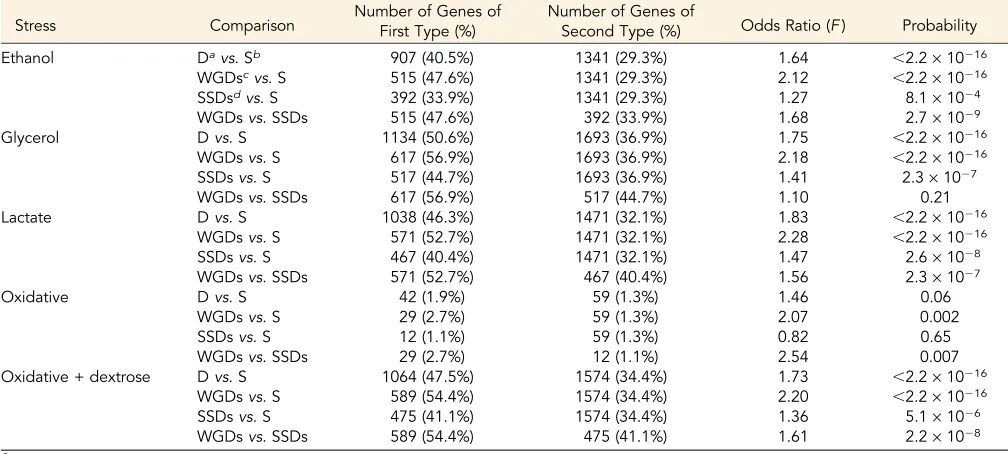
n Table 1 Transcription alterations under stress conditions
Stress Comparison Number of Genes ofFirst Type (%) Number of Genes ofSecond Type (%) Odds Ratio (F) Probability
Ethanol Davs.Sb 907 (40.5%) 1341 (29.3%) 1.64 ,2.2·10216
WGDscvs.S 515 (47.6%) 1341 (29.3%) 2.12 ,2.2·10216
SSDsdvs.S 392 (33.9%) 1341 (29.3%) 1.27 8.1·1024
WGDsvs.SSDs 515 (47.6%) 392 (33.9%) 1.68 2.7·1029
Glycerol Dvs.S 1134 (50.6%) 1693 (36.9%) 1.75 ,2.2·10216
WGDsvs.S 617 (56.9%) 1693 (36.9%) 2.18 ,2.2·10216
SSDsvs.S 517 (44.7%) 1693 (36.9%) 1.41 2.3·1027
WGDsvs.SSDs 617 (56.9%) 517 (44.7%) 1.10 0.21
Lactate Dvs.S 1038 (46.3%) 1471 (32.1%) 1.83 ,2.2·10216
WGDsvs.S 571 (52.7%) 1471 (32.1%) 2.28 ,2.2·10216
SSDsvs.S 467 (40.4%) 1471 (32.1%) 1.47 2.6·1028
WGDsvs.SSDs 571 (52.7%) 467 (40.4%) 1.56 2.3·1027
Oxidative Dvs.S 42 (1.9%) 59 (1.3%) 1.46 0.06
WGDsvs.S 29 (2.7%) 59 (1.3%) 2.07 0.002
SSDsvs.S 12 (1.1%) 59 (1.3%) 0.82 0.65
WGDsvs.SSDs 29 (2.7%) 12 (1.1%) 2.54 0.007
Oxidative + dextrose Dvs.S 1064 (47.5%) 1574 (34.4%) 1.73 ,2.2·10216
WGDsvs.S 589 (54.4%) 1574 (34.4%) 2.20 ,2.2·10216
SSDsvs.S 475 (41.1%) 1574 (34.4%) 1.36 5.1·1026
WGDsvs.SSDs 589 (54.4%) 475 (41.1%) 1.61 2.2·1028
aDuplicated genes. bSingleton genes. c
Whole-genome duplicates.
allowed to evolve for hundreds of generations in YPD medium, hence is adapted to this medium, and allows the maintenance of population genetic polymorphism due to its higher mutation rate compared to the wild-type strain.
Duplicated genes exhibit significant transcriptional plasticity under stress
After growing biological replicates of the yeast populations under normal and each of thefive different stress conditions, we extracted total RNA for RNAseq library construction and identified differentially expressed (DE) genes based on the comparison of their expression levels relative to normal conditions (seeMaterials and Methods). In total, we obtained reliable RNA sequence data for 5825 genes in the YPD medium (normal conditions) and each of thefive stress con-ditions (File S1,File S2,File S3,File S4, andFile S5), of which an important fraction was significantly altered under stress conditions (Table 1).
In all stress conditions, there was a significant transcriptomic re-sponse affecting 2248, 2827, 2509, 101, and 2638 genes under stress induced by ethanol, glycerol, lactate, oxidative stress, and oxidative stress in a medium supplemented with dextrose, respectively (File S1,File S2, File S3,File S4, andFile S5). The response affected duplicates signifi-cantly more than singletons in all stress conditions, although the low number of altered genes limited the power of the test in the case of oxidative stress (Table 1 and Figure 1A). The mechanism of duplica-tion, including WGD and SSD, also made a difference, with WGDs being more significantly enriched for altered expression genes than SSDs (Table 1 and Figure 1B). Taking all nonredundant transcriptomic responses together for all stress conditions, duplicated genes showed significantly larger increments of transcription under stress than sin-gleton genes (Figure 1B). Indeed, on average 837 duplicated genes out of the 2240 duplicates (37.4%) in S. cerevisiaeexhibited significant
increments of expression against 1227 out of 4580 singletons (26.8%) (Fisher’s exact test: odds ratioF= 1.63,P,2.2·10216). We identified an average of 42.2%, over all the stresses of 464 duplicates out of 1100 WGDs, to be transcriptionally plastic, a proportion significantly
higher than that for singletons (Fisher’s exact test: odds ratioF= 1.99,
P,2.2·10216). Likewise, the proportion of transcriptionally plastic SSDs (an average of 372 out of 1140 SSDs, 32.6%) was significantly higher than that for singletons (Fisher’s exact test: odds ratioF= 1.32,
P= 1.1·1024). WGDs also presented a significantly higher proportion of transcriptionally plastic genes than SSDs (Fisher’s exact test: odds ratioF= 1.51,P= 3.5·1026).
An alternative explanation for the adaptive value of the transcrip-tional plasticity of duplicates under stress is a low contribution of duplicates tofitness, with their response being the reflection of tran-scriptional noise caused by environmental perturbations. To test this possibility, we calculated the contribution of each duplicated gene to the fitness ofS. cerevisiaeunder normal and stress conditions taking pre-viously publishedfitness data (Steinmetzet al.2002). To this end, we subtracted the normalizedfitness values of a strain after a gene was deleted or knocked down under stress from thefitness of its ancestral strain (i.e., 1). Therefore, large fitness absolute increment values in-dicate that the contribution of the gene tofitness is high under those conditions.
Wefirst compared the contribution tofitness of duplicates with and without altered transcriptomic profiles in YPD. Transcriptionally altered duplicates exhibited higher contribution tofitness than unaltered du-plicates (Figure 1, C–F), discarding the possibility that altered dupli-cates may have less contribution tofitness than not-altered duplicates consequently being less selectively constrained to change. Both tran-scriptionally altered and not-altered duplicates showed a significant increase in their contribution tofitness under stress (Figure 1, C–F). However, this increase was sharper in transcriptionally altered dupli-cates than in unaltered duplidupli-cates.
Increased transcriptional plasticity after gene duplication
The higher transcriptional plasticity of duplicated genes inS. cerevisiae
when compared to singletons may be the result of a biased preservation in duplicate of highly transcriptionally plastic genes. To test whether Figure 1 Duplicated genes exhibit higher transcriptional plasticity than singleton genes and are involved in adaptation. (A) Percentage of genes with transcriptional flexibility when
S. cerevisiae is grown under each of the five stress conditions tested in this study: ethanol stress, glycerol stress, acidic stress by lactate, oxida-tive stress, and oxidaoxida-tive stress in a medium supplemented with dextrose. (B) The mean percentage of genes of the categories’singletons (black bar), duplicates (orange bar), duplicates generated by whole genome duplica-tion (red bar), and duplicates gener-ated by small-scale duplication (light yellow bar) with transcriptional alter-ations in the five stress conditions tested in this study. (C–F) We mea-sured the contribution of transcription-ally altered duplicates to thefitness ofS. cerevisiaeunder YPD and stress growth conditions using knock down gene data from Steinmetzet al.
gene duplication increases transcriptional plasticity we examined the patterns of transcriptional plasticity of duplicates and singletons in the post-WGD yeast C. glabrata, a phylogenetically close species to
S. cerevisiae. To this end, we asked the question of whether duplicates ofS. cerevisiaehad singleton orthologs inC. glabratathat were not more transcriptionally plastic than expected when compared to other
C. glabratasingletons under stress and vice versa. We obtained RNA sequence data from a previous publication in which transcriptomic data were available under YPD conditions and under acidic stress (Lindeet al.2015), similar to our data on lactic acid stress.S. cerevisiae
orthologs fromC. glabratawere identified using syntheny information
available in the pillars of YGOB (Byrne and Wolfe 2005). In total, we identified 4844 reliable S. cerevisiae:C. glabrataorthologs. Of these
4844 orthologs, 788 genes in C. glabrata were duplicated genes (394 pairs,File S6), of which 123 were duplicated inC. glabratabut not inS. cerevisiae. Of the 2240 duplicates ofS. cerevisiae, we found 1019 orthologs that were singletons in C. glabrata. We first asked whether singletons inC. glabratathat are orthologs of duplicates in
S. cerevisiaeexhibit higher transcriptional plasticity than singletons in
C. glabratawith no duplicate orthologs inS. cerevisiae. If this were the case, then gene duplication would have no role in transcriptional plas-ticity inS. cerevisiae. Notwithstanding that the transcriptional plasticity for a particular gene may vary among species, we found that the per-centage of singletons with significant transcriptional alterations under stress in C. glabrata that are orthologs to S. cerevisiae duplicates (599 out of a total of 1019 genes, 58.7%) was not significantly higher than that of transcriptionally altered singletons inC. glabratathat had no duplicate orthologs inS. cerevisiae(1725 out of a total of 3062 sin-gleton genes, 56.3%) (Fisher exact test: odd’s ratioF= 1.10,P= 0.17). Conversely, duplicates inC. glabratathat were orthologs to single-tons in S. cerevisiaeexhibited a significantly higher percentage of
transcriptionally altered genes under stress (82 out of a total of 123 genes, 66.7%) than singletons inC. glabrata(Fisher’s exact test: odd’s ratioF= 1.55,P= 0.02).
Differential patterns of transcriptional alterations within duplicated genes
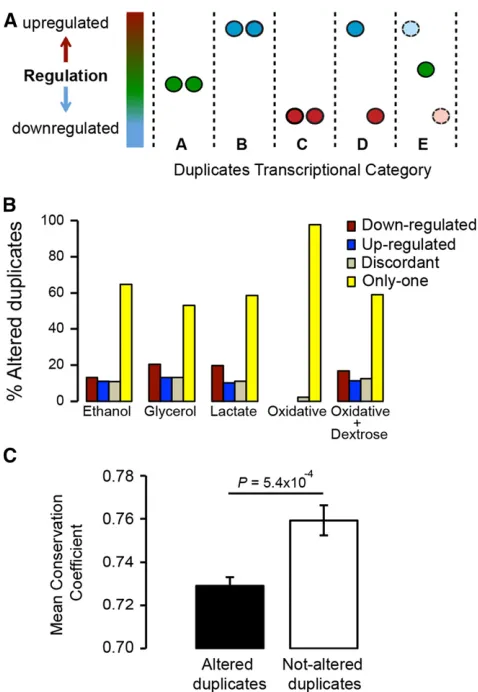
We sought to investigate the different transcriptional profiles of pairs of duplicated genes and their contributions to thefitness ofS. cerevisiae. We divided duplicated genes that underwent transcriptional alterations after stress intofive different categories (Figure 2A and Table 2): (a) duplicates in which both of the gene copies were up-regulated under stress (called herein Up pattern); (b) duplicates with both copies down-regulated under stress (Down pattern); (c) duplicates with one copy up-regulated and one copy down-regulated under stress (Discordant pattern), (d) duplicates with one copy showing not-altered transcription under stress while its sister copy shows either up-regulation or down-regulation under stress (Only-one pattern), and (e) duplicates that remained unchanged under stress (Not-altered pattern).
In each of the stress conditions, the category“Only-one”comprised the largest number of duplicates with altered transcriptional profiles, with this category including 53–97% of the altered duplicates in thefive stresses (Figure 2B). These results support the classical view of evolu-tion by gene duplicaevolu-tion, according to which following gene duplicaevolu-tion one copy undergoes rapid divergence while the other copy keeps the ancestral function. Here we show that this pattern of evolution by gene duplication is also true for the regulatory evolution of duplicated genes.
Duplicate gene copies with higher transcriptional divergence under stress should show higher sequence divergence when compared to orthologous sequences from other phylogenetically related species if the basis for this transcriptional plasticity was encoded in the gene sequence. To test this hypothesis, we were able to obtain 537 reliable promoter alignments for duplicates in S. cerevisiaeand at least four additional phylogenetically related yeast species (File S7). The main
Saccharomycesspecies we comparedS. cerevisiaeto wereS. bayanus,
[image:5.603.52.291.43.389.2]S. castellii,S. mikatae,S. paradoxus,S. kluyveri, andS. kudriavzevii. Not all species presented annotated intergenic regions but we used all those alignments that included at least four of the species. We aligned the 600 nucleotide sequence regions upstream of duplicated genes and their orthologs, as these are likely to include most if not all the regulatory elements of the genes (Ohler and Niemann 2001). We then measured the coefficient of conservation (CC) for each nucleotide site using the Figure 2 Duplicated genes exhibit differential patterns of
entropy equation (Cover and Thomas 2006; Halabiet al.2009; Ruiz-Gonzalez and Fares 2013):
CC¼fkðaÞlnf ðaÞ k
qðaÞ þ
12fkðaÞ
ln12f
ðaÞ k
12qðaÞ;"a2 ½A;T;G;C In this equation, CC of a nucleotide (a) at position (k) in an alignment is defined as the entropy of the observed frequency ofaatk(fkðaÞ) relative to the background frequency of ain all sequences of the alignment (q(a)). Therefore, the more conserved the site the higher
is its CC value. CC was averaged for each promoter and then these averages were used to compare altered duplicates (those belonging to the categories“Up,” “Down,” “Discordant,”and“Only-one”) with not-altered duplicates (those belonging to the category“Not-altered”). For each of the stress conditions we estimated the CC values for altered and not-altered duplicates. We then pulled all the data together from all stress conditions and compared the CC values of altered to that of not-altered duplicates. The CC values of duplicates with constant transcriptional profiles under stress (mean6SE = 0.7660.005) were significantly larger than those of duplicates with altered transcriptional profiles (mean6SE = 0.7260.01) (Figure 2C), and the difference was significant using a parametric test (t-test:t= 3.47, d.f. = 1140.9,
P= 5.4·1024) and a nonparametric test (Mann–WhitneyU-test:
P= 0.003), indicating that higher transcriptional plasticity of dupli-cates may be due to a divergence in their promoter sequences from the ancestral preduplication state.
Duplicates with different transcriptional divergence patterns exhibit different functional dependencies To determine whether the transcriptional plasticity of duplicated genes is accompanied by a functional divergence of gene copies, we analyzed the genetic interaction network ofS. cerevisiaeand asked how many of the duplicated genes show genetic interactions between their gene copies, hence are functionally dependent on one another (Costanzo et al.
2010), within each of the transcriptional categories (i.e., Up, Down, Discordant, Only one, and Not-altered). To this end, we used the ge-netic interaction map of S. cerevisiaeas a proxy to the functions of each of the genes (Costanzoet al.2010). This map contains roughly 6.5 million genetic interactions and the functional chart for 75% of the
S. cerevisiaegenes. The number of genetic interactions for a particular gene is a proxy to the number of functions it performs, as the deletion of both of the genes identified as interacting produces significantly differ-entfitness effects than the multiplicative effect of single gene deletions (Costanzoet al.2010). We identified 762,768 significant genetic
inter-actions (i.e., epistasis,e) inS. cerevisiae, of which 52% were synergistic (i.e., the double mutant exhibited significantly lowerfitness W12than the multiplicative effects of individual mutants:e = W12– W1W2;
e ,0) and 48% were antagonistic interactions (e = W12–W1W2;
e.0). However, duplicated genes were largely biased regarding the sign epistasis, with the majority of the epistasis (89.5%) being synergis-tic (binomial test: P,2.2· 10216). This pattern was also true for transcriptionally altered duplicates (89.74% synergistic epistasis). Divid-ing transcriptionally altered duplicates into the different categories pro-vides similar results, with all such categories being equally enriched for duplicates with synergistic epistasis: up-regulated duplicates presented largely synergistic epistasis (varying between 86% in ethanol and 93% under oxidative stress supplemented with dextrose), and so did the only-one category (ranging between 87% of the interactions being synergistic under glycerol stress and 92.7% in ethanol stress). These percentages were of the same order in the“Down”and“Discordant”categories.
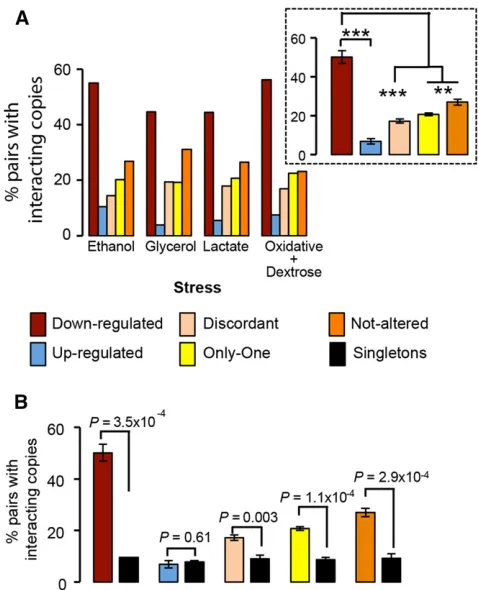
In all stress conditions the category“Down”showed the highest enrichment for those duplicates with interacting gene copies (Figure 3A). On average over all stress conditions, the genetically interacting duplicates enrichment followed the same pattern, with a distribu-tion among the categories in the following decreasing manner: the category “Down,” followed by the category “Not-altered,” then the category“Only-one,”then the category“Discordant,”and fi-nally the category“Up”(Figure 3A, inset box and Table 3).
The strong genetic interaction between the gene copies could be due to either each gene copy having a largefitness effect such that deleting both magnifies such an effect, or each gene copy having very lowfitness effects due to genetic redundancy but deleting both significantly mag-nifies this effect (i.e., functional compensation of a gene deletion or both gene copies are needed to perform the function because they have subfunctionalized). The category“Up”is the one with the lowest num-ber of gene copy interactions, therefore is likely to contain very little genetic compensation, perhaps because gene copies have diverged in their function from the ancestral preduplication gene, and as such the multiplicative effect of deleting single gene copies may be as important in their contribution tofitness as the double gene deletions. The category
“Discordant”shows higher levels of genetic interactions between gene copies than the category“Up,”but lower levels than“Down.”Since all discordant duplicates exhibit synergistic epistasis, this suggests certain functional redundancy under normal conditions for transcriptionally discordant duplicates, which also applies to the categories of “ One-altered”(average percentage of synergistic epistasis among all stresses: 89.9%; binomial test:P,3.61·1027) and“Only-one”duplicates.
To determine whether duplicate gene copies are more dependent upon each other’s functions than expected, we built sets of singleton genes for each of the duplicate sets according to their transcriptional profiles. Each of the singleton transcriptional categories was built taking random pairs of singleton genes. For example, for the“Up”category, both of the singleton genes were sampled from the set of up-regulated singleton genes under stress. We built sets of 1000 pairs and compared each of the duplicate transcriptional categories with the corresponding singleton transcriptional categories. Results show that all the categories,
n Table 2 Categories of altered expression of duplicates Number of Pairs Both Copies
Concordant
Stress Down Up Number of PairsDiscordant Number of PairsNot-Altered Number of PairsOne-Altered
Ethanol 89 76 74 438 677
Glycerol 159 103 102 413 777
Lactic acid 147 76 83 433 739
Oxidative 0 0 1 41 42
with the exception of the one including duplicates with both gene copies up-regulated, exhibit a significant proportion of their duplicates with interacting gene copies when compared to singletons of the same transcriptional category (Figure 3B). Therefore, up-regulated duplicates seem to exhibit evidence of independent evolution of their gene copies likely due to thefinding of novel functions by each copy under stress.
Functional divergence and genetic redundancy of duplicated genes
The differences in the functional dependencies between gene copies found in the duplicate transcriptional categories hint at a different mode
of evolution by gene duplication for these categories. We hypothesize, based on the patterns of genetic interactions, that the functional fate of duplicates in terms of neo- or subfunctionalization is dependent on the transcriptional category they belong to and the genetic redundancy between gene copies. Genetic redundancy has been shown to correlate with evolvability because it provides mutational robustness, which in turn increases the evolvability of genes (Draghiet al.2010; Wagner 2000b, 2005).
To test whether a given transcriptional category of duplicates is more likely to have evolved neo- or subfunctionalization, we examined two parameters linked to genetic interactions: (a) the number of shared interactions between the gene copies, (b) the number of total interactions of the gene copies. Neo-functionalized duplicates involve those in which one of the gene copies has lost all ancestral functions and acquired new functions, hence is likely to have a reduced number of genetic interac-tions. Conversely, subfunctionalization should affect duplicates with many functions in which each copy has become specialized in a set of ancestral functions while sharing common functions with its sister gene copy, hence is likely to be overrepresented among highly interacting duplicates. Neo-functionalization should also lead to lower levels of sharing of genetic interactions between the gene copies as one of the copies has acquired novel functions that are perhaps independent from subfunctionalization. In agreement with our hypotheses, duplicates from the down-regulated category exhibited a greater number of genetic interactions (mean 6 SE: 393.39 6 14.17) than those of the up-regulated category (mean6SE: 313.95613.95;t-test:t= 3.99, d.f. = 551.94,P= 7.36·1025). The index of shared interactions was calculated as:ShA;B¼12
Sh NAþ
Sh NB
, withShA,Breferring to the mean
number of shared interactions between gene copies A and B,Sh re-ferring to the number of shared interactions, and Nbeing the total number of interactions. Duplicates from the down-regulated category shared more interactions (mean6SE: 0.1560.005) than those of the up-regulated category (mean6SE: 0.1260.004;t-test:t= 3.29, d.f. = 209.27,P= 1.1·1023). These results indicate that while up-regulated duplicates may have neo-functionalized, down-regulated duplicates have likely subfunctionalized.
Sequence divergence levels of duplicates correlate with their transcriptional profiles
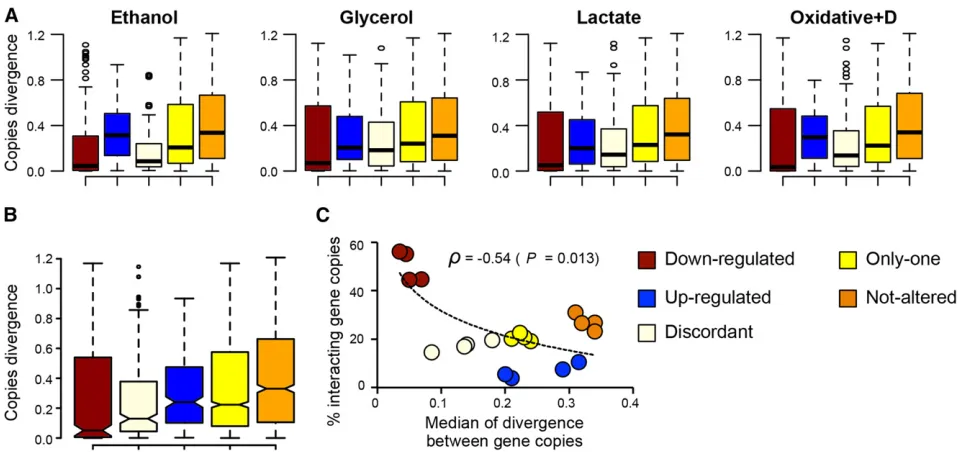
To determine whether the transcriptional duplicate categories included specific functional divergence profiles between gene copies, we inferred the amino acid distances between duplicate gene copies for all tran-scriptional categories and stress conditions. Divergence between dupli-cate gene copies was calculated using Poisson-corrected distances. Under all four stresses, the duplicates of category“Down”presented the lowest distance between gene copies (Figure 4A), followed by the category“Discordant,”then the category“Only-one,”then the category
“Up,”andfinally the category“Not-altered”(Figure 4A). Taking all stresses together, we found three groups of transcriptional categories according to the divergence values between gene copies of duplicates (Figure 4B). Thefirst category is“Down”: this category exhibited the lowest divergence levels between gene copies which was significantly smaller than the following group that included“Discordant”category duplicates (median divergence values for “Down”: 0.05, median for
[image:7.603.52.291.45.340.2]“Discordant”: 0.12, Wilcoxon rank test:P,2.2·10216). The following group included duplicates belonging to the transcriptional categories of “Only-one”(median divergence between gene copies: 0.22),“Up” (median divergence between gene copies: 0.24), and“Not-altered” (median divergence of gene copies: 0.33). The category“Discordant” Figure 3 The genetic dependencies between gene copies of
exhibited significantly lower divergence between gene copies than the categories“Up,” “Only-one,”and“Not-altered”(Wilcoxon rank test:P,2.2·10216).
Importantly, the mean sequence divergence levels between the duplicate gene copies correlated negatively with the mean percentage of duplicates in which both gene copies interacted genetically (Pearson correlation:r=20.54,P= 0.013; Figure 4C), indicating that the larger the divergence between the gene copies the lower is their functional dependency. This correlation became more significant when taking only those duplicates for which at least one gene copy has showed changing transcriptional patterns under stress (Pearson correlation: r=20.78,P= 3.4·1024). This result is in agreement with a previous study in which the differences between pairs of WGDs in which both gene copies interacted genetically and those in which gene copies did not was analysed (Mussoet al.2008).
These results strongly suggest that gene copies that become up-regulated (category“Up”) under stress have undergone accelerated evolution and divergence from their ancestral, preduplication functions perhaps allowing the adaptation to stress conditions that are often encountered by the cell in nature.
The origin of specific and general adaptations in S. cerevisiae
To determine whether the transcriptional plasticity of duplicates is the result of an adaptive process to face environmental perturbations, we sought to investigate whether this plasticity is stress specific (i.e., the result of adaptive processes) or a general response to stress. We exam-ined common transcriptionally altered duplicates for each of the tran-scriptional categories among stress conditions. We found that a substantial proportion of duplicates showed stress-specific transcrip-tional plasticity (Figure 5A). This pattern was the inverse in the case of transcriptionally altered singletons, with many common such single-tons responding to all four stress conditions (Figure 5B). Comparison of the proportion of duplicates in each of the categories for stress re-sponse (i.e., stress specific, common genes response to two, three,
or four stresses) revealed more significant stress-specific transcrip-tional alterations in duplicates than in singletons (a mean of 34.4% of duplicates with transcriptionalflexibility were stress specific com-pared to 26% of singletons, Fisher’s exact test: odds ratioF= 1.47,
P= 3.3·1024), while singletons showed more common responses to all stresses than duplicates (a mean of 32.8% of singletons responded to all stress conditions compared to 23% of duplicates, Fisher’s exact test: odds ratioF= 1.64,P= 1.1·1025) (Figure 5C). These results reveal a fundamental difference in the transcriptional plasticity of duplicates and singletons, with evidence for the role of natural selection in duplicates’ transcriptional differences as an adaptive mechanism.
Because of the fundamental difference in transcriptional plasticities between WGDs and SSDs (Figure 1B), we split the dataset for duplicates into these two groups and conducted the same comparison as above. Both the WGDs and SSDs showed very similar transcriptional flexibil-ity patterns to the entire dataset: WGDs and SSDs had their largest
transcriptional plasticity in genes that responded in a stress-specific manner (Figure 5D).
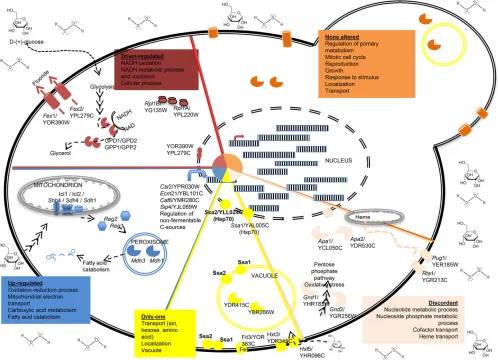
To understand the relationship between adaptation to stress and transcriptional plasticity, we analyzed how the different transcrip-tional alterations in duplicates may have an important role in the adaptation to oxidative stress supplemented with dextrose (Figure 6). Oxidation generates reactive oxidative molecules or species (ROS) including peroxide, superoxide, hydroxyl radicals, and single oxy-gen in the cell. Increasing ROS in the cell can lead to important structural damage. We found a number of important duplicates that are involved in mitochondrial respiration (Icl1/Icl2,Shh4/Shh1, and Sdh4/Sdh1duplicated genes, among others) as well as duplicated genes encoding transcriptional gluconeogenesis activators (Cat8/ Sip4 and Csr2/Ecm21) to be up-regulated under oxidative stress, perhaps to reduce the generation of ROS. Moreover, duplicated genes involved in NADH metabolism and oxidative processes in the glycolysis pathway (Gpd1/Gpd2, Gpp1/Gpp2) are down-regulated under stress (Figure 6). Interestingly, as previously noticed (Belli et al.2004), the gene copies (Pug1/Rta1) involved in heme transport and iron ion homeostasis showed discordant expression patterns, while the gene copies (Fit3/Fit1) involved in ion transport showed transcriptional alterations only forFit3(Figure 6).
The transcriptional plasticity of the duplicates belonging to the category“Only-one”was very noticeable under oxidative stress affect-ing functional classes required to minimize ROS, includaffect-ing many du-plicated genes involved in ion transport (Fit1/Fit3), hexose transport (Hxt3/Hxt5), and heat stress response (Ssa2/Ssa1). Similarly, the tran-scriptional category“Discordant”also showed a prominent response pattern to oxidative stress, including duplicates involved in nucleotide/ nucleoside metabolism (Gnd1/Gnd2,Apa1/Apa2), and in heme trans-port and iron ion homeostasis (Pug1/Rta1). Most of these duplicates have important roles in DNA replication and stress.
Interestingly, some of these genes are involved in many stresses but their transcriptional plasticity exhibits different patterns under different stresses. For example, the duplicates (Gpd1/Gpd2andGpp1/Gpp2) that drive glycerol production using dextrose through the glycolysis path-way (NADH metabolism and oxidative processes) behave transcrip-tionally different under the different stresses. Both of the gene copies of these duplicates are down-regulated under oxidative stress supple-mented with dextrose, while only one gene copy is down-regulated when the cell is subjected to stress by lactate or glycerol, and none of the gene copies showed any differential expression level with the wild type when the cell grew under ethanol stress. Similarly, the gene copies of the duplicates (Shh4/Sdh4andSdh1/Sdh1b) involved in oxidation of succinate and electron transfer to ubiquinone are up-regulated under oxidative stress. However, under ethanol stress, only gene copiesShh4 andSdh4are up-regulated while their corresponding paralogsShh1and Sdh1show wild-type expression levels (Figure 6).
DISCUSSION
In this study, we demonstrate that ancient duplicates ofS. cerevisiae
exhibit a large transcriptional plasticity when subjected to stress. This
n Table 3 Number of duplicates with genetically interacting gene copies for each transcriptional category of duplicates
Stress (Total) Down-RegulatedNumber of Pairs (Total) Up-RegulatedNumber of Pairs (Total) DiscordantNumber of Pairs (Total) Only-OneNumber of Pairs (Total) Not-AlteredNumber of Pairs
Ethanol 27 (49) 6 (57) 8 (55) 61 (301) 67 (249)
Glycerol 38 (85) 3 (77) 15 (77) 54 (281) 59 (190)
Lactate 36 (81) 3 (54) 10 (56) 65 (313) 55 (207)
transcriptional plasticity may be the result of preadaptations to envi-ronmental stress. Such preadaptations may have been generated through an increase in the polymorphism of the regulatory sequence regions of duplicated genes, perhaps the same sequence changes that have led to the regulatory divergence between the gene copies of du-plicates. The transcriptional divergence between gene copies has been studied in plants (Blanc and Wolfe 2004; Haet al.2007, 2009; Wang
et al.2012) and animals (Huminiecki and Wolfe 2004). InS. cerevisiae, while the genome-wide transcriptional plasticity has been reported un-der stress (Caustonet al.2001; Cormieret al.2010; Fereaet al.1999; Idekeret al.2001; Landryet al.2006; Sternet al.2007), the differential patterns in this plasticity between duplicates and singletons have re-ceived little attention. Findings from these studies led authors to con-clude that the transcriptional plasticity of the genes inS. cerevisiaeis the result of a general response to a wide range of stresses, sparking the possibility that this plasticity is an emerging property resulting from a universal feature of the underlying regulatory network. In this study we show that: (i) ancient duplicates ofS. cerevisiaeexhibit a large tran-scriptional plasticity when subjected to stress; and (ii) the transcrip-tional plasticity of duplicated genes differs from that of singletons, is more complex than thought before, and is likely the result of selection for an adaptive response to specific environmental challenges.
The transcriptional changes affecting one or both of the gene copies resulting from gene duplication may be selectively advantageous in unicellular organisms because the absence of tissue-specific transcrip-tional subfunctranscrip-tionalization precludes a relief of the genetic redundancy of duplicated genes. Therefore, in unicellular eukaryotes, such as
S. cerevisiae, the efficiency of purifying selection or positive selection
must be a strong force driving the fate of duplicated genes. In agreement with this prediction, the genetic redundancy generated inS. cerevisiae
after the WGD event that took place roughly 100 MYA was erased by purifying selection, as 92% of duplicated genes returned to single copy genes (Wolfe and Shields 1997). Despite this, the number of duplicates inS. cerevisiae(roughly 30% of all the genes) is higher than predicted by
theory, raising the possibility that most retained genes have become functionally specialized, hence less redundant, shortly after duplication (Forceet al.1999; Lynch and Katju 2004; Barkman and Zhang 2009; Des Marais and Rausher 2008; He and Zhang 2005; Conant and Wolfe 2006), transcriptionally divergent (Blanc and Wolfe 2004; Ha et al.
2007, 2009; Wanget al.2012; Francino 2005), preserved due to their higher mutational robustness (Fares 2015; Fareset al.2013; Keaneet al.
2014; Wagner 2000b, 2005), maintained owing to a selective advantage for higher gene dosage (Conant and Wolfe 2008), or kept to preserve stoichiometric balances in duplicates encoding protein complexes (Gibson and Spring 1998; Veitia 2003a,b).
In this study, the transcriptional plasticity identified inS. cerevisiaeis likely the result of population polymorphism at the regulatory regions of duplicates (Figure 3C), which were selectively relaxed after gene duplication. This polymorphism has likely given rise to preadaptations to environments never before faced by the yeast and becamefixed in the populations after facing such environmental perturbations. It is there-fore likely that duplicates that show transcriptional plasticity, in par-ticular those that become up-regulated under stress, are usually performing important functions in the cell and are hence maintained by purifying selection. However, under stress, such genes may encode new functions that provide the yeast with the ability to survive stress, a property encapsulated within the term exaptation (Gould and Vrba 1982). The question that remains is: how important an adaptive force is the transcriptional divergence against the functional divergence of duplicates inS. cerevisiae?
Functional divergence after gene and genome duplication has been the subject of intense scrutiny and a number of examples unequivocally correlate the origin of important gene families and functional special-ization with the divergence between gene paralogs. Indeed, key globin proteins that specialized in different aspects of oxygen metabolism have originated through WGD events (Hoffmannet al.2011, 2012a,b; Storz
[image:9.603.62.541.45.271.2]in the rates of sequence evolution in the duplicate gene copies (Blanc and Wolfe 2004), in good agreement with the fundamental tenet of the molecular evolution theory (Gu et al. 2002; Dermitzakis and Clark 2001). Expression divergence, but not transcriptional plasticity, be-tween the copies of duplicated genes has also been demonstrated in a number of organisms.
We propose the hypothesis supporting a link between expression and functional divergence–that is, one level of divergence necessarily drives the other level. Indeed, gene expression levels largely determine the rates of evolution of the proteins they encode (Drummond et al.
2006; Drummond and Wilke 2008; Palet al.2001; Rocha and Danchin 2004; Wilke and Drummond 2006). The theoretical justification for this link between gene expression and its rate of evolution can be found in the misfolding–mistranslation hypothesis, according to which highly expressed genes evolve slower constrained by the need to maintain low levels of misfolded or mistranslated proteins bearing destabilizing mutations (Drummond et al. 2005). On the other hand, functional divergence, or acquisition of novel functions, may involve afine-tuning of the expression of the encoding gene to perform the required function at the right rate. Whether expression divergence came before functional divergence or vice versa remains to be investigated but our data suggest a link between these two levels of divergence because different tran-scriptional categories exhibit different patterns of sequence evolution and divergence between gene copies (Figure 4C). We hypothesize that genetic redundancy has allowed transcriptional divergence between gene copies due to relaxed selective constraints. This has allowed divergence at the coding level driven by changes in gene expression, as gene expression is a strong determinant of sequence evolution (Drummondet al.2005). Such functional divergence may have led to the acquisition of functions that enabled the adaptation to stress conditions (Figure 5C).
[image:10.603.64.280.48.574.2]In this study, we determine the plasticity that each of the gene copies has at the regulatory level, the link of this plasticity with the functional dependencies among gene copies, and the role of such a link in the response to stress. Our study reveals different modes of evolution for the different transcriptional categories. Most responsive duplicates to stress present only one copy altered, following the classic view of evolution by gene duplication. The genetic dependencies and low sequence diver-gence between gene copies for these duplicates also reveal the mode of evolution and innovation: these duplicates exhibit the highest pro-portion of cases with synergistic epistasis between gene copies, which summed to the low sequence divergence between the gene copies indicates higher genetic redundancy (VanderSluiset al. 2010). This nontrivial pattern of evolution of novel functions is in agreement with previous predictions, according to which higher genetic redundancy allows the functional compensation between gene copies, the neutral exploration of genotypic space, and eventualfinding of additional novel functions (Fares 2015; Fares et al.2013; Keaneet al.2014; Wagner 2005). The category of up-regulated duplicates exhibits evidence of neo-functionalization based on the rapid evolution of the gene copies when compared to their ancestor and the low functional dependency of each copy on its sister copy, suggesting the acquisition of novel func-tions. Duplicates with both copies being down-regulated under stress present low divergence between the gene copies and significant func-tional dependencies among the gene copies, suggesting the subfunc-tionalization of the gene copies through the partition of ancestral functions. The partition of ancestral functions in these duplicates is not complete, as the gene copies share more functions than expected. This greater sharing may reflect a selective advantage for gene dosage, particularly in the ancestral state immediately postdating genome du-plication (Ihmels et al. 2007; VanderSluiset al. 2010). Finally, the category in which gene copies exhibit discordant transcriptional Figure 5 Transcriptional plasticity of duplicates is stress-specific. We
alterations under stress (“Discordant”) presents a low number of ge-netic interactions between gene copies and low sequence divergence of the gene copies when compared to a preduplication ancestral gene, suggesting that both of the gene copies may be performing very similar functions under different conditions (Forceet al.1999). The category of discordant duplicates may include cases in which copies have diverged in their regulation such that one copy is active under stress and its sister copy is active under normal conditions, thereby avoiding the costly evolutionary optimization of the encoded function under two different conditions (Conant and Wolfe 2006). Remarkably, duplicates with no evidence for expression alteration under stress conditions exhibit a greater number of interactions between gene copies than expected. Be-cause these duplicates are not affected by environmental perturbations, their enrichment for genetic interactions supports genetic buffering be-tween the gene copies that is independent of the environment, a phe-nomenon important for genetic robustness (Deanet al.2008; DeLuna
et al.2008; Fares 2015; Keaneet al.2014; VanderSluiset al.2010). Our results point to the expression divergence between the gene copies of duplicated genes as a strategy to yield adaptive
[image:11.603.54.552.49.409.2]profiles are mostly stress-specific and affect functions that are strictly related to the interaction with the environment and signal transduction.
In conclusion, we reveal the underlying transcriptional plasticity of duplicates in S. cerevisiaeand the potential of this plasticity to give origin to adaptations (by means of specialization of duplicates) to en-vironmental perturbations. This study sets a new research endeavor mainly aiming atfinding the as yet unexplored metabolic capabilities resulting from the evolution of duplicated genes.
ACKNOWLEDGMENTS
We thank members of the Fares laboratory for careful reading and discussion of the results in the manuscript. We are also grateful to colleagues at Trinity College for helpful discussions. This work was supported by a grant from the Spanish Ministerio de Economía y Competitividad (reference: BFU2015-66073-P) and a grant (ref-erence: ACOMP/2015/026) from the local government Consellería de Educación Investigación, Cultura y Deporte, Generalitat Valenciana to M.A.F. C.T. was supported by a grant Juan de la Cierva from the Spanish Ministerio de Economía y Competitividad (reference: JCA-2012-14056).
LITERATURE CITED
Altschul, S. F., T. L. Madden, A. A. Schaffer, J. Zhang, Z. Zhanget al., 1997 Gapped BLAST and PSI-BLAST: a new generation of protein database search programs. Nucleic Acids Res. 25(17): 3389–3402. Anders, S., and W. Huber, 2010 Differential expression analysis for
se-quence count data. Genome Biol. 11(10): R106.
Barkman, T., and J. Zhang, 2009 Evidence for escape from adaptive con-flict? Nature 462 (7274): E1; discussion E2–3.
Belli, G., M. M. Molina, J. Garcia-Martinez, J. E. Perez-Ortin, and E. Herrero, 2004 Saccharomyces cerevisiaeglutaredoxin 5-deficient cells subjected to continuous oxidizing conditions are affected in the expression of specific sets of genes. J. Biol. Chem. 279(13): 12386–12395.
Blanc, G., and K. H. Wolfe, 2004 Functional divergence of duplicated genes formed by polyploidy duringArabidopsisevolution. Plant Cell 16(7): 1679–1691.
Byrne, K. P., and K. H. Wolfe, 2005 The yeast gene order browser: com-bining curated homology and syntenic context reveals gene fate in polyploid species. Genome Res. 15(10): 1456–1461.
Carretero-Paulet, L., and M. A. Fares, 2012 Evolutionary dynamics and functional specialization of plant paralogs formed by whole and small-scale genome duplications. Mol. Biol. Evol. 29(11): 3541–3551. Causton, H. C., B. Ren, S. S. Koh, C. T. Harbison, E. Kaninet al.,
2001 Remodeling of yeast genome expression in response to environ-mental changes. Mol. Biol. Cell 12(2): 323–337.
Conant, G. C., and K. H. Wolfe, 2006 Functional partitioning of yeast co-expression networks after genome duplication. PLoS Biol. 4(4): e109.
Conant, G. C., and K. H. Wolfe, 2008 Turning a hobby into a job: how duplicated genesfind new functions. Nat. Rev. Genet. 9(12): 938–950.
Cormier, L., R. Barbey, and L. Kuras, 2010 Transcriptional plasticity through differential assembly of a multiprotein activation complex. Nucleic Acids Res. 38(15): 4998–5014.
Costanzo, M., A. Baryshnikova, J. Bellay, Y. Kim, E. D. Spearet al., 2010 The genetic landscape of a cell. Science 327(5964): 425–431. Cover, T. M., and J. A. Thomas, 2006 Elements of Information Theory.
Ed. 2. Wiley-Interscience, New York.
Cui, L., P. K. Wall, J. H. Leebens-Mack, B. G. Lindsay, D. E. Soltiset al., 2006 Widespread genome duplications throughout the history of flowering plants. Genome Res. 16(6): 738–749.
Dean, E. J., J. C. Davis, R. W. Davis, and D. A. Petrov, 2008 Pervasive and persistent redundancy among duplicated genes in yeast. PLoS Genet. 4(7): e1000113.
DeLuna, A., K. Vetsigian, N. Shoresh, M. Hegreness, M. Colon-Gonzalez
et al., 2008 Exposing thefitness contribution of duplicated genes. Nat. Genet. 40(5): 676–681.
Dermitzakis, E. T., and A. G. Clark, 2001 Differential selection after du-plication in mammalian developmental genes. Mol. Biol. Evol. 18(4): 557–562.
Des Marais, D. L., and M. D. Rausher, 2008 Escape from adaptive conflict after duplication in an anthocyanin pathway gene. Nature 454(7205): 762–765.
Draghi, J. A., T. L. Parsons, G. P. Wagner, and J. B. Plotkin, 2010 Mutational robustness can facilitate adaptation. Nature 463(7279): 353–355. Drummond, D. A., and C. O. Wilke, 2008 Mistranslation-induced protein
misfolding as a dominant constraint on coding-sequence evolution. Cell 134(2): 341–352.
Drummond, D. A., J. D. Bloom, C. Adami, C. O. Wilke, and F. H. Arnold, 2005 Why highly expressed proteins evolve slowly. Proc. Natl. Acad. Sci. USA 102(40): 14338–14343.
Drummond, D. A., A. Raval, and C. O. Wilke, 2006 A single determinant dominates the rate of yeast protein evolution. Mol. Biol. Evol. 23(2): 327–337.
Fares, M. A., 2015 The origins of mutational robustness. Trends Genet. 31(7): 373–381.
Fares, M. A., O. M. Keane, C. Toft, L. Carretero-Paulet, and G. W. Jones, 2013 The roles of whole-genome and small-scale duplications in the functional specialization ofSaccharomyces cerevisiaegenes. PLoS Genet. 9(1): e1003176.
Ferea, T. L., D. Botstein, P. O. Brown, and R. F. Rosenzweig, 1999 Systematic changes in gene expression patterns following adaptive evolution in yeast. Proc. Natl. Acad. Sci. USA 96(17): 9721–9726.
Ferris, S. D., and G. S. Whitt, 1979 Evolution of the differential regulation of duplicate genes after polyploidization. J. Mol. Evol. 12(4): 267–317. Force, A., M. Lynch, F. B. Pickett, A. Amores, Y. L. Yanet al.,
1999 Preservation of duplicate genes by complementary, degenerative mutations. Genetics 151(4): 1531–1545.
Francino, M. P., 2005 An adaptive radiation model for the origin of new gene functions. Nat. Genet. 37(6): 573–577.
Gibson, T. J., and J. Spring, 1998 Genetic redundancy in vertebrates: polyploidy and persistence of genes encoding multidomain proteins. Trends Genet. 14(2): 46–49, discussion 49–50.
Goldman, N., and Z. Yang, 1994 A codon-based model of nucleotide substitution for protein-coding DNA sequences. Mol. Biol. Evol. 11(5): 725–736.
Gould, S. J., and E. S. Vrba, 1982 Exaptation-A missing term in the science of form. Paleobiology 8(1): 12.
Gu, Z., D. Nicolae, H. H. Lu, and W. H. Li, 2002 Rapid divergence in expression between duplicate genes inferred from microarray data. Trends Genet. 18(12): 609–613.
Ha, M., W. H. Li, and Z. J. Chen, 2007 External factors accelerate expres-sion divergence between duplicate genes. Trends Genet. 23(4): 162–166. Ha, M., E. D. Kim, and Z. J. Chen, 2009 Duplicate genes increase expression diversity in closely related species and allopolyploids. Proc. Natl. Acad. Sci. USA 106(7): 2295–2300.
Halabi, N., O. Rivoire, S. Leibler, and R. Ranganathan, 2009 Protein sectors: evolutionary units of three-dimensional structure. Cell 138(4): 774–786. He, X., and J. Zhang, 2005 Rapid subfunctionalization accompanied by
prolonged and substantial neofunctionalization in duplicate gene evolu-tion. Genetics 169(2): 1157–1164.
Hoegg, S., H. Brinkmann, J. S. Taylor, and A. Meyer, 2004 Phylogenetic timing of thefish-specific genome duplication correlates with the diver-sification of teleostfish. J. Mol. Evol. 59(2): 190–203.
Hoffmann, F. G., J. C. Opazo, and J. F. Storz, 2011 Differential loss and retention of cytoglobin, myoglobin, and globin-E during the radiation of vertebrates. Genome Biol. Evol. 3: 588–600.
Hoffmann, F. G., J. C. Opazo, and J. F. Storz, 2012b Whole-genome duplications spurred the functional diversification of the globin gene superfamily in vertebrates. Mol. Biol. Evol. 29(1): 303–312. Holub, E. B., 2001 The arms race is ancient history inArabidopsis, the
wildflower. Nat. Rev. Genet. 2(7): 516–527.
Huminiecki, L., and K. H. Wolfe, 2004 Divergence of spatial gene expres-sion profiles following species-specific gene duplications in human and mouse. Genome Res. 14(10A): 1870–1879.
Ideker, T., V. Thorsson, J. A. Ranish, R. Christmas, J. Buhleret al., 2001 Integrated genomic and proteomic analyses of a systematically perturbed metabolic network. Science 292(5518): 929–934.
Ihmels, J., S. R. Collins, M. Schuldiner, N. J. Krogan, and J. S. Weissman, 2007 Backup without redundancy: genetic interactions reveal the cost of duplicate gene loss. Mol. Syst. Biol. 3: 86.
Innan, H., and F. Kondrashov, 2010 The evolution of gene duplications: classifying and distinguishing between models. Nat. Rev. Genet. 11(2): 97–108.
Keane, O. M., C. Toft, L. Carretero-Paulet, G. W. Jones, and M. A. Fares, 2014 Preservation of genetic and regulatory robustness in ancient gene duplicates ofSaccharomyces cerevisiae. Genome Res. 24(11): 1830–1841.
Kim, S., M. J. Yoo, V. A. Albert, J. S. Farris, P. S. Soltiset al., 2004 Phylogeny and diversification of B-function MADS-box genes in angiosperms: evolu-tionary and functional implications of a 260-million-year-old duplication. Am. J. Bot. 91(12): 2102–2118.
Landry, C. R., J. Oh, D. L. Hartl, and D. Cavalieri, 2006 Genome-wide scan reveals that genetic variation for transcriptional plasticity in yeast is bi-ased towards multi-copy and dispensable genes. Gene 366(2): 343–351. Lespinet, O., Y. I. Wolf, E. V. Koonin, and L. Aravind, 2002 The role of
lineage-specific gene family expansion in the evolution of eukaryotes. Genome Res. 12(7): 1048–1059.
Li, W. H., J. Yang, and X. Gu, 2005 Expression divergence between dupli-cate genes. Trends Genet. 21(11): 602–607.
Linde, J., S. Duggan, M. Weber, F. Horn, P. Sieberet al., 2015 Defining the transcriptomic landscape ofCandida glabrataby RNA-Seq. Nucleic Acids Res. 43(3): 1392–1406.
Lohse, M., A. M. Bolger, A. Nagel, A. R. Fernie, J. E. Lunnet al., 2012 RobiNA: a user-friendly, integrated software solution for RNA-Seq-based transcrip-tomics. Nucleic Acids Res. 40(Web Server issue): W622–W627.
Lynch, M., and J. S. Conery, 2000 The evolutionary fate and consequences of duplicate genes. Science 290(5494): 1151–1155.
Lynch, M., and J. S. Conery, 2003 The evolutionary demography of du-plicate genes. J. Struct. Funct. Genomics 3(1–4): 35–44.
Lynch, M., and V. Katju, 2004 The altered evolutionary trajectories of gene duplicates. Trends Genet. 20(11): 544–549.
Marcet-Houben, M., and T. Gabaldon, 2015 Beyond the whole-genome duplication: phylogenetic evidence for an ancient interspecies hybridiza-tion in the Baker’s yeast lineage. PLoS Biol. 13(8): e1002220.
Musso, G., M. Costanzo, M. Huangfu, A. M. Smith, J. Pawet al., 2008 The extensive and condition-dependent nature of epistasis among whole-genome duplicates in yeast. Genome Res. 18(7): 1092–1099.
Ohler, U., and H. Niemann, 2001 Identification and analysis of eukaryotic promoters: recent computational approaches. Trends Genet. 17(2): 56–60. Ohno, S., 1970 Evolution by Gene Duplication. Springer Verlag, New York. Ohno, S., 1999 Gene duplication and the uniqueness of vertebrate genomes
circa 1970–1999. Semin. Cell Dev. Biol. 10(5): 517–522.
Otto, S. P., and J. Whitton, 2000 Polyploid incidence and evolution. Annu. Rev. Genet. 34: 401–437.
Pal, C., B. Papp, and L. D. Hurst, 2001 Highly expressed genes in yeast evolve slowly. Genetics 158(2): 927–931.
Robinson, M. D., D. J. McCarthy, and G. K. Smyth, 2010 edgeR: a Bio-conductor package for differential expression analysis of digital gene expression data. Bioinformatics 26(1): 139–140.
Rocha, E. P., and A. Danchin, 2004 An analysis of determinants of amino acids substitution rates in bacterial proteins. Mol. Biol. Evol. 21(1): 108–116. Ruiz-Gonzalez, M. X., and M. A. Fares, 2013 Coevolution analyses
illumi-nate the dependencies between amino acid sites in the chaperonin system GroES-L. BMC Evol. Biol. 13: 156.
Steinmetz, L. M., C. Scharfe, A. M. Deutschbauer, D. Mokranjac, Z. S. Herman
et al., 2002 Systematic screen for human disease genes in yeast. Nat. Genet. 31(4): 400–404.
Stern, S., T. Dror, E. Stolovicki, N. Brenner, and E. Braun, 2007 Genome-wide transcriptional plasticity underlies cellular adaptation to novel challenge. Mol. Syst. Biol. 3: 106.
Storz, J. F., J. C. Opazo, and F. G. Hoffmann, 2011 Phylogenetic diversifi -cation of the globin gene superfamily in chordates. IUBMB Life 63(5): 313–322.
Storz, J. F., J. C. Opazo, and F. G. Hoffmann, 2013 Gene duplication, genome duplication, and the functional diversification of vertebrate glo-bins. Mol. Phylogenet. Evol. 66(2): 469–478.
Taylor, J. S., and J. Raes, 2004 Duplication and divergence: the evolution of new genes and old ideas. Annu. Rev. Genet. 38: 615–643.
Thompson, D. A., S. Roy, M. Chan, M. P. Styczynsky, J. Pfiffneret al., 2013 Evolutionary principles of modular gene regulation in yeasts. eLife 2: e00603.
Tong, A. H., M. Evangelista, A. B. Parsons, H. Xu, G. D. Baderet al., 2001 Systematic genetic analysis with ordered arrays of yeast deletion mutants. Science 294(5550): 2364–2368.
VanderSluis, B., J. Bellay, G. Musso, M. Costanzo, B. Pappet al.,
2010 Genetic interactions reveal the evolutionary trajectories of dupli-cate genes. Mol. Syst. Biol. 6: 429.
Veitia, R. A., 2003a Nonlinear effects in macromolecular assembly and dosage sensitivity. J. Theor. Biol. 220(1): 19–25.
Veitia, R. A., 2003b A sigmoidal transcriptional response: cooperativity, synergy and dosage effects. Biol. Rev. Camb. Philos. Soc. 78(1): 149–170. Wagner, A., 2000a Decoupled evolution of coding region and mRNA
expression patterns after gene duplication: implications for the neutralist-selectionist debate. Proc. Natl. Acad. Sci. USA 97(12): 6579–6584. Wagner, A., 2000b Robustness against mutations in genetic networks of
yeast. Nat. Genet. 24(4): 355–361.
Wagner, A., 2005 Robustness, evolvability, and neutrality. FEBS Lett. 579(8): 1772–1778.
Wang, Y., X. Wang, and A. H. Paterson, 2012 Genome and gene duplica-tions and gene expression divergence: a view from plants. Ann. N. Y. Acad. Sci. 1256: 1–14.
Wendel, J. F., 2000 Genome evolution in polyploids. Plant Mol. Biol. 42(1): 225–249.
Wilke, C. O., and D. A. Drummond, 2006 Population genetics of trans-lational robustness. Genetics 173(1): 473–481.
Wolfe, K. H., 2015 Origin of the yeast whole-genome duplication. PLoS Biol. 13(8): e1002221.
Wolfe, K. H., and D. C. Shields, 1997 Molecular evidence for an ancient duplication of the entire yeast genome. Nature 387(6634): 708–713. Yang, Z., 2007 PAML 4: phylogenetic analysis by maximum likelihood.
Mol. Biol. Evol. 24(8): 1586–1591.
Zhang, Z. H., D. J. Jhaveri, V. M. Marshall, D. C. Bauer, J. Edsonet al., 2014 A comparative study of techniques for differential expression analysis on RNA-Seq data. PLoS One 9(8): e103207.