Overcoming the Memory Bottleneck in Distributed Training of
Latent Variable Models of Text
Yi Yang
Northwestern University Evanston, IL
Alexander Yates Temple University
Philadelphia, PA [email protected]
Doug Downey Northwestern University
Evanston, IL
Abstract
Large unsupervised latent variable models (LVMs) of text, such as Latent Dirichlet Al-location models or Hidden Markov Models (HMMs), are constructed using parallel train-ing algorithms on computational clusters. The memory required to hold LVM parameters forms a bottleneck in training more powerful models. In this paper, we show how the mem-ory required for parallel LVM training can be reduced by partitioning the training corpus to minimize the number of unique words on any computational node. We present a greedy document partitioning technique for the task. For large corpora, our approach reduces mem-ory consumption by over 50%, and trains the same models up to three times faster, when compared with existing approaches for paral-lel LVM training.
1 Introduction
Unsupervised latent variable models (LVMs) of text are utilized extensively in natural language process-ing (Griffiths and Steyvers, 2004; Ritter et al., 2010; Downey et al., 2007; Huang and Yates, 2009; Li and McCallum, 2005). LVM techniques include Latent Dirichlet Allocation (LDA) (Blei et al., 2003), Hid-den Markov Models (HMMs) (Rabiner, 1989), and Probabilistic Latent Semantic Analysis (Hofmann, 1999), among others.
LVMs become more predictive as they are trained on more text. However, training LVMs on mas-sive corpora introduces computational challenges, in terms of both time and space complexity. The time complexity of LVM training has been addressed
through parallel training algorithms (Wolfe et al., 2008; Chu et al., 2006; Das et al., 2007; Newman et al., 2009; Ahmed et al., 2012; Asuncion et al., 2011), which reduce LVM training time through the use of large computational clusters.
However, the memory cost for training LVMs re-mains a bottleneck. While LVM training makes se-quential scans of the corpus (which can be stored on disk), it requires consistent random access to model parameters. Thus, the model parameters must be stored in memory on each node. Because LVMs in-clude a multinomial distribution over words for each latent variable value, the model parameter space in-creases with the number of latent variable values times the vocabulary size. For large models (i.e., with many latent variable values) and large cor-pora (with large vocabularies), the memory required for training can exceed the limits of the commod-ity servers comprising modern computational clus-ters. Because model accuracy tends to increase with both corpus size and model size (Ahuja and Downey, 2010; Huang and Yates, 2010), training accurate lan-guage models requires that we overcome the mem-ory bottleneck.
We present a simple technique for mitigating the memory bottleneck in parallel LVM training. Ex-isting parallelization schemes begin by partitioning the training corpusarbitrarilyacross computational nodes. In this paper, we show how to reduce mem-ory footprint by instead partitioning the corpus to minimize the number of unique wordson each node (and thereby minimize the number of parameters the node must store). Because corpus partitioning is a pre-processing step in parallel LVM training, our
technique can be applied to reduce the memory foot-print of essentially any existing LVM or training ap-proach. The accuracy of LVM training for a fixed model size and corpus remains unchanged, but in-telligent corpus partitioning allows us to train larger and typically more accurate models using the same memory capacity.
While the general minimization problem we en-counter is NP-hard, we develop greedy approxima-tions that work well. In experiments with both HMM and LDA models, we show that our technique offers large advantages over existing approaches in terms of both memory footprint and execution time. On a large corpus using 50 nodes in parallel, our best partitioning method can reduce the memory required per node to less than 1/10th that when training with-out corpus partitioning, and to half that of a random partitioning. Further, our approach reduces the train-ing time of an existtrain-ing parallel HMM codebase by 3x. Our work includes the release of our partitioning codebase, and an associated codebase for the paral-lel training of HMMs.1
2 Problem Formulation
In a distributed LVM system, a training corpusD=
{d1, d2, . . . , dN}of documents is distributed across Tcomputational nodes. We first formalize the mem-ory footprint on each nodent, wheret={1, ..., T}.
LetDt⊂Ddenote the document collection on node nt, and Vt be the number of word types (i.e., the
number of unique words) inDt. LetK be the
num-ber of latent variable values in the LVM.
With these quantities, we can express how many parameters must be held in memory on each com-putational node for training LVMs in a distributed environment. In practice, the LVM parameter space is dominated by an observation model: a condi-tional distribution over words given the latent vari-able value. Thus, the observation model includes
K(Vt−1)parameters. Different LVMs include
var-ious other parameters to specify the complete model. For example, a first-orderHMMincludes additional distributions for the initial latent variable and latent variable transitions, for a total ofK(Vt−1) +K2
parameters.LDA, on the other hand, includes just a
1https://code.google.com/p/
corpus-partition/
single multinomial over the latent variables, making a total ofK(Vt−1) +K−1parameters.
The LVM parameters comprise almost all of the memory footprint for LVM training. Further, as the examples above illustrate, the number of parame-ters on each node tends to vary almost linearly with
Vt (in practice, Vt is typically larger thanK by an
order of magnitude or more). Thus, in this paper we attempt to minimize memory footprint by lim-iting Vt on each computational node. We assume
the typical case in a distributed environment where nodes are homogeneous, and thus our goal is to par-tition the corpus such that themaximumvocabulary sizeVmax =maxTt=1Vton any single node is
mini-mized. We define this task formally as follows.
Definition CORPU SPART: Given a corpus of
N documentsD={d1, d2, . . . , dN}, andT nodes,
partition D into T subsets D1, D2, . . . , DT, such
thatVmaxis minimized.
For illustration, consider the following small ex-ample. Let corpus C contain three short docu-ments {c1=“I live in Chicago”, c2=“I am studying physics”, c3=“Chicago is a city in Illinois”}, and consider partitioning C into 2 non-empty subsets, i.e.,T = 2. There are a total of three possibilities:
• {{c1,c2},{c3}}.Vmax = 7 • {{c1,c3},{c2}}.Vmax = 8 • {{c2,c3},{c1}}.Vmax = 10
The decision problem version of
CORPU SPART is NP-Complete, by a re-duction from independent task scheduling (Zhu and Ibarra, 1999). In this paper, we develop greedy algorithms for the task that are effective in practice.
We note that CORPU SPART has a submodu-larproblem structure, where greedy algorithms are often effective. Specifically, let |S| denote the vo-cabulary size of a set of documentsS, and letS0 ⊆ S. Then for any documentcthe following inequality holds.
|S0∪c| − |S0| ≥ |S∪c| − |S|
That is, adding a document c to the subset S0 in-creases vocabulary size at least as much as adding
guarantees exist for similar problems, to our knowl-edge none apply directly in our case. For example, (Krause et al., 2007) considers maximizing the mini-mum over a set of monotonic submodular functions, which is the opposite of our problem. The distinct task of minimizing a single submodular function has been investigated in e.g. (Iwata et al., 2001).
It is important to emphasize that data partition-ing is apre-processingstep, after which we can em-ploy precisely the same Expectation-Maximization (EM), sampling, or variational parameter learning techniques as utilized in previous work. In fact, for popular learning techniques including EM for HMMs (Rabiner, 1989) and variational EM for LDA (Wolfe et al., 2008), it can be shown that the param-eter updates are independent of how the corpus is partitioned. Thus, for those approaches our parti-tioning is guaranteed to produce the same models as any other partitioning method; i.e., model accuracy is unchanged.
Lastly, we note that we targetsynchronizedLVM training, in which all nodes must finish each train-ing iteration before any node can proceed to the next iteration. Thus, we desire balanced partitions to help ensure iterations have similar durations across nodes. We achieve this in practice by constraining each node to hold at most 3% more than Z/T to-kens, whereZ is the corpus size in tokens.
3 Corpus Partitioning Methods
Our high-level greedy partitioning framework is given in Algorithm 1. The algorithm requires an-swering two key questions: How do we select which document to allocate next? And, given a document, on which node should it be placed? We present al-ternative approaches to each question below.
Algorithm 1Greedy Partitioning Framework
INPUT:{D,T}
OUTPUT:{D1, . . . , DT} Objective: MinimizeVmax
Initialize each subsetDt=∅forT nodes repeat
document selection:Select documentdfromD node selection: Select nodent, and adddtoDt
RemovedfromD
untilall documents are allocated
A baseline partitioning method commonly used in practice simply distributes documents across nodes randomly. As our experiments show, this baseline approach can be improved significantly.
In the following, set operations are interpreted as applying to the set of unique words in a document. For example,|d∪Dt|indicates the number of unique
word types in nodentafter documentdis added to
its document collectionDt.
3.1 Document Selection
For document selection, previous work (Zhu and Ibarra, 1999) proposed a heuristicDISSIMILARITY
method that selects the documentdthat isleast sim-ilar to any of the node document collections Dt,
where the similarity of d and Dt is calculated as: Sim(d, DT) = |d∩Dt|. The intuition behind the
heuristic is that dissimilar documents are more likely to impact future node selection decisions. Assigning the dissimilar documents earlier helps ensure that more greedy node selections are informed by these impactful assignments.
However, DISSIMILARITYhas a prohibitive time
complexity ofO(T N2), because we must compare
T nodes to an order ofN documents for a total of
N iterations. To scale to large corpora, we propose a novel BATCHDISSIMILARITYmethod. In BATCH
DISSIMILARITY, we select the top L most dissim-ilar documents in each iteration, instead of just the most dissimilar. Importantly, L is altered dynami-cally: we begin withL= 1, and then increaseLby one for iterationi+1iffusing a batch size ofL+1in iterationiwould not have altered the algorithm’s ul-timate selections (that is, if the most dissimilar doc-ument in iterationi+ 1is in fact the L+ 1st most dissimilar in iterationi). In the ideal case where L
is incremented each iteration, BATCHDISSIMILAR
will have a reduced time complexity ofO(T N3/2). Our experiments revealed two key findings re-garding document selection. First, BATCHDISSIM
-ILARITYprovides a memory reduction within 0.1%
we utilize BATCH DISSIMILARITY in the final sys-tem we evaluate, simple random document selection may be preferable in some practical settings.
3.2 Node Selection
Given a selected document d, the MINIMUM
method proposed in previous work selects nodent
having the minimum number of word types after al-location ofdtont(Zhu and Ibarra, 1999). That is,
MINIMUMminimizes|d∪Dt|. Here, we introduce
an alternative node selection methodJACCARDthat
selects node nt maximizing the Jaccard index,
de-fined here as|d∩Dt|/|d∪Dt|.
Our experiments showed that our JACCARDnode selection method outperforms the MINIMUM selec-tion method. In fact, for the largest corpora used in our experiments, JACCARD offered an 12.9% larger reduction in Vmax than MINIMUM. Our
proposed system, referred to as BJAC, utilizes our best-performing strategies for document selec-tion (BATCH DISSIMILARITY) and node selection (JACCARD).
4 Evaluation of Partitioning Methods
We evaluate our partitioning method against the baseline and Z&I, the best performing scalable method from previous work, which uses random document selection and MINIMUM node selection (Zhu and Ibarra, 1999). We evaluate on three cor-pora (Table 1): theBrowncorpus of newswire text (Kucera and Francis, 1967), the Reuters Corpus Vol-ume1 (RCV1) (Lewis et al., 2004), and a larger Web-Sent corpus of sentences gathered from the Web (Downey et al., 2007).
Corpus N V Z
Brown 57339 56058 1161183 RCV1 804414 288062 99702278 Web-Sent 2747282 214588 58666983
Table 1: Characteristics of the three corpora. N = # of documents, V = # of word types, Z = # of tokens. We treat each sentence as a document in the Brown and Web-Sent corpora.
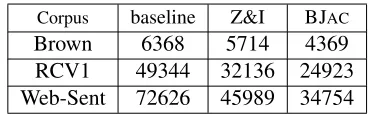
Table 2 shows how the maximum word type size
Vmaxvaries for each method and corpus, forT = 50
nodes. BJACsignificantly decreasesVmax over the
[image:4.612.333.518.56.113.2]Corpus baseline Z&I BJAC Brown 6368 5714 4369 RCV1 49344 32136 24923 Web-Sent 72626 45989 34754
Table 2: Maximum word type size Vmax for each
partitioning method, for each corpus. For the larger corpora, BJACreducesVmaxby over 50% compared
to the baseline, and by 23% compared to Z&I.
random partitioning baseline typically employed in practice. Furthermore, the advantage of BJACover the baseline is maintained as more computational nodes are utilized, as illustrated in Figure 1. BJac reducesVmaxby a larger factor over the baseline as
more computational nodes are employed.
0 20,000 40,000 60,000 80,000 100,000 120,000 140,000
10 20 30 40 50 60 70 80 90 100
number of word types
number of nodes
[image:4.612.321.535.293.424.2]Vmax by baseline Vmax by BJac
Figure 1: Effects of partitioning as the number of computational nodes increases (Web-Sent corpus). With 100 nodes, BJac’sVmaxis half that of the
base-line, and 1/10th of the full corpus vocabulary size.
[image:4.612.79.291.529.586.2]5 Evaluation in Parallel LVM Systems We now turn to an evaluation of our corpus parti-tioning within parallel LVM training systems.
Table 3 shows the memory footprint required for HMM and LDA training for three different partition-ing methods. We compare BJAC with the random partitioning baseline, Zhu’s method, and with all-words, the straightforward approach of simply stor-ing parameters for the entire corpus vocabulary on every node (Ahuja and Downey, 2010; Asuncion et al., 2011). All-words has the same memory footprint as when training on a single node.
all-LVM Corpus all-words baseline BJAC
HMM
Brown 435.3 56.2 40.9
RCV1 2205.4 384.1 197.8 Web-Sent 1644.8 561.7 269.7
LDA
Brown 427.7 48.6 33.3
[image:5.612.341.511.56.128.2]RCV1 2197.7 376.5 190.1 Web-Sent 1637.2 554.1 262.1
Table 3: Memory footprint of computational nodes in megabytes(MB), using 50 computational nodes. Both models utilize 1000 latent variable values.
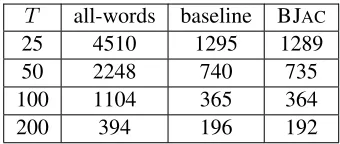
words. The results demonstrate that in addition to the well-known savings in computation time offered by parallel LVM training, distributed computation also significantly reduces the memory footprint on each node. In fact, for the RCV1 corpus, BJAC re-duces memory footprint to less than 1/10th that of training with all words on each computational node. We next evaluate the execution timefor an itera-tion of model training. Here, we use a parallel im-plementation of HMMs, and measure iteration time for training on the Web-sent corpus with 50 hidden states as the number of computational nodes varies. We compare against the random baseline and against the all-words approach utilized in an existing paral-lel HMM codebase (Ahuja and Downey, 2010). The results are shown in Table 4. Moving beyond the all-words method to exploit corpus partitioning reduces training iteration time, by a factor of two to three. However, differences in partitioning methods have only small effects in iteration time: BJAChas essen-tially the same iteration time as the random baseline in this experiment.
It is also important to consider the additional time required to execute the partitioning methods them-selves. However, in practice this additional time is negligible. For example, BJAC can partition the Web-sent corpus in 368 seconds, using a single com-putational node. By contrast, training a 200-state HMM on the same corpus requires over a hundred CPU-days. Thus, BJAC’s time to partition has a neg-ligible impact on total training time.
6 Related Work
The CORPU SPART task has some similarities to the graph partitioning task investigated in other
T all-words baseline BJAC
25 4510 1295 1289
50 2248 740 735
100 1104 365 364
200 394 196 192
Table 4: Average iteration time(sec) for training an HMM with 50 hidden states on Web-Sent. Partition-ing with BJAC outperforms all-words, which stores parameters for all word types on each node.
parallelization research (Hendrickson and Kolda, 2000). However, our LVM training task differs sig-nificantly from those in which graph partitioning is typically employed. Specifically, graph partitioning tends to be used for scientific computing applica-tions where communication is the bottleneck. The graph algorithms focus on creating balanced parti-tions that minimize the cut edge weight, because edge weights represent communication costs to be minimized. By contrast, in our LVM training task, memory consumption is the bottleneck and commu-nication costs are less significant.
Zhu & Ibarra (1999) present theoretical results and propose techniques for the general partitioning task we address. In contrast to that work, we fo-cus on the case where the data to be partitioned is a large corpus of text. In this setting, we show that our heuristics partition faster and provide smaller mem-ory footprint than those of (Zhu and Ibarra, 1999).
7 Conclusion
We presented a general corpus partitioning tech-nique which can be exploited in LVM training to re-duce memory footprint and training time. We eval-uated the partitioning method’s performance, and showed that for large corpora, our approach reduces memory consumption by over 50% and learns mod-els up to three times faster when compared with ex-isting implementations for parallel LVM training.
Acknowledgments
[image:5.612.75.297.56.154.2]References
Amr Ahmed, Moahmed Aly, Joseph Gonzalez, Shra-van Narayanamurthy, and Alexander J. Smola. 2012. Scalable inference in latent variable models. In Pro-ceedings of the fifth ACM international conference on Web search and data mining, WSDM ’12, pages 123– 132, New York, NY, USA. ACM.
Arun Ahuja and Doug Downey. 2010. Improved extrac-tion assessment through better language models. In
Human Language Technologies: Annual Conference of the North American Chapter of the Association for Computational Linguistics (NAACL HLT).
Arthur U. Asuncion, Padhraic Smyth, and Max Welling. 2011. Asynchronous distributed estimation of topic models for document analysis. Statistical Methodol-ogy, 8(1):3 – 17. Advances in Data Mining and Statis-tical Learning.
David M. Blei, Andrew Y. Ng, and Michael I. Jordan. 2003. Latent dirichlet allocation. J. Mach. Learn. Res., 3:993–1022, March.
Cheng T. Chu, Sang K. Kim, Yi A. Lin, Yuanyuan Yu, Gary R. Bradski, Andrew Y. Ng, and Kunle Olukotun. 2006. Map-Reduce for machine learning on multicore. In Bernhard Sch¨olkopf, John C. Platt, and Thomas Hoffman, editors,NIPS, pages 281–288. MIT Press. Abhinandan S. Das, Mayur Datar, Ashutosh Garg, and
Shyam Rajaram. 2007. Google news personaliza-tion: scalable online collaborative filtering. In Pro-ceedings of the 16th international conference on World Wide Web, WWW ’07, pages 271–280, New York, NY, USA. ACM.
D. Downey, S. Schoenmackers, and O. Etzioni. 2007. Sparse information extraction: Unsupervised language models to the rescue. InProc. of ACL.
T. L. Griffiths and M. Steyvers. 2004. Finding scien-tific topics. Proceedings of the National Academy of Sciences, 101(Suppl. 1):5228–5235, April.
Bruce Hendrickson and Tamara G Kolda. 2000. Graph partitioning models for parallel computing. Parallel computing, 26(12):1519–1534.
Thomas Hofmann. 1999. Probabilistic latent semantic indexing. In Proceedings of the 22nd annual inter-national ACM SIGIR conference on Research and de-velopment in information retrieval, SIGIR ’99, pages 50–57, New York, NY, USA. ACM.
Fei Huang and Alexander Yates. 2009. Distributional representations for handling sparsity in supervised se-quence labeling. InProceedings of the Annual Meet-ing of the Association for Computational LMeet-inguistics (ACL).
Fei Huang and Alexander Yates. 2010. Exploring representation-learning approaches to domain adapta-tion. In Proceedings of the ACL 2010 Workshop on
Domain Adaptation for Natural Language Processing (DANLP).
Satoru Iwata, Lisa Fleischer, and Satoru Fujishige. 2001. A combinatorial strongly polynomial algorithm for minimizing submodular functions. J. ACM, 48:761– 777.
Andreas Krause, H. Brendan Mcmahan, Google Inc, Car-los Guestrin, and Anupam Gupta. 2007. Selecting observations against adversarial objectives. Technical report, In NIPS, 2007a.
H. Kucera and W. N. Francis. 1967. Computational analysis of present-day American English. Brown University Press, Providence, RI.
David D. Lewis, Yiming Yang, Tony G. Rose, Fan Li, G. Dietterich, and Fan Li. 2004. Rcv1: A new bench-mark collection for text categorization research. Jour-nal of Machine Learning Research, 5:361–397. Wei Li and Andrew McCallum. 2005. Semi-supervised
sequence modeling with syntactic topic models. In
Proceedings of the 20th national conference on Artifi-cial intelligence - Volume 2, AAAI’05, pages 813–818. AAAI Press.
David Newman, Arthur Asuncion, Padhraic Smyth, and Max Welling. 2009. Distributed algorithms for topic models. Journal of Machine Learning Research, 10:1801–1828.
L. R. Rabiner. 1989. A tutorial on Hidden Markov Models and selected applications in speech recogni-tion. Proceedings of the IEEE, 77(2):257–286. Alan Ritter, Colin Cherry, and Bill Dolan. 2010.
Unsu-pervised modeling of twitter conversations. InHuman Language Technologies: The 2010 Annual Conference of the North American Chapter of the Association for Computational Linguistics, HLT ’10, pages 172–180, Stroudsburg, PA, USA. Association for Computational Linguistics.
Jason Wolfe, Aria Haghighi, and Dan Klein. 2008. Fully distributed EM for very large datasets. In Proceed-ings of the 25th international conference on Machine learning, ICML ’08, pages 1184–1191, New York, NY, USA. ACM.