A Just-In-Time Keyword Extraction from Meeting Transcripts
Hyun-Je Song Junho Go Seong-Bae Park Se-Young Park
School of Computer Science and Engineering Kyungpook National University
Daegu, Korea
{hjsong,jhgo,sbpark,sypark}@sejong.knu.ac.kr
Abstract
In a meeting, it is often desirable to extract keywords from each utterance as soon as it is spoken. Thus, this paper proposes a just-in-time keyword extraction from meeting tran-scripts. The proposed method considers two major factors that make it different from key-word extraction from normal texts. The first factor is the temporal history of preceding ut-terances that grants higher importance to re-cent utterances than old ones, and the sec-ond is topic relevance that forces only the pre-ceding utterances relevant to the current utter-ance to be considered in keyword extraction. Our experiments on two data sets in English and Korean show that the consideration of the factors results in performance improvement in keyword extraction from meeting transcripts.
1 Introduction
A meeting is generally accomplished by a number of participants and a wide range of subjects are dis-cussed. Therefore, it would be helpful to meeting participants to provide them with some additional information related to the current subject. For in-stance, assume that a participant is discussing a spe-cific topic with other participants at a meeting. The summary of previous meetings on the topic is then one of the most important resources for her discus-sion.
In order to provide information on a topic to par-ticipants, keywords should be first generated for the topic since keywords are often representatives of a topic. A number of techniques have been proposed
for automatic keyword extraction (Frank et al., 1999; Turney, 2000; Mihalcea and Tarau, 2004; Wan et al., 2007), and they are designed to extract keywords from a written document. However, they are not suitable for meeting transcripts. In a meeting, it is often desirable to extract keywords at the time at which a new utterance is made for just-in-time ser-vice of additional information. Otherwise, the ex-tracted keywords become just the important words at the end of the meeting.
Two key factors for just-in-time keyword extrac-tion from meeting transcripts are time of preceding utterances and topic of current utterance. First, cur-rent utterance is affected by temporal history of pre-ceding utterances. That is, when a new utterance is made it is likely to be related more closely with latest utterances than old ones. Second, the preced-ing utterances which carry similar topics to current utterance are more important than irrelevant utter-ances. Since a meeting consists of several topics, the utterances that have nothing to do with current utterance are inappropriate as a history of the cur-rent utterance.
This paper proposes a graph-based keyword ex-traction to reflect these factors. The proposed method represents an utterance as a graph of which nodes are candidate keywords. The preceding utter-ances are also expressed as a history graph in which the weight of an edge is the temporal importance of the keywords connected by the edge. To reflect the temporal history of utterances, forgetting curve
(Wozniak, 1999) is adopted in updating the weights of edges in the history graph. It expresses effectively not only the reciprocal relation between memory
tention and time, but also active recall that makes frequent words more consequential in keyword ex-traction. Then, a subgraph that is relevant to the current utterance is derived from the history graph, and used as an actual history of the current utterance. The keywords of the current utterance are extracted by TextRank (Mihalcea and Tarau, 2004) from the merged graph of the current utterance and the his-tory graphs.
The proposed method is evaluated with two kinds of data sets: the National Assembly transcripts in Korean and the ICSI meeting corpus (Janin et al., 2003) in English. The experimental results show that it outperforms both the TFIDF frame-work (Frank et al., 1999; Liu et al., 2009) and the PageRank-based graph model (Wan et al., 2007). One thing to note is that the proposed method im-proves even the supervised methods that do not re-flect utterance time and topic relevance for the ICSI corpus. This proves that it is critical to consider time and content of utterances simultaneously in keyword extraction from meeting transcripts.
The rest of the paper is organized as follows. Sec-tion 2 reviews the related studies on keyword extrac-tion. Section 3 explains the overall process of the proposed method, and Section 4 addresses its de-tailed description how to reflect meeting character-istics. Experimental results are presented in Section 5. Finally, Section 6 draws some conclusions.
2 Related Work
Keyword extraction has been of interest for a long time in various fields such as information retrieval, document clustering, summarization, and so on. Thus, there have been many studies on automatic keyword extraction. The frequency-based key-word extraction with TFIDF weighting (Frank et al., 1999) and the graph-based keyword extraction (Mi-halcea and Tarau, 2004) are two base models for this task. Many studies recently tried to extend them by incorporating specific information such as linguistic knowledge (Hulth, 2003), web-based resource (Tur-ney, 2003), and semantic knowledge (Chen et al., 2010). As a result, they show good performance on written text. However, it is difficult to use them di-rectly for spoken genres, since spoken genres have significantly different characteristics from written
text.
There have been a few studies focused on key-word extraction from spoken genres. Among them, the extraction from meetings has attracted more con-cern, since the need for grasping important points of a meeting or an opinion of each participant has increased. The studies on meetings focused on the exterior features of meeting dialogues such as unstructured and ill-formed sentences. Liu et al. (2009) used some knowledge sources such as Part-of-Speech (POS) filtering, word clustering, and sen-tence salience to reflect dialogue features, and they found out that a simple TFIDF-based keyword ex-traction using these knowledge sources works rea-sonably well. They also extended their work by adopting various features such as decision making sentence features, speech-related features, and sum-mary features that reflect meeting transcripts better (Liu et al., 2011). Chen et al. (2010) extracted key-words from spoken course lectures. In this study, they considered prosodic information from HKT forced alignment and topics in a lecture generated by Probabilistic Latent Semantic Analysis (pLSA). These studies focused on the exterior characteris-tics of spoken genres, since they assumed that entire scripts are given in advance and then they extracted keywords that best describe the scripts. However, to the best of our knowledge, there is no previous study considered time of utterances which is an intrinsic element of spoken genres.
The relevance between current utterance and pre-ceding utterances is also a critical feature in keyword extraction from meeting transcripts. The study that considers this relevance explicitly is CollabRank
Current utterance graph (G1)
History graph (G2)
Subgraph (G3)
Expanded graph (G4)
Keyword graph (G5)
Subgraph extraction
Expand
Keyword extraction
Merge
Keywords Current
utterance
[image:3.612.101.510.52.319.2]Filter
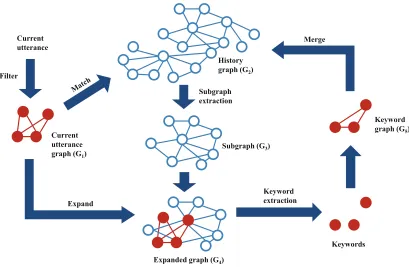
Figure 1: The overall process of the just-in-time keyword extraction from meeting transcripts.
3 Just-In-Time Keyword Extraction for a Meeting
Figure 1 depicts the overall process of extracting keywords from an utterance as soon as it is spo-ken. We represent all the components in a meeting as graphs. This is because graphs are effective to ex-press the relationship between words, and the graph operations that are required for keyword extraction are also efficiently performed. That is, whenever an utterance is spoken, it is represented as a graph (G1) of which nodes are the potential keywords in the ut-terance. This graph is named as current utterance graph.
The summary of all preceding utterances is also represented as ahistory graph(G2). We assume that only the preceding utterances that are directly re-lated with the current utterance are important for ex-tracting keywords from the current utterance. There-fore, a subgraph of G2 that maximally covers the current utterance graph (G1) is extracted. This sub-graph is labeled asG3in Figure 1. Then, the current utterance graph G1 is expanded by merging it and
G3. This expanded graph (G4) is a combined rep-resentation of the current and preceding utterances,
and then the keywords of the current utterance is ex-tracted from this graph. The keywords are so-called hub nodes ofG4.
After keywords are extracted from the current ut-terance, the current utterance becomes a part of the history graph for the next utterance. For this, the extracted keywords are also represented as a graph (G5), and it is merged into the current history G2. This merged graph becomes a new history graph for the next utterance. In merging two graphs, the weight of each edge inG2 is updated to reflect the temporal history. If an edge is connecting two nouns from an old utterance, its weight becomes small. In the same way, the weights for the edges from recent utterances get large. The weights of the edges from
G5are 1, the largest possible value.
4 Graph Representation and Weight Update
4.1 Current Utterance Graph and History Graph
key-words from the current utterance. Since all key-words within the current utterance are not keywords, some words are filtered out. For this filtering out, we fol-low the POS filtering approach proposed by Liu et al. (2009). This approach filters out non-keywords using a stop-word list and POS tags of the words. Assume that nwords remain after the filtering out, wheren ≤ m. Thesenwords become the vertices of the current utterance graph.
Formally, the current utterance graph G1 =
(V1, E1) is an undirected graph, where |V1| = n.
E1 is a set of edges and each edge implies that the nouns connected by the edge co-occur within a win-dow sizedW. For eache1ij ∈E1that connects nodes
v1
i andvj1, its weight is given by
wij1 =
(
1 ifv1
i&vj1cooccur within the window,
0 otherwise. (1)
In a meeting, preceding utterances affect the cur-rent utterance. We assume that only the keywords of preceding utterances are effective. Therefore, the
history graphG2= (V2, E2)is an undirected graph of keywords in the preceding utterances. That is, all vertices in V2 are keywords extracted from one or more previous utterances, and the edge between two keywords implies that they co-occurred at least once. Every edge inE2has a weight that represents its temporal importance.
The history graph is updated whenever keywords are extracted from a new utterance. This is because the current utterance becomes a part of the history graph for the next utterance. As a history, old ut-terances are less important than recent ones. Thus, the temporal importance should decrease gradually according to the passage of time. In addition, the keywords which occur frequently at a meeting are more important than those mentioned just once or twice. Since the frequently-mentioned keywords are normally major topics of the meeting, their influence should last for a long time.
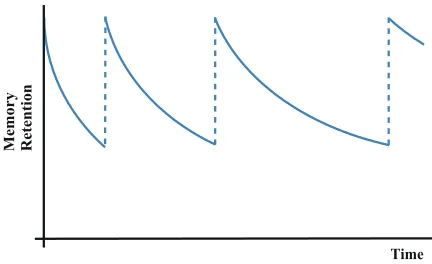
To model these characteristics, the forgetting curve (Wozniak, 1999) is adopted in updating the history graph. It models the decline of memory re-tention in time. Figure 2 shows a typical represen-tation of the forgetting curve. The X-axis of this figure is time and the Y-axis is memory retention. As shown in this figure, memory retention of new
Time
M
e
mo
r
y
R
e
te
n
ti
o
[image:4.612.318.534.53.185.2]n
Figure 2: Memory retention according to time.
information decreases gradually by the exponential nature of forgetting. However, whenever the inmation is repeated, it is recalled longer. This is for-mulated as
R=e−St,
whereRis memory retention,tis time, andSis the relative strength of memory.
Based on the forgetting curve, the weight of each edgee2ij ∈E2between keywordsvi2andvj2is set as
wij2 = exp−
t f(vi,vj),
(2)
wheretis the elapse of utterance time andf(vi, vj)
is the frequency that vi and vj co-occur from the
beginning of the meeting to now. According to this equation, the temporal importance between key-words decreases gradually as time passes by, but the keyword relations repeated during the meeting are remembered for a long time in the history graph.
4.2 Keyword Extraction by Merging Current Utterance and History Graphs
All words within the history graph are not equally important in extracting keywords from the current utterance. In general, many participants discuss a wide range of topics in a meeting. Therefore, some preceding utterances that shares topics with the cur-rent utterance are more significant. We assume that the preceding utterances that contain the nouns in the current utterance share topics with the current utterance. Thus, only a subgraph ofG2 that contain words inG1is relevant for keyword extraction from
Given the current utterance graphG1 = (V1, E1) and the history graph G2 = (V2, E2), the relevant graph G3 = (V3, E3) is a subgraph of G2. Here,
V3= (V1∩V2)∪adjacency(V1)andadjacency(V1) is a set of vertices fromG2 which are directly con-nected to the words in V1. That is, V3 contains the words of G1 and their direct neighbor words in
G2. E3 is a subset ofE2. Only the edges that ap-pear inE2 are included in E3. The weightw3ij of
eache3
ij ∈ E3 is also borrowed fromG2. That is,
w3ij =wij2. Therefore,G3 is a 1-walk subgraph1 of
G2 in which words inG1 and their neighbor words appear.
The keywords of the current utterance should re-flect the relevant history as well as the current utter-ance itself. For this purpose, G1 is expanded with respect toG3. The expanded graphG4 = (V4, E4) ofG1is defined as
V4=V1∪V3,
E4 =E1∪E3.
For each edgee4ij ∈E4, its weightw4ijis determined
to be the larger value betweenw1ij andwij3 if it ap-pears in bothG1 andG3. When it appears in only one of the graphs, wij4 is set to be the weight of its corresponding graph. That is,
w4ij =
max(wij1, wij3) ifeij4 ∈E1ande4ij ∈E3,
wij1 ife4ij ∈E1ande4ij ∈/ E3,
w3
ij otherwise.
From this expanded graph G4, the keywords are extracted by TextRank (Mihalcea and Tarau, 2004). TextRank is an unsupervised graph-based method for keyword extraction. It singles out the key ver-tices of a graph by providing a ranking mechanism. In order to rank the vertices, it computes the score of each vertexvi4∈V4 by
S(vi4) = (1−d) +d· X
v4 j∈adj(vi4)
w4
ji
P
v4 k∈adj(v
4 j)
w4
jk
S(vj4),
(3)
1If am-walk subgraph (m >1) is used, more affluent his-tory is used. However, this graph contains some words irrel-evant to the current utterance. According to our experiments, 1-walk subgraph outperforms otherm-walk subgraphs where
m >1. In addition, extractingG3becomes expensive for large
m.
where0 ≤ d ≤ 1 is a damping factor andadj(vi)
denotes vi’s neighbors. Finally, the words whose
score is larger than a specific threshold θ are cho-sen as keywords. Especially when the current utter-ance is the first utterutter-ance of a meeting, the history graph does not exist. In this case, the current utter-ance graph becomes the expanded graph (G4=G1), and keywords are extracted from the current utter-ance graph.
The proposed method extracts keywords when-ever an utterance is spoken. Thus, it tries to extract keywords even if the current utterance is not related to the topics of a meeting or is too short. However, if the current utterance is irrelevant to the meeting, it has just a few connections with other previous terances, and thus the potential keywords in this ut-terance are apt to have a low score. The proposed method, however, does not select the words whose score is smaller than the threshold θ as keywords. As a result, it extracts only the relevant keywords during the meeting.
Since the keywords for the current utterance should be the history for the next utterance, they have to be reflected into the history graph. There-fore, akeyword graphG5 = (V5, E5)is constructed from the keywords. Here, V5 is a set of keywords extracted from G4, and E5 is a subset of E4 that corresponds toV5. The weights of edges in E5 are same with those inE4. That is,w5ij =wij4. The
key-word graphG5is then merged into the history graph
G2in the same way thatG1andG3are merged. As stated above, the weights of the edges in the history graph G2 are updated by Equation (2). Therefore, before merging G5 and G2, all weights of G2 are updated by increasingtast+ 1to reflect temporal importance of preceding utterances.
5 Experiments
Table 1: Simple statistics of the National Assembly transcripts
the first meeting the second meeting
No. of utterances 1,280 573
Average No. of words per utterance 7.22 10.17
5.1 National Assembly Transcripts in Korean
The first corpus used to evaluate our method is the National Assembly transcripts2. This corpus is ob-tained from the Knowledge Management System of the National Assembly of KoreaIt is transcribed from the 305th assembly record of the Knowledge Economy Committee in 2012. Table 1 summa-rizes simple statistics of the National Assembly tran-scripts. The 305th assembly record actually consists of two meetings. The first meeting contains 1,280 utterances and the second has 573 utterances. The average number of words per utterance in the first meeting is 7.22 while the second meeting contains 10.17 words per utterance on average. The second meeting transcript is used as a development data set to determine window size W of Equation (1), the damping factordof Equation (3), and the threshold
θ. For all experiments below,dis set 0.85,W is 10, andθis 0.28. The remaining first meeting transcript is used as a data set to extract keywords since this transcript contains more utterances. Only nouns are considered as potential keywords. That is, only the words whose POS tag is NNG (common noun) or NNP (proper noun) can be a keyword.
Three annotators are engaged to extract keywords manually for each utterance in the first meeting transcript, since the Knowledge Management Sys-tem does not provide the keywords3. The aver-age number of keywords per utterance is 2.58. To see the inter-judge agreement among the annotators, the Kappa coefficient (Carletta, 1996) was investi-gated. The kappa agreement of the National Assem-bly transcript is 0.31 that falls under the category of ‘Fair’. Even though all congressmen in the transcript belong to the same committee, they discussed vari-ous topics at the meeting. As a result, the keywords are difficult to be agreed unanimously by all three
2The data set is available: http://ml.knu.ac.kr/ dataset/keywordextraction.html
3A guideline was given to the annotators that keywords must be a single word and the maximum number of keywords per utterance is five.
annotators. Therefore, in this paper the words that are recommended by more than two annotators are chosen as keywords.
The evaluation is done with two metics: F-measure and the weighted relative score (WRS). Since the previous work by Liu et al. (2009) re-ported only F-measure and WRS, F-measure instead of precision/recall are used for the comparison with their method. The weighted relative score is de-rived from Pyramid metric (Nenkova and Passon-neau, 2004). When a keyword extraction system generates keywords which many annotators agree, a higher score is given to it. On the other hand, a lower score is given if fewer annotators agree.
The proposed method is compared with two base-line models to see its relative performance. One is the frequency-based keyword extraction with TFIDF weighting (Frank et al., 1999) and the other is Tex-tRank in which the weight of edges is mutual in-formation between vertices (Wan et al., 2007). In TFIDF, each utterance is considered as adocument, and thus all utterances including the current one are regarded as whole documents. The frequency-based TFIDF chooses top-K words according to their TFIDF value from the set of words appearing in the meeting transcript. Since the human annotators are restricted to extract up to five keywords, the key-word extraction systems including our method are also requested to select top-5 keywords when more than five keywords are produced.
Figure 3: The performance of baseline models according to the number of preceding utterances
Table 2: The experimental results on the National Assem-bly transcripts
Methods F-measure WRS
TextRank 0.478 0.387
TFIDF 0.481 0.394
Proposed method 0.533 0.421
[image:7.612.75.297.71.235.2]when too many utterances are considered. The per-formance of TextRank model drops from 20 preced-ing utterances, while that of TFIDF model begins to drops at 50 utterances. When too many preceding utterances are taken into account, it is highly pos-sible that some of their topics are irrelevant to the current utterance, which leads to performance drop. Table 2 compares our method with the baseline models on the National Assembly transcripts. The performances of baseline models are obtained when they show the best performance for various number of preceding utterances. TextRank model achieves F-measure of 0.478 and weighted relative score of 0.387, while TFIDF reports its best F-measure of 0.481 and weighted relative score of 0.394. Thus, the difference between TFIDF and TextRank is not significant. However, F-measure and weighted rel-ative score of the proposed method are 0.533 and 0.421 respectively, and they are much higher than those of baseline models. In addition, our method achieves precision of 0.543 and recall of 0.523 and
Table 3: The importance of temporal history F-measure WRS
With Temporal History 0.533 0.421
Without Temporal History 0.518 0.413
this is much higher performance than TextRank whose precision is just 0.510. Since the proposed method uses, as history, the preceding utterances relevant to the current utterance, its performance is kept high even if whole utterances are used. There-fore, it could be inferred that it is important to adopt only the relevant history in keyword extraction from meeting transcripts.
One of the key factors of our method is the tem-poral history. Its importance is given in Table 3. As explained above, the temporal history is achieved by Equation (2). Thus, the proposed model does not reflect the temporal importance of preceding utter-ances ifw2ij = 1always. That is, under w2ij = 1, old utterances are regarded as important as recent ut-terances. Without temporal history, F-measure and weighted relative score are just 0.518 and 0.413 re-spectively. These poor performances prove the im-portance of the temporal history in keyword extrac-tion from meeting transcripts.
5.2 ICSI Meeting Corpus in English
The proposed method is also evaluated on the ICSI meeting corpus (Janin et al., 2003) which consists of naturally occurring meetings recordings. This cor-pus is widely used for summarizing and extracting keywords of meetings. We followed all the exper-imental settings proposed by Liu et al. (2009) for this corpus. Among 26 meeting transcripts chosen by Liu et al. from 161 transcripts of the ICSI meet-ing corpus, 6 transcripts are used as development data and the remaining transcripts are used as data to extract keywords. The parameters for the ICSI meeting corpus are set to be d = 0.85, W = 10, andθ = 0.20. Each meeting of the corpus consists of several topic segments, and every topic segment contains three sets of keywords that are annotated by three annotators. Up to five keywords are annotated for a topic segment.
Table 4: Simple statistics of the ICSI meeting data
Information Value
# of meetings 26
# of topic segments 201
[image:8.612.73.294.180.251.2]# of topic segments used actually 140 Average # of utterances per topic segment 260 Average # of words per utterance 7.22
Table 5: The experimental results on the ICSI corpus
Methods F-measure WRS
TFIDF-Liu 0.290 0.404
TextRank-Liu 0.277 0.380
ME model 0.312 0.401
Proposed method 0.334 0.533
have keywords. Such segments are discarded, and the remaining 140 topic segments are actually used. The average number of utterances in a topic segment is 260 and the average number of words per utter-ance is 7.22.
Unlike the National Assembly transcripts, the keywords of the ICSI meeting corpus are annotated at the topic segment level, not the utterance level. Therefore, the proposed method which extracts key-words at the utterance level can not be applied di-rectly to this corpus. In order to obtain keywords for a topic segment with the proposed method, the keywords are first extracted from each utterance in the segment by the proposed method and then they are all accumulated. The proposed method extracts keywords for a topic segment from these accumu-lated utterance-level keywords as follows. Assume that a topic segment consists oflutterances. Since our method can extract up to 5 keywords for each utterance, the number of keywords for the segment can reach to 5·l. From these keywords, we select top-5 keywords ranked by Equation (3).
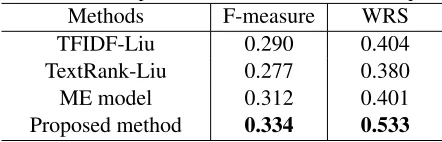
The proposed method is compared with three pre-vious studies. The first two are the methods pro-posed by Liu et al. (2009) One is the frequency-based method of TFIDF weighting with the fea-tures such as POS filtering, word clustering, and sen-tence salience score, and the other is the graph-based method with POS filtering. The last method is a maximum entropy model applied to this task (Liu et al., 2008). Note that the maximum entropy is a supervised learning model.
Table 6: The effect of considering topic relevance
Methods F-measure WRS
With topic relevance 0.334 0.533
Without topic relevance 0.291 0.458
Table 5 summarizes the comparison results. As shown in this table, the proposed method outper-forms all previous methods. Our method achieves precision of 0.311 and recall of 0.361, and thus the F-score is 0.334. The weight relative score of the proposed method is 0.533. This is the im-provement of up to 0.044 in F-measure and 0.129 in weighted relative score over other unsupervised methods (TFIDF-Liu and TextRank-Liu). It should be also noted that the proposed method outperforms even the supervised method (ME model). The differ-ence between our method and the maximum entropy model in weighted relative score is 0.132.
One possible variant of the proposed method for the ICSI corpus is to simply merge the current utter-ance graph (G1) with the history graph (G2) rather than to extract keywords from each utterance. Af-ter the current utAf-terance graph of the last utAf-terance in a topic segment is merged into the history graph, the keywords for the segment are extracted from the history graph. This variant and the proposed method both rely on the temporal history, but the difference is that the history graph of the variant accumulates all information within the topic segment. Thus, the keywords extracted from the history graph by this variant are those without consideration of topic rel-evance.
6 Conclusion
In this paper, we have proposed a just-in-time key-word extraction from meeting transcripts. Whenever an utterance is spoken, the proposed method extracts keywords from the utterance that best describe the utterance. Based on the graph representation of all components in a meeting, the proposed method ex-tracts keywords by TextRank with some graph oper-ations.
Temporal history and topic of the current utter-ance are two major factors especially in keyword ex-traction from meeting transcripts. This is because re-cent utterances are more important than old ones and only the preceding utterances of which topic is rele-vant to the current utterance are important. To model the temporal importance of the preceding utterances, the concept of forgetting curve is used in updating the history graph of preceding utterances. In addi-tion, the subgraph of the history graph that shares words appearing in the current utterance graph is used to extract keywords rather than whole history graph. The proposed method was evaluated with the National Assembly transcripts and the ICSI meeting corpus. According to our experimental results on these data sets, the performance of keyword extrac-tion is improved when we consider temporal history and topic relevance.
Acknowledgments
This research was supported by the Converging Re-search Center Program funded by the Ministry of Education, Science and Technology (2012K001342)
References
Jean Carletta. 1996. Assessing agreement on classifi-cation tasks: The kappa statistic. Computational Lin-guistics, 22(2):249–254.
Yun-Nung Chen, Yu Huang, Sheng-Yi Kong, , and Lin-Shan Lee. 2010. Automatic key term extraction from spoken course lectures using branching entropy and prosodic/semantic features. In Proceedings of IEEE Workshop on Spoken Language Technology, pages 265–270.
Eibe Frank, Gordon W. Paynter, Ian H. Witten, Carl Gutwin, and Craig G. Nevill-Manning. 1999. Domain-specific keyphrase extraction. InProceedings of the 18th International Joint Conference on Artificial intelligence, pages 668–671.
Anette Hulth. 2003. Improved automatic keyword ex-traction given more linguistic knowledge. In Proceed-ings of International Conference on Empirical Meth-ods in Natural Language Processing, pages 216–223. Adam Janin, Don Baron, Jane Edwards, Dan Ellis,
David Gelbart, Nelson Morgan, Barbara Peskin, Thilo Pfau, Elizabeth Shriberg, Andreas Stolcke, and Chuck Wooters. 2003. The icsi meeting corpus. In Proceed-ings of International Conference on Acoustics, Speech, and Signal Processing, pages 364–367.
Fei Liu, Feifan Liu, and Yang Liu. 2008. Automatic key-word extraction for the meeting corpus using super-vised approach and bigram expansion. InProceedings of IEEE Spoken Language Technology, pages 181– 184.
Feifan Liu, Deana Pennell, Fei Liu, and Yang Liu. 2009. Unsupervised approaches for automatic keyword ex-traction using meeting transcripts. InProceedings of Annual Conference of the North American Chapter of the ACL, pages 620–628.
Fei Liu, Feifan Liu, and Yang Liu. 2011. A super-vised framework for keyword extraction from meeting transcripts. IEEE Transactions on Audio, Speech, and Language Processing, 19(3):538–548.
Rada Mihalcea and Paul Tarau. 2004. Textrank: Bring-ing order into texts. InProceedings of International Conference on Empirical Methods in Natural Lan-guage Processing, pages 404–411.
Ani Nenkova and Rebecca Passonneau. 2004. Evaluat-ing content selection in summarization: The pyramid method. InProceedings of Annual Conference of the North American Chapter of the ACL, pages 145–152. Peter D. Turney. 2000. Learning algorithms for
keyphrase extraction. Information Retrieval, 2:303– 336.
Peter D. Turney. 2003. Coherent keyphrase extrac-tion via web mining. In Proceedings of the 18th In-ternational Joint Conference on Artificial intelligence, pages 434–439.
Xiaojun Wan and Jianguo Xiao. 2008. Collabrank: Towards a collaborative approach to single-document keyphrase extraction. InProceedings of International Conference on Computational Linguistics, pages 969– 976.
Xiaojun Wan, Jianwu Yang, and Jianguo Xiao. 2007. To-wards an iterative reinforcement approach for simulta-neous document summarization and keyword extrac-tion. InProceedings of the 45th Annual Meeting of the Association of Computational Linguistics, pages 552– 559.