Unsupervised Metaphor Identification Using Hierarchical Graph
Factorization Clustering
Ekaterina Shutova
International Computer Science Institute and Institute for Cognitive and Brain Sciences
University of California, Berkeley [email protected]
Lin Sun Computer Laboratory University of Cambridge [email protected]
Abstract
We present a novel approach to automatic metaphor identification, that discovers both metaphorical associations and metaphorical expressions in unrestricted text. Our sys-tem first performs hierarchical graph factor-ization clustering (HGFC) of nouns and then searches the resulting graph for metaphorical connections between concepts. It then makes use of the salient features of the metaphori-cally connected clusters to identify the actual metaphorical expressions. In contrast to pre-vious work, our method is fully unsupervised. Despite this fact, it operates with an encour-aging precision (0.69) and recall (0.61). Our approach is also the first one in NLP to exploit the cognitive findings on the differences in or-ganisation of abstract and concrete concepts in the human brain.
1 Introduction
Metaphor has traditionally been viewed as a form of linguistic creativity, that gives our expression more vividness, distinction and artistism. While this is true on the surface, the mechanisms of metaphor have a much deeper origin in our reasoning. To-day metaphor is widely understood as a cognitive phenomenon operating at the level of mental pro-cesses, whereby one concept or domain is system-atically viewed in terms of the properties of another (Lakoff and Johnson, 1980). Consider the examples (1) “Heshot downall of my arguments” and (2) “He attacked every weak point in my argument”. They demonstrate a metaphorical mapping of the concept ofargumentto that ofwar. Theargument, which is the target concept, is viewed in terms of abattle(or
awar), the source concept. The existence of such a link allows us to systematically describearguments using the war terminology, thus leading to a num-ber of metaphorical expressions. Lakoff and John-son call such generalisations a source–target domain mapping, orconceptual metaphor.
The ubiquity of metaphor in language has been established in a number of corpus studies (Cameron, 2003; Martin, 2006; Steen et al., 2010; Shutova and Teufel, 2010) and the role it plays in human reasoning has been confirmed in psychological ex-periments (Thibodeau and Boroditsky, 2011). This makes metaphor an important research area for com-putational and cognitive linguistics, and its auto-matic processing indispensable for any semantics-oriented NLP application. The problem of metaphor modeling is gaining interest within NLP, with a growing number of approaches exploiting statisti-cal techniques (Mason, 2004; Gedigian et al., 2006; Shutova, 2010; Shutova et al., 2010; Turney et al., 2011; Shutova et al., 2012). Compared to more traditional approaches based on hand-coded knowl-edge (Fass, 1991; Martin, 1990; Narayanan, 1997; Narayanan, 1999; Feldman and Narayanan, 2004; Barnden and Lee, 2002; Agerri et al., 2007), these more recent methods tend to have a wider cover-age, as well as be more efficient, accurate and ro-bust. However, even the statistical metaphor pro-cessing approaches so far often focused on a lim-ited domain or a subset of phenomena (Gedigian et al., 2006; Krishnakumaran and Zhu, 2007), and only addressed one of the metaphor processing sub-tasks: identification of metaphorical mappings (Ma-son, 2004) or identification of metaphorical expres-sions (Shutova et al., 2010; Turney et al., 2011). In this paper, we present the first computational method
that identifies the generalisations that govern the production of metaphorical expressions, i.e. con-ceptual metaphors, and then uses these generalisa-tions to identify metaphorical expressions in unre-stricted text. As opposed to previous works on sta-tistical metaphor processing that were supervised or semi-supervised, and thus required training data, our method is fully unsupervised. It relies on building a hierarchical graph of concepts connected by their as-sociation strength (using hierarchical clustering) and then searching for metaphorical links in this graph.
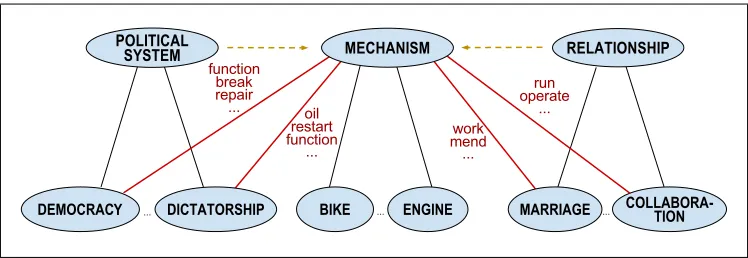
Shutova et al. (2010) introduced the hypothesis of “clustering by association” and claimed that in the course of distributional noun clustering, abstract concepts tend to cluster together if they are associ-ated with the same source domain, while concrete concepts cluster by meaning similarity. We share this intuition, but take this idea a significant step further. Our approach is theoretically grounded in the cognitive science findings suggesting that ab-stract and concrete concepts are organised differ-ently in the human brain (Crutch and Warrington, 2005; Binder et al., 2005; Wiemer-Hastings and Xu, 2005; Huang et al., 2010; Crutch and Warring-ton, 2010; Adorni and Proverbio, 2012). Accord-ing to Crutch and WarrAccord-ington (2005), these differ-ences emerge from their general patterns of relation with other concepts. However, most NLP systems to date treat abstract and concrete concepts as iden-tical. In contrast, we incorporate this distinction into our model by creating a network (or a graph) of concepts, and automatically learning the differ-ent patterns of association of abstract and concrete concepts with other concepts. We expect that, while concrete concepts would tend to naturally organise into a tree-like structure (with more specific terms descending from the more general terms), abstract concepts would exhibit a more complex pattern of associations. Consider the example in Figure 1. The figure schematically shows a small portion of the graph describing the concepts of mechanism (con-crete), political system and relationship (abstract) at two levels of generality. One can see from this graph that if concrete concepts, such asbike or en-ginetend to be connected to only one concept at the higher level in the hierarchy (mechanism), abstract concepts may have multiple higher-level associates: the literal ones and the metaphorical ones. For
ex-ample, the abstract concept of democracy is liter-ally associated with a more general concept of po-litical system, as well as metaphorically associated with the concept of mechanism. Such multiple as-sociations are due to the fact that political systems are metaphorically viewed asmechanisms, they can function, break, they can beoiledetc. We often dis-cuss them usingmechanismterminology, and thus a corpus-based distributional learning approach would learn that they share features withpolitical systems (from their literal uses), as well as withmechanisms (from their metaphorical uses, as shown next to the respective graph edges in the figure). Our system discovers such association patterns within the graph and uses them to identify metaphorical connections between the concepts.
To the best of our knowledge, our method is the first one to use a hierarchical clustering model for the metaphor processing task. The original graph of concepts is built using hierarchical graph factoriza-tion clustering (HGFC) (Yu et al., 2006) of nouns, yielding a network of clusters with different levels of generality. The weights on the edges of the graph indicate association between the clusters (concepts). HGFC has not been previously employed for noun clustering in NLP, but showed successful results in the verb clustering task (Sun and Korhonen, 2011).
In summary, our system (1) builds a graph of con-cepts usingHGFC, (2) traverses it to find metaphor-ical associations between clusters using weights on the edges of the graph, (3) generates lists of salient features for the metaphorically connected clusters and (4) searches the British National Corpus (BNC) (Burnard, 2007) for metaphorical expressions de-scribing the target domain concepts using the verbs from the set of salient features. We evaluated the performance of the system with the aid of human judges in precision- and recall-oriented settings. In addition, we compared its performance to that of two baselines, an unsupervised baseline using agglom-erative clustering (AGG) and a supervised baseline built upon WordNet (Fellbaum, 1998) (WN).
2 Method
2.1 Dataset and Feature Extraction
Figure 1: Organisation of the hierarchical graph of concepts
Following previous semantic noun classification ex-periments (Pantel and Lin, 2002; Bergsma et al., 2008), we use the grammatical relations (GRs) as features for clustering. We extracted the fea-tures from the Gigaword corpus (Graff et al., 2003), which was first parsed using the RASP parser (Briscoe et al., 2006). The verb lemmas in VERB–SUBJECT, VERB–DIRECT OBJECT and VERB–INDIRECT OBJECT relations with the nouns in the dataset were then extracted from the GR out-put of the parser. The feature values were the relative frequencies of the features.
2.2 Hierarchical Graph Factorization Clustering
The most widely used method for hierarchical word clustering is AGG (Schulte im Walde and Brew, 2001; Stevenson and Joanis, 2003; Ferrer, 2004; Devereux and Costello, 2005). The method treats each word as a singleton cluster and then succes-sively merges two closest clusters until all the clus-ters have been merged into one. The cluster simi-larity is measured using linkage criteria (e.g. Ward (1963) measures the decrease in variance for the clusters being merged). As opposed to this, HGFC derives probabilistic bipartite graphs from the sim-ilarity matrix (Yu et al., 2006). Since we require a graph of concepts, our task is rather different from standard hierarchical word clustering that produces a tree of concepts. In a tree, each word can only have a unique parent cluster at each level. Our con-cept graph does not have this constraint: at any level a word can be associated with an arbitrary number of parent clusters. Therefore, not only HGFC out-performed agglomerative clustering methods in
hi-erarchical clustering tasks (Yu et al., 2006; Sun and Korhonen, 2011), but its hierarchical graph output is also a more suitable representation of the concept graph. In addition,HGFC can detect the number of levels and the number of clusters on each level of the hierarchical graph automatically. This is essen-tial for our task as these settings are difficult to pre-define for a general-purpose concept graph.
Given a set of nouns,V ={vn}Nn=1, the
similar-ity matrixW forHGFCis constructed using Jensen-Shannon Divergence.W can be encoded by an undi-rected graph G(Figure 2(a)), where the nouns are mapped to vertices andWij is the edge weight be-tween verticesi andj. The graph G and the clus-ter structure can be represented by a bipartite graph
K(V, U). V are the vertices onG. U = {up}mp=1
represent the hiddenmclusters. For example, look-ing at Figure 2(b),V onGcan be grouped into three clusters u1, u2 andu3. The matrix B denotes the n×madjacency matrix, withbipbeing the connec-tion weight between the vertexviand the clusterup. Thus, B represents the connections between clus-ters at an upper and lower level of clustering. A flat clustering algorithm can be induced by assign-ing a lower level node to the parent node that has the largest connection weight. The number of clusters at any level can be determined by only counting the number of non-empty nodes (namely the nodes that have at least one lower level node associated).
The bipartite graph K also induces a similarity (W0) between vi and vj: w0ij =
Pm
p=1
bipbjp λp =
(BΛ−1BT)ij where Λ = diag(λ1, ..., λm). There-fore,B can be found by minimizing the divergence distance (ζ) between the similarity matricesW and
v1 v6 v2 v4 v3 v5 v7 v8 v9 (a) v1 v7 v6 v9 v8 v2 v3 v4 v5 u1 u2 u3 (b) u3 u1 u2 v1 v6 v2 v4 v3 v5 v7 v8 v9 (c)
u1 u2
u3 (d) v1 v7 v6 v9 v8 v2 v3 v4 v5 u1 u2 u3 q1 q2 (e)
Figure 2: (a) An undirected graphGrepresenting the similarity matrix; (b) The bipartite graph showing three clusters onG; (c) The induced clustersU; (d) The new graphG1over clustersU; (e) The new bipartite graph overG1
min
H,Λζ(W, HΛH T), s.t.
n
X
i=1
hip= 1 (1)
H =BΛ−1;ζ(X, Y) =X
ij
(xijlog
xij
yij
−xij+yij)
Yu et al. (2006) showed that this cost function is non-increasing under the update rule:
˜
hip∝hip
X
j
wij
(HΛHT) ij
λphjps.t.
X
i
˜
hip = 1 (2)
˜ λp∝λp
X
j
wij
(HΛHT) ij
hiphjps.t.
X
p
˜ λp=
X
ij
wij (3)
The cost function can thus be optimized by updating
handλalternately.
The similarity between clustersp(up, uq) can be induced fromB, as follows:
p(up, uq) = p(up)p(up|uq) = (BTD−1B)pq (4)
D = diag(d1, ..., dn)wheredi = m
X
p=0
bip
We can then construct a new graph G1 (Figure
2(d)) with the clusters U as vertices, and the clus-ter similaritypas the connection weight. The clus-tering algorithm can now be applied again (Figure 2(e)). This process can go on iteratively, leading to a hierarchical graph.
The number of levels (L) and the number of clusters (ml) are detected automatically, using the method of Sun and Korhonen (2011). Clustering starts with an initial setting of number of clusters (m0) for the first level. In our experiment, we set the
value ofm0 to 800. For the subsequent levels, ml is set to the number of non-empty clusters (bipartite graph nodes) on the parent level. The matrices B
andΛ are initialized randomly. We found that the actual initialization values have little impact on the final result. The rows inB are normalized after the initialization so the values in each row add up to one. For a wordvi, the probability of assigning it to clus-terx(pl) ∈Xlat levellis given by:
p(x(pl)|vi) =
X
Xl−1
... X
x(1)∈X1
p(x(pl)|x (l−1)
)...p(x(1)|vi)
= (D1(−1)B1D2−1B2...D−l 1Bl)ip (5)
Due to the random walk property of the graph, ml is non-increasing for higher levels (Sun and Korho-nen, 2011). The algorithm can thus terminate when all nouns are assigned to one cluster. We run 1000 iterations of updates ofhandλ(equation 2 and 3) for each two adjacent levels.
The resulting graph is composed of a set of bipar-tite graphs defined byBl, Bl−1, ..., B1. A bipartite
[image:4.612.93.524.58.208.2]are hidden anexplicit graph. The whole algorithm can be summarized as follows:
Require: NnounsV, initial number of clustersm1
Compute the similarity matrixW0fromV
Build the graphG0fromW0,l←1
whileml>1do
FactorizeGl−1to obtain bipartite graphKlwith the
adjacency matrixBl(eq. 1, 2 and 3)
Build a graph Gl with similarity matrix Wl =
BTl Dl−1Blaccording to equation 4
l←l+ 1;ml←No. non-empty clusters (eq. 5)
end while
return Bl, Bl−1...B1
2.3 Identification of Metaphorical Associations
Once we obtained the explicit graph of concepts, we can now identify metaphorical associations based on the weights connecting the clusters at different levels (eq. 5). Taking a single noun (e.g.fire) as input, the system computes the probability of its cluster mem-bership for each cluster at each level, using these weights. We expect the cluster membership prob-abilities to indicate the level of association of the input noun with the clusters. The system can then rank the clusters at each level based on these prob-abilities. We chose level 3 as the optimal level of generality for our experiments, based on our qualita-tive analysis of the graph. The system selects 6 top-ranked clusters from this level (we expect an average source concept to have no more than 5 typical tar-get associates) and excludes the literal cluster con-taining the input concept (e.g. “fire flame blaze”). The remaining clusters represent the target concepts associated with the input source concept. Example output for the input concepts offire anddisease is shown in Figure 3. One can see from the Figure that each of the noun-to-cluster mappings represents a new conceptual metaphor, e.g. EMOTIONisFIRE, VIOLENCEisFIRE,CRIMEis aDISEASEetc. These mappings are exemplified in language by a number of metaphorical expressions (e.g. “His anger will burnhim”, “violence flared again”, “it’s time they found acurefor corruption”).
2.4 Identification of Salient Features and Metaphorical Expressions
After extracting the source–target domain mappings, we now move on to the identification of the
cor-SOURCE: fire
TARGET 1: sense hatred emotion passion enthusiasm sentiment hope interest feeling resentment optimism hostility excitement anger
TARGET2: coup violence fight resistance clash rebel-lion battle drive fighting riot revolt war confrontation volcano row revolution struggle
TARGET3: alien immigrant TARGET4: prisoner hostage inmate
SOURCE: disease
TARGET 1: fraud outbreak offense connection leak count crime violation abuse conspiracy corruption ter-rorism suicide
TARGET2: opponent critic rival
TARGET3: execution destruction signing TARGET4: refusal absence fact failure lack delay
Figure 3: Discovered metaphorical associations
rage-ncsubj engulf-ncsubj erupt-ncsubj burn-ncsubj
light-dobj consume-ncsubj flare-ncsubj sweep-ncsubj
spark-dobj battle-dobj gut-idobj smolder-ncsubj
ig-nite-dobj destroy-idobj spread-ncsubj damage-idobj
light-ncsubj ravage-ncsubj crackle-ncsubj open-dobj
fuel-dobjspray-idobjroar-ncsubjperish-idobjdestroy -ncsubj wound-idobj start-dobj ignite-ncsubj injure -idobjfight-dobj rock-ncsubjretaliate-idobjdevastate -idobjblaze-ncsubjravage-idobjrip-ncsubj burn-idobj
spark-ncsubjwarm-idobjsuppress-dobjrekindle-dobj
Figure 4: Salient features forfireand theviolencecluster
responding metaphorical expressions. The system does this by harvesting the salient features that lead to the input noun being strongly associated with the extracted clusters. The salient features are selected by ranking the features according to the joint prob-ability of the feature (f) occurring both with the in-put noun (w) and the cluster (c). Under a simplified independence assumption, p(w, c|f) = p(w|f)× p(c|f). p(w|f)andp(c|f)are calculated as the ra-tio of the frequency of the feature f to the total frequency of the input noun and the cluster respec-tively. The features ranked higher are expected to represent the source domain vocabulary that can be used to metaphorically describe the target concepts. We selected the top 50 features from the ranked list. Example features (verbs and their grammatical rela-tions) extracted for the source domain nounfireand theviolencecluster are shown in Figure 4.
FEELING IS FIRE
hope lit (Subj), angerblazed (Subj), optimism raged (Subj), enthusiasmengulfed them (Subj), hatredflared (Subj), passionflared(Subj), interestlit(Subj),fuel re-sentment (Dobj), angercrackled(Subj), feelingsroared (Subj), hostilityblazed (Subj), lightwith hope (Iobj)
CRIME IS A DISEASE
curecrime (Dobj), abusetransmitted(Subj),eradicate terrorism (Dobj), suffer from corruption (Iobj),
diag-nose abuse (Dobj), combat fraud (Dobj), cope with crime (Iobj),cureabuse (Dobj),eradicatecorruption
Figure 5: Identified metaphorical expressions for the mappingsFEELING IS FIREandCRIME IS A DISEASE
quantify how well the extracted features describe the source domain (e.g. fire). We extracted nominal ar-gument distributions of the verbs in our feature lists for VERB–SUBJECT, VERB–DIRECT OBJECT and VERB–INDIRECT OBJECTrelations. We used the al-gorithm of Sun and Korhonen (2009) to create SP classes and the measure of Resnik (1993) to quantify how well a particular argument class fits the verb. Resnik measures selectional preference strength
SR(v)of a predicate as a Kullback-Leibler distance between two distributions: the prior probability of the noun class P(c) and the posterior probability of the noun class given the verbP(c|v). SR(v) =
D(P(c|v)||P(c)) = P
cP(c|v) log P(c|v)
P(c) . In order
to quantify how well a particular argument class fits the verb, Resnik defines selectional association as
AR(v, c) = S 1
R(v)P(c|v) log P(c|v)
P(c) . We rank the
nominal arguments of the verbs in our feature lists using their selectional association with the verb, and then only retain the features whose top 5 arguments contain the source concept. For example, the verb start, that is a common feature for bothfireand the violence cluster (e.g. “start a war”, “start a fire”), would be filtered out in this way, whereas the verbs flareorblazewould be retained as descriptive source domain vocabulary.
We then search the RASP-parsed BNC for gram-matical relations, in which the nouns from the target domain cluster appear with the verbs from the source domain vocabulary (e.g. “war blazed” (subj), “to fuelviolence” (dobj) for the mapping VIOLENCEis FIRE). The system thus annotates metaphorical ex-pressions in text, as well as the corresponding con-ceptual metaphors, as shown in Figure 5.
3 Evaluation and Discussion
3.1 Baselines
AGG: the agglomerative clustering baseline is constructed using SciPy implementation (Oliphant, 2007) of Ward’s linkage method (Ward, 1963). The output tree is cut according to the number of lev-els and the number of clusters of the explicit graph detected by HGFC. The resulting tree is converted into a graph by adding connections from each clus-ter to all the clusclus-ters one level above. The connec-tion weight (the cluster distance) is measured us-ing Jensen-Shannon Divergence between the cluster centroids. This graph is used in place of theHGFC graph in the metaphor identification experiments.
WN: in the WNbaseline, the WordNet hierarchy is used as the underlying graph of concepts, to which the metaphor extraction method is applied. Given a source concept, the system extracts all its sense-1 hypernyms two levels above and subsequently all of their sister terms. The hypernyms themselves are considered to represent the literal sense of the source noun and are, therefore, removed. The sister terms are kept as potential target domains.
3.2 Evaluation of Metaphorical Associations
na-tive speakers of English, participated in this exper-iment. Their agreement on the task was κ = 0.60 (n = 2, N = 150, k = 2) (Siegel and Castel-lan, 1988). The main differences in the annotators’ judgements stem from the fact that some metaphor-ical associations are less obvious and common than others, and thus need more context (or imaginative effort) to establish. Such examples, where the judges disagreed included metaphorical mappings such as INTENSITY is SPEED, GOAL is aCHILD, COLLEC -TIONis aSYSTEM,ILLNESSis aBREAKDOWN.
The system performance was then evaluated against these judgements in terms of precision (P), i.e. the proportion of the valid metaphorical map-pings among those identified. We calculated sys-tem precision (in all experiments) as an average over both annotations.HGFCoperates with a precision of
P = 0.69, whereas the baselines attainP = 0.36
(AGG) and P = 0.29 (WN). The precision of an-notator judgements against each other (the human ceiling) isP = 0.80, suggesting that this is a chal-lenging task.
Setting 2: To measure recall,R, of the systems we asked two annotators (both native speakers with a background in metaphor, different from Setting 1) to write down up to 5 target concepts they strongly associated with each of the 10 source concepts. Their annotations were then aggregated into a sin-gle metaphor association gold standard, consisting of 63 mappings in total. The recall of the systems was measured against this gold standard, resulting in HGFCR= 0.61,AGGR= 0.11andWNR= 0.03. As expected, HGFC outperforms both AGG and WN baselines in both settings. AGG has been pre-viously shown to be less accurate thanHGFC in the verb clustering task (Sun and Korhonen, 2011). Our analysis of the noun clusters indicated that HGFC tends to produce more pure and complete clusters than AGG. Another important reason AGG fails is that it by definition organises all concepts into tree and optimises its solution locally, taking into ac-count a small number of clusters at a time. How-ever, being able to discover connections between more distant domains and optimising globally over all concepts is crucial for metaphor identification. This makesAGGless suitable for the task, as demon-strated by our results. However, AGG identified a number of interesting mappings missed by HGFC,
e.g. CAREER IS A CHILD, LANGUAGE IS A SYS -TEM, CORRUPTION IS A VEHICLE, EMPIRE IS A CONSTRUCTION, as well as a number of mappings in common withHGFC, e.g.DEBATE IS A WAR,DE -STRUCTION IS A DISEASE. The WN system also identified a few interesting metaphorical mappings (e.g. COGNITION IS FIRE, EDUCATION IS CON -STRUCTION), but its output is largely dominated by the concepts similar to the source noun and contains some unrelated concepts. The comparison ofHGFC toWNshows thatHGFCidentifies meaningful prop-erties and relations of abstract concepts that can not be captured in a tree-like classification (even an ac-curate, manually created one). The latter is more ap-propriate for concrete concepts, and a more flexible representation is needed to model abstract concepts. The fact that both baselines identified some valid metaphorical associations, relying on less suitable conceptual graphs, suggests that our way of travers-ing the graph is a viable approach in principle.
HGFC identifies valid metaphorical associations for a range of source concepts. On of them (CRIME IS A VIRUS) happened to have been already vali-dated in psychological experiments (Thibodeau and Boroditsky, 2011). The most frequent type of error ofHGFC is the presence of target clusters similar or closely related to the source noun (e.g. the parent cluster forchild). The clusters from the same do-main can, however, be filtered out if their nouns fre-quently occur in the same documents with the source noun (in a large corpus), i.e. by topical similarity. The latter is less likely for the metaphorically con-nected nouns. We intend to implement this improve-ment in the future version of the system.
3.3 Evaluation of Metaphorical Expressions
HLJ 26 [..] ”effective action” was needed toeradicate terrorism, drug-traffickingandcorruption.
EG0 275 In the 1930s the words ”means test” was a curse,fuelling the resistanceagainst it both among the unemployed and some of its administrators.
CRX 1054 [..] if the rehabilitative approach were demonstrably successful incuring crime.
HL3 1206 [..] he would strive toaccelerate progress towards the economic integration of the Caribbean. HXJ 121 [..] it is likely that someindustries will flour-ishin certain countries as themarket widens.
Figure 6: Metaphors tagged by the system (in bold)
whereby the main source of disagreement was the presence of lexicalized metaphors, e.g. verbs such as impose, decline etc. The system performance against these annotations isP = 0.65(HGFC),P = 0.47(AGG) andP = 0.12(WN). The human ceiling for this task was measured at P = 0.79. Figure 6 shows example sentences annotated by HGFC. The performance of our unsupervised approach is close to the previous supervised systems of Mason (2004) (accuracy of 0.73) and Shutova et al. (2010) (preci-sion of 0.79), however, the results are not directly comparable due to different experimental settings.
The system errors in this task stem from multiple word senses of the salient features or the source and target sharing some physical properties (e.g. one can “die from crime” and “die froma disease”). Some identified expressions invoke a chain of mappings (e.g. ABUSE IS A DISEASE,DISEASE IS AN ENEMY for “combat abuse”), however, such chains are not yet incorporated into the system. The performance ofAGGis higher than in the mappings identification task, since it outputs only few expressions for the incorrect mappings. In contrast, WNtagged a large number of literal expressions due to the incorrect prior identification of the underlying associations.
Since there is no large metaphor-annotated corpus available, it was impossible for us to reliably evalu-ate the recall of metaphorical expressions. However, we estimated it as a recall of salient features. We manually compiled sets of typical features for the 10 source domains, and measured their recall among the top 50HGFCfeatures atR= 0.70. However, in practice the coverage in this task would directly de-pend on that of the metaphorical associations.
4 Related Work
One of the first attempts to identify and interpret metaphorical expressions in text is the met* sys-tem of Fass (1991), that utilizes hand-coded knowl-edge and detects non-literalness via selectional pref-erence violation. In case of a violation, the re-spective phrase is first tested for being metonymic using hand-coded patterns (e.g. CONTAINER-FOR -CONTENT). If this fails, the system searches the knowledge base for a relevant analogy in order to discriminate metaphorical relations from anomalous ones. The system of Krishnakumaran and Zhu (2007) uses WordNet (the hyponymy relation) and word bigram counts to predict verbal, nominal and adjectival metaphors at the sentence level. The au-thors discriminate between conventional metaphors (included in WordNet) and novel metaphors. Birke and Sarkar (2006) present a sentence clustering ap-proach that employs a set of seed sentences an-notated for literalness and computes similarity be-tween the new input sentence and all of the seed sen-tences. The system then tags the sentence as literal or metaphorical according to the annotation in the most similar seeds, attaining an f-score of 53.8%.
a result, the system can recognize new metaphorical expressions in unrestricted text (e.g. from the seed “stir excitement” it infers that “swallow anger” is also a metaphor), achieving a precision of 79%.
Turney et al. (2011) classify verbs and adjectives as literal or metaphorical based on their level of con-creteness or abstractness in relation to a noun they appear with. They learn concreteness rankings for words automatically (starting from a set of exam-ples) and then search for expressions where a con-crete adjective or verb is used with an abstract noun (e.g. “dark humour” is tagged as a metaphor and “dark hair” is not). They report an accuracy of 73%.
5 Conclusions and Future Directions
Previous research on metaphor addressed a num-ber of different aspects of the phenomenon, and has shown that these aspects can be successfully mod-eled using statistical techniques. However, the meth-ods often focused on a limited domain and needed manually-labeled training data. This made them dif-ficult to apply in a real-world setting with the goal of improving semantic interpretation in NLP at large. Our method takes a step towards this direction. It is fully unsupervised, and thus more robust, and can perform accurate metaphor identification in unre-stricted text. It identifies metaphor with a precision of 69% and a recall of 61%, which is a very encour-aging result for an unsupervised method. We be-lieve that this work has important implications for computational and cognitive modeling of metaphor, but is also applicable to a range of other seman-tic tasks within NLP. Integrating different represen-tations of abstract and concrete concepts into NLP systems may improve their performance, as well as make the models more cognitively plausible.
One of our key future research objectives is to in-vestigate the use and adaptation of the created con-ceptual graph to perform metaphor interpretation. In addition, we plan to extend this work to cover nom-inal and adjectival metaphors, by harvesting salient nominal and adjectival features.
Acknowledgments
This work was funded by the MetaNet project (grant number W911NF-12-C-0022) and the Dorothy Hodgkin Postgraduate Award.
References
Roberta Adorni and Alice Mado Proverbio. 2012. The neural manifestation of the word concreteness effect: An electrical neuroimaging study. Neuropsychologia, 50(5):880 – 891.
Rodrigo Agerri, John Barnden, Mark Lee, and Alan Wallington. 2007. Metaphor, inference and domain-independent mappings. In Proceedings of
RANLP-2007, pages 17–23, Borovets, Bulgaria.
John Barnden and Mark Lee. 2002. An artificial intel-ligence approach to metaphor understanding. Theoria
et Historia Scientiarum, 6(1):399–412.
Shane Bergsma, Dekang Lin, and Randy Goebel. 2008. Discriminative learning of selectional preference from unlabeled text. InProceedings of the Conference on
Empirical Methods in Natural Language Processing, EMNLP ’08, pages 59–68, Honolulu, Hawaii. Jeffrey R. Binder, Chris F. Westbury, Kristen A.
McKier-nan, Edward T. Possing, and David A. Medler. 2005. Distinct brain systems for processing concrete and ab-stract concepts. Journal of Cognitive Neuroscience, 17(6):905–917.
Julia Birke and Anoop Sarkar. 2006. A clustering ap-proach for the nearly unsupervised recognition of non-literal language. InIn Proceedings of EACL-06, pages 329–336.
Ted Briscoe, John Carroll, and Rebecca Watson. 2006. The second release of the rasp system. In
Proceed-ings of the COLING/ACL on Interactive presentation sessions.
Lou Burnard. 2007. Reference Guide for the British
Na-tional Corpus (XML Edition).
Lynne Cameron. 2003. Metaphor in Educational
Dis-course. Continuum, London.
Sebastian J. Crutch and Elizabeth K. Warrington. 2005. Abstract and concrete concepts have struc-turally different representational frameworks. Brain, 128(3):615–627.
Sebastian J Crutch and Elizabeth K Warrington. 2010. The differential dependence of abstract and concrete words upon associative and similarity-based informa-tion: Complementary semantic interference and facil-itation effects. Cognitive Neuropsychology, 27(1):46– 71.
Barry Devereux and Fintan Costello. 2005. Propane stoves and gas lamps: How the concept hierarchy in-fluences the interpretation of noun-noun compounds. InProceedings of the Twenty-Seventh Annual
Confer-ence of the Cognitive SciConfer-ence Society.
Dan Fass. 1991. met*: A method for discriminating metonymy and metaphor by computer.Computational
Jerome Feldman and Srini Narayanan. 2004. Embodied meaning in a neural theory of language. Brain and
Language, 89(2):385–392.
Christiane Fellbaum, editor. 1998. WordNet: An
Elec-tronic Lexical Database (ISBN: 0-262-06197-X). MIT Press, first edition.
Eva E. Ferrer. 2004. Towards a semantic classification of spanish verbs based on subcategorisation information. InProceedings of the ACL 2004 workshop on Student
research, page 13. Association for Computational Lin-guistics.
Matt Gedigian, John Bryant, Srini Narayanan, and Bran-imir Ciric. 2006. Catching metaphors. InIn
Proceed-ings of the 3rd Workshop on Scalable Natural Lan-guage Understanding, pages 41–48, New York. David Graff, Junbo Kong, Ke Chen, and Kazuaki Maeda.
2003. English gigaword. Linguistic Data Consortium,
Philadelphia.
Hsu-Wen Huang, Chia-Lin Lee, and Kara D. Federmeier. 2010. Imagine that! erps provide evidence for distinct hemispheric contributions to the processing of con-crete and abstract concepts. NeuroImage, 49(1):1116 – 1123.
Paul Kingsbury and Martha Palmer. 2002. From TreeBank to PropBank. In Proceedings of
LREC-2002, pages 1989–1993, Gran Canaria, Canary Is-lands, Spain.
Saisuresh Krishnakumaran and Xiaojin Zhu. 2007. Hunting elusive metaphors using lexical resources. In Proceedings of the Workshop on Computational
Approaches to Figurative Language, pages 13–20, Rochester, NY.
George Lakoff and Mark Johnson. 1980. Metaphors We
Live By. University of Chicago Press, Chicago. George Lakoff, Jane Espenson, and Alan Schwartz.
1991. The master metaphor list. Technical report, University of California at Berkeley.
James Martin. 1990. A Computational Model of
Metaphor Interpretation. Academic Press Profes-sional, Inc., San Diego, CA, USA.
James Martin. 2006. A corpus-based analysis of con-text effects on metaphor comprehension. In A. Ste-fanowitsch and S. T. Gries, editors,Corpus-Based
Ap-proaches to Metaphor and Metonymy, Berlin. Mouton de Gruyter.
Zachary Mason. 2004. Cormet: a computational, corpus-based conventional metaphor extraction sys-tem. Computational Linguistics, 30(1):23–44. Srini Narayanan. 1997. Knowledge-based Action
Repre-sentations for Metaphor and Aspect (KARMA). Tech-nical report, PhD thesis, University of California at Berkeley.
Srini Narayanan. 1999. Moving right along: A compu-tational model of metaphoric reasoning about events. InProceedings of AAAI 99), pages 121–128, Orlando, Florida.
Travis E. Oliphant. 2007. Python for scientific comput-ing.Computing in Science and Engineering, 9:10–20. Patrick Pantel and Dekang Lin. 2002. Discovering word senses from text. InProceedings of the eighth ACM
SIGKDD international conference on Knowledge dis-covery and data mining, pages 613–619. ACM. Philip Resnik. 1993. Selection and Information: A
Class-based Approach to Lexical Relationships. Ph.D. thesis, Philadelphia, PA, USA.
Sabine Schulte im Walde and Chris Brew. 2001. Induc-ing German semantic verb classes from purely syntac-tic subcategorisation information. InACL ’02:
Pro-ceedings of the 40th Annual Meeting on Association for Computational Linguistics, pages 223–230, Mor-ristown, NJ, USA. Association for Computational Lin-guistics.
Ekaterina Shutova and Simone Teufel. 2010. Metaphor corpus annotated for source - target domain map-pings. In Proceedings of LREC 2010, pages 3255– 3261, Malta.
Ekaterina Shutova, Lin Sun, and Anna Korhonen. 2010. Metaphor identification using verb and noun cluster-ing. InProceedings of Coling 2010, pages 1002–1010, Beijing, China.
Ekaterina Shutova, Simone Teufel, and Anna Korhonen. 2012. Statistical Metaphor Processing.
Computa-tional Linguistics, 39(2).
Ekaterina Shutova. 2010. Automatic metaphor inter-pretation as a paraphrasing task. In Proceedings of
NAACL 2010, pages 1029–1037, Los Angeles, USA. Sidney Siegel and N. John Castellan. 1988.
Nonpara-metric statistics for the behavioral sciences. McGraw-Hill Book Company, New York, USA.
Gerard J. Steen, Aletta G. Dorst, J. Berenike Herrmann, Anna A. Kaal, Tina Krennmayr, and Trijntje Pasma. 2010. A method for linguistic metaphor
identifica-tion: From MIP to MIPVU. John Benjamins, Ams-terdam/Philadelphia.
Suzanne Stevenson and Eric Joanis. 2003. Semi-supervised verb class discovery using noisy features. InProceedings of HLT-NAACL 2003, pages 71–78. Lin Sun and Anna Korhonen. 2009. Improving
verb clustering with automatically acquired selectional preferences. In Proceedings of EMNLP 2009, pages 638–647, Singapore, August.
Lin Sun and Anna Korhonen. 2011. Hierarchical verb clustering using graph factorization. In Proceedings
Paul H. Thibodeau and Lera Boroditsky. 2011. Metaphors we think with: The role of metaphor in rea-soning.PLoS ONE, 6(2):e16782, 02.
Peter D. Turney, Yair Neuman, Dan Assaf, and Yohai Cohen. 2011. Literal and metaphorical sense iden-tification through concrete and abstract context. In
Proceedings of the Conference on Empirical Meth-ods in Natural Language Processing, EMNLP ’11, pages 680–690, Stroudsburg, PA, USA. Association for Computational Linguistics.
Joe H. Ward. 1963. Hierarchical grouping to optimize an objective function. Journal of the American statistical
association, 58(301):236–244.
Katja Wiemer-Hastings and Xu Xu. 2005. Content Dif-ferences for Abstract and Concrete Concepts.
Cogni-tive Science, 29(5):719–736.
Kai Yu, Shipeng Yu, and Volker Tresp. 2006. Soft clustering on graphs. Advances in Neural Information