Unsupervised Learning of Prototypical Fillers
for Implicit Semantic Role Labeling
Niko SchenkandChristian Chiarcos Applied Computational Linguistics Lab Goethe University Frankfurt am Main, Germany {n.schenk,chiarcos}@em.uni-frankfurt.de
Abstract
Gold annotations for supervised implicit se-mantic role labeling are extremely sparse and costly. As a lightweight alternative, this paper describes an approach based on unsupervised parsing which can do without iSRL-specific training data: We induce prototypical roles from large amounts of explicit SRL annota-tions paired with their distributed word repre-sentations. An evaluation shows competitive performance with supervised methods on the SemEval 2010 data, and our method can eas-ily be applied to predicates (or languages) for which no training annotations are available.
1 Introduction
Semantic role labeling (SRL) (Gildea and Jurafsky, 2002) has become a well-established and highly im-portant NLP component which directly benefits var-ious downstream applications, such as text summa-rization (Trandab˘at¸, 2011), recognizing textual en-tailment (Sammons et al., 2012) or QA systems (Shen and Lapata, 2007; Moreda et al., 2011). Its goal is to detect verbal or nominal predicates, to-gether with their associated arguments and semantic roles, either by PropBank/Nombank (Palmer et al., 2005; Meyers et al., 2004) or FrameNet (Baker et al., 1998) analysis. In its traditional form, however, SRL is restricted to thelocal syntactic context of the predicateas in the following example from Ruppen-hofer et al. (2010):
[GOAL/NIIn the centre of this room] there
was an upright beam, [THEMEwhich] had been placed[TIMEat some period] as a support for
the old worm-eaten baulk of timber which spanned the roof.
In a FrameNet-style analysis of the sentence, the predicate place evokes the PLACING frame,
with two frame elements (roles) overtly expressed (THEMEand TIME) but with one role – GOAL–
be-yond the embedded relative clause and thus bebe-yond the scope of the SRL parser. Such implicit roles, or
null instantiations(NIs) (Fillmore, 1986; Ruppen-hofer, 2005) are much harder to detect automatically, as they require to broaden the analysis to the sur-rounding discourse, commonly also to preceding (or following) sentences.
State-of-the-art approaches to implicit SRL (iSRL) are supervised and need a groundwork of hand-annotated training data – which is costly, ex-tremely sparse, limited to only a handful of predi-cates, and requires careful feature engineering (Ger-ber and Chai, 2012; Sil(Ger-berer and Frank, 2012; Li et al., 2015). A first attempt has been made to combine the scarce resources available (Feizabadi and Pad´o, 2015), but given the great diversity of predicate-specific roles and enormous complexity of the task, the main issues remain (Chen et al., 2010).
A promising exploratory effort recently made by Gorinski et al. (2013) aims to overcome the anno-tation bottleneck by using distributional methods to infer evidence for elements filling null instantiated roles. The authors do not rely on gold annotations but instead learn distributional properties of fillers induced from a large corpus.
Our Contribution: We propose an extension of the distributional idea for unsupervised iSRL to loosen the need for annotated training data. Specifically, we
propose to induce predicate and role-specific proto-typical fillersfrom large amounts of SRL annotated texts in order to resolve null instantiations as (se-mantically and syntactically) similar elements found in the context. Parts of our approach have been suc-cessfully applied in traditional SRL (Hermann et al., 2014), but not yet to implicit roles. Our work dif-fers from Gorinski et al. (2013) in that we extend discrete context vectors to SRL-guided embeddings and experiment with a variety of different configu-rations. We intendnotto set a new benchmark beat-ing the current state-of-the-art forsupervisediSRL, but rather provide a simple and alternative strategy which does not rely on manually annotated gold data. Still, we demonstrate that our method is highly competitive with supervised methods on one out of two standard evaluation sets and that it can easily be extended to other predicates for which no implicit gold annotations are available.
2 Method
2.1 Prototypical Fillers
We use large amounts ofexplicitSRL annotations to compute predicate-specificprotofillers(prototypical fillers) for each frame element (role) individually:
#»
vprotofiller = 1
N
N
X
i=0
E(wi) (1)
whereN is the total number of tokens filling a par-ticular role andE(·)is an embedding function which maps a wordwito its distributed representation, i.e., a precomputed vector of d dimensions. Note that only those words contribute to the protofiller of a frame element which occur in this role.
2.2 Identifying Null Instantiations
Our approach generalizes over labeled filler in-stances of the frame (PLACING in the example) as
found in corpus data, e.g.,placed on the middle pic-ture, planted on the top of the church, hung over the river, laid on the table, etc. We exploit their syntactic (here: prepositional) and semantic prop-erties (inanimate, spacial NPs) in order to capture a composed meaning and thus to approximate the correct implicit rolein the centre of this room. We measure similarity between a trained protofiller #»vp
and a candidate constituent #»vc by cosine similar-ity cos(θ) = #»vp·#»vc
k#»vpkk#»vck and predict a candidate as
null instantiation which maximizes the inner prod-uct with the protofiller. As candidate constituents for an implicit argument we initially consider all ter-minal and non-terter-minal nodes in a context window of the predicate, ruling out those categories which never occur as implicit arguments, which do contain the target predicate and/or which are already overt arguments. The result set comprises mainly nouns, verbs and PPs. Candidate constituents in our evalua-tion data are available from their respective (manual) syntax annotation, but could easily be extracted us-ing automated phrase-structure parsers. The candi-datevectorsfor arbitrary length n-grams are derived in the same way (by means of Equation 1).
2.3 Training Resources & Tools
In accordance with domain-specific evaluation data, we chose to learn protofillers on two distinct cor-pora: The Corpus of Late Modern English Texts, CLMET (Smet, 2005) (≈35M tokens, 18th–20th century novels) and a subset of the English Giga-word corpus (Graff and Cieri, 2003) (≈500M to-kens of Newswire texts). We label the first one with SEMAFOR1(Das et al., 2014), a FrameNet-style se-mantic parser. We employ MATE2 (Bj¨orkelund et al., 2009) to obtain a PropBank/NomBank analysis for each sentence in Gigaword.
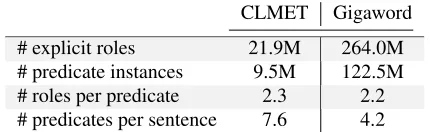
[image:2.612.318.533.463.529.2]CLMET Gigaword # explicit roles 21.9M 264.0M # predicate instances 9.5M 122.5M # roles per predicate 2.3 2.2 # predicates per sentence 7.6 4.2
Table 1: Statistics on the number of explicit fillers used for training protofillers.
Table 1 highlights general statistics on the number of predicates collected from both corpora. Two ob-servations are worth noting: While on average the number of explicitly realized roles/frame elements per predicate/frame in both data sets is similar, we find more predicate instances in CLMET than in Gi-gaword. This is due to the FrameNet lexicon and its more fine-grained modeling of lexical units, as
opposed to PropBank. Also note that FrameNet currently specifies 9.7 frame elements per lexical frame3which – despite the fact that this number also comprises non-core arguments – is much larger than what can explicitly be labeled by the SRL systems.
Regarding the distributional component, we ex-perimented with a variety of distributed word repre-sentations: We chose out of the box vectors; Col-lobert et al. (2011), dependency-based word embed-dings (Levy and Goldberg, 2014) and the pre-trained Google News vectors fromword2vec4 (Mikolov et al., 2013). Using the same tool, we also trained cus-tom embeddings (bag-of-words and skip-gram) with 50 dimensions on our two corpora.
3 Evaluation
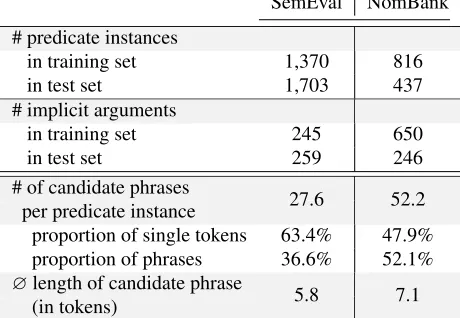
In order to assess the usefulness of our approach, a quantitative evaluation has been conducted on two iSRL test sets which have become a de facto stan-dard in this domain: a collection of fiction novels from the SemEval 2010 Shared Task with manual annotations of null instantiations (Ruppenhofer et al., 2010), and Gerber and Chai (2010)’s augmented NomBank data set. Table 2 shows some general statistics on the number of implicit roles and can-didate phrases involved in our experiments. As to have a comparison with the supervised approaches referred to in this study, we also provide the size of the training data.
SemEval NomBank # predicate instances
in training set 1,370 816
in test set 1,703 437
# implicit arguments
in training set 245 650
in test set 259 246
# of candidate phrases
per predicate instance 27.6 52.2 proportion of single tokens 63.4% 47.9% proportion of phrases 36.6% 52.1%
∅length of candidate phrase
[image:3.612.315.541.302.382.2](in tokens) 5.8 7.1
Table 2:Statistics on implicit arguments and candidate phrases from the test sections of the two evaluation sets.
3https://framenet.icsi.berkeley.edu/
fndrupal/current_status, accessed March 2016. 4https://code.google.com/p/word2vec/
3.1 SemEval Data
In Table 4, we report the classification scores for the (NI-only) null instantiation linking task on the SemEval data, given the parsed candidate phrases and the gold information about the missing frame element.5For space reasons, we only include the re-sults of our best-performing configuration, obtained from protofillers trained on the late modern English texts and Collobert et al. (2011) embeddings (C&W) with the search space for candidate NIs limited to the current and previous sentence. As a reference, we compare our results to the two best models (M1and
M10) by Silberer and Frank (2012), the vector-based
resolver (VEC) by Gorinski et al. (2013) – which is
most similar to ours – and, finally, their ensemble combination of four semantically informed resolvers by majority vote (4X).
P R F1
Silberer and Frank (2012) M1 30.8 25.1 27.7
Silberer and Frank (2012) M10 35.6 20.1 25.7
Gorinski et al. (2013) VEC 21.0 18.0 19.0 Gorinski et al. (2013) 4X 26.0 24.0 25.0 This paper: C&W embeddings 27.2 25.7 26.4
Table 4:NI linking performance on the SemEval test data.
The figures in Table 4 suggest that our approach clearly outperforms the vector-based method by Gorinski et al. (2013) and is best in terms of over-all recognition rate (recover-all) among over-all systems. One potential reason for that might be that, in contrast to the VECresolver, we do not compute mere
con-text vectors but do rely on the valuable annotations obtained from explicit SRL structures. Also, we do not restrict our analysis tohead words only, as we have seen that syntactic information from function words is crucial for the resolution of null instantiated roles, too. Moreover, our distributional protofiller method is highly competitive with state-of-the-art performance by Silberer and Frank (2012), yet does not yield better results in terms ofF1 score. Note
[image:3.612.72.302.474.633.2]B Gerber & Chai Laparra & Rigau Proto C&W Proto W2Vcbow
predicates: F1 P R F1 P R F1 P R F1 P R F1
[image:4.612.72.540.60.229.2]sale 36.2 47.2 41.7 44.2 41.2 39.4 40.3 61.0 29.6 39.8 60.8 26.8 37.2 price 15.4 36.0 32.6 34.2 53.3 53.3 53.3 14.7 25.8 18.7 21.8 36.6 27.3 investor 9.8 36.8 40.0 38.4 43.0 39.5 41.2 22.5 48.3 30.7 24.1 57.2 33.9 bid 32.3 23.8 19.2 21.3 52.9 51.0 52.0 30.4 31.5 30.9 40.0 41.5 40.7 plan 38.5 78.6 55.0 64.7 40.7 40.7 40.7 41.1 43.2 42.1 44.3 51.0 47.4 cost 34.8 61.1 64.7 62.9 56.1 50.2 53.0 32.5 19.1 24.0 49.9 29.3 36.9 loss 52.6 83.3 83.3 83.3 68.4 63.5 65.8 54.8 73.1 62.6 54.7 63.8 58.9 loan 18.2 42.9 33.3 37.5 25.0 20.0 22.2 33.9 49.0 40.1 33.2 44.2 37.9 investment 0.0 40.0 25.0 30.8 47.6 35.7 40.8 29.1 21.8 24.9 39.2 34.3 36.6 fund 0.0 14.3 16.7 15.4 66.7 33.3 44.4 100.0 33.3 50.0 75.0 25.0 37.5 Overall 26.5 44.5 40.4 42.3 47.9 43.8 45.8 30.2 35.2 32.5 33.5 39.2 36.1
Table 3:Classification scores for implicit argument labeling on the NomBank test section. BaselineBfrom Gerber & Chai (2010): uses previous occurrence of same predicate. Gerber & Chai (2010): supervised logistic regression classifier trained on implicit fillers. Laparra & Rigau (2013): algorithm based on coherence relationship between predicates and fillers. Our best-performing protofillers are obtained by Collobert et al. (2011) embeddings (Proto C&W) and custom trained vectors (Proto W2Vcbow) using Gigaword SRL annotations.
plicit semantic roles in a supervised setting. An error analysis of our method reveals that it is par-ticularly effective for NIs encountered in the same sentence as the target predicate (44.4% accuracy), which seems plausible given the contextual setup in which protofillers are derived.
3.2 NomBank Data
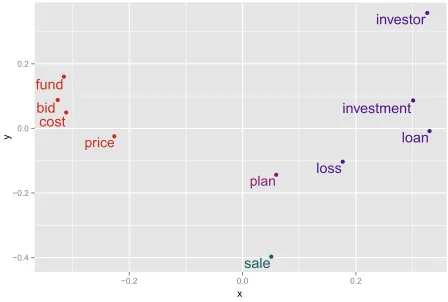
Compared to the SemEval data, Gerber and Chai (2010)’s augmented NomBank resource covers only ten nominal predicates, which allows us to nicely vi-sualize the distributional profile based on their pro-totypical fillers. For each predicate, we simply con-catenate all per role computed protofillers and apply multidimensional scaling to project the so obtained vectors onto two dimensions (cf. Figure 1).
We observe that the predicate grouping is now based on the prototypical fillers that they co-occur with: In the Wall Street Journal texts,loss,loanand
investment are similar because their proto-agents (A0 fillers) who lose, lend and invest resp. are se-mantically shared (i.e. companies, banks). Simi-larly, bid, cost andfund are related in that the tar-gets or commodities (A2) are all money-financed. Finally, the predicates sale andplan are to be ex-pected as outliers as they are less homogeneous in their prototypical argument structure.
We have empirically evaluated our protofiller
sale
price
investor
bid
plan
cost
loss
loan investment
fund
−0.4
−0.2 0.0 0.2
−0.2 0.0 0.2 x
y
Figure 1: Clustered projection of the ten nominal predicates from Gerber and Chai (2010) in protofiller space.
[image:4.612.317.541.326.477.2]candidate. POS lists and cosine similarity thresholds which trigger an actual prediction have been opti-mized on the development set. The context window for candidate NIs is optimal for the current and pre-vious two sentences in our setting, which explains why the the number of candidate constituents is ap-proximately twice as large for the NomBank predi-cates (cf. Table 2).
Our best-performing protofillers are again ob-tained by Collobert et al. (2011) embeddings sub-stituting explicit SRL annotations in the Gigaword corpus, and with custom-trained embeddings using the continuous bag-of-words model. Overall, our re-sults significantly exceed the highly informed base-line but cannot beat the state-of-the art on this test set. For some predicates, the protofillers seem to generalize better (higher recall), and in particular for the low-frequency predicates (fund), precision can be increased. Also, we found that the dependency-based word embeddings do perform slightly worse (not shown), compared to our optimal two con-figurations. This might be due to the fact that the inherent properties of dependency-based con-texts mostly focus on relations between semanti-cally valuable nouns, ignoring (“skipping”) func-tional words and categories.6 The same pertains to the pre-computed Google News vectors which come with a frequency cutoff excluding stop words, again a constraint which is harmful for the correct identification of implicit roles. Furthermore, skip-gram embeddings perform significantly worse than the embeddings derived by the continuous bag-of-words implementation (relative decrease in F1 by
more than 30%). Finally, we observed that infer-ring implicit roles for nominal predicates is much more challenging because our collected fillers ex-hibit a much greater variation. For example, the protoagents ofloancan roughly be divided into two categories, institutions and countries. This in turn introduces noise and has a negative effect on the quality of the singleton protofillers which by vector average capture neither of the two groups perfectly. Promising alternatives could operate on (topic-like) protofillerclusterswhich we leave for future work.
6This is also nicely illustrated in Levy and Goldberg (2014).
4 Summary & Conclusion
We have described a lightweight approach for the resolution of implicit semantic roles which does not rely on manual gold annotations. For each predicate-specific role, our method generalizes over explicit SRL-guided annotations incorporating pre-trained word embeddings. This allows us to capture their idiosyncratic properties and use the so-inferred protofillers to find null instantiated roles by means of distributional similarity.
Our method has proven to be generally useful, in particular on the SemEval data, where it is compet-itive with supervised systems. Its greatest benefit stems from its simplicity and from that fact that it allows to induce null-instantiated roles for arbitrary predicates. As it is applicable even if no iSRL train-ing data is available, it represents a promistrain-ing tech-nique to address iSRL data scarcity issues.
In our experiment, we employed PropBank/Nom-Bank-style (i)SRL annotations, and our general de-sign clearly benefits from using small-scale inven-tories of semantic roles. It should be noted though, that our approach is not restricted to any particular SRL tagset, but can be equally applied to other role inventories with similar degrees of consistence and size. Beyond SRL annotations in a strict sense, this might even extend to syntactic dependency annota-tions that are occasionally taken as a substitute for semantic roles proper. In particular, we see poten-tial in combining our experiments with on-going ef-forts to cross-lingual projection, adaptation and har-monization of syntax annotations along the lines of Sukhareva and Chiarcos (2014, 2016) and related approaches based on frameworks such as the Uni-versal Dependencies (Nivre, 2015, UD).7If success-ful, an adaptation using grammatical relations rather than semantic roles represents a promising possibil-ity to create iSRL annotation and iSRL annotation tools for other languages, as Universal Dependen-cies are becoming increasingly available for major and low-resourced languages and can be projected to others.
The protofillers involved in this study are available at: http://acoli.cs.
uni-frankfurt.de/resources.
Acknowledgments
The authors would like to thank Joyce Chai and Hendrik De Smet for providing us access to their resources and corpora. We are grateful to Egoitz Laparra for sending us their evaluation script and also thank the anonymous reviewers for their valuable feedback and insightful comments.
References
Collin F. Baker, Charles J. Fillmore, and John B. Lowe. 1998. The Berkeley FrameNet Project. In Pro-ceedings of the 36th Annual Meeting of the Asso-ciation for Computational Linguistics and 17th In-ternational Conference on Computational Linguistics (ACL-COLIG 1998), pages 86–90, Montreal, Quebec, Canada.
Anders Bj¨orkelund, Love Hafdell, and Pierre Nugues. 2009. Multilingual Semantic Role Labeling. In
Proceedings of the Thirteenth Conference on Compu-tational Natural Language Learning (CoNLL-2009): Shared Task, pages 43–48, Boulder, Colorado, June. Desai Chen, Nathan Schneider, Dipanjan Das, and
Noah A. Smith. 2010. SEMAFOR: Frame Argument Resolution with Log-linear Models. InProceedings of the 5th International Workshop on Semantic Evalua-tion (SemEval-2010), pages 264–267, Los Angeles. Ronan Collobert, Jason Weston, L´eon Bottou, Michael
Karlen, Koray Kavukcuoglu, and Pavel Kuksa. 2011. Natural Language Processing (Almost) from Scratch.
Journal of Machine Learning Research, 12:2493– 2537.
Dipanjan Das, Desai Chen, Andr´e F. T. Martins, Nathan Schneider, and Noah A. Smith. 2014. Frame-semantic Parsing. Computational Linguistics, 40(1):9–56. Parvin S. Feizabadi and Sebastian Pad´o. 2015.
Combin-ing SeemCombin-ingly Incompatible Corpora for Implicit Se-mantic Role Labeling. InProceedings of the 4th Joint Conference on Lexical and Computational Semantics (*SEM 2015), pages 40–50, Denver, CO.
Charles J. Fillmore. 1986. Pragmatically Controlled Zero Anaphora. InProceedings of Berkeley Linguis-tics Society, pages 95–107, Berkeley, CA.
Matthew Gerber and Joyce Chai. 2010. Beyond Nom-Bank: A Study of Implicit Arguments for Nominal Predicates. In Proceedings of the 48th Annual Meet-ing of the Association for Computational LMeet-inguistics (ACL-2010), pages 1583–1592, Uppsala, Sweden. Matthew Gerber and Joyce Chai. 2012. Semantic Role
Labeling of Implicit Arguments for Nominal Predi-cates.Computational Linguistics, 38(4):755–798.
Daniel Gildea and Daniel Jurafsky. 2002. Automatic La-beling of Semantic Roles. Computational Linguistics, 28(3):245–288.
Philip Gorinski, Josef Ruppenhofer, and Caroline Sporleder. 2013. Towards Weakly Supervised Resolu-tion of Null InstantiaResolu-tions. InProceedings of the 10th International Conference on Computational Semantics (IWCS 2013), pages 119–130, Potsdam, Germany. David Graff and Christopher Cieri. 2003. English
Gi-gaword. Linguistic Data Consortium, Philadelphia, LDC2003T05. Web Download.
Karl Moritz Hermann, Dipanjan Das, Jason Weston, and Kuzman Ganchev. 2014. Semantic Frame Identifi-cation with Distributed Word Representations. In Pro-ceedings of the 52th Annual Meeting of the Association for Computational Linguistics (ACL-2014), Baltimore, Maryland.
Egoitz Laparra and German Rigau. 2012. Exploiting Explicit Annotations and Semantic Types for Implicit Argument Resolution. InProceedings of the 6th Inter-national Conference on Semantic Computing (ICSC-2012), pages 75–78.
Egoitz Laparra and German Rigau. 2013. ImpAr: A De-terministic Algorithm for Implicit Semantic Role La-belling. InProceedings of the 51st Annual Meeting of the Association for Computational Linguistics (ACL-2013), pages 1180–1189, Sofia, Bulgaria.
Omer Levy and Yoav Goldberg. 2014. Dependency-Based Word Embeddings. InProceedings of the 52nd Annual Meeting of the Association for Computational Linguistics (ACL-2014), pages 302–308, Baltimore, MD.
Ru Li, Juan Wu, Zhiqiang Wang, and Qinghua Chai. 2015. Implicit Role Linking on Chinese Discourse: Exploiting Explicit Roles and Frame-to-Frame Rela-tions. InProceedings of the 53rd Annual Meeting of the Association for Computational Linguistics and the 7th International Joint Conference on Natural Lan-guage Processing (ACL-IJCNLP 2015), pages 1263– 1271, Beijing, China.
Adam Meyers, Ruth Reeves, Catherine Macleod, Rachel Szekely, Veronika Zielinska, Brian Young, and Ralph Grishman. 2004. The NomBank Project: An In-terim Report. InProceedings of the HLT-NAACL 2004 Workshop on Frontiers in Corpus Annotation, pages 24–31, Boston, Massachusetts.
Tomas Mikolov, Kai Chen, Greg Corrado, and Jeffrey Dean. 2013. Efficient Estimation of Word Represen-tations in Vector Space. CoRR, abs/1301.3781. Paloma Moreda, Hector Llorens, Estela Saquete, and
Joakim Nivre. 2015. Towards a Universal Gram-mar for Natural Language Processing. In Proceed-ings of the 16th International Conference on Com-putational Linguistics and Intelligent Text Processing (CICLing-2015), pages 3–16, Cairo, Egypt. LNCS 9041, Springer.
Martha Palmer, Daniel Gildea, and Paul Kingsbury. 2005. The Proposition Bank: An Annotated Cor-pus of Semantic Roles. Computational Linguistics, 31(1):71–106.
Josef Ruppenhofer, Caroline Sporleder, Roser Morante, Collin Baker, and Martha Palmer. 2010. SemEval-2010 Task 10: Linking Events and Their Participants in Discourse. InProceedings of the 5th International Workshop on Semantic Evaluation (SemEval-2010), pages 45–50, Los Angeles, CA.
Josef Ruppenhofer. 2005. Regularities in Null Instantia-tion. Ms, University of Colorado.
Mark Sammons, V.G.Vinod Vydiswaran, and Dan Roth. 2012. Recognizing Textual Entailment. In Daniel M. Bikel and Imed Zitouni, editors, Multilingual Natu-ral Language Applications: From Theory to Practice, chapter 6, pages 209–258. IBM Press.
Dan Shen and Mirella Lapata. 2007. Using Seman-tic Roles to Improve Question Answering. In Pro-ceedings of the 2007 Joint Conference on Empirical Methods in Natural Language Processing and Compu-tational Natural Language Learning (EMNLP-CoNLL 2007), pages 12–21, Prague, Czech Republic.
Carina Silberer and Anette Frank. 2012. Casting Implicit Role Linking as an Anaphora Resolution Task. In Pro-ceedings of the First Joint Conference on Lexical and Computational Semantics (*SEM-2012), pages 1–10, Montreal, Quebec, Canada.
Hendrik De Smet. 2005. A Corpus of Late Modern En-glish Texts. International Computer Archive of Mod-ern and Medieval English (ICAME), 29:69–82. Maria Sukhareva and Christian Chiarcos. 2014.
Di-achronic Proximity vs. Data Sparsity in Cross-lingual Parser Projection. A Case Study on Germanic. In
COLING-2014 Workshop on Applying NLP Tools to Similar Languages, Varieties and Dialects (VarDial-2014), Dublin, Ireland.
Maria Sukhareva and Christian Chiarcos. 2016. Com-bining Ontologies and Neural Networks for Analyzing Historical Language Varieties. A Case Study in Mid-dle Low German. InProceedings of the 10th Interna-tional Conference on Language Resources and Evalu-ation (LREC-2016), Portoroˇz, Slovenia.