Proceedings of NAACL-HLT 2018, pages 493–499
Incremental Decoding and Training Methods for Simultaneous
Translation in Neural Machine Translation
Fahim Dalvi⇤
Hassan Sajjad Stephan Vogel
[email protected] [email protected]
Qatar Computing Research Institute – HBKU Nadir Durrani⇤
Abstract
We address the problem of simultaneous trans-lation by modifying the Neural MT decoder to operate with dynamically built encoder and at-tention. We propose a tunable agent which de-cides the best segmentation strategy for a user-defined BLEU loss and Average Proportion (AP) constraint. Our agent outperforms previ-ously proposed Wait-if-diff and Wait-if-worse agents (Cho and Esipova,2016) on BLEU with a lower latency. Secondly we proposed data-driven changes to Neural MT training to better match the incremental decoding framework.
1 Introduction
Simultaneous translation is a desirable attribute in Spoken Language Translation, where the transla-tor is required to keep up with the speaker. In a lec-ture or meeting translation scenario where utter-ances are long, or the end of sentence is not clearly marked, the system must operate on a buffered sequence. Generating translations for such in-complete sequences presents a considerable chal-lenge for machine translation, more so in the case of syntactically divergent language pairs (such as German-English), where the context required to correctly translate a sentence, appears much later in the sequence, and prematurely committing to a translation leads to significant loss in quality.
Various strategies to select appropriate segmen-tation points in a streaming input have been pro-posed (F¨ugen et al.,2007;Bangalore et al.,2012;
Sridhar et al., 2013;Yarmohammadi et al.,2013;
Oda et al., 2014). A downside of this approach is that the MT system translates sequences inde-pendent of each other, ignoring the context. Even if the segmenter decides perfect points to segment the input stream, an MT system requires lexical history to make the correct decision.
⇤
These authors contributed equally to this work
The end-to-end nature of the Neural MT archi-tecture (Sutskever et al., 2014; Bahdanau et al.,
2015) provides a natural mechanism1 to integrate
stream decoding. Specifically, the recurrent prop-erty of the encoder and decoder components pro-vide an easy way to maintain historic context in a fixed size vector.
We modify the neural MT architecture to oper-ate in an online fashion where i) theencoderand
theattentionare updated dynamically as new input
words are added, through aREADoperation, and ii) thedecodergenerates output from the available encoder states, through aWRITE operation. The decision of when to WRITEis learned through a tunable segmentation agent, based on user-defined thresholds. Our incremental decoder significantly outperforms the chunk-based decoder and restores the oracle performance with a deficit of2BLEU points across 4 language pairs with a moderate delay. We additionally explore whether modify-ing the Neural MT trainmodify-ing to match the decoder can improve performance. While we observed sig-nificant restoration in the case of chunk decod-ing matched with chunk-based NMT traindecod-ing, the same was not found true with our proposed incre-mental training to match the increincre-mental decoding framework.
The remaining paper is organized as follow: Section2describes modifications to the NMT de-coder to enable stream decoding. Section 3 de-scribes various agents to learn a READ/WRITE
strategy. Section 4 presents evaluation and re-sults. Section 5 describes modifications to the NMT training to mimic corresponding decoding strategy, and Section6concludes the paper.
1as opposed to the traditional phrase-based decoder (Moses), which requires pre-computation of phrase-table, future-cost estimation and separately maintaining each state-full feature (language model, OSM (Durrani et al.,2015) etc.)
Neural MT Food ﺍ ﻻ ﻣ
ﻥ ﻲﺋﺫﺍﻐﺍﻟ ﺭﻣﺃ
security matter Neural MT Food ﺍ ﻻ ﻣ
ﻥ ﻲﺋﺫﺍﻐﺍﻟ ﺭﻣﺃ ﻱﺭﻭﺭﺿ
security is an important matter
Neural MT Security ﺍ ﻻ ﻣ ﻥ Neural MT Food ﺍ ﻻ ﻣ ﻥ ﻲﺋﺫﺍﻐﺍﻟ
security
Iteration 1 Iteration 2 Iteration 3 Iteration 4 nw = 0 nw = 2 nw = 0 nw = 4
Neural MT Food ﺍ ﻻ ﻣ
ﻥ ﻲﺋﺫﺍﻐﺍﻟ ﺭﻣﺃ
securitymatter Neural MT Food ﺍ ﻻ ﻣ
ﻥ ﻲﺋﺫﺍﻐﺍﻟ ﺭﻣﺃ ﻱﺭﻭﺭﺿ
security is an important matter
Neural MT Security ﺍ ﻻ ﻣ ﻥ Neural MT Food ﺍ ﻻ ﻣ ﻥ ﻲﺋﺫﺍﻐﺍﻟ
security
[image:2.595.92.498.64.173.2]Iteration 1 Iteration 2 Iteration 3 Iteration 4 nw = 0 nw = 2 nw = 0 nw = 4
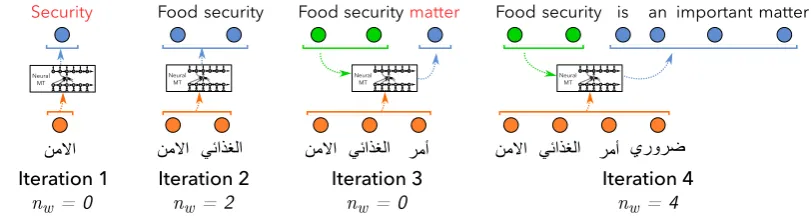
Figure 1: A decoding pass over a 4-word source sentence. nw denotes the number of words the agent chose to commit. Green nodes = committed words, Blue nodes = newly generated words in the current iteration. Words marked in red are discarded, as the agent chooses to not commit them.
2 Incremental Decoding
Problem: In a stream decoding scenario, the en-tire source sequence is not readily available. The translator must either wait for the sequence to finish in order to compute the encoder state, or commit partial translations at several intermediate steps, potentially losing contextual information.
Chunk-based Decoder: A straight forward way to enable simultaneous translation is to chop the incoming input after every N-tokens. A draw-back of these approaches is that the translation and segmentation process operate independently of each other, and the previous contextual his-tory is not considered when translating the current chunk. This information is important to generate grammatically correct and coherent translations.
Incremental Decoding: The RNN-based NMT framework provides a natural mechanism to pre-serve context and accommodate streaming. The decoder maintains the entire target history through the previous decoder state alone. But to enable in-cremental neural decoding, we have to address the following constraints: i) how to dynamically build the encoder and attention with the streaming in-put? ii) what is the best strategy to pre-commit translations at several intermediate points? Inspired by Cho and Esipova (2016), we mod-ify the NMT decoder to operate in a sequence of
READ andWRITE operations. The former reads the next word from the buffered source sequence and translates it using the available context, and the latter is computed through an AGENT, which
decides how many words should be committed from this generated translation. Note that, when a translation is generated in the READ operation, the already committed target words remain un-changed, i.e. the generation is continued from
Algorithm 1Algorithm for incremental decoder
s, Source sequence
s0, Available source sequence
tc, Committed target sequence
t, Current decoded sequence fors0
nw, Number of tokens to commit
s0 empty
fortokeninsdo .READoperation
s0 s0+token
t NMTDECODER(s0,tc) ifs06=sthen
nw AGENT(s0,tc,t) else
nw length(t) length(tc)
end if .commit all new words if we have seen the
entire source
t0c GETNEWTOKENS(tc,t,nw)
tc tc+t0c .WRITEoperation end for
functionGETNEWTOKENS(tc,t,nw)
start length(tc) + 1
end start+nw
returnt[start:end] end function
the last committed target word using the saved decoder state. See Algorithm 1 for details. The AGENTdecides how many target words toWRITE
after everyREADoperation, and has complete con-trol over the context each target word gets to see before being committed, as well as the overall de-lay incurred. Figure1shows the incremental de-coder in action, where the agent decides to not commit any target words in iterations 1 and 3. The example shows an instance where the incorrectly translated words are discarded when more context becomes available. Given this generic framework, we describe several AGENTSin Section3, trained to
optimize the BLEU loss and latency.
READ READ WRITE
beam 2 READ WRITEbeam 1
Normal Decodin
g
Incrmemental D
[image:3.595.93.270.61.188.2]ecoding
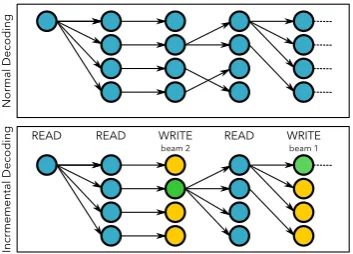
Figure 2: Beam Search in normal decoding vs incre-mental decoding. Green nodes indicate the hypoth-esis selected by the agent to WRITE. Since we can-not change what we have already committed, the other nodes (marked in yellow) are discarded and future hy-potheses originate from the selected hypothesis alone. Normal beam search is executed forconsecutiveREAD
operations (blue nodes).
complexities for beam decoding. For example, if at some iteration the decoder generates 5 new
words, but the agent decides to commit only2of
these, the best hypothesis at the2ndword may not
be the same as the one at the5thword. Hence, the
agent has to re-rank the hypotheses at the last tar-get word it decides to commit. Future hypotheses then continue from this selected hypothesis. See Figure2 for a visual representation. The overall utility of beam decoding is reduced in the case of incremental decoding, because it is necessary to commit and retain only one beam at several points to start producing output with minimal delay.
3 Segmentation Strategies
In this section, we discuss different AGENTSthat we
evaluated in our modified incremental decoder. To measure latency in these agents, we useAverage
Proportion(AP) metric as defined byCho and
Es-ipova(2016). AP is calculated as the total number of source words each target word required before being committed, normalized by the product of the source and target lengths. It varies between0and 1with lesser being better. See supplementary ma-terial for details.
Wait-until-end: The WUE agent waits for the entire source sentence before decoding, and serves as an upper bound on the performance of our agents, albeit with the worstAP = 1.
Wait-if-worse/diff: We reimplemented the baseline agents described in Cho and Esipova
(2016). TheWait-if-Worse(WIW) agentWRITES
a target word if its probability does not decrease after aREAD operation. The Wait-if-Diff(WID) agent insteadWRITESa target word if the target word remains unchanged after aREADoperation.
Static Read and Write: The STATIC-RW:
agent is inspired from the chunk-based decoder and tries to resolve its shortcomings while main-taining its simplicity. The primary drawback of the chunk-based decoder is the loss of context across chunks. Our agent starts by performing S READ
operations, followed by repeated RW WRITES
andREADSuntil the end of the source sequence. The number ofWRITEandREADoperations is the same to ensure that the gap between the source and target sequence does not increase with time. The initialSREADoperations essentially create a buffer of S tokens, allowing some future context to be used by the decoder. Note that the latency induced by this agent in this case is only in the be-ginning, and remains constant for the rest of the sentence. This method actually introduces a class
of AGENTSbased on theirS,RW values. We tune
S andRW to select the specific AGENTwith the
user-defined BLEU-loss and AP thresholds.
4 Evaluation
Data: We trained systems for 4 language pairs: German-, Arabic-, Czech- and Spanish-English pairs using the data made available for IWSLT (Cettolo et al.,2014). See supplementary material for data stats. These language pairs present a di-verse set of challenges for this problem, with Ara-bic and Czech being morphologically rich, Ger-man being syntactically divergent, and Spanish introducing local reorderings with respect to En-glish.
NMT System: We trained a 2-layered LSTM encoder-decoder models with attention using the
seq2seq-attn implementation (Kim, 2016). Please see supplementary material for settings.
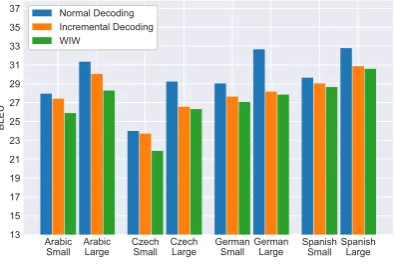
Results: Figure 3 shows the results of various streaming agents. Our proposed STATIC-RW
agent outperforms other methods while maintain-ing an AP < 0.75 with a loss of less than 0.5
BLEU points on Arabic, Czech and Spanish. This was found to be consistent for all test-sets 2011-2014 (See under “small” models in Figure4). In the case of German the loss at AP < 0.75 was
around 1.5 BLEU points. The syntactical
Figure 3: Results for various streamingAGENTS(WID,WIW,WUE,C6(Chunk decoding with a N=6) andS,RW
forSTATIC-RW) on the tune-set. For each AP bucket, we only show the Agents with the top 3 BLEU scores in
that bucket, with remaining listed in descending order of their BLEU scores.
bigger challenge and requires larger context than other language pairs. For example the conjugated verb in a German verb complex appears in the sec-ond position, while the main verb almost always occurs at the end of the sentence/phrase (Durrani et al.,2011). Our methods are also comparable to the more sophisticated techniques involving Rein-forcement Learning to learn an agent introduced byGu et al.(2017) andSatija and Pineau(2016), but without the overhead of expensive training for the agent.
Scalability: The preliminary results were ob-tained using models trained on the TED corpus only. We conducted further experiments by train-ing models on larger data-sets (See the supple-mentary section again for data sizes) to see if our findings are scalable. We fine-tuned (Luong and Manning, 2015; Sajjad et al., 2017b) our mod-els with the in-domain data to avoid domain dis-parity. We then re-ran our agents with the best
S,RW values (with an AP under 0.75) for each
language pair. Figure 4 (“large” models) shows that the BLEU loss from the respective oracle in-creased when the models were trained with big-ger data sizes. This could be attributed to the in-creased lexical ambiguity from the large amount of out-domain data, which can only be resolved with additional contextual information. However our results were still better than the WIW agent, which also has an AP value above0.8. Allowing
similar AP, ourSTATIC-RW agents were able to restore the BLEU loss to be1.5 for all language
Figure 4: Averaged results on test-sets (2011-2014) us-ing the models trained on small and large datasets usus-ing
AP 0.75. Detailed test-wise results are available in
the supplementary material.
pairs except German-English. Detailed test results are available in the suplementary material.
5 Incremental Training
The limitation of previously described decoding approaches (chunk-based and incremental) is the mismatch between training and decoding. The training is carried on full sentences, however, at the test time, the decoder generates hypothesis based on incomplete source information. This dis-crepancy between training and decoding can be potentially harmful. In Section 2, we presented two methods to address the partial input sentence decoding problem, the Chunk Decoder and the
Incremental Decoder. We now train models to
[image:4.595.319.517.323.455.2]5.1 Chunk Training
In chunk-based training, we simply split each training sentence into chunks ofN tokens.2 The
corresponding target sentence for each chunk is generated by having a span of target words that are word-aligned3 with the words in the source span.
Chunking the data into smaller segments increases the training time significantly. To overcome this problem, we train a model on the full sentences using all the data and then fine-tune it with the in-domain chunked data.
5.2 Add-M Training
Next we formulate a training mechanism to match the incremental decoding described in Section2. A way to achieve this is to force the attention on a local span of encoder states and block it from giving weight to the non-local (rightward) encoder states. The hope is that in the case of long-range dependencies, the model learns to predict these dependencies without the entire source context. Such a training procedure is non-trivial, as it re-quires dynamic inputs to the attention mechanism while training, including backpropagation where some encoder states which have been seen by the attention mechanism a greater number of times dynamically receiving more gradient inputs. We leave this idea as future work, while focusing on a data-driven technique to mimic this kind of train-ing as described below.
We start with the firstN words in a source sen-tence and generate target words that are aligned to these words. We then generate the next training in-stances withN+M,N+ 2M,N+ 3M... source words until the end of sentence has been reached.4
The resulting training roughly mimics the decod-ing scenario where the source-side context is grad-ually built. The down-side of this method is that the data size increases quadratically, making the training infeasible. To overcome this, we fine-tune a model trained on full sentences with the in-domain corpus generated using this method.
2Although randomly segmenting the source sentence based on number of tokens is a na¨ıve approach that does not take into account the linguistic properties, our goal here was to exactly match the training with the chunk-based decoding scenario.
[image:5.595.319.517.66.197.2]3We used fast-align (Dyer et al.,2013) for alignments. 4We trained withN = 6andM= 1for our experiments.
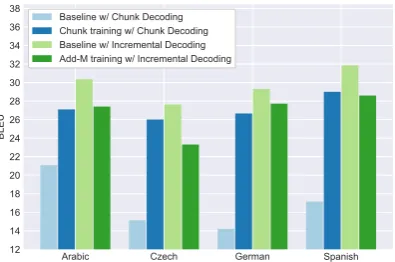
Figure 5: Averaged test set results on various training modifications
5.3 Results
The results in Figure 5 show that matching the chunk-decoding with corresponding chunk-based training significantly improves performance, with a gain of up to 12 BLEU points. However, we were not able to improve upon our incre-mental decoder, with the results deteriorating no-tably. One reason for this degradation is that the training/decoding scenarios are still not perfectly matched. The training pipeline in this case also sees the beginning of sentences much more often, which could lead to unnatural distributions being inferred within the model.
6 Conclusion
We addressed the problem of simultaneous trans-lation by modifying the architecture in Neural MT decoder. We presented a tunable agent which de-cides the best segmentation strategy based on user-defined BLEU loss and AP constraints. Our re-sults showed improvements over previously es-tablished WIW and WID methods. We addition-ally modified the Neural MT training to match the incremental decoding, which significantly im-proved the chunk-based decoding, but we did not observe any improvement usingAdd-M Training. The code for our incremental decoder and agents has been made available.5 While were able to
sig-nificantly improve the the chunk-based decoder, we did not observe any improvement using the
Add-M Training. In the future we would like to
change the training model to dynamically build the encoder and the attention model in order to match our incremental decoder.
5https://github.com/fdalvi/
References
Ahmed Abdelali, Kareem Darwish, Nadir Durrani, and Hamdy Mubarak. 2016. Farasa: A fast and furious segmenter for arabic. InProceedings of the 2016 Conference of the North American Chapter of the Association for Computational Linguistics: Demon-strations. Association for Computational Linguis-tics, San Diego, California, pages 11–16. http:// www.aclweb.org/anthology/N16-3003.
Dzmitry Bahdanau, Kyunghyun Cho, and Yoshua Ben-gio. 2015. Neural machine translation by jointly learning to align and translate. InICLR. http: //arxiv.org/pdf/1409.0473v6.pdf.
Srinivas Bangalore, Vivek Kumar Rangarajan Srid-har, Prakash Kolan, Ladan Golipour, and Aura Jimenez. 2012. Real-time incremental speech-to-speech translation of dialogs. In Proceedings of the 2012 Conference of the North American Chap-ter of the Association for Computational Linguis-tics: Human Language Technologies. Association for Computational Linguistics, Montr´eal, Canada, pages 437–445.
Mauro Cettolo, Jan Niehues, Sebastian St¨uker, Luisa Bentivogli, and Marcello Federico. 2014. Report on the 11th IWSLT Evaluation Campaign.Proceedings of the International Workshop on Spoken Language Translation, Lake Tahoe, US.
Kyunghyun Cho and Masha Esipova. 2016. Can neu-ral machine translation do simultaneous translation?
CoRRabs/1606.02012.
Nadir Durrani, Helmut Schmid, and Alexander Fraser. 2011. A Joint Sequence Translation Model with In-tegrated Reordering. InProceedings of the Associ-ation for ComputAssoci-ational Linguistics: Human Lan-guage Technologies (ACL-HLT’11). Portland, OR, USA.
Nadir Durrani, Helmut Schmid, Alexander Fraser, Philipp Koehn, and Hinrich Sch¨utze. 2015. The Operation Sequence Model – Combining N-Gram-based and Phrase-N-Gram-based Statistical Machine Trans-lation. Computational Linguistics41(2):157–186.
Chris Dyer, Victor Chahuneau, and Noah A. Smith. 2013. A simple, fast, and effective reparameteriza-tion of ibm model 2. InProceedings of NAACL’13.
Andreas Eisele and Yu Chen. 2010. MultiUN: A Mul-tilingual Corpus from United Nation Documents. In
Proceedings of the Seventh conference on Interna-tional Language Resources and Evaluation. Valleta, Malta.
Christian F¨ugen, Alex Waibel, and Muntsin Kolss. 2007. Simultaneous translation of lectures and speeches. Machine Translation21(4):209–252.
Jiatao Gu, Graham Neubig, Kyunghyun Cho, and Vic-tor O.K. Li. 2017. Learning to translate in real-time with neural machine translation. InProceedings of
the 15th Conference of the European Chapter of the Association for Computational Linguistics: Volume 1, Long Papers. Association for Computational Lin-guistics, Valencia, Spain, pages 1053–1062.
Yoon Kim. 2016. Seq2seq-attn. https:// github.com/harvardnlp/seq2seq-attn.
Philipp Koehn, Hieu Hoang, Alexandra Birch, Chris Callison-Burch, Marcello Federico, Nicola Bertoldi, Brooke Cowan, Wade Shen, Christine Moran, Richard Zens, Chris Dyer, Ondrej Bojar, Alexandra Constantin, and Evan Herbst. 2007. Moses: Open source toolkit for statistical machine translation. In
Proceedings of the ACL 2007. Prague, Czech Re-public.
Minh-Thang Luong and Christopher D. Manning. 2015. Stanford Neural Machine Translation Sys-tems for Spoken Language Domains. In Proceed-ings of the International Workshop on Spoken Lan-guage Translation. Da Nang, Vietnam.
Yusuke Oda, Graham Neubig, Sakriani Sakti, Tomoki Toda, and Satoshi Nakamura. 2014. Optimiz-ing segmentation strategies for simultaneous speech translation. In Proceedings of the 52nd Annual Meeting of the Association for Computational Lin-guistics (Volume 2: Short Papers). Association for Computational Linguistics, Baltimore, Maryland, pages 551–556. http://www.aclweb.org/ anthology/P14-2090.
Hassan Sajjad, Fahim Dalvi, Nadir Durrani, Ahmed Abdelali, Yonatan Belinkov, and Stephan Vogel. 2017a. Challenging Language-Dependent Segmen-tation for Arabic: An Application to Machine Trans-lation and Part-of-Speech Tagging. InProceedings of the 55th Annual Meeting of the Association for Computational Linguistics. Association for Compu-tational Linguistics, Vancouver, Canada.
Hassan Sajjad, Nadir Durrani, Fahim Dalvi, Yonatan Belinkov, and Stephan Vogel. 2017b. Neural Ma-chine Translation Training in a Multi-Domain Sce-nario. In Proceedings of the 14th International Workshop on Spoken Language Technology (IWSLT-14).
Harsh Satija and Joelle Pineau. 2016. Simultane-ous machine translation using deep reinforcement learning. In Abstraction in Reinforcement Learn-ing Workshop. International Conference on Machine Learning, New York, USA.
Rangarajan Sridhar, Vivek Kumar, John Chen, Srinivas Bangalore, Andrej Ljolje, and Rathinavelu Chengal-varayan. 2013. Segmentation strategies for stream-ing speech translation. In Proceedings of the 2013 Conference of the North American Chap-ter of the Association for Computational Linguis-tics: Human Language Technologies. Association for Computational Linguistics, Atlanta, Georgia, pages 230–238. http://www.aclweb.org/ anthology/N13-1023.
Ilya Sutskever, Oriol Vinyals, and Quoc VV Le. 2014. Sequence to Sequence Learning with Neural Net-works. InAdvances in neural information process-ing systems. pages 3104–3112.