Proceedings of NAACL-HLT 2018, pages 661–666
Pruning Basic Elements for Better Automatic Evaluation of Summaries
Ukyo Honda1 Tsutomu Hirao2 Masaaki Nagata2
1 Nara Institute of Science and Technology 2 NTT Communication Science Laboratories 1[email protected]
2 {hirao.tsutomu, nagata.masaaki}@lab.ntt.co.jp
Abstract
We propose a simple but highly effective au-tomatic evaluation measure of summarization, pruned Basic Elements (pBE). Although the BE concept is widely used for the automated evaluation of summaries, its weakness is that it redundantly matches basic elements. To avoid this redundancy, pBE prunes basic elements by (1) disregarding frequency count of basic elements and (2) reducing semantically over-lapped basic elements based on word similar-ity. Even though it is simple, pBE outper-forms ROUGE in DUC datasets in most cases and achieves the highest rank correlation coef-ficient in TAC 2011 AESOP task.
1 Introduction
Automatic evaluation measures have a significant impact on the research on summarization. Since there is no other practical way to quickly evaluate the quality of system summaries, summarization studies work on raising the scores that are given by automatic evaluation measures.
Among the automatic evaluation measures, the most popular ones are ROUGE (Lin,2004) and BE (Hovy et al.,2006). ROUGE/BE counts the num-ber of ngrams/basic elements1that match those in
manual reference summaries. ROUGE normally employs unigrams or bigrams while BE uses de-pendency triples (head|modifier|relation) as their units. It is known that both ROUGE and BE are well correlated with human judgment.
Their evaluation approach, however, is quite different from humans’ in two ways: they score low-information units higher and ignore the se-mantic overlap of units. The first problem is
1We use “BE” to represent the evaluation method Basic Elements, “basic element(s)” to represent the fragments of Basic Elements and “unit” as a general term of ngrams and basic elements.
caused by scoring units according to their frequen-cies. We found that the units that occur multi-ple times in a summary are highly likely to be function-word bigrams (e.g., “of the”) or basic elements that represent only single nouns (e.g., (house|the|det)); such units are less informative than units connected with verbs (e.g., “John went” and (went|John|nsubj)). The second problem is
that ROUGE/BE sometimes gives scores twice or more to the units that are semantically overlapped but spelled differently. This is due to the fact that ROUGE/BE only considers the surface level of unit matching, which also yields inaccurate scor-ing of paraphrased units.
Our method is aimed at solving these problems by cutting back redundant units. We use BE, but with Universal Dependencies (UD) (Nivre et al.,
2016), a more ideal form of annotation that is available for multiple languages, and introduce two steps to prune basic elements. The first step is to disregard the frequency count of basic elements, and the other one is to reduce semantically over-lapped basic elements using word embeddings. We call this new measure pruned BE (pBE). Our experiments show that pBE outperforms ROUGE in most DUC datasets and achieves the highest rank correlation coefficient in TAC 2011 AESOP task.
2 Related Work
ROUGE-WE (Ng and Abrecht,2015) and BEwT-E (Tratz and Hovy,2008) are closely related to our method in that they aim to improve unit match-ing. ROUGE-WE exploits word embeddings to softly match ngrams based on their cosine similar-ities. Although this also takes semantic correspon-dence into consideration, it is different from pBE because it does not judge word similarity within one summary, but only between a target
mary and its reference summaries. Furthermore, ROUGE-WE does not remove the frequency count of ngrams as pBE does. As a result, ROUGE-WE does not achieve our goal of reducing redundant units.
BEwT-E transforms basic elements to help in matching. However, it requires complex trans-formation rules, which are difficult to apply to languages other than English. pBE, on the other hand, needs no resources other than word embed-dings and UD parsers, and so can be implemented in many other languages. BEwT-E was checked as to whether the frequency count of basic ele-ments affected its performance. The focus, how-ever, was not to prune basic elements and there was no clear explanation as to why disregarding frequency count was effective. Our contribution is that we have identified why disregarding fre-quency count is effective; it yields the pruning of low-information basic elements, and thus works well in combination with reducing semantic over-laps.
Syntactically and semantically richer structures are free from low-information units. In this sense, PEAK (Yang et al.,2016) is related to our method in that it tries to employ predicate-argument struc-tures as primitive units for matching. However, the predicate-argument structures are more diffi-cult to extract than dependency triples. It is re-ported that PEAK scored only about 0.7 in Pearson coefficient for the DUC 2006 dataset (Yang et al.,
2016), whereas ROUGE achieved around 0.83.
3 pruned BE (pBE)2
In this section, we describe our implementation of BE and the two steps of pruning basic elements.
3.1 Our Implementation of BE
BE was proposed to compensate some of the short-comings of ngrams (Hovy et al.,2006). ROUGE usually uses short ngrams such as unigrams and bigrams, but these can be low-information con-tent because they are simply extracted without considering the syntactic relations of the words. For example, the sentence “John went to the store on foot” is decomposed into the bigrams [“John went”, “went to”, “to the”, “the store”, “store on”, “on foot”]. The function-word pair “to the” bears almost no meaning but is frequently found since
2Code will be available at https://github.com/
ukyh/prunedBE
function words appear in sentences quite often. On the other hand, a dependency triple holds the syn-tactic information that the dependency of “to” is not “the” but “store”. Although BE requires ap-plying parsers to summaries, syntactic dependen-cies enable BE to avoid making low-information units3.
Accordingly, while we use BE, the annota-tion is UD based, an approach not employed in previous studies. Since UD focuses on the relations between content words, UD triples are able to represent key components of sen-tences more directly. For example, the sen-tence above can be decomposed in UD as [(went|John|nsubj), (store|to|case), (store|the|det),
(went|store|nmod:to), (foot|on|case), (went|foot|
nmod:on)]4, while it is [(went|John|nsubj), (went|
to|prep), (store|the|det), (to|store|pobj), (went|on|
prep), (on|foot|pobj)] in Stanford Dependen-cies (de Marneffe et al., 2006). In UD, the predicate-object relation is directly expressed as (went|store|nmod:to), instead of having interme-diate triples (went|to|prep) and (to|store|pobj). Moreover, UD has another key advantage, that it is available in many languages. This makes our method available for multiple languages other than English.
We use (head|modifier|relation) triples of UD v1 relations which correspond to narrow-sense pendencies and multiword expression (MWE) de-pendencies of UD v25. One thing to note here is
that we excluded auxpass and mwe relations. It is because the information of these is mostly con-tained in other relations such as nsubjpass, nmod and advcl. Auxpass is a special relation of aux, which indicates that a verb is passive. Aux in-dicates a verb’s modality or tense, which is not mentioned by nsubj relation alone. Auxpass also indicates an important information of a verb, its voice. However, the information of voice is al-ready contained in the relation of nsubjpass. Mwe is used for multiword expressions with function words that behave like a single function word.
3It can be pointed out that bigrams of function words can be avoided if we remove function words. However, this is just an ad hoc measure, which leads to another meaningless bigram “store foot”.
4root relation triple is omitted because we do not include it in our basic elements. See the next footnote.
The whole information of mwe, however, is gerally contained in nmod or advcl relations in en-hanced++ UD representation (Schuster and Man-ning,2016) (e.g., (fruits|apple|nmod:such as) and (bought|fixing|advcl:insted of)). Counting these relations can lead to redundant unit matching. In fact, the performance was better when we ex-cluded these relations.
3.2 Step 1: Disregard Frequency Count
ROUGE/BE score is defined as follows:
ROUGE/BE(R, S) = PK
k=1
PMk
m=1min{N(fmk,Rk), N(fmk, S)} PK
k=1
PMk
m=1{N(fmk,Rk)}
.
(1)
Given K reference summaries R =
{R1, ...,RK}, target summary S, and the set of
units that appear in Rk as Fk = {f1k, ..., fMkk}
(|Fk| = Mk), ROUGE/BE counts how many
times each f occurs in target summary S. Let N(fk
m,Rk) be the frequency of fmk in Rk and N(fmk, S) be the frequency of fmk in S. Unit f contributes to ROUGE/BE scores according to its frequency6.
The problem is that the units found mul-tiple times tend to be low-information units. ROUGE-2 often finds function-word bigrams, which leads to their overweighting. While BE is free from function-word bigrams, it still con-tains improperly weighted basic elements: com-pound and det. For example, in DUC 2003, 302 basic elements are returned more than 1 in min{N(fk
m,Rk), N(fmk, S)} of which 139 were
compound and 96 were det; together they occupy about 78% of the total. This is because these rela-tions represent only single nouns. Since they are not associated with verbs, which are key compo-nents of sentences, they appear in many sentences even within one summary7. It is not that
com-pound and det are meaningless units, but that they should not be weighted more than other relations such as nsubj, dobj and iobj, which are associated with verbs.
6In BE, it is optional to consider or disregard this fre-quency count (Tratz and Hovy,2008). We describe why dis-pensing with the frequency count affects the results below.
7“Donald Trump” can be used in various sentences like “Donald Trump won the election.” and “Donald Trump will visit China next week.” But “Trump won” can only occur in the specific situation where Trump won something, which is unlikely to be described in a summary more than once.
Therefore, we simply get rid of the frequency count. We define our scoring function as follows:
pBE−cnt(R, S) =
PK k=1
PMk
m=1{O(fmk, S)} PK
k=1
PMk
m=1{O(fmk,Rk)} . (2)
HereO(fk
m,Rk)andO(fmk, S)are functions that
return 1 iffmk is inRkandSrespectively, and
oth-erwise return 0. This way, we can simplify equa-tion (1) and avoid undue weighting.
3.3 Step 2: Cluster Basic Elements Using Word Embeddings
We are able to detect semantic correspondence. If we are given key points to be included in the summary, we can judge whether the key points are in the summary or not on the semantic level. ROGUE/BE, however, judges the correspondence of key points only on the surface level. Since the same content can be expressed in various sur-face forms, ROUGE/BE sometimes scores seman-tically overlapped units multiple times or does not score units that semantically correspond to each other but are significantly different on the surface level8.
To deal with this problem, we put semantically identical words into one cluster based on word similarity. Our method only requires word em-beddings trained with word2vec (Mikolov et al.,
2013), and so offers multilingual capability. Given K reference summaries R =
{R1, ...,RK}, target summary S, a set of all
unigrams in R and S asU = {u1, ..., uP}, and
a set ofQ word embeddings for the unigrams as V ={v1, ..., vQ}(Q≤P), we putU into the set
of cluster IDs C = {c1, ..., cN} by hierarchical
clustering using word similarities. The number of clusters,N, is a hyperparameter. Next, we convert the unigrams ofRandS into the cluster IDc. If unigramui has no word embeddings, we leave it
in its surface form. Let the converted reference summaries and target summary be R0 and S0, respectively. We define the set of basic elements in R0k as Fk0 = {f10k, ..., fM0kk} (|F
0
k| = Mk).
DUC03 DUC04 DUC05 DUC06 DUC06 pyr DUC07 DUC07 pyr ROUGE-2 .906/.821/.617 .909/.838/.691 .932/.931/.792 .836/.767/.584 .905/.884/.740 .880/.873/.715 .979/.989/.949 ROUGE-S4 .851/.791/.617 .876/.816/.647 .915/.889/.727 .829/.759/.574 .888/.880/.732 .850/.836/.646 .971/.956/.872 ROUGE-SU4 .782/.774/.600 .854/.772/.559 .925/.893/.731 .849/.790/.601 .885/.850/.706 .835/.832/.650 .961/.973/.897 BE .928/.862/.700 .936/.868/.721 .897/.863/.706 .831/.757/.587 .881/.848/.688 .890/.890/.732 .982/.978/.923 pBE−cnt .930/.871/.717 .938/.873/.735 .904/.882/.723 .854/.793/.628 .894/.848/.714 .902/.906/.760 .985/.978/.923 pBE+cls .929/.871/.717 .940/.877/.735 .897/.862/.702 .834/.768/.601 .886/.849/.697 .890/.894/.736 .980/.967/.897 pBE−cnt+cls .932/.871/.717 .943/.885/.765 .905/.877/.718 .859/.801/.631 .898/.849/.714 .902/.906/.756 .985/.995/.974
Table 1: Correlation coefficients of pBE and ROUGE. The coefficients are written in the order of “Pear-son/Spearman/Kendall”.
Pearson Spearman Kendall
ROUGE-SU4 .981 .894 .737
C S IIITH3 .965 .903 .758
ROUGE-WE-1 .949 .914 .753
[image:4.595.308.525.211.304.2]pBE−cnt+cls .947 .915 .774
Table 2: Correlation coefficients of pBE and other participants with manual pyramid scores in TAC 2011. ROUGE-SU4/ROUGE-WE-1/C S IIITH3 ( Ku-mar et al.,2011) achieved the highest correlation coeffi-cient in Pearson/Spearman/Kendall correlation among the past results.
Combined with step 1, fully pruned BE is defined as follows:
pBE−cnt+cls(R, S) =
PK k=1
PMk
m=1{O(fm0k, S0)} PK
k=1
PMk
m=1{O(fm0k,R0k)} . (3)
4 Experimental Setup
To assess the effectiveness of pBE, we computed the correlation coefficient between pBE scores and human judgments, as well as between the scores of other automatic evaluation measures and manual scores for comparison. We used multi-document summarization datasets DUC 2003 - 2007 and TAC 2011. The correlation was computed be-tween all system summaries, excluding reference summaries.
Our first experiment compared the performance of pBE and ROUGE on DUC datasets. Since a de-pendency triple is a type of bigram/skip-bigram, we chose ROUGE-2 and ROUGE-S4 for compar-ison. We also examined ROUGE-SU49 because
it is known as a strong baseline that outperforms most of other measures in TAC 2011 AESOP task (Owczarzak and Dang,2011).
The second experiment was designed to see how well pBE worked compared with our related 9All three ROUGE here were run with stemming but with no removal of stopwords.
Evaluation Limit Topic Ref System DUC 2003 coverage 100 30 4 16 DUC 2004 coverage 100 50 4 17 DUC 2005 responsiveness 250 50 4 or 9 32 DUC 2006 responsivenesspyramid 250 5020 4 3522
[image:4.595.87.274.211.269.2]DUC 2007 responsivenesspyramid 250 4523 4 3213 TAC 2011 pyramid 100 44 4 51
Table 3: The details of the datasets. “Evaluation” rep-resents manual evaluation methods and “Limit” repre-sents word limits of summarization.
method ROUGE-WE. We chose the latest AE-SOP dataset, TAC 2011, for which ROUGE-WE achieved the highest Spearman coefficient (Ng and Abrecht,2015).
The details of our experimental setup are given in Table 3 and below.
Parser: We used the neural-network depen-dency parser of Stanford CoreNLP (Manning et al., 2014). Dependencies were set to en-hanced++ Universal Dependencies (Schuster and Manning,2016).
Clustering: We employed hierarchical cluster-ing, maximum distance method. The number of clusters,N, was set to 0.975∗Q.
Word Embeddings: A set of pre-trained Google-News word embeddings10. It contains 3
million words, each of which has a word embed-ding of 300 dimensions.
5 Results and Discussion
Table 1 and 2 show the evaluation results on DUC and TAC data set, respectively.
Regardless of the diversity of datasets, pBE out-performed ROUGE in most cases (table 1). Inter-estingly, although step 2 itself sometimes did not work well, the combination of both steps
gener-10https://code.google.com/archive/p/
Relation BE BE+cls Increased
DUC 2003 compound & detsubj & obj 2351 2811 460
DUC 2004 compound & detsubj & obj 42610 44610 200
DUC 2005 compound & det 2570subj & obj 32 275039 1807
DUC 2006 compound & det 2969subj & obj 26 308349 11423
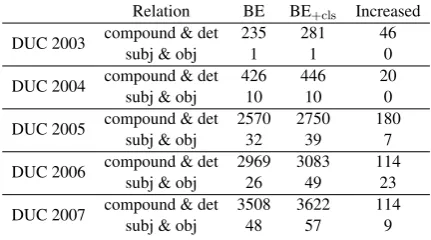
[image:5.595.73.289.62.182.2]DUC 2007 compound & det 3508subj & obj 48 362257 1149
Table 4: The number of basic elements which returned more than 1 in min{N(fk
m,Rk), N(fmk, S)}, before
clustering (BE) and after clustering (BE+cls), and the difference of the numbers, BE+cls−BE (Increased). The relation “subj & obj” includes nsubj, nsubjpass, csubj, csubjpass, iobj and dobj.
ally achieved the best performance. This is be-cause clustering enhanced not only the match-ing of informative basic elements but also that of low-information basic elements. Table 4 shows how the number of compound and det triples in-creased, compared with that of subj (nsubj, nsub-jpass, csubj and csubjpass) and obj (iobj and dobj) triples. In all datasets, the number of com-pound and det triples that returned more than 1 in min{N(fmk,Rk), N(fmk, S)} increased much
more than that of subj and obj, after convert-ing unigrams into cluster IDs. Although cluster-ing reduced semantic mismatches, it worsened the problem of redundant counting. Nonetheless, this problem can be easily solved by applying step 1. This is why the combination of step 1 and 2 was so synergistic.
Another problem with step 2 is that it some-times makes inappropriate clusters. For example, numbers tend to be put in the same clusters since our word embeddings place them close to each other. In summaries, however, confusing quanti-tative information such as “two apples” and “five apples” must be avoided . It will be our future work to specify where clustering fails to work and to get rid of inappropriate clusters.
Table 2 shows that pBE achieved the best rank correlation among the other competitors in TAC 2011 and ROUGE-WE. Although its score was lower in Pearson coefficient, it should be noted that the Pearson correlation is based on some strict assumptions: Samples are normally distributed and are linearly related to each other. Since Spear-man/Kendall correlation is free from these as-sumptions, the best rank correlation is a good
evi-dence of pBE’s performance.
6 Conclusion
We proposed an automatic evaluation measure of summarization, pBE. It is designed to prune re-dundant basic elements in two steps: (1) disre-garding frequency count of basic elements and (2) using word similarity to reduce semantically overlapped basic elements. Our experiments show that pBE outperforms ROUGE in most cases and achieves the highest rank correlation coefficient in TAC 2011 AESOP task.
References
Marie-Catherine de Marneffe, Bill MacCartney, and Christopher D. Manning. 2006. Generating typed dependency parses from phrase structure parses. In 5th International Conference on Language Re-sources and Evaluation (LREC 2006).
Eduard H. Hovy, Chin-Yew Lin, Liang Zhou, and Ju-nichi Fukumoto. 2006. Automated summarization evaluation with basic elements. InProceedings of the Fifth International Conference on Language Re-sources and Evaluation (LREC 06).
Niraj Kumar, Kannan Srinathan, and Vasudeva Varma. 2011. Using unsupervised system with least linguis-tic features for tac aesop task. InProceed- ings of the Text Analysis Conference (TAC).
Chin-Yew Lin. 2004. Rouge: A package for automatic evaluation of summaries. InIn Text Summarization Branches Out: Proceedings of the ACL-04 Work-shop. pages 74–81.
Christopher D. Manning, Mihai Surdeanu, John Bauer, Jenny Finkel, Steven J Bethard, and David Mc-Closky. 2014. The Stanford CoreNLP natural lan-guage processing toolkit. InAssociation for Compu-tational Linguistics (ACL) System Demonstrations. pages 55–60.
Tomas Mikolov, Ilya Sutskever, Kai Chen, Greg S Cor-rado, and Jeff Dean. 2013. Distributed representa-tions of words and phrases and their compositional-ity. InProceedings of the 27th Annual Conference on Neural Information Processing Systems (NIPS). pages 3111–3119.
Jun-Ping Ng and Viktoria Abrecht. 2015. Better sum-marization evaluation with word embeddings for rouge. In Proceedings of the 2015 Conference on Empirical Methods in Natural Language Process-ing. Association for Computational Linguistics, Lis-bon, Portugal, pages 1925–1930.
Natalia Silveira, Reut Tsarfaty, and Daniel Zeman. 2016. Universal dependencies v1: A multilingual treebank collection. InProceedings of the Tenth In-ternational Conference on Language Resources and Evaluation (LREC-2016).
Karolina Owczarzak and Hoa Trang Dang. 2011. Overview of the TAC 2011 summarization track: Guided task and AESOP task. InProceedings of the Text Analysis Conference (TAC).
Sebastian Schuster and Christopher D. Manning. 2016. Enhanced English Universal Dependencies: An im-proved representation for natural language under-standing tasks. InProceedings of the Tenth Interna-tional Conference on Language Resources and Eval-uation (LREC 2016).
Stephen Tratz and Eduard H. Hovy. 2008. Summariza-tion evaluaSummariza-tion using transformed basic elements. In Proceedings of Text Analytics Conference (TAC).