Weakly supervised learning of allomorphy
Miikka Silfverberg and Mans Hulden Department of Linguistics
University of Colorado [email protected]
Abstract
Most NLP resources that offer annotations at the word segment level provide morpho-logical annotation that includes features indicating tense, aspect, modality, gender, case, and other inflectional information. Such information is rarely aligned to the relevant parts of the words—i.e. the al-lomorphs, as such annotation would be very costly. These unaligned weak label-ings are commonly provided by annotated NLP corpora such as treebanks in various languages. Although they lack alignment information, the presence/absence of la-bels at the word level is also consistent with the amount of supervision assumed to be provided to L1 and L2 learners. In this paper, we explore several methods to learn this latent alignment between parts of word forms and the grammatical in-formation provided. All the methods un-der investigation favor hypotheses regard-ing allomorphs of morphemes that re-use a small inventory, i.e. implicitly mini-mize the number of allomorphs that a mor-pheme can be realized as. We show that the provided information offers a signif-icant advantage for both word segmenta-tion and the learning of allomorphy.
1 Introduction
Many NLP resources provide weakly labeled mor-phological resources in data sets that are primar-ily annotated for higher-level constructs besides morphology. Most treebanks, for example, in-clude some morphological annotation on the word level of varying granularity. The Penn treebank (Marcus et al., 1993) uses a limited label set of 45, while the Universal Dependencies (UD)
(Nivre et al., 2017) project annotates word forms with a much larger set of morphological feature-value pairs. Noteworthy is that such annotation is not in any way aligned with the substrings in the word forms themselves: if the Finnish word kaatuisi ’would fall down’ is annotated as
kaatua,V,Cond,Pres,3,Sg, there is no
in-dication thatkaatucorresponds to the stem,isito
Cond, and thatV, 3andSgare realized as zero allomorphs.
In essence, such labeled resources provide an inference problem in the realm of inflectional mor-phology in that one can exploit statistical regulari-ties in the data to perform a morpheme segmenta-tion and labeling of the data. A linguistically in-formed observation based on a simple assumption of systematic regularity between form and mean-ing is that it is very unlikely that a smean-ingle mor-pheme such as the Finnish conditional be realized in more than a handful of different allomorphs. Conversely, it is unlikely that a part of a word, such as the affix isi carry many disparate mean-ings, i.e. be associated with a large array of dif-ferent labels. Still, morphemes are often realized by more than one allomorph although the number of allomorphs is typically small. Consider for ex-ample English plural number which is realized by different allomorphs in the formsdogs,churches, oxenandchildren. From a data-driven perspec-tive, the inference problem thus becomes to find a globally good allomorph segmentation and label-ing of all word forms given in a large resource of inflected word forms.
Besides NLP applications, this type of input and the related inference problem is consistent with the assumptions of relevant inputs witnessed in L1 acquisition—a combination of stems and other af-fixes where the learner knows from the environ-ment some semantic signal from the immediate discourse, e.g. plurality, tense, etc. Children tend
to show the ability to analyze affixes before they can use them productively. For example, three-year-olds have been shown to be able to associate agentive meaning to an-ermorpheme in English, but can only produce the suffix later (Clark and Hecht,1982;Clark and Berman,1984).
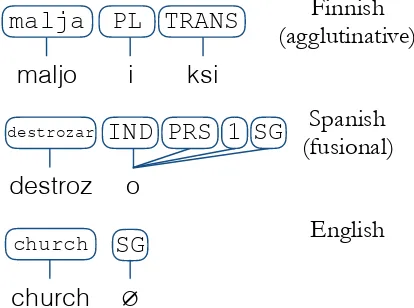
In this paper we explore and evaluate several methods for automatically segmenting and label-ing each allomorph present in resources that are labeled with morphosyntactic features at the word level. This means that our training data consists of plain unsegmented word forms (for example kaa-tuisi) and morphological feature sets (for example {V,Cond, Pres, 3, Sg}). The result is a phologically segmented corpus where each mor-phological segment is associated with at least one morphological feature as shown in Figure1. In or-der to account for fusional morphology, we allow one segment to be associated with multiple mor-phological features.
We treat the problem of joint segmentation and feature assignment as a search problem in the space of all possible segmentations and labelings of each word form in a (weakly) annotated cor-pus. The crucial constraint provided by the weak labeling is that not all labels can be present in a word form—the set of labels present for each in-flected word must be restricted to those given by the resource. To our knowledge, this weakly su-pervised task has not previously been explored al-though joint segmentation and labeling has been explored in a fully supervised setting byCotterell et al.(2015).
To solve the problem, we explore global met-rics that indirectly favor re-use of allomorphs ac-cording to the intuition given above. We formalize a generic objective function that scores the good-ness of segmentations and labeling globally in a corpus. The scoring portion of this objective func-tion is tested with several metrics: symmetric con-ditional probability, which favors that allomorphs be good predictors of labels and vice versa, a per-ceptron learner that weights allomorph-label asso-ciation, a Rescorla-Wagner model based on clas-sical conditioning that also learns such association weights, and a model of Kullback-Leibler diver-gence that favors that labels and allomorphs have similar distributions throughout a data set.1 We
also compare the performance of the various
meth-1Our code is freely available at https://github.
com/mpsilfve/learn-allomorphs
ods to a baseline unsupervised model, Morfessor2,
augmented with the capacity to also provide labels of allomorphs in addition to segmenting.
2 Related Work
In the realm of natural language processing, mor-phological segmentation is a well-researched and established problem (Goldsmith (2001), Creutz and Lagus(2005),Poon et al.(2009),Dreyer and Eisner(2011),Ruokolainen et al.(2016)). While most approaches to pure segmentation are unsu-pervised, semi-supervised work usually assumes the availability of a limited number of gold seg-mentations (Dasgupta and Ng, 2007; Kohonen et al.,2010;Grönroos et al.,2014;Sirts and Gold-water,2013). Using vector space representations of words to produce a weak labeling that identifies related forms has also been investigated (Schone and Jurafsky,2000;Soricut and Och,2015).Kann et al. (2016) perform unsupervised canonicaliza-tion of allomorphs, transforming words such as havingtohave ing, a task which is somewhat re-lated to the problem addressed in this paper. Many methods that tackle specific morphology-related NLP tasks implicitly learn some model of allomor-phy. This includes semi-supervised vocabulary ex-pansion (Faruqui et al.,2016), and morphological inflection from examples (Cotterell et al.,2016a).
To our knowledge, the weakly supervised learn-ing problem addressed in this paper has not been considered in the literature. Cotterell et al.(2015) present a closely related task. They investigate la-beled morphological segmentation, that is, simul-taneous segmentation and labeling of segments with morphological features. The crucial differ-ence between our work and the work byCotterell et al. (2015) is that our models are learned in a weakly supervised manner from plain word forms and sets of morphological features. In contrast, Cotterell et al.(2015) learn segmentation models in a fully supervised manner from data where each word is morphologically segmented and the seg-ments are annotated with morphological features.
In the cognitive literature on L1 and L2 learn-ing, statistical learning -based approaches that at-tempt to explain language learning through obser-vations about statistical regularities have explored the extent to which relatively simple generaliza-tions based on co-occurrence observageneraliza-tions and
2http://www.cis.hut.fi/projects/
maljo
i
ksi
malja PL TRANS
(agglutinative)
Finnish
destroz
o
destrozar
IND PRS 1 SG
Spanish
(fusional)
English
church
church
SG
[image:3.595.77.284.64.218.2]∅
Figure 1: Morphological feature alignments in ag-glutinative and fusional languages; in the Finnish word (malja ‘cup’) each allomorph has a single feature while in the Spanish word (destrozar ‘de-stroy’) several features are associated with a sin-gle allomorph. In the English example, a zero allomorph is declared to which the featureSGis aligned.
statistical generalizations can be used to model learning of various levels of structure in natu-ral language, including discovery of words (Saf-fran et al.,1996), grammatical categories (Reeder et al., 2013), and syntactic structure (Newport, 2016).
3 Methods
Given a corpus of word forms and associated mor-phological features, we want to find the correct segmentation for a word such asbarkedinto seg-mentswhich correspond to morphemesbark,ed,
∅, and the correct assignment of morphological features in a feature set {bark,V,Past} onto the segments. In this case: bark/bark,ed/Past
and∅/V. Note that we treat the lemma as a mor-phological feature.
Zero morphs (∅) are required because several languages have morphological features which are not visible in the word form, for example singular number of English nouns. In our gold standard segmented test data, we align word class mark-ers such as N and V with a zero morph because they do not correspond to any substring of the word form. This decision is somewhat arbitrary. Other options include aligning them with the word stem and simply removing them from the corpus. In some cases, as in the case of English adverbs with suffix -ly, one could also consider aligning
the word class marker with an affix.
We propose to accomplish segmentation and feature assignment by learning a real-valued scor-ing functionΘ : Σ∗×Y →R, whereΣ∗is the set possible segments andY is the finite set of mor-phological features.3 The scoring functionΘ
ex-presses the strength of association between a seg-ment such asedand a morphological feature such asPast. It is learned from a set of unsegmented word forms and their morphological label sets. We present several alternative formulations forΘ.
Using the scoring function Θ, we find the op-timal segmentation xmax = x1...xn of the
in-put word form and optimal feature assignment
ymax=y1∪...∪ynwhich together maximize the
value of Θas given by Equation 1. We perform the maximization using an exact search algorithm over the set of segmentations and feature assign-ments. Therefore, we are guaranteed to find the optimal segmentation and feature assignment.
(xmax, ymax) = arg max x1...xn=x
y1∪...∪yn=y X
xi X
y∈yi
Θ(xi, y)
(1) We perform the maximization in Equation 1in the following way. Let x be an input string and lety={f1, ..., fk}be a set of morphological
fea-tures. We first form an exhaustive set of segmenta-tions ofx(in order to allow for tractable inference, we only consider segmentations into maximally5 segments). We then consider each segmentation
x1...xn = x in turn and find the feature
assign-menty1∪...∪yn=ywhich maximizes the score Θusing a recursive algorithm presented below.
Given a partitiony1, ..., ynof a possibly empty
prefix ofy = {f1, ..., fk} (that is a collection of
pointwise disjoint setsy1, ...,ynwherey1∪...∪
yn = {f1, ..., fj} and j ≤ k), we can find the
optimal scoreMfor assigning the remaining mor-phological featuresyrest = y− {f1, ..., fj} into
sets iny1, ..., ynusing the following recursive
al-gorithm.4 Set M := −∞ and iterate over i in
{1, ..., n}.
• If yrest is empty, then y1 ∪ ... ∪ yn =
y. If each yl 6= ∅, assign M := max(M,Θ((x1, ..., xn),(y1, ..., yn))).
3Y is finite because the inventory of morphological
fea-tures is derived from a finite corpus.
4A natural extension of this algorithm will recover the
• If yrest is not empty, assign yi := yi ∪ {fj+1} and find the optimal score M0 for
y0
rest ={fj+1, ..., fk} − {fj+1}. SetM :=
max(M, M0).
Finally, returnM.
By initially setting y1 =... =yn =∅, we can
find the optimal feature assignment for the entire segmentationx1, ..., xn.
We limit the set of segmentations of a word to those which have maximally one empty substring and explore assignments where each segment is aligned with at least one morphological feature. One segment may, however, be aligned with sev-eral features. This is required when a morpheme encodes for several morphological features.
These assumptions are in line with typological considerations—agglutinative languages such as Finnish and Turkish largely associate allomorphs with a single morphological feature, while fu-sional languages, such as Swedish and Spanish, may associate many features with a substring (see figure 1). Allomorph overlap, where a substring xyz in a word has xy associated with one fea-ture andyzwith another, is generally not attested cross-linguistically which narrows down the set of hypotheses we need to consider. However, a typo-logically interesting case not modeled in our ap-proach is templatic, or root-and-pattern morphol-ogy, where a discontinuous subsequence may be associated with a feature, such as in the classic Arabic examplekataba‘to write’, where root rad-icals associate with a stem (ktb= related to writ-ing) and intervening vowels with inflectional and derivational patterns. The objective functions we develop may be adapted to this case, however, at the cost of enlarging the search space since all sub-sequences would need to be considered when as-sociating parts of word forms and morphological features. Moreover, even languages with templatic morphology can be handled using the current sys-tem, provided that templatic phenomena are not annotated in the corpus. For example, a model of Arabic may represent vowel changes in the stem by declaring different stem allomorphs instead of treating the discontinuous root radical consonants as the stem, e.g.kataba(‘to write’ perfect indica-tive 2p masculine) vs. taktubu(‘to write’ imper-fective indicative 2p masculine).
Below, we present several alternative formula-tions for the scoring functionΘ. Two of the func-tions symmetric conditional probability and
KL-divergenceare statistics which can be computed in a straightforward manner given a training data set. The two remaining functions, theperceptron and
Rescorla-Wagner, are derived by learning multi-class multi-classifiers which predict the morphological labels of a word based on its sub-strings. The pa-rameters of these classifiers express associations between morphological labels and substrings. We use these associations as the scoring functionΘ. 3.1 Symmetric conditional probability Intuitively, a substring x is a good candidate al-lomorph for a morphological featurey ifxandy
frequently co-occur. Symmetric conditional prob-ability (SCP), introduced byda Silva et al.(1999) for mining of lexical multi-word units, is a mathe-matical realization of this principle.
The SCP of a segmentxand a featureyis given by equation 2. The probability p(x) is the fre-quency of words having substringx,p(y)the fre-quency of words having morphological labelyand
p(x, y) the frequency of words having both sub-stringxand labely.
SCP(x, y) =p(x|y)p(y|x) = pp((xx, y)p()y2) (2)
By setting Θ(x, y) = SCP(x, y), we can use the symmetric conditional probability as a scoring function.
3.2 Perceptron
We explore a simple extension of the classical per-ceptron learning algorithm (Rosenblatt,1958) for multi-label classification (Tsoumakas and Katakis, 2007). Instead of predicting a single label for each input instance, we predict a set of outputs corre-sponding to the morphological features related to a word.
We start with a standard perceptron classifier defined by a feature extraction functionf : Σ∗ →
{0,1}k, which maps word formsx into a vector,
and one parameter vectorφy ∈ Rkfor each
mor-phological featurey∈Y. Here,kis the total num-ber of distinct substrings that occur in the data set
D.5 Intuitively,f extracts substrings of x. More
formally, it maps a word formx into a vector in a space where each dimension corresponds to a string inΣ∗andf(x)[i] = 1, iffxhas a substring corresponding to theith dimension. Inference in
5kis between 144,000 and 423,000 for all of the data sets
the model is defined by Equation3and parameter updates are defined by Equation4, whereygoldis
the gold standard label.
ymax= arg max y∈Y φ
>
yf(x) (3)
φymax :=φymax−f(x) andφygold:=φygold+f(x)
(4) We modify standard perceptron updates in the fol-lowing way: For a wordxwith a set of morpho-logical labelsY, where|Y| =n, we examine the set N consisting of the top-n labels returned by the perceptron classifier using the current parame-ter estimates. We then perform a negative update for parameters corresponding to labels which were not associated with the word form x in the gold standard, that is labels in the set N −Y. Con-versely, we perform a positive update for parame-ters which were associated with word formx, that is morphological features in the setY −N.
Clearly, we perform no updates for a particular word formx, iff the top-ncandidates returned by the classifier exactly correspond to the set of mor-phological features ofx.
We first train a system using the aforementioned variant of the perceptron algorithm. As feature templates, we us the substrings of words inD. We then use the parameter values corresponding to as-sociations of substringsxand featuresy, learned by the perceptron algorithm, as scoresΘ(x, y).
3.3 Rescorla-Wagner learning
The Rescorla-Wagner (R-W) rule (Rescorla and Wagner, 1972) is a model of classical condition-ing that provides an account of the association strength between a conditioned stimulus (CS) and an unconditioned stimulus (US); or, alternatively, the strength between a stimulusand the expecta-tion ofreward. This type of a learning model has been applied to acquisition of plurals (Ramscar and Yarlett,2007;Ramscar,2013), number names (Ramscar et al., 2011) word recognition (Baayen et al.,2011), and typology of number encoding in inflectional morphology (Ackerman et al.,2016).
In the single stimulus case, we have an expected rewardv which is calculated as a linear combina-tion of a binary stimulus u and a learned weight
w:
v=wu (5)
As stimuli arrive possibly paired with a reward, the weightwis updated depending on whether the reward was present as w = w+ εδu, where δ
is set in proportion tor, the ‘actual’ reward, usu-ally set to1or100if the association is valid, else 0. The quantity δ = r −v is hence the pre-diction error which drives association updates to-ward0 or toward the maximum association score andεis a learning rate (set to 0.01 here). In our model, the reward is a morphological label, and thestimuliare the substrings present in the word forms witnessed. We extend the common single-stimulus/single-reward R-W model to one which learns association strengths of multiple stimuli and multiple rewards in a standard way (Dayan and Abbott,2001). Each possible morphological label is associated with a weight vector wwhere each dimension corresponds to a string inΣ∗, as in the perceptron case. As stimuli arrive, weight updates are performed per label as:
w=w+εδu where δ=r−v (6) Here, as before,ris0if the label is absent and 100if it is present.
Learning is very similar to perceptron learning—the conditions under which R-W learning and perceptron training is identical is explored in detail in Dawson (2008). The main difference between our R-W and perceptron implementations is that perceptron updates are only performed if the n labels present in a word form do not appear in then-best scoring list, while R-W updates are always done if the expectation produced by summing the individual expectations caused by the substrings in a word fails to match the maximum label ‘reward’.
3.4 Kullback-Leibler divergence
Given a set of labeled wordsU ⊂ D in our data set, we can examine the distribution of morpholog-ical features inU defined byp(f|U)∝ |{(x, y)∈ U|f ∈ y}|for all f ∈ Y. We can examine dif-ferent subsets of D defined by criteria concern-ing (1) morphological features, or (2) existence of a given substring in word forms. Intuitively, a substring s is a good candidate morpheme for a morphological feature f, if Us = {(x, y) ∈ D|sis a substring ofx} and Uf = {(x, y) ∈ D|f ∈ y}define similar distributions of morpho-logical features.
# train wf # test wf # lemmas feat. types Eng 10,000 300 8591 7
Fin 12,693 300 10049 39
Swe 10,000 300 6589 23
Tur 7,645 300 2523 36
Table 1: Data set sizes for English, Finnish, Swedish and Turkish.
used measure for the distance of two discrete prob-ability distributions defined on the same sample space defined by Equation7.
KL(p||q) =X x
p(x) logpq((xx)) (7)
We use the negative KL divergence of the distri-butions over morphological features defined by a substringxand a morphological featuref, respec-tively, as scoreΘ(x, f).
3.5 Baseline
As our baseline, we use the unsupervised morpho-logical segmentation given by the Morfessor Base-line method (Creutz and Lagus,2005). We use its default settings for all parameters.
We assign labels to segments based on maxi-mum likelihood as defined by co-occurrence of segments and labels in the segmented data set. When there are fewer segments than morphologi-cal features, we assign at least one feature per seg-ment. Otherwise, we assign at most one feature per segment while maximizing the joint probabil-ity of segments and morphological features.
This baseline was chosen because it is easily ac-cessible to most researchers and very easy and fast to apply.
4 Data
We use data from the 2016 SIGMORPHON shared task on morphological re-inflection (Cot-terell et al.,2016b) (Finnish and Turkish) and the 2017 CoNLL shared task on morphological re-inflection6(English and Swedish). Figure2shows
an example of the data format and Table1shows details for each data set.
We use the training and test sets from subtask 1 from the SIGMORPHON shared task (Cotterell et al., 2016a) and the task 1 high training set to-gether with the task 1 development set from the
6https://sites.google.com/view/
conll-sigmorphon2017/
CoNLL shared task 2017 (Cotterell et al.,2017). Figure3 shows an example of the annotated test data.
5 Experiments
We first train each of the scoring functions pre-sented in Section3on the combined training data andunsegmentedtest data. After that, we find the optimal segmentation and label alignment for each word in the test data using each scoring function. We explore all segmentations consisting of maxi-mally 5 segments and all assignments of morpho-logical features to the segments using a dynamic algorithm in order to speed up inference.
For perceptron and R-W learning, we run the training algorithm for three epochs over the train and test data. The learning rateεfor R-W learning is fixed to0.01and the maximum possible associ-ation responseris fixed to100.
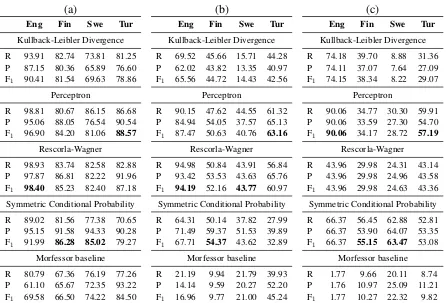
We evaluate each scoring function with regard to three different criteria: (1) identification of mor-pheme boundaries, (2) identification of unlabeled morphemes, and (3) identification of labeled mor-phemes. For each criterion, we give recall, pre-cision and F1-score. Evaluation criteria (1) and
(2) are very similar, but we include both for easier comparison with earlier work in the field of unsu-pervised morphological segmentation.
To illustrate our evaluation scheme, consider the following gold standard segmentation and align-ment for English
ping/ping ing/V.PTCP,PRS NULL/V
The aligned form contains three morpheme boundaries: at index 1 (start of word), at index 4 (between the stem and participle suffix) and at index 7 (end of word). It contains two unlabeled morphemes: pinganding, and four labeled mor-phemes: ping/ping, ing/V.PTCP, ing/PRS and NULL/V. Counts for these units are used to com-pute recall, precision and F1-score for each
evalu-ation criterion. 6 Results
Table 2 shows the results of all experiments for each language.
psychoanalyse V,V.PTCP,PRS psychoanalysing
aalloittaisuus pos=N,case=ON+ESS,num=PLN aalloittaisuuksilla
centralbank N,DEF,GEN,SG centralbankens
haberle¸smek V,IND,3,SG,PST,PROG,POS,DECL haberle¸siyordu
Figure 2: Example lines from the English, Finnish, Swedish and Turkish training data set of. The first field contains the lemma, the second field contains additional morphological features and the last field contains the word form.
autofocuss/autofocus ed/PST NULL/V
paali/paali n/case=ACC NULL/num=SGN,pos=N kammarrätt/kammarrätt s/GEN NULL/N,INDF,SG âmâ/âmâ lar/PL dan/ABL NULL/N
Figure 3: Example entries from the annotated En-glish, Finnish, Swedish and Turkish test sets. We align the stem with the lemma and the part-of-speech with the zero allomorph.
R-W seems to deliver consistently competitive performance when compared to the other systems on morpheme boundary recovery and morpheme identification. The performance of the perceptron algorithm is quite similar to the R-W but, in gen-eral, lower. The perceptron algorithm, however, delivers the best performance for Turkish.
KL divergence seems to perform the worst of all of the scoring functions. It delivers markedly worse performance on the Swedish data set than the other systems.
SCP delivers superior performance when com-pared to R-W for Finnish on morpheme boundary recovery and morpheme identification. However, its performance on English and and Turkish is sub-stantially worse than both R-W and the perceptron algorithm.
In the case of labeled morphemes, SCP seems to deliver consistently good performance. It out-performs R-W even in the case of Turkish and En-glish, where it delivers substantially worse perfor-mance on unlabeled morpheme identification.
7 Discussion
The results show clear improvement over the base-line approach of first applying unsupervised mor-phological segmentation and then assigning labels based on co-occurrence counts of segments and la-bels. That is, including information about mor-phological features in the segmentation process is clearly beneficial.
The perceptron and R-W learning algorithms
have very similar performance, which can be ex-plained by the fact that the algorithms themselves are quite similar. However, the R-W algorithm seems to deliver somewhat superior performance. One possible reason for this is that the R-W will prefer solutions where one substring in the word explains one morphological feature, whereas the perceptron algorithm does not have such a bias. This can be attributed to the ‘blocking’ effect of R-W learning: when one feature (substring) has al-ready been weighted early during training enough to yield a maximum response (label), no updates are made for other features which may also co-occur with the same label.
The fact that both R-W and the perceptron al-gorithm seem to perform poorly for labeled mor-pheme identification can be explained by the fact that both algorithms are trained to predict each of the morphological labels of the word from all sub-strings occurring in the word. This can lead to con-fusion of features for morphemes occurring in the same word. For example, the R-W performs com-paratively poorly on labeled morpheme identifi-cation for the Finnish, Swedish and English data sets. This happens because it assigns the part-of-speech feature to the stem in many words but the gold standard analysis is that the part-of-speech is aligned with the zero morpheme. Conversely, it also assigns the lemma to the zero morpheme in many words, whereas the gold standard instead as-signs lemmas to stems. Note that the decision to align part-of-speech with the zero morpheme in-stead of the word stem is fairly arbitrary. There-fore, a different gold standard segmentation could give substantially higher labeled morpheme per-formance for R-W.
# n o u s s e i s s a # Inessive Plural Noun
# a e r o b i c a t k o o n # 3rd5Person Imperative Verb 75 65 55 45 35 25 15 5 ?5 ?10
# t e p k i m e n i z i n # N PSS2P GEN SG
# m u k a v e m e t l e r e # N PL DAT
# n o u s s e i s s a # Inessive Plural Noun
# a e r o b i c a t k o o n # 3rd5Person Imperative Verb 75 65 55 45 35 25 15 5 ?5 ?10
# t e p k i m e n i z i n # N PSS2P GEN SG
# m u k a v e m e t l e r e # N PL DAT # n o u s s e i s s a #
Inessive Plural Noun
# a e r o b i c a t k o o n # 3rd5Person Imperative Verb 75 65 55 45 35 25 15 5 ?5 ?10
# t e p k i m e n i z i n # Noun 2P5Possessive Genitive Singular
# m u k a v e m e t l e r e # Noun Plural Dative
# n o u s s e i s s a #
Inessive Plural Noun
# a e r o b i c a t k o o n #
3rd5Person Imperative Verb 75 65 55 45 35 25 15 5 ?5 ?10
# t e p k i m e n i z i n #
Noun 2P5Possessive Genitive Singular
# m u k a v e m e t l e r e #
Noun Plural Dative
# n o u s s e i s s a # Inessive Plural Noun
# a e r o b i c a t k o o n # 3rd5Person Imperative Verb 75 65 55 45 35 25 15 5 ?5 ?10
# t e p k i m e n i z i n # Noun 2P5Possessive Genitive Singular
[image:8.595.82.518.101.193.2]# m u k a v e m e t l e r e # Noun Plural Dative
Finnish
Turkish
Figure 4: Example activations for two inflected Finnish words (noussut‘risen’,aerobicata‘to do aer-obics’) and two Turkish words (tepkime ‘reaction’, mukavemet ‘durability’) with Rescorla-Wagner learning. The activation score at each character is calculated as a sum of the activations associated with the substrings that the character participates in. Standard linguistic analyses have the Finnish inessive as-ssa, the plural as -i-, and both the imperative and 3rd person fused as-koon. For Turkish, the 2P Possessive is-niz-, the genitive is-in, the plural is-ler-, and the dative is-e.
(a)
Eng Fin Swe Tur
Kullback-Leibler Divergence R 93.91 82.74 73.81 81.25 P 87.15 80.36 65.89 76.60 F1 90.41 81.54 69.63 78.86
Perceptron
R 98.81 80.67 86.15 86.68 P 95.06 88.05 76.54 90.54 F1 96.90 84.20 81.06 88.57
Rescorla-Wagner
R 98.93 83.74 82.58 82.88 P 97.87 86.81 82.22 91.96 F1 98.40 85.23 82.40 87.18
Symmetric Conditional Probability R 89.02 81.56 77.38 70.65 P 95.15 91.58 94.33 90.28 F1 91.99 86.28 85.02 79.27
Morfessor baseline R 80.79 67.36 76.19 77.26 P 61.10 65.67 72.35 93.22 F1 69.58 66.50 74.22 84.50
(b)
Eng Fin Swe Tur
Kullback-Leibler Divergence R 69.52 45.66 15.71 44.28 P 62.02 43.82 13.35 40.97 F1 65.56 44.72 14.43 42.56
Perceptron
R 90.15 47.62 44.55 61.32 P 84.94 54.05 37.57 65.13 F1 87.47 50.63 40.76 63.16
Rescorla-Wagner R 94.98 50.84 43.91 56.84 P 93.42 53.53 43.63 65.76 F1 94.19 52.16 43.77 60.97
Symmetric Conditional Probability R 64.31 50.14 37.82 27.99 P 71.49 59.37 51.53 39.89 F1 67.71 54.37 43.62 32.89
Morfessor baseline R 21.19 9.94 21.79 39.93 P 14.14 9.59 20.27 52.20 F1 16.96 9.77 21.00 45.24
(c)
Eng Fin Swe Tur
Kullback-Leibler Divergence R 74.18 39.70 8.88 31.36 P 74.11 37.07 7.64 27.09 F1 74.15 38.34 8.22 29.07
Perceptron
R 90.06 34.77 30.30 59.91 P 90.06 33.59 27.30 54.70 F1 90.06 34.17 28.72 57.19
Rescorla-Wagner R 43.96 29.98 24.31 43.14 P 43.96 29.98 24.96 43.58 F1 43.96 29.98 24.63 43.36
Symmetric Conditional Probability R 66.37 56.45 62.88 52.81 P 66.37 53.90 64.07 53.35 F1 66.37 55.15 63.47 53.08
Morfessor baseline R 1.77 9.66 20.11 8.74 P 1.76 10.97 25.09 11.21 F1 1.77 10.27 22.32 9.82
[image:8.595.77.523.377.680.2]how many new allomorphs are implicitly detected when the held-out data is also segmented and la-beled. The expectation is that very few new al-lomorphs should be found in a held-out set if a model assigns labels to substrings in a consistent manner. Whether a good score on such an evalua-tion would correspond to linguistically motivated allomorph sets is a question we intent to investi-gate in the future. If so, a robust evaluation could potentially be made without any gold segmenta-tion and labeling at all.
In addition to the scoring functions presented in Section3, we investigated a number of other scor-ing functions, for example pointwise mutual in-formation (PMI)7of segments and morphological
features, but these did not yield competitive per-formance according to preliminary experiments. We also experimented with IBM models (Brown et al., 1993) for alignment of characters to mor-phosyntactic labels, which also performed poorly. SCP performs poorly on the English and Turk-ish data sets. For EnglTurk-ish, a major problem is that SCP does not find the present participle suf-fix ing. This suffix is problematic because it is associated with a combination of morphological features, namely present tense and the participle feature. Both of these co-occur more frequently with other suffixes (ed in the case of participle andNULLin the case of present tense), however, when they co-occur, they always occur with the ing suffix. This seems to be a problem for SCP which encodes a strong preference that there be a one-to-one mapping between morphemes and fea-tures.
A possible explanation for the poor perfor-mance of SCP on the Turkish data set is that this is the smallest of all data sets, while still having a very large number of morphological features.
In this investigation, we have not exhausted the set of reasonable scoring functions. One objec-tive function that is particularly interesting is to simply try to minimize the total number of differ-ent allomorphs discovered in the data. This
ob-7The reason for the poor performance of PMI is that it
will often align features with rare substrings and, therefore, it can assign a great number of distinct allomorphs to the same morphological feature. To illustrate this, letpmi(x, y) = logp(x, y)/(p(x)p(y))be the PMI of segmentx and fea-turey. This quantity can never exceedlog 1/p(y)because p(x, y)≤p(x). Assume thatxonly occurs once in the train-ing corpus and the sole occurrence is in a word with feature y. Thusp(x, y) = p(x)andpmi(x, y) = log 1/p(y), i.e. the maximal PMI for any segmentxgiven featurey.
jective function is difficult to integrate in our cur-rent approach since the function is discontinuous. In essence, this objective function calls for an al-gorithm that discovers a segmentation and label-ing of the data such that the sum total of different allomorph types is minimized. The problem ap-pears to be computationally intractable in princi-ple, since it bears strong similarities to other in-tractable problems such as set covering. But good heuristic solvers for NP-complete problems such asMoskewicz et al. (2001) may perhaps be har-nessed to find good solutions under this formula-tion. A thorough analysis and evaluation of this type of model remains future work.
8 Conclusion
We have presented a new learning problem for natural language processing, namely weakly su-pervised learning of allomorphy. The problem is important from a practical point of view because there are many morphologically annotated corpora where the annotation is not extended to the mor-pheme level. It is also relevant from a theoretical point of view because it is related to L1 morphol-ogy learning.
We explored four different learning methods: KL divergence, perceptron learning, R-W learning and SCP. We compared these to a baseline consist-ing of unsupervised morphological segmentation augmented by a straightforward labeling mecha-nism. Our results show that weak supervision de-livers sizable improvements when evaluated with regard to F1-score on labeled and unlabeled
seg-mentation. According to our experiments, R-W learning, while not only efficient, also delivers the best results on this task.
Acknowledgements
We wish to thank Jordan Boyd-Graber, Koen Claessen, Gerlof Bouma, and Hubie Chen for very helpful discussion and comments. This work has been supported in part by the Defense Advanced Research Projects Agency (DARPA) in the pro-gram Low Resource Languages for Emergent In-cidents (LORELEI).
References
R. Harald Baayen, Petar Milin, Dusica Filipovi´c Ður ¯devi´c, Peter Hendrix, and Marco Marelli. 2011. An amorphous model for morphological processing in visual comprehension based on naive discrimi-native learning. Psychological review 118(3):438– 481.
Peter F. Brown, Stephen A. Della Pietra, Vincent J. Della Pietra, and Robert L. Mercer. 1993. The math-ematics of statistical machine translation: Parameter estimation. Computational Linguistics 19(2):263– 313.
Eve V. Clark and Ruth A. Berman. 1984. Structure and use in the acquisition of word formation. Language
pages 542–590.
Eve V. Clark and Barbara Frant Hecht. 1982. Learn-ing to coin agent and instrument nouns. Cognition
12(1):1–24.
Ryan Cotterell, Christo Kirov, John Sylak-Glassman, Géraldine Walther, Ekaterina Vylomova, Patrick Xia, Manaal Faruqui, Sandra Kübler, David Yarowsky, Jason Eisner, and Mans Hulden. 2017. The CoNLL-SIGMORPHON 2017 shared task: Universal morphological reinflection in 52 languages. In Proceedings of the CoNLL-SIGMORPHON 2017 Shared Task: Universal Mor-phological Reinflection. Association for Computa-tional Linguistics, Vancouver, Canada.
Ryan Cotterell, Christo Kirov, John Sylak-Glassman, David Yarowsky, Jason Eisner, and Mans Hulden. 2016a. The SIGMORPHON 2016 shared task—morphological reinflection. In Proceed-ings of the 14th SIGMORPHON Workshop on Computational Research in Phonetics, Phonology, and Morphology. Association for Computational Linguistics, Berlin, Germany, pages 10–22.
Ryan Cotterell, Thomas Müller, Alexander M. Fraser, and Hinrich Schütze. 2015. Labeled morphological segmentation with semi-Markov models. InCoNLL. pages 164–174.
Ryan Cotterell, Tim Vieira, and Hinrich Schütze. 2016b. A joint model of orthography and mor-phological segmentation. In Proceedings of the 2016 Conference of the North American Chapter of the Association for Computational Linguistics: Hu-man Language Technologies. Association for Com-putational Linguistics, San Diego, California, pages 664–669.
Mathias Creutz and Krista Lagus. 2005. Unsupervised morpheme segmentation and morphology induction from text corpora using Morfessor 1.0. Technical Report A81, Helsinki University of Technology. Joaquim Ferreira da Silva, Gaël Dias, Sylvie Guilloré,
and José Gabriel Pereira Lopes. 1999. Using Local-Maxs algorithm for the extraction of contiguous and non-contiguous multiword lexical units. InProgress in Artificial Intelligence: 9th Portuguese Conference
on Artificial Intelligence, EPIA ’99 Évora, Portu-gal, September 21–24, 1999 Proceedings, Springer Berlin Heidelberg, Berlin, Heidelberg, pages 113– 132.
Sajib Dasgupta and Vincent Ng. 2007. High-performance, language-independent morphological segmentation. In Human Language Technologies 2007: The Conference of the North American Chap-ter of the Association for Computational Linguis-tics; Proceedings of the Main Conference. Associa-tion for ComputaAssocia-tional Linguistics, Rochester, New York, pages 155–163.
Michael R. W. Dawson. 2008. Connectionism and classical conditioning. Comparative Cognition and Behavior Reviews3:1–115.
P. Dayan and L. F. Abbott. 2001. Classical condition-ing and reinforcement learncondition-ing. Theoretical Neuro-science.
Markus Dreyer and Jason Eisner. 2011. Discovering morphological paradigms from plain text using a Dirichlet process mixture model. InProceedings of EMNLP 2011. Association for Computational Lin-guistics, Edinburgh, pages 616–627.
Manaal Faruqui, Ryan McDonald, and Radu Soricut. 2016. Morpho-syntactic lexicon generation using graph-based semi-supervised learning. Transac-tions of the Association for Computational Linguis-tics4:1–16.
John Goldsmith. 2001. Unsupervised learning of the morphology of a natural language. Computational linguistics27(2):153–198.
Stig-Arne Grönroos, Sami Virpioja, Peter Smit, and Mikko Kurimo. 2014. Morfessor FlatCat: An HMM-based method for unsupervised and semi-supervised learning of morphology. InProceedings of COLING 2014, the 25th International Conference on Computational Linguistics. Dublin City Univer-sity and Association for Computational Linguistics, Dublin, Ireland, pages 1177–1185.
Katharina Kann, Ryan Cotterell, and Hinrich Schütze. 2016. Neural morphological analysis: Encoding-decoding canonical segments. In Proceedings of the 2016 Conference on Empirical Methods in Nat-ural Language Processing. Association for Compu-tational Linguistics, Austin, Texas, pages 961–967. Oskar Kohonen, Sami Virpioja, and Krista Lagus.
2010. Semi-supervised learning of concatenative morphology. InProceedings of the 11th Meeting of the ACL Special Interest Group on Computational Morphology and Phonology (SIGMORPHON). As-sociation for Computational Linguistics, pages 78– 86.
Matthew W. Moskewicz, Conor F. Madigan, Ying Zhao, Lintao Zhang, and Sharad Malik. 2001. Chaff: Engineering an efficient SAT solver. In
Proceedings of the 38th annual Design Automation Conference. ACM, pages 530–535.
Elissa L. Newport. 2016. Statistical language learn-ing: Computational, maturational, and linguistic constraints. Language and Cognition 8(03):447– 461.
Joakim Nivre, Željko Agi´c, Lars Ahrenberg, Maria Je-sus Aranzabe, Masayuki Asahara, Aitziber Atutxa, et al. 2017. Universal dependencies 2.0. LIN-DAT/CLARIN digital library at the Institute of For-mal and Applied Linguistics, Charles University in Prague.
Hoifung Poon, Colin Cherry, and Kristina Toutanova. 2009. Unsupervised morphological segmentation with log-linear models. In Proceedings of Human Language Technologies: The 2009 Annual Confer-ence of the North American Chapter of the Associa-tion for ComputaAssocia-tional Linguistics. Association for Computational Linguistics, pages 209–217.
Michael Ramscar. 2013. Suffixing, prefixing, and the functional order of regularities in meaningful strings.Psihologija46(4):377–396.
Michael Ramscar, Melody Dye, Hanna Muenke Popick, and Fiona O’Donnell-McCarthy. 2011. The enigma of number: Why children find the meanings of even small number words hard to learn and how we can help them do better. PloS one6(7).
Michael Ramscar and Daniel Yarlett. 2007. Linguistic self-correction in the absence of feedback: A new approach to the logical problem of language acqui-sition. Cognitive Science31(6):927–960.
Patricia A. Reeder, Elissa L. Newport, and Richard N. Aslin. 2013. From shared contexts to syntactic cat-egories: The role of distributional information in learning linguistic form-classes. Cognitive psychol-ogy66(1):30–54.
Robert A. Rescorla and Allan R. Wagner. 1972. A the-ory of Pavlovian conditioning: Variations in the ef-fectiveness of reinforcement and nonreinforcement.
Classical conditioning II: Current research and the-ory2:64–99.
Frank Rosenblatt. 1958. The perceptron: A probabilis-tic model for information storage and organization in the brain. Psychological Review65(6):386–408. Teemu Ruokolainen, Oskar Kohonen, Kairit Sirts,
Stig-Arne Grönroos, Mikko Kurimo, and Sami Virpioja. 2016. A comparative study of minimally supervised morphological segmentation. Computational Lin-guistics42(1):91–120.
Jenny R. Saffran, Richard N. Aslin, and Elissa L. New-port. 1996. Statistical learning by 8-month-old in-fants.Science274(5294):1926–1928.
Patrick Schone and Daniel Jurafsky. 2000. Knowledge-free induction of morphology us-ing latent semantic analysis. In Proceedings of the 2nd workshop on Learning language in logic and the 4th conference on Computational natural language learning. Association for Computational Linguistics, pages 67–72.
Kairit Sirts and Sharon Goldwater. 2013. Minimally-supervised morphological segmentation using adap-tor grammars. Transactions of the Association for Computational Linguistics1:255–266.
Radu Soricut and Franz Och. 2015. Unsupervised mor-phology induction using word embeddings. In Pro-ceedings of the 2015 Conference of the North Amer-ican Chapter of the Association for Computational Linguistics: Human Language Technologies. Asso-ciation for Computational Linguistics, Denver, Col-orado, pages 1627–1637.
Grigorios Tsoumakas and Ioannis Katakis. 2007. Multi-label classification: An overview. IJDWM