A study on irony within the context of 7x1-PT
corpus
Silvia M. W. Moraes1, Rackel M. Machado1,Matheus S. Redecker1, Rafael G. Cadaval1and Felipe R. Meneguzzi1
1Pont´ıficia Universidade Cat´olica Rio Grande do Sul (PUCRS), Avenida Ipiranga, 6681. Pr´edio 32, CEP 90619-900. Porto Alegre, RS-Brasil
{silvia.moraes, felipe.meneguzzi}@pucrs.br
{rackel.machado, matheus.redecker, rafael.cadaval}@acad.pucrs.br
Abstract. The increasing use of social networks to express consumer opinions yields a large amount of potentially useful information for organizations to gauge consumer perception of their products. Nevertheless, gauging informa-tion by assigning polarities to opinionated text is not a trivial task, especially when dealing with short and ironical text. In this paper, we evaluate the pres-ence of irony at the sentpres-ence level within a Portuguese corpus extracted from Twitter.
1. Introduction
Social media is a popular communication channel through which users often express their opinions on products and services. In this virtual environment, both customers and orga-nizations can find useful information. While customers can use the information to decide if they should buy a product or not, organizations can improve their products and services based on customer feedback and public opinion. The interest in social networks is greater in Brazil than in other countries [Banks 2015], and although most Brazilian posts are pho-tos and videos, much text in Portuguese circulates in such networks, especially Twitter. Portuguese is among the top 10 most spoken languages in the world, around 240 million people communicate in this language1, what makes it an interesting topic for research. The automatic extraction of opinions is a difficult task, regardless of the language, espe-cially when the source of information is web text [Kiritchenko et al. 2014]. Sentiment Analysis, or Opinion Mining [Liu 2012], is the area that performs such task, determining the evaluative nature of a text and defining whether it expresses a positive, a negative, or a neutral sentiment [Kiritchenko et al. 2014]. [Liu 2010] calls this orientation of sentiment polarity, which can be treated, basically, in three granularity levels: text, sentence, and entity. Text level Sentiment Analysis defines the polarity of a document as a whole, being especially suitable for product reviews since, in this case, a broader perspective about a product is more important than an opinion about its components. Sentence level Senti-ment Analysis determines the polarity of sentences, for example, a Twitter post or part of it. Entity level Sentiment Analysis identifies positive and negative aspects of a particular entity. For example, a user can praise the screen of a computer (entity) for its quality (as-pect) but criticize it for its size (as(as-pect). In this paper, we focus on Sentiment Analysis at the sentence level. One of the challenges in this analysis process is detecting irony. Irony is a figure of speech, often used implicitly, that inverts the polarity of the sentiment that one expresses. When building automatic systems for irony detection, brief text messages
pose a greater obstacle than reviews, for example, given the lack of contextual informa-tion. The identification of context is of great help in detecting irony. Acorpuscan provide an overall context or a specific one to each sentence that composes it. In this paper, we describe a work in progress whose aim is to study irony detection in web texts. For this purpose, we carry out the analysis of the 7x1-PTcorpus, which contains around 2,700 tweets in Brazilian Portuguese posted during the football match between Germany and Brazil in the 2014 FIFA World Cup. Our goal is to study and annotate tweets in which this linguistic phenomenon occurs, discuss the concept of irony, and the difficulties in the annotation of this phenomenon.
2. Irony
According to Wilson [Wilson 2013], verbal irony has three distinctive features: a char-acteristic attitude, normative bias, and tone of voice. Wilson discusses the echoic and pretense accounts of irony, given that verbal irony necessarily involves the former, but does not necessarily involves the latter. Contrarily to the traditional account of irony, in which the speaker says one thing meaning the opposite, according to the echoic account, actually, the speaker echoes a thought. Through an ironical utterance, the speaker criti-cizes or complains about a situation or an event that does not fulfill his or her norm-based expectations, that is, the speaker’s ideas about how such situation or event should be. To the echoic account, an utterance is ironical when it expresses the speaker’s mocking, scornful, or contemptuous attitude toward the echoed thought. In this sense, Wilson’s [Wilson 2013] experimental work does not consider phenomena such as hyperbole, joc-ularity, banter, teasing, understatement, and rhetorical questions as forms of irony, since they do not display any of the distinctive features of irony. Nevertheless, while some of these phenomena are similar to irony in form (e.g., banter), others can be combined to irony (e.g., hyperbole), giving a cue to the speaker’s characteristic ironical attitude. When performing an utterance, the speaker’s facial expression and intonation can also indicate an ironical attitude; in written text, the ’tone of voice’ might be expressed by splitting a word into syllables to convey an exaggerated monotone, or using exclamation marks to show excessive enthusiasm, for instance. Since irony cannot be recognized only by its linguistic form, Wilson and Sperber [Wilson and Sperber 1992] describes the role of Relevance in explaining that to understand an ironical utterance, one needs linguis-tic form and context. Context, in sum, is the information that the receptor access (prior knowledge) in the moment that the communicator produces an utterance. This interaction between form and context determines verbal comprehension.
3. 7x1-PTCorpus
Moraeset al. [Moraes et al. 2015] built the 7x1-PT corpus2 that we use in this study. Thecorpus consists of 2,728 tweets in Brazilian Portuguese posted during the match in which Brazil lost 7-1 to Germany in the 2014 FIFA World Cup Brazil. The tweets are mostly about Brazil football players and political issues concerning the event. Two human annotators from the Computer Science area manually annotated thecorpusconsidering three classes: negative, neutral, and positive. Thekappacoefficient, which measures inter-rater agreement, was of 0.53. Although Moraeset al. [Moraes et al. 2015] annotated 2Acorpusis a large collection of written material in a machine-readable format; thus,corporaare
ironical tweets in 7x1-PTcorpusas neutral, they mentioned that the number of tweets expressing irony in theircorpuswas significant. We chose, therefore, to annotate 7x1-PTcorpus, besides, we could analyze the tweets into an overall context, of football and politics, which is crucial for irony recognition and classification.
3.1. Our Annotation
A human annotator from the Linguistics area revised the annotation of thecorpus consid-ering irony as a fourth class alongside positive, negative, and neutral. Table 1 shows the polarity distribution in thecorpus. In this annotation, we considered the broader defini-tion of irony (including hyperbole, jocularity, banter, and the like), since it can give hints about the user’s ironical attitude. The results show a considerable number of ironical tweets (40%) in thecorpus.
[Moraes et al. 2015]’s classification Our Classification Polarity #Tweets(%) #Tweets(%) Negative 800 (29%) 757 (27%)
Positive 1,771 (65%) 251(09%) Neutral 157 (0.6%) 636 (23%)
[image:3.595.164.422.324.395.2]Irony - 1,804 (40%)
Table 1. Number of tweets in the 7x1-PTcorpusaccording to the classification of Moraeset al.[Moraes et al. 2015] and our classification.
3.2. The Role of Context
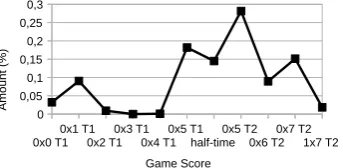
We align information of the time in which a user posts a tweet with a timetable of goals scored during the match between Germany and Brazil. In this way, considering Wilson’s [Wilson 2013] features of verbal irony, we can infer the information users want to con-vey through their utterances; in other words, we can understand their attitude or reaction toward the echoed thought. Since thethoughtis the norm-based expectation, the context helps to form such expectations. First, we need to consider that Brazil is widely known as the country of the football for its love for the sport (prior knowledge). Most Twitter users who posted within the period in which the tweets were collected, expected Brazil to win and to become the six-time champion of the 2014 FIFA World Cup (this is thenorm, a socially shared idea). During the match, Brazil’s performance did not live up to users’ expectations who, consequently, started to complain about the situation and criticize the team (this is theattitude). In the 7x1-PTcorpus, the information about the goals scored throughout the match works as the context for each tweet. Figure 1 shows the number of ironic tweets in thecorpusduring the match so that, from the fifth goal to the end of the second half of the match, the figure shows the highest peaks regarding user input. The following tweets illustrate the importance of context when analyzing irony: (1)”SOU BRASILEIRO E VOU CANTAR COM MUITO ORGULHO COM MUITO AMOR ESSE JOGO VAI VIRAR EU QUERO SER O VENCEDOR”(”I’M BRAZILIAN AND I’LL PROUDLY AND PASSIONATELY SING [.] [BRAZIL] WILL REVERSE THE SCORE [.] I WANT TO BE THE WINNER”). (2)”Vamo que da pra vira AAHAUSHAUSHAU”
(”Come on there is still time to reverse the score HAHAHA”) (3)”Copa das Copas”
demonstration against the Cup costs”) (5)”Vem c´a n˜ao era hj q os jogadores iam vir com mais garra pelo Neymar?!”(”Hold on wasn’t it today that the players would show their vigor for Neymar?!”). Considering that Brazil was playing at home and its background on sports as a context for the tweets, we can infer that most of the users were support-ing Brazil. Thus, when the score stood at 1-0 in Germany’s favor, we can classify (1) as positive, since it might express a genuine belief in Brazil’s victory. When the score stood at 7-1, at the end of the match, we can classify (2) as ironic, since a belief in Brazil’s victory might be not genuine at all. One of the most frequent expressions in thecorpus
was (3), meaning that this Cup would be the best of all Cups. At the beginning of the match, we can classify (3) as positive, although at the end of the match, we can classify (3) as ironic. (4) and (5) express irony; while in (4) the sentiment is toward the political issues involving the Cup costs that resulted in various demonstrations across Brazil, in (5) the sentiment is toward Brazil squad’s performance, since they had promised to play vig-orously for Neymar, who was injured. Only when we put all these pieces of information together, within a context, we can classify the polarity of the sentences accurately.
0x0 T10x1 T10x2 T10x3 T10x4 T10x5 T1half-time0x5 T20x6 T20x7 T21x7 T2 0
0,05 0,1 0,15 0,2 0,25 0,3
Game Score
Amou
[image:4.595.204.376.353.437.2]nt (%)
Figure 1. Ironic tweets throughout the match.
4. Related Work
5. Final Considerations
In our work, we explain the linguistic phenomenon of irony and its particularities within the context of 7x1-PTcorpus. We also discuss the difficulties in irony detection due to its dependence on context, which has an essential role in conveying more complexity to the annotation especially when it comes to automatizing irony detection in short messages like tweets. In the analysis of the 7x1-PTcorpus, we could verify such dependence as we compared similar tweets that, when posted in different moments of the match, expressed a different attitude toward the event. Additionally, we discussed how previous knowledge is essential to understand a context making it easier to identify irony. Without such pieces of information, it is impossible to recognize an ironic attitude based only on code. Re-gardless of Portuguese being one of the most spoken languages of the world, the number of Portuguesecorporathat are available for linguistic studies is still low, particularly cor-porathat consider irony detection. The objective of our work is to provide acorpuswith an annotation of irony that can be of help to other studies on this subject. As for future work, we intend to carry out an in-depth analysis of irony considering it as positive or negative.
6. Acknowledgments
Our thanks to Dell and PUCRS (EDITAL N. 01/2016 - Programa de Apoio `a Atuac¸˜ao de Professores Horistas em Atividades de Pesquisa) for the financial support of this work.
References
Banks, A. (2015). Brasil digital future in focus 2015. http: //blog.aotopo.com.br/wp-content/uploads/2015/02/
Futuro-Digital-do-Brasil-em-Foco -2015-ComScore.pdf.
de Freitas, L. A., Vanin, A. A., Hogetop, D. N., Bochernitsan, M. N., and Vieira, R. (2014). Pathways for irony detection in tweets. InProceedings of the 29th Annual ACM Symposium on Applied Computing, pages 628–633.
Kiritchenko, S., Zhu, X., and Mohammad, S. M. (2014). Sentiment analysis of short informal texts. J. Artif. Int. Res., 50(1):723–762.
Liu, B. (2010). Sentiment analysis and subjectivity. Handbook of Natural Language Processing, 2nd ed.
Liu, B. (2012). Sentiment analysis and opinion mining, volume 5. Morgan & Claypool Publishers.
Moraes, S., Manssour, I., and Silveira, M. S. (2015). 7x1-pt: um corpus extra´ıdo do twitter para an´alise de sentimentos em l´ıngua portuguesa. InX STIL, 4th BRACIS, pages 21–25.
Reyes, A. and Rosso, P. (2011). Mining subjective knowledge from customer reviews: A specific case of irony detection. InProceedings of the 2nd Workshop on Computational Approaches to Subjectivity and Sentiment Analysis, pages 118–124. ACL.
Wilson, D. (2013). Irony comprehension: A developmental perspective.Journal of Prag-matics, 59:40–56.