Soft Cardinality: A Parameterized Similarity Function for Text Comparison
Sergio Jimenez
Universidad Nacional
de Colombia, Bogota,
Ciudad Universitaria
edificio 453, oficina 220
[email protected]
Claudia Becerra
Universidad Nacional
de Colombia, Bogota
[email protected]
Alexander Gelbukh
CIC-IPN
Av. Juan Dios Bátiz,
Av. Mendizábal, Col.
Nueva Industrial Vallejo,
CP 07738, DF, México
[email protected]
Abstract
We present an approach for the construction of text similarity functions using a parameterized resem-blance coefficient in combination with a softened cardinality function called soft cardinality. Our ap-proach provides a consistent and recursive model, varying levels of granularity from sentences to char-acters. Therefore, our model was used to compare sentences divided into words, and in turn, words di-vided intoq-grams of characters. Experimentally, we observed that a performance correlation func-tion in a space defined by all parameters was rel-atively smooth and had a single maximum achiev-able by “hill climbing.” Our approach used only sur-face text information, a stop-word remover, and a stemmer to tackle the semantic text similarity task 6 at SEMEVAL 2012. The proposed method ranked 3rd (average), 5th (normalized correlation), and 15th (aggregated correlation) among 89 systems submit-ted by 31 teams.
1
Introduction
Similarity is the intrinsic ability of humans and some animals to balance commonalities and differences when comparing objects that are not identical. Although there is no direct evidence of how this process works in liv-ing organisms, some models have been proposed from the cognitive perspective (Sjöberg, 1972; Tversky, 1977; Navarro and Lee, 2004). On the other hand, several simi-larity models have been proposed in mathematics, statis-tics, and computer science among other fields. Particu-larly in AI, similarity measures play an important role in the construction of intelligent systems that are required to exhibit behavior similar to humans. For instance, in the field of natural language processing, text similarity functions provide estimates of the human similarity judg-ments related to language. In this paper, we combine el-ements from the perspective of cognitive psychology and
computer science to propose a model for building simi-larity functions suitable for the task of semantic text sim-ilarity.
We identify four main families of text similarity func-tions: i) resemblance coefficients based on sets (e.g. Jac-card’s (1901) and Dice’s (1945) coefficients) ii) functions in metric spaces (e.g. cosinetf-idf similarity (Salton et al., 1975)); iii) the edit distance family of measures (e.g. Levenstein (1966) distance, LCS (Hirschberg, 1977)); and iv) hybrid approaches ((Monge and Elkan, 1996; Co-hen et al., 2003; Corley and Mihalcea, 2005; Jimenez et al., 2010)). All of these measures use a subdivision of the texts in different granularity levels, such asq-grams of words, words, q-grams of characters, syllables, and characters. Among hybrid approaches, Monge-Elkan’s measure and soft cardinality methods are recursive and can be used to build similarity functions at any arbitrary range of granularity. For instance, it is possible to con-struct a similarity function to compare sentences based on a function that compares words, which in turn can be constructed based on a function that compares bigrams of characters. Furthermore, hybrid approaches can integrate similarity functions that are not based on the representa-tion of the surface of text, such as semantic relatedness measures (Pedersen et al., 2004).
Text similarity measures can be static or adaptive whether they are binary functions using only surface in-formation of the two texts, or are functions that suit to a wider set of texts. For instance, measures using
tf-idf weights adapt their results to the set of texts in which those weights were obtained. Other approaches learn parameters of the similarity function from a set of texts to optimize a particular task. For instance, Ris-tad and Yianilos (1998) and Bikenko and Mooney (2003) learned the costs of edit operations for all characters for an edit-distance function in a name-matching task. Other machine-learning approaches have also been proposed to build adaptive measures in name-matching (Bilenko and
Mooney, 2003) and textual-entailment tasks.
However, those machine-learning-based methods for adaptive similarity suffer from sparseness and the “curse of dimensionality”. For example, the method of Ristad and Yianilos learnsn2+ 2nparameters, wherenis the size of the character set. Similarly, dimensionality in the method of Bilenko and Mooney is the size of the data set vocabulary. This issue is addressed primarily through machine-learning algorithms, which reduce the dimen-sionality of the problem regularizating to achieve enough generalization to get an acceptable performance differ-ence between training and test data. Although machine-learning solutions have proven effective for many appli-cations, the principle of Occam’s razor suggests that it should be preferable to have a model that explains the data with a smaller number of significant parameters. In this paper, we seek a simpler adaptive similarity model with few meaningful parameters.
Our proposed similarity model starts with a cardinality-based resemblance coefficient (i.e. Dice’s coefficient 2|A∩B|/|A|+|B|) and generalizes it to model the effect of asymmetric selection of the referent. This effect is a human factor discovered by Tversky (1977) that affects judgments of similarity, i.e. humans tends to select the more prominent stimulus as the referent and the less salient stimulus as the object. Some of Tversky’s examples are “the son resembles the father” rather than “the father resembles the son”, “an ellipse is like a circle” not “a circle is like an ellipse”, and “North Korea is like Red China” rather than “Red China is like North Korea”. Generally speaking, “the variant is more similar to the prototype than vice versa”. In the previous example, stimulus salience is associated with the promi-nence of the country; for text comparison we associate word salience withtf-idf weights. At the text level, we associate salience with a combination of word-salience, inter-word similarity, and text length provided by soft cardinality. Experimentally, we observed that this effect also occurs when comparing texts, but not necessarily in the same direction suggested by Tversky. We used this effect to improve the performance of our similarity model. In addition, we proposed a parameter that biases the function to generate greater or lower similarity scores.
Finally, in our model we used a soft cardinality func-tion (Jimenez et al., 2010) instead of the classical set car-dinality. Just as classical cardinality counts the number of elements which are not identical in a set, soft cardi-nality uses an auxiliary inter-element similarity function to make a soft count. For instance, the soft cardinality of a set with two very similar (but not identical) elements should be a real number closer to 1.0 instead of 2.0.
The rest of the paper is organized as follows. In Sec-tion 2 we briefly present soft cardinality. In SecSec-tion 3 the
proposed parameterized similarity model is presented. In Section 4 experimental validation is provided using 8 data sets annotated with human similarity judgments from the “Semantic-Text-Similarity” task at SEMEVAL-2012. Fi-nally, a brief discussion is provided in Section 5 and con-clusions are presented in Section 6.
2
Soft Cardinality
LetA=a1, a2, . . . , a|A| andB =
b1, b2, . . . , b|B|
be two sets being compared. When each element ofai
or bj has an associated weightwai or wbj the problem
of comparing those sets becomes a weighted similarity problem. This means that such model has to take into account not only the commonalities and diferences, but also their weights. Also, if an(|A∪B|)×(|A∪B|)
similarity matrixSis available, the problem becomes a weighted soft similarity problem because the common-ality between A and B has to be computed not only with identical elements, but also with elements with a degree of similarity. The values ofS can be obtained from an auxiliary similarity functionsim(a, b)that sat-isfies at least non-negativity (∀a, b, sim(a, b) ≥ 0) and reflexivity (∀a, sim(a, a) = 1). Other postulates such as symmetry (∀a, b, sim(a, b) =sim(b, a)) and triangle in-equality1(∀a, b, c, sim(a, c)≥sim(a, b) +sim(b, c)−
1) are not strictly necessary.
Jimenez et al. (2010) proposed a set-based weighted soft-similarity model using resemblance coefficients and the soft cardinality function instead of classical set car-dinality. The idea of calculating the soft cardinality is to treat elementsai in set theAas sets themselves and
to treat inter-element similarities as the intersections be-tween the elementssim(ai, aj) = |ai∩aj|. Therefore,
the soft cardinality of setA becomes|A|0 =
S|A|
i=1ai
.
Since it is not feasible to calculate this union, they pro-posed the following weighted approximation using|ai|= wai:
|A|0sim'
|A| X
i wai
|A| X
j
sim(ai, aj)p
−1
(1)
Parameter p ≥ 0 in eq.1 controls the “softeness” of the cardinality, takingp= 1its no-effect value and leav-ing element similarities unchanged for the calculation of soft cardinality. When pis large, all sim(∗,∗) results lower than 1 are transformed into a number approaching 0. As a result, the soft cardinality behaves like the clas-sical cardinality, returning the addition of all the weights of the elements, i.e|A|0sim'P|A|
i wai. Whenpis close
to 0, allsim(∗.∗)results are transformed approaching
1triangle inequality postulate for similarity is derived from its
into a number approaching 1, making the soft cardinal-ity returns the average of the weights of the elements, i.e. |A|0sim ' 1
|A|
P|A|
i wai. Jimenez et al. usedp= 2and idf weights in the same name-matching task proposed by Cohen et al. (Cohen et al., 2003).
3
A Parameterized Similarity Model
As we mentioned above, Tvesky proposed that humans tends to select more salient stimulus asreferentand less salient stimulus asobjectwhen comparing two objectsA
andB. Based on the idea of Tvesrky, the similarity be-tween two objects can be measured as the ratio bebe-tween
the salience of commonalitiesandthe salience of the less salient object. Drawing an analogy between objects as sets and salience as the cardinality of a set, the salience of commonalities is|A∩B|, and the salience of the less salient object ismin(|A|,|B|).This ratio is known as the overlap coefficientOverlap(A, B) =min(|A∩B||A|,|B|). How-ever, whether|A|<|B|or whether|A| |B|, the sim-ilarity obtained byOverlap(A, B)is the same. Hence, we propose to model the selecction of the referent using a parameter αthat makes a weighted average between
min(|A|,|B|)andmax(|A|,|B|), controling the degree to which the asymmetric referent-selection effect is con-sidered in the similarity measure.
SIM(A, B) = |A∩B|+bias
αmax (|A|,|B|) + (1−α) min (|A|,|B|)
(2) The parameter α controls the degree to which the asymmetric referent-selection effect is considered in the similarity measure. Its no-effect value is α = 0.5, so the eq.2 becomes the Dice coefficient. Moreover, when
α = 0the eq.2 becomes the overlap coefficient, other-wise whenα= 1the opposite effect is modeled.
In addition, we introduced abiasparameter in eq. 2 that increases the commonalities of each object pair by the same amount, and so it measures the degree to which all of the objects have commonalities among each other. Clearly, the non-effect value for thebiasparameter is 0.
Besides, the biasparameter has the effect of biasing
SIM(A, B)by considering any pairhA, Bimore sim-ilar ifbias > 0 and their cardinalities are small. Con-versely, the similarity between pairs with large cardinal-ities is promoted ifbias <0. However, as higher values ofbiasmay result in similarity scores outside the interval
[0,1], additional post-procesing to limit the similarities in this interval may be required.
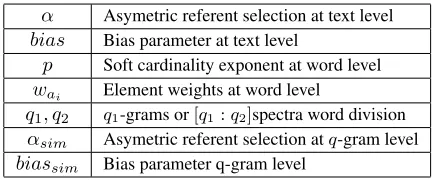
The proposed parameterized text similarity measure is constructed by combining the proposed resemblance co-efficient in eq.2 and the soft cardinality in eq.1. The resulting measure has three parameters: α,bias, andp. Weightswaican beidf weights. This measure takes two
α Asymetric referent selection at text level
bias Bias parameter at text level
p Soft cardinality exponent at word level
wai Element weights at word level
q1, q2 q1-grams or[q1:q2]spectra word division
[image:3.612.318.535.56.146.2]αsim Asymetric referent selection atq-gram level biassim Bias parameter q-gram level
Table 1: Parameters of the proposed similarity model
texts represented as sets of words and returns their simi-larity. The auxiliary similarity functionsim(a, b) neces-sary for calculating the soft cardinality is another param-eter of the model. This auxiliary function is any function that can compare two words and return a similarity score in[0,1].
To build thissim(a, b)function, we chose to reuse the eq.2 but representing words as sets ofq-grams or ranges ofq-grams of different sizes, i.e. [q1 : q2]spectra. Q
-grams are consecutive overlapped substrings of size q. For instance, the word “saturday” divided into trigrams is {/sa, sat,atu,tur,urd,rda,day,ay.}. The character ’.’ is a padding character added to differenciateq-grams at the begining or end of the string. A [2 : 4]spectra is the combined representation of a word using –in this example– bigrams, trigrams and quadgrams (Jimenez and Gelbukh, 2011). The cardinality function forsim()was the classical set cardinality. Clearly, the soft cardinal-ity could be used again if an auxiliary similarcardinal-ity func-tion for character comparison and a q-gram weighting mechanism are provided to allow another level of recur-sion. Therefore, the parameters ofsim(a, b)are: αsim, biassim. Finally, the entire set of parameters of the
pro-posed similarity model is shown in Table 1.
4
Experimental Setup and Results
The aim of these experiments is to observe the behavior of the parameters of our similarity model and verify if the hypothesis that motivated these parameters can be con-firmed experimentally. The experimental data are 8 data sets (3 for training and 5 for test) proposed in the “Seman-tic Text Similarity” task at SEMEVAL-2012. Each data set consist of a set of pairs of text annotated with human-similarity judgments on a scale of 0 to 5. Each human-similarity judgment is the average of the judgments provided by 5 human judges. For a comprehensible description of the task see(Agirre et al., 2012).
4.1 Model Parameters
In order to make an initial exploration of the parame-ters in Table 1, we setq1 = 2(i.e. bigrams) and used
wai =idf(ai). For other parameters, we started with all the non-effect values, i.e. α = 0.5, bias = 0,p = 1,
αsim = 0.5andbiassim = 0. Plots in Figure 1 show the Pearson correlation measured in each of the data sets. For each graph, the non-effect configuration was used and each parameter varies in the range indicated in each hor-izontal axis. For best viewing, the non-effect values on each graph are represented by a vertical line.
In this exploration of the parameters it was noted that each parameter defines a function for the performance measure that is smooth and with an unique global maxi-mum. Therefore, we assumed that the join performance function in the space defined by the 5 parameters also had the same properties. The parameters for each data set shown in Table 2 were found using a simple hill-climbing algorithm. Different q-gram and spectra configurations were tested manually.
5
Discussion
It is possible to observe from the results in Figure 1 and Table 2 that the behavior of the parameters is similar in pairs of data sets that have training and test parts. This behavior is evident in both MSRvid and MSRpar data sets, but it is less evident in SMTeuroparl. Furthermore, the optimal parameters for training data sets MSRvid and MSRpar were similar to those of their test data sets. In conclusion, the proposed set of parameters provides a set of features that characterize a data set for the text similar-ity task.
Regarding the effect of asymmetry in referent selecc-tion proposed by Tvesrky, it was observed that –at text level– the MSRvid data sets were the only ones that sup-ported this hypothesis (α= 0.32,0.42). The remaining data sets showed the opposite effect (α > 0.5). That is, annotators chose the most salient document (the longer) as the referent when a pair of texts is being compared.
The Table 2 also shows that the optimal parameters for all data sets were different from the no-effect values combination. This result can also be seen in Figure 1, where curves crossed the vertical line of no-effect value –in most of the cases– in values different to the optimum. Clearly, the proposed set of parameters is useful for ad-justing the similarity function for a particular data set and task.
6
Conclusions
We have proposed a new parameterized similarity func-tion for text comparison and a method for finding the op-timal values of the parameter set when training data is
available. In addition, the parameterα, which was moti-vated by the similarity model of Tversky, proved effective in obtaining better performance, but we could not con-firm the Tvesky’s hypothesis that humans tends to select the object (text) with less stimulus salience (text length) as the referent. This result might have occurred because either the stimulus salience is not properly represented by the length of the text, or Tversky’s hypothesis cannot be extended to text comparison.
The proposed similarity function proved effective in the task of “Semantic Text Similarity” in SEMEVAL 2012. Our method obtained the third best average cor-relation on the 5 test data sets. This result is remarkable because our method only used data from the surface of the texts, a stop-word remover, and a stemmer, which can be even be considered as a baseline method.
Acknowledgments
This research was funded by the Systems and Industrial Engineering Department, the Office of Student Welfare of the National University of Colombia, Bogotá, and throught a grant from the Colombian Department for Science, Technology and Innovation Colciencias, proj. 110152128465. The second author recognizes the sup-port from Mexican Government (SNI, COFAA-IPN, SIP 20113295, CONACYT 50206-H) and CONACYT–DST India (proj. “Answer Validation through Textual Entail-ment”).
References
Eneko Agirre, Daniel Cer, Mona Diab, and Gonzalez-Agirre Aitor. 2012. SemEval-2012 task 6: A pilot on semantic textual similarity. InProc. of the 6th International Workshop on Semantic Evaluation (SemEval 2012), in conjunction with the First Joint Conference on Lexical and Computational Se-mantics (*SEM 2012)., Montreal,Canada.
Mikhail Bilenko and Raymond J. Mooney. 2003. Adaptive du-plicate detection using learnable string similarity measures. In Proc. of the ninth ACM SIGKDD international confer-ence on Knowledge discovery and data mining, pages 39–48, Washington, D.C. ACM.
William W Cohen, Pradeep Ravikumar, and Stephen E Fien-berg. 2003. A comparison of string distance metrics for Name-Matching tasks. InProc. of the IJCAI2003 Workshop on Information Integration on the Web II Web03.
Courtney Corley and Rada Mihalcea. 2005. Measuring the se-mantic similarity of texts. InProc. of the ACL Workshop on Empirical Modeling of Semantic Equivalence and Entail-ment, Stroudsburg, PA.
Lee R. Dice. 1945. Measures of the amount of ecologic associ-ation between species.Ecology, pages 297–302.
0.6 0.7 0.8
co
rr
el
at
io
n
p
0.3 0.4 0.5
0 1 2 3 4 5 6 7 8
P
ea
rs
o
n
co
rr
el
at
io
n
α
0 0.5 1 1.5
bias
-15 -5 5 15
α sim
-0.5 0.5 1.5
biassim
-4 -2 0 2 4
MSRvid(tr) MSRvid(te) MSRpar(tr) MSRpar(te) SMTeur(tr) SMTeur(te) OnWN SMTnews no effect
[image:5.612.86.530.61.222.2]-5 -3 -1 1 3 5
Figure 1: Exploring similarity model parameters around their no-effect values (tr=training, te=test)
Parameters correl. Official Results
Data set [q1:q2] α bias p αsim biassim r SoftCard Best
MSRpar.training [4] 0.62 1.14 0.77 -0.04 -0.38 0.6598 n/a n/a
MSR.par.test [4] 0.60 1.02 0.9 -0.02 -0.4 0.6335 0.64051 0.7343
MSRvid.training [1:4] 0.42 -0.80 2.28 0.18 0.08 0.8323 n/a n/a
MSRvid.test [1:4] 0.32 -0.80 1.88 1.08 0.08 0.8579 0.8562 0.8803
SMTeuroparl.training [2:4] 0.74 -0.06 0.91 1.88 2.90 0.6193 n/a n/a
SMTeuroparl.test [2:4] 0.84 -0.16 0.71 1.78 3.00 0.5178 0.51522 0.5666
OnWN.test [2:5] 0.88 -0.62 1.36 -0.02 -0.70 0.7202 0.71091 0.7273
SMTnews.test [1:4] 0.88 0.88 1.57 0.80 3.21 0.5344 0.48331 0.6085
1Result obtained using Jaro-Winkler (Winkler, 1990) measure assim(a, b)function between words.
2Result obtained using generalized Monge-Elkan measurep= 4, no stop-words removal and no term weights
(Jimenez et al., 2009).
Table 2: Results with optimized parameters and official SEMEVAL 2012 results
Paul Jaccard. 1901. Etude comparative de la distribution florare dans une portion des alpes et des jura.Bulletin de la Société Vaudoise des Sciences Naturelles, pages 547–579.
Sergio Jimenez and Alexander Gelbukh. 2011. SC spectra: a linear-time soft cardinality approximation for text compari-son. InProc. of the 10th international conference on Artifi-cial Intelligence, MICAI’11, Puebla, Mexico.
Sergio Jimenez, Claudia Becerra, Alexander Gelbukh, and Fabio Gonzalez. 2009. Generalized Monge-Elkan method for approximate text string comparison. InComputational Linguistics and Intelligent Text Processing, volume 5449 of LNCS, pages 559–570.
Sergio Jimenez, Fabio Gonzalez, and Alexander Gelbukh. 2010. Text comparison using soft cardinality. InString Pro-cessing and Information Retrieval, volume 6393 ofLNCS, pages 297–302.
Vladimir I. Levenshtein. 1966. Binary codes capable of cor-recting deletions, insertions, and reversals. Soviet Physics Doklady, 10(8):707–710.
Alvaro E. Monge and Charles Elkan. 1996. The field matching problem: Algorithms and applications. InProc. KDD-96, pages 267–270, Portland, OR.
Daniel Navarro and Michael D. Lee. 2004. Common and dis-tinctive features in stimulis representation: A modified ver-sion of the contrast model.Psychonomic Bulletin & Review, 11:961–974.
Ted Pedersen, Siddharth Patwardhan, and Jason Michelizzi. 2004. WordNet::Similarity: measuring the relatedness of concepts. In Proc. HLT-NAACL–Demonstration Papers, Stroudsburg, PA.
Martin Porter. 1980. An algorithm for suffix stripping. Pro-gram, 3(14):130–137.
Eric S. Ristad and Peter N. Yianilos. 1998. Learning string edit distance. IEEE Transactions on Pattern Analysis and Machine Intelligence, 20(5):522–532.
Gerard Salton, A. Wong, and C.S. Yang. 1975. A vector space model for automatic indexing.Com. ACM, 18(11):613–620. L. Sjöberg. 1972. A cognitive theory of similarity. Göteborg
Psychological Reports.
Amos Tversky. 1977. Features of similarity. Psychological Review, 84(4):327–352.
[image:5.612.84.527.264.392.2]