TreeMatch: A Fully Unsupervised WSD System Using Dependency
Knowledge on a Specific Domain
Andrew Tran Chris Bowes David Brown Ping Chen
University of Houston-Downtown
Max Choly Wei Ding
University of Massachusetts-Boston
Abstract
Word sense disambiguation (WSD) is one of the main challenges in Computational Linguistics. TreeMatch is a WSD system originally developed using data from SemEval 2007 Task 7 (Coarse-grained English All-words Task) that has been adapted for use in SemEval 2010 Task 17 (All-words Word Sense Disambiguation on a Specific Domain). The system is based on a fully unsupervised method using dependency knowledge drawn from a domain specific knowledge base that was built for this task. When evaluated on the task, the system precision performs above the First Sense Baseline.
1
Introduction
There are many words within natural languages that can have multiple meanings or senses depending on its usage. These words are called homographs. Word sense disambiguation is the process of determining which sense of a homograph is correct in a given context. Most WSD systems use supervised methods to identify senses and tend to achieve the best results. However, supervised systems rely on
manually annotated training corpora.
Availability of manually tagged corpora is limited and generating these corpora is costly and time consuming. With our TreeMatch system, we use a fully unsupervised domain-independent method that only requires a dictionary (WordNet, Fallbaum, 1998.) and unannotated text as input (Chen et.al, 2009).
WSD systems trained on general corpora tend to perform worse when disambiguating words from a document on a specific domain. The SemEval 2010 WSD-domain task (Agirre et. al., 2010) addresses this issue by testing participant systems on documents from the environment domain. The environment domain specific corpus for this task
was built from documents contributed by the European Centre for Nature Conservation
(ECNC) and the World Wildlife Fund (WWF). We adapted our existing TreeMatch system from running on a general context knowledge base to one targeted at the environment domain.
This paper is organized as follows. Section 2 will detail the construction of the knowledge base. In Section 3 the WSD algorithm will be explained. The construction procedure and WSD algorithm described in these two sections are similar to the procedure presented in our NAACL 2009 paper (Chen et.al, 2009). In Section 4 we present our experiments and results, and Section 5 discusses related work on WSD. Section 6 finishes the paper with conclusions.
2
Context Knowledge Acquisition and
Representation
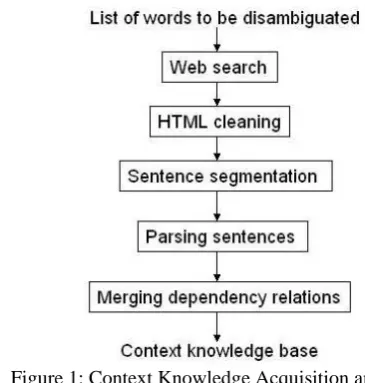
[image:1.595.318.501.477.669.2]Figure 1 shows an overview of our context knowledge acquisition process. The collected knowledge is saved in a local knowledge base. Here are some details about each step.
Figure 1: Context Knowledge Acquisition and Representation Process
2.1 Corpus Building Through Web Search
The goal of this step is to collect as many valid sample sentences as possible that contain instances of the target word. Preferably these instances are also diverse enough to contain all the different glosses of a word.
The World Wide Web is a boundless source of textual information that can be utilized for corpus building. This huge dynamic text collection represents a wide cross section of writing backgrounds that may not be represented in other corpora and may be able to better represent common human knowledge.
However, because the content on the internet is not necessarily checked for grammatical or factual accuracy, concerns may arise about the use of a corpus built from it. The quality of context knowledge will be affected by sentences of poor linguistic and poor word usage but from our experience these kind of errors are negligible when weighted against the staggering volume of valid content also retrieved.
To start the acquisition process, words that are candidates for disambiguation are compiled and saved in a text file as seeds for search queries. Each single word is submitted to a Web search engine as a query. Several search engines provide API’s for research communities to automatically retrieve large number of Web pages. In our experiments we used MSN Bing! API (Bing!, 2010) to retrieve up to 1,000 Web pages and PDF documents for each to-be-disambiguated word. Collected Web pages are cleaned first, e.g., control characters and HTML tags are removed. Then sentences are segmented simply based on punctuation (e.g., ?, !, .). PDF files undergo a similar cleaning process, except that they are converted from PDF to HMTL beforehand. Sentences that contain the instances of a specific word are extracted and saved into a local repository.
2.2 Parsing
After the sentences have been cleaned and segmented they are sent to the dependency parser Minipar (Lin, 1998). After parsing, sentences are converted to parsing trees and saved into files. The files contain the weights of all connections between all words existing within the knowledge base. Parsing tends to take the most time in the entire WSD process. Depending on the initial size of the corpus, parsing can take weeks. The long parsing time can be attributed to Minipar’s execution through system calls and also to the lack of multithreading used. However, we only need to parse the corpus once to construct the knowledge base. Any further parsing is only done on the
input sentences from the words
to-be-disambiguated, and the glosses of those words.
2.3 Merging dependency relations
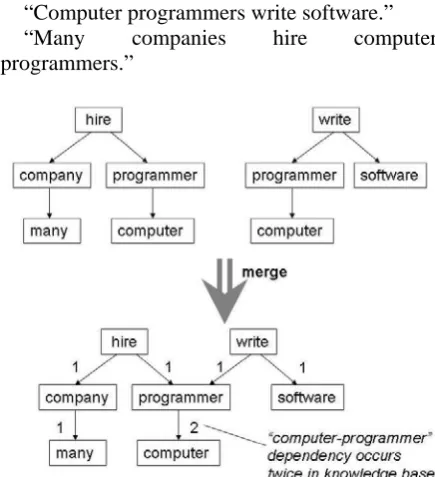
After parsing, dependency relations from different sentences are merged and saved in a context knowledge base. The merging process is straightforward. A dependency relation includes one head word/node and one dependent word/node. Nodes from different dependency relations are merged into one as long as they represent the same word. An example is shown in Figure 2, which merges the following two sentences:
“Computer programmers write software.”
“Many companies hire computer
programmers.”
Figure 2: Merging two parsing trees. The number beside each edge is the number of occurrences of this dependency relation existing in the context knowledge base.
[image:2.595.307.525.219.458.2]3
WSD Algorithm
Our WSD approach is based on the following insight:
If a word is semantically coherent with its context, then at least one sense of this word is semantically coherent with its context.
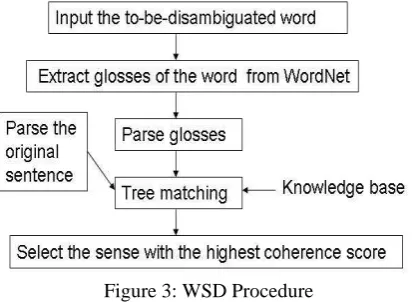
[image:3.595.76.283.339.490.2]Assuming that the documents given are semantically coherent, if we replace a targeted to-be-disambiguated word with its glosses one by one, eventually one of the glosses will have semantic coherence within the context of its sentence. From that idea we can show the overview of our WSD procedure in Figure 3. For a given to-be-disambiguated word, its glosses from WordNet are parsed one by one along with the original sentence of the target word. The semantic coherency between the parse tree of each individual gloss and the parse tree of the original sentence are compared one by one to determine which sense is the most relevant.
Figure 3: WSD Procedure
To measure the semantic coherence we use the following hypotheses (assume word1 is the to-be-disambiguated word):
• If in a sentence word1 is dependent on word2, and we denote the gloss of the correct sense of word1 as g1i, then g1i contains the most semantically coherent words that are dependent on word2;
• If in a sentence a set of words DEP1 are dependent on word1, and we denote the gloss of the correct sense of word1 as g1i, then g1i
contains the most semantically coherent words that DEP1 are dependent on.
These hypotheses are used for the functions in Figure 4. The TreeMatching function uses what we call dependency matching to ascertain the correct sense of the to-be-disambiguated word. NodeMatching function is an extension from Lesk algorithm (Lesk, 1986).
Input: Glosses from WordNet;
S: the to-be-disambiguated sentence;
G: the knowledge base generated in Section 2;
1. Input a sentence S, W = {w| w’s part of speech is noun, verb, adjective, or adverb, w∈S}; 2. Parse S with a dependency parser, generate
parsing tree TS; 3. For each w∈W {
4. Input all w’s glosses from WordNet;
5. For each gloss wi {
6. Parse wi, get a parsing tree Twi;
7. scored = TreeMatching(TS, Twi);
Scoren = NodeMatching(TS, Twi);
}
8. If the highest scored and Scoren indicate
the sense, choose this sense;
9. Otherwise, choose the first sense.
10. }
TreeMatching(TS, Twi)
11. For each node nSi∈TS {
12. Assign weight wSi = 1
𝑙𝑙𝑙𝑙𝑙𝑙 , lSi is the length between nSi and wi in TS; 13. }
14. For each node nwi ∈Twi {
15. Load its dependent words Dwi from G; 16. Assign weight wwi = 1
𝑙𝑙𝑙𝑙𝑙𝑙, lwi is the level number of nwi in Twi; 17. For each nSj {
18. If nSj ∈Dwi
19. calculate connection strength sji
between nSj and nwi;
20. score = score + wSi × wwi × sji;
21. }
}
22. Return score;
NodeMatching (TS, Twi)
23. For each node nSi∈TS { 24. Assign weight wwi = 1
𝑙𝑙𝑙𝑙𝑙𝑙, lwi is the level number of nwi in Twi; 25. For each nSj {
28. If nSi == wwi
29. score = score + wSi × wwi
} }
Figure 4: WSD Algorithm
4
Experiment
Table 1: Fine-Grained SemEval 2010 Task 17 Disambiguation Scores
Since we knew the task’s domain specific corpus would be derived from ECNC and WWF materials, we produced our query list from the same source. A web crawl starting from both the ECNC and WWF main web pages was performed that retrieved 772 PDF documents. Any words that were in the PDFs and also had more than one gloss in WordNet were retained for Bing! search queries to start the acquisition process as described in section 2. 10779 unique words were obtained in this manner.
Using the 10779 unique words for search queries, the web page and PDF retrieval step took 35 days, collecting over 3 TB of raw html and PDF files, and the cleaning and sentence extraction step took 2 days, reducing it down to 3 GB of relevant sentences, while running on 5 machines. Parsing took 26 days and merging took 6 days on 9 machines. From the parse trees we obtained 2202295 total nodes with an average of 87 connections and 13 dependents per node.
Each machine was a 2.66 GHz dual core PC with 2 GB of memory with a total of 10 machines used throughout the process.
There were 3 test documents provided by the task organizers with about 6000 total words and
1398 to-be-disambiguated words.
Disambiguation of the target words took 1.5 hours for each complete run. Each run used the same WSD procedure with different parameters.
The overall disambiguation results are shown in Table 1. The precision of our best submission edged out the First Sense Baseline (1sense) baseline by .001 and is ahead of the Random selection baseline by .276.
The recall of our submissions is lower than the precision because of our reliance on Minipar for the part of speech and lemma information of the target words. Sometimes Minipar would give an incorrect lemma which at times cannot be found in WordNet and thus our system would not attempt to disambiguate the words. Previous tasks provided the lemma and part of speech for target words so we were able to bypass that step.
5
Related work
Generally WSD techniques can be divided into four categories (Agirre, 2006),
• Dictionary and knowledge based methods.
These methods use lexical knowledge bases (LKB) such as dictionaries and thesauri, and extract knowledge from word definitions
(Lesk, 1986) and relations among
words/senses. Recently, several graph-based WSD methods were proposed. In these approaches, first a graph is built with senses as nodes and relations among words/senses (e.g., synonymy, antonymy) as edges, and the relations are usually acquired from a LKB (e.g., Wordnet). Then a ranking algorithm is conducted over the graph, and senses ranked the highest are assigned to the corresponding words. Different relations and ranking algorithms were experimented with these methods, such as TexRank algorithm (Mihalcea, 2005), personalized PageRank algorithm (Agirre, 2009), a two-stage
searching algorithm (Navigli, 2007),
Structural Semantic Interconnections
algorithm (Navigli, 2005), centrality
algorithms (Sinha, 2009).
• Supervised methods. A supervised method
includes a training phase and a testing phase. In the training phase, a sense-annotated training corpus is required, from which syntactic and semantic features are extracted to build a classifier using machine learning techniques, such as Support Vector Machine (Novisch, 2007). In the following testing phase, the classifier picks the best sense for a word based on its surrounding words (Mihalcea, 2002). Currently supervised methods achieved the best disambiguation quality (about 80% in precision and recall for coarse-grained WSD in the most recent WSD evaluation conference SemEval 2007 (Novisch, 2007). Nevertheless, since training
corpora are manually annotated and
expensive, supervised methods are often brittle due to data scarcity, and it is impractical to manually annotate huge number of words existing in a natural language.
• Semi-supervised methods. To overcome the
knowledge acquisition bottleneck suffered in
supervised methods, semi-supervised
methods make use of a small annotated corpus as seed data in a bootstrapping process (Hearst, 1991) (Yarowsky, 1995). A
System Precision Recall
1sense 0.505 0.505
TreeMatch-1 0.506 0.493
TreeMatch-2 0.504 0.491
TreeMatch-3 0.492 0.479
word-aligned bilingual corpus can also serve as seed data (Zhong, 2009).
• Unsupervised methods. These methods
acquire knowledge from unannotated raw text, and induce senses using similarity
measures (Lin, 1997). Unsupervised
methods overcome the problem of
knowledge acquisition bottleneck, but none of existing methods can outperform the most frequent sense baseline, which makes them not useful at all in practice. The best unsupervised systems only achieved about 70% in precision and 50% in recall in the SemEval 2007 (Navigli, 2007). One recent
study utilized automatically acquired
dependency knowledge and achieved 73% in precision and recall (Chen, 2009), which is still below the most-frequent-sense baseline (78.89% in precision and recall in the SemEval 2007 Task 07).
Additionally there exist some
“meta-disambiguation” methods that ensemble multiple disambiguation algorithms following the ideas of bagging or boosting in supervised learning (Brody, 2006).
6
Conclusion
This paper has described a WSD system which has been adapted for use in a specific domain for SemEval 2010 Task 17: All-Words Word Sense Disambiguation on a Specific Domain. Our system has shown that domain adaptation can be handled by unsupervised systems without the brittleness of supervised
methods by utilizing readily available
unannotated text from internet sources and still achieve viable results.
Acknowledgments
This work is partially funded by National Science Foundation grants CNS 0851984 and DHS #2009-ST-061-C10001.
References
E. Agirre, Philip Edmonds, editors. Word Sense Disambiguation: Algorithms and Applications, Springer. 2006.
E. Agirre, O. Lopez de Lacalle, C. Fellbaum, S. Hsieh, M. Tesconi, P. Vossen, and R. Segers. SemEval-2010 Task 17: All-words Word Sense Disambiguation on a Specific Domain. In Proceedings of the 5th International Workshop on
Semantic Evaluations(SemEval-2010),
Association for Computational Linguistics, Uppsala, Sweden. 2010.
E. Agirre, A. Soroa. Personalizing pagerank for word sense disambiguation. In Proceedings of the 12th conference of the European chapter of the Association for Computational Linguistics (EACL-2009).
Bing! API, available at msdn.microsoft.com
A. Brody, R. Navigli, M. Lapata, Ensemble Methods For Unsupervised WSD, COLING-ACL, 2006 P. Chen, W. Ding, C. Bowes, D. Brown. 2009. A
Fully Unsupervised Word Sense Disambiguation Method and Its Evaluation on Coarse-grained All-words Task, NAACL 2009.
C. Fellbaum. 1998. WordNet: An Electronic Lexical Database, MIT press, 1998
M. Hearst. Noun Homograph Disambiguation Using Local Context in Large Text Corpora. Proc. 7th Annual Conference of the Univ. of Waterloo Center for the New OED and Text Research, Oxford. 1991.
M. Lesk. 1986. Automatic sense disambiguation using machine readable dictionaries: how to tell a pine cone from an ice cream cone. In Proceedings of the 5th Annual international Conference on Systems Documentation (Toronto, Ontario, Canada). V. DeBuys, Ed. SIGDOC ’86.
D. Lin. Using syntactic dependency as local context to resolve word sense ambiguity. In Proceedings of the 35th Annual Meeting of the Association For Computational Linguistics and Eighth Conference of the European Chapter of the Association For Computational Linguistics. 1997.
D. Lin. 1998. Dependency-based evaluation of minipar. In Proceedings of the LREC Workshop on the Evaluation of Parsing Systems, pages 234– 241, Granada, Spain.
R. Mihalcea. Unsupervised Large-Vocabulary Word Sense Disambiguation with Graph-based Algorithms for Sequence Data Labeling, in Proceedings of the Joint Conference on Human Language Technology Empirical Methods in Natural Language Processing (HLT/EMNLP), Vancouver, October, 2005.
R. Mihalcea. Instance based learning with automatic feature selection applied to word sense disambiguation. In Proceedings of the 19th International Conference on Computational linguistics. 2002.
R. Navigli, Mirella Lapata. Graph Connectivity Measures for Unsupervised Word Sense Disambiguation. IJCAI 2007
R. Navigli, Paola Velardi. Structural semantic interconnections: a knowledge-based approach to word sense disambiguation. IEEE Transactions on Pattern Analysis and Machine Intelligence (PAMI), 27(7):1063-1074. 2005.
coarse grained all words task at semeval 2007. Proceedings of the Fourth International Workshop on Semantic Evaluations (SemEval-2007), pages 223--226, Prague, Czech Republic. 2007.
R. Sinha, Rada Mihalcea. Unsupervised Graph-based Word Sense Disambiguation, in “Current Issues in Linguistic Theory: Recent Advances in Natural Language Processing”, Editors Nicolas Nicolov and Ruslan Mitkov, John Benjamins, 2009. D. Yarowsky. Unsupervised word sense
disambiguation rivaling supervised methods. In Proceedings of the 33rd Annual Meeting on Association For Computational Linguistics, Cambridge, Massachusetts, 1995.