Proceedings of the Joint Workshop on
Linguistic Annotation, Multiword Expressions and Constructions (LAW-MWE-CxG-2018), pages 51–61 Santa Fe, New Mexico, USA, August 25-26, 2018.
51
Fixed Similes: Measuring Aspects of the Relation between MWE
Idiomatic Semantics and Syntactic Flexibility
Stella Markantonatou Institute for Language and Speech Processing,
Athena RIC, Greece
stiliani.markantonatou @gmail.com
Panagiotis Kouris School of Electrical and
Computer Engineering, National Technical University of Athens,
Greece
Yanis Maistros School of Electrical and
Computer Engineering, National Technical University of Athens,
Greece
Abstract
We shed light on aspects of the relation between the semantics and the syntactic flexibility of multiword expressions (MWE) by investigating fixed adjective similes (FS), a predicative. MWE class not studied in this respect before. We work on Modern Greek data1and find that only a subset of the observed syntactic structures is related with idiomaticity. We identify and measure two aspects of semantic idiomaticity, one of which seems to allow to predict FS syntactic flexibility. Our research draws on a resource developed with the semantic and detailed syntactic annotation of web-retrieved material, indicating frequency of use of the individual similes.
1 Introduction
The relation between the idiomatic semantics of multiword expressions (MWE) and their syntactic flexibility, namely the ability of a MWE to occur in different syntactic configurations without loss of the idiomatic meaning, has offered a fertile field of research because it challenges the notion of composition-ality, namely the derivation of the meaning of an utterance from the meaning of its components and its syntactic structure. The (predicative) free subject verb MWEs of the type verb+noun (V+N) have been one of the privileged fields of these studies. We add to the understanding of this relation by investigating a class of predicative (non-verb) MWEs that, to the best of our knowledge, has not been studied from this point of view so far, namely the class of fixed similes (FS) of the type adjective+connector+(article)+noun such assweet like honey. Modern Greek, a lesser studied language in this respect, is our object language. We ask whether the occurrence of the syntactic structures considered as manifestations of syntactic flex-ibility is related with (idiomatic) semantics and we find that this holds only for some structures –a subset of which could be characterised as syntactic alternatives. Our results corroborate the idea that syntactic structures demonstrate varying sensitivity to the semantics of their components and that the presence of syntactic variants may not be dependent only on idiomatic semantics. Next, we investigate the notion of idiomaticity. We understand idiomaticity as the degree of similarity between the FS semantics and the semantics of their free property (i.e., the free adjective, see Table 1) and, we identify and measure two types of similarity, one of which allows us to make predictions about FS syntactic flexibility. Our results were drawn from a resource developed as part of the research presented here by extensively annotating a large amount of web-retrieved unique FS usage examples. The special feature of this resource is that it offers an as good as possible approximation of the actual FS usage in texts, both in terms of frequency and in terms of structure selection.
Table 1 shows the terminology for the parts of an FS adopted from Hanks (2005):
1
We acknowledge support of this work by the project “Computational Sciences and Technologies for Data, Content and Interaction” (MIS 5002437) which is implemented under the Action “Reinforcement of the Research and Innovation Infras-tructure”, funded by the Operational Programme “Competitiveness, Entrepreneurship and Innovation” (NSRF 2014-2020) and co-financed by Greece and the European Union (European Regional Development Fund).
entity modified by the FS adjective connector (article) noun
[image:2.595.82.352.497.767.2]tenor property vehicle
Table 1: Terminology for the parts of an FS.
In §2 we contextualise our work with respect to state-of-the-art research. In §3 we talk about data collection and annotation and the development of the resource. In §4 we describe the results we receive by quantitatively studying the resource. We present our conclusions and our plans for the future in §5.
2 Related work
Simile is a figure of speech, which, unlike metaphor, draws attention to the likeness between the tenor and the vehicle that are implied to share certain properties (Veale and Hao, 2007). Similes draw on con-ventional beliefs about likeness and effectively convey the speaker’s superlative evaluation of the tenor (Israel et al., 2004). They follow the same structure as comparative, e.g. Knowledge issweeter than honey, equative, e.g.Her argument wasas clear as glassand similative statements, e.g.My hands were
cold like ice(Chila-Markopoulou, 1986; Israel et al., 2004; Niculae and Danescu-Niculescu-Mizil, 2014; Mpouli and Ganascia, 2015). Many conventional similes tend to be fixed and have idiom status (Hanks, 2005). For instance, FS6 κόκκινος σαν αστακός (kokinos san astakos) ‘red as lobster’ (see Table 2) ap-plies mainly to persons or body (parts) (96,4% in our data) to denote blushing or sunburned people; this meaning can not be derived from the parts of the FS. Some English FS tend to select tenors from a small range of semantic fields (Mpouli and Ganascia, 2015); for Greek see Figure 1. FS have been found to share a good part of simile usage in English (Niculae and Danescu-Niculescu-Mizil, 2014).
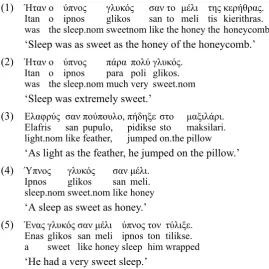
Modern Greek FS assume the syntactic functions of the adjectives (Markantonatou et al., 2016). They appear as complements of the copula (1), as phrasal adjuncts controlled by the subject of the main verb (3), in verbless sentences (4), in the typical adjective position between the determiner and the noun (5) and, rarely, as subjects and objects of verbs or prepositions. In all these structures, FS can be replaced with the superlative of the adjective (exemplified only for the complement of copula (2)). They may occur with the adverb πολύ (poli) ‘much’ or, rarely, with some other intensifying adverb. In this case, the simile is not pronounced as a unit but as if a punctuation mark existed between the property and the σαν+vehicle part. We annotated these structures asempp(phrasal emphasis (Table 3)). We will treat FS as MWE adjectives.
(1) Ήταν Itan was ο o the ύπνος ipnos sleep.nom γλυκός glikos sweetnom σαν san like το to the μέλι meli honey της tis the κερήθρας. kierithras. honeycomb.gen ‘Sleep was as sweet as the honey of the honeycomb.’
(2) Ήταν Itan was ο o the ύπνος ipnos sleep.nom πάρα para much πολύ poli very γλυκός. glikos. sweet.nom ‘Sleep was extremely sweet.’
(3) Ελαφρύς Elafris light.nom σαν san like πούπουλο, pupulo, feather, πήδηξε pidikse jumped στο sto on.the μαξιλάρι. maksilari. pillow ‘As light as the feather, he jumped on the pillow.’
(4) Ύπνος Ipnos sleep.nom γλυκός glikos sweet.nom σαν san like μέλι. meli. honey ‘A sleep as sweet as honey.’
Computational methods distinguishing between similes and other comparisons take advantage of the at-tested semantic distance between the similes’ tenor and vehicle and of definiteness (Niculae and Danescu-Niculescu-Mizil, 2014). Ηοwever, we show that in Modern Greek, determiner distribution is independent of FS idiomaticity (§4.1).
The study of large amounts of data of V+N MWEs has shown that MWE syntactic flexibility is related to MWE idiomaticity modeled as the semantic distance between the environments where the MWE and its parts occur (Fazly et al., 2009). Our research on FS sheds more light on this attested relation.
A much debated proposal claims that MWE syntactic flexibility is related with MWE semantic analysability, namely the degree to which the idiomatic semantics of the MWE can be derived syntheti-cally from the (idiomatic) meanings of its parts (indicatively, Nunberg et al. (1994), Kay and Sag (2012) argue in favor of the syntactic analysability approach and Laporte (2018) argues against it). Interestingly, (Kay and Sag, 2012, 4) maintain that while “meaningful idiom words can be modified and can appear in syntactic contexts that meaningless ones cannot”, only those language structures that “do not entail inter-pretive consequences (as does, for example, English topicalization) are precisely the syntactic contexts that permit meaningless idiom words to be “displaced.”” We demonstrate that the syntactic environments in which FS occur can be split into FS semantics sensitive and insensitive ones.
3 The resource
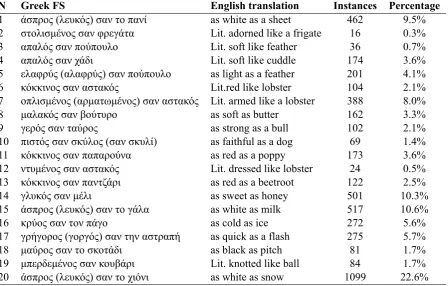
N Greek FS English translation Instances Percentage
1 άσπρος (λευκός) σαν το πανί as white as a sheet 462 9.5%
2 στολισμένος σαν φρεγάτα Lit. adorned like a frigate 16 0.3%
3 απαλός σαν πούπουλο Lit. soft like feather 36 0.7%
4 απαλός σαν χάδι Lit. soft like cuddle 174 3.6%
5 ελαφρύς (αλαφρύς) σαν πούπουλο as light as a feather 201 4.1%
6 κόκκινος σαν αστακός Lit.red like lobster 104 2.1%
7 οπλισμένος (αρματωμένος) σαν αστακός Lit. armed like a lobster 388 8.0%
8 μαλακός σαν βούτυρο as soft as butter 162 3.3%
9 γερός σαν ταύρος as strong as a bull 102 2.1%
10 πιστός σαν σκύλος (σαν σκυλί) as faithful as a dog 69 1.4%
11 κόκκινος σαν παπαρούνα as red as a poppy 173 3.6%
12 ντυμένος σαν αστακός Lit. dressed like lobster 24 0.5%
13 κόκκινος σαν παντζάρι as red as a beetroot 122 2.5%
14 γλυκός σαν μέλι as sweet as honey 501 10.3%
15 άσπρος (λευκός) σαν το γάλα as white as milk 517 10.6%
16 κρύος σαν τον πάγο as cold as ice 272 5.6%
17 γρήγορος (γοργός) σαν την αστραπή as quick as a flash 275 5.7%
18 μαύρος σαν το σκοτάδι as black as pitch 81 1.7%
19 μπερδεμένος σαν κουβάρι Lit. knotted like ball 84 1.7%
[image:3.595.80.529.322.608.2]20 άσπρος (λευκός) σαν το χιόνι as white as snow 1099 22.6%
Table 2: FS distribution in the resource.
3.1 Data collection
With a tailor-made Facebook application (Mitrović and Markantonatou, 2018) we asked 260 native speakers of Modern Greek to specify which of 152 similes they would use in their everyday exc hange.2 Krippendorff’s alpha coefficient (Artstein and Poesio, 2008) was used to evaluate inter-speaker agree-ment. 85 similes were found to be used by a critical number of speakers. According to Baldwin and Kim
2The similes were collected from the Hellenic National Corpus (HNC), http://hnc.ilsp.gr/, and a corpus of 100 million words
(2010), the selected similes can be considered MWEs because (i) they fulfill the statistical idiomaticity criterion; as explained in §3.2, the similes are subject to minimal lexical variation (ii) most of them fulfill the semantic idiomaticity criterion (§2). Of them, we selected 20 FS (Table 2) that represent the classes defined in two different simile classifications by the semantics of the vehicle and of the property, one of Modern Greek FS (Mpolla-Mavridou, 1996) and one of English similes (Hanks, 2005). A corpus consist-ing of 4900 unique usage examples (instances from now on) was collected from the web with exhaustive searches, which allowed our resource to represent instance frequency.3Regular expressions were used to capture the rich morphology of Modern Greek, its flexible word order as well as lexical and syntactic variation. The retrieved material was cleaned from multiple occurrences of the same instance and from machine translation outputs. Table 2 shows the distribution of instances per FS in the corpus.
3.2 Lexical and syntactic variation in the case of Modern Greek FS
Lexical variation is not attested for most FS in our data (Table 2). The adjectives άσπρος (aspros) ‘white’, οπλισμένος (oplismenos) ‘armed’ and γρήγορος (grigoros) ‘fast’ variate between synonyms that differ in terms of style and the variants occur in considerable frequencies. FS1 άσπρος σαν το πανί (aspros san to pani) ‘as white as sheet’ is exceptional because there is a small number of adjectives with the sensepalethat variate with άσπρος: κίτρινος (kitrinos) ‘yellow’, ωχρός (ochros) ‘ashy, ghostly’, χλωμός (chlomos) ‘pale’. FS10 πιστός σανσκύλος(pistos san skilos.masc) ‘as faithful as a dog’, variates with πιστός σανσκυλί(pistos san skili.neut) because the vehicle occurs in both genders.
Syntactic variation is more frequent in our data. The FS alternative with connector σαν (san) ‘like, as’ (6) is the most frequently used form, which we will call the normative form. The same property and vehicle may appear in a comparative structure; (7) features a morphological comparative form and (8) a phrasal one (Chila-Markopoulou, 1986). They can also appear in an equative form (9). Similar observations have been made for English (Niculae and Danescu-Niculescu-Mizil (2014); Mpouli and Ganascia (2015)). We will use the term FS alternative to refer to syntactic variations (6)-(10): we have also treated as FS alternatives the structures that contain a punctuation mark (comma, full stop, dots) between the property and the connector+vehicle part of the FS (10) provided that the parts on either side of the punctuation mark are predicated of the same entity.
(6) Σε Se you.acc παίρνει perni take ο o the γνωστός gnostos familiar μεσημεριανός mesimerianos noon ύπνος, ipnos, sleep.nom, ο o the γλυκός glikos sweet σαν san like μέλι. meli. honey ‘The familiar nap, that is sweet like honey, comes all over you.’
(7) Είναι Ine is γλυκύτερος glikiteros sweeter από apo than μέλι meli honey και kie and δυστυχώς distichos unfortunately δεν den not δείχνει dichni shows σκυλί skili dog επιβίωσης. epiviosis. of.survival
‘It is sweeter than honey but, unfortunately, it does not seem to be a survivor dog.’
(8) Έλεγε Elegie said τραγούδια tragudia songs γλυκά, glika, sweet πιο pio more γλυκά glika sweet κι ki and από apo from το to the μέλι meli honey της tis of.the μέλισσας. melisas. bee ‘He sang sweet songs, sweeter than the honey of the bee.’
(9) Αλείφουν Alifun rub τις tis the βρύσες vrises taps με me with μέλι, meli, honey ώστε oste so that ο o the καινούριος kienurgios new χρόνος chrons year να na to είναι ine be τόσο toso as γλυκός glikos sweet σαν san like το to the μέλι. meli. honey ‘They rub the taps with honey to ensure that the new year will be as sweet as honey.’
(10) Και Kie and είναι ine is τόσο toso so απαλό. apalo. soft Σαν San like το to the στερνό sterno last σου su your χάδι. chadi. cuddle ‘And it is so soft. Like your last cuddle.’
3.3 Syntactic and semantic annotation
Syntactic annotation modeled FS syntactic flexibility; it captured the normative form and the deviations from it observed in the data, including FS alternatives. As Greek FS function as adjective MWEs (§2), we assume that their semantics is represented by the semantics of the NPs they select as tenors (Table 1). We used WordNet supersenses to annotate the tenors; this detailed semantic annotation allowed us to distinguish between types of idiomaticity. In the remainder, we will use the term FS semantics to denote the set of semantic annotations assigned to the tenors of a particular FS in the resource. High degrees of inter-annotator agreement were obtained as confirmed by Krippendorff’s alpha coefficient.
[image:5.595.75.524.236.479.2]3.3.1 Syntactic annotation
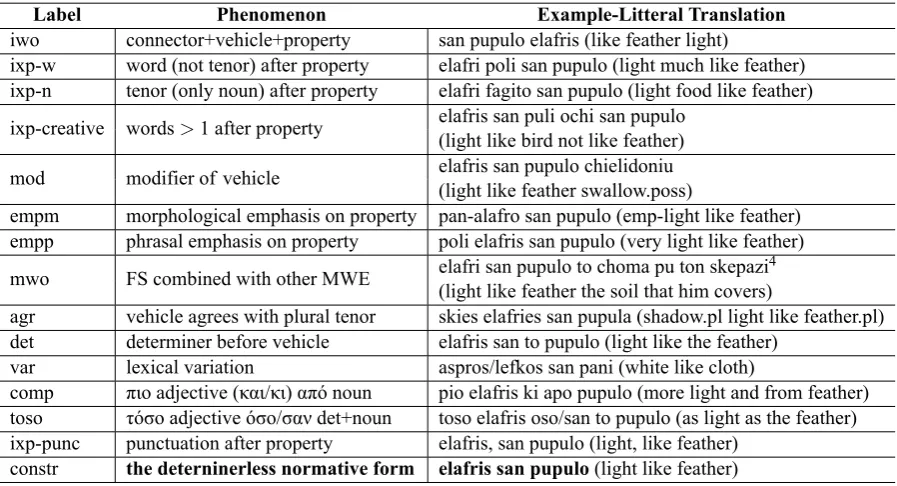
Table 3 summarises the labels used to annotate syntactic flexibility. The last four lines of Table 3 show the FS alternants. The annotators used a manual developed for this purpose.
Label Phenomenon Example-Litteral Translation iwo connector+vehicle+property san pupulo elafris (like feather light)
ixp-w word (not tenor) after property elafri poli san pupulo (light much like feather) ixp-n tenor (only noun) after property elafri fagito san pupulo (light food like feather)
ixp-creative words>1 after property elafris san puli ochi san pupulo (light like bird not like feather)
mod modifier of vehicle elafris san pupulo chielidoniu (light like feather swallow.poss)
empm morphological emphasis on property pan-alafro san pupulo (emp-light like feather) empp phrasal emphasis on property poli elafris san pupulo (very light like feather)
mwo FS combined with other MWE elafri san pupulo to choma pu ton skepazi
4
(light like feather the soil that him covers)
agr vehicle agrees with plural tenor skies elafries san pupula (shadow.pl light like feather.pl) det determiner before vehicle elafris san to pupulo (light like the feather)
var lexical variation aspros/lefkos san pani (white like cloth)
comp πιο adjective (και/κι) από noun pio elafris ki apo pupulo (more light and from feather) toso τόσο adjective όσο/σαν det+noun toso elafris oso/san to pupulo (as light as the feather) ixp-punc punctuation after property elafris, san pupulo (light, like feather)
constr the deterninerless normative form elafris san pupulo(light like feather)
Table 3: The labels for syntactic flexibility annotation.
To check inter-annotator agreement 630 instances (12,9% of the data), representing 6 FS (FS19, FS18, FS12, FS11, FS9, FS8), were annotated by 3 linguists. Krippendorff’s alpha coefficient was equal to 0.91.
3.3.2 Semantic annotation
WordNet supersenses were used to semantically annotate the tenors (Schneider et al., 2013; Schneider and Smith, 2015). No sufficient WordNets are available for Modern Greek, so we translated Greek tenors into English. In case of pronouns or pro-drop phenomena, the tenor was induced from the context.
To check inter-annotator agreement 2400 instances (49% of the data), representing 4 FS (FS20, FS19, FS18, FS1), were annotated by 5 linguists. Krippendorff’s alpha coefficient was equal to 0.95.
Figure 1 shows the distribution of semantic categories of tenors in the resource. We see that FS (at least, the ones we studied) mainly describe humans and that they select a small set of semantic categories (Mpouli and Ganascia, 2015), which partly explains the high inter-annotator agreement.
3.4 The Flat-Folia resource
To make the annotated resource5machine-readable, extensible and reusable, we converted it to Folia format (van Gompel and Reynaert, 2013), an XML-based format for linguistic annotation. We use the
4
MWE1: elafri to choma pu ton skiepazi, lit.light the soil that covers him(it is said for those who have passed away), FS: elafris san pupulo ‘as light as a feather’.
PERSON (42.0%) BODY (13.0%)
ARTIFACT (10.8%) FOOD (5.6%)
ANIMAL (4.9%) COGNITION (3.1%)
SUBSTANCE (2.7%) ACT (2.6%)
[image:6.595.157.446.63.233.2]COMMUNICATION (2.5%) ATTRIBUTE (2.2%) GROUP (1.7%) OBJECT (1.6%) PLANT (1.3%) TIME (1.2%) STATE (1.1%) FEELING (0.9%) OTHER (2.9%)
Figure 1: Distribution of semantic categories of tenors in the resource.
Flat - FoliA Linguistic Annotation Tool,6which allows users to view and edit Folia annotated documents.
4 Investigating the resource
4.1 The relation between syntactic flexibility and tenor semantics
Shannon entropy is used as a measure of the syntactic and semantic diversity (Manning and Schütze, 1999; Lebani et al., 2015). For the syntactic entropy, each FS instance is represented as a vector including binary values of the syntactic features defined in Table 3 (presence or absence of a feature). Thus, syntactic entropy is measured according to the distinct vectors and their frequency. Semantic entropy is measured by the number of occurrences of each semantic category (Figure 1).
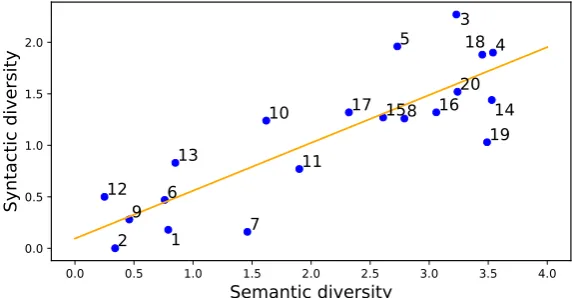
Pearson correlation coefficient (Benesty et al., 2009) showed a strong positive linear relationship be-tween the syntactic and semantic diversity (equal to0.84withp−value = 3.2·10−6), across the FS for the syntactic features constr, comp, toso, ixp-punc, ixp-creative, ixp-n, empp, mwo. We observe a positive relation between fixedness and semantic idiomaticity, also observed for V+N MWEs (Fazly and Stevenson, 2007). Correlation improved for the aforementioned syntactic features and deteriorated for the featuresiwo, ixp-w, mod, var, det, empm(Table 3). This result is reminiscent of the (Kay and Sag, 2012, 4) observation that syntactic contexts may or may not interfere with MWE semantics (§2). The relation between the syntactic and semantic diversity of each FS is depicted in Figure 2.
0.0 0.5 1.0 1.5 2.0 2.5 3.0 3.5 4.0
Semantic diversity
0.00.5 1.0 1.5 2.0
Syntactic diversity
1
2
3
4
5
6
7
8
9
10
11
12
13
14
15
16
17
18
19
20
Figure 2: The linear relation between the syntactic and semantic diversity of the similes (the diversity is measured in terms of Shannon entropy).
6FLAT is an open source software developed at the Centre of Language and Speech Technology, Radboud University
[image:6.595.154.444.532.681.2]4.2 Classification of FS by syntactic flexibility
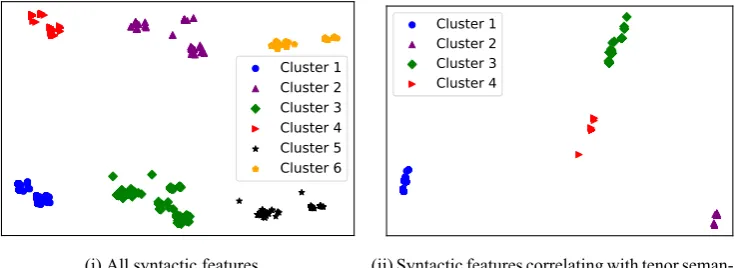
Clustering over the vectors including binary values of the syntactic features (presence or absence of a feature) failed to produce an FS classification by syntactic flexibility (such as the one proposed for all MWEs in Sag et al. (2002)); rather, it produced interesting FS instance clusters. We applied Logistic Principal Component Analysis (LPCA) (Landgraf and Lee, 2015) to achieve dimensionality reduction and to visualize the FS instances in two dimensions. The k-Means algorithm7 is used to separate the data in k clusters of FS instances, where the instances in each cluster are expected to have similar char-acteristics (Berkhin, 2006). Although the instances could be analyzed in more clusters employing more complicated clustering algorithms, in this initial approach, we identify significant knowledge in a more general separation, as we describe below.
0.50 0.25 0.00 0.25 0.50 0.75 1.00 1.25 0.4
0.2 0.0 0.2 0.4 0.6 0.8
Cluster 1 Cluster 2 Cluster 3 Cluster 4 Cluster 5 Cluster 6
(i) All syntactic features.
0.2 0.0 0.2 0.4 0.6 0.8 1.0 1.2 0.25
0.00 0.25 0.50 0.75 1.00
1.25 Cluster 1Cluster 2 Cluster 3 Cluster 4
[image:7.595.117.485.216.350.2](ii) Syntactic features correlating with tenor seman-tics only.
Figure 3: Clustering FS instances.
When all syntactic features are used, we obtain six clusters (Figure 3(i)) with prominent featuresdet, var,compandconstr. Onlyconstr’s andcomp’s syntactic diversity correlates with tenor’s semantic di-versity (§4.1). The most frequent features by cluster are: cluster 1,constr(the normative form); cluster 2,det,var; cluster 3,det; cluster 4,var; cluster 5,det,comp,constr; cluster 6,det,comp,constr,var.
When only the syntactic flexibility features that contribute positively to the flexibility-idiomatic se-mantics correlation are used (§4.1), we obtain four clusters (Figure 3(ii)) with prominent featuresconstr, comp,ixp-puncandtoso. The most frequent features by cluster are: cluster 1,constr(the normative form, i.e. absence of any syntactic feature); cluster 2,comp,constr; cluster 3,ixp-punc,constr; cluster 4,toso, constr. The featureconstroccurs in the clusters 2, 3 & 4, so these clusters can be characterized by their other featurescomp,ixp-puncandtoso. The four structures are the FS alternatives (§3) that more or less partition the set of FS instances (onlyixp-puncco-occurs with the other FS alternatives, very rarely).
Geeraert et al. (2017), using eyetracking, identified lexical variation (corresponding to our featurevar) as one of the “easiest” MWE variations for English in terms of comprehension. This might indicate that MWE variations that are “easy” in terms of comprehension are, at the same time, independent of MWE idiomaticity and “more prominent” than other syntactic structures in the speakers’ output.
4.3 Predicting syntactic flexibility
To better understand the relation between semantic and syntactic diversity, we sought a quantitative definition of idiomaticity. Intuitively, since FS function as MWE adjectives (§2), rather than defining idiomaticity as the distance of the context of the constituents of the FS from the context of the FS itself (Fazly and Stevenson, 2007), we defined it as the similarity between the tenor semantics and the semantics of the NPs selected by the free property of the FS. For instance, we calculated the similarity between the semantics of the tenors of FS1 άσπρος σαν το πανί (aspros san to pani) ‘as white as a sheet’ and the semantics of the NPs selected by the free occurrences of the adjective άσπρος (aspros) ‘white’. We defined two measures of semantic similarity:
Semantic similarity measure 1 (SSM1): Cosine similarity (Manning and Schütze, 1999) based on frequency is applied to the vectors of the two sets of supersenses described above, which include the frequency of each supersense, for instance, the frequency of the supersense person in the semantics of FS1 and in the semantics of the NPs selected by the FS’s free property. To ensure comparability of the vectors, frequencies have been normalized in the range zero to one.
Semantic similarity measure 2 (SSM2): Cosine similarity based on binary vectors: the vectors of both supersence sets which include only the presence or absence (i.e. 1 or 0, respectively) of each supersense. For instance, FS1 selects 7 semantic categories and the respective free adjective selects 17; 5 semantic categories occur in both sets.
Simile 1 2 3 4 5 6 7 8 9 10 11 12 13 14 15 16 17 18 19 20
SSM 1 .09 .23 .67 .80 .74 .14 .99 .66 .61 .89 .28 .99 .16 .87 .27 .43 .51 .56 .79 .58
[image:8.595.74.526.202.239.2]SSM 2 .46 .45 .72 .72 .75 .58 .68 .73 .42 .42 .78 .47 .47 .93 .86 .77 .65 .75 .77 .79
Table 4: TheSemantic Similarity Measure 1 (SSM1)and theSemantic Similarity Measure 2 (SSM2)of the semantics of the 20 similes and the supersences of the respective free adjectives.
0.3 0.4 0.5 0.6 0.7 0.8 0.9 1.0
Semantic Similarity Measure 2
0.0 0.5 1.0 1.5 2.0
Syntactic Diversity
1 2
3 4 5
6 7
8
9 10
11 12
13
14 15 16 17
18
19 20
(i) Relation betweensyntactic diversityandSSM2.
0.3 0.4 0.5 0.6 0.7 0.8 0.9 1.0
Semantic Similarity Measure 2
0 1 2 3 4
Semantic Diversity 1
2
34 5
6 7
8
9
10 11
12 13
14
15 16 17
181920
(ii) Relation betweensemantic diversityandSSM2.
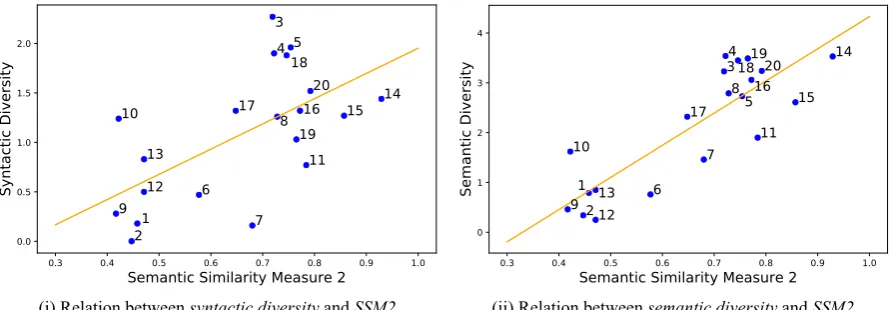
Figure 4: The linear relation betweensyntactic diversity orsemantic diversityandsemantic similarity measure 2 (SSM2).
For each property of the 20 FS, we retrieved the first 200 unique instances from the HNC. We excluded MWEs involving the adjectives, for instance, for the property κόκκινος (kokinos) ‘red’ we excluded the occurrences of κόκκινη γραμμή (kokini grami) ‘red line’8. The NPs selected by the adjectives in ques-tion were annotated semantically with the WordNet supersenses. The results of both semantic similarity measures are reported in Table 4.
We found that onlySSM2is correlated with syntactic diversity and semantic diversity (only syntactic flexibility features correlating with syntactic diversity were used (§4.1)). Pearson correlation coefficient between syntactic diversity andSSM2is equal to0.61withp−value= 4.4·10−4(Figure 4(i) depicts the correlation) and betweensemantic diversityandSSM2, it is equal to0.85 with p−value = 2· 10−6(Figure 4(ii) depicts the strong linear correlation). The positive linear correlation between syntactic diversity andSSM2is less strong than between semantic diversity andSSM2(Figure 4). This might indicate that some similes tend to be used in particular syntactic configurations, which interfere with the semantically sensitive syntactic alternants; this is a hypothesis that will be checked with future research. Because cosine similarity by the semantic categories selected by the FS and its free property correlates well with the syntactic and semantic diversity of FS, it could be used as a predictor of the semantic idiomaticity of FS.
[image:8.595.76.523.304.459.2]5 Conclusion
The quantitative study of the Modern Greek fixed simile (FS) resource adds interesting new aspects to the understanding of the relation between MWE syntactic flexibility and idiomatic semantics and paves the way to further research.
We found that cosine similarity by the semantic categories selected by the FS and its free property, but not cosine similarity by frequency, correlates well with both the syntactic and semantic diversity of FS and it could be used as a predictor of FS syntactic flexibility and idiomaticity. Furthermore, syntactic deviations from the normative form can be split in “FS semantics sensitive ” and “FS semantics insensi-tive” ones. The latter introduce noise in the correlation of idiomaticity and syntactic flexibility and in their correlation with cosine similarity by semantic categories (SSM2). Finally, the clustering of FS instances as vectors of syntactic flexibility features showcases some “semantics insensitive syntactic deviations” as dominant features. The same constructions have been shown by V+N MWE comprehension studies to require less comprehension effort than other syntactic constructions. If future research shows that a correlation exists, it may be inferred that, along with idiomatic semantics, syntactic flexibility depends on certain cognitive factors/skills.
Aknowledgements
We thank Katerina Selimi, Dimitra Stasinou, Vasiliki Moutzouri and Maria Chantou for their help at the annotation phase of this work.
References
Ron Artstein and Massimo Poesio. Inter-coder agreement for Computational Linguistics.Computational Linguistics, 34(4):555–596, December 2008.
Timothy Baldwin and Su Nam Kim. Multiword expressions. In Nitin Indurkhya and Fred J. Damerau, editors,Handbook of Natural Language Processing, Second edition, pages 267–292. CRC Press, Boca Raton, 2010.
Jacob Benesty, Jingdong Chen, Yiteng Huang, and Israel Cohen. Pearson correlation coefficient. InNoise reduction in speech processing, pages 1–4. Springer, 2009.
Pavel Berkhin. A survey of clustering data mining techniques. InGrouping multidimensional data, pages 25–71. Springer, 2006.
Despina Chila-Markopoulou.Modern Greek comparative constructions: A syntactic analysis of adjecti-val and adverbial comparatives. PhD thesis, National and Kapodistrian University of Athens, 1986. (In Greek).
Afsaneh Fazly and Suzanne Stevenson. Distinguishing subtypes of multiword expressions using linguistically-motivated statistical measures. InProceedings of the Workshop on A Broader Perspec-tive on Multiword Expressions, pages 9–16. Association for Computational Linguistics, June 2007. Afsaneh Fazly, Paul Cook, and Suzanne Stevenson. Unsupervised type and token identification of
idiomatic expressions. Computational Linguistics, 35(1):61–103, 2009. ISSN 0891-2017. URL
http://aclweb.org/anthology/J09-1005.
Kristina Geeraert, R. Harald Bayen Bayen, and John Newman. Understanding idiomatic variation. In Proceedings of the 13th Workshop on Multiword Expressions (MWE 2017), page 80–90, April 2017. Patrick Hanks. Similes and sets: The English preposition “like”. In Languages and Linguistics:
Festschrift for Professor Fr. Čermák. Philosophy Faculty of the Charles University, Prague, 2005. Michael Israel, Jennifer Riddle Harding, and Vera Tobin. On simile. In Michel Achard and Suzanne
Paul Kay and Ivan A. Sag. A lexical theory of phrasal idioms. Available at: www1.icsi.berkeley.edu/∼kay/idioms-submitted.pdf, 2012.
Andrew J. Landgraf and Yoonkyung Lee. Dimensionality reduction for binary data through the projection of natural parameters. arXiv preprint arXiv:1510.06112, 2015.
Eric Laporte. Choosing features for classifying multiword expressions. In Manfred Sailer and Stella Markantonatou, editors,Multiword expressions: Insights from a multi-lingual perspective, Phraseology and Multiword Expressions. Language Science Press, 2018.
Gianluca E. Lebani, Marco Senaldi, and Alessandro Lenci.Modeling idiom variability with entropy and Distributional Semantics. Universitätsbibliothek Tübingen, 2015.
Christopher D. Manning and Hinrich Schütze. Foundations of statistical Natural Language Processing. MIT press, 1999.
Stella Markantonatou, Panagiotis Kouris, Katerina Selimi, Dimitra Stasinou, and Yanis Maistros. Ψυχή άσπρη σαν το χιόνι but never ψυχή άσπρη σαν το γάλα: semasio-syntactic comments on the fixed sim-iles of modern greek. InProceedings of the 38th Annual Meeting of the Department of Linguistics, School of Philology, Aristotle University of Thessaloniki, (In Memoriam Michalis Setatos, Thessa-loniki, 2016.
Jelena Mitrović and Stella Markantonatou. A cross-linguistic study on greek and serbian mwes and en-richment of lexical resources via crowdsourcing. In Stella Markantonatou and Anastasia Christofidou, editors,Multiword expressions in Greek, volume 15 ofDeltio Epistimonikis Orologias ke Neologismon. Language Science Press, 2018.
Vasileia Mpolla-Mavridou. A contrastive study of the fixed similes of the Greek and English languages. PhD thesis, Aristotle University of Thessaloniki, 1996. In Greek.
Suzanne Mpouli and Jean-Gabriel Ganascia. “pale as death” or “pâle come le mort”: Frozen similes used as literary clichés. InEUROPRHAS 2015: Computerised and Corpus-Based Approaches to Phraseol-ogy: Monolingual and Multilingual Perspectives, 2015.
Vlad Niculae and Cristian Danescu-Niculescu-Mizil. Brighter than gold: Figurative language in user generated comparisons. In Proceedings of the 2014 Conference on Empirical Methods in Natural Language Processing (EMNLP), pages 2008–2018. Association for Computational Linguistics, Octo-ber 2014.
Geoffrey Nunberg, Ivan A. Sag, and Thomas Wasow. Idioms. Language, 70(3):491–538, 1994.
Ivan A. Sag, Timothy Baldwin, Francis Bond, Ann A. Copestake, and Dan Flickinger. Multiword ex-pressions: A pain in the neck for NLP. InProceedings of the 3rd International Conference on Compu-tational Linguistics and Intelligent Text Processing, volume 2276/2010 ofCICLing ’02, pages 1–15, London, UK, 2002. Springer-Verlag. ISBN 3-540-43219-1.
Nathan Schneider and Noah A. Smith. A corpus and model integrating multiword expressions and super-senses. InProceedings of the 2015 Conference of the North American Chapter of the Association for Computational Linguistics: Human Language Technologies, pages 1537–1547. Association for Com-putational Linguistics, May–June 2015. URLhttp://www.aclweb.org/anthology/N15-1177.
Maarten van Gompel and Martin Reynaert. Folia: A practical xml format for linguistic annotation-a descriptive and comparative study. Computational Linguistics in the Netherlands Journal, 3:63–81, 2013.