Proceedings of the First Workshop on Linguistic Resources for Natural Language Processing, pages 57–64 57
STYLUS: A Resource for Systematically Derived Language Usage
Bonnie Dorr
Institute for Human and Machine Cognition 15 SE Osceola Ave, Ocala, FL 34471
Clare Voss
U.S. Army Research Laboratory Adelphi, MD 20783
Abstract
Starting from an existing lexical-conceptual structure (LCS) Verb Database of 500 verb classes (containing a total of 9525 verb entries), we automatically derived a resource that supports ar-gument identification for language understanding and arar-gument realization for language gene-ration. The extended resource, called STYLUS (SysTematicallY Derived Language USage), supports constraints at the syntax-semantics interface through the inclusion of components of meaning and collocations. We show that the resulting resource covers three cases of language usage patterns both for spatially oriented applications such as dialogue management for robot navigation and for non-spatial applications such as generation of cyber-related notifications.
1 Introduction*
This paper presents a derivative resource, called STYLUS (SysTematicallY Derived Language US-age), produced through extraction of a set of argument realizations from lexical-semantic representati-ons for a range of different verb classes (Appendix A). Prior work (Jackendoff, 1996; Levin, 1993; Olsen, 1994; Kipper et al., 2008; Palmer et al., 2017) has suggested a close relation between un-derlying lexicalsemantic structures of predicates and their syntactic argument structure. Subsequent work (Dorr and Voss, 2018) argued that regular patterns of language usage can be systematically deri-ved from lexicalsemantic representations and used in applications such as dialogue management for robot navigation. The latter investigation focused on the spatial dimension, e.g., motion and direction.
We adopt the view that this systematicity also holds for verbs in the non-spatial dimension, includ-ing those that have been metaphorically related to the spatial dimension by a range of corpus-based techniques (Dorr and Olsen, 2018). We consider one example of a non-spatial application: generation of cyber-related textual notifications. We argue that this application requires knowledge at the syn-taxsemantics interface that is analogous to spatial knowledge for robot navigation. A recent survey of narrative generation techniques (Kybartas and Bidarra, 2017) highlights several important components of narrative generation (including a story, plot, space, and discourse for telling the story), leaving open the means for surface-realization of arguments from an underlying lexical-semantic structure. STYLUS is designed to accommodate mechanisms for filling this gap.
STYLUS extends an existing Lexical-Conceptual Structure Verb Database (LVD) (Dorr et al., 2001) that includes 500 verb classes (9525 verb entries) with structurally-specified information about realiza-tion of arguments for both spatial and non-spatial verbs. STYLUS was produced through systematic derivation of regular patterns of language usage (Block, Overlap, Fill) without requiring manual anno-tation. The next section reviews related work, starting with the spatial underpinnings of the original LVD. Following this, we describe our extensions and present examples for two applications: natural language processing for robot navigation and generation of cyber-related notifications.
2 Background
2.1 Spatial Language Understanding
Spatial language understanding has made great strides in recent years, with the emergence of language resources and standards for capturing spatial information, e.g., (ISO-24617-7, 2014), which provide guidelines for annotating spatial information in English language texts (Pustejovsky and Lee, 2017;
Pustejovsky and Yocum, 2014). This work differs from the perspective adopted for STYLUS in that it provides annotation guidelines for training systems for spatial information extraction, and so it does not focus on generalized mappings at the syntax-semantics interface.
The Semantic Annotation Framework (semAF) identifies places, paths, spatial entities, and spatial relations that can be used to associate sequences of processes and events in news articles (Pustejovsky et al., 2011). Prepositions and particles (near, off) and verbs of position and movement (lean, swim) have corresponding components of meanings and collocations adopted in this paper.
Spatial role labeling using holistic spatial semantics (i.e., analysis at the level of the full utterance) has been used for identifying spatial relations between objects (Kordjamshidi et al., 2011). The associ-ation between thematic roles and their corresponding surface realizassoci-ations has been investigated pre-viously, including in the LCS formalism (described next), but Kordjamshidi et al’s approach also ties into deeper notions such as region of space and frame of reference.
2.2 Lexical-Conceptual Structure Verb Database (LVD)
Lexical Conceptual Structure (LCS) (Jackendoff, 1983; Jackendoff, 1990; Dorr, 1993; Dowty, 1979; Guerssel et al., 1985) has been used for wide-ranging applications, including interlingual machine translation (Voss and Dorr, 1995; Habash and Dorr, 2002), lexical acquisition (Habash et al., 2006), crosslanguage information retrieval (Levow et al., 2000), language generation (Traum and Habash, 2000), and intelligent language tutoring (Dorr, 1997).
LCS incorporates primitives whose combination captures syntactic generalities, i.e., actions and en-tities must be systematically related to a syntactic structure: GO, STAY, BE, GO-EXT, ORIENT, and also an ACT primitive developed by Dorr and Olsen (1997). LCS is grounded in the spatial domain and is naturally extended to non-spatial domains, as specified by fields. For example, the spatial di-mension of the LCS representation corresponds to the (Loc)ational field, which underlies the meaning of John traveled from Chicago to Boston in the LCS [John GOLoc [From Chicago] [To Boston]]. This
is straightforwardly extended to the (Temp)oral field to represent analogous meanings such as The me-eting went from 7pm to 9pm in the LCS [Meeting GOTemp [From 7pm] [To 9pm]].
The LVD developed in prior work (Dorr et al., 2001) includes a set of LCS templates classified ac-cording to an extension of Levin (1993)’s 192 classes to a total of 500 classes covering 9525 verb en-tries (an additional 5500+ verb enen-tries beyond the original 4000+ verb enen-tries). The first 44 classes were added beyond the original set of semantic classes (Dorr and Jones, 1996). The remaining classes were derived through aspectual distinctions to yield a set of LCS classes that were finer-grained than the original Levin classes (Olsen et al., 1997). Each LCS class consists of a set of verbs and, in several cases, the classes included non-Levin words (those not in Levin (1993)), derived semi-automatically (Dorr, 1997).
The original LVD provides a mapping of lexical-semantic structures to their surface realization. This mapping serves as a foundation for the enrichments that yield STYLUS. The new resource bene-fits from decades of prior study that led to the LVD. Specifically, Levin’s classes are based on signifi-cant corpus analysis and have been validated in numerous within-language studies (Levin and Rappa-port Hovav, 1995; RappaRappa-port Hovav and Levin, 1998) and cross-language studies (Guerssel et al., 1985; Levin, 2015). Thus, STYLUS is expected to have an important downstream impact, in both depth and breadth, for future linguistic investigations and computational applications.
2.3 Syntax-Semantics Interface
Prior work (Jackendoff, 1996; Levin, 1993; Dorr and Voss, 1993; Voss and Dorr, 1995; Kipper et al., 2004; Kipper et al., 2008; Palmer et al., 2017) suggests that there is a close relation between un-derlying lexical-semantic structures of verbs and nominal predicates and their syntactic argument structure. VerbNet (Kipper et al., 2004) reinforces the view in this resource paper, that prepositions and their relation with verb classes serve as significant predictors of semantic content, but does not leverage an inner structure of events for compositional derivation of argument realizations.
(2018), which suggests that the generation of a preposition (in English) is dependent on both the inter-nal semantics of the predicate and structural idiosyncracies at the syntax-semantics interface. As such, the following two definitions are fundamental to the syntax-semantics mappings adopted in STYLUS1:
• Component of meaning: Implicit semantic unit, such as UPWARD for the verb elevate
• Collocation: Explicit juxtaposition of a particular word, such as up for the verb lift in “lift up”
Leveraging these definitions, Section 3 describes the enrichments necessary to produce STYLUS without requiring training on annotated data.
3 Addition of Components of Meaning and Collocations to LVD Classes
We investigate the systematic derivation of language usage patterns for both understanding and gener-ation of language and leverage this investiggener-ation to simplify and enrich the LVD presented in Section 2. The resulting resource, STYLUS (downloadable as described in Appendix 5), relies on lexically implicit components of meaning and lexically explicit collocations (as defined above) to cover three cases of language usage patterns applicable to language understanding and generation:
• Block refers to components of meaning that do not co-occur with their collocational counter-parts, e.g., elevate and ascend include the UPWARD component and thus do not co-occur with the collocation up;
• Overlap refers to components of meaning that optionally co-occur with their collocational counterparts, e.g., lift and raise include the UPWARD component but optionally co-occur with the collocation up;
• Fill refers to underspecified components of meaning that fall into one of two cases:
-Oblig: obligatory co-occurrence with collocations, e.g., the verb put does not specify a direc-tion and thus always co-occurs with a collocadirec-tion such as up;
-Opt: optional co-occurrence with collocations, e.g., the motion verb move does not specify a direction but optionally co-occurs with a collocation such as up.
STYLUS contains simplified verb classes from the LVD, omitting the full LCS structures and the-matic roles while adding prepositional collocations and components of meaning. For example, in the LVD Verbs of inherently directed motion (Class 51.1.a in (Levin, 1993)), the verb leave need not co-occur with a prepositional collocate (e.g., leave the room) whereas the verb depart can co-occur with
from (e.g., departed from the room). For either case, the component of meaning is uniformly “GO TO (outside the room) FROM (inside of the room),” and the collocation from is optional:
LVD Class Entry:
(:NUMBER "51.1.a"
:NAME "Verbs Inherently Directed Motion / -from/to"
:WORDS (advance arrive ascend climb come depart descend enter escape exit fall flee go leave plunge recede return rise tumble)
:NON_LEVIN_WORDS (approach come! defect head)
:LCS (go loc (* thing 2)
((* from 3) loc (thing 2) (at loc (thing 2) (thing 4))) ((* to 5) loc (thing 2) ([at] loc (thing 2) (thing 6))) (!!+ingly 26))
:THETA_ROLES ((1 "_th,src(from),goal(towards)") (1 "_th,goal,src(from)")
(1 "_th,src(from),goal(to)")))
Derivation of components of meaning and collocations, along with their obligatoriness or optionali-ty, was achieved by a simple automated procedure, without manual annotation. Components of
1 Teletype font is used for components of meaning such as UPWARD. Several examples throughout this paper were purposely
ing were derived either from the LCS structure or from verb-prepositions pairs in a “Categorial Varia-tion” database (Habash and Dorr, 2003). For example, the LCS above (from the :LCS slot) includes a sublexical component of meaning, ((* from 3) loc (thing 2) (at loc (thing 2) (thing 4))), that maps op-tionally to a preposition from in the surface form (as in exit (from) the room). Prepositional colloca-tions (such as from) were derived from the thematic roles (in the :THETA ROLES slot) of the original LVD. These prepositions are specified in parentheses, and are preceded either by a comma (,) for op-tional collocations or by underscore (_) for obligatory collocations. In the example above, the theme is obligatory (_th), whereas the source (,src) and goal (,goal) are optional. Verbs are thus paired with their corresponding prepositions by virtue of their class membership in the final STYLUS re-source2:
STYLUS Class Entry:
(:NUMBER "51.1.a"
:NAME "Verbs Inherently Directed Motion / -from/to"
:WORDS (advance arrive ascend climb come depart descend enter escape exit fall flee go leave plunge recede return rise tumble) :NON_LEVIN_WORDS (approach come! defect head)
:COLLOCATIONS ("from" "to" "towards")
:COMPONENT_OF_MEANING (FROM, AWAY_FROM, OUT_OF, OR, UP_TO, UP, BEFORE, INTO, TO)) ;; Fill-Opt <<SPATIAL>>
The derivative collocations and components of meaning obviate the need for spelling out the full LCS, thus ensuring a more compact representation of the original LVD. In addition, the Block, Over-lap, Fill-Oblig, and Fill-Opt designations were easily derived automatically from the :COLLOCATIONS and :COMPONENT OF MEANING slots according to the four rules below:
(1) Tag Blockif :COMPONENT OF MEANING filled and :COLLOCATIONS not filled, e.g., Face the doorway; (2) Tag Overlapif :COMPONENT OF MEANING and :COLLOCATIONS both filled, and use of comma (,)
in front of the corresponding thematic role, e.g., “,src(behind)” for Follow (behind) the car;
(3) Tag Fill-Obligif :COMPONENT OF MEANING and :COLLOCATIONS both filled, and use of undersco- re (_) in front of the corresponding thematic role, e.g., “_goal(to))” for Put the box onto the table;
(4) Tag Fill-Optif :COMPONENT OF MEANING not filled and either :COLLOCATIONS not filled or use of comma (,) in front of a modifier role, as in Move the box (to the table).
Finally, each entry was automatically tagged <<SPATIAL>> if the LCS indicated a Loc(ational) or Poss(essional) field in association with the underlying primitive (GO, BE, etc.). All non-spatial entries were automatically tagged <<NON-SPATIAL>>.
4 STYLUS: Spatial and Non-Spatial Subset of LVD Classes
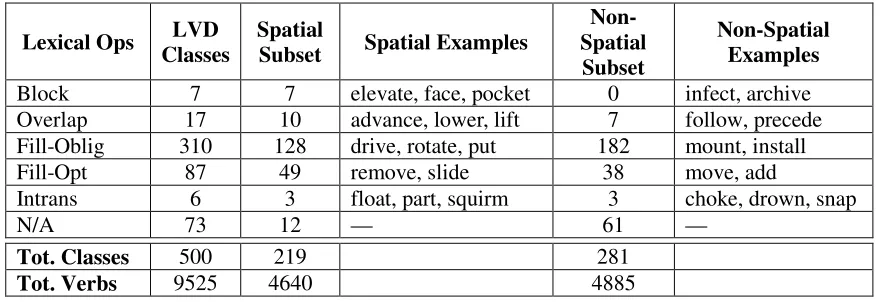
The number of classes associated with the language usage patterns introduced above is in the table below, with tallies for the full set of LVD classes, the spatial subset, and non-spatial subset.3 Repre-sentative examples of verbs in both the spatial subset (e.g., for robot navigation) and the non-spatial subset (e.g., cyber-notification generation) are provided in Table 1.
Interestingly, the Spatial Subset of classes is sizeable (44% of the entire set). However, STYLUS development has yielded generalizations beyond prior LCS-inspired work that focused strictly on spa-tial verbs (Voss et al., 1998). Most notably, the Block, Overlap and Fill patterns are generalizable to a high number of LCS classes that are non-spatial as well. The obvious cases are those with non-zero values in Table 1 (Overlap and Fill): e.g., tread on (Overlap), cram for (Fill-Oblig), and blend together
(Fill-Opt). However, although the number of non-spatial Block cases appears to be 0, the correspond-ing 7 spatial usages also extend to metaphorical extensions, e.g., in the phrase elevated her spirits, the use of “up” is blocked. Although STYLUS encodes elevate as a spatial verb, this same lexico-semantic
2 In the original LVD, the :SPATIAL COMPONENT OF MEANING field name was used. More recently, such components
have been determined to be useful for non-spatial verbs as well. For example, admire (in class 31.2.c) has a toward compo-nent of meaning, whereas abhor has an away-from component of meaning. Thus, the more general :COMPONENT OF MEANING field name has been subsequently adopted.
property applies for its non-spatial (metaphorical) usage. Analogously, STYLUS encodes the con-trasting verb lift as a spatial verb, designated as Overlap, to enable lifted up her hand. A metaphorical (non-spatial) usage would be lift up her spirits. Such cases indicate that Block, Overlap, and Fill apply even more broadly than was conceived in the original LVD—which means that the numbers in the Non-Spatial Subset column above are understated and would benefit from additional analysis of meta-phorical extensions.
Lexical Ops LVD Classes
Spatial
Subset Spatial Examples
Non-Spatial
Subset
Non-Spatial Examples
Block 7 7 elevate, face, pocket 0 infect, archive Overlap 17 10 advance, lower, lift 7 follow, precede Fill-Oblig 310 128 drive, rotate, put 182 mount, install Fill-Opt 87 49 remove, slide 38 move, add
Intrans 6 3 float, part, squirm 3 choke, drown, snap
N/A 73 12 — 61 —
Tot. Classes 500 219 281
Tot. Verbs 9525 4640 4885
Table 1: Language Usage Patterns for Spatial and Non-Spatial Verbs with Representative Examples
To explore the broader applicability of the Block, Overlap, and Fill patterns, we first examined verbs in the Spatial Subset and determined that many of them are among those relevant to robot navi-gation, e.g., move, go, advance, drive, return, rotate, and turn. Others are easily accommodated by extending classes—without modification to the spatial language usage patterns described above. For example, back up matches the class template containing advance, and pivot matches the class template containing rotate. We then considered the Non-Spatial Subset for generation of cyber-related notifica-tions, a sub-task of an ongoing cyber-attack prediction project (Dalton et al., 2017). We determined that the Fill, Overlap, and Block patterns apply to members of the same classes that were relevant to robot navigation. Specifically, we examined the four classes shown in Table 2.
[image:5.595.78.518.157.308.2]Class [Pattern]
Robot Navigation Cyber Notification
(Generation Only) Understanding Generation
9.8-Fill [Block]
Face the doorway
Face to the doorway
Where do I face? *Where do I face to?
Risk that trojan horse virus will infect
(*to) System A increased 5% 47.8.1-Contig
[Overlap]
Follow the car
Follow behind the car
Which car do I follow
(behind)?
Risk increased 25% that VPN failure will follow (behind) malware attack 9.1-Put
[FillOblig]
Put it on the table *Put the box
Where do I put it? *Do I put the box?
Risk of malware increases 5% if disk
A mounted on file server B
11.2-Slide [FillOpt]
Move it to the table
Move it
Where do I move it? Do I move it?
10% increased malware risk if System A files are moved (to System B)
Table 2: Class-Based Patterns for Robot Navigation and Cyber Notification
Note that Block, Overlap, and Fill can be applied as validity constraints on language usage patterns in the spatial domain of human-robot commands (for understanding and generation).4 Corresponding-ly, for the non-spatial domain of cyber notification generation, these same four classes included other class members (e.g., for 9.8 and 9.1) or meaning extensions of the same class members (e.g., for 47.8.1 and 11.2) that exhibited the same language usage patterns as their robot navigation counterparts.
5 Conclusion and Future Work
STYLUS provides the basis for both understanding and generation in the spatial robot navigation do-main and for generation in the non-spatial cyber notification domain. A larger scale application and evaluation of the effectiveness of STYLUS for understanding and generation in these two domains is a
future area of study. A starting point is an ongoing Bot Language project (Marge et al., 2017) that has heretofore focused on dialogue annotation (Traum et al., 2018) and has not yet incorporated lexicon-based knowledge necessary for automatically detecting incomplete, vague, or implicit navigation commands.
Another avenue for exploration is the enhancement of cyber notifications through systematic deri-vation of mappings to surface realizations for other parts of speech. This work will involve access to a “Categorial Variation” database (CatVar) (Habash and Dorr, 2003) to map verbs in the LCS classes to their nominalized and adjectivalized forms. For example, the CatVar entry for infect includes the nom-inalized form infection, which provides additional options that may be more fluent in cyber-related notifications, e.g., viral infection of system might be considered less stilted than virus will infect sys-tem.
Although STYLUS is strictly for English, the lexical-semantic foundation from which it is derived has been investigated for a range of multilingual applications (Habash et al., 2006; Cabezas et al., 2001; Levow et al., 2000). Future work will examine the derivation of this resource for non-English languages.
Acknowledgements
This research is supported, in part by the Institute for Human and Machine Cognition, in part by the U.S. Army Research Laboratory, and in part by the Office of the Director of National Intelligence (ODNI) and the Intelligence Advanced Research Projects Activity (IARPA) via the Air Force Research Laboratory (AFRL) contract number FA875016C0114. The U.S. Government is authorized to repro-duce and distribute reprints for Governmental purposes notwithstanding any copyright annotation thereon.
Disclaimer: The views and conclusions contained herein are those of the authors and should not be interpreted as necessarily representing the official policies or endorsements, either expressed or im-plied, of ODNI, IARPA, AFRL, ARL, or the U.S. Government.
References
Clara Cabezas, Bonnie J. Dorr, and Philip Resnik. 2001. Spanish Language Processing at University of Mary-land: Building Infrastructure for Multilingual Applications. In Proceedings of the Second International
Work-shop on Spanish Language Processing and Language Technologies (SLPLT-2), Jaen, Spain,
http://www.umiacs.umd.edu/users/bonnie/Publications/slplt-01.htm.
Adam Dalton, Bonnie Dorr, Leon Liang, and Kristy Hollingshead. 2017. Improving cyber-attack predictions via unconventional sensors discovered through information foraging. In Proceedings of the 2017 International
Workshop on Big Data Analytics for Cyber Intelligence and Defense, BDA4CID ’17, pages 4560–4565. IEEE.
Bonnie Dorr and Doug Jones. 1996. Acquisition of Semantic Lexicons: Using Word Sense Disambiguation to Improve Precision. In In Proceedings of theWorkshop on Breadth and Depth of Semantic Lexicons, 34th
An-nual Conference of the Association for Computational Linguistics, pages 42–50. Kluwer Academic
Publish-ers.
Bonnie J. Dorr and Mari Broman Olsen. 1997. Deriving Verbal and Compositional Lexical Aspect for NLP Ap-plication. In Proceedings of the 35th Annual Meeting of the Association for Computational Linguistics and
Eighth Conference of the European Chapter of the Association for Computational Linguistics, pages 151–158.
Bonnie J. Dorr and Mari Broman Olsen. 2018. Lexical Conceptual Structure of Literal and Metaphorical Spatial Language: A Case Study of Push. In Proceedings of the NAACLWorkshop on Spatial Language Understand-ing, pages 31–40.
Bonnie J. Dorr and Clare R. Voss. 1993. Machine Translation of Spatial Expressions: Defining the Relation be-tween an Interlingua and a Knowledge Representation System. In Proceedings of the Twelfth Conference of
the American Association for Artificial Intelligence, pages 374–379.
Bonnie J. Dorr and Clare Voss. 2018. The Case for Systematically Derived Spatial Language Usage. In
Proceed-ings of the NAACL Workshop on Spatial Language Understanding, pages 63–70.
Bonnie J. Dorr, Mari Olsen, Nizar Habash, and Scott Thomas. 2001. LCS Verb Database Documentation.
Bonnie J. Dorr. 1993. Machine Translation: A View from the Lexicon. MIT Press, Cambridge, MA.
Bonnie J. Dorr. 1997. Large-Scale Dictionary Construction for Foreign Language Tutoring and Interlingual Ma-chine Translation. Machine Translation, 12:271–322.
David Dowty. 1979. Word Meaning and Montague Grammar. Reidel, Dordrecht.
Charles J. Fillmore. 2002. Linking sense to syntax in FrameNet (keynote speech). In 19th International
Confer-ence on Computational Linguistics, Taipei. COLING,
http://www.lirmm.fr/˜lafourca/ML-enseign/DEA/DEA03-TALN-articles/fillmore.pdf.
M. Masten Guerssel, Kenneth Hale, Mary Laughren, Beth Levin, and Josie White Eagle. 1985. A Cross-linguistic Study of Transitivity Alternations. In W. H. Eilfort and P. D. Kroeber nad K. L. Peterson, editor, Pa-pers from the Parasession in Causatives and Agentivity at the Twenty-first Regional meeting of the Chicago
Linguistic Society, pages 48–63.
Nizar Habash and Bonnie J. Dorr. 2002. Handling Translation Divergences: Combining Statistical and Symbolic Techniques in Generation-Heavy Machine Translation. In Proceedings of the Fifth Conference of the
Associa-tion for Machine TranslaAssocia-tion in the Americas, pages 84–93, Tiburon, CA.
Nizar Habash and Bonnie Dorr. 2003. A categorial variation database for English. In NAACL/HLT 2003, Pro-ceedings of the Human Language Technology and North American Association for Computational Linguistics
Conference, pages 96–102.
Nizar Habash, Bonnie J. Dorr, and Christof Monz. 2006. Challenges in Building an Arabic GHMT system with SMT Components. In Proceedings of the 7th Conference of the Association for Machine Translation in the
Americas, pages 56–65, Boston, MA, August.
ISO-24617-7. 2014. Language Resource management Semantic Annotation Framework Part 7: Spatial
infor-mation (ISOspace), http://www.iso.org/standard/60779.html.
Ray Jackendoff. 1983. Semantics and Cognition. MIT Press, Cambridge, MA.
Ray Jackendoff. 1990. Semantic Structures. MIT Press, Cambridge, MA.
Ray Jackendoff. 1996. The Proper Treatment of Measuring Out, Telicity, and Perhaps Even Quantification in English. Natural Language and Linguistic Theory, 14:305–354.
Karin Kipper, Benjamin Snyder, and Martha Palmer. 2004. Using Prepositions to Extend a Verb Lexicon. In
Pro-ceedings of the HLT/NAACL Workshop on Computational Lexical Semantics, pages 23–29.
Karin Kipper, Anna Korhonen, Neville Ryant, and Martha Palmer. 2008. A Large-scale Classification of English Verbs. Language Resources and Evaluation, 42(1):21–40.
Parisa Kordjamshidi, Martijn Van Otterlo, and Marie-Francine Moens. 2011. Spatial Role Labeling: Task Defini-tion and AnnotaDefini-tion Scheme. In Proceedings of the Seventh Conference on International Language Resources
and Evaluation, pages 413–420.
Ben Kybartas and Rafael Bidarra. 2017. A survey on story generation techniques for authoring computational narratives. IEEE Transactions on Computational Intelligence and AI in Games, 9(3):239–253.
Beth Levin and Malka Rappaport Hovav. 1995. Unaccusativity: At the Syntax-Lexical Semantics Interface,
Lin-guistic Inquiry Monograph 26. MIT Press, Cambridge, MA.
Beth Levin. 1993. English Verb Classes and Alternations: A Preliminary Investigation. The University of Chica-go Press.
Beth Levin. 2015. Verb Classes Within and Across Languages. In B. Comrie and A. Malchukov, editors, Valency
Classes: A Comparative Handbook, pages 1627–1670. De Gruyter, Berlin.
Gina-Anne Levow, Bonnie J. Dorr, and Dekang Lin. 2000. Construction of Chinese-English Semantic Hierarchy for Cross-Language Retrieval. In Workshop on English-Chinese Cross Language Information Retrieval,
In-ternational Conference on Chinese Language Computing, pages 187–194, Chicago, IL.
Malka Rappaport Hovav and Beth Levin. 1998. Building Verb Meanings. In M. Butt and W. Geuder, editors, The
Projection of Arguments: Lexical and Compositional Factors, pages 97–134. CSLI Publications, Stanford,
CA.
Mari Broman Olsen, Bonnie J. Dorr, and Scott Thomas. 1997. Toward Compact Monotonically Compositional Interlingua Using Lexical Aspect. In Proceedings of the Workshop on Interlinguas in MT, pages 33–44, San Diego, CA, October.
Mari Broman Olsen. 1994. The Semantics and Pragmatics of Lexical and Grammatical Aspect. Studies in the
Linguistic Sciences, 24(1–2):361–375.
Rainer Osswald and Robert D. Van Valin. 2014. Framenet, Frame Structure, and the Syntax-semantics Interface. In T. Gamerschlag, D. Gerland, R. Osswald, andW. Petersen, editors, Frames and Concept Types:
Applica-tions in language and philosophy (Studies in Linguistics and Philosophy 94), pages 125–56. Heidelberg:
Springer.
Martha Palmer, Claire Bonial, and Jena D. Hwang. 2017. VerbNet: Capturing English Verb behavior, Meaning and Usage. In Susan Chipman, editor, The Oxford Handbook of Cognitive Science. Oxford University Press.
James Pustejovsky and Kiyong Lee. 2017. Enriching the Notion of Path in ISOspace. In Proceedings of the 13th
Joint ISO-ACL Workshop on Interoperable Semantic Annotation (ISA-13),
http://aclweb.org/anthology/W17-7415.
James Pustejovsky and Zachary Yocum. 2014. Image annotation with iso-space: Distinguishing content from structure. In Proceedings of the Ninth International Conference on Language Resources and Evaluation
(LREC’14), pages 426–431.
James Pustejovsky, Jessica Moszkowicz, and Marc Verhagen. 2011. Using ISO-Space for Annotating Spatial
Information, http://www2.denizyuret.com/bib/pustejovsky/pustejovsky2011cosit/
COSIT-ISO-Space.final.pdf.
David Traum and Nizar Habash. 2000. Generation from Lexical Conceptual Structures. In Proceedings of the Workshop on Applied Interlinguas, North American Association for Computational Linguistics / Applied NLP
Conference, pages 34–41.
David Traum, Cassidy Henry, Stephanie Lukin, Ron Artstein, Felix Gervits, Kimberly Pollard, Claire Bonial, Su Lei, Clare Voss, Matthew Marge, Cory Hayes, and Susan Hill. 2018. Dialogue Structure Annotation for Multi-Floor Interaction. In Nicoletta Calzolari (Conference chair), Khalid Choukri, Christopher Cieri, Thierry De-clerck, Sara Goggi, Koiti Hasida, Hitoshi Isahara, Bente Maegaard, Joseph Mariani, Hlne Mazo, Asuncion Moreno, Jan Odijk, Stelios Piperidis, and Takenobu Tokunaga, editors, Proceedings of the Eleventh
Interna-tional Conference on Language Resources and Evaluation (LREC 2018), Miyazaki, Japan, May 7-12, 2018.
European Language Resources Association (ELRA).
Clare R. Voss and Bonnie J. Dorr. 1995. Toward a Lexicalized Grammar for Interlinguas. J. of Machine Transla-tion, 10:143–184.
Clare R. Voss, Bonnie J. Dorr, and M. U. Şencan. 1998. Lexical Allocation in Interlingua-based Machine Trans-lation of Spatial Expressions. In Patrick Oliver and Klaus-Peter Gapp, editor, Representation and Processing
of Spatial Expressions, pages 133–148. L. Erlbaum Associates Inc., Hillsdale, NJ, USA.
Appendices
Appendix A. Supplemental Material: STYLUS
STYLUS (SysTematicallY Derived Language USage) is a simplified and extended version of Lexical Conceptual Structure Verb Database (LVD) (Dorr et al., 2001) with 500 classes of verbs that incorpo-rate components of meaning and prepositional collocations (in ascii .txt format). The classes include over 9500 verb entries—about 5500 entries beyond the original 4000+ entries in Levin 1993. This re-source can be downloaded from the link below: