344
Coherence Modeling Improves Implicit Discourse Relation Recognition
Noriki Nishida and Hideki Nakayama
Graduate School of Information Science and Technology The University of Tokyo
{nishida,nakayama}@nlab.ci.i.u-tokyo.ac.jp
Abstract
The research described in this paper exam-ines how to learn linguistic knowledge as-sociated with discourse relations from un-labeled corpora. We introduce an unsu-pervised learning method on text coher-ence that could produce numerical repre-sentations that improve implicit discourse relation recognition in a semi-supervised manner. We also empirically examine two variants of coherence modeling: order-orientedandtopic-orientednegative sam-pling, showing that, of the two, topic-oriented negative sampling tends to be more effective.
1 Introduction
Shallow discourse parsing aims to automatically identify discourse relations (e.g., comparisons) be-tween adjacent sentences. When connectives such as however explicitly appear, discourse relations are relatively easy to classify, as connectives pro-vide strong cues (Pitler et al.,2008). In contrast, it remains challenging to identify discourse relations across sentences that have no connectives.
One reason for this inferior performance is a shortage of labeled instances, despite the diversity of natural language discourses. Collecting anno-tations about implicit relations is highly expensive because it requires linguistic expertise.1A variety of semi-supervised or unsupervised methods have been explored to alleviate this issue. Marcu and Echihabi(2002) proposed generating synthetic in-stances by removing connectives from sentence pairs. This idea has been extended in many works
1The Penn Discourse Treebank (PDTB) 2.0 cor-pus (Prasad et al.,2008), which is the current largest corpus for discourse relation recognition, contains only about 16K annotated instances in total.
and remains a core approach in the field (Zhou et al.,2010;Patterson and Kehler,2013;Lan et al., 2013;Rutherford and Xue, 2015;Ji et al., 2015; Liu et al.,2016;Braud and Denis,2016;Lan et al., 2017; Wu et al., 2017). However, these meth-ods rely on automatically detecting connectives in unlabeled corpora beforehand, which makes it al-most impossible to utilize parts of unlabeled cor-pora in which no connectives appear.2 In addi-tion, as Sporleder and Lascarides (2008) discov-ered, it is difficult to obtain a generalized model by training on synthetic data due to domain shifts. Though several semi-supervised methods do not depend on detecting connectives (Hernault et al., 2010,2011;Braud and Denis,2015), these meth-ods are restricted to manually selected features, linear models, or word-level knowledge transfer.
In this paper, our research question is how to ex-ploit unlabeled corpora without explicitly detect-ing connectives to learn ldetect-inguistic knowledge as-sociated with implicit discourse relations.
Our core hypothesis is that unsupervised learn-ing about text coherence could produce numerical representations related to discourse relations. Sen-tences that compose a coherent document should be connected with syntactic or semantic rela-tions (Hobbs,1985;Grosz et al.,1995). In partic-ular, we expect that there should be latent relations among local sentences. In this study, we hypoth-esize that parameters learned through coherence modeling could contain useful information for identifying (implicit) discourse relations. To ver-ify this hypothesis, we develop a semi-supervised system whose parameters are first optimized for coherence modeling and then transferred to im-plicit discourse relation recognition. We also em-pirically examine two variants of coherence
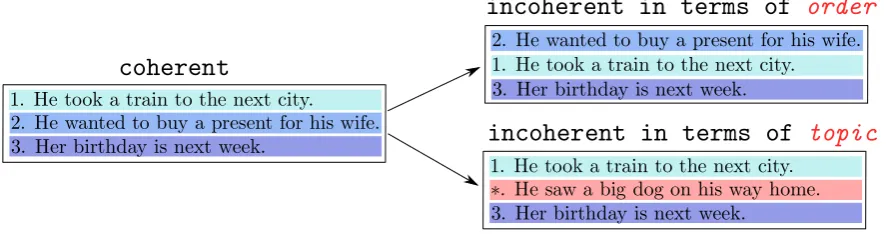
Figure 1: An example of order-oriented and topic-oriented negative sampling in coherence modeling.
eling: (1) order-oriented negative sampling and (2)topic-orientednegative sampling. An example is shown in Figure1.
Our experimental results demonstrate that co-herence modeling improves Macro F1on implicit
discourse relation recognition by about3points on first-level relation classes and by about 5 points on second-level relationtypes. Coherence model-ing is particularly effective for relation categories with few labeled instances, such as temporal re-lations. In addition, we find that topic-oriented negative sampling tends to be more effective than the order-oriented counterpart, especially on first-level relation classes.
2 Coherence Modeling
In this study, we adopt the sliding-window ap-proach of Li and Hovy (2014) to form a con-ditional probability that a document is coherent. That is, we define the probability that a given doc-umentXis coherent as a product of probabilities at all possible local windows, i.e.,
P(coherent|X, θ) = Y x∈X
P(coherent|x, θ), (1)
where P(coherent|x, θ) denotes the conditional probability that the local clique x is coherent and θ denotes parameters. Clique x is a tuple of a central sentence and its left and right sen-tences, (s−, s, s+). Though larger window sizes
may allow the model to learn linguistic properties and inter-sentence dependencies over broader con-texts, it increases computational complexity dur-ing traindur-ing and suffers from data sparsity prob-lem.
We automatically build a datasetD = P ∪ N for coherence modeling from an unlabeled corpus. Here,PandN denote sets of positive and negative instances, respectively. Given a source corpusCof
|C| sentences s1, s2, . . . , s|C|, we collect positive instances as follows:
P ={(si−1, si, si+1)|i= 2, . . . ,|C| −1}. (2)
Text coherence can be corrupted by two aspects, which correspond to how to build negative setN.
The first variant isorder-oriented negative sam-pling, i.e.,
N ={x0|x0 ∈φ(x)∧x∈ P} (3)
where φ(x) denotes the set of possible permuta-tions ofx, excludingxitself.
The second variant is topic-oriented negative sampling, i.e.,
N ={(s−, s0, s+)|s0 ∈ C ∧ (s−, s, s+)∈ P}
(4)
where s0 denotes a sentence randomly sampled from a uniform distribution over the entire cor-pus C. We call this method topic-oriented be-cause topic consistency shared across a clique (s−, s, s+)is expected to be corrupted by
replac-ingswiths0.
3 Model Architecture
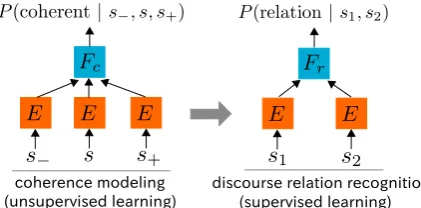
We develop a simple semi-supervised model with neural networks. An overall view is shown in Fig-ure 2. Our model mainly consists of three com-ponents: sentence encoder E, coherence classi-fier Fc, and implicit discourse relation classifier
1st-Level RelationClasses 2nd-Level RelationTypes Coherence Acc. (%) Macro F1 (%) Acc. (%) Macro F1(%) Acc. (%)
IRelonly 51.49 42.29 37.49 24.81 N/A
IRel+O-Coh(Small) 52.16 41.39 37.77 25.46 57.96
IRel+O-Coh(Large) 52.29 42.48 41.29 30.70 64.24 IRel+T-Coh(Small) 51.70 40.84 37.91 25.35 83.04
[image:3.595.89.511.64.158.2]IRel+T-Coh(Large) 53.54 45.03 41.39 29.67 91.53
Table 1: The results of implicit discourse relation recognition (multi-class classification) and coher-ence modeling (binary classification). IRel andO/T-Coh denote that the model is trained on implicit discourse relation recognition and order/topic-oriented coherence modeling respectively. “Small” and “large” correspond to the relative size of the used unlabeled corpus: 37K (WSJ) and 22M (BLLIP) positive instances, respectively.
(unsupervised learning) (supervised learning) discourse relation recognition coherence modeling
Figure 2: The semi-supervised system we devel-oped. The model consists of sentence encoderE, coherence classifierFc, and implicit discourse re-lation classifierFr.
2016)), such architectures are outside the scope of this study, since the effectiveness of incorporating coherence-based knowledge would be broadly or-thogonal to the model’s complexity.
3.1 Sentence Encoder
Sentence encoder E transforms a symbol se-quence (i.e., a sentence) into a continuous vector. First, a bidirectional LSTM (BiLSTM) is applied to a given sentence ofntokensw1, . . . , wn, i.e.,
− →
hi = FwdLSTM( − →
hi−1, wi)∈RD, (5)
←−
hi = BwdLSTM( ←−
hi+1, wi)∈RD (6)
where FwdLSTM and BwdLSTM denote forward and backward LSTMs, respectively. We initial-ize the hidden states to zero vectors, i.e., −→h0 =
←−
hn+1 = 0. In our preliminary experiments, we
tested conventional pooling functions (e.g., sum-mation, average, or maximum pooling); we found that the following concatenation tends to yield
higher performances:
h=−→h>L,←h−>1>∈R2D. (7)
We use Eq.7as the aggregation function through-out our experiments.
3.2 Classifiers
We develop two multi-layer perceptrons (MLPs) with ReLU nonlinearities followed by softmax normalization each for Fc andFr. The MLP in-puts are the concatenation of sentence vectors. Thus, the dimensionalities of the input layers are 2D×3and2D×2respectively. The MLPs consist ofinput,hidden, andoutputlayers.
4 Experiments
4.1 Preparation
We used the Penn Discourse Treebank (PDTB) 2.0 corpus (Prasad et al.,2008) as a dataset for implicit discourse relation recognition. We followed the standard section partition, which is to use Sections 2–20 for training, Sections 0-1 for development, and Sections 21–22 for testing. We evaluate multi-class multi-classifications with first-level relationclasses
(four classes) and second-level relationtypes (11 classes).
We used the Wall Street Journal (WSJ) ar-ticles (Marcus et al., 1993)3 or the BLLIP North American News Text (Complete) ( Mc-Closky et al.,2008)4 to build a coherence model-ing dataset, resultmodel-ing in about 48K (WSJ) or 23M (BLLIP) positive instances. We inserted a spe-cial symbol “hARTICLE BOUNDARYi” to each
3
We used the raw texts in LDC99T42 Treebank-3: https://catalog.ldc.upenn.edu/LDC99T42
[image:3.595.74.285.258.362.2]Acc. (%) Macro F1(%)
Rutherford and Xue(2015) 57.10 40.50
Liu et al.(2016) 57.27 44.98
Braud and Denis(2016)5 52.81 42.27
Wu et al.(2017) 58.85 44.84
IRelonly 51.49 42.29
IRelonly* 52.72 42.61
IRel+T-Coh(Large) 53.54 45.03
[image:4.595.74.292.61.170.2]IRel+T-Coh(Large)* 56.60 46.90
Table 2: Comparison with previous works that exploit unlabeled corpora on first-level relation
classes. An asterisk indicates that word embed-dings are fine-tuned (which slightly decreases per-formance on second-level relation types due to overfitting).
Exp. Cont. Comp. Temp.
# of training data 6,673 3,235 1,855 582
IRelonly 66.40 53.49 39.48 32.31
IRel+T-Coh 67.48 54.94 40.41 35.60
Table 3: Results on one-vs.-others binary clas-sification in implicit discourse relation recogni-tion. The evaluation metric is Macro F1 (%).
We evaluate on the first-level relation classes: Expansion, Contingency, Comparison, andTemporal.
article boundary. For the WSJ corpus, we split the sections into training/development/test sets in the same way with the implicit relation recogni-tion. For the BLLIP corpus, we randomly sampled 10,000 articles each for the development and test sets. Negative instances are generated following the procedure described in Section 2. Note that this procedure requires neither human annotation nor special connective detection.
We set the dimensionalities of the word embed-dings, hidden states of the BiLSTM, and hidden layers of the MLPs to100,200, and100, respec-tively. GloVe (Pennington et al.,2014) was used to produce pre-trained word embeddings on the BLLIP corpus. To avoid overfitting, we fixed the word embeddings during training in both coher-ence modeling and implicit relation recognition. Dropout (ratio 0.2) was applied to word embed-dings and MLPs’s layers. At every iteration dur-ing traindur-ing in both tasks, we configured class-balanced batches by resampling.
5The values are taken fromWu et al.(2017).
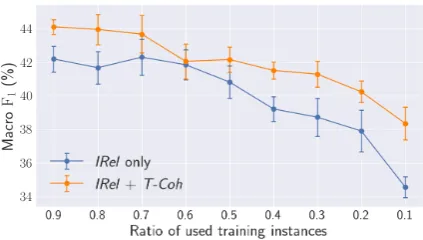
Figure 3: Results on implicit discourse rela-tion recognirela-tion (first-levelclasses), with different numbers of training instances. The error bars show one standard deviation over 10 trials.
4.2 Results
To verify whether unsupervised learning on co-herence modeling could improve implicit dis-course relation recognition, we compared the semi-supervised model (i.e., implicit discourse relation recognition (IRel) + coherence model-ing with order/topic-oriented negative samplmodel-ing (O/T-Coh)) with the baseline model (i.e., IRel
only). The evaluation metrics are accuracy (%) and Macro F1 (%). We report the mean scores
over 10 trials. Table1shows that coherence mod-eling improves Macro F1 by about 3 points in
first-level relation classes and by about 5 points in second-level relationtypes. Coherence model-ing also outperforms the baseline in accuracy. We observed that the higher the coherence modeling performance (see Small vs. Large), the higher the implicit relation recognition score. These results support our claim that coherence modeling could learn linguistic knowledge that is useful for iden-tifying discourse relations.
We also found that topic-oriented negative sam-pling tends to outperform its order-oriented coun-terpart, especially on first-level relation classes. We suspect that this is because order-oriented co-herence modeling is more fine-grained and chal-lenging than topic-oriented identification, result-ing in poor generalization. For example, there could be order-invariant cliques that still hold co-herence relations after random shuffling, whereas topic-invariant cliques hardly exist. Indeed, train-ing on order-oriented negative sampltrain-ing con-verged to lower scores than that of topic-oriented negative sampling (see coherence accuracy).
[image:4.595.310.522.63.183.2]cor-pora. As shown in Table2, we found our model to outperform previous systems in Macro F1. In this
task, Macro F1 is more important than accuracy
because the class balance in the test set is highly skewed. Note that these previous models rely on previously detected connectives in the unlabeled corpus, whereas our system is free from such de-tection procedures.
To assess the effectiveness of coherence mod-eling on different relation classes, we trained and evaluated the models on one-vs-others binary clas-sification. That is, we treated each of the first-level relationclasses(4 classes) as the positive class and others as the negative class. Table 3 shows that coherence modeling is effective, especially for the Temporalrelation which has relatively fewer la-beled instances than others, indicating that coher-ence modeling could compensate for the shortage of labeled data.
We also performed an ablation study to dis-cover the performance contribution from coher-ence modeling by changing the number of train-ing instances used in implicit relation recognition. Here, we assume that in real-world situations, we do not have sufficient labeled data. We downsam-pled from the original training set and maintained the balance of classes as much as possible. As shown in Figure3, coherence modeling robustly yields improvements, even if we reduced the la-beled instances to10%.
5 Conclusion
In this paper, we showed that unsupervised learn-ing on coherence modellearn-ing improves implicit dis-course relation recognition in a semi-supervised manner. Our approach does not require detecting explicit connectives, which makes it possible to exploit entire unlabeled corpora. We empirically examined two variants of coherence modeling and show that topic-oriented negative sampling tends to be more effective than the order-oriented coun-terpart on first-level relationclasses.
It still remains unclear whether the coherence-based knowledge is complemental to those by pre-vious work. It is also interesting to qualitatively inspect the differences of learned properties be-tween order-oriented and topic-oriented negative sampling. We will examine this line of research in future.
Acknowledgments
The authors would like to thank anonymous re-viewers for their constructive and helpful sugges-tions on this work. This work was supported by JSPS KAKENHI Grant Number 16H05872.
References
Chlo´e Braud and Pascal Denis. 2015. Comparing word representations for implicit discourse relation classi-fication. InProceedings of the 2015 Conference on Empirical Methods in Natural Language Processing (EMNLP 2015).
Chlo´e Braud and Pascal Denis. 2016. Learning connective-based word representations for implicit discourse relation identification. InProceedings of the 2016 Conference on Empirical Methods in Nat-ural Language Processing (EMNLP 2016).
Jifan Chen, Qi Zhang, Pengfei Liu, and Xuanjing Huang. 2016. Discourse relations detection via a mixed generative-discriminative framework. In Pro-ceedings of the 30th Conference on Artificial Intelli-gence (AAAI 2016).
Barbara J. Grosz, Aravind K. Joshi, and Scott Wein-stein. 1995. Centering: A framework for modelling the local coherence of discourse. Computational Linguistis, 21(2):203–225.
Hugo Hernault, Danushka Bollegala, and Mitsuru Ishizuka. 2010. A semi-supervised approach to im-prove classification of infrequent discourse relations using feature vector extension. InProceedings of the 2010 Conference on Empirical Methods in Natural Language Processing (EMNLP 2010).
Hugo Hernault, Danushka Bollegala, and Mitsuru Ishizuka. 2011. Semi-supervised discourse relation classification with structure learning. In Proceed-ings of the 12th International Conference on Com-putational Linguistics and Intelligent Text Process-ing (CICLProcess-ing 2011).
Jerry R. Hobbs. 1985. On the coherence and structure of discourse. Technical Report CSLI-85-37, Center for the Study of Language and Information (CSLI), Stanford University.
Yangfeng Ji, Gongbo Zhang, and Jacob Eisenstein. 2015. Closing the gap: domain adaptation from ex-plicit to imex-plicit discourse relations. InProceedings of the 53st Annual Meeting of the Association for Computational Linguistics (ACL 2015).
Man Lan, Jianxiang Wang, Yuanbin Wu, Zheng-yu Niu, and Haifeng Wang. 2017. Multi-task attention-based neural networks for implicit discourse re-lationship representation and identification. In
Man Lan, Yu Xu, and Zhengyu Niu. 2013. Leveraging synthetic discourse data via multi-task learning for implicit discourse relation recognition. In Proceed-ings of the 51st Annual Meeting of the Association for Computational Linguistics (ACL 2013).
Jiwei Li and Eduard Hovy. 2014. A model of coher-ence based on distributed sentcoher-ence representation. InProceedings of the 2014 Conference on Empirical Methods in Natural Language Processing (EMNLP 2014).
Yang Liu and Sujian Li. 2016. Recognizing implicit discourse relations via repeated reading: neural net-works with multi-level attention. InProceedings of the 2016 Conference on Empirical Methods in Nat-ural Language Processing (EMNLP 2016).
Yang Liu, Sujian Li, Xiaodong Zhang, and Zhifang Sui. 2016. Implicit discourse relation classification via multi-task neural networks. In Proceedings of the 30th Conference on Artificial Intelligence (AAAI 2016).
Daniel Marcu and Abdessamad Echihabi. 2002. An unsupervised approach to recognizing discourse re-lations. In Proceedings of the 40th Annual Meet-ing of the Association for Computational LMeet-inguistics (ACL 2002).
Mitchell P. Marcus, Mary Ann Marcinkiewicz, and Beatrice Santorini. 1993. Building a large annotated corpus of english: The penn treebank. Computa-tional Linguistics, 19(2):313–330.
David McClosky, Eugene Charniak, and Mark John-son. 2008. Bllip north american news text, com-plete. Linguistic Data Consortium.
Gary Patterson and Andrew Kehler. 2013. Predicting the presence of discourse connectives. In Proceed-ings of the 2013 Conference on Empirical Methods in Natural Language Processing (EMNLP 2013).
Jeffrey Pennington, Richard Socher, and Christo-pher D. Manning. 2014. Glove: Global vectors for word representations. In Proceedings of the 2014 Conference on Empirical Methods in Natural Lan-guage Processing (EMNLP 2014).
Emily Pitler, Mridhula Raghupathy, Hena Mehta, Ani Nenkova, Alan Lee, and Aravind Joshi. 2008. Easily identifiable discourse relations. In Proceedings of the 24th International Conference on Computational Linguistics (COLING 2008).
Rashmi Prasad, Nikhil Dinesh, Alan Lee, Eleni Milt-sakaki, Livio Robaldo, Aravind Joshi, and Bonnie Webber. 2008. The penn discourse treebank 2.0. In Proceedings of the Sixth International Confer-ence on Language Resources and Evaluation (LREC 2008).
Lianhui Qin, Zhisong Zhang, and Hai Zhao. 2016. A stacking gated neural architecture for implicit dis-course relation classification. InProceedings of the
2016 Conference on Empirical Methods in Natural Language Processing (EMNLP 2016).
Samuel R¨onnqvist, Niko Schenk, and Christian Chiar-cos. 2017. A recurrent neural model with attention for the recognition of chinese implicit discourse re-lations. In Proceedings of the 55th Annual Meet-ing of the Association for Computational LMeet-inguistics (ACL 2017).
Attapol T. Rutherford and Nianwen Xue. 2015. Im-proving the inference of implicit discourse relations via classifying explicit discourse connectives. In
Proceedings of the 2015 Conference of the North American Chapter of the Association for Computa-tional Linguistics: Human Language Technologies (NAACL-HLT 2015).
Caroline Sporleder and Alex Lascarides. 2008. Using automatically labelled examples to classify rhetori-cal relations: an assessment. Natural Language En-gineering, 14(03).
Changxing Wu, Xiaodong Shi, Yidong Chen, Jinsong Su, and Boli Wang. 2017. Improving implicit dis-course relation recognition with disdis-course-specific word embeddings. InProceedings of the 55th An-nual Meeting of the Association for Computational Linguistics (ACL 2017).