Data-Driven Spelling Correction using Weighted Finite-State Methods
Miikka Silfverberga Pekka Kauppinenb Krister Lind´enb Department of Modern Languages, University of Helsinki
a[email protected],b[email protected]
Abstract
This paper presents two systems for spelling correction formulated as a se-quence labeling task. One of the systems is an unstructured classifier and the other one is structured. Both systems are imple-mented using weighted finite-state meth-ods. The structured system delivers state-of-the-art results on the task of tweet nor-malization when compared with the recent AliSeTra system introduced by Eger et al. (2016) even though the system presented in the paper is simpler than AliSeTra be-cause it does not include a model for input segmentation. In addition to experiments on tweet normalization, we present exper-iments on OCR post-processing using an Early Modern Finnish corpus of OCR pro-cessed newspaper text.
1 Introduction
Spelling correction is one of the most widely ap-plied language technological utilities. The most obvious application of spelling correction is as a writer’s aid. However, many natural lan-guage processing applications can also benefit from a spelling correction component. For ex-ample, many existing NLP systems are trained on newswire which tends to closely adhere to ortho-graphical and grammatical norms. These systems may incur a substantial hit in performance when they are applied to noisy domains like social me-dia. When spelling correction is applied as a pre-processing step, performance can be better. Dig-itization of documents is another domain where spelling correction is useful. Digitization often aims to transform physical documents into digi-tal representations which support free text search. This requires the use of an optical character
recog-input A m . c
output A nn ε e
Figure 1: Post-editing as sequence labeling. The input to the post-editor is ”Am.c” and the correct output is ”Anne”. This representation corresponds to the 1-to-n alignment of Bisani and Ney (2008) because each input symbol is associated with a possibly empty sequence of outputs.
nition (OCR) engine. Depending on the quality of the engine and source documents, this can succeed to varying degrees. Spelling correction can be ap-plied as a post-processing step in order to improve quality.
Spelling correction is an instance of the more general task of string-to-string translation. In spelling correction, the objective is to transform a possibly erroneous input string, for example a misspelling or OCR error, into a correct out-put string. Like many string-to-string translation tasks, spelling correction can be formulated as se-quence labeling: the correction system receives a string of input symbols and associates each input symbol with a (possibly empty) sequence of out-put symbols as shown in Figure 1. The inout-put to the correction system can represent a line of text or an isolated word. We will only consider the case of isolated word correction in the present work.
This paper presents two models for supervised spelling correction. Both treat the task as sequence labeling but one of the models is structured and the other one is unstructured. Both systems are imple-mented as finite-state machines and are trained on data consisting of word pairs aligned at character level.
Our unstructured model is a finite-state trans-ducer compiled from a set of weighted context-sensitive replace rules that are used to generate
correction candidates from input strings. These substitutions and their contexts are extracted from training data. This approach was first presented by Lind´en (2006) for generating multilingual spelling variants of scientific and medical terms originating from Latin and Greek, but it also suitable for other tasks involving probabilistic string-to-string trans-lation.
Our structured model is an averaged perceptron tagger. We represent the classifier as a composi-tion of two weighted finite-state machines which incorporate the unstructured and structured fea-tures and parameters of the tagger. When these are combined with an input string, the resulting finite-state machine encodes all correction candidates with their respective weights assigned by the tag-ger. The finite-state implementation allows us to extract a given amount of the best scoring correc-tion candidates using well-known and efficient al-gorithms that are widely available. The finite-state implementation also allows for restricting candi-dates to those found in a dictionary.
The paper is structured in the following way. Section 2 presents earlier approaches to spelling correction and the more general task of string-to-string translation. In Section 3, we present the un-structured and un-structured models used for spelling correction. In Section 4, we present the features utilized by the correction systems and in Section 5, we show how the systems can be implemented us-ing finite-state methods. In Section 6, we present the data sets used in the experiments and in Sec-tion 7, we present the experimental setup of the paper and the results of the experiments. Finally, we discuss the results in Section 8 and conclude the paper in Section 9.
2 Related Work
Spelling correction is an old NLP task. The earli-est approaches used plain edit distance combined with a lexicon. The edit distance approach was refined by Brill and Moore (2000) who added weights for edit operations. These systems ig-nored the context of the edit operation, which can nevertheless be quite useful.
Dreyer et al. (2008) investigate string-to-string translation which is a more general task than spelling correction. In order to incorporate symbol contexts into their models, they formulate string-to-string translation as a sequence labeling task. Their sequence labeling model is discriminative
and the alignment between the input and output string is a latent variable. Dreyer et al. (2008) im-plement their model as a finite-state machine. This model is similar to ours but we do not treat the alignment between input and output strings as a latent variable. Instead, the training data for our model is aligned in advance.
Another interesting approach is presented by Xu et al. (2014) who learn a number of weighted rewrite rules from data. They use a log linear model to combine the rules and treat the alignment of the input and output forms as a latent variable like Dreyer et al. (2008). This system is reminis-cent of ours because we also implement our two systems using rewrite rules. However, again, we do not treat the alignment of the input and output strings as a hidden variable.
Hulden and Francom (2013) compare two FST based methods for Spanish-language tweet nor-malization. The first method relies on a hierarchi-cally arranged set of unweighted context-sensitive replace rules, while their other approach utilizes a noisy-channel FST model on the input string. These operations and their weights are extracted from the training data set. The authors report a somewhat better performance for the unweighted rule-based method, with a final accuracy of 60 %, but note that there is no theoretical obstacle that would prevent the inclusion of contexts in the weighted model.
Han and Baldwin (2011) present a method for recognizing and correcting out-of-vocabulary words in tweets and SMSs. They perform a set of normalization processes to the input word to make the relationship between the incorrect form and the correct form more transparent and generate a set of candidates within a certain edit distance. In ad-dition to comparing orthographic forms, they also consider the phonetic realization of the input word and find correction candidates whose pronuncia-tion is within a certain edit distance from the pro-nunciation of the input word.
2010) represents the translation task as a pipeline of a string segmentation system, which splits the input string into character sequences, and a dis-criminative sequence labeling system which trans-lates the character sequences into output symbols. DirecTL+ utilizes joint character n-grams in the discriminative sequence labeling system. (3) The AliSeTra system is based on the work of Eger (2012). Like DirecTL+, it also views string-to-string translation as a pipeline of segmentation and sequence labeling. (4) The final system sur-veyed by Eger et al. (2016) represents the string-to-string translation task as a series of contex-tual edit operations on the input string (Cotterell et al., 2015). The operations are compiled into a weighted finite-state machine. The edit oper-ations are weighted using a probabilistic model which resembles the maximum entropy Markov model (MEMM) (McCallum et al., 2000). This system is similar to our structured system but we use a different feature set and estimate weights us-ing the average perceptron algorithm. This avoids the well-known label bias problem (Lafferty et al., 2001) associated with MEMMs.
Systems 1, 2 and 3 surveyed by Eger et al. (2016) form an interesting contrast to our systems because we do not use segmentation of the input string. In this sense, our system is simpler.
Eger et al. (2016) present experiments on spelling correction both for the individual systems discussed in the paper and also various combi-nations of the systems. The AliSeTra system is shown to give the best performance of all indi-vidual surveyed systems on both Twitter data and historical Latin. We also present experiments on the Twitter data used by Eger et al. (2016) and show that our structured system delivers at least the same level of performance as the AliSeTra sys-tem.
3 Models
In the following, we present the unstructured and structured models used for spelling correction. Both models express the probability p(y|x) of a normalization sequencey = (y1, ..., yT)given an input sequencex= (x1, ..., xT).
The input sequencexand output sequenceyare formally required to have the same length. In prac-tice, each element ofycan, however, consist of a number of characters. This allows modeling of in-sertions and deletions. For example in Figure 1,
the input sequence is (A,m, .,c) and the output sequence is (A,nn, ε,e). This corresponds to a deletion. → εand a substitutionm → nn. The model cannot directly express the substitution of two consecutive input symbols with one output, for examplenn → m. This can, however, be ex-pressed indirectly using a deletion and subsequent substitution as inn→εandn→m.
The parameters of the models are estimated in a supervised manner using training data consisting of pairs of input and output strings. In order to accelerate training, we use aligned training data (consisting of symbol pairs) instead of treating the alignment of input and output strings as a latent variable.
3.1 Unstructured Classifier
This classifier represents the conditional proba-bilityp(y|x) of a normalization y = (y1, ..., yT) given an inputx= (x1, ..., xT)in an unstructured manner, that is
p(y|x) = T
Y
t=1
p(yt|x, t)
This corresponds to making the assumption that output symbolsytandyu(t6=u) are independent given the inputx.
To determine the probabilities p(yt,|x, t), we first map each input position (x, t) to a context
LxtR, whereLandRare regular languages, and the input position(x, t) matchesLxtR, that is
x1... xt−1xtxt+1... xT ∈LxtR.
Thesymbol is a special symbol which does not occur in any input string or output string.
We then define
p(yt|x, t) =p(yt|LxtR)
where the probabilityp(yt|LxtR)is estimated from the training data simply by counting occur-rences of output symbols z in positions which matchLxtR. More precisely,
p(z|LxtR) =
|{(x, t) matchesLxtRandyt=z}|
|{(x, t) matchesLxtR}|
in such a way that it forms a partition ofΣ∗ΣΣ∗,
where Σis the set of all input symbols. In Sec-tion 4, we give a more detailed explanaSec-tion of how these contexts are chosen.
3.2 Peceptron Tagger
Our structured spelling correction system is for-mulated as a traditional averaged perceptron tag-ger (Collins, 2002) as shown in Equation 1. Given an input sequencexof lengthT, the model assigns a scores(·)for each output sequence y of length
T as determined by the model parameterswand a vector valued feature extraction functionφ. Then
best normalization candidates given by the system can be extracted by finding thenhighest scoring outputsy.
s(x, y;w) =XT t=1
w·φ(yt−2, yt−1, yt, x, t) (1)
The labelsy−1 andy0required for Equation 1 are
word boundary symbols.
4 System Specification
This section presents the contexts used for the un-structured correction system and the features used by the structured correction system.
4.1 Contexts for the Unstructured Classifier
As explained in Section 3.1, the unstructured nor-malization model maps each input position(x, t) to a context L xt R. These contexts form a partition ofΣ∗ΣΣ∗.
The inventory of contexts is controlled by hyper-parameters which are determined using held-out data: nT H which is a minimum number of context occurrences in the training data. An-other parameter is lC which is the length of the maximal right-hand context. We have set the value oflCas 2 based on preliminary experiments.
Ifxt−1xtxt+1...xt+lCoccurs at leastnT Htimes
in the training data,
Σ∗x
t−1xtxt+1...xt+lCΣ∗
is chosen as context. If it occurs fewer times, each of the sub-stringsxt−1xtxt+1...xt+k, where0 ≤
k < nC is considered in turn. The longest one that occurs at leastnT H times in the training data is used to define a context. If none of them occur more thannT Htimes, the single symbolxtis used to define the context.
For each contextLxtR, we include a number of back-off contexts. For example, letΣ∗axt b cΣ∗ be a context, then back-off contexts are the
following contexts. Σ∗ax
tbΣ∗ Σ∗axtΣ∗
Σ∗xtΣ∗
In order to ensure that no two contexts overlap, we need to modify the contexts slightly:
Σ∗ax
tb[Σ−c] Σ∗ Σ∗axt[Σ−b] Σ∗
Σ∗[Σ−a] x
tΣ∗
4.2 Features for the Perceptron Tagger
The structured correction system extracts unstruc-tured and strucunstruc-tured features from the input and output context of letters. Unstructured features associate the output in a single position with let-ters in the input. In contrast, structured features associate output letters with each other. Given an input string x = (x1, ..., xT) and an output string y = (y1, ..., yT), the unstructured features extracted at positiontare
1. (xt, yt)
2. (xt−1, xt, yt)and(xt, xt+1, yt)
3. (xt−3, xt−2, xt−1, yt), (xt−2, xt−1, xt, yt), (xt−1, xt, xt+1, yt), (xt, xt+1, xt+1, yt) and (xt+1, xt+2, xt+3, yt)
In addition, we extract the structured features 1. (yt)
2. (yt−1, yt) 3. (yt−2, yt−1, yt)
The unstructured features are aimed at capturing the context of edit operations. Meanwhile, the structured features act as a language model.
5 Implementation
5.1 Weighted Parallel Replace Rules
Consider the following rule in XFST syntax (Beesley and Karttunen, 2003)
u→ε::0.05 || u
The rule matches in a context where the input contains two consecutive symbols u, deletes the second of them and assigns a penalty weight of 0.05≈ −log(0.95). The HFST library (Lind´en et al., 2011) implements these weighted rules.
The unstructured system described in Section 3.1 uses a set of mutually exclusive features as explained in Section 4.1. Conceptually, the sys-tem can therefore be seen as a set of parallel re-place rules (Kempe and Karttunen, 1996) acting on the same input strings. Although this formula-tion is theoretically pleasing and weighted paral-lel replace rules are available through the HFST interface (Lind´en et al., 2011), preliminary ex-periments revealed that compilation of the system represented using parallel replace rules is slow in presence of training data of realistic scope. How-ever, the subset of parallel replace rules needed in our two systems can be reformulated as normal replace rules to take advantage of a sequence of compose operations eliminating the speed issue in practice, see Section 5.3.
5.2 Unstructured Rules
The formulation of the substitutions and the con-texts as explained in 4.1 as parallel replace rules is fairly straightforward. For instance, the substitu-tionxtwithzin the contextΣ∗axt b cΣ∗is accomplished by the rule
xt→z::w ka b c
Rules are assigned log weights which correspond to the probabilitiesp of the substitutions they ex-press, i.e.w=−log(p).
As explained in 5.1, rules are formulated as mu-tually exclusive by supplementing the contexts of the backoff rules with a negative expression con-taining the non-overlapping parts from the higher-order rule. This expression effectively blocks the lower-order rule if a higher-order rule can be ap-plied instead. For instance, if the rule set contains the higher-order rule
x→z::0.4 kx y z
and a backoff rule
a→b::0.2 kx y
the latter is rewritten as
a→b::0.2 kx y[ ? − z]
Note that deletions and insertions are treated here as ordinary substitutions, and the empty stringεis thus treated like any other symbol. The weights for insertions such as ε → a and non-insertions (ε→ε) are estimated accordingly. The sole exception to this are context-free insertions that, unlike other context-free substitutions, are disallowed altoghether.
5.3 Cascaded Weighted Rewrite Rules
In order to avoid the slow compilation of gen-eral parallel replace rules, we can reformulate the problem using a cascade of replace rules. In or-der to maintain the correct semantics of the sys-tem in a cascaded setting, we formulate the input and output in such a way that rules no longer per-form translation of the input string. Instead the in-put already encodes all possible outin-puts and rules simply assign weights to alternative output can-didates. In practice, we represent inputs as se-quences of pairs separated1 by a special symbol
•which is neither an input nor a potential output symbol. Let us look at the following regular ex-pression in Xerox syntax:
•# # • t [t|th|O] • e [e|c|O] • # #•
The • symbol unambiguously outlines the se-quence of input and output symbol pairs. The first pair of the sequence contains the word bound-ary symbols#. Before feature extraction, we pad the aligned strings with this auxiliary symbol in order to formulate correspondences occurring in string-inital and and string-final positions.The sec-ond pair of the sequence contains an input symbol tand a set of potential output symbols, of which theOsymbol denotes a deletion.
Using this representation, rules can be reformu-lated as weighting expressions. For example, the rule
O→O::0.05 || t ? • e •
assigns a penalty of0.05to a deletion of the sec-ond of the input symbols in our example above.
Features are composed into a weighted trans-ducerW. Given an inputIin the format presented above, an n-best algorithm (Allauzen et al., 2007) can extract the best scoring paths ofI◦W, from which the output strings are extracted.
5.4 Structured Rules
The structured classifier uses both unstructured and structured features. As seen above, un-structured features can be compiled into replace rules. Structured features can also be formulated as rules. For example, the following rule assigns a penalty to the output sequence ”thh”:
h→h::−33126 || ? t•? h•? •
Both the unstructured and the structured sys-tems apply rules in the same way. Unstructured and structured features are composed respectively giving us two weighted transducers U and S. Given an input I in the format presented above, we extract the best scoring paths fromI◦U◦S.
5.5 Minimization of Transducers with Weights in the Tropical Semiring
We use finite-state machines with weights in the tropical weight semiring as defined by Allauzen et al. (2007). Because we use a series of composi-tions spanning several thousands of rule transduc-ers for compiling the unstructured and structured feature transducersUandS, efficient determiniza-tion and minimizadeterminiza-tion algorithms are crucial.
The minimization algorithm presented by Mohri and Sproat (1996) is available through the HFST interface and applicable to transduc-ers with tropical weights where the weights are non-negative. Unfortunately, the structured cor-rection system incorporates both positive and neg-ative weights.
One solution to this problem is provided by Eis-ner (2003) who introduces a more geEis-neral for-mulation of transducer minimization which is ap-plicable to transducers with tropical weights in the entire range R∪ {∞,−∞} and many other weight classes as well. We have, however, re-sorted to a simpler approach which is applicable in the special case of tropical weights. After ep-silon removal and determinization but before min-imization, we traverse the transitions and the final state of the transducer M once and find the min-imal weight wmin. Subsequently, we increment all transition and final weights in transducer M
by|wmin|which results in a transducerM+with non-negative weights.
LetwM(p)be the weight assigned by transducer
M to path p. It is easy to see that wM+(p) =
wM(p)+|p| · |wmin|, where|p|is the length ofp.
We then apply conventional minimization result-ing in a machineN+. Subsequently, we subtract
the weight|wmin|from each transition inN+ re-sulting in a machineN. As long as M does not contain any epsilon transitions, the length of each pathpmust be preserved by minimization. There-fore the total weight of each pathp
wN(p) = wM(p) +|p| · |wmin| − |p| · |wmin| = wM(p)
is also preserved. Consequently, the minimized machine accepts the same weighted relation as the original machine.
5.6 Using a Lexicon
Some of our experiments utilize a lexicon. Pre-liminary experiments indicated that the lexicon should be combined in different ways with the un-structured and un-structured system.
When using a lexicon, the unstructured system returns the highest scoring correction candidate which is found in the lexicon. If none of the candi-dates are found in the lexicon, the system returns the input form. In the unstructured system, the task of an ouput language model is carried by the lexicon alone.
The structured system extracts the N highest scoring correction candidates and returns the high-est scoring one of these that is found in the lexi-con. If none of the candidates are found in the lex-icon, the system returns the highest scoring can-didate, which is plausible when part of the ouput language model is encoded by the structured fea-tures assuming that the lexicon is incomplete. This setup was also used by Eger et al. (2016).
6 Data and Resources
We perform experiments on two data sets: a col-lection of twitter spelling errors2 used by Eger et
al. (2016) and a corpus of Early Modern Finnish scanned texts that have been processed using an OCR engine. The data sets differ in the sense that the Twitter data contains only spelling errors but the Early Modern Finnish corpus contains a large number of correctly recognized forms in addition to OCR errors. Following Eger et al. (2016), we use only the first 5000 word pairs from the Twitter data set.
Both data sets consist of word pairs where the first word is the original word and the second one
is its normalization. As our systems are trained on aligned data, we used the grapheme to phoneme translation system Phonetisaurus (Novak et al., 2016) to align input and output strings used for training.
The Finnish data used in our experiments con-stitutes a part of a larger corpus of historical news-papers and magazines (KLK) that has been digi-tized by the National Library of Finland. Some of this digitized material has been manually cor-rected and edited at the Institute for the Languages of Finland. Further correction has been carried out via crowd-sourcing. Our data set consists of run-ning text extracted from the OCR processed 19th-century publications for which manually edited material is available and comprises roughly 40 000 OCR processed word pairs.
We perform tenfold cross-validation on both data sets. We divide the data sets into ten non-overlapping parts D1, ..., D10 in the following way. For each consecutive ten word pairs (starting with the first), we assign the pair at positionito set
Di. We then form ten training, development and test sets. The test setEi isDi. The development set Ui isTi−1 wheni > 1 andT10when i = 1.
The training setTi consists of the remaining par-titionsDj. Hence training setTi, development set Uiand test setEi never overlap.
A lexicon is required for some of the exper-iments. For Twitter data, we use the lexicon ColLex.EN (Br¨uck et al., 2014) following Eger et al. (2016), and for the Finnish OCR data, we use the OMorFi open-source Finnish morphologi-cal analyzer (Pirinen, 2008).
For the task of correcting text written in Early Modern Finnish, the OMorFi analyzer had to be modified slightly to recognize capitalized variants of all word forms as well as to accept some of the more archaic spelling variants and vocabulary found in Early Modern Finnish. We did this by supplementing the acceptor with word forms ex-tracted from the KLK corpus whose frequency equals or exceeds 100. Word forms already ac-cepted by OMorFi were given precedence.
7 Experiments
We perform experiments on the Twitter data and Early Modern Finnish OCR data in the same man-ner. For each data set, we measure the perfor-mance of the unstructured and structured correc-tion system using tenfold cross-validacorrec-tion on the
tp Number of erroneous inputs which are corrected.
fp Number of correct inputs which are changed to an incorrect output.
fn Number of erroneous input which are not corrected.
Table 1: Definition of edit types.
data splits presented in Section 6. Our data sets and code are available online.3
Both of the models presented in the paper incor-porate parameters. We first set the hyper-parameters using development data, then com-bined the development and training data and use the combination to train the final system which is used to process the test data.
The FinnPos tagger toolkit (Silfverberg et al., 2015) is used to train the models for the structured system and the HFST Python interface (Lind´en et al., 2011) is used for constructing and operat-ing finite-state machines. When trainoperat-ing FinnPos models, we used default settings for most hyper-parameters. Only the number of training epochs is determined using development data. For exper-iments using a lexicon, we additionally use devel-opment data to set the number of top correction candidatesN which are looked up in the lexicon as explained in Section 5.6. For tweet normaliza-tion, we use N = 80 and for Finnish OCR post processing, we useN = 5.
As an evaluation metrics, we usecorrection rate (CR) defined as
CR = tptp+−fnfp
wheretp,fpandfnare defined in Table 1. Note that when all input forms are incorrect (as in the case of the Twitter data), CR corresponds exactly to the evaluation metric word accuracy (WACC) used by Eger et al. (2016) because the countfpis 0.
WACC = tp+tpfn
7.1 Results
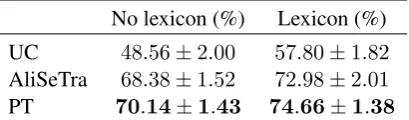
Tables 2 and 3 show the results of the experiments on the Finnish OCR data and Twitter data. We per-form tenfold cross-validation and provide t-based confidence intervals at the 95% level.
No lexicon (%) Lexicon (%) UC 48.56±2.00 57.80±1.82 AliSeTra 68.38±1.52 72.98±2.01 PT 70.14±1.43 74.66±1.38
Table 2: Results for tweet normalization. UC refers to the unstructured classifier presented in Section 3.1, PT to the perceptron tagger presented in Section 3.2 and AliSeTra to the system pre-sented by Eger et al. (2016).
No lexicon (%) Lexicon (%) UC 20.02±1.29 21.58±2.11 PT 32.05±1.97 35.09±2.08
Table 3: Results for Finnish historical OCR.
For the Finnish OCR data, the structured per-ceptron correction system clearly outperforms the unstructured system both without using a lexicon and when using a lexicon. The difference in per-formance is statistically significant in both cases at the 95% confidence level. Because the AliSe-Tra system is not freely available, we do not have results for that system on the Finnish OCR data.
For the Twitter data, both AliSeTra and the perceptron tagger deliver superior accuracy when compared with the unstructured system. The av-erage performance of the perceptron tagger in this experiment is superior to the performance of the AliSeTra system as reported by Eger et al. (2016). The difference in performance is, however, not sta-tistically significant. It should be noted that the data splits used in this work differ from the splits used by Eger et al. (2016).
8 Discussion
The advantage of the unstructured approach is that relatively little time is required for training the er-ror model (on the league of ten minutes for our data sets). The drawback of the unstructured mod-els used is that they accommodate a very limited set of features which manifests as comparably low normalization performance.
The performance of our structured system is at least equal to recent work of Eger et al. (2016) on tweet normalization even though our system is simpler in the sense that we use a 1-to-n mapping from inputs to outputs whereas Eger et al. (2016) use an n-to-n alignment between the input and
output. The n-to-n alignment, however, requires segmentation of the input as a preprocessing step. This may induce errors which cannot be corrected later. Treating the segmentation as a latent vari-able following (Cotterell et al., 2015) could be a solution but it carries the disadvantage of slow es-timation and inference.
It should be noted that we use some additional unstructured features compared with Eger et al. (2016) which may explain our slight performance advantage.
9 Conclusions
We have presented two systems for word based spelling correction using finite-state methods. We have shown that we reach state-of-the-art results when compared with a recent system presented by Eger et al. (2016) on the task of tweet normal-ization. Additionally, we have presented experi-ments on the task of OCR post-processing on a corpus consisting of Early Modern Finnish news-paper text.
10 Acknowledgments
We wish to thank the anonymous reviewers for their valuable suggestions.
References
Cyril Allauzen, Michael Riley, Johan Schalkwyk, Wo-jciech Skut, and Mehryar Mohri. 2007. Openfst: A general and efficient weighted finite-state transducer library. In Proceedings of the 12th International Conference on Implementation and Application of Automata, CIAA’07, pages 11–23, Berlin, Heidel-berg. Springer-Verlag.
Kenneth R. Beesley and Lauri Karttunen. 2003. Fi-nite State Morphology, volume 3 ofCSLI Studies in Computational Linguistics. CSLI Publications. Maximilian Bisani and Hermann Ney. 2008.
Joint-sequence models for grapheme-to-phoneme conver-sion.Speech Commun., 50(5):434–451, May. Eric Brill and Robert C. Moore. 2000. An improved
error model for noisy channel spelling correction. In Proceedings of the 38th Annual Meeting on As-sociation for Computational Linguistics, ACL ’00, pages 286–293, Stroudsburg, PA, USA. Association for Computational Linguistics.
Maegaard, Joseph Mariani, Asuncion Moreno, Jan Odijk, and Stelios Piperidis, editors,Proceedings of the Ninth International Conference on Language Re-sources and Evaluation (LREC’14), Reykjavik, Ice-land, may. European Language Resources Associa-tion (ELRA).
Michael Collins. 2002. Discriminative training meth-ods for hidden markov models: Theory and exper-iments with perceptron algorithms. InProceedings of the ACL-02 Conference on Empirical Methods in Natural Language Processing - Volume 10, EMNLP ’02, pages 1–8, Stroudsburg, PA, USA. Association for Computational Linguistics.
Ryan Cotterell, Nanyun Peng, and Jason Eisner. 2015. Modeling word forms using latent underlying morphs and phonology. Transactions of the Associ-ation for ComputAssoci-ational Linguistics, 3:433–447. Markus Dreyer, Jason R. Smith, and Jason Eisner.
2008. Latent-variable modeling of string transduc-tions with finite-state methods. In Proceedings of the Conference on Empirical Methods in Natural Language Processing, EMNLP ’08, pages 1080– 1089, Stroudsburg, PA, USA. Association for Com-putational Linguistics.
Steffen Eger, Tim vor der Brck, and Alexander Mehler. 2016. A comparison of four character-level string-to-string translation models for (ocr) spelling error correction. The Prague Bulletin of Mathematical Linguistics, 105:77–99.
Steffen Eger. 2012. S-restricted monotone alignments: Algorithm, search space, and applications. In Pro-ceedings of COLING 2012, pages 781–798, Mum-bai, India, December. The COLING 2012 Organiz-ing Committee.
Jason Eisner. 2003. Simpler and more general mini-mization for weighted finite-state automata. In HLT-NAACL.
Bo Han and Timothy Baldwin. 2011. Lexical normali-sation of short text messages: Makn sens a# twitter. In Proceedings of the 49th Annual Meeting of the Association for Computational Linguistics: Human Language Technologies-Volume 1, pages 368–378. Association for Computational Linguistics.
Mans Hulden and Jerid Francom. 2013. Weighted and unweighted transducers for tweet normalization. In
Tweet-Norm@ SEPLN, pages 69–72. Citeseer. Sittichai Jiampojamarn, Colin Cherry, and Grzegorz
Kondrak. 2010. Integrating joint n-gram features into a discriminative training framework. InHuman Language Technologies: Conference of the North American Chapter of the Association of Computa-tional Linguistics, Proceedings, June 2-4, 2010, Los Angeles, California, USA, pages 697–700.
Andr´e Kempe and Lauri Karttunen. 1996. Parallel re-placement in finite state calculus. InProceedings of the 16th Conference on Computational Linguistics
- Volume 2, COLING ’96, pages 622–627, Strouds-burg, PA, USA. Association for Computational Lin-guistics.
John D. Lafferty, Andrew McCallum, and Fernando C. N. Pereira. 2001. Conditional random fields: Probabilistic models for segmenting and labeling se-quence data. InProceedings of the Eighteenth Inter-national Conference on Machine Learning, ICML ’01, pages 282–289, San Francisco, CA, USA. Mor-gan Kaufmann Publishers Inc.
Krister Lind´en, Erik Axelson, Sam Hardwick, Tommi A Pirinen, and Miikka Silfverberg. 2011. HFSTFramework for Compiling and Applying Mor-phologies. In Cerstin Mahlow and Michael Pi-otrowski, editors, Systems and Frameworks for Computational Morphology, volume 100 of Com-munications in Computer and Information Science, pages 67–85. Springer Berlin Heidelberg.
Krister Lind´en. 2006. Multilingual modeling of cross-lingual spelling variants. Inf. Retr., 9(3):295–310, June.
Andrew McCallum, Dayne Freitag, and Fernando C. N. Pereira. 2000. Maximum entropy markov mod-els for information extraction and segmentation. In
Proceedings of the Seventeenth International Con-ference on Machine Learning, ICML ’00, pages 591–598, San Francisco, CA, USA. Morgan Kauf-mann Publishers Inc.
Mehryar Mohri and Richard Sproat. 1996. An effi-cient compiler for weighted rewrite rules. In Pro-ceedings of the 34th Annual Meeting of the Associa-tion for ComputaAssocia-tional Linguistics, pages 231–238, Santa Cruz, California, USA, June. Association for Computational Linguistics.
Josef Robert Novak, Nobuaki Minematsu, and Keikichi Hirose. 2016. Phonetisaurus: Exploring grapheme-to-phoneme conversion with joint n-gram models in the wfst framework. Natural Language Engineer-ing, FirstView:1–32, 4.
Tommi Pirinen. 2008. Automatic finite state mor-phological analysis of Finnish language using open source resources (in Finnish). Master’s thesis, Uni-versity of Helsinki.
Miikka Silfverberg, Teemu Ruokolainen, Krister Lindn, and Mikko Kurimo. 2015. Finnpos: an open-source morphological tagging and lemmatiza-tion toolkit for finnish. Language Resources and Evaluation, pages 1–16.
Gu Xu, Hang Li, Ming Zhang, and Ziqi Wang. 2014. A probabilistic approach to string transformation.