Sparsifying Word Representations for Deep Unordered Sentence
Modeling
Prasanna Sattigeri
IBM T. J. Watson Research Center Yorktown Heights, NY [email protected]
Jayaraman J. Thiagarajan Lawrence Livermore National Laboratory
Livermore, CA
Abstract
Sparsity often leads to efficient and inter-pretable representations for data. In this paper, we introduce an architecture to in-fer the appropriate sparsity pattern for the word embeddings while learning the sen-tence composition in a deep network. The proposed approach produces competitive results in sentiment and topic classifica-tion tasks with high degree of sparsity. It is computationally cheaper to compute sparse word representations than existing approaches. The imposed sparsity is di-rectly controlled by the task considered and leads to more interpretability.
1 Introduction
The recent surge in representation learning has re-sulted in remarkable advances in a variety of ap-plications including computer vision and speech processing. In the context of natural language processing, much effort has been focused on con-structing vector space representations for words through neural language models (Mikolov et al., 2013; Pennington et al., 2014) and designing ap-propriate composition functions to apply word embeddings for modeling sentences or documents. By design, the goal of neural word embedding ap-proaches is to build dense vector representations that capture syntactic and semantic similarities in data (e.g., beautiful, and attractive have similar meanings, as opposed to ugly, and repulsive), that the classic categorical representation of words as indices of a vocabulary fails to capture.
The composition function based on these em-beddings can be either unordered (e.g. average of the word representations) or syntactic, wherein the word order is explicity modeled (Socher et al., 2013a; Sutskever et al., 2011; Bowman, 2013).
(a) Original word vectors. (b) Sparsified word vectors.
Figure 1: t-SNE embedding of the sentence repre-sentations obtained as the average of word vectors for a random set of 1000 sentences from the SUBJ dataset.
While the former class of approaches results in simple architectures that are easily scalable, the latter can provide richer models with much se-vere computational complexity during training. Furthermore, the input word vectors are often fine-tuned during the training phase to improve the sentence (or document) classification perfor-mance. However, this can lead to severe over-fitting and hence regularization strategies such as
word-dropout are used (Iyyer et al., 2015) and in other cases the original word vectors are aug-mented to the input as astaticchannel (Kim, 2014; Zhang and Wallace, 2015).
Alternately, approaches that build word repre-sentations using different forms of regularization inspired by the linguistic study of word meanings have been effective in modeling sentences. For ex-ample,sparsityregularization can be been used to construct distributed representations (Eisenstein et al., 2011) that capture some of the crucial lexi-cal semantics largely based on familiar, discrete classes (e.g., supersenses) and relations (e.g., syn-onymy and hypernymy).
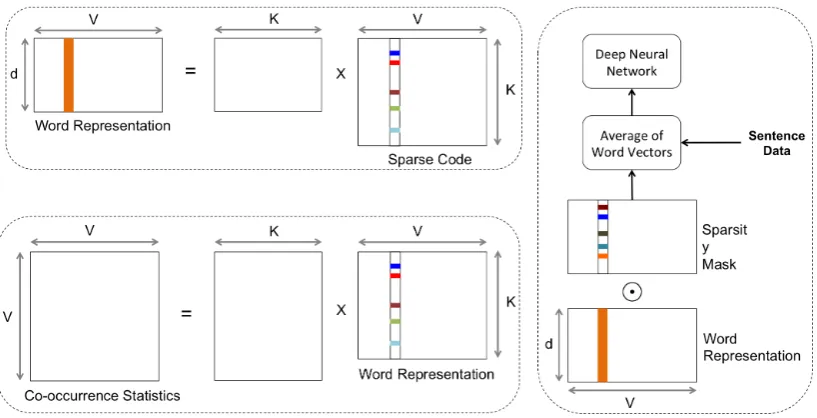
Instead of employing sparsity to regularize word embeddings, we propose to infer appropri-ate sparsity patterns for pre-learned word vectors
Figure 2: Sparsity has been commonly used to regularize word embeddings in order to effectively govern the relationship between word dimensions and provide interpretable representations. Examples include the approaches in (Yogatama et al., 2015) (left-top) and (Faruqui et al., 2015) (left-bottom). In contrary, we propose to infer sparsity patterns for pre-learned word embeddings in order to preserve only the key semantics required for the sentence classification task (right).
to improve the discrimination of sentence repre-sentations. In particular, we consider a unordered composition setting, similar to (Iyyer et al., 2015), wherein the sentence representation is obtained as the average of the words. Intuitively, spar-sity is imposed to govern the relationship between word dimensions to capture only the semantics crucial to the particular task considered. For ex-ample, in a sentiment analysis task, opposite re-lationships between adjectives such as beautiful and ugly are more important than gender relation-ships such as king and queen. Surprisingly, with-out any additional regularization such as word-dropout or static channel of word vectors, the pro-posed approach produces competitive results in sentiment and topic classification tasks with high degree of sparsity. While it is cheaper to com-pute sparse word representations than existing ap-proaches (Faruqui et al., 2015; Yogatama et al., 2015) the imposed sparsity is not merely based on the semantics of the space of words, but directly controlled by the task considered. Furthermore, by automatically learning sparsity masks that pre-serve only the semantic relationships appropriate for the task at hand, the resulting sentence models are highly discriminative. For example, in Figures 6(a) and 6(b), we show the sentence representa-tions (word averaging) obtained using the origi-nal Glove word embeddings and the proposed
ap-Figure 3: Tensorflow architecture for the proposed approach of sparsifying word embeddings based on labeled sentence data.
proach.
2 Sparsity in Word Embeddings
[image:2.595.308.530.384.564.2]representa-Figure 4: Convergence behavior of the pro-posed approach on the SUBJ dataset - Both the
%Sparsity of the inferred mask and the testing ac-curacy are shown. Interestingly, only less than
50%of the entries are retained.
tions typically found in lexical semantics, wherein each word can be represented sparsely in terms of an extensive set of discrete classes. For exam-ple, the word apple can be sparsely represented in terms of discrete concepts such as fruit, edi-ble food, red etc. In contrast, learned word rep-resentations such as the Word2vec produces dense vectors, where the word dimensions that actually reveal a particular semantic relationship are not transparent. This motivated NLP researchers to explicitly impose sparsity into the word embed-ding inference. Sparse modeling with an over-complete set of features is well known to pro-duce simple, interpretable representations, while retaining the approximation power of dense mod-els. Authors in (Andreas and Klein, 2014), use the creation of a word such asnortheastfrom words north and east to illustrate that linguistic descrip-tors orient along a sparse set of perceptual basis. In the context of nlp tasks, it has been showed that sparse codes inferred from the pre-learned word embeddings (Figure 2) are more interpretable and hence sparsity can be used to govern relationships between word dimensions (Fyshe et al., 2014; Faruqui et al., 2015). Since sparsity can reveal the word dimensions pertinent to specific semantics, the resulting sparse representations were more ef-fective in sentence classification. Similarly Chang et.al. found that sparse word vectors performed better in the behavioral task used to quantify in-terpretability (Chang et al., 2009). Furthermore, in (Yogatama and Smith, 2014), the authors
ad-(a) Average`1norm per dimension
[image:3.595.326.505.61.337.2](b) Average `1 norm for the top500words based with the largest`1norm in the original word vector space.
Figure 5: Measuring changes in the original dense word vectors and word vectors sparsified using mask inferred from the newswire dataset.
vocate several sparsity based structural regular-ization schemes as a more suitable inductive bias and show improvements over dense representa-tions several NLP tasks. In addition to the inher-ent computational complexity, an important down-side of these approaches is that sparsity is merely used to regularize the word embeddings and hence cannot directly improve the discrimination of sen-tence representations constructed using these word vectors.
[image:3.595.76.288.64.215.2]Model SST-fine IMDB SUBJ Reuters
CNN-MC (Kim, 2014) 47.4 – 93.2 –
F-Dropout (Wang and Manning, 2013) – 91.1 93.6 –
TreeLSTM (Tai et al., 2015) 50.6 – – –
PVEC (Le and Mikolov, 2014) 48.7 92.6 – –
DAN + Word-Drop (Iyyer et al., 2015) 46.9 89.4 92.4 72.6
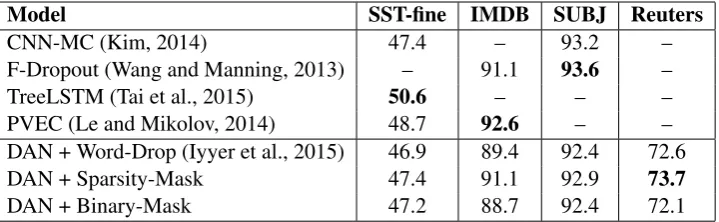
DAN + Sparsity-Mask 47.4 91.1 92.9 73.7
[image:4.595.121.481.62.173.2]DAN + Binary-Mask 47.2 88.7 92.4 72.1
Table 1: Sentence classification performance of the proposed approach in comparison to other meth-ods. In addition to outperforming the deep averaging architecture, our approach achieves competitive performances in comparison to state-of-the-art syntactic sentence classification methods.
Word / NNs Sentiment Mask Newswire Mask Original uncomfortable uneasy, enough, renovations, racket, awkward, uneasy,
terribly, hence contingent, competing unpleasant, bothered president being, concerned, between, growth, vice, chief,
nothing, then bank, earnings executive, former
Table 2: Neighborhood of words obtained with two different sparsity masks: (a) sentiment mask from the SST dataset, (b) Newswire mask from the Reuters newswire dataset. In addition, we show the neighbors identified using the original word embeddings.
the NLP task at hand. Such a task-driven approach has two important advantages: (a) By inferring sparsity patterns specific to the task/dataset there is improved discrimination, (b) We can circum-vent the computationally intensive sparse learning by adding this as a layer into the traditional deep learning architectures used for sentence classifica-tion. In the rest of paper, we describe our approach to couple the process of sparsifying word embed-dings in deep undordered sentence classification framework similar to (Iyyer et al., 2015).
3 Proposed Approach
The proposed architecture shown in Figure 2(right) aims to infer a sparsity mask for the word embeddings using a deep unordered composition network (Iyyer et al., 2015). Note that, the sen-tence modeling corresponds to simply averaging the word vectors in that sentence. Let the word vectors be denoted by a matrixW 2RV,d. In our
architecture, we introduce the sparsity mask M which is applied to the word vector matrixW as an element-wise product. The mask is a real valued matrix which is passed through Relu non-linear activation to transform into a sparse mask with non-negative entries. This mask is applied in a multiplicative manner onW to obtain the masked word vector matrixWˆ = W Relu(M)and is
optimized such that the sentence-level classifica-tion performance is maximized. We also consider a variant of this architecture, wherein the entries are thresholded to discrete values0or1based on the sign of entries in the real valued mask.
For all analysis and results reported in this pa-per, we used the pre-trained 300 dimensional
Glove(Pennington et al., 2014) word vectors. As described earlier, a sentence level representation is created by averaging the word vectors corre-sponding to the constituent words. This 300 -dimensional representation is then passed through a series of fully connected layers and finally a soft-max layer for prediction of labels. In contrast to the architecture in (Iyyer et al., 2015) no word-dropout regularization is used. Apart form the standard cross-entropy loss with a weight-decay regularization, we also include a term in the loss function to minimize the `1-norm of the mask to
explicitly enforce sparsity on the latter. We im-plemented the architectures for both the real mask and binary mask versions using Tensorflow and Figure 3 shows the masking operation in detail us-ing the tensorboard network architecture. visual-izer.
non-(a) Original Antonym Word Vectors (b) Original Gender Word Vectors
[image:5.595.118.482.64.376.2](c) Antonym Word Vectors with Sentiment Mask (d) Gender Word Vectors with Sentiment Mask
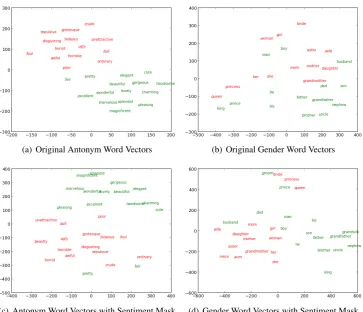
Figure 6: t-SNE plots of original and sparsified word vectors illustrating the ability of the learned mask to retain only semantic relationships relevant to the task at hand.
linear layers followed by the soft-max layer. The non-linear layer consisted of a linear transforma-tion followed by the ReLu unit. The hidden layers have a constant dimension of300and dropout is applied at each of these layers. The same hyperpa-rameters were used across all datasets. Adam opti-mizer was used with learning rate set to1e 4and the dropout out rate was set0.5. The`2
regulariza-tion parameter for weight-decay was set to1e 4.. The weights of the FCN layers were initialized randomly from uniform distribution [ 1,1] and scaled with a factor of0.08. 10-fold CV was ap-plied to datasets with no explicit train/test splits.
4 Experiments and Results
We evaluated the proposed approaches using a set of commonly used text classification datasets both at the sentence level and the document level. We report the performance of the proposed architec-ture with respect to the classification task pertain-ing to each dataset. This is followed up by investi-gation of the properties of the sparsified word vec-tors. For all classification performance
compar-isons we used the vanilla DAN with word-dropout regularization (Iyyer et al., 2015), and the pro-posed DAN + sparsity mask and DAN + binary mask variants.
Datasets:
• IMDB (document level): This dataset (Maas et al., 2011) consists of 50,000 labeled in-stances of movie reviews taken form the movie review site, IMDB. Each review can be made up of several sentences and is labeled as either positive or negative. The dataset also provides a balanced split of 25,000 instances for training and 25,000 instances for testing.
sev-original: fanatically, stylings, melding, inimitable, ardently
masked: whole-heartedly, uncompromising, rosily, principled, hard-driving original: post-camp, larceny, family-friendly, light-years, matchmaking
masked: post-camp, family-friendly, voyages, four-star, cabins original: ballot, ontiveros, candidate, nomination, badge
[image:6.595.130.469.59.174.2]masked: candidate, nomination, laziest, vote, voting original: 95, shave, grad, veggietales, colgate masked: shave, grad, veggietales, colgate, golf
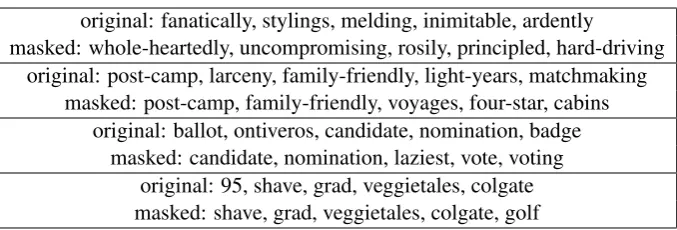
Table 3: Words in the newswire dataset with largest coefficient along a random dimension of word vectors. Each row belongs to different dimension.
Original blinddate, micro-device, bible-study, greenfingers, fever-pitched, bogosian, darabont, navona, 66-day, murri
Masked screenplay, cinematic, entertaining, fascinating, movie,
daughter, he, micro-device, secret, discovers
Table 4: Demonstration of the discriminative power of sparsified word embeddings - Words with largest `1-norm in the SUBJ dataset. The words colored in blue occur most commonly found in sentences from
the subjective class while words marked in red occur commonly in objective sentences.
eral existing syntactic approaches also utilize the phrase level labels by augmenting them to the training set. However, we evaluate the three DAN architectures without the phrase-level labels.
• SUBJ (sentence level): This dataset called as the Subjective dataset (Pang and Lee, 2004) involves classifying a sentence as either being subjective or objective. This dataset provides 10,000 instances in total and contain separate validation/test set.
• Reuters (document level): This dataset com-prises of 11228 newswires from Reuters. The task is to classify the newswires into one of the given 46 topics. There is no standard train/test split for this dataset.
The classification performance on these datasets is reported in table 1. As it can be observed, the sparsified word vectors ourperform the con-ventional word embeddings with the DAN archi-tecture and perform competitively with respect to state-of-the-art syntactic methods. Investigating the properties of the masked work vectors and comparing them to original work vectors can shed some light on the behavior of the sparsification procedure. Figure 5(a) shows the mean`1-norm
of each dimension of the word vector across all the words in the vocabulary for the SST sentiment
classification dataset. The dimensions are ordered by their`1-norm in the original word vector space.
The general behavior remains the same, however with an overall reduction in norm that can be at-tributed to the sparsity in the masked word vec-tors. Similar analysis can be performed with re-spect to words instead of each word vector dimen-sions. In figure 5(b), the blue line corresponds to `1-norm of the top 500 words ordered by the norm.
The norm for the same words in the masked space is shown in red, which indicates that the mask is word-specific and can tune the entries as suited for the task in hand.
Analysis of task-specific mask: To understand the effect of the task-specific mask, we study the similarity of words and compare them in the origi-nal word vector space and the sparsified word vec-tor spaces. Table 4 shows a couple of example neighborhoods of words in these spaces. Subjec-tively, we can see that the word vector semantic space is modified such that word neighborhoods that are more important for the task are preserved and enhanced. We can draw similar inferences by looking at the t-SNE (Van der Maaten and Hinton, 2008; Faruqui and Dyer, 2014) plots as seen in fig-ure 6.
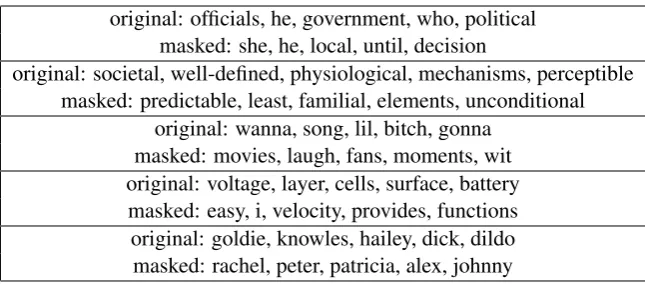
original: officials, he, government, who, political masked: she, he, local, until, decision
original: societal, well-defined, physiological, mechanisms, perceptible masked: predictable, least, familial, elements, unconditional
original: wanna, song, lil, bitch, gonna masked: movies, laugh, fans, moments, wit original: voltage, layer, cells, surface, battery
[image:7.595.137.460.60.202.2]masked: easy, i, velocity, provides, functions original: goldie, knowles, hailey, dick, dildo masked: rachel, peter, patricia, alex, johnny
Table 5: Words from SUBJ dataset with largest coefficient along the top-5 dimensions (in terms of`1
-norm) of word vectors.
of the original word vectors and the correspond-ing dimensions from the masked counterparts ob-tained from the SST-fine sentiment classification task. The top words are obtained by sorting the absolute value of the words along each of those di-mensions. Since, there is a direct correspondence between original and masked word vector dimen-sions, we can directly compare them. The exam-ples in table 3 show that mask improves the se-mantic consistency and hence improves interpre-tation of individual dimensions. Similar analysis is carried our for the SUBJ dataset and the results are reported in Table 5
Finally, we use the SUBJ dataset to demonstrate the discriminative power of sparsified word em-beddings in sentence classification. The words with the largest `1-norm in the masked vector
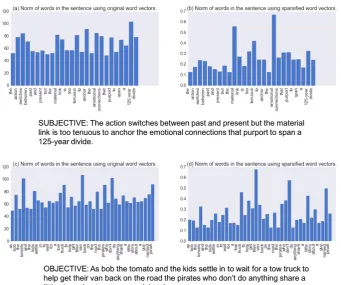
space in Table 4 reveal that the sparsity mask iden-tifies a set of words crucial for discriminating the two classes. Finally, we consider an example sen-tence in each of the two classes and show the aver-age`1 norms for words in the sentences in Figure
7. As it can be observed, words such asemotional
andmaterialare crucial to identifying the subjec-tive nature of the sentence while words such as
125 yearwhich has prominence in the original word vector space has no relevance.
5 Conclusions
We have described an architecture that performs fine tuning of the word vectors in a classifi-cation setup while promoting sparsity in them. The resulting network achieves competitive re-sults on several text classification datasets. This approach of inducing sparsity is computationally much cheaper than the traditional sparse models. The fine-tuned word vectors are also shown to be
more interpretable, task specific and in process enhance the effectiveness of architectures based on simple unordered composition model. Also, the resulting word vectors posses improved dis-criminatory power suggesting that the use of this method as a pre-processing step can potentially lead to improved performance in other tasks which utilize word vectors.
References
Jacob Andreas and Dan Klein. 2014. Grounding lan-guage with points and paths in continuous spaces. In
CoNLL, pages 58–67.
Samuel R Bowman. 2013. Can recursive neural tensor networks learn logical reasoning? arXiv preprint arXiv:1312.6192.
Jonathan Chang, Sean Gerrish, Chong Wang, Jordan L Boyd-Graber, and David M Blei. 2009. Reading tea leaves: How humans interpret topic models. In
Advances in neural information processing systems, pages 288–296.
Jacob Eisenstein, Noah A Smith, and Eric P Xing. 2011. Discovering sociolinguistic associations with structured sparsity. InProceedings of the 49th An-nual Meeting of the Association for Computational Linguistics: Human Language Technologies-Volume 1, pages 1365–1374. Association for Computational Linguistics.
Manaal Faruqui and Chris Dyer. 2014. Community evaluation and exchange of word vectors at word-vectors.org. In Proceedings of the 52nd Annual Meeting of the Association for Computational Lin-guistics: System Demonstrations, Baltimore, USA, June. Association for Computational Linguistics. Manaal Faruqui, Yulia Tsvetkov, Dani Yogatama, Chris
Figure 7: An example from the SUBJ dataset demonstrating the ability of the proposed sparisification to choose words that easily discriminate the two classes.
Alona Fyshe, Partha P Talukdar, Brian Murphy, and Tom M Mitchell. 2014. Interpretable semantic vectors from a joint model of brain-and text-based meaning. InProceedings of the conference. Associ-ation for ComputAssoci-ational Linguistics. Meeting, vol-ume 2014, page 489. NIH Public Access.
Mohit Iyyer, Varun Manjunatha, Jordan Boyd-Graber, and Hal Daum´e III. 2015. Deep unordered compo-sition rivals syntactic methods for text classification. In Proceedings of the 53rd Annual Meeting of the Association for Computational Linguistics and the 7th International Joint Conference on Natural Lan-guage Processing, volume 1, pages 1681–1691. Yoon Kim. 2014. Convolutional neural
net-works for sentence classification. arXiv preprint arXiv:1408.5882.
Quoc V Le and Tomas Mikolov. 2014. Distributed representations of sentences and documents. arXiv preprint arXiv:1405.4053.
Andrew L Maas, Raymond E Daly, Peter T Pham, Dan Huang, Andrew Y Ng, and Christopher Potts. 2011. Learning word vectors for sentiment analysis. In
Proceedings of the 49th Annual Meeting of the Asso-ciation for Computational Linguistics: Human Lan-guage Technologies-Volume 1, pages 142–150. As-sociation for Computational Linguistics.
Tomas Mikolov, Ilya Sutskever, Kai Chen, Greg S Cor-rado, and Jeff Dean. 2013. Distributed
representa-tions of words and phrases and their compositional-ity. InAdvances in neural information processing systems, pages 3111–3119.
Bo Pang and Lillian Lee. 2004. A sentimental educa-tion: Sentiment analysis using subjectivity summa-rization based on minimum cuts. InProceedings of the 42nd annual meeting on Association for Compu-tational Linguistics, page 271. Association for Com-putational Linguistics.
Bo Pang and Lillian Lee. 2005. Seeing stars: Exploit-ing class relationships for sentiment categorization with respect to rating scales. InProceedings of the 43rd Annual Meeting on Association for Computa-tional Linguistics, pages 115–124. Association for Computational Linguistics.
Jeffrey Pennington, Richard Socher, and Christopher D Manning. 2014. Glove: Global vectors for word representation. InEMNLP, volume 14, pages 1532– 1543.
Richard Socher, Danqi Chen, Christopher D Manning, and Andrew Ng. 2013a. Reasoning with neural ten-sor networks for knowledge base completion. In Ad-vances in Neural Information Processing Systems, pages 926–934.
models for semantic compositionality over a senti-ment treebank. InProceedings of the conference on empirical methods in natural language processing (EMNLP), volume 1631, page 1642. Citeseer. Ilya Sutskever, James Martens, and Geoffrey E
Hin-ton. 2011. Generating text with recurrent neural networks. InProceedings of the 28th International Conference on Machine Learning (ICML-11), pages 1017–1024.
Kai Sheng Tai, Richard Socher, and Christopher D Manning. 2015. Improved semantic representa-tions from tree-structured long short-term memory networks. arXiv preprint arXiv:1503.00075. Laurens Van der Maaten and Geoffrey Hinton. 2008.
Visualizing data using t-sne. Journal of Machine Learning Research, 9(2579-2605):85.
Sida Wang and Christopher Manning. 2013. Fast dropout training. In Proceedings of the 30th In-ternational Conference on Machine Learning, pages 118–126.
Dani Yogatama and Noah A Smith. 2014. Linguistic structured sparsity in text categorization.
Dani Yogatama, Manaal Faruqui, Chris Dyer, and Noah Smith. 2015. Learning word representations with hierarchical sparse coding. In Proceedings of the 32nd International Conference on Machine Learn-ing (ICML-15), pages 87–96.
Ye Zhang and Byron Wallace. 2015. A sensitiv-ity analysis of (and practitioners’ guide to) convo-lutional neural networks for sentence classification.