Filling in the Blanks in Understanding Discourse Adverbials:
Consistency, Conflict, and Context-Dependence in a Crowdsourced
Elicitation Task
Hannah Rohde∗ Anna Dickinson∗ Nathan Schneider∗,† Christopher N. L. Clark∗ Annie Louis‡ Bonnie Webber∗
∗University of Edinburgh
Edinburgh, UK
†Georgetown University
Washington, DC, USA
‡University of Essex
Colchester, UK {hannah.rohde,bonnie.webber}@ed.ac.uk,
{anna.y.dickinson,chrisclark272}@gmail.com,
[email protected],[email protected]
Abstract
The semantic relationship between a sen-tence and its context may be marked explic-itly, or left to inference. Rohde et al. (2015) showed that, contrary to common assump-tions, this isn’texclusive or: a conjunction can often be inferred alongside an explicit discourse adverbial. Here we broaden the investigation to a larger set of 20 discourse
adverbials by eliciting≈28K conjunction
completions via crowdsourcing. Our data replicate and extend Rohde et al.’s findings that discourse adverbials do indeed license inferred conjunctions. Further, the diverse patterns observed for the adverbials include cases in which more than one valid connec-tion can be inferred, each one endorsed by a substantial number of participants; such differences in annotation might otherwise be written off as annotator error or bias, or just a low level of inter-annotator agree-ment. These results will inform future dis-course annotation endeavors by revealing where it is necessary to entertain implicit relations and elicit several judgments to fully characterize discourse relationships.
1 Introduction
Existing work highlights the importance of under-standing discourse relations in context, showing a range of phenomena that are sensitive to the se-mantic connection that holds between two spans of discourse (Hirschberg and Litman, 1987; Kehler and Rohde, 2013). Such connections can be made explicit in text via an overt connective or marked syntax; otherwise they must be inferred. Various contextual cues have been identified that guide the
establishment of discourse relations (Hirschberg and Litman, 1987; Kehler, 2002; Webber, 2013).
When it comes to producing resources annotated with discourse relations—e.g., the Penn Discourse Treebank (PDTB; Prasad et al., 2008)—it is
com-monly assumed that at most asinglediscourse
re-lation holds between two spans of discourse. It may not be simple to identify or infer that relation, but once achieved, the task is taken to be done.
But properties of the discourse adverbialinstead
(Webber, 2013) have challenged this assumption.
In particular, sentence-initialinsteadsupports the
inference of another discourse relation, with the specific relation depending on properties of the spans. This can be seen through what coordinating conjunction makes the relation explicit—compare:
(1) I planned to make lasagna. Instead I made hamburgers.
⇒But instead I made hamburgers
(2) I don’t know how to make lasagna. Instead I made hamburgers.
⇒So instead I made hamburgers
(3) Surprisingly, they ignored the lasagna. Instead they just ate the salad.
⇒And instead they just ate the salad
While this means that full annotation ofinstead
requires asking annotators what additional relation
they infer (besides that associated withinstead
it-self), one still needs to ask:
• For clauses starting with discourse adverbials other thaninstead, is the relation signalled by the adverbial all there is, or can an additional relation be inferred with the previous text? In the former case, no additional annotation is required; in the latter, it is.
• If another relation can be inferred, can it be in-ferred deterministically based on the adverbial alone? If so, no additional work is required, as the relation can be annotated automatically. • If it can’t be inferred based on the discourse
adverbial alone (as in the case of instead),
how should an annotator figure out what it is? • Could there be different ways of framing the inferred relation, such that annotators may dis-agree as to its identity, but all still be correct? This paper addresses these questions using crowd-sourced data elicited on 969 passages involving twenty discourse adverbials. We describe our methodology, what we have so far been able to
learn, and howinter-annotator disagreementshave
led us to look more deeply into the judgments and what conclusions we can draw from them. Our re-sults demonstrate that inter-annotator disagreement is informative, and need not be treated as annotator bias, inattention, or noise.
2 Background
The current work should be seen against the back-ground of two research areas: Research on multiple co-occurring connectives and research on acquiring useful linguistic judgments from a large number of annotators, whether by crowdsourcing or in-house.
In the PDTB, all explicit connectives in a
sen-tence were separately annotated. Then,if and only
if a sentence lacked an explicit inter-sentential con-nective linking it to the previous context, annotators were asked to infer and annotate its relation, if any, to the previous sentence. This reflected the com-mon assumption, noted earlier, that the situation is “either/or” – if a discourse relation is marked, there
is nothing to infer.
With respect to research on explicit multiple co-occurring connectives, over 15 years ago, Web-ber et al. (1999) used them to argue that discourse spans could be related by both adjacency relations and anaphoric relations. Similary, in the context of Catalan and Spanish oral narrative, Cuenca and Marín (2009) used them to argue for different pat-terns and degrees of discourse cohesion. Oates (2000) considered how multiple discourse connec-tives should be used in Natural Language Genera-tion, noting that the order in which they occur cor-relates with the hierarchy of discourse connectives presented in (Knott, 1996), while Fraser (2013) offers an account of the order in which multiple
contrastiveconnectives co-occur, in terms of what
he callsgeneral contrastivediscourse markers and
specific contrastivediscourse markers. For Turk-ish, Zeyrek (2014) has described patterns of
multi-ple co-occuring connectives that signalcontrastive
and/orconcessiverelations.
These efforts have all been directed at explaining the existence of multiple explicit connectives and how they pattern. Closer to the focus of the current paper is work by Rohde et al. (2015), in which
judg-ments were crowdsourced on four adverbials:after
all, in fact, in general and instead. Rohde et al.
found that, given one of these discourse adverbials, naïve participants identified an operative discourse relation—via a conjunction whose presence they endorsed alongside the discourse adverbial. They did so reliably both for explicit passages in which the author’s explicit pre-adverbial conjunction had been elided and for implicit passages in which the adverbial originally appeared alone. For Rohde et al.’s four adverbials, the inferred relation could not be predicted entirely on the basis of the ad-verbial alone. The current study extends Rohde et al.’s work to a larger set of adverbials. We fo-cus on participant judgments on implicit passages since such cases are left largely untreated by exist-ing annotation endeavors as well as current formal accounts.
The other research area that forms the back-ground to the current work is research on acquiring linguistic judgments from a large number of annota-tors, whether by crowdsourcing or in-house. Here, research has addressed either identifying and cor-recting for problems arising from judgments from large numbers of unknown, possibly biased and/or inattentive annotators (Hovy et al., 2013; Passon-neau and Carpenter, 2014), or identifying benefits that arise from having a large number of annotators (Artstein and Poesio, 2005, 2008). Work in the former area attempts to eliminate judgments that should be treated as noise, while the latter work shows that annotator bias decreases with the num-ber of annotators.
In related research, Poesio and Artstein (2005) reflect on the “true ambiguity” of some pronoun tokens and how the presence of these distinct co-present viable interpretations can be brought to light via a sufficiently large number of annotators. In one example they cite, a boxcar has been at-tached to a train engine. The next sentence spec-ified what should then be done. Over half their
sentence as referring to the boxcar, while others in-terpreted it to refer to the engine. But the situation associated with these two different interpretations was the same in both cases, since the engine and boxcar had effectively become a single moving, functioning unit. This ambiguity would not nec-essarily have been made apparent or taken to be as significant without the large number of partici-pants.
Lastly, there is new work (Scholman et al., 2016) that tests naïve annotators’ ability to infer discourse relations, specifically to distinguish four dimen-sions along which relations are posited to vary. Their work targets annotator agreement, and shows consistency comparable with expert annotators for two of the four posited dimensions. Unlike their task, which asked participants to make a decision about abstract semantic features, our methodology involves asking participants to consider whether a short passage with an explicit conjunction is a para-phrase of one without that conjunction. Crucially, we will avoid the assumption that there is a single correct answer.
3 Crowdsourcing judgments on discourse adverbials: Methodology
Here we extend the crowdsourcing approach of Ro-hde et al. (2015) to a larger dataset with many more adverbials. The goal is to learn from participants’ endorsements of particular conjunction–adverbial combinations in naturally occurring passages, as to whether additional annotation will be needed.
3.1 Participants
We recruited 28 participants from Amazon Mechan-ical Turk. All were native English speakers and were paid $88 each for their participation. These 28 individuals were selected from a larger pool who participated in a pre-trial involving 50 annotations. The pre-trial allowed us to identify participants who understood the task, whose responses were in line with the group average, who did not overuse
NONE, and who were not outliers in speed.
3.2 Materials
The target passages that participants read were se-lected from the NY Times Annotated Corpus (Sand-haus, 2008). Passages varied from 9 to 122 words (minimally a sentence and maximally, a short para-graph). They were chosen to be comprehensible as stand-alone excerpts. Each target passage consisted
(minimally) of two spans of text, the second begin-ning with a discourse adverbial, as in examples (1)–(3) and the sample materials shown in (4)–(5). (4) “Nervous? No, my leg’s not shaking,” said Griffey, who caused everyone to laugh /
indeed his right foot was shaking.
(5) Sellers are usually happy, too / after all
/ they are the ones leaving with money. In example (4)’s original form, the author had
in-cluded an explicit conjunction (because). In
exam-ple (5), the original text contained only the adver-bial, meaning that a discourse relation conveyed by a conjunction would have been implicit. Punctua-tion adjacent to the adverbial was replaced with a slash.
Each passage contained one of the following
discourse adverbials after the gap: actually,
af-ter all,first of all, for example, for instance, how-ever, in fact, in general, in other words, indeed,
instead, nevertheless, nonetheless, on the one hand, on the other hand, otherwise, specifically,
then,therefore, andthus. These represent a sam-pling of high-frequency adverbials, which belong to a variety of semantic classes and which showed a range of conjunction co-occurrence patterns in counts extracted from the Google Books Ngram Corpus (Michel et al., 2011; Lin et al., 2012).
Half the target passages originally contained a
conjunction before the adverbial. For thoseexplicit
passages, we excised the conjunction and replaced
it with a gap. For excerpts that were originally
im-plicit passages, we simply inserted a gap before the adverbial. For each of the 20 adverbials, par-ticipants saw 25 explicit passages and 25 implicit
passages, with the exception ofhowever, which
appeared in 25 implicit passages and 1 explicit pas-sage (due to the rarity of conjunctions that naturally
occur directly beforehowever).
The distribution of original (author-chosen) con-junctions in the explicit passages reflected the dis-tribution observed in Google n-gram counts of each
adverbials with each of the conjunctionsAND,BE
-CAUSE, BUT, OR, SO. These 5 conjunctions
ap-peared in a list of possible response options for participants.
With 20 adverbials and 50 passages per adverbial
(26 passages forhowever), this yields a set of 976
also included 32 catch trials, which were used to check that participants were paying attention and using the experimental interface correctly. The catch trials contained well-known quotes and ex-pressions that had a ‘correct’ conjunction (e.g.,you can lead a horse to water you can’t make it drink). Some of the catch trials expected the
response BEFORE, so this was included as a 6th
option in the list of possible conjunction responses. How much can we learn from participants’ selec-tion of a conjuncselec-tion? All six conjuncselec-tions we use are relatively unambiguous: In the PDTB (Prasad et al., 2008), each has a different main sense that
it is associated with>90% of the time.1 More to
the point, while 5.9% of the explicit tokens ofand
were assigned a result sense, of the 1272 tokens
whereANDwas inserted as an implicit connective,
none were labelled with the inferred senseresult.
(97% of the time, when ANDwas inserted as an
implicit connective, it was with an inferred sense of
conjunctionorlist, as with explicit tokens ofAND.)
As such, there are grounds for believing that the experiment targeted the participants’ inferred rela-tion through choosing a conjuncrela-tion that realizes it, even if the sense is only a coarse one.
3.3 Procedure
All participants saw all passages. Participants were instructed to fill in the gap with the word of their
choice (from the six conjunctionsAND,BECAUSE,
BEFORE,BUT,OR,SO) that “best reflects the
mean-ingof the connection” between the spans. They
also had the option of choosing either NONE AT
ALL (if they felt that no conjunction was
possi-ble) or OTHER WORD OR PHRASE(if they felt that
only some option other than the six presented con-junctions was appropriate). The instructions were followed by three practice items.
During pilot testing, it emerged that participants
sometimes chose NONE AT ALLwhen it sounded
more fluent and less awkward to them than did an explicit conjunction. To avoid this, we explicitly in-structed participants to choose the conjunction that best conveyed the sense of the connection, “even if the resulting text sounds awkward”, but then of-fered them the opportunity to record whether or not they would in fact use the chosen conjunction in that context (recording “I could say it this way” or “It sounds strange here”).
1ORhas the senseDisjunction86.7%, since it is labelled asConjunctionwhen it is in a negative context.
To avoid order effects, passages were pseudo-randomised: Participants never encountered more than three of the same adverbial in a row, and for explicit passages, they never saw excerpts whose original (author-chosen) conjunction was the same more than three times in a row. Also randomized was the list of possible conjunctions from which participants selected their response: The list ap-peared in a different order for each participant. Cur-sory examination of a sample of the data fails to show any obvious bias from the order in which the choices were presented.
The task was completed over several weeks. Par-ticipants worked at a rate of roughly 85 tokens per hour (making the hourly rate roughly $8/hour). They were not permitted to do more than 100 to-kens per day.
4 Results
4.1 Issues addressed by the results
Our crowdsourced data can be used to answer dis-tinct questions: Responses on explicit passages (§4.2) can be used to test whether untrained
par-ticipantscando the task and deliver useful
infor-mation. Given that the answer is found to be ‘yes’, responses on implicit passages (§4.3) can be used to answer our fundamental research questions: (1) Do inferrable discourse relations hold in implicit pas-sages containing only a discourse adverbial, and (2) how can individual adverbials best be character-ized with respect to inferrable discourse relations? Assuming that the first question is answered in the affirmative (as was shown by Webber (2013) forinstead), the two strongest answers to the latter
question would be either:
i. Uniformity across adverbials: All adver-bials co-occur with the same preferred con-junction.
ii. Uniformity per adverbial: Each adverbial has a single preferred conjunction, not neces-sarily the same across adverbials but possibly predictable from the semantic class of the ad-verbial.
§5 will then show that systematic variability in the responses of our untrained annotators re-veals cases in which multiple interpretations are inferable—an outcome that, as in (Poesio and Art-stein, 2005), only presents itself with the use of multiple annotators. We discuss implications for large-scale annotation frameworks and methods.
4.2 Responses for explicit passages
For each of the 20 adverbials in our study, we
elicited responses for 25explicitpassages, where
the original sentence contained an adverbial pre-ceded by a conjunction. (As already noted, for
howeverwe elicited responses for only one explicit passage; also, in the case of four explicit passages containing other adverbials, there were errors in presentation.) With 28 participants who saw all of these explicit passages, we have 13,216 analyzable data points.
The results show that conjunctions selected by authors in original texts are indeed recoverable: More than half the time (57%), participants se-lected the conjunction that the author had used. Moreover, it has been noted that the conjunction
AND provides a less specified signal regarding
the intended discourse relation (Knott, 1996) than some other conjunctions. For our data, if one
considersSOandBUTas compatible with
author-chosenANDand allow for such matches in
compu-tation of the overall agreement rate, participant se-lections matched the authors’ original conjunction 70% of the time. The confusion matrix for author-chosen and participant-selected conjunctions is shown in table 1.
AND BECAUSE BUT OR SO
AND 2686 149 325 159 344
BECAUSE 280 786 176 156 156
BUT 1000 174 2798 179 180
OR 68 41 15 355 28
SO 550 127 129 298 1215
BEFORE 4 2 1 0 1
NONE 248 105 158 108 167
[image:5.595.319.516.62.133.2]OTHER 8 16 10 5 9
Table 1:Confusion matrix of author conjunctions (columns) and participant responses (rows) in explicit passages
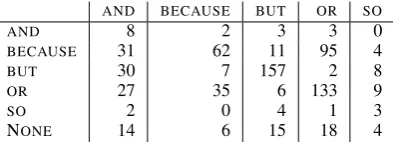
Other cases of divergence in participant selec-tion point to contexts in which normally different conjunctions can convey the same relation. A case
in point are passages containing the adverbial
oth-erwise(table 2). Here, authorORreceived an
un-expectedly high number ofBECAUSEparticipant
responses, and vice versa.
It appears that, withotherwise, bothBECAUSE
and OR can be used to express a reason. This is
AND BECAUSE BUT OR SO
AND 8 2 3 3 0
BECAUSE 31 62 11 95 4
BUT 30 7 157 2 8
OR 27 35 6 133 9
SO 2 0 4 1 3
[image:5.595.76.286.522.613.2]NONE 14 6 15 18 4
Table 2: Confusion matrix for explicit passages containing
otherwise(author conjunctions as columns, participant
re-sponses as rows)
apparent in passage (6) below, where responses to
authorORwere split, with 17 participants selecting
ORand 11,BECAUSE.
(6) “The Ravitch camp has had about 25 fund-raisers and has scheduled 20 more. Thirty others are in various stages of planning,” Ms. Marcus said. “It has to be highly organized
otherwise it’s total chaos,” she added. These two strong signals are neither noise nor disagreement nor evidence of ambiguity (as in Poesio and Artstein (2005)), but rather different, context-specific ways of conveying the same sense. Given the number of possible responses on each trial (6 conjunctions, NONE, OTHER) and the
differ-ent senses that these conjunctions are usually taken to express, our observed levels of agreement are encouraging and suggest that participants can rec-ognize intended concurrent relations and provide meaningful responses in this task.
4.3 Responses for implicit passages
For each of the 20 adverbials in our study, we
elicited responses for 25implicitpassages, where
the original sentence contained an adverbial not preceded by a conjunction (excepting 3 implicit passages with errors in presentation). With 28 par-ticipants who saw all implicit passages, we have 13,916 analyzable data points.
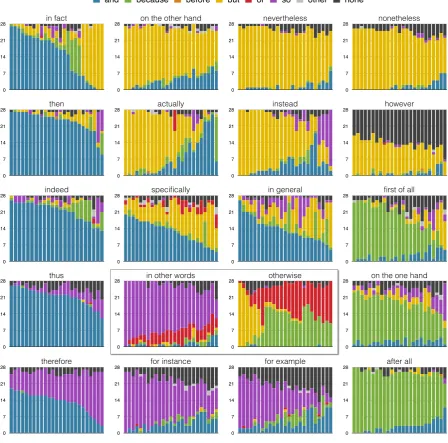
To help categorize participants’ behavior across adverbials, we visualize each adverbial’s response profile as a stacked bar chart, as shown in figure 1 for all 20 adverbials. Every point on the x-axis rep-resents a passage, and passages have been ordered for presentation here to highlight trends for the
ad-verbial.2 For each passage, bars color-coded by
response (chosen conjunction) are sized according to the number of respondents who chose that
re-sponse, and stacked in a consistent order: firstAND
(blue) at the bottom, thenBECAUSE(green), then
BUT(yellow), etc. The y-axis reaches 28 because
however
0 7 14 21 28 0
7 14 21 28
and because before but or so other none
nevertheless nonetheless
0 7 14 21 28
0 7 14 21
28 on the other hand
0 7 14 21
28 actually
0 7 14 21
28 instead
0 7 14 21
28 in general
0 7 14 21
28 specifically 0
7 14 21
28 in fact
0 7 14 21
28 then
0 7 14 21 28
first of all
0 7 14 21 28
0 7 14 21
28 on the one hand
after all indeed
0 7 14 21 28
for example
0 7 14 21 28
for instance
0 7 14 21 28
therefore
thus in other words
0 7 14 21 28 0 7 14 21 28
0 7 14 21 28
0 7 14 21
[image:6.595.74.523.71.514.2]28 otherwise
Figure 1:Data for implicit passages. Plots are arranged according to the dominant response(s).
every passage has 28 responses. We have manu-ally arranged the plots so that patterns of dominant responses can be observed; e.g., plots with high
concentrations ofBUT(shown in yellow) are in the
upper portion of the figure.
Comparing even just two of the plots in figure 1
leads us to several observations. Consider
other-wiseandin other words(highlighted in the middle
of the fourth row of figure 1).
• These two adverbials have markedly differ-ent profiles of inserted conjunctions, suggest-ing different patterns of implied/inferred dis-course relations.
• Neither response pattern is totally random; clear trends are observable in each. At the same time, neither adverbial has a single
con-junction that is dominant overall. Instead, we see 2 or 3 conjunctions that are most often chosen for passages with the adverbial. • Neither adverbial has a completely consistent
distribution of responses within particular
pas-sages. The plot forin other wordsshows an
overall preference on most passages forSO,
but the degree of competition fromBUTand
OR(and evenBECAUSEandAND) varies
de-pending on the passage. Forotherwise, some
passages favorBUT whereas others are split
betweenBECAUSEandORresponses.
We can also see that several observations in Ro-hde et al. (2015) regarding their 4 targeted adver-bials are replicated here: The preferred
conjunc-tions forafter allandin fact are againBECAUSE
andAND/BUT/BECAUSE, respectively; likewise,in generalhas the same dominant preference forAND,
although the frequency of alternative conjunctions
differs. Rohde et al. reported thatinsteadfavored
SO, but our data showSOsecond toBUT. This may
be taken to underscore the sensitivity of these
infer-ences to the passages in whichinsteadappears.
More generally, these plots reveal striking simi-larities as well as striking differences. With respect
to the question of whether a conjunction can
co-occur with a discourse adverbial even when the author did not use one, the answer is yes:
Partic-ipants favored the NONE option for only a few
adverbials (however, for instance, for example),
implying that the conjunctions they endorsed for other adverbials reflect connections they saw in the text and were not merely an artefact of the exper-iment. Furthermore, with respect to the question of how to characterize individual adverbials, fig-ure 1 shows that neither of the uniformity outcomes listed in §4.1 hold for these data: It is not the case that all adverbials co-occur with the same preferred conjunction, nor does each have a single preferred conjunction or necessarily pattern with other adver-bials from the same semantic class.
More specifically, we see that all adverbials have 1–3 frequent responses out of the 8 options. Al-though none the plots are overwhelmingly
dom-inated by a single conjunction,neverthelessand
nonethelesscome closest with their preference for
BUT. The responsesBEFORE(orange) and OTHER
(gray) were very rare. Some pairs of
neighbor-ing plots are highly similar, e.g., nevertheless/
nonethelessin the upper right, and for instance/
for examplein the bottom center. This is reassur-ing as the members of each pair have intuitively
similar meanings. That said, even though
actu-ally, indeed, and in fact would all be classified as modal stance adverbials (Aijmer and Simon-Vandenbergen, 2007), they elicit different response patterns:actuallyandin factelicitAND,BUT, and BECAUSE with a smattering of SO, whileindeed
elicitsANDandBECAUSE.
On the other hand, instead exhibits a
context-specific pattern of inference: Many instead
pas-sages elicit aBUT response, but others elicit SO,
showing that what drives the choice must be spe-cific to the passage, not the adverbial alone.
Like-wise forotherwise: some passages elicitBUT, but
most reflect an explanation, conveyed with either
BECAUSE orOR, similar to responses for the
ex-0.6 0.8 1.0 1.2 1.4 1.6 1.8
Average Per-passage Entropy (bits) 0.8
1.0 1.2 1.4 1.6 1.8 2.0
Overall Entropy (bits)
actually
after-all
first-of-all
for-example
for-instance
however in-fact
in-general
in-other-words
indeed instead
nevertheless nonetheless
on-the-one-hand
on-the-other-hand
otherwise
specifically
then
therefore
[image:7.595.309.524.63.278.2]thus
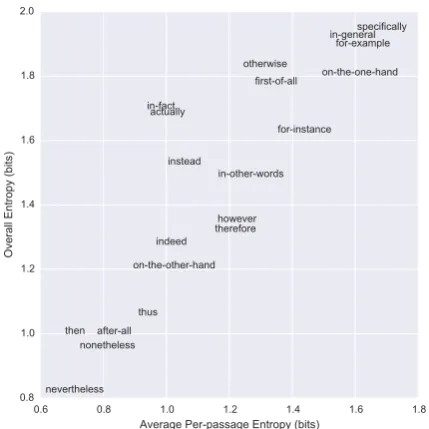
Figure 2:Each adverbial’s entropy of responses for implicit passages. The x-axis is mean per-passage entropy; the y-axis is entropy of the distribution aggregating all responses over all passages for the adverbial.
plicitotherwisepassages (§4.2).
Entropy. An important facet to understand in our data is the extent to which (in)consistency in
re-sponses comes fromadverbialsvs. individual
pas-sages. Qualitatively, we observe from figure 1
that adverbials like therefore have a “consistent
inconsistency”—i.e., most passages produce re-sponses split evenly between two conjunctions, so the overall response distribution looks a lot like the
individual passage distributions.3 In other cases,
like in fact, most passages have a dominant re-sponse, though that response differs across pas-sages.
The within-passage vs. overall (in)consistency
can be quantified byentropy. Each adverbial is
shown in Figure 2 with the x-axis indicating the mean entropy across of the response distribution for each passage, and the y-axis indicating the en-tropy of the aggregate distribution of responses across passages. The adverbials differ markedly
in entropy, with extremes beingneverthelessand
specifically. Most adverbials have overall entropy slightly greater than mean per-passage entropy, but a few stand out as having unusually high overall
3One might wonder if the split for an adverbial like there-forereflects a split between participants who uniformly fa-voredANDand those who uniformly favoredSO. However, this does not appear to be the case: No participant chose the same conjunction for allthereforepassages; likewise for
oth-erwise(which yielded a 3-way split). Both adverbials show a
entropy given their per-passage entropies: in fact
andactuallyare most extreme in this regard. These
are cases where individual passages aremore
con-sistent than the overall distribution would suggest.
Implications. Our analysis suggests that, if an an-notation effort wishes to fully capture the sense relations taken to hold in the presense of discourse adverbials, it should always use multiple annota-tors. However, if annotation resources are limited, adverbials in the lower left of figure 2 offer the most consistency, allowing one to get away with fewer annotators. Further, if an effort wants reasonable coverage of sense relations, it should assign more annotators to adverbials whose within-passage en-tropy accounts in our data for most of the overall entropy (i.e., those close to the diagonal).
5 Characterization of adverbials
The notion that conjunction+adverbial
combina-tions could occur has been introduced in prior
work (Webber, 2013; Jiang, 2013; Rohde et al., 2015), but the range observed in our dataset is un-precedented. What does this mean for annotation schemes of discourse relations? At the very least, an annotation scheme must include the possibility that, given an adverbial, another relation, signalled by a conjunction, can also be inferred.
Our data suggests how conjunctions and adver-bials combine. Although one might expect this to be limited, as §4 shows, the range of combinations
far exceeds any limits imposed byad hoc
defini-tions. One might expect that the combinations can be predicted based on the semantic class of the ad-verbial. However, when we group the adverbials by class, we see mixed results: on the one hand,
ad-verbials that convey exemplification (for example,
for instance) pattern similarly; on the other hand,
it is not the case that adverbials that convey result-ing states (thus,therefore) pattern uniformly
(par-ticipants endorse SOforthereforenearly 4 times
as often as forthus), and our examples of modal
stance adverbials (actually, in fact, indeed) show very different distributions.
Contrary to these hypotheses, it appears that the two parts of a conjunction+adverbial combination can contribute in different ways:
i. Same sense:The adverbial conveys the same lexical semantics as the conjunction (e.g.,
SOthus, in which both convey the sense that
the second argument is the result of the first)
ii. Separate sense: The adverbial conveys dis-tinct lexical semantics from the conjunction
(e.g., SOin other words, in which the result
sense conveyed bySOhas no overlap with the
restatement conveyed byin other words)
iii. Parasitic sense: The sense conveyed by the adverbial serves that conveyed by the
conjunc-tion (e.g.,SOfor example, whereSOconveys
a result, which is then evidenced by one or more examples)
The combinations we observe suggest that the adverbial contributes meaning, but context deter-mines what that meaning is contributed to. When both adverbial and inferred conjunction convey the same sense, it suffices to consider the discourse relation expressed by the adverbial; otherwise, the the meaning of each must both be considered.
Finally, we turn to annotator disagreement. We
definedivergent tokensas those for which at least
8 participants chose each of two conjunctions from
the setBECAUSE,BUT,ORorSO. SinceANDcan
sometimes be taken as underspecified and hence
compatible withSOandBUT, it is not included here
as a fully independent competitor.
Somedivergent tokensshow annotators connect-ing the post-gap text to different parts of the context through different conjunctions. In the explicit
pas-sage shown in (4), 13 participants choseBECAUSE
(the original author’s choice) and 11 chose BUT.
Closer examination reveals that different choices connect to different parts of the pre-gap context:
BECAUSE links “his right foot was shaking” to
the subordinate clause (“who caused everyone to
laugh”), whereas BUT, like the adverbialindeed,
links it to the statement “No, my leg’s not shak-ing”. In this case, the divergent participant choices demonstrate the disambiguating effect of the con-junction where multiple relations are possible. By removing the conjunction (which performed a dif-ferent role from the adverbial), relations between the two spans are rendered ambiguous.
Otherdivergent tokensshow annotators drawing
different interpretations between the same spans. For the passage shown in (7), 15 participants
se-lectedBECAUSE, and 11 choseBUT(the original
author’s choice).
(7) There was a testy moment driving over the George Washington Bridge when the toll-taker charged him $24 for his truck and trailer,
after all it was New York.
with respect to the expectation that bridge tolls are usually a small amount of money (not $24),
whereas BECAUSEexpresses the reason why the
reader should not be surprised why it’s so high.
6 Conclusion and future work
We set out to gather further evidence that a semantic relationship between a sentence and its context may
both be marked explicitly andinvolve inference.
The extensive data we gathered through crowd-sourcing judgments (20 adverbials, 50 different passages each, 28 different participants), replicate and extend earlier findings that discourse adver-bials do indeed license inferred conjunctions. The patterns we have observed show that selected con-junctions are neither uniform across all 20 adver-bials nor uniform within passages for a particular adverbial, but that both types of variability can be used to characterize the adverbials. In some cases, the adverbial and conjunction selected by partici-pants share the same sense; in other cases, they are distinct (or sometimes even parasitic on the other).
Further, the diverse patterns observed for the ad-verbials include cases in which more than one valid connection can be inferred, each endorsed by a sub-stantial number of participants. This resembles the
true ambiguityof coreferential pronouns observed earlier by Poesio and Artstein (2005). Without gathering judgments from a substantial number of participants, such differences in annotation might otherwise be written off as annotator error or bias, or just a low level of inter-annotator agreement. Here, they reveal real differences in how people take a piece of text to relate to its context.
A reviewer asks if participant behavior changes over time. Because we ensured that the passages for a given adverbial appeared in a different pseudo-random order for each participant, any performance differences early or late in the token set could yield noise but not overall bias per adverbial. Token order was recorded, so future analysis is possible to test for changes in the overall rate of certain responses over time or the interactions over time between different adverbials, different participants, different conjunction-presentation orders, etc.
To extend our set of analyzed adverbials and to understand the mutual informativity between ad-verbials and conjunctions, another crowdsourced study with 35 new adverbials is underway, with a complementary study planned that asks partici-pants to fill in an adverbial following a conjunction
(i.e., given a conjunction, is an adverbial recover-able?). In addition, we are piloting a new response interface in which participants can select multi-ple conjunctions, as a means of testing whether individual participants endorse the alternative and sometimes divergent conjunctions observed across participants for a given passage.
Acknowledgments
This work has been supported in part by a grant from the Nuance Foundation. We thank Yangfeng Ji for a helpful suggestion of related work, and anonymous reviewers for their feedback.
References
Karin Aijmer and Anne-Marie Simon-Vandenbergen. 2007.
The Semantic Field of Modal Certainty: A Corpus-Based Study of English Adverbs. Mouton de Gruyter.
Ron Artstein and Massimo Poesio. 2005. Bias decreases in proportion to the number of annotators. In James Rogers, editor,Proceedings, 10th Conference on Formal Grammar and 9th Meeting on Mathematics of Language, pages 139– 148. CSLI Publications, Edinburgh, Scotland, UK. Ron Artstein and Massimo Poesio. 2008. Survey article:
Inter-coder agreement for computational linguistics. Computa-tional Linguistics, 34:555–596.
Maria-Josep Cuenca and Maria-Josep Marín. 2009. Co-occurrence of discourse markers in Catalan and Spanish oral narrative.Journal of Pragmatics, 41(5):899–914. Bruce Fraser. 2013. Combinations of contrastive discourse
markers in English. International Review of Pragmatics, 5:318–340.
Julia Hirschberg and Diane Litman. 1987. Now let’s talk about
now: identifying cue phrases intonationally. In Proceed-ings, 25th Annual Meeting of the Association for Compu-tational Linguistics, pages 163–171. Stanford, California, USA.
Dirk Hovy, Taylor Berg-Kirkpatrick, Ashish Vaswani, and Eduard Hovy. 2013. Learning whom to trust with MACE. InProceedings, 2013 Conference of the North American Chapter of the Association for Computational Linguistics: Human Language Technologies, pages 1120–1130. Atlanta, Georgia, USA.
Xi Jiang. 2013. Predicting the use and interpretation of im-plicit and exim-plicit discourse connectives. Ph.D. thesis, Linguistics and English Language (LEL), University of Edinburgh. MSc in English Language.
Andrew Kehler. 2002.Coherence, Reference and the Theory of Grammar. CSLI Publications.
Andrew Kehler and Hannah Rohde. 2013. A probabilistic reconciliation of coherence-driven and centering-driven theories of pronoun interpretation.Theoretical Linguistics, 39(1–2):1–37.
Alistair Knott. 1996.A Data-driven Methodology for Motivat-ing a Set of Coherence Relations. Ph.D. thesis, Department of Artificial Intelligence, University of Edinburgh. Yuri Lin, Jean-Baptiste Michel, Erez Aiden Lieberman, Jon
Orwant, Will Brockman, and Slav Petrov. 2012. Syntac-tic annotations for the Google Books Ngram Corpus. In
Proceedings, ACL 2012 System Demonstrations, pages 169–174. Jeju Island, Korea.
Norvig, Jon Orwant, Steven Pinker, Martin A. Nowak, and Erez Lieberman Aiden. 2011. Quantitative analy-sis of culture using millions of digitized books. Science, 331(6014):176–182. PMID: 21163965.
Sarah Oates. 2000. Multiple discourse marker occurrence: Creating hierarchies for natural language generation. In
Proceedings, ANLP-NAACL 2000 Student Research Work-shop, pages 41–45. Seattle, Washington, USA.
Rebecca Passonneau and Bob Carpenter. 2014. The benefits of a model of annotation. Transactions of the Association of Computational Linguistics, 2(1):311–326.
Massimo Poesio and Ron Artstein. 2005. The reliability of anaphoric annotation, reconsidered: Taking ambiguity into account. InProceedings, Workshop on Frontiers in Corpus Annotations II, pages 76–83. Ann Arbor, Michigan. Rashmi Prasad, Nikhil Dinesh, Alan Lee, Eleni Miltsakaki,
Livio Robaldo, Aravind Joshi, and Bonnie Webber. 2008. The Penn Discourse TreeBank 2.0. InProceedings, 6th International Conference on Language Resources and Eval-uation, pages 2961–2968. Marrakech, Morocco.
Hannah Rohde, Anna Dickinson, Chris Clark, Annie Louis, and Bonnie Webber. 2015. Recovering discourse relations: Varying influence of discourse adverbials. In Proceed-ings, First Workshop on Linking Computational Models of Lexical, Sentential and Discourse-level Semantics, pages 22–31. Lisbon, Portugal.
Evan Sandhaus. 2008. New York Times corpus: Corpus overview. LDC catalogue entry LDC2008T19.
Merel C.J. Scholman, Jacqueline Evers-Vermeul, and Ted J.M. Sanders. 2016. A step-wise approach to discourse an-notation: Towards a reliable categorization of coherence relations.Dialogue & Discourse, 7(2):1–28.
Bonnie Webber. 2013. What excludes an alternative in co-herence relations? In Proceedings, 10th International Conference on Computational Semantics, pages 276–287. Potsdam, Germany.
Bonnie Webber, Alistair Knott, and Aravind Joshi. 1999. Mul-tiple discourse connectives in a lexicalized grammar for dis-course. InThird International Workshop on Computational Semantics, pages 309–325. Tilburg, The Netherlands. Deniz Zeyrek. 2014. On the distribution of
contrastive-concessive discourse connectivesama(‘but/yet’) andfakat