Proceedings of the Fourth Joint Conference on Lexical and Computational Semantics (*SEM 2015), pages 279–288,
Dependency-Based Semantic Role Labeling using
Convolutional Neural Networks
William R. Foland Jr.
OKRobotGo, Ltd. 5345 Dunraven Circle Golden, Co, 80403, USA
James H. Martin
Department of Computer Science and Institute of Cognitive Science
University of Colorado Boulder, CO 80309
Abstract
We describe a semantic role labeler with state-of-the-art performance and low computational requirements, which uses convolutional and time-domain neural networks. The system is designed to work with features derived from a dependency parser output. Various system options and architectural details are discussed. Incremental experiments were run to explore the benefits of adding increasingly more com-plex dependency-based features to the system; results are presented for both in-domain and out-of-domain datasets.
1 Introduction
Semantic role labeling (Gildea and Jurafsky [2002]), the task of identifying and classifying the semantic arguments of verbal and nominal predicates in text, represents one of the most complex NLP tasks to be addressed by supervised machine learning tech-niques. In the standard supervised approach to building SRL systems, collections of multiway clas-sifiers are trained using annotated corpora such as PropBank (Palmer et al. [2005]). In this approach, classifiers are trained using features derived directly from the original source text, as well as from subse-quent syntactic and semantic processing.
As reported in several shared tasks (Carreras and M`arquez [2004],Carreras and M`arquez [2005],Hajiˇc et al. [2009]), SRL systems trained in this manner can achieve high performance. State-of-the-art sys-tems employ classifiers such as support vector ma-chines trained with large numbers of relatively com-plex combinations of features, often combined with
re-ranking based on multiple syntactic analyses. Un-fortunately, these approaches have a number of non-trivial limitations including the computational cost of the syntactic parsing and the sparse nature of the complex features on which they rely. This latter lim-itation is particularly critical since it leads to signif-icant degradation in performance when the trained system is applied to texts from new domains.
However, recent results using multilayer neu-ral networks and pre-trained word embeddings have demonstrated high performance using a much smaller number of minimalist features. The archi-tecture described by Collobert et al. [2011] com-bines time delay convolutional neural networks (Waibel et al. [1989]) and pre-trained word embed-dings for a number of NLP tasks. They develop four components and compare their performance to pre-vious benchmarks, one of which is an SRL system which uses features derived from a phrase-structure parse as input, based on the CoNLL 2005 shared task (Carreras and M`arquez [2005]).
The work described here adopts the basic archi-tecture from Collobert et al. [2011] and explores issues related to the use of this architecture in the context of the CoNLL 2009 shared task. In partic-ular, we present Daisy, a system that (1) employs features derived from dependency parse as input, (2) assigns semantic roles to both verbal and nom-inal predicates, and (3) automatically assigns word senses to the predicates as described in the CoNLL 2009 shared task (Hajiˇc et al. [2009]).
plore the utility of features derived from dependency parses, including a version of the traditional SRL syntactic path feature.
2 Experimental Setup
The CoNLL 2009 shared task consists of identify-ing the sense and semantic arguments for each given argument-bearing token (predicate). In addition to the words themselves, the training data provides the part of speech, syntactic head, and syntactic depen-dency relation to the head for each word in the sen-tence. Table 1 shows an example sentence and its representation in the dataset. The PDEPREL and PHEAD features are the head word and dependency relation predicted automatically by a dependency parser. In the example sentence, there are two pred-icates identified for labeling: announce, andclose.
The system should output two arguments for
an-nounce: results:A1 (Object), and after:AM-TEMP
(Temporal Marker). Similarly,market:A1 should be
output for the predicate close. In addition to role
identification, the word sense for each predicate is
output, in the example, the expected sense for
an-nounceis 01, and forcloseis 02.
The training, validation, and evaluation datasets are annotated sentences from the Wall Street Jour-nal. An additional out of domain dataset mostly from the Brown corpus was also supplied. A com-prehensive F1 score was generated for both role labels and sense predictions using the provided eval09.pl perl script.
3 Semantic Role Labeling System
The general block diagrams for the Daisy SRL sys-tem are shown in Figure 1. The input to the syssys-tem is a list of wordswi fromw1 town, a list of pred-icate positions, and dependency parse tree informa-tion for the sentence. We treat role labeling and the sense identification as two separate tasks. For each predicate in a given sentence, the Role Subsystem outputs the list of predicted role tags for all words
(SRLi), and the Sense Subsystem outputs the sense
tag of the predicate. The system is composed of five major components:
• Word Preprocessing and Word Derived Feature
Convolution (Figure 2).
• Predicate Position Feature Convolution.
Feature Vector Convolution
Word Derived
Role Neural Network and Viterbi Decoder Predicate Position
and Path
Word Position
⌃ Sentence Words
wi
Dependency Tree
Word POS
Sentence SRL Tags
SRLi
A B C
D
(a) Role Subsystem
Feature Vector Convolution
Word Derived
Sense Neural Network Predicate Position
and Path
⌃
Sentence Words wi
Dependency Tree
Word POS
Predicate Senses
B A
E
Predicate Lemma
[image:2.612.334.515.77.301.2](b) Sense Subsystem
Figure 1: SRL Role and Sense Block Diagrams
• Word Position Feature Convolution.
• Neural Network and Viterbi (Figure 4).
• Predicate Sense Neural Network (Figure 5).
3.1 Word Derived Feature Convolution Section
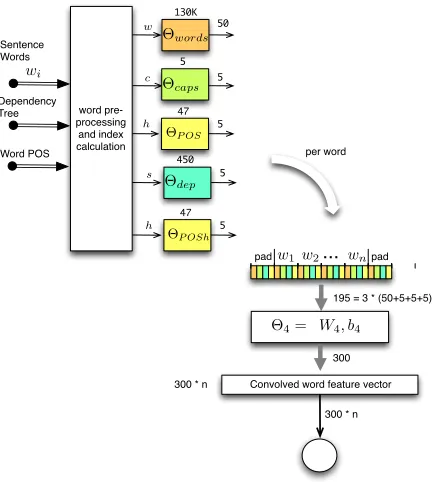
The Word Derived Features and Convolution sec-tion, shown in Figure 2, is sourced by five features which are derived on a word by word basis.
The upper portion of Figure 2 depicts the process of looking up features from the words and parse tree information. The numeric information from the fea-tures for each word is concatenated together to form one long feature vector, shown in the diagram as a multi-shaded set of rectangles. Three words of fea-ture information (the word and its two neighbors) from the Word Derived Feature Vector are
multi-plied by the the weights and bias ofΘ4 and stored
in the Convolved Word Derived Feature Vector, for each word in the sentence. For the default convo-lution width of 300, this results in a long vector of
300·n, wherenis the number of words in the
sen-tence.
Each feature lookup table contains an entry for
PADDING. In order to allow the window to extend beyond boundaries of the sentence for early and late words the Feature Vector is padded with the
fea-ID FORM LEMMA PLEMMA POS PPOS FEAT PFEAT HEAD PHEAD DEPREL PDEPREL FILLPRED PRED A[announce] A[close]
1 The the the DT DT 2 2 NMOD NMOD
2 results result result NNS NNS 3 3 SBJ SBJ A1
3 were be be VBD VBD 0 0 ROOT ROOT
4 announced announce announce VBN VBN 3 3 VC VC Y announce.01
5 after after after IN IN 4 4 TMP TMP AM-TMP
6 the the the DT DT 8 8 NMOD NMOD
7 stock stock stock NN NN 8 8 NMOD NMOD
8 market market market NN NN 9 9 SBJ SBJ A1
9 closed close close VBD VBD 5 5 SUB SUB Y close.02
[image:3.612.77.295.212.453.2]10 . . . 3 3 P P
Table 1: CoNLL format SRL Dependency Parse Input Test Sentence Example
300 300 * n Convolved word feature vector
⇥4={W4, b4} 130K
5
450
Sentence Words
⇥words
⇥caps
⇥dep
wi
...
w1w2 wn
pad pad
5 5 50
ic
is
}
per word
iw
5 47 ih Dependency
Tree
Word POS
195 = 3 * (50+5+5+5)
⌃
300 * n
5 47 ih
⇥P OS
⇥P OSh
word pre-processing and index calculation
Figure 2: Word Preprocessing, Word Derived Features, and Word Derived Feature Convolution. A in figures 1(a) and 1(b).
ture is in the table, the associated vector is output, otherwise the vector corresponding to the special to-kenUNKNOWNis output. ThePADDINGand UN-KNOWNvectors are trained during supervised train-ing.
To train the word representations from scratch, all except the 0.63% least common unique words from the training set are added to the lookup table. The remaining words are therefore trained as the UN-KNOWN word, which can then be used to represent any word encountered outside the trained word list. For other features, the representation for the most probable token is used as the UNKNOWN
represen-tation.
The five types of word-derived features tested for the SRL Dependency Parse tagger are:
• Word Embeddings
• Capitalization
• POS tag of word
• Dependency Relation
• POS tag of head
3.1.1 Word Pre-processing
The input data provided for the CoNLL 2009 task has already gone through some initial tokeniz-ing. This prevents tokenization differences of differ-ent systems from influencing the results, which are meant to allow comparison of the SRL tagging ar-chitecture itself. The Daisy pre-processor does not split hyphenated input words, so each input word will result in a single pre-processed word. Numeric
values are collapsed to the single common0token,
and words are lower-cased to create a word repre-sentation lookup word.
3.1.2 Word Embeddings
Words are transformed to numeric representations using a lookup table. Like all other feature lookup tables in the system, the word representation vec-tors can be initialized to small random values to start with, and then trained using the supervised training algorithm.
specific application learning, see for example Hin-ton et al. [2006], Bengio et al. [2007] and WesHin-ton et al. [2012].
The word representations, or embeddings, used as input to the Daisy SRL System for the experiments described here were generated by Collobert et al. [2011] and were created using a pairwise ranking approach (Schapire and Singer [1998]).
3.1.3 Capitalization
Prior to lower casing, each word is checked for all capitals, initial capital, any capital, or no capitals, and this criteria is used to lookup a vector (default length 5) from the caps table.
3.1.4 Predicted Dependency Relation
The PDEPREL column from the training data, shown in table 1.
3.1.5 Predicted POS tag of word and of head
The Predicted Part-of-speech tag is provided in PPOS column of the training data. The head part of speech tag is found by following the PHEAD col-umn and extracting the PPOS colcol-umn. (see Table 1).
3.2 Predicate Position and Path Feature Convolution Section
Predicate Position and optional Path features are ex-tracted on a per word basis and convolved, once per predicate (the outer loop of two).
3.2.1 Predicate Position Feature
The position of each word relative to the predicate being evaluated is represented by 25 vectors, based on distances of -12 to +12, and distances outside this range are saturated.
3.2.2 Dependency Path Feature
Information about the path from each word to a given predicate is maintained in a lookup table and is provided in the Predicate Position Convolution sec-tion as a per word feature.
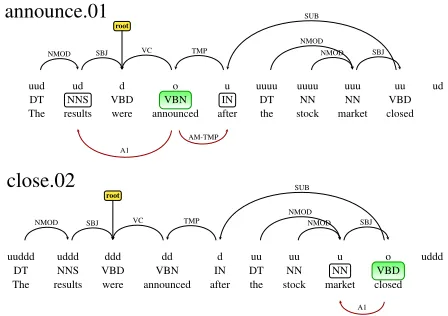
Generic Path: The sequence of up and down transitions to traverse the tree from a word to a given predicate is referred to here as theGeneric Path. The dependency parse trees for each of the two predi-cates from the example training sentence shown in Table 1 are diagrammed in Figure 3. The Generic
uud ud d o u uuuu uuuu uuu uu ud
DT NNS VBD VBN IN DT NN NN VBD
The results were announced after the stock market closed
NMOD SBJ
root
VC TMP
NMOD
NMOD SBJ
SUB
A1
AM-TMP
announce.01
uuddd uddd ddd dd d uu uu u o uddd
DT NNS VBD VBN IN DT NN NN VBD
The results were announced after the stock market closed
NMOD SBJ
root
VC TMP NMODNMOD SBJ
SUB
A1
[image:4.612.314.538.72.230.2]close.02
Figure 3: Dependency Parse and Generic Paths
Path for each word is shown in the diagram, above the part of speech tag for the word.
Labeled Path: These are path descriptions which include both the arc direction (Generic Path) and the dependency relation of the arc within the depen-dency tree. After several rounds of experimentation, we chose to include paths which occur at least five times in the training data, which resulted in about 77K unique path types.
3.3 Word Position Feature Convolution Section
The position of every word with respect to the spe-cific word being evaluated is extracted once per word, per predicate (the inner loop of two). In a sim-ilar fashion to the predicate position feature, the po-sition of each word relative to the word being evalu-ated is represented by 25 vectors, based on distances of -12 to +12, and distances outside this range are saturated.
3.4 Role Neural Network and Viterbi
fl
Θ=Wl−1fΘl−1+bl−1 (1)
The tanh function is used as the nonlinear activa-tion funcactiva-tion.
SRL Tag Scores
n (number of words) Sentence SRL Tags
SRLi
Sequence Detector (Viterbi)
⇥initial
⇥transition
500
186 SRL Tag Scores
tanh
⇥out
(and output)
300 Max
300 * n
per word, per verb
⌃
⇥1={W1, b1} Sum of Convolved Features For:
•Word Derived
•Predicate Position
[image:5.612.89.275.145.322.2]•Word Position
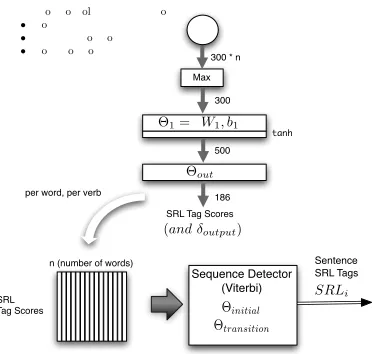
Figure 4: SRL Neural Network and Viterbi. D in figure 1(a).
The three Convolved Feature Vectors (dia-grammed separately) are summed, then the maxi-mum for each index within each group of 300 is determined. This results in a 300 element vector which will be the input to the Neural Network. A single layer neural network followed by a single out-put layer is used to create a ”score” for each possi-ble role ”tag”, for the word and predicate being an-alyzed. After running all words through the system for a single predicate, a matrix of SRL roles scores
of sizetags×wordsis created, which will be used
as the input to the Viterbi sequence decoder.
3.5 Sequence Decoder (Viterbi)
The Viterbi decoding algorithm input is a matrix which consists of a vector of SRL role scores for each word. The algorithm is initialized with a learned set of weights per tag, and computes the log-likelihood of transitioning from each state to the next by applying a learned set of weights from the transi-tion matrix.
3.6 Predicate Sense Neural Network
Figure 5 shows the process of combining the Con-volved Feature Vectors, processing with a neural
network, and finding the most likely sense for a given predicate. The neural network parameters for the sense subsystem are managed with a lookup ta-ble holding parameters for each lemma in the train-ing set that is mapped to multiple senses.
300
20
Predicate Sense
tanh
300 Max
300 * n
⌃
⇥sns={Wsns, bsns}
⇥sns out
Sum of Convolved Features For: •Word Derived
•Predicate Position
[image:5.612.325.526.153.329.2](one set per Lemma)
Figure 5: SRL Neural Network for Predicate Sense. E in figure1(b).
4 Sense Labeler Training and Forward Model Creation
Both the Role and Sense subsystems are trained us-ing stochastic gradient descent. A forward pass is first run on the system, during which the indices of the maximum values of the sum of the convolutions layers (word-derived and predicate) are saved.
Back-propagation of the Sense Neural Network is based on minimizing a log-likelihood objective:
logp(y|x,Θ) =f[x,Θ]y−log(
X
j
e(f[x,Θ]j)) (2)
The two Sense and Role subsystems have the same convolution structures (See figures 1(a) and 1(b)). Experiments run using a common structure for both tasks resulted in about 0.5% worse perfor-mance, so the the systems were kept independent.
[2011] was used to decrease training time. To min-imize memory requirements and training time, the sense for lemmas which always train to the same sense in the training data are stored in a dictionary. During forward processing, when a lemma is en-countered that was not trained (and therefore is not in the parameter lookup table), the sense from the dictionary is output. If the lemma never occurred during training, it won’t be in the dictionary, and the most commonly occurring sense of ”01” is output by default.
5 Role Labeler Training and Forward Model Creation
During a forward pass, the activation layers and maxIndices are saved and reused during training.
5.1 Cost Calculation
The Viterbi parameters for initial score and tran-sition probabilities are trained using the Sentence Level Log-Likelihood (SLL) cost function.
This cost function is based on Sentence Level Likelihood and is similar to equation 2, except the reference path score must be normalized by using the sum of the exponential of all path scores (the
sum of unnormalized probabilities for all possible
paths, instead of for all possible tags). A recursive method, developed in Rabiner [1989] and specified in Collobert et al. [2011], provides an important and efficient means of computing the sum of the expo-nential of all path scores. An intermediate vector,δ, is calculated, which will contain the unnormalized log probability that any path through the trellis will pass through a particular state k for the particular
word t. Theδ vectors have a dimension of N, the
number of tags, and they are re-used for the gradient calculation during back-propagation.
5.2 Back-propagation
The recursion described in Collobert et al. [2011] is used to calculate Viterbi delta terms and gradients. The error is then back-propagated through the sys-tem in reverse, ending with the feature lookup ta-bles. This is done for each word, for each predi-cate, requiring two nested loops for training a full sentence. The loop structure makes for long train-ing times, roughly three days on a 2015 compute-optimized AWS core.
6 Results 6.1 Benchmark
The best ConLL 2009, English, SRL F1 score, is labeled Nugues, and the system is described in Bj¨orkelund et al. [2009]. To the best of our knowl-edge, the current state of the art for this dataset is represented by these results, and we therefore use them as a benchmark (See section 7). To generate these benchmark results, 20 features were used for argument identification, including the Dependency Relation Path, and Part of Speech of Dependency Relation Path. A reranker was then run on the out-put of multiple system outout-puts.
Table 2 compares the benchmark with a complete Daisy system using a labeled path, with a cutoff of 5, and two separate systems for sense and role la-bels. F1 scores are 0.41% higher for the WSJ Eval dataset, and 2.59% higher for the out of domain (OOD) Brown dataset.
System Description WSJ F1 Brown F1 Benchmark
(CoNLL2009) 85.63% 73.31%
Daisy 86.04% 75.90%
Table 2: SRL Dependency Parse Test F1
6.2 Metrics
6.3 Incremental Experiments and Results
Feature abbreviations used in the descriptions are shown in Table 3.
Abbrev. Feature Description
W words, initialized randomly prior to
training
C capitalization
P Part of Speech
HP Part of Speech of head word
DR Dependency Relation
GP Generic path
TW words, initialized with pre-trained
word embeddings prior to training
LP5 Labeled paths that occur at least five
[image:7.612.316.562.71.220.2]times in the training data.
Table 3: Feature Abbreviations
81.0% 82.0% 83.0% 84.0% 85.0% 86.0%
Development systemF1
81.0% 82.0% 83.0% 84.0% 85.0% 86.0% 87.0%
WSJ Eval systemF1
(85.63%)
WSJ (Eval) Incremental Feature Progression
[image:7.612.70.301.125.302.2]Daisy(W,C) Daisy(W,C,P) Daisy(W,C,P,HP,DR) Daisy(W,C,P,HP,DR,GP) Daisy(TW,C,P,HP,DR,GP) Daisy(TW,C,P,HP,DR,LP5)
Figure 6: Scatter Plot of Dev F1 vs. Eval F1 for Various Feature Configurations (See also Table 4)
Incremental experiments were run to explore the benefits of adding increasingly more complex dependency-based features to the system.
We began with a basic configuration of only words (randomly initialized) and capitalization (W,C), Following this, a simple per-token part of speech was added (W,C,P). Information from the dependency parser is then added in two steps, first the head word part of speech and dependency re-lation (W,C,P,HP,DR), and next the generic path (W,C,P,HP,DR,GP). The word representations were then seeded with the pre-trained embeddings
de-81.0% 82.0% 83.0% 84.0% 85.0% 86.0%
Development systemF1
69.0% 70.0% 71.0% 72.0% 73.0% 74.0% 75.0% 76.0% 77.0% 78.0%
Out of Domain systemF1
(73.31%)
OOD (Brown) Incremental Feature Progression
Daisy(W,C) Daisy(W,C,P) Daisy(W,C,P,HP,DR) Daisy(W,C,P,HP,DR,GP) Daisy(TW,C,P,HP,DR,GP) Daisy(TW,C,P,HP,DR,LP5)
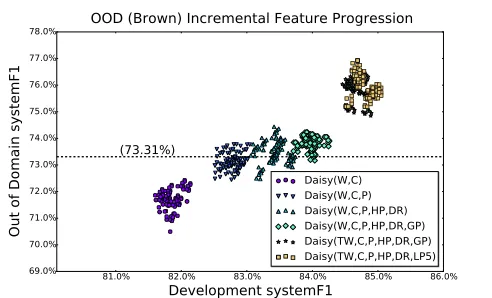
Figure 7: Dev F1 vs. Brown (OOD) F1 for Various Fea-ture Configurations (See also Table 5)
scribed in section 3.1.2 (TW,C,P,HP,DR,GP). Fi-nally, the labeled path was used instead of the generic path, still seeding the words with pre-trained embeddings (TW,C,P,HP,DR,LP5).
For each system configuration, 12 role subsys-tems and 8 sense subsyssubsys-tems were trained and tested, using the WSJ development F1 score dur-ing traindur-ing to determine the best model parameter state. After model generation, the WSJ development scores for different systems don’t correlate well with the WSJ eval or Brown scores. For example, mod-els with high development scores don’t necessarily correspond to best scoring models for the WSJ or Brown data tests.
[image:7.612.73.303.149.490.2]The CoNLL2009 results used as benchmarks were given as single data points so statistics are not available.
Figure 7 shows the relationship between the de-velopment and Evaluation F1 scores, as well as the general performance improvement as features were added.
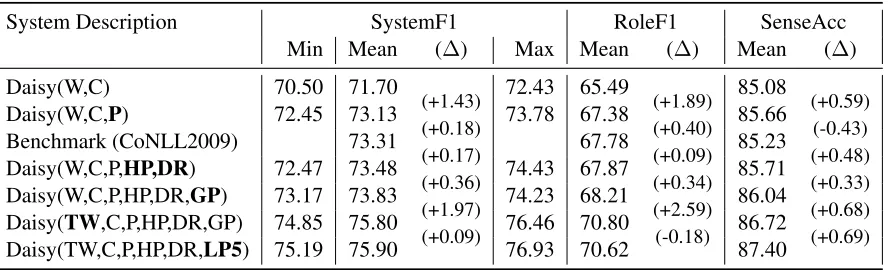
Tables 4 and 5 show the statistical performance of the system with WSJ and Brown test data.
[image:7.612.78.302.357.498.2]System Description SystemF1 RoleF1 SenseAcc
Min Mean (∆) Max Mean (∆) Mean (∆)
Daisy(W,C) 82.86 83.03 83.24 77.47 94.92
Daisy(W,C,P) 83.83 84.12 (+1.09) 84.43 79.00 (+1.52) 95.15 (+0.23)
Daisy(W,C,P,HP,DR) 84.46 84.79 (+0.67) 85.10 79.92 (+0.92) 95.29 (+0.13)
Daisy(W,C,P,HP,DR,GP) 85.05 85.38 (+0.58) 85.78 80.69 (+0.76) 95.46 (+0.17)
Benchmark (CoNLL2009) 85.63 (+0.25) 81.00 (+0.31) 95.59 (+0.13)
Daisy(TW,C,P,HP,DR,GP) 85.64 85.92 (+0.29) 86.17 81.40 (+0.40) 95.66 (+0.07)
[image:8.612.85.530.72.205.2]Daisy(TW,C,P,HP,DR,LP5) 85.77 86.04 (+0.13) 86.31 81.53 (+0.13) 95.77 (+0.11)
Table 4: Performance on WSJ Eval Dataset for Various System Configurations
System Description SystemF1 RoleF1 SenseAcc
Min Mean (∆) Max Mean (∆) Mean (∆)
Daisy(W,C) 70.50 71.70 72.43 65.49 85.08
Daisy(W,C,P) 72.45 73.13 (+1.43) 73.78 67.38 (+1.89) 85.66 (+0.59)
Benchmark (CoNLL2009) 73.31 (+0.18) 67.78 (+0.40) 85.23 (-0.43)
Daisy(W,C,P,HP,DR) 72.47 73.48 (+0.17) 74.43 67.87 (+0.09) 85.71 (+0.48)
Daisy(W,C,P,HP,DR,GP) 73.17 73.83 (+0.36) 74.23 68.21 (+0.34) 86.04 (+0.33)
Daisy(TW,C,P,HP,DR,GP) 74.85 75.80 (+1.97) 76.46 70.80 (+2.59) 86.72 (+0.68)
Daisy(TW,C,P,HP,DR,LP5) 75.19 75.90 (+0.09) 76.93 70.62 (-0.18) 87.40 (+0.69)
Table 5: Performance on Brown Dataset (OOD) for Various System Configurations
For the Brown (OOD) dataset, the role subsys-tem F1 improves significantly with POS and depen-dency parse information (+2.72%) while the sense subsystem benefits less (0.96%). The role subsys-tem dramatically improves when pre-trained words are added (2.59%), due in large part to a better abil-ity to handle unseen words. The mean System F1 scores are higher than the benchmark as soon as de-pendency parser information is supplied, and the F1 is significantly better for the fully populated system (+2.59%).
7 Related Work
The same Semantic Role Labeling system used to generate the results used as our benchmark was later tested using improved dependency parsing in Bj¨orkelund et al. [2010]. Woodsend and Lapata [2014] explore text rewriting and compare results with the benchmark, which they accept as the cur-rent state-of-the-art.
Kanerva and Ginter [2014] use the CoNLL 2009 data as a benchmark for investigating the use of
Fin-ish and EnglFin-ish word vector relationships, and the relationships of word vectors as they relate to se-mantic roles.
In Socher et al. [2013], the authors present a Re-cursive Neural Tensor Network (RNTN) which uses word vectors as a primary input and which is used to recursively generate a phrase tree structure for each sentence. The resulting structures are then further used to generate fine-grained sentiment analysis es-timates.
Convolutional neural networks which include character level structures have been effectively used for sentiment analysis by dos Santos and Gatti [2014]. The characters are not pre-trained, and syn-tactic trees are not used as input to the network.
In Luong et al. [2013], words are broken down into morphemes as the input to a recursive neural network to capture morphological compositionality with the goal of improving the vector representa-tions of scarce words.
[image:8.612.87.531.239.374.2]in-vestigated by Mikolov et al. [2013] and Chen et al. [2013].
8 Conclusion and Future Work
We have presented a dependency-based semantic role labeler using neural networks, inspired by Col-lobert et al. [2011] and others to reduce the use of hand-crafted features and make use of unsuper-vised techniques. Experimental evaluations show that our architecture improves the state of the art performance for this task significantly, for both in domain and out of domain test data. A key element of the system’s performance is based on the use of features derived from syntactic dependency parses. The use of a dependency-based path feature, in par-ticular, provides a significant boost in performance over simpler feature sets.
Promising future directions suggested by these re-sults include whether proxies for the dependency-based features can be derived from a similar archi-tecture without the direct need for a full dependency analysis, thus eliminating the pre-processing parser cost. Another future direction involves the pred-icate disambiguation system. Although this sense disambiguation task is part of the CoNLL 2009 SRL evaluation, it is more properly a word sense disam-biguation problem. A more thorough investigation of sense disambiguation in the context of an SRL system is warranted.
References
Yoshua Bengio, Pascal Lamblin, Dan Popovici, and Hugo Larochelle. Greedy layer-wise training of
deep networks. Advances in neural information
processing systems, 19:153, 2007.
Anders Bj¨orkelund, Love Hafdell, and Pierre Nugues. Multilingual semantic role labeling. In Proceedings of the Thirteenth Conference on Computational Natural Language Learning: Shared Task, pages 43–48. Association for Com-putational Linguistics, 2009.
Anders Bj¨orkelund, Bernd Bohnet, Love Hafdell, and Pierre Nugues. A high-performance syntactic
and semantic dependency parser. InProceedings
of the 23rd International Conference on Compu-tational Linguistics: Demonstrations, pages 33–
36. Association for Computational Linguistics, 2010.
Xavier Carreras and Llu´ıs M`arquez. Introduction to the conll-2004 shared task: Semantic role
la-beling. In Proceedings of the Eighth
Confer-ence on Computational Natural Language Learn-ing, CoNLL 2004, Held in cooperation with HLT-NAACL 2004, Boston, Massachusetts, USA, May 6-7, 2004, pages 89–97, 2004.
Xavier Carreras and Llu´ıs M`arquez. Introduction to the conll-2005 shared task: Semantic role
la-beling. In Proceedings of the Ninth Conference
on Computational Natural Language Learning, pages 152–164. Association for Computational Linguistics, 2005.
Yanqing Chen, Bryan Perozzi, Rami Al-Rfou, and Steven Skiena. The expressive power of word
em-beddings. arXiv preprint arXiv:1301.3226, 2013.
Ronan Collobert, Jason Weston, L´eon Bottou, Michael Karlen, Koray Kavukcuoglu, and Pavel Kuksa. Natural language processing (almost)
from scratch. The Journal of Machine Learning
Research, 12:2493–2537, 2011.
Cıcero Nogueira dos Santos and Maıra Gatti. Deep convolutional neural networks for sentiment
anal-ysis of short texts. In Proceedings of the 25th
International Conference on Computational Lin-guistics (COLING), Dublin, Ireland, 2014. John Duchi, Elad Hazan, and Yoram Singer.
Adap-tive subgradient methods for online learning and
stochastic optimization. The Journal of Machine
Learning Research, 12:2121–2159, 2011.
Daniel Gildea and Daniel Jurafsky. Automatic
label-ing of semantic roles. Computational Linguistics,
28(3):245–288, 2002.
Jan Hajiˇc, Massimiliano Ciaramita, Richard Johans-son, Daisuke Kawahara, Maria Ant`onia Mart´ı, Llu´ıs M`arquez, Adam Meyers, Joakim Nivre, Se-bastian Pad´o, Jan ˇStˇep´anek, et al. The conll-2009 shared task: Syntactic and semantic
dependen-cies in multiple languages. InProceedings of the
Teh. A fast learning algorithm for deep
be-lief nets. Neural computation, 18(7):1527–1554,
2006.
Jenna Kanerva and Filip Ginter. Post-hoc manip-ulations of vector space models with application
to semantic role labeling. InProceedings of the
2nd Workshop on Continuous Vector Space Mod-els and their Compositionality (CVSC)@ EACL, pages 1–10, 2014.
Minh-Thang Luong, Richard Socher, and Christo-pher D Manning. Better word representations with recursive neural networks for morphology.
CoNLL-2013, 104, 2013.
Tomas Mikolov, Wen-tau Yih, and Geoffrey Zweig. Linguistic regularities in continuous space word
representations. InProceedings of NAACL-HLT,
pages 746–751, 2013.
Martha Palmer, Paul Kingsbury, and Daniel Gildea. The proposition bank: An annotated corpus of
se-mantic roles. Computational Linguistics, 31(1):
71–106, 2005.
Lawrence Rabiner. A tutorial on hidden markov models and selected applications in speech
recog-nition. Proceedings of the IEEE, 77(2):257–286,
1989.
William W Cohen Robert E Schapire and Yoram
Singer. Learning to order things. In Advances
in Neural Information Processing Systems 10: Proceedings of the 1997 Conference, volume 10, page 451. MIT Press, 1998.
Richard Socher, Alex Perelygin, Jean Y Wu, Jason Chuang, Christopher D Manning, Andrew Y Ng, and Christopher Potts. Recursive deep models for semantic compositionality over a sentiment
treebank. In Proceedings of the conference on
empirical methods in natural language process-ing (EMNLP), volume 1631, page 1642. Citeseer, 2013.
Alex Waibel, Toshiyuki Hanazawa, Geoffrey Hin-ton, Kiyohiro Shikano, and Kevin J Lang. Phoneme recognition using time-delay neural
net-works. Acoustics, Speech and Signal Processing,
IEEE Transactions on, 37(3):328–339, 1989. Jason Weston, Fr´ed´eric Ratle, Hossein Mobahi,
and Ronan Collobert. Deep learning via
semi-supervised embedding. In Neural Networks:
Tricks of the Trade, pages 639–655. Springer, 2012.
Kristian Woodsend and Mirella Lapata. Text
rewrit-ing improves semantic role labelrewrit-ing. Journal of