A Comparison of Pivot Methods for Phrase-based Statistical Machine
Translation
Masao Utiyama and Hitoshi Isahara
National Institute of Information and Communications Technology 3-5 Hikari-dai, Soraku-gun, Kyoto 619-0289 Japan
{mutiyama,isahara}@nict.go.jp
Abstract
We compare two pivot strategies for phrase-based statistical machine transla-tion (SMT), namely phrase translatransla-tion and sentence translation. The phrase translation strategy means that we di-rectly construct a phrase translation ta-ble (phrase-tata-ble) of the source and tar-get language pair from two phrase-tables; one constructed from the source language and English and one constructed from En-glish and the target language. We then use that phrase-table in a phrase-based SMT system. The sentence translation strat-egy means that we first translate a source language sentence into n English sen-tences and then translate thesensentences into target language sentences separately. Then, we select the highest scoring sen-tence from these target sensen-tences. We con-ducted controlled experiments using the Europarl corpus to evaluate the perfor-mance of these pivot strategies as com-pared to directly trained SMT systems. The phrase translation strategy signifi-cantly outperformed the sentence transla-tion strategy. Its relative performance was 0.92 to 0.97 compared to directly trained SMT systems.
1 Introduction
The rapid and steady progress in corpus-based ma-chine translation (Nagao, 1981; Brown et al., 1993)
has been supported by large parallel corpora such as the Arabic-English and Chinese-English paral-lel corpora distributed by the Linguistic Data Con-sortium and the Europarl corpus (Koehn, 2005), which consists of 11 European languages. How-ever, large parallel corpora do not exist for many language pairs. For example, there are no pub-licly available Arabic-Chinese large-scale parallel corpora even though there are Arabic-English and Chinese-English parallel corpora.
Much work has been done to overcome the lack of parallel corpora. For example, Resnik and Smith (2003) propose mining the web to collect parallel corpora for low-density language pairs. Utiyama and Isahara (2003) extract Japanese-English parallel sentences from a noisy-parallel corpus. Munteanu and Marcu (2005) extract parallel sentences from large Chinese, Arabic, and English non-parallel newspaper corpora.
Researchers can also make the best use of exist-ing (small) parallel corpora. For example, Nießen and Ney (2004) use morpho-syntactic information to take into account the interdependencies of inflected forms of the same lemma in order to reduce the amount of bilingual data necessary to sufficiently cover the vocabulary in translation. Callison-Burch et al. (2006a) use paraphrases to deal with unknown source language phrases to improve coverage and translation quality.
In this paper, we focus on situations where no par-allel corpus is available (except a few hundred paral-lel sentences for tuning parameters). To tackle these extremely scarce training data situations, we pro-pose using a pivot language (English) to bridge the
source and target languages in translation. We first translate source language sentences or phrases into English and then translate those English sentences or phrases into the target language, as described in Section 3. We thus assume that there is a parallel corpus consisting of the source language and En-glish as well as one consisting of EnEn-glish and the tar-get language. Selecting English as a pivot language is a reasonable pragmatic choice because English is included in parallel corpora more often than other languages are, though any language can be used as a pivot language.
In Section 2, we describe a phrase-based statisti-cal machine translation (SMT) system that was used to develop the pivot methods described in Section 3. This is the shared task baseline system for the 2006 NAACL/HLT workshop on statistical machine translation (Koehn and Monz, 2006) and consists of the Pharaoh decoder (Koehn, 2004), SRILM (Stol-cke, 2002), GIZA++ (Och and Ney, 2003), mkcls (Och, 1999), Carmel,1 and a phrase model training code.
2 Phrase-based SMT
We use a phrase-based SMT system, Pharaoh, (Koehn et al., 2003; Koehn, 2004), which is based on a log-linear formulation (Och and Ney, 2002). It is a state-of-the-art SMT system with freely avail-able software, as described in the introduction. The system segments the source sentence into so-called phrases (a number of sequences of consecu-tive words). Each phrase is translated into a target language phrase. Phrases may be reordered.
Letfbe a source sentence (e.g, French) andebe a target sentence (e.g., English), the SMT system out-puts anˆethat satisfies
ˆ
e = arg max
e Pr(e|f) (1)
= arg max
e
M
X
m=1
λmhm(e,f) (2)
where hm(e,f) is a feature function and λm is a
weight. The system uses a total of eight feature functions: a trigram language model probability of the target language, two phrase translation probabil-ities (both directions), two lexical translation
prob-1http://www.isi.edu/licensed-sw/carmel/
abilities (both directions), a word penalty, a phrase penalty, and a linear reordering penalty. For details on these feature functions, please refer to (Koehn et al., 2003; Koehn, 2004; Koehn et al., 2005). To set the weights,λm, we carried out minimum error rate
training (Och, 2003) using BLEU (Papineni et al., 2002) as the objective function.
3 Pivot methods
We use the phrase-based SMT system described in the previous section to develop pivot methods. We use Englisheas the pivot language. We use French fand Germangas examples of the source and target languages in this section.
We describe two types of pivot strategies, namely
phrase translation and sentence translation.
The phrase translation strategy means that we di-rectly construct a French-German phrase translation table (phrase-table for short) from a French-English phrase-table and an English-German phrase-table. We assume that these French-English and English-German tables are built using the phrase model train-ing code in the baseline system described in the introduction. That is, phrases are heuristically ex-tracted from word-level alignments produced by do-ing GIZA++ traindo-ing on the corresponddo-ing parallel corpora (Koehn et al., 2003).
The sentence translation strategy means that we first translate a French sentence intonEnglish sen-tences and translate thesensentences into German separately. Then, we select the highest scoring sen-tence from the German sensen-tences.
3.1 Phrase translation strategy
The phrase translation strategy is based on the fact that the based SMT system needs a phrase-table and a language model for translation. Usually, we have the language model of a target language. Consequently, we only need to construct a phrase-table to train the phrase-based SMT system.
We assume that we have a French-English phrase-table TF E and an English-German phrase-table
TEG. From these tables, we construct a
French-German phrase-table TF G, which requires
pw( ¯f|¯g)andpw(¯g|f¯), wheref¯andg¯are French and
German phrases that are parts of phrase translation pairs inTF E andTEG, respectively.2
We estimate these probabilities using the proba-bilities available inTF E andTEGas follows.3
φ( ¯f|¯g) = X
¯
e∈TF E∩TEG
φ( ¯f|¯e)φ(¯e|¯g) (3)
φ(¯g|f¯) = X
¯
e∈TF E∩TEG
φ(¯g|¯e)φ(¯e|f¯) (4)
pw( ¯f|¯g) =
X
¯
e∈TF E∩TEG
pw( ¯f|¯e)pw(¯e|¯g) (5)
pw(¯g|f¯) =
X
¯
e∈TF E∩TEG
pw(¯g|¯e)pw(¯e|f¯) (6)
wheree¯∈TF E∩TEGmeans that the English phrase
¯
eis included in bothTF E andTEGas part of phrase
translation pairs. φ( ¯f|¯e) and φ(¯e|f¯) are phrase translation probabilities for TF E and φ(¯e|¯g) and
φ(¯g|¯e)are those forTEG. pw( ¯f|¯e)andpw(¯e|f¯)are
lexical translation probabilities forTF Eandpw(¯e|¯g)
andpw(¯g|¯e)are those forTEG.
The definitions of the phrase and lexical transla-tion probabilities are as follows (Koehn et al., 2003).
φ( ¯f|¯e) = Pcount( ¯f ,e¯) ¯
f0count( ¯f0,¯e)
(7)
where count( ¯f ,e¯) gives the total number of times the phrasef¯is aligned with the phrasee¯in the par-allel corpus. Eq. 7 means thatφ( ¯f|¯e)is calculated using maximum likelihood estimation.
The definition of the lexical translation probabil-ity is
pw( ¯f|¯e) = max
a pw( ¯f|¯e,a) (8)
pw( ¯f|¯e,a) = n
Y
i=1
Ew(fi|¯e,a) (9)
Ew(fi|¯e,a) = |{j|(i, j1)∈a}|
X
∀(i,j)∈a
w(fi|ej)
(10)
2Feature functions scores are calculated using these
proba-bilities. For example, for a translation probability of a French sentencef= ¯f1. . .f¯Kand a German sentenceg= ¯g1. . .¯gK,
h(g,f) = logQKi=1φ( ¯fi|g¯i), where K is the number of
phrases. 3
Wang et al. (2006) use essentially the same definition to induce the translation probability of the source and target guage word alignment that is bridged by an intermediate lan-guage. Callison-Burch et al. (2006a) use a similar definition for a paraphrase probability.
w(f|e) = Pcount(f, e)
f0count(f0, e) (11)
where count(f, e) gives the total number of times the word f is aligned with the word e in the par-allel corpus. Thus, w(f|e) is the maximum likeli-hood estimation of the word translation probability off givene. Ew(fi|¯e,a)is calculated from a word
alignmentabetween a phrase pairf¯= f1f2. . . fn
ande¯=e1e2. . . emwherefiis connected to several
(|{j|(i, j)∈a}|) English words. Thus,Ew(fi|¯e,a)
is the average (or mixture) ofw(fi|ej). This means
that Ew(fi|¯e,a) is an estimation of the
probabil-ity of fi ina. Consequently, pw( ¯f|¯e,a) estimates
the probability of f¯given ¯eand a using the prod-uct of the probabilities Ew(fi|¯e,a). This assumes
that the probability offi is independent givene¯and
a. pw( ¯f|¯e) takes the highest pw( ¯f|¯e,a) if there
are multiple alignmentsa. This discussion, which is partly based on Section 4.1.2 of (Och and Ney, 2004), means that the lexical translation probability pw( ¯f|¯e) is another probability estimated using the
word translation probabilityw(f|e).
The justification of Eqs. 3–6 is straightforward. From the discussion above, we know that the prob-abilities, φ( ¯f|¯e), φ(¯e|f¯), φ(¯g|¯e), φ(¯e|¯g), pw( ¯f|¯e),
pw(¯e|f¯), pw(¯g|¯e), and pw(¯e|¯g) are probabilities in
the ordinary sense. Thus, we can derive φ( ¯f|¯g), φ(¯g|f¯), pw( ¯f|¯g), and pw(¯g|f¯) by assuming that
these probabilities are independent given an English phrase¯e(e.g.,φ( ¯f|¯g,¯e) =φ( ¯f|¯e)).
We construct a TF G that consists of all
French-German phrases whose phrase and lexical transla-tion probabilities as defined in Eqs. 3–6 are greater than 0. We use the term PhraseTrans to denote SMT systems that use the phrase translation strategy de-scribed above.
3.2 Sentence translation strategy
The sentence translation strategy uses two inde-pendently trained SMT systems. We first trans-late a French sentence f into n English sentences e1,e2, ...,en using a French-English SMT system.
Each ei (i = 1. . . n) has the eight scores
calcu-lated from the eight feature functions described in Section 2. We denote these scoreshei1, hei2, . . . hei8. Second, we translate each ei into n German
SMT system. Eachgij (j = 1. . . n) has the eight
scores, which are denoted as hgij1, hgij2, . . . , hgij8. This situation is depicted as
f → ei (hei1, hei2, . . . , hei8)
→ gij (hgij1, hgij2, . . . , hgij8)
We define the score ofgij,S(gij), as
S(gij) =
8 X
m=1
(λemheim+λgmhgijm) (12)
where λe
m and λgm are weights set by performing
minimum error rate training4as described in Section 2. We select the highest scoring German sentence
ˆ
g= arg max
gij S(gij) (13)
as the translation of the French sentencef.
A drawback of this strategy is that translation speed is aboutO(n)times slower than those of the component SMT systems. This is because we have to run the English-German SMT systemntimes for a French sentence. Consequently, we cannot setn very high. When we used n = 15 in the experi-ments described in Section 4, it took more than two days to translate 3064 test sentences on a 3.06GHz LINUX machine.
Note that when n = 1, the above strategy pro-duces the same translation with the simple sequen-tial method that we first translate a French sentence into an English sentence and then translate that sen-tence into a German sensen-tence.
We use the terms SntTrans15 and SntTrans1 to de-note SMT systems that use the sentence translation strategy withn= 15andn= 1, respectively.
4 Experiments
We conducted controlled experiments using the Europarl corpus. For each language pair de-scribed below, the Europarl corpus provides three
4
We use a reranking strategy for the sentence translation strategy. We first obtainn2
German sentences for each French sentence by applying two independently trained French-English and English-German SMT systems. Each of the translated Ger-man sentences has the sixteen scores as described above. The weights in Eq. 12 are tuned against reference German sentences by performing minimum error rate training. These weights are in general different from those of the original French-English and English-German SMT systems.
types of parallel corpora; the source language– English, English–the target language, and the source language–the target language. This means that we can directly train an SMT system using the source and target language parallel corpus as well as pivot SMT systems using English as the pivot language. We use the term Direct to denote directly trained SMT systems. For each language pair, we com-pare four SMT systems; Direct, PhraseTrans,
Snt-Trans15, and SntTrans1.5
4.1 Training, tuning and testing SMT systems
We used the training data for the shared task of the SMT workshop (Koehn and Monz, 2006) to train our SMT systems. It consists of three paral-lel corpora: French-English, Spanish-English, and German-English.
We used these three corpora to extract a set of sentences that were aligned to each other across all four languages. For that purpose, we used English as the pivot. For each distinct English sentence, we extracted the corresponding French, Spanish, and German sentences. When an English sentence oc-curred multiple times, we extracted the most fre-quent translation. For example, because “Resump-tion of the session” was translated into “Wiederauf-nahme der Sitzungsperiode” 120 times and aufnahme der Sitzung” once, we extracted “Wieder-aufnahme der Sitzungsperiode” as its translation. Consequently, we extracted 585,830 sentences for each language. From these corpora, we constructed the training parallel corpora for all language pairs.
We followed the instruction of the shared task baseline system to train our SMT systems.6 We used the trigram language models provided with the shared task. We did minimum error rate training on the first 500 sentences in the shared task develop-ment data to tune our SMT systems and used the
5
As discussed in the introduction, we intend to use the pivot strategies in a situation where a very limited amount of parallel text is available. The use of the Europarl corpus is not an accu-rate simulation of the intended situation because it enables us to use a relatively large parallel corpus for direct training. How-ever, it is necessary to evaluate the performance of the pivot strategies against that of Direct SMT systems under controlled experiments in order to determine how much the pivot strate-gies can be improved. This is a first step toward the use of pivot methods in situations where training data is extremely scarce.
6
3064 test sentences for each language as our test set. Our evaluation metric was %BLEU scores, as cal-culated by the script provided along with the shared task.7 We lowercased the training, development and test sentences.
4.2 Results
Table 1 compares the BLEU scores of the four SMT systems; Direct, PhraseTrans, SntTrans15, and
Snt-Trans1 for each language pair. The columns SE and
ET list the BLEU scores of the Direct SMT sys-tems trained on the source language–English and English–the target language parallel corpora. The numbers in the parentheses are the relative scores of the pivot SMT systems, which were obtained by dividing their BLEU scores by that of the cor-responding Direct system. For example, for the Spanish–French language pair, the BLEU score of the Direct SMT system was 35.78, that of the
PhraseTrans SMT system was 32.90, and the
rela-tive performance was 0.92 = (32.90/35.78). For the SntTrans15 SMT system, the BLEU score was 29.49 and the relative performance was 0.82 =
(29.49/35.78).
The BLEU scores of the Direct SMT systems were higher than those of the PhraseTrans SMT sys-tems for all six source-target language pairs. The
PhraseTrans SMT systems performed better than
the SntTrans15 SMT systems for all pairs. The
SntTrans15 SMT systems were better than the Snt-Trans1 SMT systems for four pairs. According to the sign test, under the null hypothesis that the BLEU scores of two systems are equivalent, finding one system obtaining better BLEU scores on all six language pairs is statistically significant at the 5 % level. Obtaining four better scores is not statistically significant. Thus, Table 1 indicates
Direct>PhraseTrans>SntTrans15∼SntTrans1
where “>” and “∼” means that the differences of the BLEU scores of the corresponding SMT systems are statistically significant and insignificant, respec-tively.
7
Callison-Burch et al. (2006b) show that in general a higher BLEU score is not necessarily indicative of better translation quality. However, they also suggest that the use of BLEU is appropriate for comparing systems that use similar translation strategies, which is the case with our experiments.
As expected, the Direct SMT systems outper-formed the other systems. We regard the BLEU scores of the Direct systems as the upperbound. The
SntTrans15 SMT systems did not significantly
out-perform the SntTrans1 SMT systems. We think that this is becausen= 15was not large enough to cover good translation candidates.8 Selecting the highest scoring translation from a small pool did not always lead to better performance. To improve the perfor-mance of the sentence translation strategy, we need to use a largen. However, this is not practical be-cause of the slow translation speed, as discussed in Section 3.2.
The PhraseTrans SMT systems significantly out-performed the SntTrans15 and SntTrans1 systems. That is, the phrase translation strategy is better than the sentence translation strategy. Since the phrase-tables constructed using the phrase transla-tion strategy can be integrated into the Pharaoh de-coder as well as the directly extracted phrase-tables, the PhraseTrans SMT systems can fully exploit the power of the decoder. This led to better performance even when the induced phrase-tables were noisy, as described below.
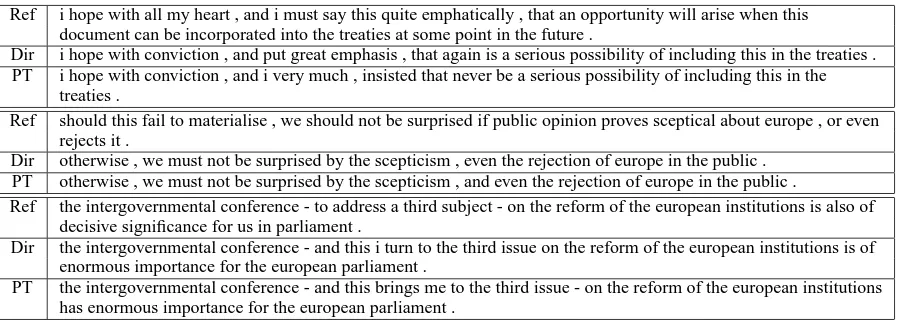
The relative performance of the PhraseTrans SMT systems compared to the Direct SMT systems was 0.92 to 0.97. These are very promising re-sults. To show how these systems translated the test sentences, we translated some outputs of the Spanish-French Direct and PhraseTrans SMT sys-tems into English using the French-English Direct system. These are shown in Table 3 with the refer-ence English sentrefer-ences.
The relative performance seems to be related to the BLEU scores for the Direct SMT systems. It was relatively high (0.95 to 0.97) for the difficult (in terms of BLEU) language pairs but relatively low (0.92) for the easy language pairs; Spanish–French and French–Spanish. There is a lot of room for improvement for the relatively easy language pairs. This relationship is stronger than the relationship be-tween the BLEU scores for SE/ET and those for the
PhraseTrans systems, where no clear trend exists.
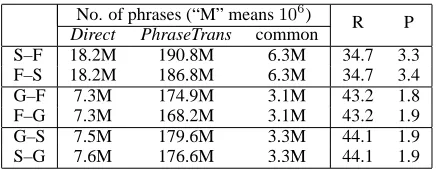
Table 2 shows the number of phrases stored in the phrase-tables. The Direct SMT systems had 7.3 to
8
Source–Target Direct PhraseTrans SntTrans15 SntTrans1 SE ET Spanish–French 35.78 > 32.90 (0.92) > 29.49 (0.82) > 29.16 (0.81) 29.31 28.80 French–Spanish 34.16 > 31.49 (0.92) > 28.41 (0.83) > 27.99 (0.82) 27.59 29.07 German–French 23.37 > 22.47 (0.96) > 22.03 (0.94) > 21.64 (0.93) 22.40 28.80 French–German 15.27 > 14.51 (0.95) > 14.03 (0.92) < 14.21 (0.93) 27.59 15.81 German–Spanish 22.34 > 21.76 (0.97) > 21.36 (0.96) > 20.97 (0.94) 22.40 29.07 Spanish–German 15.50 > 15.11 (0.97) > 14.46 (0.93) < 14.61 (0.94) 29.31 15.81
Table 1: BLEU scores and relative performance
No. of phrases (“M” means106
)
Direct PhraseTrans common R P
S–F 18.2M 190.8M 6.3M 34.7 3.3 F–S 18.2M 186.8M 6.3M 34.7 3.4 G–F 7.3M 174.9M 3.1M 43.2 1.8 F–G 7.3M 168.2M 3.1M 43.2 1.9 G–S 7.5M 179.6M 3.3M 44.1 1.9 S–G 7.6M 176.6M 3.3M 44.1 1.9
“S”, “F”, and “G” are the acronyms of Spanish, French, and German, respectively. “X–Y” means that “X” is the source lan-guage and “Y” is the target lanlan-guage.
Table 2: Statistics for the phrase-tables
18.2 million phrases, and the PhraseTrans systems had 168.2 to 190.8 million phrases. The numbers of phrases stored in the PhraseTrans systems were very large compared to those of Direct systems.9 How-ever, this does not cause a computational problem in decoding because those phrases that do not appear in source sentences are filtered so that only the relevant phrases are used during decoding.
The figures in the common column are the number of phrases common to the Direct and PhraseTrans systems. R (recall) and P (precision) are defined as follows.
R= No. of common phrases×100 No. of phrases in Direct system
9In Table 2, the PhraseTrans systems have more than 10x
as many phrases as the Direct systems. This can be explained as follows. Letfi be the fanout of an English phrasei, i.e.,
fiis the number of phrase pairs containing the English phrase
iin a phrase-table, then the size of the phrase-table iss1 =
Pn
i=1fi, wherenis the number of distinct English phrases.
When we combine two phrase-tables, the size of the combined phrase table is roughlys2 =
Pn i=1f
2
i. Thus, the relative size
of the combined phrase table is roughlyr = s2
s1 =
E(f2) E(f),
whereE(f) = s1
n and E(f
2) = s2
n are the averages over
fiand fi2, respectively. As an example, we calculated these
averages for the German-English phrase table. E(f)was 1.5, E(f2)
was 43.7, andrwas28.9. This shows that even if an average fanout is small, the size of a combined phrase table can be very large.
P= No. of common phrases×100 No. of phrases in PhraseTrans system
Recall was reasonably high. However, the upper bound of recall was 100 percent because we used a multilingual corpus whose sentences were aligned to each other across all four languages, as described in Section 4.1. Thus, there is a lot of room for im-provement with respect to recall. Precision, on the other hand, was very low. However, translation per-formance was not significantly affected by this low precision, as is shown in Table 1. This indicates that recall is more important than precision in building phrase-tables.
5 Related work
Pivot languages have been used in rule-based ma-chine translation systems. Boitet (1988) discusses the pros and cons of the pivot approaches in multi-lingual machine translation. Schubert (1988) argues that a pivot language needs to be a natural language, due to the inherent lack of expressiveness of artifi-cial languages.
Pivot-based methods have also been used in other related areas, such as translation lexicon induc-tion (Schafer and Yarowsky, 2002), word alignment (Wang et al., 2006), and cross language information retrieval (Gollins and Sanderson, 2001). The trans-lation disambiguation techniques used in these stud-ies could be used for improving the quality of phrase translation tables.
[image:6.612.77.295.169.254.2]showed that this direct training method is superior to the sentence translation strategy (SntTrans1) in translating Catalan into English but is inferior to it in the opposite translation direction (in terms of the BLEU score). In contrast, we have shown that the phrase translation strategy consistently outper-formed the sentence translation strategy in the con-trolled experiments.
6 Conclusion
We have compared two types of pivot strategies, namely phrase translation and sentence translation. The phrase translation strategy directly constructs a phrase translation table from a source language and English phrase-table and a target language and En-glish phrase-table. It then uses this phrase table in a phrase-based SMT system. The sentence transla-tion strategy first translates a source language sen-tence intonEnglish sentences and translates thesen sentences into target language sentences separately. Then, it selects the highest scoring sentence from the target language sentences.
We conducted controlled experiments using the Europarl corpus to compare the performance of these two strategies to that of directly trained SMT systems. The experiments showed that the perfor-mance of the phrase translation strategy was statis-tically significantly better than that of the sentence translation strategy and that its relative performance compared to the directly trained SMT systems was 0.92 to 0.97. These are very promising results.
Although we used the Europarl corpus for con-trolled experiments, we intend to use the pivot strate-gies in situations where very limited amount of par-allel corpora are available for a source and target lan-guage but where relatively large parallel corpora are available for the source language–English and the target language–English. In future work, we will further investigate the pivot strategies described in this paper to confirm that the phrase translation strat-egy is better than the sentence translation stratstrat-egy in the intended situation as well as with the Europarl corpus.10
10
As a first step towards real situations, we conducted addi-tional experiments. We divided the training corpora in Section 4 into two halves. We used the first 292915 sentences to train source-English SMT systems and the remaining 292915 ones to train English-target SMT systems. Based on these
source-References
Christian Boitet. 1988. Pros and cons of the pivot and transfer approaches in multilingual machine
transla-tion. In Dan Maxwell, Klaus Schubert, and Toon
Witkam, editors, New Directions in Machine Trans-lation. Foris. (appeared in Sergei Nirenburg, Harold Somers and Yorick Wilks (eds.) Readings in Machine Translation published by the MIT Press in 2003).
Peter F. Brown, Stephen A. Della Pietra, Vincent J. Della Pietra, and Robert L. Mercer. 1993. The mathematics of statistical machine translation: Parameter estima-tion. Computational Linguistics, 19(2):263–311.
Chris Callison-Burch, Philipp Koehn, and Miles Os-borne. 2006a. Improved statistical machine transla-tion using paraphrases. In NAACL.
Chris Callison-Burch, Miles Osborne, and Philipp Koehn. 2006b. Re-evaluating the role of BLEU in machine translation research. In EACL.
Adri´a de Gispert and Jos´e B. Mari no. 2006. Catalan-English statistical machine translation without parallel corpus: Bridging through Spanish. In Proc. of LREC 5th Workshop on Strategies for developing Machine Translation for Minority Languages.
Tim Gollins and Mark Sanderson. 2001. Improving
cross language information retrieval with triangulated translation. In SIGIR.
Manuel Kauers, Stephan Vogel, Christian F¨ugen, and Alex Waibel. 2002. Interlingua based statistical ma-chine translation. In ICSLP.
Philipp Koehn and Christof Monz. 2006. Manual and au-tomatic evaluation of machine translation between eu-ropean languages. In Proceedings on the Workshop on Statistical Machine Translation, pages 102–121, New York City, June. Association for Computational Lin-guistics.
Philipp Koehn, Franz Josef Och, and Daniel Marcu. 2003. Statistical phrase-based translation. In HLT-NAACL.
English and English-target SMT systems, we trained
Phrase-Trans and SntPhrase-Trans1 SMT systems. Other experimental
condi-tions were the same as those described in Section 4. The table below shows the BLUE scores of these SMT systems. It indi-cates that the PhraseTrans systems consistently outperformed the SntTrans1 systems.
Source-Target PhraseTrans SntTrans1
Ref i hope with all my heart , and i must say this quite emphatically , that an opportunity will arise when this document can be incorporated into the treaties at some point in the future .
Dir i hope with conviction , and put great emphasis , that again is a serious possibility of including this in the treaties . PT i hope with conviction , and i very much , insisted that never be a serious possibility of including this in the
treaties .
Ref should this fail to materialise , we should not be surprised if public opinion proves sceptical about europe , or even rejects it .
Dir otherwise , we must not be surprised by the scepticism , even the rejection of europe in the public . PT otherwise , we must not be surprised by the scepticism , and even the rejection of europe in the public .
Ref the intergovernmental conference - to address a third subject - on the reform of the european institutions is also of decisive significance for us in parliament .
Dir the intergovernmental conference - and this i turn to the third issue on the reform of the european institutions is of enormous importance for the european parliament .
[image:8.612.83.534.56.217.2]PT the intergovernmental conference - and this brings me to the third issue - on the reform of the european institutions has enormous importance for the european parliament .
Table 3: Reference sentences (Ref) and the English translations (by the French-English Direct system) of the outputs of the Spanish-French Direct and PhraseTrans SMT systems (Dir and PT).
Philipp Koehn, Amittai Axelrod, Alexandra Birch Mayne, Chris Callison-Burch, Miles Osborne, and David Talbot. 2005. Edinburgh system description for the 2005 IWSLT speech translation evaluation. In IWSLT.
Philipp Koehn. 2004. Pharaoh: a beam search decoder for phrase-based statistical machine translation mod-els. In AMTA.
Philipp Koehn. 2005. Europarl: A parallel corpus for statistical machine translation. In MT Summit.
Dragos Stefan Munteanu and Daniel Marcu. 2005. Im-proving machine translation performance by exploit-ing non-parallel corpora. Computational Lexploit-inguistics, 31(4):477–504.
Makoto Nagao. 1981. A framework of a
mechani-cal translation between Japanese and English by anal-ogy principle. In the International NATO Symposium on Artificial and Human Intelligence. (appeared in Sergei Nirenburg, Harold Somers and Yorick Wilks (eds.) Readings in Machine Translation published by the MIT Press in 2003).
Sonja Nießen and Hermann Ney. 2004. Statistical ma-chine translation with scarce resources using
morpho-syntactic information. Computational Linguistics,
30(2):181–204.
Franz Josef Och and Hermann Ney. 2002. Discrimina-tive training and maximum entropy models for statis-tical machine translation. In ACL.
Franz Josef Och and Hermann Ney. 2003. A system-atic comparison of various statistical alignment mod-els. Computational Linguistics, 29(1):19–51.
Franz Josef Och and Hermann Ney. 2004. The align-ment template approach to statistical machine transla-tion. Computational Linguistics, 30(4):417–449.
Franz Josef Och, Daniel Gildea, Sanjeev Khudanpur, Anoop Sarkar, Kenji Yamada, Alex Fraser, Shankar Kumar, Libin Shen, David Smith, Katherine Eng, Viren Jain, Zhen Jin, and Dragomir Radev. 2004. A smorgasbord of features for statistical machine trans-lation. In HLT-NAACL.
Franz Josef Och. 1999. An efficient method for deter-mining bilingual word classes. In EACL.
Franz Josef Och. 2003. Minimum error rate training in statistical machine translation. In ACL.
Kishore Papineni, Salim Roukos, Todd Ward, and Wei-Jing Zhu. 2002. BLEU: a method for automatic eval-uation of machine translation. In ACL.
Philip Resnik and Noah A. Smith. 2003. The web
as a parallel corpus. Computational Linguistics,
29(3):349–380.
Charles Schafer and David Yarowsky. 2002.
Induc-ing translation lexicons via diverse similarity measures and bridge languages. In CoNLL.
Klaus Schubert. 1988. Implicitness as a guiding princi-ple in machine translation. In COLING.
Andreas Stolcke. 2002. SRILM - an extensible language modeling toolkit. In ICSLP.
Masao Utiyama and Hitoshi Isahara. 2003. Reliable
measures for aligning Japanese-English news articles and sentences. In ACL, pages 72–79.