Topical Segmentation: a Study of Human Performance
and a New Measure of Quality
Anna Kazantseva
School of Electrical Engineering and Computer Science,
University of Ottawa [email protected]
Stan Szpakowicz
School of Electrical Engineering and Computer Science, University of Ottawa & Institute of Computer Science,
Polish Academy of Sciences [email protected]
Abstract
In a large-scale study of how people find top-ical shifts in written text, 27 annotators were asked to mark topically continuous segments in 20 chapters of a novel. We analyze the re-sulting corpus for inter-annotator agreement and examine disagreement patterns. The re-sults suggest that, while the overall agree-ment is relatively low, the annotators show high agreement on a subset of topical breaks – places where most prominent topic shifts occur. We recommend taking into account the prominence of topical shifts when evalu-ating topical segmentation, effectively penal-izing more severely the errors on more impor-tant breaks. We propose to account for this in a simple modification of thewindowDiff metric. We discuss the experimental results of evaluat-ing several topical segmenters with and with-out considering the importance of the individ-ual breaks, and emphasize the more insightful nature of the latter analysis.
1 Introduction
Topical segmentation is a useful intermediate step in many high-level NLP applications such as in-formation retrieval, automatic summarization and question answering. It is often necessary to split a long document into topically continuous segments. Segmentation may be particularly beneficial when working with documents without overt structure: speech transcripts (Malioutov and Barzilay, 2006), newswire (Misra et al., 2011) or novels (Kazantseva and Szpakowicz, 2011). The customary approach
is to cast text segmentation as a binary problem: is there a shift of topic between any two adjacent tex-tual units (e.g., sentences or paragraphs)? While necessary, this simplification is quite crude. Topic in discourse usually changes continually; some shifts are subtle, others – more prominent.
The evaluation of text segmentation remains an open research problem. It is a tradition to compile a gold-standard segmentation reference using one or more annotations created by humans. If an auto-matic segmenter agrees with the reference, it is re-warded, otherwise it is penalized (see Section 4 for details). The nature of the task, however, is such that creating and applying a reference segmentation is far from trivial. The identification of topical shifts re-quires discretization of a continuous concept – how much the topic changes between two adjacent units. That is why annotators often operate at different lev-els of granularity. Some people mark only the most prominent topic fluctuations, while others also in-clude finer changes. The task is also necessarily under-defined. In addition to topic changesper se, annotators effectively must classify some rhetorical and pragmatic phenomena – exactly how much it is depends on the document genre. For simplicity we do not directly address the latter problem here; we concentrate on the former.
To study how people identify topical shifts in written text, we asked 27 annotators to segment into
episodes 20 chapters of the novel The Moonstone
by Wilkie Collins. Each chapter was annotated by 4-6 people. An episode roughly corresponds to a topically continuous segment – the term is defined
in Section 3. The analysis of the resulting corpus reveals that while the overall inter-annotator agree-ment is quite low and is not uniform throughout each chapter. Some topical shifts are marked by most or all annotators, others – by one or by a minority. In fact, only about 50% of all annotated topical shifts are supported by at least 50% of annotators (includ-ing near-hits), while the other half is only marked by a minority. In this work we take the agreement about a certain topical shift as a measure of its prominence, and show how this measure can be simply utilized for the purpose of evaluation.
The main claim of this paper is perhaps the fol-lowing: when evaluating the performance of auto-matic segmenters, it is important to consider not only the overall similarity between human and ma-chine segmentations, but also to examine the regions of disagreement. When a program misses or mis-places a prominent topic shift – a segment bound-ary marked by all annotators – it should be penal-ized more than if it was mistaken about a boundary marked by one person. Similarly, a false positive in the region where none of the annotators found a change in topic is worse than a boundary inserted in a place where at least one person perceived a topic change. We suggest that it is important to use all available reference segmentations instead of com-piling them into a single gold standard. We show how a small modification to the popular windowD-iff (Pevzner and Hearst, 2002) metric can allow con-sidering multiple annotations at once.
To demonstrate the increased interpretive power of such evaluation we run and evaluate several state-of-the art segmenters on the corpus described in this work. We evaluate their performance first in a con-ventional manner – by combining all available ref-erences into one – and then by using the proposed modification. Comparing the results suggests that the information provided by this method differs from what existing methods provide.
Section 2 gives a brief background on text seg-mentation. Section 3 describes the corpus and how it was collected. Section 4 contain quantitative and qualitative analysis of the corpus and its interpreta-tions. Section 5 proposes a modified version of win-dowDiff and motivates it. Section 6 compares eval-uation of three segmenters in several different ways.
Section 7 contains the conclusions and outlines di-rections for future work.
2 Background and Related Work
The goal of topical text segmentation is to identify segments within which the topic under discussion remains relatively constant. A flip-side of this def-inition is identifying topic shifts – places where the topic shifts significantly or abruptly. In the context of this paper we allow ourselves to use these two def-initions interchangeably, sometimes talking about identifying topic shifts, at other times – about identi-fying topically continuous segments. While the the-oretical correctness of such usage remains question-able, it is sufficient for the purpose of our discussion, and it is in line with the literature on the topic.
There is a number of corpora annotated for the presence of topical shifts by one or more annotators. Passonneau and Litman (1997) describe an experi-ment where seven untrained annotators were asked to find discourse segments in a corpus of transcribed narratives about a movie. While the authors show that the agreement is significant, they also note that people include segment boundaries at different rates.
Gruenstein, Niekrasz, and Purver (2005) describe the process of annotating parts of two corpora of meeting transcripts: ICSI (Janin et al., 2003) and ISL (Burger, MacLaren, and Yu, 2002). Two peo-ple annotated the texts at two levels: major and mi-nor, corresponding to the more and less important topic shifts. Topical shifts were to be annotated so as to allow an outsider to glance at the transcript and get the gist of what she missed. Not unlike our work, the authors report rather low overall inter-annotator agreement. Galley et al. (2003) also com-piled a layer of annotation for topical shifts for part of the ICSI corpus, using a somewhat different pro-cedure with three annotators. Malioutov and Barzi-lay (2006) created a corpus of course lectures seg-mented by four annotators, noting that the annota-tors operated at different levels of granularity. In these three projects, manual annotations were com-piled into a single gold standard reference for use in evaluating and fine-tuning automatic segmenters.
the first attempt to annotate literary texts for topical shifts. Because we collected relatively many anno-tations for each chapter (four to six), we can make some generalizations as to the nature of the process. In addition to compiling and describing the corpus, we analyze disagreement patterns between annota-tors. We claim that even though the annotators may not agree on granularity, they do agree at some level, at least with respect to most prominent breaks. We propose that instead of compiling a single reference from multiple annotations it may be more useful to evaluate automatic segmenters against several anno-tations at once. We will show how to do that.
3 The Overview of the Corpus
Our current work on text segmentation is part of a larger project on automatic summarization of fic-tion, which is why we chose a XIX century novel,
The Moonstone by Wilkie Collins, as the text to be annotated. We used two chapters for a pilot study and then another 20 for the large-scale experi-ment. The annotators worked with individual chap-ters and were required to align segment boundaries with paragraph breaks.
Objectives. The main question behind this study was this: “How do people identify topical shifts in literature?” This vague question can be mapped to several more specific objectives. First, we sought to verify that topical segmentation of literature was a sensible task from the viewpoint of an untrained annotator. Next, it was important to examine inter-annotator agreement to make sure that the annota-tors in fact worked on the same phenomena and that the resulting corpus is a reasonable approximation of how people segment literature in general. Third, in addition to analyzing the overall agreement we also took a close look at the type of common disagree-ments, in search of patterns and insights to evaluate automatic segmenters.
Subjects. The participants were undergraduate students of an English department at the University of Ottawa, recruited by email. They received $50 each for their participation. Everyone had to anno-tate four chapters fromThe Moonstone, not neces-sarily consecutive ones. The chapters were divided so as to ensure an approximately equal workload.
We had planned six independent annotations for each chapter of the novel.1 The annotators were di-vided into five groups, each group asked to read and annotate four distinct chapters. In the end we had three groups with six people, one group with five and one group with four.
Procedure. The experiment was conducted re-motely. The students received email packages with detailed instructions and an example of a segmented chapter from a different novel. They had two weeks to annotate the first two chapters and then two more weeks to annotate another two chapters.
The annotators were instructed to read each chap-ter and split it into episodes – topically continuous spans of text demarcated by the most perceptible shifts of topic in the chapter. We asked the anno-tators to provide a brief one-sentence description of each episode, effectively creating a chapter outline. The students were also asked to record places they found challenging and to note the time it takes to complete the task.
Because even short chapters of most traditional novels are rather lengthy, we chose to use paragraphs as the basic unit of annotation (sentences are more common in text segmentation literature).
4 Corpus Analysis
Time. On average, an annotator required 137.9 min-utes to complete both tasks. The standard devia-tion wasσ= 98.32 minutes appropriately reflecting the fact that some students are very fast readers and besides have already read the novel in one of their classes, while others are quite slow.
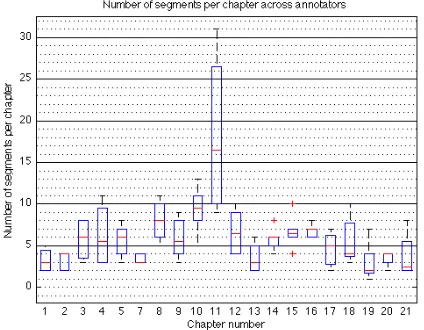
The average chapter has 53.85 paragraphs (σ = 29.31), the average segment length across all anno-tators is 9.25 paragraphs (σ= 9.77). On average the annotators identified 5.80 episodes (σ = 2.45) per chapter. Figure 1 shows the distribution of the num-ber of segments identified in each chapter. An indi-vidual box plot is compiled using all available anno-tations for that chapter – six for most, four or five for several. The data are plotted for individual chap-ters, so the only source of variance is the disagree-ment between annotators as to what is the appropri-ate level of detail for the task. Figure 1 confirms
1
Figure 1: Distribution of segment counts across chapters.
other researchers’ findings: people find topical shifts at different levels of granularity (Malioutov and Barzilay, 2006; Gruenstein, Niekrasz, and Purver, 2005). We take this investigation further and explore whether there are patterns to this disagreement and how they can be interpreted and leveraged.
4.1 Inter-annotator Agreement
In order to make sure that our guidelines are suffi-ciently clear and the annotators in fact annotate the same phenomenon, it is important to measure inter-annotator agreement (Artstein and Poesio, 2008). This is particularly important given the fact that the resulting corpus is intended as a benchmark dataset for evaluation of automatic segmenters.
When looking at inter-annotator agreement inde-pendently of the domain, the most commonly used metrics are coefficients of agreement –α (Krippen-dorff, 2004), κ (Cohen, 1960; Shrout and Fleiss, 1979), π (Scott, 1955) and several others. In this work we use a multi-annotator version of π, also known in the CL community as Fleiss’s κ (Shrout and Fleiss, 1979; Siegel and Castellan, 1988) .
Fleiss’sκis computed as follows:
κ=Agreementobserved−Agreementexpected
1−Agreementexpected (1)
Agreementobserved= 1 ic(c−1)
X
i∈I
X
k∈K
nik(nik−1) (2)
Agreementexpected= 1 (ic)2
X
k∈K
n2k (3)
whereiis the number of items to be classified in set
I,kis the number of available categories in setK,cis the number of annotators,nikis the number of
anno-tators who assign itemito categoryk,nkis the total
number of items assigned to categorykby all anno-tators (Artstein and Poesio, 2008, pp. 562-563). Ef-fectivelyκmeasures how much the annotators agree above what can be expected by chance. The value ofκis 0 where there is no agreement above chance and 1 where the annotators agree completely.
While we report κ values for our dataset, it is important to note that κ is ill-suited to measuring agreement in segmentation. The main problem is its insensitivity to near-hits. When asked to segment a document, the annotators often disagree about the exact placement of the boundary but agree that there is a boundary somewhere in the region (e.g., con-sider paragraphs 9-11 in segmentations in Figure 2). It is desirable to give partial credit to such near-hits instead of dismissing them as utter disagreement. This cannot be achieved withκ. The second prob-lem is the independence assumption: the label for each item must be independent from the labels of all other items. In our case, this would amount to claim-ing, highly unrealistically, that the probability of a topical shift between two sentences is independent of the topical landscape of the rest of the document. Two other commonly used agreement metrics are
Pk(Beeferman, Berger, and Lafferty, 1999) and win-dowDiff (Pevzner and Hearst, 2002), both designed to compare a hypothetical segmentation to a refer-ence, not to measure agreement per se. A com-mon feature of both metrics is that they award partial credit to near-hits by sliding a fixed-length window through the sequence and comparing the reference segmentation and hypothetical segmentation at each window position. The window size is generally set at half the average segment length.
Pk(Equation 4) measures the probability that two units randomly drawn from a document are correctly classified as belonging to the same topical segment.
Hearst, 2002, pp. 22-26) for details. Despite its shortcomings, Pk is widely used. We report it for comparison with other corpora.
P k(ref, hyp) = X
1≤i≤j≤n
D(i, j)(δref(i, j) XN OR δhyp(i, j))
(4)
Functionsδhyp andδref indicate whether the two
segment endpointsi andjbelong to the same seg-ment in the hypothetical segseg-mentation and reference segmentation respectively.
windowDiff was designed to remedy some ofPk’s shortcomings. It counts erroneous windows in the hypothetical sequence normalized by the total num-ber of windows. A window is judged erroneous if the boundary counts in the reference segmentation and hypothetical segmentation differ; that is (|ref -hyp| 6=0) in Equation 5).
winDif f= 1
N−k N−k
X
i=1
(|ref−hyp| 6= 0) (5)
BothPkandwindowDiff produce penalty scores be-tween 0 and 1, with 1 corresponding to all windows being in error, and 0 – to a perfect segmentation.
Table 1 reportsPk, windowDiff andκ values for our corpus. PkandwindowDiff are computed pair-wise for all annotators within one group and then averaged. We set the window size to half the aver-age segment length as measured across all annota-tors who worked on a given chapter. The values are computed for each group separately; Table 1 shows the averages across five groups.
Even by most relaxed standards, e.g., (Landis and Koch, 1977), theκvalue of 0.38 corresponds to low agreement. This is not surprising, since it only in-cludes the cases when the annotators agree exactly where the boundary should be. For the purpose of our task, such a definition is too strict.
The values of windowDiff andPk are more rea-sonable; windowDiff = 0.34 means that on aver-age a pair of annotators disagrees on 34% of win-dows. windowDiff was originally designed to pare only two segmentations. Our strategy of com-puting its values pairwise is perhaps not optimal but in the absence of another metric allowing to account for near-hits we are practically forced to use it as a primary means of inter-annotator agreement.
Table 1: Overview of inter-annotator agreement.
Mean Std. dev.
κ 0.29 0.15
Pk 0.33 0.17
[image:5.612.312.539.87.277.2]windowDiff 0.38 0.09
Figure 2: Example segmentation for Chapter 1.
4.2 Patterns of Disagreement
Figure 2 shows the segmentation of the shortest chapter in the dataset. The overall agreement is quite low (windowDiff=0.38,κ= 0.28). This is not surprising, since annotators 1 and 3 found two seg-ments, annotator 3 – five segseg-ments, and annotator 4 – four. Yet all annotators agree on certain things: ev-eryone found that there was a significant change of topic between paragraphs 9 and 11 (though they dis-agree on its exact placement). It is therefore likely that the topical shift between paragraphs 9 and 11 is quite prominent. Annotators 2 and 4 chose to place a segment boundary after paragraph 2, while anno-tators 1 and 3 did not place one there. It is likely that the topical shift occurring there is less prominent, al-though perceptible. According to these annotations, the least perceptible topic shifts in the chapter oc-cur after paragraph 4 (marked only by annotator 2) and possibly after paragraph 11 (marked only by an-notator 1). Overall, glancing at these segmentations suggests that there is a prominent topical shift be-tween paragraphs 9-11, three significant ones (after 2, 10 and 12) and several minor fluctuations (after 3 and possibly after 10 and 11).
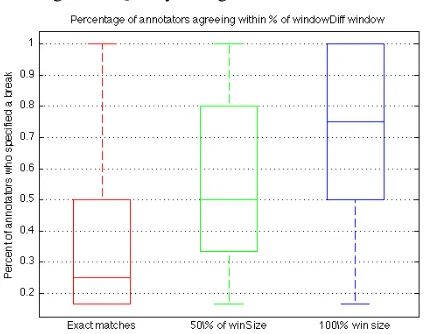
dis-Figure 3: Quality of segment boundaries.
agreements due to granularity and disagreements due to true lack of agreement (annotator 1 and 3). We would also like to leverage this information for the evaluation of automatic segmenters.
Distinguishing between true disagreement and different granularity while taking into account near-hits is not trivial, especially since we are working with multiple annotations simultaneously and there is noonecorrect segmentation.
In order to estimate the quality of individual boundaries and look inside the segmented sequence, we approximate the quality of each suggested seg-ment boundary by the percentage of annotators who marked it. Since the annotators may disagree on the exact placement of the boundaries, our measurement must be relaxed to allow for near-hits.
Figure 3 shows the distribution of segment bound-aries using three different standards of quality. We consider all segment boundaries introduced by at least one annotator. Then, for each suggested bound-ary we compute how much support there is from peer annotators: what percentage of annotators in-cluded this boundary in their segmentation. The left-most box plot in Figure 3 corresponds to the left-most strict standard. When computing support we only consider perfect matches: segment boundaries spec-ified in exactly the same location (window size = 0). The middle box plot is more relaxed: we con-sider boundaries found within half of a
windowD-iff window size of the boundary under inspection. The rightmost box plot corresponds to the inclusion of boundaries found within a fullwindowDiff win-dow size of the boundary under inspection.
Looking at exact matches (the leftmost box plot), we observe that at least a half of segment bound-aries were specified by less than 25% of annotators (which corresponds to one person). It explains why
κvalues in Table 1 are so low: this is the only sort of agreement κ captures. Also one can notice that at most 25% of the boundaries have the support of more than 50% of the annotators.
The picture changes if we consider all boundaries within a tight window around the candidate bound-ary (the middle box plot). This standard is twice as strict as the regularwindowDiff evaluation. Here 50% of all boundaries are marked by at least 35% at and most 80% of annotators. Only 25% of bound-aries are marked by less than 30% of the annotators.
The rightmost plot looks even better. If we con-sider the support found within a window size of any candidate boundary, then 50% of all boundaries are supported by over 70% of annotators. However, we find this way of measuring support too optimistic. The reason is, again, the difference in the granu-larity of segmentations. The window size used for these measurements is based on the average segment length across all annotations. For example, the aver-age segment length for segmentation shown in Fig-ure 2 is 4, making the window size 2. This size is too relaxed for annotators 2 and 3, who were very detailed. Due to the excessively large window there will almost always be a boundary where fine-grained annotations are concerned, but those boundaries will not correspond to the same phenomena. That is why we think that a stricter standard is generally more appropriate. This is especially the case since we work with paragraphs, not sentences. A distance of 2-3 sentences is quite tolerable, but a distance of 2-3 paragraphs is considerable, and it is far more likely that a stricter notion of near-hits must be considered.
5 Proposed Modification towindowDiff
[image:6.612.85.298.76.243.2]from a reference boundary. Section 4.2 argued that some boundaries are more prominent. We aim to modifywindowDiffso the prominence of the bound-aries matters in evaluating automatic segmenters.
Recall that to compute windowDiff we slide a window through the reference and the hypotheti-cal segmentation and check whether the number of boundaries is equal at each window position. The number of erroneous windows is then normalized:
winDif f= 1
N−k N−k
X
i=1
(|refi−hypi| 6= 0) (6)
refi andhypoi are the counts of boundaries in a
given window in the reference and the hypothetical sequence,N is the length of the complete sequence,
kis the window size (so there areN - kwindows). The prominence of a boundary can be approxi-mated by how many annotators specified it in their segmentations. One simple way to take prominence into account is to slide a window through all avail-able segmentations, not just one. A straighforward modification to equation (6) achieves that:
winDif f0= 1
h(N−m) h
X
a=1
N−m
X
i=1
(|refai−hypi| 6= 0) (7)
A is the set of all available annotations and h is their total number. Effectively, for each position of the window the hypothetical output is penalized as many times as there are reference annotations with which it disagrees. Note that the window sizemis different from that used for pair-wise comparisons. Following the convention, we recommend setting it to half of the size of an average segment length (av-eraged over all available references). The size of the window effectively specifies a tolerance thresh-old for what is an acceptable near-hit (as opposed to a plain miss), and can be modified accordingly.
windowDiff and Pk range from 0 to 1, with 0 corresponding to an ideal segmentation. The upper and lower bounds for Equation 7 are different and depend on how much the reference segmentations agree between themselves.2
2
We find that the upper bound corresponds to the worst-case, and the lower bound to the best-case scenario. To avoid confu-sion, we talk of thebest-case boundand theworst-case bound.
Let us refer to the most popular opinion for a given position of the window as themajority opin-ion. Then, for each window, the smallest possible penalty is assigned if the hypothetical segmentation correctly “guesses” the majority opinion (the win-dow then receives a penalty equal to the number of annotators disagreeing with the majority opinion):
best case= 1
N−m N−m
X
i=1
(h−majority support) (8)
Heremajority supportis the number of annota-tors who support the most frequent opinion.
Conversely, to merit the highest penalty, a hypo-thetical segmentation must “guess” the least popu-lar opinion (possibly an opinion not supported by any annotators) at each window position. In Equa-tion 9,unpopular supportis the number of anno-tators who agree with the least popular opinion.
worst case= 1
N−m N−m
X
i=1
(h−unpopular support) (9)
In order to have a multi-annotator version of win-dowDiff interpretable within the familiar [0,1] in-terval, we normalize Equation 7:
multW inDif f=
(Ph a=1
PN−m
i=1 (|refa−hyp| 6= 0))−best case h(N−m)(worst case−best case) (10)
The best and the worst-case bounds serve as indi-cators of how much agreement there can be between reference segmentations and so as indicators of how difficult to segment a given document is.
The multWinDiff metric in Equation 10 has the same desirable properties as the original metric, namely it takes into account near hits and penal-izes according to how far the reference and hypo-thetical boundaries are. Additionally, for each win-dow position it takes into account how much a hy-pothetical segmentation is similar to all available an-notations, thus penalizing mistakes according to the prominence of boundaries (or to the certainty that there are no boundaries).3
3
6 Experiments
In order to illustrate why using a single gold-standard reference segmentation can be problem-atic, we evaluate three publicly available seg-menters, MinCutSeg (Malioutov and Barzilay, 2006), BayesSeg (Eisenstein and Barzilay, 2008) and APS (Kazantseva and Szpakowicz, 2011), us-ing several different gold standards and then usus-ing all available annotations. The corpus used for eval-uation is The Moonstone corpus described in Sec-tions 3-4. We withheld the first four chapters for de-velopment and used the remaining 16 for testing. We also compared the segmenters to a random baseline which consisted of randomly selecting a number of boundaries equal to the average number of segments across all available annotations.
None of the segmenters requires training in the conventional sense, but APS and MinCutSeg seg-meters come with scripts allowing to fine-tune sev-eral parameters. We selected the best parameters for these two segmenters using the first four chapters of the corpus. BayesSeg segmeter, a probabilistic seg-menter, does not require setting any parameters.
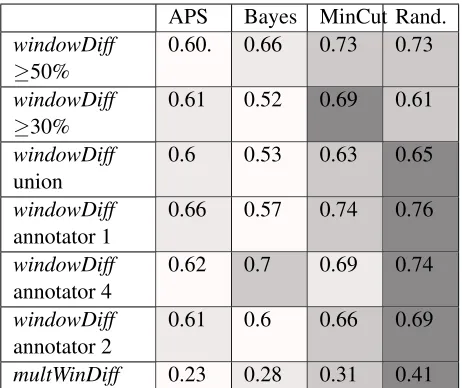
Table 2 sums up the results. Each row corre-sponds to one reference segmentation and metric – regular windowDiff in the first six rows. We com-piled several flavours of consensus reference seg-mentations: 1) all boundaries marked by≥50% of the annotators (windowDiff ≥50%), 2) all boundaries marked by≥30% of the annotators (windowDiff ≥ 30%), 3) all boundaries marked by at least one an-notator (windowDiff union). To illustrate why com-paring against a single annotation is unreliable, we report comparisons against three single-person an-notations (windowDiff annotator 1, 4, 2).multWinDiff
is the proposed multi-annotator version from Equa-tion 10. The best-case bound formultWinDiffis 0.21 and the worst-case bound is 1.0.
Each segmenter produced just one segmentation, so the numbers in the Table 2 differ only depending on the mode of evaluation. The cells are coloured. The lightest shade correspond to the best perfor-mance, darker shades – to poorer performance. The actual values for the first six rows are rather low, but what is more bothersome is the lack of consistency in the ranking of segmenters. Only the random
base-APS Bayes MinCut Rand.
windowDiff
≥50%
0.60. 0.66 0.73 0.73
windowDiff
≥30%
0.61 0.52 0.69 0.61
windowDiff
union
0.6 0.53 0.63 0.65
windowDiff
annotator 1
0.66 0.57 0.74 0.76
windowDiff
annotator 4
0.62 0.7 0.69 0.74
windowDiff
annotator 2
0.61 0.6 0.66 0.69
[image:8.612.313.544.56.250.2]multWinDiff 0.23 0.28 0.31 0.41
Table 2: The three segmenters and a random baseline compared using different references for computing win-dowDiff. windowDiff ≥50%: the gold standard consists of all boundaries specified by at least 50% of the anno-tators; windowDiff ≥30%: all boundaries specified by at least 30% of the annotators; windowDiff union: all boundaries specified by at least one person; windowD-iff annotatora: comparisons against individual annota-tors. multWinDiff is multi-annotator windowDiff from equation (10).
line remains the worst in most cases. The APS and BayesSeg segmenters tend to appear better than the MinCutSeg but it is not always the case and the rank-ings among the three are not consistent.
The last row reports multi-annotator windowD-iff which takes into account all available references and also the best-case and the worst-case bounds. In principle, there is no way to prove that the metric is better than usingwindowDiff and a single reference annotation. It does, however, take into account all available information and provides a different, if not unambiguously more true, picture of the compara-tive performance of automatic segmenters.
7 Conclusions and Future Work
Our analysis of the corpus confirms the hypothe-sis that when asked to find topical segments, people operate at different levels of granularity. We show that only a small percentage of segment boundaries is agreed upon by all or almost all annotators. If, however, near-hits are considered, suggested seg-ment boundaries can be ranked by their prominence using the information about how many people in-clude each boundary in their annotation.
We propose a simple modification to windowD-iff which allows for taking into account more than one reference segmentation, and thus rewards or pe-nalizes the output of automatic segmenters by con-sidering the severity of their mistakes. The proposed metric is not trouble-free. It is a window-based met-ric so its value depends on the choice of the window size. While it has become a convention to set the window size to half of the average segment length in the reference segmentation, it is not obvious that the same logic applies in case of multi-annotator win-dowDiff. The metric also hides whether false posi-tives or false negaposi-tives are the main source of error.
All these shortcomings notwithstanding, the met-ric offers an advantage of allowing the evaluation of hypothetical segmentations with more subtlety than those using a single gold standard reference. When using regularwindowDiff and a single reference seg-mentation, one is restricted to an evaluation based on binary comparisons: whether a given hypothet-ical boundary is similar to the gold standard seg-mentation (e.g., the majority opinion). Divergent segmentations are penalized even if they are simi-lar to minority opinions (and thus feasible, though maybe less likely) or if they are completely different from anything created by humans (and thus proba-bly genuinely erroneous). Our version of windowD-iff, however, takes into account multiple annotations and gives partial reward to segmentations based on how similar there are to any human segmentation, not just the majority opinion (while giving prefer-ence to high agreement with the majority opinion).
To evaluate the output of topical segmenters is hard. There is disagreement between the annota-tors about the appropriate level of granularity and about the exact placement of segment boundaries. The task itself is also a little vague. Just as it is the case in automatic text summarization, generation
and other advanced NLP tasks, there is no single cor-rect answer and the goal of a good evaluation met-ric is to reward plausible hypotheses and to penalize improbable ones. It is quite possible that a better metric than the one proposed here can be devised; see, for example, (Fournier and Inkpen, 2012)(Sca-iano and Inkpen, 2012). We feel, however, that any reliable metric for evaluating segmentations must – in one manner or another – take into account more than one annotation and the prominence of segment breaks.
Acknowledgments
We thank William Klement and Chris Fournier for commenting on an early draft of this paper. The first author also thanks Chris Fournier and Martin Sca-iano for insightful discussions about the evaluation of topical segmenters. This work is partially funded by the National Sciences and Engineering Research Council of Canada and by the Ontario Graduate Scholarship program.
References
Artstein, Ron and Massimo Poesio. 2008. Inter-Coder Agreement for Computational Linguistics. Computa-tional Linguistics, 34(4):555–596.
Beeferman, Doug, Adam Berger, and John Lafferty. 1999. Statistical Models for Text Segmentation. Ma-chine Learning, 34:177–210, February.
Burger, Susanne, Victoria MacLaren, and Hua Yu. 2002. The ISL meeting corpus: the impact of meeting type on speech style. InINTERSPEECH’02.
Cohen, Jacob. 1960. A coefficient of agreement for nominal scales .Educational and Psychological Mea-surement, 20:37–46.
Eisenstein, Jacob and Regina Barzilay. 2008. Bayesian unsupervised topic segmentation. In Proceedings of the 2008 Conference on Empirical Methods in Natu-ral Language Processing, pages 334–343, Honolulu, Hawaii, October.
Fournier, Chris and Diana Inkpen. 2012. Segmentation similarity and agreement. InProceedings of NAACL-HLT 2012 (this volume), Montr´eal, Canada, June. Galley, Michel, Kathleen McKeown, Eric Fosler-Lussier,
569, Stroudsburg, PA, USA. Association for Compu-tational Linguistics.
Gruenstein, Alexander, John Niekrasz, and Matthew Purver. 2005. Meeting Structure Annotation: Data and Tools. InIn Proceedings of the SIGdial Workshop on Discourse and Dialogue, pages 117–127.
Janin, Adam, Don Baron, Jane Edwards, D. Ellis, David Gelbart, Nelson Morgan, Barbara Peskin, Thilo Pfau, Elizabeth Shriberg, A.ndreas Stolcke, and Chuck Wooters. 2003. The ICSI Meeting Corpus. In Proceedings of the IEEE International Conference on Acoustics, Speech, and Signal Processing (ICASSP-03), volume 1, pages 364–367, April.
Kazantseva, Anna and Stan Szpakowicz. 2011. Lin-ear Text Segmentation Using Affinity Propagation. In Proceedings of the 2011 Conference on Empirical Methods in Natural Language Processing, pages 284– 293, Edinburgh, Scotland, UK., July. Association for Computational Linguistics.
Krippendorff, Klaus. 2004. Content Analysis. An Intro-duction to Its Methodology. Sage Publications. Landis, J. Richards and Garry G. Koch. 1977. The
Mea-surement of Observer Agreement for Categorical Data. Biometrics, 33(1):159–174.
Malioutov, Igor and Regina Barzilay. 2006. Minimum Cut Model for Spoken Lecture Segmentation. In Pro-ceedings of the 21st International Conference on Com-putational Linguistics and 44th Annual Meeting of the Association for Computational Linguistics, pages 25– 32, Sydney, Australia, July.
Misra, Hemant, Franc¸ois Yvon, Olivier Capp´e, and Joe-mon M. Jose. 2011. Text segmentation: A topic mod-eling perspective. Information Processing and Man-agement, 47(4):528–544.
Passonneau, Rebecca J. and Diane J. Litman. 1997. Dis-course segmentation by human and automated means. Computational Linguistics, 23(1):103–139, March. Pevzner, Lev and Marti A. Hearst. 2002. A Critique and
Improvement of an Evaluation Metric for Text Seg-mentation.Computational Linguistics, 28(1):19–36. Scaiano, Martin and Diana Inkpen. 2012. Getting
more from segmentation evaluation. In Proceedings of NAACL-HLT 2012 (this volume), Montr´eal, Canada, June.
Scott, William. 1955. Reliability of content analysis: The case of nominal scale coding. Public Opinion Quaterly, 19(3):321–325.
Shrout, Patrick E. and Joseph L. Fleiss. 1979. Intraclass correlations: uses in assessing rater reliability. Psy-chological Bulletin, 86(2):420–428.