The Web as a Baseline: Evaluating the Performance of
Unsupervised Web-based Models for a Range of NLP Tasks
Mirella Lapata
Department of Computer Science
University of Sheffield
211 Portobello St., Sheffield S1 4DP
[email protected]
Frank Keller
School of Informatics
University of Edinburgh
2 Buccleuch Pl., Edinburgh EH8 9LW
[email protected]
Abstract
Previous work demonstrated that web counts can be used to approximate bigram frequen-cies, and thus should be useful for a wide va-riety of NLP tasks. So far, only two gener-ation tasks (candidate selection for machine translation and confusion-set disambiguation) have been tested using web-scale data sets. The present paper investigates if these results gener-alize to tasks covering both syntax and seman-tics, both generation and analysis, and a larger range of n-grams. For the majority of tasks, we find that simple, unsupervised models perform better when n-gram frequencies are obtained from the web rather than from a large corpus. However, in most cases, web-based models fail to outperform more sophisticated state-of-the-art models trained on small corpora. We ar-gue that web-based models should therefore be used as a baseline for, rather than an alternative to, standard models.
1
Introduction
Keller and Lapata (2003) investigated the validity of web counts for a range of predicate-argument bigrams (verb-object, adjective-noun, and noun-noun bigrams). They presented a simple method for retrieving bigram counts from the web by querying a search engine and demon-strated that web counts (a) correlate with frequencies ob-tained from a carefully edited, balanced corpus such as the 100M words British National Corpus (BNC), (b) cor-relate with frequencies recreated using smoothing meth-ods in the case of unseen bigrams, (c) reliably predict hu-man plausibility judgments, and (d) yield state-of-the-art performance on pseudo-disambiguation tasks.
Keller and Lapata’s (2003) results suggest that web-based frequencies can be a viable alternative to bigram frequencies obtained from smaller corpora or recreated using smoothing. However, they do not demonstrate that realistic NLP tasks can benefit from web counts. In or-der to show this, web counts would have to be applied to a diverse range of NLP tasks, both syntactic and
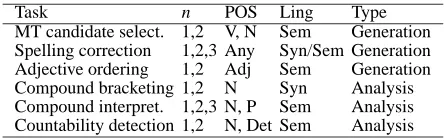
seman-Task n POS Ling Type
[image:1.612.314.536.226.295.2]MT candidate select. 1,2 V, N Sem Generation Spelling correction 1,2,3 Any Syn/Sem Generation Adjective ordering 1,2 Adj Sem Generation Compound bracketing 1,2 N Syn Analysis Compound interpret. 1,2,3 N, P Sem Analysis Countability detection 1,2 N, Det Sem Analysis
Table 1: Overview of the tasks investigated in this paper (n: size of n-gram; POS: parts of speech; Ling: linguistic knowledge; Type: type of task)
tic, involving analysis (e.g., disambiguation) and gener-ation (e.g., selection among competing outputs). Also, it remains to be shown that the web-based approach scales up to larger n-grams (e.g., trigrams), and to combinations of different parts of speech (Keller and Lapata 2003 only tested bigrams involving nouns, verbs, and adjectives). Another important question is whether web-based meth-ods, which are by definition unsupervised, can be com-petitive alternatives to supervised approaches used for most tasks in the literature.
This paper aims to address these questions. We start by using web counts for two generation tasks for which the use of large data sets has shown promising results: (a) tar-get language candidate selection for machine translation (Grefenstette, 1998) and (b) context sensitive spelling correction (Banko and Brill, 2001a,b). Then we investi-gate the generality of the web-based approach by apply-ing it to a range of analysis and generations tasks, involv-ing both syntactic and semantic knowledge: (c) orderinvolv-ing of prenominal adjectives, (d) compound noun bracketing, (e) compound noun interpretation, and (f) noun count-ability detection. Table 1 gives an overview of these tasks and their properties.
2
Method
Following Keller and Lapata (2003), web counts for n-grams were obtained using a simple heuristic based on queries to the search engine Altavista.1In this approach, the web count for a given n-gram is simply the number of hits (pages) returned by the search engine for the queries generated for this n-gram. Three different types of queries were used for the NLP tasks in the present paper:
Literal queries use the quoted n-gram directly as a
search term for Altavista (e.g., the bigramhistory changes
expands to the query"history changes").
Near queries use Altavista’s NEAR operator to ex-pand the n-gram; a NEAR b means that a has to oc-cur in the same ten word window as b; the window is treated as a bag of words (e.g.,history changesexpands to"history" NEAR "changes").
Inflected queries are performed by expanding an n-gram into all its morphological forms. These forms
are then submitted as literal queries, and the result-ing hits are summed up (e.g., history changes ex-pands to "history change", "histories change",
"history changed", etc.). John Carroll’s suite of mor-phological tools (morpha, morphg, and ana) was used to generate inflected forms of verbs and nouns.2In cer-tain cases (detailed below), determiners were inserted be-fore nouns in order to make it possible to recognize sim-ple NPs. This insertion was limited toa/an,the, and the empty determiner (for bare plurals).
All queries (other than the ones using theNEAR oper-ator) were performed as exact matches (using quotation marks in Altavista). All search terms were submitted to the search engine in lower case. If a query consists of a single, highly frequent word (such asthe), Altavista will return an error message. In these cases, we set the web count to a large constant (108). This problem is limited to unigrams, which were used in some of the models de-tailed below. Sometimes the search engine fails to return a hit for a given n-gram (for any of its morphological vari-ants). We smooth zero counts by setting them to .5.
For all tasks, the web-based models are compared against identical models whose parameters were esti-mated from the BNC (Burnard, 1995). The BNC is a static 100M word corpus of British English, which is about 1000 times smaller than the web (Keller and La-pata, 2003). Comparing the performance of the same model on the web and on the BNC allows us to assess how much improvement can be expected simply by using a larger data set. The BNC counts were retrieved using the Gsearch corpus query tool (Corley et al., 2001); the morphological query expansion was the same as for web queries; the NEAR operator was simulated by assuming a window of five words to the left and five to the right.
1We did not use Google counts, as Google limits the number of queries to 1000 per day, which makes the process of retriev-ing a large number of web counts very time consumretriev-ing.
2The tools can be downloaded from http://www.cogs. susx.ac.uk/lab/nlp/carroll/morph.html.
# best model on development set
∗ 6 ∗ (not) sign. different from best BNC model on test set †6† (not) sign. different from baseline
‡6‡ (not) sign. different from best model in the literature
Table 2: Meaning of diacritics indicating statistical sig-nificance (χ2tests)
Gsearch was used to search solely for adjacent words; no POS information was incorporated in the queries, and no parsing was performed.
For all of our tasks, we have to select either the best of several possible models or the best parameter setting for a single model. We therefore require a separate develop-ment set. This was achieved by using the gold standard data set from the literature for a given task and randomly dividing it into a development set and a test set (of equal size). We report the test set performance for all models for a given task, and indicate which model shows optimal performance on the development set (marked by a ‘#’ in all subsequent tables). We then compare the test set per-formance of this optimal model to the perper-formance of the models reported in the literature. It is important to note that the figures taken from the literature were typically obtained on the whole gold standard data set, and hence may differ from the performance on our test set. We work on the assumption that such differences are negligible.
We useχ2tests to determine whether the performance of the best web model on the test set is significantly differ-ent from that of the best BNC model. We also determine whether both models differ significantly from the base-line and from the best model in the literature. A set of diacritics is used to indicate significance throughout this paper, see Table 2.
3
Candidate Selection for Machine
Translation
Target word selection is a generation task that occurs in machine translation (MT). A word in a source language can often be translated into different words in the target language and the choice of the appropriate translation de-pends on a variety of semantic and pragmatic factors. The task is illustrated in (1) where there are five translation al-ternatives for the German nounGeschichtelisted in curly brackets, the first being the correct one.
(1) a. DieGeschichte ¨andert sich, nicht jedoch die Geographie.
b. {History, story, tale, saga, strip} changes but geography does not.
et al. (2000) who do not produce a translation of the en-tire sentence. Instead, they focus on specific syntactic re-lations. Grefenstette translates compounds from German and Spanish into English, and uses BNC frequencies as a filter for candidate translations. He observes that this approach suffers from an acute data sparseness problem and goes on to obtain counts for candidate compounds through web searches, thus achieving a translation accu-racy of 86–87%.
Prescher et al. (2000) concentrate on verbs and their objects. Assuming that the target language translation of the verb is known, they select from the candidate transla-tions the noun that is semantically most compatible with the verb. The semantic fit between a verb and its argument is modeled using a class-based lexicon that is derived from unlabeled data using the expectation maximization algorithm (verb-argument model). Prescher et al. also propose a refined version of this approach that only mod-els the fit between a verb and its object (verb-object model), disregarding other arguments of the verb. The two models are trained on the BNC and evaluated against two corpora of 1,340 and 814 bilingual sentence pairs, with an average of 8.63 and 2.83 translations for the ob-ject noun, respectively. Table 4 lists Prescher et al.’s re-sults for the two corpora and for both models together with a random baseline (select a target noun at random) and a frequency baseline (select the most frequent target noun).
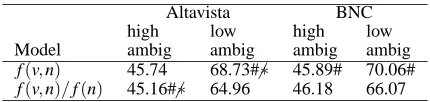
Grefenstette’s (1998) evaluation was restricted to pounds that are listed in a dictionary. These com-pounds are presumably well-established and fairly quent, which makes it easy to obtain reliable web fre-quencies. We wanted to test if the web-based approach extends from lexicalized compounds to productive syn-tactic units for which dictionary entries do not exist. We therefore performed our evaluation using Prescher et al.’s (2000) test set of verb-object pairs. Web counts were re-trieved for all possible verb-object translations; the most likely one was selected using either co-occurrence fre-quency ( f(v,n)) or conditional probability ( f(v,n)/f(n)). The web counts were gathered using inflected queries in-volving the verb, a determiner, and the object (see Sec-tion 2). Table 3 compares the web-based models against the BNC models. For both the high ambiguity and the low ambiguity data set, we find that the performance of the best Altavista model is not significantly different from that of the best BNC model. Table 4 compares our simple, unsupervised methods with the two sophisticated class-based models discussed above. The results show that there is no significant difference in performance be-tween the best model reported in the literature and the best Altavista or the best BNC model. However, both models significantly outperform the baseline. This holds for both the high and low ambiguity data sets.
Altavista BNC
high low high low
Model ambig ambig ambig ambig
f(v,n) 45.74 68.73#6 ∗ 45.89# 70.06# f(v,n)/f(n) 45.16#6 ∗ 64.96 46.18 66.07
Table 3: Performance of Altavista counts and BNC counts for candidate selection for MT (data from Prescher et al. 2000)
high low
Model ambig ambig
Random baseline 14.20 45.90
Frequency baseline 31.90 45.50
Prescher et al. (2000): verb-argument 43.30 61.50 Best Altavista 45.16†6‡ 68.73†6‡
Best BNC 45.89†6‡ 70.06†6‡
[image:3.612.318.533.70.121.2]Prescher et al. (2000): verb-object 49.40 68.20
Table 4: Performance comparison with the literature for candidate selection for MT
4
Context-sensitive Spelling Correction
Context-sensitive spelling correction is the task of cor-recting spelling errors that result in valid words. Such a spelling error is illustrated in (4) whereprincipal was typed whenprinciplewas intended.
(2) Introduction of the dialogueprincipal proved strik-ingly effective.
The task can be viewed as generation task, as it consists of choosing between alternative surface realizations of a word. This choice is typically modeled by confusion sets such as{principal, principle} or{then, than}under the assumption that each word in the set could be mistakenly typed when another word in the set was intended. The task is to infer which word in a confusion set is the cor-rect one in a given context. This choice can be either syn-tactic (as for{then, than}) or semantic (as for{principal, principle}).
A number of machine learning methods have been pro-posed for context-sensitive spelling correction. These in-clude a variety of Bayesian classifiers (Golding, 1995; Golding and Schabes, 1996), decision lists (Golding, 1995) transformation-based learning (Mangu and Brill, 1997), Latent Semantic Analysis (LSA) (Jones and Martin, 1997), multiplicative weight update algorithms (Golding and Roth, 1999), and augmented mixture mod-els (Cucerzan and Yarowsky, 2002). Despite their differ-ences, most approaches use two types of features: context words and collocations. Context word features record the presence of a word within a fixed window around the tar-get word (bag of words); collocational features capture the syntactic environment of the target word and are usu-ally represented by a small number of words and/or part-of-speech tags to the left or right of the target word.
Model Alta BNC Model Alta BNC f(t) 72.98 70.00 f(w1,t,w2)/f(t) 87.77 76.33 f(w1,t) 84.40 83.02 f(w1,w2,t)/f(t) 86.27 74.47 f(t,w1) 84.89 82.74 f(t,w2,w2)/f(t) 84.94 74.23 f(w1,t,w2) 89.24#*77.13 f(w1,t,w2)/f(w1,t)80.70 73.69 f(w1,w2,t) 87.13 74.89 f(w1,t,w2)/f(t,w2)82.24 75.10 f(t,w1,w2) 84.68 75.08 f(w1,w2,t)/f(w2,t)72.11 69.28 f(w1,t)/f(t)82.81 77.84 f(t,w1,w2)/f(t,w1)75.65 72.57 f(t,w1)/f(t)77.49 80.71#
Table 5: Performance of Altavista counts and BNC counts for context sensitive spelling correction (data from Cucerzan and Yarowsky 2002)
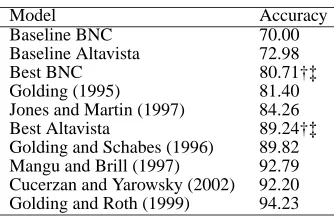
Model Accuracy
Baseline BNC 70.00
Baseline Altavista 72.98
Best BNC 80.71†‡
Golding (1995) 81.40
Jones and Martin (1997) 84.26
Best Altavista 89.24†‡
Golding and Schabes (1996) 89.82 Mangu and Brill (1997) 92.79 Cucerzan and Yarowsky (2002) 92.20 Golding and Roth (1999) 94.23
Table 6: Performance comparison with the literature for context sensitive spelling correction
the Brown corpus, using 80% for training and 20% for testing.3
We devised a simple, unsupervised method for performing spelling correction using web counts. The method takes into account collocational features, i.e., words that are adjacent to the target word. For each word in the confusion set, we used the web to estimate how frequently it co-occurs with a word or a pair of words immediately to its left or right. Disambiguation is then performed by selecting the word in the confusion set with the highest co-occurrence frequency or probability. The web counts were retrieved using literal queries (see Sec-tion 2). Ties are resolved by comparing the unigram fre-quencies of the words in the confusion set and defaulting to the word with the highest one. Table 5 shows the types of collocations we considered and their corresponding ac-curacy. The baseline ( f(t)) in Table 5 was obtained by always choosing the most frequent unigram in the confu-sion set. We used the same test set (2056 tokens from the Brown corpus) and confusion sets as Golding and Sch-abes (1996), Mangu and Brill (1997), and Cucerzan and Yarowsky (2002).
Table 5 shows that the best result (89.24%) for the web-based approach is obtained with a context of one word to the left and one word to the right of the target word ( f(w1,t,w2)). The BNC-based models perform consis-tently worse than the web-based models with the excep-tion of f(t,w1)/t; the best Altavista model performs
sig-nificantly better than the best BNC model. Table 6 shows
3An exception is Golding (1995), who uses the entire Brown corpus for training (1M words) and 3/4 of the Wall Street Jour-nal corpus (Marcus et al., 1993) for testing.
that both the best Altavista model and the best BNC model outperform their respective baselines. A compari-son with the literature shows that the best Altavista model outperforms Golding (1995), Jones and Martin (1997) and performs similar to Golding and Schabes (1996). The highest accuracy on the task is achieved by the class of multiplicative weight-update algorithms such as Winnow (Golding and Roth, 1999). Both the best BNC model and the best Altavista model perform significantly worse than this model. Note that Golding and Roth (1999) use al-gorithms that can handle large numbers of features and are robust to noise. Our method uses a very small feature set, it relies only on co-occurrence frequencies and does not have access to POS information (the latter has been shown to have an improvement on confusion sets whose words belong to different parts of speech). An advantage of our method is that it can be used for a large number of confusion sets without relying on the availability of training data.
5
Ordering of Prenominal Adjectives
The ordering of prenominal modifiers is important for natural language generation systems where the text must be both fluent and grammatical. For example, the se-quence big fat Greek wedding is perfectly acceptable, whereasfat Greek big weddingsounds odd. The ordering of prenominal adjectives has sparked a great deal of the-oretical debate (see Shaw and Hatzivassiloglou 1999 for an overview) and efforts have concentrated on defining rules based on semantic criteria that account for different orders (e.g., age≺color, value≺dimension).
Data intensive approaches to the ordering problem rely on corpora for gathering evidence for the likelihood of different orders. They rest on the hypothesis that the rel-ative order of premodifiers is fixed, and independent of context and the noun being modified. The simplest strat-egy is what Shaw and Hatzivassiloglou (1999) call
di-rect evidence. Given an adjective pair{a,b}, they count how many timesha,biandhb,aiappear in the corpus and choose the pair with the highest frequency.
Unfortunately the direct evidence method performs poorly when a given order is unseen in the training data. To compensate for this, Shaw and Hatzivassiloglou (1999) propose to compute the transitive closure of the ordering relation: if a≺c and c≺b, then a≺b.
[image:4.612.100.267.203.312.2]Model Altavista BNC f(a1,a2): f(a2,a1) 89.6#∗6‡ 80.4#‡ f(a1,a2)/f(a2): f(a2,a1)/f(a1) 83.2 77.0 f(a1,a2)/f(a1): f(a2,a1)/f(a2) 80.2 80.6 Malouf (2000): memory-based – 91.0
Table 7: Performance of Altavista counts and BNC counts for adjective ordering (data from Malouf 2000)
hb,ai).
Malouf (2000) extracted 263,838 individual pairs of adjectives from the BNC which he randomly partitioned into test (10%) and training data (90%) and evaluated all the above methods for ordering prenominal adjec-tives. His results showed that a memory-based classi-fier that uses morphological information as well as po-sitional probabilities as features outperforms all other methods (see Table 7). For the ordering task we restricted ourselves to the direct evidence strategy which simply chooses the adjective order with the highest frequency or probability (see Table 7). Web counts were obtained by submitting literal queries to Altavista (see Section 2). We used the same 263,838 adjective pairs that Malouf ex-tracted from the BNC. These were randomly partitioned into a training (90%) and test corpus (10%). The test corpus contained 26,271 adjective pairs. Given that sub-mitting 26,271 queries to Altavista would be fairly time-consuming, a random sample of 1000 sequences was ob-tained from the test corpus and the web frequencies of these pairs were retrieved. The best Altavista model sig-nificantly outperformed the best BNC model, as indicated in Table 7. We also found that there was no significant difference between the best Altavista model and the best model reported by Malouf, a supervised method using positional probability estimates from the BNC and mor-phological variants.
6
Bracketing of Compound Nouns
The first analysis task we consider is the syntactic disam-biguation of compound nouns, which has received a fair amount of attention in the NLP literature (Pustejovsky et al., 1993; Resnik, 1993; Lauer, 1995). The task can be summarized as follows: given a three word compound
n1 n3n3, determine the correct binary bracketing of the word sequence (see (3) for an example).
(3) a. [[backup compiler]disk] b. [backup[compiler disk]]
Previous approaches typically compare different brack-etings and choose the most likely one. The adjacency
model compares[n1n2]against[n2n3]and adopts a right branching analysis if[n2n3]is more likely than[n1n2]. The dependency model compares[n1n2]against[n1n3] and adopts a right branching analysis if[n1n3]is more likely than[n1n2].
The simplest model of compound noun disambiguation compares the frequencies of the two competing analyses and opts for the most frequent one (Pustejovsky et al.,
Model Alta BNC
Baseline 63.93 63.93
[image:5.612.316.542.70.187.2]f(n1,n2): f(n2,n3) 77.86 66.39 f(n1,n2): f(n1,n3) 78.68#∗ 65.57 f(n1,n2)/f(n1): f(n2,n3)/f(n2) 68.85 65.57 f(n1,n2)/f(n2): f(n2,n3)/f(n3) 70.49 63.11 f(n1,n2)/f(n2): f(n1,n3)/f(n3) 80.32 66.39 f(n1,n2): f(n2,n3)(NEAR) 68.03 63.11 f(n1,n2): f(n1,n3)(NEAR) 71.31 67.21 f(n1,n2)/f(n1): f(n2,n3)/f(n2)(NEAR) 61.47 62.29 f(n1,n2)/f(n2): f(n2,n3)/f(n3)(NEAR) 65.57 57.37 f(n1,n2)/f(n2): f(n1,n3)/f(n3)(NEAR) 75.40 68.03#
Table 8: Performance of Altavista counts and BNC counts for compound bracketing (data from Lauer 1995)
Model Accuracy
Baseline 63.93
Best BNC 68.036†‡
Lauer (1995): adjacency 68.90 Lauer (1995): dependency 77.50 Best Altavista 78.68†6‡ Lauer (1995): tuned 80.70
[image:5.612.316.495.428.515.2]Upper bound 81.50
Table 9: Performance comparison with the literature for compound bracketing
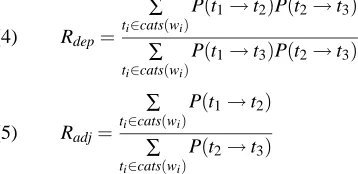
1993). Lauer (1995) proposes an unsupervised method for estimating the frequencies of the competing brack-etings based on a taxonomy or a thesaurus. He uses a probability ratio to compare the probability of the left-branching analysis to that of the right-left-branching (see (4) for the dependency model and (5) for the adjacency model).
Rdep=
∑
ti∈cats(wi)
P(t1→t2)P(t2→t3)
∑
ti∈cats(wi)
P(t1→t3)P(t2→t3) (4)
Radj=
∑
ti∈cats(wi)
P(t1→t2)
∑
ti∈cats(wi)
P(t2→t3) (5)
Here t1, t2and t3are conceptual categories in the taxon-omy or thesaurus, and the nouns w1. . .wiare members of
these categories. The estimation of probabilities over con-cepts (rather than words) reduces the number of model parameters and effectively decreases the amount of train-ing data required. The probability P(t1→t2)denotes the modification of a category t2by a category t1.
scheme which takes strictly adjacent nouns into account. Performance increased further by 3.2% when POS tags were taken into account. The results for this tuned model are also given in Table 9. Finally, Lauer conducted an ex-periment with human judges to assess the upper bound for the bracketing task. An average accuracy of 81.50% was obtained.
We replicated Lauer’s (1995) results for compound noun bracketing using the same test set. We compared the performance of the adjacency and dependency mod-els (see (4) and (5)), but instead of relying on a corpus and a thesaurus, we estimated the relevant probabilities us-ing web counts. The latter were obtained usus-ing inflected queries (see Section 2) and Altavista’s NEAR operator. Ties were resolved by defaulting to the most frequent analysis (i.e., left-branching). To gauge the performance of the web-based models we compared them against their BNC-based alternatives; the performance of the best Al-tavista model was significantly higher than that of the best BNC model (see Table 8). A comparison with the literature (see Table 9) shows that the best BNC model fails to significantly outperform the baseline, and it per-forms significantly worse than the best model in the liter-ature (Lauer’s tuned model). The best Altavista model, on the other hand, is not significantly different from Lauer’s tuned model and significantly outperforms the baseline. Hence we achieve the same performance as Lauer with-out recourse to a predefined taxonomy or a thesaurus.
7
Interpretation of Compound Nouns
The second analysis task we consider is the semantic interpretation of compound nouns. Most previous ap-proaches to this problem have focused on the interpre-tation of two word compounds whose nouns are related via a basic set of semantic relations (e.g.,CAUSErelates
onion tears,FORrelatespet spray). The majority of pro-posals are symbolic and therefore limited to a specific domain due to the large effort involved in hand-coding semantic information (see Lauer 1995 for an extensive overview).
Lauer (1995) is the first to propose and evaluate an un-supervised probabilistic model of compound noun inter-pretation for domain independent text. By recasting the interpretation problem in terms of paraphrasing, Lauer assumes that the semantic relations of compound heads and modifiers can be expressed via prepositions that (in contrast to abstract semantic relations) can be found in a corpus. For example, in order to interpretwar story, one needs to find in a corpus related paraphrases:story about the war,story of the war,story in the war, etc. Lauer uses eight prepositions for the paraphrasing task (of, for, in, at, on, from, with, about). A simple model of compound noun paraphrasing is shown in (6):
p∗=arg max
p P(p|n1,n2)
(6)
Lauer (1995) points out that the above model contains one parameter for every triplehp,n1,n2i, and as a result
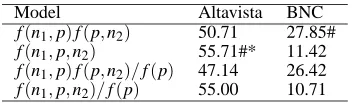
Model Altavista BNC
[image:6.612.338.514.70.122.2]f(n1,p)f(p,n2) 50.71 27.85# f(n1,p,n2) 55.71#* 11.42 f(n1,p)f(p,n2)/f(p) 47.14 26.42 f(n1,p,n2)/f(p) 55.00 10.71
Table 10: Performance of Altavista counts and BNC counts for compound interpretation (data from Lauer 1995)
Model Accuracy
Best BNC 27.856†‡
Lauer (1995): concept-based 28.00
Baseline 33.00
Lauer (1995): word-based 40.00
Best Altavista 55.71†‡
Table 11: Performance comparison with the literature for compound interpretation
hundreds of millions of training instances would be nec-essary. As an alternative to (6), he proposes the model in (7) which combines the probability of the modifier given a certain preposition with the probability of the head given the same preposition, and assumes that these two probabilities are independent.
p∗=arg max
p
∑
t1∈cats(n1)
t2∈cats(n2)
P(t1|p)P(t2|p) (7)
Here, t1and t2 represent concepts in Roget’s thesaurus. Lauer (1995) also experimented with a lexicalized ver-sion of (7) where probabilities are calculated on the basis of word (rather than concept) frequencies which Lauer obtained from Grolier’s encyclopedia heuristically via pattern matching.
Lauer (1995) tested the model in (7) on 282 com-pounds that he selected randomly from Grolier’s encyclo-pedia and annotated with their paraphrasing prepositions. The prepositionof accounted for 33% of the paraphrases in this data set (see Baseline in Table 11). The concept-based model (see (7)) achieved an accuracy of 28% on this test set, whereas its lexicalized version reached an accuracy of 40% (see Table 11).
We attempted the interpretation task with the lexi-calized version of the bigram model (see (7)), but also tried the more data intensive trigram model (see (6)), again in its lexicalized form. Furthermore, we experi-mented with several conditional and unconditional vari-ants of (7) and (6). Co-occurrence frequencies were es-timated from the web using inflected queries (see Sec-tion 2). Determiners were inserted before nouns result-ing in queries of the type story/stories about and
[image:6.612.347.504.165.224.2]Altavista BNC
Model Count Uncount Count Uncount
f(n) 87.01 90.13 87.32# 90.39#
f(det,n) 88.38#6 ∗ 91.22#6 ∗ 51.01 50.23 f(det,n)/f(n) 83.19 85.38 50.95 50.23
[image:7.612.72.305.69.130.2]Backoff 87.01 89.80 – –
Table 12: Performance of Altavista counts and BNC counts for noun countability detection (data from Bald-win and Bond 2003)
achieved a performance that is not significantly different from the baseline, and significantly worse than Lauer’s best model.
8
Noun Countability Detection
The next analysis task that we consider is the problem of determining the countability of nouns. Countability is the semantic property that determines whether a noun can occur in singular and plural forms, and affects the range of permissible modifiers. In English, nouns are typically either countable (e.g.,one dog,two dogs) or uncountable (e.g.,some peace, *one peace, *two peaces).
Baldwin and Bond (2003) propose a method for auto-matically learning the countability of English nouns from the BNC. They obtain information about noun countabil-ity by merging lexical entries from COMLEX (Grishman et al., 1994) and the ALTJ/E Japanese-to-English seman-tic transfer dictionary (Ikehara et al., 1991). Words are classified into four classes: countable, uncountable, bi-partite (e.g., trousers), and plural only (e.g., goods). A memory-based classifier is used to learn the four-way dis-tinction on the basis of several linguistically motivated features such as: number of the head noun, number of the modifier, subject-verb agreement, plural determiners.
We devised unsupervised models for the countability learning task and evaluated their performance on Bald-win and Bond’s (2003) test data. We concentrated solely on countable and uncountable nouns, as they account for the vast majority of the data. Four models were tested: (a) compare the frequency of the singular and plural forms of the noun; (b) compare the frequency of determiner-noun pairs that are characteristic of countable or uncountable nouns; the determiners used weremany
for countable andmuch for uncountable ones; (c) same as model (b), but the det-noun frequencies are normalized by the frequency of the noun; (d) backoff: try to make a decision using det-noun frequencies; if these are too sparse, back off to singular/plural frequencies.
Unigram and bigram frequencies were estimated from the web using literal queries; for models (a)–(c) a thresh-old parameter was optimized on the development set (this parameter determines the ratio of singular/plural frequen-cies or det-noun frequenfrequen-cies above which a noun was considered as countable). For model (b), an additional backoff parameter was used, specifying the minimum fre-quency that triggers backoff.
The models and their performance on the test set are
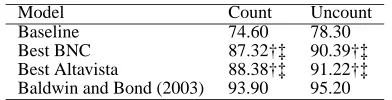
Model Count Uncount
Baseline 74.60 78.30
Best BNC 87.32†‡ 90.39†‡
[image:7.612.328.524.70.120.2]Best Altavista 88.38†‡ 91.22†‡ Baldwin and Bond (2003) 93.90 95.20
Table 13: Performance comparison with the literature for noun countability detection
listed in Table 12. The best Altavista model is the condi-tional det-noun model ( f(det,n)/f(n)), which achieves 88.38% on countable and 91.22% on uncountable nouns. On the BNC, the simple unigram model performs best. Its performance is not statistically different from that of the best Altavista model. Note that for the BNC models, data sparseness means the det-noun models perform poorly, which is why the backoff model was not attempted here. Table 13 shows that both the Altavista model and BNC model significantly outperform the baseline (relative fre-quency of the majority class on the gold-standard data). The comparison with the literature shows that both the Altavista and the BNC model perform significantly worse than the best model proposed by Baldwin and Bond (2003); this is a supervised model that uses many more features than just singular/plural frequency and det-noun frequency.
9
Conclusions
We showed that simple, unsupervised models using web counts can be devised for a variety of NLP tasks. The tasks were selected so that they cover both syntax and se-mantics, both generation and analysis, and a wider range of n-grams than have been previously used.
For all but two tasks (candidate selection for MT and noun countability detection) we found that simple, usupervised models perform significantly better when n-gram frequencies are obtained from the web rather than from a standard large corpus. This result is consistent with Keller and Lapata’s (2003) findings that the web yields better counts than the BNC. The reason for this seems to be that the web is much larger than the BNC (about 1000 times); the size seems to compensate for the fact that simple heuristics were used to obtain web counts, and for the noise inherent in web data.
Our results were less encouraging when it comes to comparisons with state-of-the-art models. We found that in all but one case, web-based models fail to significantly outperform the state of the art. The exception was com-pound noun interpretation, for which the Altavista model was significantly better than the Lauer’s (1995) model. For three tasks (candidate selection for MT, adjective or-dering, and compound noun bracketing), we found that the performance of the web-based models was not signif-icantly different from the performance of the best models reported in the literature.
tri-gram frequencies, but also to linguistic information such as part-of-speech tags, semantic restrictions, or context (or a thesaurus, in the case of Lauer’s models). When un-supervised web-based models are compared against su-pervised methods that employ a wide variety of features, we observe that having access to linguistic information makes up for the lack of vast amounts of data.
Our results therefore indicate that large data sets such as those obtained from the web are not the panacea that they are claimed to be (at least implicitly) by authors such as Grefenstette (1998) and Keller and Lapata (2003). Rather, in our opinion, web-based models should be used as a new baseline for NLP tasks. The web baseline indi-cates how much can be achieved with a simple, unsuper-vised model based on n-grams with access to a huge data set. This baseline is more realistic than baselines obtained from standard corpora; it is generally harder to beat, as our comparisons with the BNC baseline throughout this paper have shown.
Note that for certain tasks, the performance of a web baseline model might actually be sufficient, so that the ef-fort of constructing a sophisticated supervised model and annotating the necessary training data can be avoided. Another possibility that needs further investigation is the combination of web-based models with supervised meth-ods. This can be done with ensemble learning methods or simply by using web-based frequencies (or probabil-ities) as features (in addition to linguistically motivated features) to train supervised classifiers.
Acknowledgments
We are grateful to Tim Baldwin, Silviu Cucerzan, Mark Lauer, Rob Malouf, Detelef Prescher, and Adwait Ratna-parkhi for making their data sets available.
References
Baldwin, Timothy and Francis Bond. 2003. Learning the count-ability of English nouns from corpus data. In Proceedings of the 41st Annual Meeting of the Association for Computa-tional Linguistics. Sapporo, Japan, pages 463–470.
Banko, Michele and Eric Brill. 2001a. Mitigating the paucity-of-data problem: Exploring the effect of training corpus size on classifier performance for natural language processing. In James Allan, editor, Proceedings of the 1st International Conference on Human Language Technology Research. Mor-gan Kaufmann, San Francisco.
Banko, Michele and Eric Brill. 2001b. Scaling to very very large corpora for natural language disambiguation. In Pro-ceedings of the 39th Annual Meeting of the Association for Computational Linguistics. Toulouse, France.
Burnard, Lou. 1995. The Users Reference Guide for the British National Corpus. British National Corpus Consortium, Ox-ford University Computing Service.
Corley, Steffan, Martin Corley, Frank Keller, Matthew W. Crocker, and Shari Trewin. 2001. Finding syntactic struc-ture in unparsed corpora: The Gsearch corpus query system. Computers and the Humanities 35(2):81–94.
Cucerzan, Silviu and David Yarowsky. 2002. Augmented mix-ture models for lexical disambiguation. In Jan Hajiˇc and Yuji Matsumoto, editors, Proceedings of the Conference on
Em-pirical Methods in Natural Language Processing. Philadel-phia, PA, pages 33–40.
Dagan, Ido and Alon Itai. 1994. Machine translation diver-gences: A formal description and proposed solution. Com-putational Linguistics 20(4):563–597.
Golding, Andrew R. 1995. A Bayesian hybrid method for context-sensitive spelling correction. In David Yarowsky and Kenneth W. Church, editors, Proceedings of the 3rd Work-shop on Very Large Corpora. Cambridge, MA, pages 39–53. Golding, Andrew R. and Dan Roth. 1999. A winnow-based approach to context sensitive spelling correction. Machine Learning 34(1–3):1–25.
Golding, Andrew R. and Yves Schabes. 1996. Combin-ing trigram-based and feature-based methods for context-sensitive spelling correction. In Proceedings of the 34th An-nual Meeting of the Association for Computational Linguis-tics. Santa Cruz, CA, pages 71–78.
Grefenstette, Gregory. 1998. The World Wide Web as a resource for example-based machine translation tasks. In Proceedings of the ASLIB Conference on Translating and the Computer. London.
Grishman, Ralph, Catherine Macleod, and Adam Meyers. 1994. COMLEX syntax: Building a computational lexicon. In Pro-ceedings of the 15th International Conference on Computa-tional Linguistics. Kyoto, Japan, pages 268–272.
Ikehara, Satoru, Satoshi Shirai, Akio Yokoo, and Hiromi Nakaiwa. 1991. Toward an MT system without pre-editing effects of new methods in ALT-J/E. In Proceedings of the Third Machine Translation Summit. Washington, DC, pages 101–106.
Jones, Michael P. and James H. Martin. 1997. Contextual spelling correction using latent semantic analysis. In Pro-ceedings of the 5th Conference on Applied Natural Language Processing. Washington, DC, pages 166–173.
Keller, Frank and Mirella Lapata. 2003. Using the web to obtain frequencies for unseen bigrams. Computational Linguistics 29(3):459–484.
Lauer, Mark. 1995. Corpus statistics meet the noun compound: Some empirical results. In Proceedings of the 33rd Annual Meeting of the Association for Computational Linguistics. Cambridge, MA, pages 47–54.
Malouf, Robert. 2000. The order of prenominal adjectives in natural language generation. In Proceedings of the 38th An-nual Meeting of the Association for Computational Linguis-tics. Hong Kong, pages 85–92.
Mangu, Lidia and Eric Brill. 1997. Automatic rule acquisi-tion of spelling correcacquisi-tion. In Proceedings of the 14th Inter-national Conference on Machine Learning. Nashville, Ten-nessee, pages 187–194.
Marcus, Mitchell P., Beatrice Santorini, and Mary Ann Marcinkiewicz. 1993. Building a large annotated corpus of English: The Penn treebank. Computational Linguistics 19(2):313–330.
Prescher, Detlef, Stefan Riezler, and Mats Rooth. 2000. Using a probabilistic class-based lexicon for lexical ambiguity res-olution. In Proceedings of the 18th International Conference on Computational Linguistics. Saarbr ¨ucken, Germany, pages 649–655.
Pustejovsky, James, Sabine Bergler, and Peter Anick. 1993. Lexical semantic techniques for corpus analysis. Computa-tional Linguistics 19(3):331–358.
Resnik, Philip Stuart. 1993. Selection and Information: A Class-Based Approach to Lexical Relationships. Ph.D. the-sis, University of Pennsylvania.