283
Incivility Detection in Online Comments
Farig Sadeque School of Information University of Arizona
Tucson, AZ 85721 [email protected]
Stephen Rains Dept. of Communication
University of Arizona Tucson, AZ 85721 [email protected]
Yotam Shmargad
School of Govt. and Public Policy University of Arizona
Tucson, AZ 85721 [email protected]
Kate Kenski Dept. of Communication
University of Arizona Tucson, AZ 85721 [email protected]
Kevin Coe
Dept. of Communication University of Utah Salt Lake City, UT 84112
Steven Bethard School of Information University of Arizona
Tucson, AZ 85721 [email protected]
Abstract
Incivility in public discourse has been a ma-jor concern in recent times as it can affect the quality and tenacity of the discourse negatively. In this paper, we present neural models that can learn to detect name-calling and vulgarity from a newspaper comment section. We show that in contrast to prior work on detecting toxic language, fine-grained incivilities like name-calling cannot be accurately detected by sim-ple models like logistic regression. We ap-ply the models trained on the newspaper com-ments data to detect uncivil comcom-ments in a Russian troll dataset, and find that despite the change of domain, the model makes accurate predictions.
1 Introduction
Online harassment, colloquially known as cyber-bullying or cyber harassment, has been rampant since the introduction of the Internet to the general population. It has been a major cause of concern since the mid- and late-90’s, and is a thoroughly researched topic in the fields of social science, be-havioral science, network science and computer se-curity. Cyberbullying is a form of harassment that is carried out using electronic modes of communi-cation like computer, phone, and in almost all the cases in recent years, the Internet. Cyberbullying is defined as a “willful and repeated harm inflicted through the medium of electronic text” byPatchin and Hinduja(2006)- but this phenomenon goes far beyond the scope of just electronic text. A more comprehensive definition of cyberbullying can be found in one of their later works, where they de-fined cyberbullying as “a form of harassment using
electronic mode of communication” (Hinduja and Patchin,2008).Fauman(2008) described cyberbul-lying as “bulcyberbul-lying through the use of technology such as the Internet and cellular phones”.
The spectrum of online harassment is vast; hence, we focus on one segment of this phe-nomenon: online incivility. Incivility has been rampant in American society for quite some time. Incivility is described asfeatures of discussion that convey an unnecessarily disrespectful tone toward the discussion forum, its participants, or its topics (Coe et al.,2014). While it is often said that in-civility is “very much in the eye of the beholder” and what is civil to someone may be uncivil to another (Kenski et al.,2017), some are universal nevertheless. One study has suggested that 69% of Americans believe that incivility in public dis-course has become a rampant problem, and only 6% do not identify it as a problem (Shandwick,2018). The average number of incivility encounters per week has also risen drastically in both the physical world and cyberspace. Social media encounters are especially alarming: a person who encountered any form of incivility anywhere, had on average 5.4 uncivil encounters per week in online social media platforms in 2018, which is almost double the amount from late 2016.
on pre-trained contextual embeddings. We applied our newspaper-comments-trained model to a dat-saets of Russian troll tweets to observe how the model generalizes from one platform to another.
2 Related Works
Kenski et al.(2017) divided incivility into several different forms, including name-calling, vulgarity, lying accusation, pejorative, and aspersion. They took comments posted by regulars in a newspaper website, and annotated these for the various forms of incivility. Their research focused mostly on the demographics and other individual attributes of readers of these comments and how they perceived incivility in these comments.
Rains et al.(2017) focused more on the perpe-trators of incivility rather than the readers. They researched a handful of news articles published in the Arizona Daily Star newspaper website and the comments posted about these articles, then man-ually annotated these comments and their posters for their incivility and political orientation. The authors found that conservatives were significantly less likely to be uncivil in these public discussions compared to liberals, and the likelihood of liberals being uncivil increased with the presence of con-servatives in the same discussion. Liberals were also found to be more repercussive compared to the conservatives.
Recent work has focused on particular forms of incivility, as described in the following sections.
2.1 Generic incivility
Reynolds et al.(2011) developed machine learning models that can detect cyberbullying by identify-ing curse and insult words in social media posts. They have collected a small set of posts from a website named formspring.me and used various non-sequential learning algorithms on this dataset to build a binary classifier for cyberbullying detec-tion.
2.2 Vulgarity
Cachola et al. (2018) used a vulgarity score for better sentiment prediction from a collection of 6800 tweets. They found that vulgarity interacts with key demographic variables like gender, age, religiosity, etc. Other research has also identified demographic keys closely associated with vulgar-ity: Wang et al. (2014) presented a quantitative analysis on the frequency of curse word usage in
Twitter and their variation with certain demograph-ics, andGauthier et al.(2015) analyzed the usage of swear words based on Tweeter users’ age and gender. As none of these papers present any ma-chine learning model that can be used for vulgarity detection,Holgate et al.(2018) claim their work to be the first in vulgarity prediction. They clas-sified functionality of vulgarity in five different cohorts: aggression, emotion expression, emphasis, auxiliary and signalling group identity; and used binary logistic regression classifiers to identify vul-gar texts. They also showed the correlation among demographic variables and vulgarity and found that age, faith, and political ideology have significant correlation with vulgarity usage.
2.3 Racism/sexism
Waseem and Hovy(2016) has presented machine learning models that can be used to detect racism and sexism in social media. They have collected and annotated a set of almost 17000 tweets, and used them to build character based n-gram models for offensive tweet detection. They have provided an extensive list of criteria that identify a tweet as racially and sexually offensive, and showed that demographic information does not add much per-formance to a character-level model.
2.4 Personal attacks
Wulczyn et al. (2017) introduced a methodol-ogy to generate annotations for personal attacks. They have used crowdsourcing to identify a set of Wikipedia comments, and used a machine learning model to imitate this annotation on a much larger scale.Agrawal and Awekar(2018) have developed deep neural models that can detect cyberbullying (Reynolds et al.,2011), racism/sexism (Waseem and Hovy,2016), and personal attacks (Wulczyn et al., 2017) in multiple social media platforms. They claim that theirs is the first work to system-atically analyze cyberbullying in social media to-wards building deep prediction models. They have shown that hand-crafted features using lexicons is not a good idea as abusive word vocabularies vary a lot from one social media platform to another, and swear words are not always considered to be uncivil in social media.
2.5 Name-calling
They identified posts that Reddit moderators had marked as violating the forum’s rules against ad hominem atacks. To identify such posts, they used stacked bidirectional Long-Short Term Mem-ory networks (LSTMs) and Convolutional Neural Networks (CNNs), and achieved 78% and 81% accuracy, respectively. One of their most inter-esting findings was that in 48.6% of the cases, ad hominem attacks are in the last comment of the thread, which shows that personal attacks and name-callings can affect user participation in pub-lic discourses.
Works that closely resemble what we are trying to do have one major issue with the datasets that have been used- they are often annotated by mechanical turks (Wulczyn et al.,2017;Reynolds et al.,2011). Incivility is based on the perception of the person in the receiving end, and this perception varies wildly from person to person. Using turkers that we know almost nothing about is not ideal- as difference in perception may introduce unintended bias in the dataset. Hence, we need a dataset that is annotated by experts who have extensive knowledge on inci-vility detection.Coe et al.(2014) presents one such dataset, and we plan to use this for our incivility detection task (more on this in Section 4).
3 Incivility Classification and Definitions
For our work, we will use the incivility classifica-tion presented byCoe et al.(2014): name-calling, vulgarity, aspersion, lying accusations and pejora-tive for speech. We focus on the two most prevalent forms of these inCoe et al.(2014)’s data: name-calling and vulgarity.
name-calling Ad hominem attacks. Although ad hominem attacks are often used to derail a con-versation by using derogatory terms towards another person, the authors have included ev-ery instances of derogatory remarks, irrespec-tive of target and intention. For example,At least the morons in the state capital no longer have control of this process! is identified as a name-calling comment as it has the word moronin it (Kenski et al.,2017).
vulgarity Contents that include any sort of curse words, including minor ones such as damn (Kenski et al., 2017). For example, I hope the voters will kick that politician out on his pompous ass next election.is marked as vul-gar, as it contains the wordassin it.
4 Data
Coe et al.(2014) graciously shared with us the data that they collected from the comment section of theArizona Daily Starnewspaper. They collected articles and comments between 17 October 2011 and 6 November 2011 from eight news sections: Business, Entertainment, Lifestyles, Local News, Nation and World, Opinion, Sports, and State News. All their data was downloaded and saved manually by one research assistant one day after the articles were posted to provide enough time for the article to garner comments, yet not long enough for the ar-ticle to be deleted. At the end of the data collection period, a total of 706 articles and 6535 comments were collected, out of which they coded 6444 for further analysis.
They used three teams of 3-5 research assistants to code articles and comments for incivility. The teams had extensive training on the coding proce-dures (Coe et al.,2014). The coding process took approximately six weeks, and chance-corrected in-tercoder reliability was established prior to the cod-ing, which ranged between 0.61 to 1.0 Krippen-dorff’s alpha score for different codes. In addition to coding the incivilities present in the comments, they also coded a variety of other metadata, e.g., the author’s name, reactions received for other read-ers (thumbs up or thumbs down), word counts, etc. All the results of the coding procedure were saved in a metadata file created using Microsoft Excel. Comments were saved in separate PDF files named based on the news sections, articles and dates.
5 Challenges in Identifying incivilities from User Contents
As we have mentioned before that incivility is in the eye of the beholder, it is sometimes challenging to identify what can be unequivocally considered as uncivil interaction. Informed by theCoe et al. (2014) data, the following sections discuss some of these challenges.
5.1 Frequency
5.2 Linguistic Variations and Creativity
Oftentimes people refrain from using an exact ver-sion of an uncivil phrase and use an abbreviation or spelling variation of that phrase instead. For example, inAll BS, just like the politicians – the same crap, the term BS is clearly an abbreviation of the wordbullshit. However, there are also in-stances in the data where BS is used to abbreviate a person’s name, which clearly is not an example of uncivil comment. Also, people often like to write uncivil words in spellings that are a derivative form. For example, people often usesh!tinstead ofshit, which clearly are the same thing in a public dis-course. Hundreds of these variations may exist, making for a challenging identification problem.
Another challenge in identifying incivilities is that people can be really creative when they try to attack someone. This often happens when some-one tries to indulge in ad hominem attacks with plausible deniability. For example, we have ob-served people using the wordDemocRatinstead of Democratto identify someone with a democratic political orientation. Although these two words look similar, and sound exactly the same, Demo-cRat indicates that the target democrat is also a rat, a colloquial word for a spy, or a dishonest per-son. There are many other examples of this kind of variation, e.g. democraps. This phenomenon is sometimes referred asObscenity Obfuscation, and researchers have found that it is becoming in-creasingly common in user generated contents in all sorts of social media platforms (Rojas-Galeano, 2017).
5.3 Difficulty in Comprehension
It is sometimes difficult to understand whether a word or a phase is used in an uncivil manner with-out understanding the context. For example, the wordlazycan be used to describe the state of some-thing that is actually slow or ineffective (e.g.,lazy algorithms), or it can be used as an ad hominem attack on someone (e.g.,the lazy politicians have ruined this country). As understanding the con-text of a content in a public discourse is difficult, separating these cases based on their contexts is challenging.
6 Incivility Prediction
In this section, we focus on our attempt to create a machine learning model that can be used as an incivility filter for moderators in social media
plat-forms. Our model will exclusively use features obtained from the contents and reciprocations in the platform, while avoiding the demographic infor-mation that was used heavily by prior work. This will allow our models to be used on the large por-tion of online discourse where such demographic information is unavailable, e.g., where users are anonymous.
6.1 Data preparation
We will train our incivility prediction models on theCoe et al. (2014) data discussed in section4. However, that data were designed for use in social science research, not natural language processing research, and thus there were several challenges in working with the data as they were collected, including:
• The comments were saved in PDFs, and the metadata referenced each comment by a num-ber that was drawn (not typed) into the PDF beside the comment.
• The naming conventions for the files were in-consistent (spelling variations, variable length identifiers, etc.)
• Dates were saved using multiple formats (ddmmyy, dd-mm-yy, etc.)
• There were no specific markers in the text that identified the start and end of a comment.
• Many comments contained quotations from other comments, also with no consistent mark-ers of where quotes began or ended.
We solved these problems using a combination of regular expressions (e.g., for normalizing dates), brute-force techniques (e.g., quotations were identi-fied by comparing against all previous comments), and manual revision (e.g., renaming the files whose names were too inconsistent to be resolved auto-matically).
The resulting set of annotated comments were saved in JSON format for further computational analysis. We ended up with 6175 comments from the original set of 6444 comments after the extrac-tion and cleaning process.
6.2 Prediction Task
trained on public discourse data would work on a social media platform. We first divided our dataset into three smaller sets: train, development and test sets. Comments are randomly assigned to sets, and we ended up with 3950 comments in the training set, 989 comments in the validation set and 1236 comments in the test set. We set the the test set aside for our final evaluation, and worked only on the training and validation dataset to find the best model that can fit the problem.
6.3 Baselines
We found a similar task in Kaggle1(Wulczyn et al., 2017) that tries to identify toxicity of comments in the discourse section of Wikipedia. In that task, the best performing model was a recurrent neural network model with gated recurrent units (GRUs; Cho et al.,2014), but some simple non-sequential models (logistic regressions and support vector ma-chines) also performed almost as well as the se-quential model on that task.
For our baseline, we used two non-sequential machine learning techniques: logistic regression and support vector machines, using TF-IDF vec-tors obtained over words in the comments. We also considered a state-of-the-art out-of-the-box text classification model as a baseline, the Flair text classification model (Akbik et al., 2018), which uses GloVe word embeddings (Pennington et al., 2014) and pre-trained contextual word embeddings derived from two character-level language models. Flair achieved state-of-the-art performance in part-of-speech tagging and named-entity recognition tasks, and we thought that the character-based na-ture of the Flair model might be helpful in the face of the linguistic variation and creativity challenges we discussed earlier.
6.4 Model
Our model was inspired by the top performing sys-tems in the Kaggle competition, and started with FastText embeddings (Joulin et al.,2016) for each of the words in a comment. These word vectors were fed to a recurrent layer consisting of bidirec-tional GRUs. The outputs of the GRUs were fed to an average pooling layer and a max pooling layer, which were then concatenated2. The output of the pooling was then fed through a sigmoid layer to
1
https://www.kaggle.com/c/jigsaw-toxic-comment-classification-challenge
2This type of pooling worked well forDemidov(2018),
and also performed well in our preliminary analysis.
produce the outputs. To avoid overfitting, we used a dropout layer (Srivastava et al.,2014) with 0.2 probability in between the input and hidden layer. We set the maximum length of input to 500 words for each comment, as this garnered the best valida-tion performance in our preliminary analysis. We set class weights based on the frequency of name-calling and vulgarity: non-name-name-calling comments are 7 times more common than the name-calling ones, and non-vulgar comments are 35 times more common than vulgar ones, so we used a weight-ing scheme of 1:7 for name-callweight-ing and 1:35 for vulgarity. The model was trained with the Adam optimizer (Kingma and Ba,2015) on mini-batches of size 32, with other hyperparameters set to their defaults. We trained each instance of this model for at most 500 epochs, with the option of early stopping if the validation accuracy did not improve for 10 consecutive epochs. A general structure of this model is shown in figure1.
To further improve our model, we wanted to incorporate any metadata that were available to use. Coe et al. (2014) found that the thumbs up and thumbs downs received by a comment, the section of the article, and the author of the article all had some significance regarding incivility in the forum. So we introduced these metadata as features in our model. We created normalized feature vectors built on these attributes, and introduced them as auxiliary features right before the sigmoid layer, by concatenating them with the output of the pooling layers.
We also explored external resources that could improve our model. We created a pretrained model on the Kaggle dataset discussed earlier, as it had a large amount of annotated comments (over 160 thousand comments obtained from Wikipedia con-tributor’s community). We used the same RNN model to train on the Kaggle data until it reached convergence, then retrained the model using our Arizona Daily Stardata. The only portion of the model that was not shared between the pre-training (on Kaggle) and the training (on Arizona Daily Star) was the output sigmoid layers.
6.5 Experimental Results
Sigmoid
Concatenation
Auxiliary features
Max pooling
Average pooling
Bidirectional GRU (160)
Embedding (500)
Input
Civil/Uncivil
[image:6.595.100.512.65.307.2]lazy politicians ruined this country
Figure 1: General structure of the RNN model. Auxiliary features are optional.
Validation
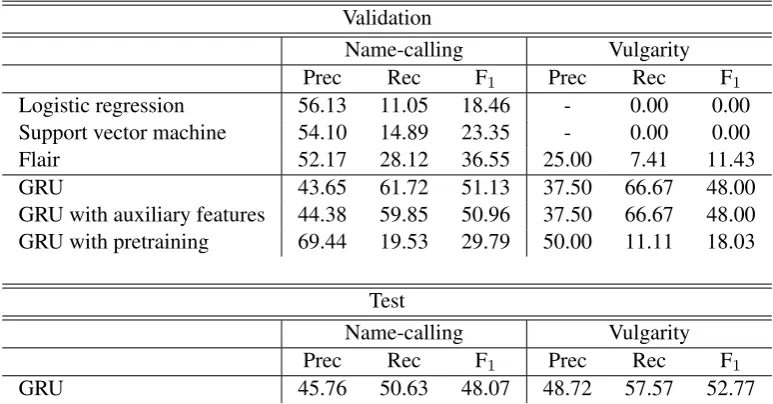
Name-calling Vulgarity Prec Rec F1 Prec Rec F1 Logistic regression 56.13 11.05 18.46 - 0.00 0.00 Support vector machine 54.10 14.89 23.35 - 0.00 0.00 Flair 52.17 28.12 36.55 25.00 7.41 11.43
GRU 43.65 61.72 51.13 37.50 66.67 48.00
GRU with auxiliary features 44.38 59.85 50.96 37.50 66.67 48.00 GRU with pretraining 69.44 19.53 29.79 50.00 11.11 18.03
Test
Name-calling Vulgarity Prec Rec F1 Prec Rec F1
GRU 45.76 50.63 48.07 48.72 57.57 52.77
Table 1: Performance of the models in terms of Precision (Prec), Recall (Rec), and F-measure (F1).
instances of vulgarity in the development dataset, hence, Flair automatically outperformed these two. But our GRU-based model easily outperformed the Flair model (51.13 vs. 36.55 F1 in name-calling, and 48.00 vs. 11.43 F1 in vulgarity). These re-sults stand in contrast to the Kaggle competition on toxicity detection, where such baselines performed nearly as well as the best (GRU-based) model, and all models achieved high levels of performance (>0.98 area under receiver operating characteristic curve). This suggests that the finer-grained inci-vility detection formulated byCoe et al.(2014) is more challenging than simple toxicity detection.
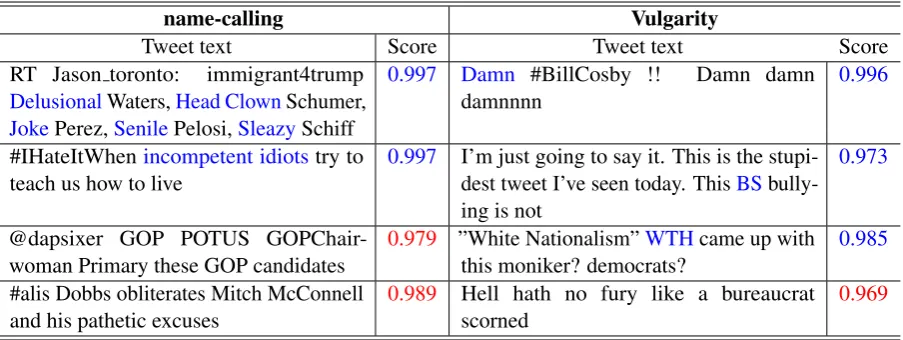
[image:6.595.105.492.339.541.2]name-calling Vulgarity
Tweet text Score Tweet text Score
RT Jason toronto: immigrant4trump
DelusionalWaters,Head ClownSchumer,
JokePerez,SenilePelosi,SleazySchiff
0.997 Damn #BillCosby !! Damn damn
damnnnn
0.996
#IHateItWhenincompetent idiots try to teach us how to live
0.997 I’m just going to say it. This is the
stupi-dest tweet I’ve seen today. ThisBS bully-ing is not
0.973
@dapsixer GOP POTUS GOPChair-woman Primary these GOP candidates
0.979 ”White Nationalism”WTHcame up with this moniker? democrats?
0.985
#alis Dobbs obliterates Mitch McConnell and his pathetic excuses
0.989 Hell hath no fury like a bureaucrat scorned
[image:7.595.74.526.62.232.2]0.969
Table 2: Examples of the GRU-based model predictions on the Russian troll Twitter data.
Since the GRU model with no auxiliary features or pre-training performed best on the development set, we evaluated the performance of this model on the test set. It achieved 48.07 F-measure for name-calling and 52.77 for vulgarity, scores roughly sim-ilar to what we had seen on the development data.
7 Incivility Prediction in Twitter
Though we built our models to detect incivilities in newspaper comments, we were interested in how well they would perform in other domains of social media.Karan and ˇSnajder(2018) has showed that cross-domain adaptation for detecting abusive lan-guage is possible- hence we would like to observe how well our model performs on a set of tweets.
In June 2018, The United States House Intel-ligence Committee released a list of 3841 Twit-ter account names that were human-operated troll accounts associated with Russia’s Internet Re-search Agency. Darren Linvill and Patrick Warren from Clemson University collected all the tweets published since June 2015 from these accounts, cleaned them, and published a set of almost 3 million tweets (Linvill and Warren,2018). These tweets are publicly available in FiveThirtyEight’s Github page3.
As prior research suggest that trolls are a big source of incivility in social media platforms ( Fau-man,2008;Hinduja and Patchin,2008), we took this opportunity to observe how our model per-forms on this dataset. We downloaded all the tweet texts and ran our GRU-based model on these texts. Results of this experiment can be found in the
au-3https://github.com/fivethirtyeight/
russian-troll-tweets
thor’s GitHub repository4.
7.1 Observations
Our model identified 13% of all tweets as name-calling and 1.7% as vulgarity. These are roughly similar to the Arizona Daily Star training data, which had 14% name-calling and and 2.8% vul-garity. Though we do not have access to the expert annotators used byCoe et al.(2014), but we can nonetheless get an approximate measure of our model’s performance by sampling predictions from our model and estimating the true label following theCoe et al.(2014) annotation guidelines.
To measure our model’s precision, we took the 250 tweets that our model was most certain con-tained name-calling, and the 250 tweets that our model was most certain contained vulgarity. We manually reviewed each of these 500 tweets, and found only 7 instances of mistakenly tagged name-calling and 5 instances of mistakenly tagged vulgar-ity. To get a rough sense of our model’s recall, we looked at the other end of the model’s prediction spectrum. Based on a manual review of the model’s prediction, the model almost never makes a mis-take when the prediction score is below 10%; we found only one instance of mistaken name-calling, and no instance of mistaken vulgarity in the bottom 250 tweets that we manually annotated.
Table 2 shows some example tweets and the prediction scores from our model. The bottom two examples under name-calling and the bottom one example under vulgarity represent mistakes. In the first name-calling error, the model is confi-dent (probability 0.979) that there is a name-calling,
perhaps because the terms GOP and POTUS fre-quently appear with name-calling in our training data. In the second name-calling error, the model is confident (probability 0.989) that there is a name-calling, likely because of the presence of the word pathetic, which is an aspersion, attacking an idea, not a name-calling, attacking a person. In the vul-garity error, hell has not been used to reference the religious concept of hell, but the word strongly associated with vulgarity in the training data. The table also shows some examples of reasonable suc-cesses of the model, for example, handling vulgar abbreviations like BS (short forbullshit) and WTH (short forWho the hell).
8 Future Works and Conclusion
Our work here aims towards keeping a civil en-vironment in public discourse forums and social media platforms. Our goal was to build a filtering system that could work alongside human moder-ators to reduce their workload, be objective and independent of user reporting, and perform well on previously unseen social media streams. There is much work to do in this area: annotation of a large random sample of the troll tweets can give a more thorough estimate of model performance, and various forms of domain adaptation like self-training might be applied to improve the perfor-mance of the model. We have used word n-grams for features in our baseline models, which can be improved by using features obtained from domain-specific lexicons. There are lexicons of abusive words (Wiegand et al.,2018)- which can be used to create non-sequential models with smaller feature sets. Whether these simpler models are better is yet to be proven - asAgrawal and Awekar(2018) has shown that vocabulary of words used for cyber-bullying varies significantly from one social media platform to another. They have also showed that swear words are not necessary to be uncivil in on-line social media- hence these types of detection techniques should not rely on such hand-crafted features.
One research question that follows this work is to observe whether incivility affects user engage-ment in social media. Prior research has observed that receiving replies can have effects in a user’s engagement (Joyce and Kraut,2006;Sadeque et al., 2015), and the language of these replies can also have consequences (Arguello et al.,2006). Haber-nal et al.(2018) has showed that 48% of comments
that included ad hominem attacks ended the argu-ment – which is indicative of lower engageargu-ment by the entire community. Hence, we believe that incivility has a significant influence on user engage-ment, and in turn may contribute to a community’s sustainability. This is yet to be proven, and more work needs to be performed to prove or disprove this hypothesis.
In this paper, we have presented a recurrent neu-ral that can identify incivilities in public discourse. Though trained on a corpus of newspaper com-ments, we have initial evidence that it also performs well in detecting incivilities in Twitter. We believe our model will be able to serve as a wide-range incivility filter in other social media platforms.
References
Sweta Agrawal and Amit Awekar. 2018. Deep learn-ing for detectlearn-ing cyberbullylearn-ing across multiple
so-cial media platforms.CoRR, abs/1801.06482.
Alan Akbik, Duncan Blythe, and Roland Vollgraf. 2018. Contextual string embeddings for sequence labeling. InCOLING 2018, 27th International Con-ference on Computational Linguistics, pages 1638– 1649.
Jaime Arguello, Brian S. Butler, Elisabeth Joyce, Robert Kraut, Kimberly S. Ling, Carolyn Ros´e, and Xiaoqing Wang. 2006. Talk to me: Foundations for successful individual-group interactions in
on-line communities. In Proceedings of the SIGCHI
Conference on Human Factors in Computing Sys-tems, CHI ’06, pages 959–968, New York, NY, USA. ACM.
Isabel Cachola, Eric Holgate, Daniel Preot¸iuc-Pietro, and Junyi Jessy Li. 2018. Expressively vulgar: The socio-dynamics of vulgarity and its effects on sen-timent analysis in social media. In Proceedings of the 27th International Conference on Computational Linguistics, pages 2927–2938.
Kyunghyun Cho, Bart van Merrienboer, Dzmitry Bah-danau, and Yoshua Bengio. 2014. On the properties of neural machine translation: Encoder-decoder ap-proaches. InEighth Workshop on Syntax, Semantics and Structure in Statistical Translation (SSST-8).
Kevin Coe, Kate Kenski, and Stephen A. Rains. 2014. Online and uncivil? patterns and determinants of
in-civility in newspaper website comments. Journal of
Communication, 64(4):658–679.
Michael A. Fauman. 2008. Cyber bullying: Bullying
in the digital age. American Journal of Psychiatry,
165(6):780–781.
Michael Gauthier, Adrien Guille, Fabien Rico, and An-thony Deseille. 2015. Text mining and twitter to ana-lyze british swearing habits. InHandbook of Twitter for Research.
Ivan Habernal, Henning Wachsmuth, Iryna Gurevych, and Benno Stein. 2018. Before name-calling: Dy-namics and triggers of ad hominem fallacies in web argumentation. arXiv preprint arXiv:1802.06613.
Sameer Hinduja and Justin W. Patchin. 2008. Cyber-bullying: An exploratory analysis of factors related
to offending and victimization. Deviant Behavior,
29(2):129–156.
Eric Holgate, Isabel Cachola, Daniel Preot¸iuc-Pietro, and Junyi Jessy Li. 2018. Why swear? analyzing and inferring the intentions of vulgar expressions. In Proceedings of the 2018 Conference on Empiri-cal Methods in Natural Language Processing, pages 4405–4414.
Armand Joulin, Edouard Grave, Piotr Bojanowski, and Tomas Mikolov. 2016.Bag of tricks for efficient text
classification. CoRR, abs/1607.01759.
Elisabeth Joyce and Robert E. Kraut. 2006.
Predict-ing continued participation in newsgroups. Journal
of Computer-Mediated Communication, 11(3):723– 747.
Mladen Karan and Jan ˇSnajder. 2018. Cross-domain
detection of abusive language online. In
Proceed-ings of the 2nd Workshop on Abusive Language On-line (ALW2), pages 132–137, Brussels, Belgium. As-sociation for Computational Linguistics.
Kate Kenski, Kevin Coe, and Stephen A. Rains. 2017. Perceptions of uncivil discourse online: An
exami-nation of types and predictors. Communication
Re-search, 0(0):0093650217699933.
Diederik Kingma and Jimmy Ba. 2015. Adam: A method for stochastic optimization. International Conference on Learning Representation.
Darren L. Linvill and Patrcik L. Warren. 2018. Troll factories: The internet research agency and state-sponsored agenda building. https://www. rcmediafreedom.eu/Publications/ Academic-sources/Troll-Factories-
The-Internet-\Research-Agency-and-State-Sponsored\-Agenda-Building.
Justin W. Patchin and Sameer Hinduja. 2006. Bullies move beyond the schoolyard: A preliminary look at
cyberbullying. Youth Violence and Juvenile Justice,
4(2):148–169.
Jeffrey Pennington, Richard Socher, and Christopher D. Manning. 2014.Glove: Global vectors for word
rep-resentation. InEmpirical Methods in Natural
Lan-guage Processing (EMNLP), pages 1532–1543.
Stephen A. Rains, Kate Kenski, Kevin Coe, and Jake Harwood. 2017. Incivility and political identity on the internet: Intergroup factors as predictors of
incivility in discussions of news online. Journal
of Computer-Mediated Communication, 22(4):163– 178.
Kelly Reynolds, April Kontostathis, and Lynne Ed-wards. 2011. Using machine learning to detect cy-berbullying. In2011 10th International Conference on Machine learning and applications and work-shops, volume 2, pages 241–244. IEEE.
Sergio Rojas-Galeano. 2017. On obstructing obscenity
obfuscation.ACM Trans. Web, 11(2):12:1–12:24.
Farig Sadeque, Thamar Solorio, Ted Pedersen, Prasha Shrestha, and Steven Bethard. 2015. Predict-ing continued participation in online health fo-rums. In SIXTH INTERNATIONAL WORKSHOP ON HEALTH TEXT MINING AND INFORMATION ANALYSIS (LOUHI), page 12.
Weber Shandwick. 2018. Civility in america 2018: Civility at work and in our public squares.
https://www.webershandwick.com/wp-
content/uploads/2018/06/Civility-in-America-VII-FINAL.pdf. Last
Ac-cessed: 2018-06-11.
Nitish Srivastava, Geoffrey E Hinton, Alex Krizhevsky, Ilya Sutskever, and Ruslan Salakhutdinov. 2014. Dropout: a simple way to prevent neural networks from overfitting. Journal of Machine Learning Re-search, 15(1):1929–1958.
Wenbo Wang, Lu Chen, Krishnaprasad Thirunarayan, and Amit P. Sheth. 2014. Cursing in english on
twit-ter. InProceedings of the 17th ACM Conference on
Computer Supported Cooperative Work & So-cial Computing, CSCW ’14, pages 415–425, New York, NY, USA. ACM.
Zeerak Waseem and Dirk Hovy. 2016. Hateful sym-bols or hateful people? predictive features for hate
speech detection on twitter. In Proceedings of the
NAACL Student Research Workshop, pages 88–93, San Diego, California. Association for Computa-tional Linguistics.
Michael Wiegand, Josef Ruppenhofer, Anna Schmidt, and Clayton Greenberg. 2018. Inducing a lexicon
of abusive words – a feature-based approach. In
Proceedings of the 2018 Conference of the North American Chapter of the Association for Computa-tional Linguistics: Human Language Technologies, Volume 1 (Long Papers), pages 1046–1056, New Orleans, Louisiana. Association for Computational Linguistics.