Partial Training for a Lexicalized-Grammar Parser
Stephen Clark
Oxford University Computing Laboratory Wolfson Building, Parks Road
Oxford, OX1 3QD, UK
James R. Curran
School of Information Technologies University of Sydney
NSW 2006, Australia [email protected]
Abstract
We propose a solution to the annotation bottleneck for statistical parsing, by ex-ploiting the lexicalized nature of Combi-natory Categorial Grammar (CCG). The parsing model uses predicate-argument dependencies for training, which are de-rived from sequences ofCCGlexical cate-gories rather than full derivations. A sim-ple method is used for extracting depen-dencies from lexical category sequences, resulting in high precision, yet incomplete and noisy data. The dependency parsing model of Clark and Curran (2004b) is ex-tended to exploit this partial training data. Remarkably, the accuracy of the parser trained on data derived from category se-quences alone is only 1.3% worse in terms of F-score than the parser trained on com-plete dependency structures.
1 Introduction
State-of-the-art statistical parsers require large amounts of hand-annotated training data, and are typically based on the Penn Treebank, the largest treebank available for English. Even robust parsers using linguistically sophisticated formalisms, such as TAG (Chiang, 2000), CCG (Clark and Curran, 2004b; Hockenmaier, 2003), HPSG (Miyao et al., 2004) and LFG (Riezler et al., 2002; Cahill et al., 2004), often use training data derived from the Penn Treebank. The labour-intensive nature of the tree-bank development process, which can take many
years, creates a significant barrier for the develop-ment of parsers for new domains and languages.
Previous work has attempted parser adaptation without relying on treebank data from the new do-main (Steedman et al., 2003; Lease and Charniak, 2005). In this paper we propose the use of anno-tated data in the new domain, but onlypartially an-notateddata, which reduces the annotation effort re-quired (Hwa, 1999). We develop a parsing model which can be trained using partial data, by exploiting the properties of lexicalized grammar formalisms. The formalism we use is Combinatory Categorial Grammar (Steedman, 2000), together with a parsing model described in Clark and Curran (2004b) which we adapt for use with partial data.
Parsing with Combinatory Categorial Grammar (CCG) takes place in two stages: first, CCGlexical
categoriesare assigned to the words in the sentence, and then the categories are combined by the parser (Clark and Curran, 2004a). The lexical categories can be thought of as detailed part of speech tags and typically express subcategorization information. We exploit the fact that CCGlexical categories contain a lot of syntactic information, and can therefore be used for training a full parser, even though attach-ment information is not explicitly represented in a category sequence. Our partial training regime only requires sentences to be annotated with lexical cate-gories, rather than full parse trees; therefore the data can be produced much more quickly for a new do-main or language (Clark et al., 2004).
The partial training method uses the log-linear dependency model described in Clark and Curran (2004b), which uses sets of predicate-argument
pendencies, rather than derivations, for training. Our novel idea is that, since there is so much informa-tion in the lexical category sequence, most of the correct dependencies can be easily inferred from the categories alone. More specifically, for a given sen-tence and lexical category sequence, we train on those predicate-argument dependencieswhich occur ink% of the derivations licenced by the lexical cat-egories. By setting the k parameter high, we can produce a set of high precision dependencies for training. A similar idea is proposed by Carroll and Briscoe (2002) for producing high precision data for lexical acquisition.
Using this procedure we are able to produce de-pendency data with over 99% precision and, re-markably, up to 86% recall, when compared against the complete gold-standard dependency data. The high recall figure results from the significant amount of syntactic information in the lexical categories, which reduces the ambiguity in the possible depen-dency structures. Since the recall is not 100%, we require a log-linear training method which works with partial data. Riezler et al. (2002) describe a partial training method for a log-linearLFG parsing model in which the “correct”LFG derivations for a sentence are those consistent with the less detailed gold standard derivation from the Penn Treebank. We use a similar method here by treating a CCG derivation as correct if it isconsistent withthe high-precision partial dependency structure. Section 3 ex-plains what we mean by consistency in this context. Surprisingly, the accuracy of the parser trained on partial data approaches that of the parser trained on full data: our best partial-data model is only 1.3% worse in terms of dependency F-score than the full-data model, despite the fact that the partial full-data does not containanyexplicit attachment information.
2 TheCCGParsing Model
Clark and Curran (2004b) describes two log-linear parsing models for CCG: a normal-form derivation model and a dependency model. In this paper we use the dependency model, which requires sets of predicate-argument dependencies for training.1
1
Hockenmaier and Steedman (2002) describe a generative model of normal-form derivations; one possibility for training this model on partial data, which has not been explored, is to use theEMalgorithm (Pereira and Schabes, 1992).
The predicate-argument dependencies are repre-sented as 5-tuples: hhf, f, s, ha, li, wherehf is the lexical item of the lexical category expressing the dependency relation;f is the lexical category; sis the argument slot; ha is the head word of the ar-gument; and l encodes whether the dependency is non-local. For example, the dependency encoding
companyas the object ofbought(as inIBM bought the company) is represented as follows:
hbought2,(S\NP1)/NP2,2,company4,−i (1)
CCGdependency structures are sets of predicate-argument dependencies. We define the probability of a dependency structure as the sum of the probabil-ities of all those derivations leading to that structure (Clark and Curran, 2004b). “Spurious ambiguity” in CCGmeans that there can be more than one deriva-tion leading to any one dependency structure. Thus, the probability of a dependency structure,π, given a sentence,S, is defined as follows:
P(π|S) = X d∈∆(π)
P(d, π|S) (2)
where∆(π)is the set of derivations which lead toπ. The probability of ahd, πipair,ω, conditional on a sentenceS, is defined using a log-linear form:
P(ω|S) = 1
ZS
eλ.f(ω) (3)
whereλ.f(ω) =Piλifi(ω). The functionfiis the integer-valued frequency function of theith feature;
λi is the weight of theith feature; and ZS is a nor-malising constant.
Clark and Curran (2004b) describes the training procedure for the dependency model, which uses a discriminative estimation method by maximising the conditional likelihood of the model given the data (Riezler et al., 2002). The optimisation of the objec-tive function is performed using the limited-memory BFGS numerical optimisation algorithm (Nocedal and Wright, 1999; Malouf, 2002), which requires calculation of the objective function and the gradi-ent of the objective function at each iteration.
The objective function is defined below, where
He anticipates growth for the auto maker NP (S[dcl]\NP)/NP NP (NP\NP)/NP NP[nb]/N N/N N
Figure 1: Example sentence withCCGlexical categories
L0
(Λ) = L(Λ)−G(Λ) (4)
= m
X
j=1
log X d∈∆(πj)
eλ.f(d,πj)
−
m
X
j=1
log X ω∈ρ(Sj)
eλ.f(ω)−
n
X
i=1 λ2i
2σ2
S1, . . . , Sm are the sentences in the training data;
π1, . . . , πmare the corresponding gold-standard de-pendency structures; ρ(S) is the set of possible
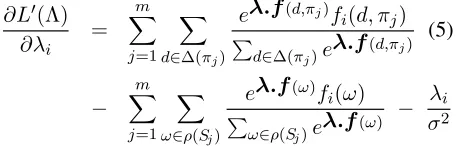
hderivation, dependency-structurei pairs forS;σ is a smoothing parameter; andnis the number of fea-tures. The components of the gradient vector are:
∂L0(Λ)
∂λi =
m
X
j=1
X
d∈∆(πj)
eλ.f(d,πj)fi(d, π
j)
P
d∈∆(πj)e
λ.f(d,πj)
(5)
−
m
X
j=1
X
ω∈ρ(Sj)
eλ.f(ω)fi(ω)
P
ω∈ρ(Sj)e
λ.f(ω) − λi
σ2
The first two terms of the gradient are expecta-tions of feature fi: the first expectation is over all derivations leading to each gold-standard depen-dency structure, and the second is over all deriva-tions for each sentence in the training data. The es-timation process attempts to make the expectations in (5) equal (ignoring the Gaussian prior term). An-other way to think of the estimation process is that it attempts to put as much mass as possible on the derivations leading to the gold-standard structures (Riezler et al., 2002).
Calculation of the feature expectations requires summing over all derivations for a sentence, and summing over all derivations leading to a gold-standard dependency structure. Clark and Cur-ran (2003) shows how the sum over the complete derivation space can be performed efficiently using a packed chart and the inside-outside algorithm, and Clark and Curran (2004b) extends this method to sum over all derivations leading to a gold-standard dependency structure.
3 Partial Training
The partial data we use for training the dependency model is derived from CCG lexical category se-quences only. Figure 1 gives an example sentence adapted from CCGbank (Hockenmaier, 2003) to-gether with its lexical category sequence. Note that, although the attachment of the prepositional phrase to the noun phrase is not explicitly represented, it can be inferred in this example because the lexical category assigned to the preposition has to combine with a noun phrase to the left, and in this example there is only one possibility. One of the key insights in this paper is that the significant amount of syntac-tic information in CCGlexical categories allows us to infer attachment information in many cases.
The procedure we use for extracting dependencies from a sequence of lexical categories is to return all those dependencies which occur ink% of the deriva-tions licenced by the categories. By giving thek pa-rameter a high value, we can extract sets of depen-dencies with very high precision; in fact, assuming that the correct lexical category sequence licences the correct derivation, settingkto 100 must result in 100% precision, since any dependency which occurs in every derivation must occur in the correct deriva-tion. Of course the recall is not guaranteed to be high; decreasingkhas the effect of increasing recall, but at the cost of decreasing precision.
This definition of “correct derivation” will intro-duce some noise into the training data. Noise arises from sentences where the recall of the extracted de-pendencies is less than 100%, since some of the derivations which are consistent with the extracted dependencies for such sentences will be incorrect. Noise also arises from sentences where the preci-sion of the extracted dependencies is less than 100%, since for these sentences every derivation which is consistent with the extracted dependencies will be incorrect. The hope is that, if an incorrect derivation produces mostly correct dependencies, then it can still be useful for training. Section 4 shows how the precision and recall of the extracted dependencies varies withkand how this affects parsing accuracy.
The definitions of the objective function (4) and the gradient (5) for training remain the same in the partial-data case; the only differences are that∆(π) is now defined to be those derivations which are con-sistent with the partial dependency structureπ, and the gold-standard dependency structuresπj are the partial structures extracted from the gold-standard lexical category sequences.2
Clark and Curran (2004b) gives an algorithm for finding all derivations in a packed chart which pro-duce a particular set of dependencies. This algo-rithm is required for calculating the value of the ob-jective function (4) and the first feature expectation in (5). We adapt this algorithm for finding all deriva-tions which are consistent with a partial dependency structure. The new algorithm is shown in Figure 2.
The algorithm relies on the definition of a packed chart, which is an instance of afeature forest(Miyao and Tsujii, 2002). The idea behind a packed chart is that equivalent chart entries of the same type and in the same cell are grouped together, and back point-ers to the daughtpoint-ers indicate how an individual entry was created. Equivalent entries form the same struc-tures in any subsequent parsing.
A feature forest is defined in terms ofdisjunctive
andconjunctivenodes. For a packed chart, the indi-vidual entries in a cell are conjunctive nodes, and the equivalence classes of entries are disjunctive nodes. The definition of a feature forest is as follows: Afeature forestΦis a tuplehC, D, R, γ, δiwhere:
2
Note that the procedure does returnallthe gold-standard dependencies for some sentences.
hC, D, R, γ, δiis a packed chart / feature forest
Gis a set of dependencies returned by the extraction procedure Letcbe a conjunctive node
Letdbe a disjunctive node
deps(c)is the set of dependencies on nodec
cdeps(c) =|deps(c)∩G|
dmax(c) =Pd∈δ(c)dmax(d) +cdeps(c)
dmax(d) = max{dmax(c)|c∈γ(d)}
mark(d):
markdas a correct node
foreachc∈γ(d)
if dmax(c) ==dmax(d)
markcas a correct node
foreachd0 ∈δ(c)
mark(d0
)
foreach dr∈R such thatdmax. (dr) =|G| mark(dr)
Figure 2: Finding nodes in derivations consistent with a partial dependency structure
• Cis a set of conjunctive nodes;
• Dis a set of disjunctive nodes;
• R⊆Dis a set of root disjunctive nodes;
• γ:D→2Cis a conjunctive daughter function;
• δ:C→2Dis a disjunctive daughter function.
Dependencies are associated with conjunctive nodes in the feature forest. For example, if the disjunctive nodes (equivalence classes of individual entries) representing the categoriesNP andS\NP combine to produce a conjunctive node S, the re-sultingS node will have a verb-subject dependency associated with it.
In Figure 2,cdeps(c)is the number of dependen-cies on conjunctive node cwhich appear in partial structure G; dmax(c) is the maximum number of dependencies inGproduced by any sub-derivation headed byc;dmax(d)is the same value for disjunc-tive node d. Recursive definitions for calculating these values are given; the base case occurs when conjunctive nodes have no disjunctive daughters.
less dependencies inGcannot be part of a derivation consistent withG.
The conjunctive and disjunctive nodes appearing in derivations consistent withGform a new “gold-standard” feature forest. The gold-standard forest, and the complete forest containing all derivations spanning the sentence, can be used to estimate the likelihood value and feature expectations required by the estimation algorithm. Let EΦ
Λfi be the ex-pected value of fi over the forest Φ for model Λ; then the values in (5) can be obtained by calculating
EΦj
Λ fi for the complete forestΦj for each sentence
Sj in the training data (the second sum in (5)), and alsoEΨj
Λ fifor each forestΨj of derivations consis-tent with the partial gold-standard dependency struc-ture for sentenceSj (the first sum in (5)):
∂L(Λ)
∂λi =
m
X
j=1
(EΨj
Λ fi−EΛΦjfi) (6)
The likelihood in (4) can be calculated as follows:
L(Λ) = m
X
j=1
(logZΨj −logZΦj) (7)
wherelogZΦis the normalisation constant forΦ.
4 Experiments
The resource used for the experiments is CCGbank (Hockenmaier, 2003), which consists of normal-form CCG derivations derived from the phrase-structure trees in the Penn Treebank. It also contains predicate-argument dependencies which we use for development and final evaluation.
4.1 Accuracy of Dependency Extraction
Sections 2-21 of CCGbank were used to investigate the accuracy of the partial dependency structures re-turned by the extraction procedure. Full, correct de-pendency structures for the sentences in 2-21 were created by running ourCCGparser (Clark and Cur-ran, 2004b) over the gold-standard derivation for each sentence, outputting the dependencies. This re-sulted in full dependency structures for 37,283 of the sentences in sections 2-21.
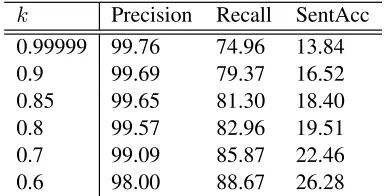
Table 1 gives precision and recall values for the dependencies obtained from the extraction proce-dure, for the 37,283 sentences for which we have
[image:5.612.330.522.58.156.2]k Precision Recall SentAcc 0.99999 99.76 74.96 13.84 0.9 99.69 79.37 16.52 0.85 99.65 81.30 18.40 0.8 99.57 82.96 19.51 0.7 99.09 85.87 22.46 0.6 98.00 88.67 26.28
Table 1: Accuracy of the Partial Dependency Data
complete dependency structures. The SentAcc col-umn gives the percentage of training sentences for which the partial dependency structures are com-pletely correct. For a given sentence, the extrac-tion procedure returns all dependencies occurring in at leastk% of the derivations licenced by the gold-standard lexical category sequence. The lexical cat-egory sequences for the sentences in 2-21 can easily be read off the CCGbank derivations.
The derivations licenced by a lexical category se-quence were created using theCCGparser described in Clark and Curran (2004b). The parser uses a small number of combinatory rules to combine the cate-gories, along with theCKY chart-parsing algorithm described in Steedman (2000). It also uses some unary type-changing rules and punctuation rules ob-tained from the derivations in CCGbank.3
The parser builds a packed representation, and counting the number of derivations in which a dependency occurs can be performed using a dynamic programming al-gorithm similar to the inside-outside alal-gorithm.
Table 1 shows that, by varying the value of k, it is possible to get the recall of the extracted depen-dencies as high as 85.9%, while still maintaining a precision value of over 99%.
4.2 Accuracy of the Parser
The training data for the dependency model was cre-ated by first supertagging the sentences in sections 2-21, using the supertagger described in Clark and Curran (2004b).4
The average number of categories
3
Since our training method is intended to be applicable in the absence of derivation data, the use of such rules may appear suspect. However, we argue that the type-changing and punc-tuation rules could be manually created for a new domain by examining the lexical category data.
4
assigned to each word is determined by a parameter,
β, in the supertagger. A category is assigned to a word if the category’s probability is withinβ of the highest probability category for that word.
For these experiments, we used aβvalue of 0.01, which assigns roughly 1.6 categories to each word, on average; we also ensured that the correct lexi-cal category was in the set assigned to each word. (We did not do this when parsing the test data.) For some sentences, the packed charts can become very large. The supertagging approach we adopt for train-ing differs to that used for testtrain-ing: if the size of the chart exceeds some threshold, the value ofβ is in-creased, reducing ambiguity, and the sentence is su-pertagged and parsed again. The threshold which limits the size of the charts was set at 300 000 indi-vidual entries. Two further values of β were used: 0.05 and 0.1.
Packed charts were created for each sentence and stored in memory. It is essential that the packed charts for each sentence contain at least one deriva-tion leading to the gold-standard dependency struc-ture. Not all rule instantiations in CCGbank can be produced by our parser; hence it is not possible to produce the gold standard for every sentence in Sec-tions 2-21. For the full-data model we used 34 336 sentences (86.7% of the total). For the partial-data models we were able to use slightly more, since the partial structures are easier to produce. Here we used 35,709 sentences (k= 0.85).
Since some of the packed charts are very large, we used an 18-node Beowulf cluster, together with a parallel version of the BFGS training algorithm. The training time and number of iterations to con-vergence were 172 minutes and 997 iterations for the full-data model, and 151 minutes and 861 iterations for the partial-data model (k = 0.85). Approximate memory usage in each case was 17.6GBofRAM.
The dependency model uses the same set of fea-tures described in Clark and Curran (2004b): de-pendency features representing predicate-argument dependencies (with and without distance measures); rule instantiation features encoding the combining categories together with the result category (with and without a lexical head); lexical category fea-tures, consisting of word–category pairs at the leaf nodes; and root category features, consisting of headword–category pairs at the root nodes. Further
k LP LR F CatAcc
0.99999 85.80 84.51 85.15 93.77 0.9 85.86 84.51 85.18 93.78
0.85 85.89 84.50 85.19 93.71
0.8 85.89 84.45 85.17 93.70 0.7 85.52 84.07 84.79 93.72 0.6 84.99 83.70 84.34 93.65
FullData 87.16 85.84 86.50 93.79
[image:6.612.321.532.57.184.2]Random 74.63 72.53 73.57 89.31
Table 2: Accuracy of the Parser on Section 00
generalised features for each feature type are formed by replacing words with theirPOStags.
Only features which occur more than once in the training data are included, except that the cutoff for the rule features is 10 or more and the count-ing is performed across all derivations licenced by the gold-standard lexical category sequences. The larger cutoff was used since the productivity of the grammar can lead to large numbers of these features. The dependency model has 548 590 features. In or-der to provide a fair comparison, the same feature set was used for the partial-data and full-data models.
TheCCGparsing consists of two phases: first the supertagger assigns the most probable categories to each word, and then the small number of combina-tory rules, plus the type-changing and punctuation rules, are used with the CKY algorithm to build a packed chart.5
We use the method described in Clark and Curran (2004b) for integrating the supertagger with the parser: initially a small number of cat-egories is assigned to each word, and more cate-gories are requested if the parser cannot find a span-ning analysis. The “maximum-recall” algorithm de-scribed in Clark and Curran (2004b) is used to find the highest scoring dependency structure.
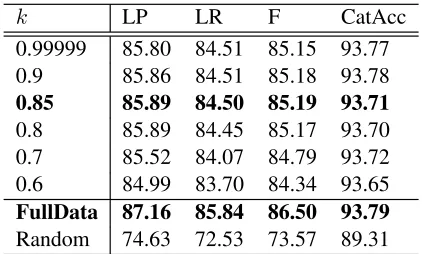
Table 2 gives the accuracy of the parser on Section 00 of CCGbank, evaluated against the predicate-argument dependencies in CCGbank.6
The table gives labelled precision, labelled recall and F-score, and lexical category accuracy. Numbers are given for the partial-data model with various values ofk, and for the full-data model, which provides an
up-5
Gold-standardPOStags from CCGbank were used for all
the experiments in this paper.
6
LP LR F CatAcc k = 0.85 86.21 85.01 85.60 93.90 FullData 87.50 86.37 86.93 94.01
Table 3: Accuracy of the Parser on Section 23
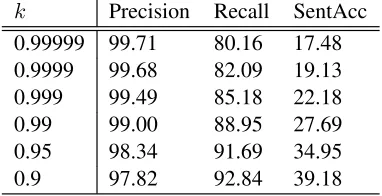
k Precision Recall SentAcc 0.99999 99.71 80.16 17.48 0.9999 99.68 82.09 19.13 0.999 99.49 85.18 22.18 0.99 99.00 88.95 27.69 0.95 98.34 91.69 34.95 0.9 97.82 92.84 39.18
Table 4: Accuracy of the Partial Dependency Data using Inside-Outside Scores
per bound for the partial-data model. We also give a lower bound which we obtain by randomly travers-ing a packed chart top-down, givtravers-ing equal proba-bility to each conjunctive node in an equivalence class. The precision and recall figures are over those sentences for which the parser returned an analysis (99.27% of Section 00).
The best result is obtained for akvalue of 0.85, which produces partial dependency data with a pre-cision of 99.7 and a recall of 81.3. Interestingly, the results show that decreasingkfurther, which results in partial data with a higher recall and only a slight loss in precison, harms the accuracy of the parser. The Random result also dispels any suspicion that the partial-model is performing well simply because of the supertagger; clearly there is still much work to be done after the supertagging phase.
Table 3 gives the accuracy of the parser on Sec-tion 23, using the best performing partial-data model on Section 00. The precision and recall figures are over those sentences for which the parser returned an analysis (99.63% of Section 23). The results show that the partial-data model is only 1.3% F-score short of the upper bound.
4.3 Further Experiments with Inside-Outside
In a final experiment, we attempted to exploit the high accuracy of the partial-data model by using it to provide new training data. For each sentence in Section 2-21, we parsed the gold-standard lexical category sequences and used the best performing
partial-data model to assign scores to each dency in the packed chart. The score for a depen-dency was the sum of the probabilities of all deriva-tions producing that dependency, which can be cal-culated using the inside-outside algorithm. (This is the score used by the maximum-recall parsing algo-rithm.) Partial dependency structures were then cre-ated by returning all dependencies whose score was above some thresholdk, as before. Table 4 gives the accuracy of the data created by this procedure. Note how these values differ to those reported in Table 1. We then trained the dependency model on this partial data using the same method as before. How-ever, the peformance of the parser on Section 00 us-ing these new models was below that of the previous best performing partial-data model for all values of
k. We report this negative result because we had hy-pothesised that using a probability model to score the dependencies, rather than simply the number of derivations in which they occur, would lead to im-proved performance.
5 Conclusions
Our main result is that it is possible to train a CCG dependency model from lexical category sequences alone and still obtain parsing results which are only 1.3% worse in terms of labelled F-score than a model trained on complete data. This is a notewor-thy result and demonstrates the significant amount of information encoded inCCGlexical categories.
The engineering implication is that, since the de-pendency model can be trained without annotating recursive structures, and only needs sequence in-formation at the word level, then it can be ported rapidly to a new domain (or language) by annotating new sequence data in that domain.
One possible response to this argument is that, since the lexical category sequence contains so much syntactic information, then the task of anno-tating category sequences must be almost as labour intensive as annotating full derivations. To test this hypothesis fully would require suitable annotation tools and subjects skilled inCCGannotation, which we do not currently have access to.
[image:7.612.90.281.142.240.2]in which a CCG parser is adapted for the ques-tion domain. The supertagger component of the parser is trained on questions annotated at the lex-ical category level only. The training data consists of over 1,000 annotated questions which took less than a week to create. This suggests, as a very rough approximation, that 4 annotators could an-notate 40,000 sentences with lexical categories (the size of the Penn Treebank) in a few months.
Another advantage of annotating with lexical cat-egories is that aCCGsupertagger can be used to per-form most of the annotation, with the human an-notator only required to correct the mistakes made by the supertagger. An accurate supertagger can be bootstrapped quicky, leaving only a small number of corrections for the annotator. A similar procedure is suggested by Doran et al. (1997) for porting anLTAG grammar to a new domain.
We have a proposed a novel solution to the an-notation bottleneck for statistical parsing which ex-ploits the lexicalized nature ofCCG, and may there-fore be applicable to other lexicalized grammar for-malisms such asLTAG.
References
A. Cahill, M. Burke, R. O’Donovan, J. van Genabith, and A. Way. 2004. Long-distance dependency resolution in au-tomatically acquired wide-coverage PCFG-based LFG ap-proximations. In Proceedings of the 42nd Meeting of the ACL, pages 320–327, Barcelona, Spain.
John Carroll and Ted Briscoe. 2002. High precision extrac-tion of grammatical relaextrac-tions. InProceedings of the 19th In-ternational Conference on Computational Linguistics, pages 134–140, Taipei, Taiwan.
David Chiang. 2000. Statistical parsing with an automatically-extracted Tree Adjoining Grammar. InProceedings of the 38th Meeting of the ACL, pages 456–463, Hong Kong.
Stephen Clark and James R. Curran. 2003. Log-linear mod-els for wide-coverage CCG parsing. InProceedings of the EMNLP Conference, pages 97–104, Sapporo, Japan.
Stephen Clark and James R. Curran. 2004a. The importance of supertagging for wide-coverage CCG parsing. In Proceed-ings of COLING-04, pages 282–288, Geneva, Switzerland.
Stephen Clark and James R. Curran. 2004b. Parsing the WSJ using CCG and log-linear models. In Proceedings of the 42nd Meeting of the ACL, pages 104–111, Barcelona, Spain.
Stephen Clark, Mark Steedman, and James R. Curran. 2004. Object-extraction and question-parsing using CCG. In
Proceedings of the EMNLP Conference, pages 111–118,
Barcelona, Spain.
C. Doran, B. Hockey, P. Hopely, J. Rosenzweig, A. Sarkar, B. Srinivas, F. Xia, A. Nasr, and O. Rambow. 1997. Main-taining the forest and burning out the underbrush in XTAG. InProceedings of the ENVGRAM Workshop, Madrid, Spain.
Julia Hockenmaier and Mark Steedman. 2002. Generative models for statistical parsing with Combinatory Categorial Grammar. InProceedings of the 40th Meeting of the ACL, pages 335–342, Philadelphia, PA.
Julia Hockenmaier. 2003. Data and Models for Statistical Parsing with Combinatory Categorial Grammar. Ph.D. the-sis, University of Edinburgh.
Rebbeca Hwa. 1999. Supervised grammar induction using training data with limited constituent information. In Pro-ceedings of the 37th Meeting of the ACL, pages 73–79, Uni-versity of Maryland, MD.
Matthew Lease and Eugene Charniak. 2005. Parsing biomed-ical literature. In Proceedings of the Second Interna-tional Joint Conference on Natural Language Processing (IJCNLP-05), Jeju Island, Korea.
Robert Malouf. 2002. A comparison of algorithms for max-imum entropy parameter estimation. InProceedings of the Sixth Workshop on Natural Language Learning, pages 49– 55, Taipei, Taiwan.
Yusuke Miyao and Jun’ichi Tsujii. 2002. Maximum entropy estimation for feature forests. InProceedings of the Human Language Technology Conference, San Diego, CA.
Yusuke Miyao, Takashi Ninomiya, and Jun’ichi Tsujii. 2004. Corpus-oriented grammar development for acquiring a head-driven phrase structure grammar from the Penn Treebank. In
Proceedings of the First International Joint Conference on Natural Language Processing (IJCNLP-04), pages 684–693, Hainan Island, China.
Jorge Nocedal and Stephen J. Wright. 1999. Numerical Opti-mization. Springer, New York, USA.
Fernando Pereira and Yves Schabes. 1992. Inside-outside rees-timation from partially bracketed corpora. InProceedings of the 30th Meeting of the ACL, pages 128–135, Newark, DE.
Stefan Riezler, Tracy H. King, Ronald M. Kaplan, Richard Crouch, John T. Maxwell III, and Mark Johnson. 2002. Parsing the Wall Street Journal using a Lexical-Functional Grammar and discriminative estimation techniques. In Pro-ceedings of the 40th Meeting of the ACL, pages 271–278, Philadelphia, PA.
Mark Steedman, Miles Osborne, Anoop Sarkar, Stephen Clark, Rebecca Hwa, Julia Hockenmaier, Paul Ruhlen, Steve Baker, and Jeremiah Crim. 2003. Bootstrapping statistical parsers from small datasets. InProceedings of the 11th Conference of the European Association for Computational Linguistics, Budapest, Hungary.