Proceedings of NAACL-HLT 2018, pages 238–251
Content-Based Citation Recommendation
Chandra BhagavatulaAllen Institute for AI [email protected]
Sergey Feldman Data Cowboys∗
Russell Power Independent Researcher†
Waleed Ammar Allen Institute for AI [email protected]
Abstract
We present a content-based method for rec-ommending citations in an academic paper draft. We embed a given query document into a vector space, then use its nearest neighbors as candidates, and rerank the candidates us-ing a discriminative model trained to distin-guish between observed and unobserved cita-tions. Unlike previous work, our method does not require metadata such as author names which can be missing, e.g., during the peer review process. Without using metadata, our method outperforms the best reported results on PubMed and DBLP datasets with relative improvements of over 18% in F1@20 and over 22% in MRR. We show empirically that, although adding metadata improves the per-formance on standard metrics, it favors self-citations which are less useful in a citation rec-ommendation setup. We release an online por-tal for citation recommendation based on our method,1and a new datasetOpenCorpusof 7 million research articles to facilitate future research on this task.
1 Introduction
Due to the rapid growth of the scientific litera-ture, conducting a comprehensive literature review has become challenging, despite major advances in digital libraries and information retrieval sys-tems. Citation recommendation can help improve the quality and efficiency of this process by sug-gesting published scientific documents as likely citations for a query document, e.g., a paper draft to be submitted for ACL 2018. Existing citation recommendation systems rely on various informa-tion of the query documents such as author names and publication venue (Ren et al.,2014;Yu et al., ∗Work done while on contract with AI2
†Work done while at AI2
1http://labs.semanticscholar.org/ citeomatic/
2012), or a partial list of citations provided by the author (McNee et al., 2002; Liu et al., 2015;Jia and Saule,2017) which may not be available, e.g., during the peer review process or in the early stage of a research project.
Our method uses a neural model to embed all available documents into a vector space by encod-ing the textual content of each document. We then select the nearest neighbors of a query document as candidates and rerank the candidates using a second model trained to discriminate between ob-served and unobob-served citations. Unlike previous work, we can embed new documents in the same vector space used to identify candidate citations based on their text content, obviating the need to re-train the models to include new published pa-pers. Further, unlike prior work (Yang et al.,2015; Ren et al.,2014), our model is computationally ef-ficient and scalable during both training and test time.
We assess the feasibility of recommending cita-tions when some metadata for the query document is missing, and find that we are able to outperform the best reported results on two datasets while only using papers’ textual content (i.e. its title and ab-stract). While adding metadata helps further im-prove the performance of our method on standard metrics, we found that it introduces a bias for self-citation which might not be desirable in a self-citation recommendation system. See§5for details of our
experimental results.
Our main contributions are:
• a content-based method for citation recom-mendation which remains robust when meta-data are missing for query documents,
• large improvements over state of the art results on two citation recommendation datasets despite omitting the metadata,
• a new dataset of seven million research pa-pers, addressing some of the limitations in
dq
d1 d2 d3
d4 d5 d6 d7
dq
d1
d2d6d3d 7 d4
d5
dq
d1cites d4 d1cites d5 d3cites d7 …
K=4 Phase 1:
candidate selection Phase 2:reranking
NNRank d2
0.7 rerankedlist
cited in nearest neighbors:
dq
NNRank d6
0.8
dq
NNRank d3
0.5
dq
NNRank d4
0.3
dq
NNRank d7
0.9
d7
d6
d2
d3
d4
to
p
N=
3
re
co
m
m
en
da
tio
ns
query document
document embeddings
[image:2.595.87.514.67.352.2]nearest neighbors of dq:
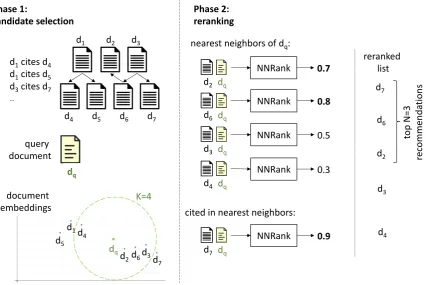
Figure 1: An overview of our Citation Recommendation system. In Phase 1 (NNSelect), we project all docu-ments in the corpus (7 in this toy example) in addition to the query documentdq into a vector space, and use its
(K=4) nearest neighbors: d2, d6, d3,andd4as candidates. We also addd7as a candidate because it was cited in d3. In Phase 2 (NNRank), we score each pair(dq, d2),(dq, d6),(dq, d3),(dq, d4),and(dq, d7)separately to rerank the candidates and return the top 3 candidates:d7,d6andd2.
previous datasets used for citation recom-mendation, and
• a scalable web-based literature review tool
based on this work.2
2 Overview
We formulate citation recommendation as a rank-ing problem. Given a query document dq and a
large corpus of published documents, the task is to rank documents which should be referenced in
dq higher than other documents. Following
pre-vious work on citation recommendation, we use standard metrics (precision, recall, F-measure and mean reciprocal rank) to evaluate our predictions against gold references provided by the authors of query documents.
Since the number of published documents in the corpus can be large, it is computationally expen-sive to score each document as a candidate refer-ence with respect to dq. Instead, we recommend
citations in two phases: (i) a fast, recall-oriented candidate selection phase, and (ii) a feature rich, 2https://github.com/allenai/citeomatic
precision-oriented reranking phase. Figure1 pro-vides an overview of the two phases using a toy example.
Phase 1 - Candidate Selection: In this phase, our goal is to identify a set of candidate references fordqfor further analysis without explicitly
iterat-ing over all documents in the corpus.3 Using a
trained neural network, we first project all pub-lished documents into a vector space such that a document tends to be close to its references. Since the projection of a document is independent of the query document, the entire corpus needs to be em-bedded only once and can be reused for subse-quent queries. Then, we project each query doc-umentdqto the same vector space and identify its
nearest neighbors as candidate references. See§3
for more details about candidate selection.
Phase 2 - Reranking: Phase 1 yields a manage-able number of candidates making it feasible to score each candidatediby feeding the pair(dq, di)
into another neural network trained to discriminate between observed and unobserved citation pairs. The candidate documents are sorted by their es-timated probability of being cited in dq, and top
candidates are returned as recommended citations. See§4for more details about the reranking model
and inference in the candidate selection phase.
3 Phase 1: Candidate Selection (NNSelect)
In this phase, we select a pool of candidate cita-tions for a given query document to be reranked in the next phase. First, we compute a dense embed-ding of the query documentdqusing the document
embedding model (described next), and selectK
nearest neighbor documents in the vector space as candidates.4 FollowingStrohman et al.(2007), we
also include the outgoing citations of theK
near-est neighbors as candidates.
The output of this phase is a list of candi-date documentsdi and their corresponding scores NNSelect(dq, di), defined as the cosine
similar-ity betweendqanddiin the document embedding
space.
Document embedding model. We use a supervised neural model to project any doc-ument d to a dense embedding based on its
textual content. We use a bag-of-word repre-sentation of each textual field, e.g., d[title] = {‘content-based’, ‘citation’, ‘recommendation’}, and compute the feature vector:
fd[title]=
X
t∈d[title]
wtmag w
dir
t
kwdirt k2
, (1)
where wdirt is a dense direction embedding and wmagt is a scalar magnitude for word typet.5 We
then normalize the representation of each field and compute a weighted average of fields to get the document embedding,ed. In our experiments, we
use the title and abstract fields of a documentd:
ed=λtitle
fd[title]
kfd[title]k2
+λabstract fd[abstract]
kfd[abstract]k2 ,
4We tuneKas a hyperparameter of our method.
5The magnitude-direction representation is based on
Sali-mans and Kingma(2016) and was found to improve re-sults in preliminary experiments, compared to the standard “direction-only” word representation.
whereλtitle andλabstract are scalar model parame-ters.
Training. We learn the parameters of the doc-ument embedding model (i.e.,λ∗, wmag∗ ,wdir∗ )
us-ing a trainus-ing setT of tripletshdq, d+, d−iwhere dq is a query document, d+ is a document cited
indq, andd− is a document not cited indq. The
model is trained to predict a high cosine similarity for the pair(dq, d+)and a low cosine similarity for
the pair(dq, d−)using the per-instance triplet loss
(Wang et al.,2014):
loss= max α+s(dq, d−)−s(dq, d+),0
, (2)
wheres(di, dj)is defined as the cosine similarity
between document embeddings cos-sim(edi,edj).
We tune the marginα as a hyperparameter of the
model (see Appendix Bfor more details). Next, we describe how negative examples are selected.
Selecting negative examples. Defining positive examples is straight-forward; we use any(dq, d+)
pair where a documentdqin the training set cites d+. However, a careful choice of negative training
examples is critical for model performance. We use three types of negative examples:
1. Random:any document not cited bydq.
2. Negative nearest neighbors: documents that are close todq in the embedding space,
but are not cited in it.6
3. Citation-of-citation: documents referenced in positive citations of dq, but are not cited
directly indq.
Negative examples belong to at least one of these types that serve different, and complemen-tary purposes. Selecting a paper from the cor-pus at random as a negative example typically re-sults in easy negative examples. Selecting near-est neighbor documents in the embedding space used for candidate selection enables the re-ranking phase (described in§4) to fix some of the mistakes
made in the candidate selection step. Finally, us-ing citations-of-citations as negative examples is based on the assumption that the authors would have included them as positive examples if they were relevant for the query paper. In Appendix
§A, we describe the number of negative examples
of each type used for training. Next, we describe how to rerank the candidate documents.
elu sigmoid
elu
fd[keyphrases]
query fd[keyphrases]
candidate
fd[abstract] fd[authors] fd[venue]
concat
abstract intersection
di[in-citations]
NNSelect(dq,di) output is a vector
output is a scalar output type
fd[title]
fd[title] cos-sim
title intersection
fd[abstract] fd[authors] fd[venue]
cos-sim cos-sim
[image:4.595.323.524.355.472.2]cos-sim cos-sim
Figure 2: NNRankarchitecture. For each of the textual and categorical fields, we compute the cosine similarity between the embedding fordqand the corresponding embedding fordi. Then, we concatenate the cosine similarity
scores, the numeric features and the summed weights of the intersection words, followed by two dense layers with ELU non-linearities The output layer is a dense layer with sigmoid non-linearity, which estimates the probability thatdqcitesdi.
4 Phase 2: Reranking Candidates (NNRank)
In this phase, we train another model which takes as input a pair of documents (dq,di) and estimates
the probability thatdishould be cited indq.
Input features. A key point of this work is to assess the feasibility of recommending citations without using metadata, but we describe all fea-tures here for completeness and defer this discus-sion to§5. For each document, we compute dense feature vectorsfd[field]as defined in Eq. 1for the
following fields: title, abstract, authors, venue and keyphrases (if available). For the title and abstract, we identify the subset of word types which appear in both documents (intersection), and compute the sum of their scalar weights as an additional fea-ture, e.g., Pt∈∩titlew∩t. We also use lognumber
of times the candidate documentdi has been cited
in the corpus, i.e.,log(di[in-citations]). Finally, we
use the cosine similarity betweendq anddi in the
embedding space, i.e., cos-sim(edq,edi).
Model architecture. We illustrate the
NNRank model architecture in Figure 2.
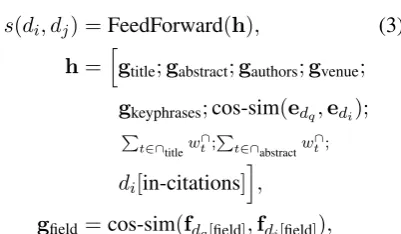
The output layer is defined as:
s(di, dj) =FeedForward(h), (3)
h=hgtitle;gabstract;gauthors;gvenue;
gkeyphrases;cos-sim(edq,edi);
P
t∈∩titlew∩t;
P
t∈∩abstractwt∩;
di[in-citations]
i
,
gfield=cos-sim(fdq[field],fdi[field]),
where ‘FeedForward’ is a three layer feed-forward neural network with two exponential linear unit layers (Clevert et al.,2015) and one sigmoid layer. ’;’ indicates concatenation.
Training. The parameters of theNNRankmodel are wmag∗ ,w∗dir, w∩∗ and parameters of the three
dense layers in ‘FeedForward’. We reuse the triplet loss in Eq. 2to learn these parameters, but redefine the similarity functions(di, dj)as the
sig-moid output described in Eq.3.
At test time, we use this model to recommend candidatesdiwith the highests(dq, di)scores.
5 Experiments
In this section, we describe experimental results of our citation recommendation method and compare it to previous work.
dataset contains over 50K scientific articles in the computer science domain, with an average of 5 citations per article. The PubMed dataset con-tains over 45K scientific articles in the medical do-mains, with an average of 17 citations per article. In both datasets, a document is accompanied by its title, abstract, venue (i.e. journal or conference where the document was published), authors, cita-tions (i.e. other documents in the corpus that are referenced in the given document) and keyphrases (i.e. phrases considered important by automated extraction methods). We replicate the experimen-tal setup ofRen et al.(2014) by excluding papers with fewer than 10 citations and using the standard train, dev and test splits.7
We also introduce OpenCorpus,8 a new
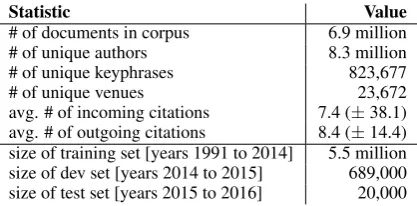
dataset of 7 million scientific articles primar-ily drawn from the computer science and neuro-science domain. Due to licensing constraints, doc-uments in the corpus do not include the full text of the scientific articles, but include the title, ab-stract, year, author, venue, keyphrases and citation information. The mutually exclusive training, de-velopment, and test splits were selected such that no document in the development or test set has a publication year less than that of any document in the training set. Papers with zero citations were removed from the development and test sets. We describe the key characteristics ofOpenCorpus
in Table1.
Statistic Value
# of documents in corpus 6.9 million # of unique authors 8.3 million
# of unique keyphrases 823,677
# of unique venues 23,672
avg. # of incoming citations 7.4 (±38.1) avg. # of outgoing citations 8.4 (±14.4) size of training set [years 1991 to 2014] 5.5 million size of dev set [years 2014 to 2015] 689,000 size of test set [years 2015 to 2016] 20,000
Table 1: Characteristics of theOpenCorpus.
Baselines. We compare our method to two base-line methods for recommending citations: Clus-Cite and BM25. ClusClus-Cite (Ren et al.,2014) clus-ters nodes in a heterogeneous graph of terms, au-thors and venues in order to find related documents which should be cited. We use the ClusCite results
7The dataset characteristics reported here are different from those in Table 3 in (Ren et al.,2014) because we report the size of the filtered datasets while they report the size of the datasets before filtering.
8http://labs.semanticscholar.org/corpus/
as reported inRen et al.(2014), which compared it to several other citation recommendation methods and found that it obtains state of the art results on the PubMed and DBLP datasets. The BM25 re-sults are based on our implementation of the pop-ular ranking function Okapi BM25 used in many information retrieval systems. See Appendix§D
for details of our BM25 implementation.
Evaluation. We use Mean Reciprocal Rank (MRR) and F1@20 to report the main results in this section. In Appendix §F, we also report ad-ditional metrics (e.g., precision and recall at 20) which have been used in previous work. We com-pute F1@20 as the harmonic mean of the corpus-level precision and recall at 20 (P@20 and R@20). Following (Ren et al.,2014), precision and recall at 20 are first computed for each query document then averaged over query documents in the test set to compute the corpus-level P@20 and R@20.
Configurations. To find candidates in
NNSelect, we use the approximate nearest
neighbor search algorithmAnnoy9, which builds a binary-tree structure that enables searching for nearest neighbors inO(logn) time. To build this
tree, points in a high-dimensional space are split by choosing random hyperplanes. We use 100 trees in our approximate nearest neighbors index, and retrieve documents using the cosine distance metric.
We use the hyperopt library10 to optimize
various hyperparameters of our method such as size of hidden layers, regularization strength and learning rate. To ensure reproducibility, we pro-vide a detailed description of the parameters used in bothNNSelectandNNRankmodels, our hy-perparameter optimization method and parameter values chosen in Appendix§A.
Main results. Table 2 reports the F1@20 and MRR results for the two baselines and three vari-ants of our method. Since the OpenCorpus
dataset is much bigger, we were not able to train the ClusCite baseline for it.Totti et al.(2016) have also found it difficult to scale up ClusCite to larger datasets. Where available, we report the mean±
standard deviation based on five trials.
The first variant, labeled “NNSelect,” only uses the candidate selection part of our method (i.e., phase 1) to rank candidates by their cosine 9https://github.com/spotify/annoy
[image:5.595.77.286.477.580.2]Method DBLP PubMed OpenCorpus
F1@20 MRR F1@20 MRR F1@20 MRR
BM25 0.119 0.425 0.209 0.574 0.058 0.218
ClusCite 0.237 0.548 0.274 0.578 – –
NNSelect 0.282±0.002 0.579±0.007 0.309±0.001 0.699±0.001 0.109 0.221 +NNRank 0.302±0.001 0.672±0.015 0.325±0.001 0.754±0.003 0.126 0.330
+ metadata 0.303±0.001 0.689±0.011 0.329±0.001 0.771±0.003 0.125 0.330
Table 2: F1@20 and MRR results for two baselines and three variants of our method. BM25 results are based on our implementation of this baseline, while ClusCite results are based on the results reported inRen et al.
(2014). “NNSelect” ranks candidates using cosine similarity between the query and candidate documents in the embedding space (phase 1). “NNSelect+ NNRank” uses the discriminative reranking model to rerank candidates (phase 2), without encoding any of the metadata features. “+ metadata” encodes the metadata features (i.e., keyphrases, venues and authors), achieving the best results on all datasets. Mean and standard deviations are reported based on five trials.
similarity to the query document in the embedding space as illustrated in Fig.1. Although the docu-ment embedding space was designed to efficiently select candidates for further processing in phase 2, recommending citations directly based on the co-sine distance in this space outperforms both base-lines.
The second variant, labeled “NNSelect +
NNRank,” uses the discriminative model (i.e., phase 2) to rerank candidates selected by
NNSelect, without encoding metadata (venues, authors, keyphrases). Both the first and second variants show that improved modeling of paper text can significantly outperform previous meth-ods for citation recommendation, without using metadata.
The third variant, labeled “NNSelect +
NNRank + metadata,” further encodes the meta-data features in the reranking model, and gives the best overall results. On both the DBLP and PubMed datasets, we obtain relative improve-ments over 20% (for F1@20) and 25% (for MRR) compared to the best reported results of ClusCite. In the rest of this section, we describe controlled experiments aimed at analyzing different aspects of our proposed method.
Choice of negative samples. As discussed in§3,
we use different types of negative samples to train our models. We experimented with using only a subset of the types, while controlling for the total number of negative samples used, and found that using negative nearest neighbors while training the models is particularly important for the method to work. As illustrated in Table 3, on the PubMed dataset, adding negative nearest neighbors while training the models improves the F1@20 score
from 0.306 to 0.329, and improves the MRR score from 0.705 to 0.771. Intuitively, using nearest neighbor negative examples focuses training on the harder cases on which the model is more likely to make mistakes.
F1@20 ∆ MRR ∆
Full model 0.329 0.771
without intersection 0.296 0.033 0.653 0.118
[image:6.595.100.499.61.157.2]without -ve NNs 0.306 0.016 0.705 0.066 without numerical 0.314 0.008 0.735 0.036
Table 3: Comparison of PubMed results of the full model with model without (i) intersection features, (ii) negative nearest neighbors in training samples, and (iii) numerical features.
Valuable features. We experimented with dif-ferent subsets of the optional features used in
NNRank in order to evaluate the contribution of various features. We found intersection fea-tures, NNSelect scores, and the number of incoming citations to be the most valuable fea-ture. As illustrated in Table 3, the intersection features improves the F1@20 score from 0.296 to 0.329, and the MRR score from 0.653 to 0.771, on the PubMed dataset. The numerical features (NNSelect score and incoming citations) im-prove the F1@20 score from 0.314 to 0.329, and improves the MRR score from 0.735 to 0.771. This shows that, in some applications, feeding en-gineered features to neural networks can be an ef-fective strategy to improve their performance.
0 0.1 0.2 0.3 0.4 0.5 2
4 6 8 10
0.37 0.34
0.35 0.34
0.35 0.31
0.37 0.32 0.32 0.3
Pubmed F1@20
V
enue
[image:7.595.74.277.59.245.2]Rank
Figure 3: F1@20 ofNNRankon the Pubmed dataset across top ten venues
ten venues (by their paper count) in the Pubmed corpus. NNRank’s performance is robust across venues.
Encoding textual features. We also experi-mented with using recurrent and convolutional neural network to encode the textual fields of query and candidate documents, instead of us-ing a weighted sum as described in Eq. 1. We found that recurrent and convolutional encoders are much slower, and did not observe a significant improvement in the overall performance as mea-sured by the F1@20 and MRR metrics. This result is consistent with previous studies on other tasks, e.g.,Iyyer et al.(2015).
Number of nearest neighbors. As discussed in §3, the candidate selection step is crucial for
the scalability of our method because it reduces the number of computationally expensive pair-wise comparisons with the query document at run-time. We did a controlled experiment on the
OpenCorpus dataset (largest among the three datasets) to measure the effect of using different numbers of nearest neighbors, and found that both P@20 and R@20 metrics are maximized when
NNSelect fetches five nearest neighbors using the approximate nearest neighbors index (and their out-going citations), as illustrated in Table4.
Self-citation bias. We hypothesized that a model trained with the metadata (e.g., authors) could be biased towards self-citations and other well-cited authors. To verify this hypothesis, we compared twoNNRankmodels – one with
meta-# of neighbors R@20 P@20 Time(ms)
1 0.123 0.079 131
5 0.142 0.080 144
10 0.138 0.069 200
[image:7.595.307.525.62.131.2]50 0.081 0.040 362
Table 4: OpenCorpus results for NNSelect step with varying number of nearest neighbors on 1,000 val-idation documents.
data, and one without. We measured the mean and max rank of predictions that had at least one author in common with the query document. This ex-periment was performed with theOpenCorpus
dataset.
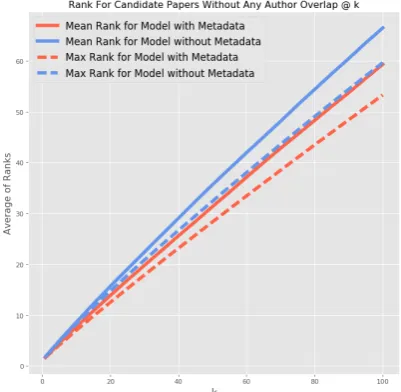
A lower mean rank forNNRank+ Metadata in-dicates that the model trained with metadata tends to favor documents authored by one of the query document’s authors. We verified the prevalence of this bias by varying the number of predictions for each model from 1 to 100. Figure 4 shows that the mean and max rank of the model trained with metadata is always lower than those for the model that does not use metadata.
Figure 4: Mean and Max Rank of predictions with varying number of candidates.
6 Related Work
[image:7.595.315.516.397.593.2]sen-tences (Huang et al.,2015;He et al.,2010;Tang and Zhang, 2009; Huang et al., 2012; He et al., 2011). A global citation recommendation system takes the entire scholarly article as input and rec-ommends citations for the paper (McNee et al., 2002;Strohman et al.,2007;Nallapati et al.,2008; Kataria et al., 2010; Ren et al., 2014). We ad-dress the global citation recommendation problem in this paper.
A key difference of our proposed method com-pared to previous work is that our method is content-based and works well even in the absence of metadata (e.g. authors, venues, key phrases, seed list of citations). Many citation recommenda-tion systems crucially rely on a query document’s metadata. For example, the collaborative filtering based algorithms ofMcNee et al.(2002); Jia and Saule (2017); Liu et al.(2015) require seed cita-tions for a query document. (Ren et al.,2014;Yu et al.,2012) require authors, venues and key terms of the query documents to infer interest groups and to extract features based on paths in a heteroge-neous graph. In contrast, our model performs well solely based on the textual content of the query document.
Some previous work (e.g. (Ren et al.,2014;Yu et al., 2012)) have addressed the citation recom-mendation problem using graph-based methods. But, training graph-based citation recommenda-tion models has been found to be expensive. For example, the training complexity of the ClusCite algorithm (Ren et al.,2014) is cubic in the number of edges in the graph of authors, venues and terms. This can be prohibitively expensive for datasets as large as OpenCorpus. On the other hand our model is a neural network trained via batched stochastic gradient descent that scales very well to large datasets (Bottou,2010).
Another crucial difference between our ap-proach and some prior work in citation predic-tion is that we build up a document representa-tion using its constituent words only. Prior algo-rithms (Huang et al.,2015,2012;Nallapati et al., 2008;Tanner and Charniak,2015) learn an explicit representation for each training document sepa-rately that isn’t a deterministic function of the doc-ument’s words. This makes the model effectively transductive since a never-before-seen document does not have a ready-made representation. Simi-larly,Huang et al.(2012)’s method needs a candi-date document to have at least one in-coming
cita-tion to be eligible for citacita-tion – this disadvantages newly published documents. Liu et al. (2015) form document representations using citation re-lations, which are not available for unfinished or new documents. In contrast, our method does not need to be re-trained as the corpus of potential can-didates grows. As long as the new documents are in the same domain as that of the model’s training documents, they can simply be added to the cor-pus and are immediately available as candidates for future queries.
While the citation recommendation task has at-tracted a lot of research interest, a recent survey paper (Beel et al.,2016) has found three main con-cerns with existing work: (i) limitations in evalu-ation due to strongly pruned datasets, (ii) lack of details for re-implementation, and (iii) variations in performance across datasets. For example, the average number of citations per document in the DBLP dataset is 5, butRen et al. (2014) filtered out documents with fewer than 10 citations from the test set. This drastically reduced the size of the test set. We address these concerns by releasing a new large scale dataset for future citation rec-ommendation systems. In our experiments on the
OpenCorpusdataset, we only prune documents with zero outgoing citations. We provide extensive details of our system (see Appendix§A) to
facil-itate reproducibility and release our code11. We
also show in experiments that our method consis-tently outperforms previous systems on multiple datasets.
Finally, recent work has combined graph node representations and text-based document repre-sentations using CCA (Gupta and Varma, 2017). This sort of approach can enhance our text-based document representations if a technique to create graph node representations at test-time is avail-able.
7 Conclusion
In this paper, we present a content-based cita-tion recommendacita-tion method which remains ro-bust when metadata is missing for query docu-ments, enabling researchers to do an effective liter-ature search early in their research cycle or during the peer review process, among other scenarios. We show that our method obtains state of the art results on two citation recommendation datasets, even without the use of metadata available to the
baseline method. We make our system publicly accessible online. We also introduce a new dataset of seven million scientific articles to facilitate fu-ture research on this problem.
Acknowledgements
We would like to thank Oren Etzioni, Luke Zettle-moyer, Doug Downey and Iz Beltagy for partic-ipating in discussions and for providing helpful comments on the paper draft; Hsu Han and rest of the Semantic Scholar team at AI2 for creating the OpenCorpus dataset. We also thank Xiang Ren for providing the data used in their experiments on the DBLP and Pubmed datasets. Finally, we thank the anonymous reviewers for insightful comments on the draft.
References
Joeran Beel, Bela Gipp, Stefan Langer, and Corinna Breitinger. 2016. Research-paper recommender sys-tems: a literature survey. International Journal on Digital Libraries17(4):305–338.
L´eon Bottou. 2010. Large-scale machine learning with stochastic gradient descent. InProceedings of COMPSTAT’2010, Springer, pages 177–186. Jane Bromley, James W Bentz, L´eon Bottou,
Is-abelle Guyon, Yann LeCun, Cliff Moore, Eduard S¨ackinger, and Roopak Shah. 1993. Signature veri-fication using a siamese time delay neural network.
International Journal of Pattern Recognition and Artificial Intelligence7(04):669–688.
Cornelia Caragea, Florin Adrian Bulgarov, Andreea Godea, and Sujatha Das Gollapalli. 2014a. Citation-enhanced keyphrase extraction from research pa-pers: A supervised approach. In Proceedings of the 2014 Conference on Empirical Methods in Natu-ral Language Processing (EMNLP). Association for Computational Linguistics, pages 1435–1446. Cornelia Caragea, Florin Adrian Bulgarov, Andreea
Godea, and Sujatha Das Gollapalli. 2014b. Citation-enhanced keyphrase extraction from research pa-pers: A supervised approach. In EMNLP. vol-ume 14, pages 1435–1446.
Djork-Arn´e Clevert, Thomas Unterthiner, and Sepp Hochreiter. 2015. Fast and accurate deep network learning by exponential linear units (elus). arXiv preprint arXiv:1511.07289.
Shashank Gupta and Vasudeva Varma. 2017. Scientific article recommendation by using distributed repre-sentations of text and graph. InWWW.
Qi He, Daniel Kifer, Jian Pei, Prasenjit Mitra, and C. Lee Giles. 2011. Citation recommendation with-out author supervision. InWSDM.
Qi He, Jian Pei, Daniel Kifer, Prasenjit Mitra, and Lee Giles. 2010. Context-aware citation recommenda-tion. InProceedings of the 19th international con-ference on World wide web. ACM, pages 421–430.
Wenyi Huang, Saurabh Kataria, Cornelia Caragea, Prasenjit Mitra, C Lee Giles, and Lior Rokach. 2012. Recommending citations: translating papers into references. In Proceedings of the 21st ACM inter-national conference on Information and knowledge management. ACM, pages 1910–1914.
Wenyi Huang, Zhaohui Wu, Liang Chen, Prasenjit Mi-tra, and C Lee Giles. 2015. A neural probabilistic model for context based citation recommendation. InAAAI. pages 2404–2410.
Mohit Iyyer, Varun Manjunatha, Jordan L. Boyd-Graber, and Hal Daum´e. 2015. Deep unordered composition rivals syntactic methods for text clas-sification. InACL.
Haofeng Jia and Erik Saule. 2017. An analysis of cita-tion recommender systems: Beyond the obvious. In
ASONAM.
Saurabh Kataria, Prasenjit Mitra, and Sumit Bhatia. 2010. Utilizing context in generative bayesian mod-els for linked corpus. InAAAI.
Haifeng Liu, Xiangjie Kong, Xiaomei Bai, Wei Wang, Teshome Megersa Bekele, and Feng Xia. 2015. Context-based collaborative filtering for citation rec-ommendation. IEEE Access3:1695–1703.
Patrice Lopez and Laurent Romary. 2010. Humb: Au-tomatic key term extraction from scientific articles in grobid. In Proceedings of the 5th international workshop on semantic evaluation. Association for Computational Linguistics, pages 248–251.
Christopher D. Manning, Mihai Surdeanu, John Bauer, Jenny Rose Finkel, Steven Bethard, and David Mc-Closky. 2014. The stanford corenlp natural language processing toolkit. InACL.
Sean M McNee, Istvan Albert, Dan Cosley, Pra-teep Gopalkrishnan, Shyong K Lam, Al Mamunur Rashid, Joseph A Konstan, and John Riedl. 2002. On the recommending of citations for research pa-pers. InProceedings of the 2002 ACM conference on Computer supported cooperative work. ACM, pages 116–125.
Ramesh Nallapati, Amr Ahmed, Eric P. Xing, and William W. Cohen. 2008. Joint latent topic models for text and citations. InKDD.
Tim Salimans and Diederik P. Kingma. 2016. Weight normalization: A simple reparameterization to ac-celerate training of deep neural networks. CoRR
abs/1602.07868. http://arxiv.org/abs/ 1602.07868.
Trevor Strohman, W. Bruce Croft, and David D. Jensen. 2007. Recommending citations for aca-demic papers. InSIGIR.
Jie Tang and Jing Zhang. 2009. A discriminative ap-proach to topic-based citation recommendation. In
PAKDD.
Chris Tanner and Eugene Charniak. 2015. A hybrid generative/discriminative approach to citation pre-diction. InHLT-NAACL.
Luam C. Totti, Prasenjit Mitra, Mourad Ouzzani, and Mohammed J. Zaki. 2016. A query-oriented ap-proach for relevance in citation networks. InWWW.
Jiang Wang, Yang Song, Thomas Leung, Chuck Rosen-berg, Jingbin Wang, James Philbin, Bo Chen, and Ying Wu. 2014. Learning fine-grained image simi-larity with deep ranking. InProceedings of the 2014 IEEE Conference on Computer Vision and Pattern Recognition. IEEE Computer Society, Washington, DC, USA, CVPR ’14, pages 1386–1393. https:
//doi.org/10.1109/CVPR.2014.180.
Cheng Yang, Zhiyuan Liu, Deli Zhao, Maosong Sun, and Edward Y Chang. 2015. Network representa-tion learning with rich text informarepresenta-tion. In Pro-ceedings of the 24th International Joint Conference on Artificial Intelligence, Buenos Aires, Argentina. pages 2111–2117.
A Hyperparameter Settings
Neural networks are complex and have a large number of hyperparameters to tune. This makes it challenging to reproduce experimental results. Here, we provide details of how the hyperparame-ters of theNNSelectandNNRankmodels were chosen or otherwise set. We chose a subset of hy-perparameters for tuning, and left the rest at man-ually set default values. Due to limited computa-tional resources, we were only able to perform hy-perparameter tuning on the development split of the smaller DBLP and Pubmed datasets.
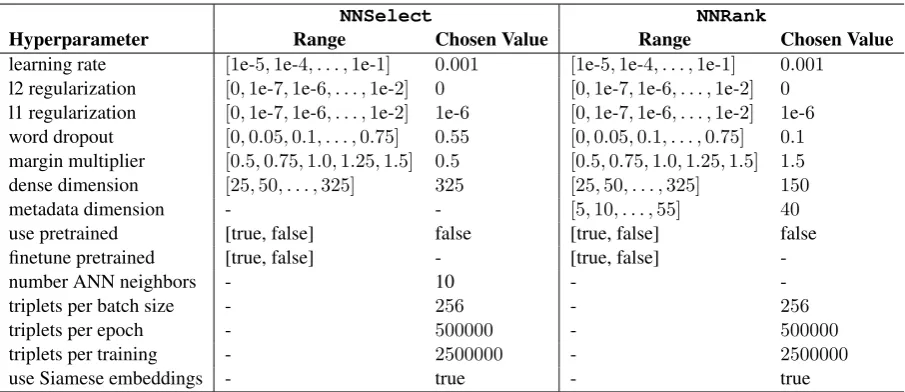
For DBLP and PubMed, we first ran Hyperopt12
with 75 trials. Each trial was run for five epochs of 500,000 triplets each. The ten top performing of these models were trained for a full 50 epochs, and the best performing model’s hyperparameters are selected. Hyperparameters for NNSelect
were optimized for Recall@20 and those for the
NNRankmodel were optimized for F1@20 on the development set. The selected values for DBLP are reported in Table 6 and for PubMed are re-ported in Table7.
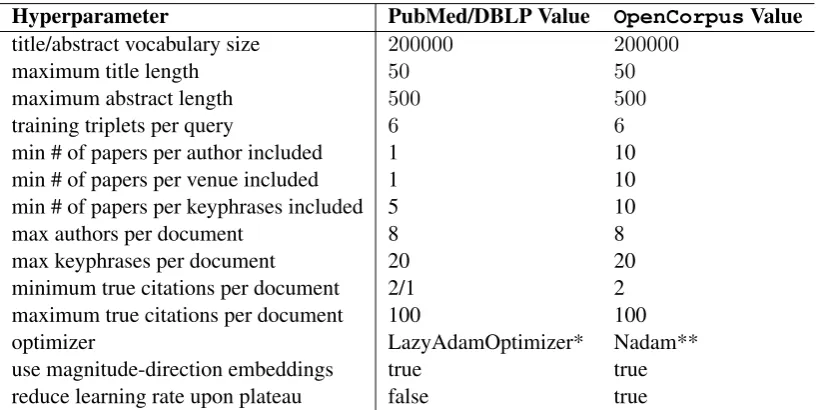
OpenCorpushyperparameters were set via in-formal hand-tuning, and the results are in Table9. A few miscellaneous parameters (not tuned) that are necessary for reproducibility are in Table8.
We briefly clarify the meaning of some param-eters below:
• Margin Multiplier- The triplet loss has
vari-able margins for the three types of negatives:
0.1γ,0.2γ,and0.3γ. We treatγ as a
hyper-parameter and refer to it as the margin multi-plier.
• Use Siamese Embeddings- For the majority
of our experiments, we use aSiamesemodel (Bromley et al., 1993). That is, the textual embeddings for the query text and abstract share the same weights. However, we had a significantly larger amount of data to train
NNRank on OpenCorpus, and found that
non-Siamese embeddings are beneficial.
• Use Pretrained - We estimate word em-beddings on the titles and abstracts of
OpenCorpus using Word2Vec
imple-mented by the gensim Python package13.
12https://github.com/hyperopt/hyperopt 13https://radimrehurek.com/gensim/
B Margin Loss Details
When computing the margins for the triplet loss, we use a boosting function for highly cited docu-ments. The full triplet loss function is as follows:
max γα(d−)
+s(dq, d−) +B(d−)
−s(dq, d+)−B(d+) ,0
whereγis the margin multiplier, andα(d−)varies
based on the type of negative document:
• α(d−) = 0.3for random negatives
• α(d−) = 0.2for nearest neighbor negatives
• α(d−) = 0.1for citation-of-citation negatives. The boosting function is defined as follows:
B(d) =
σd[in-citations100 ]
50
whereσis the sigmoid function andd[in-citations]
is the number of times documentdwas cited in the
corpus. The boosting function allows the model to slightly prefer candidates that are cited more fre-quently, and the constants were set without opti-mization.
C Nearest Neighbors for Training Details When obtaining nearest neighbors for negative ex-amples during training, we use a heuristic to find a subset of the fetched nearest neighbors that are sufficiently wrong. That is, these are non-citation samples that look dissimilar in the original text but similar in the embedding space. This procedure is as follows for each training query:
1. Compute the Jaccard similarities between a training query and all of its true citations using the concatenation of title and abstract texts.
2. Compute the bottom fifth percentile Jaccard similarity value. I.e. the value below which only the bottom 5% most least textually sim-ilar true citations fall. For example, if the Jaccard similarities range from 0.2 to 0.9, the fifth percentile might plausibly be 0.3.
4. Compute the textual Jaccard similarity be-tween all of the nearest neighbors and the query document.
5. Retain nearest neighbors that have a smaller Jaccard similarity than the fifth percentile. Using the previous example, retain the near-est neighbors that have a lower Jaccard simi-larity than 0.3.
D BM25 Details
BM25
Implemen-tation DBLP PubMed
F@20 MRR F@20 MRR
Ren et al.(2014) 0.111 0.411 0.153 0.497 Our approximation 0.119 0.425 0.209 0.574 Table 5: Results of our BM25 implementation on DBLP and Pubmed datasets.
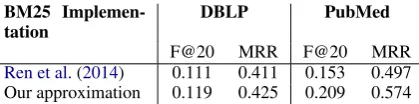
Okapi-BM25 is a popular ranking function. We use BM25 as an IR-based baseline for the task of citation recommendation. For the DBLP and Pubmed datasets, BM25 performance is pro-vided in Ren et al. (2014). To create a com-petitive BM25 baseline for OpenCorpus, we first created indexes for the DBLP and Pubmed datasets and tuned the query to approximate the performance reported in previous work. We used Whoosh14to create an index. We extract the key
terms (using Whoosh’skey terms from text method) from the title and abstract of each query document. The key terms from the document are concatenated to form the query string. Table 5 shows that our BM25 is a close approximation to the BM25 implementation of previous work and can be reliably used as a strong IR baseline for
OpenCorpus. In Table2, we report results on all three datasets using our BM25 implementation.
E Key Phrases forOpenCorpus
In the OpenCorpus dataset, some documents are accompanied by automatically extracted key phrases. Our implementation of automatic key phrase extraction is based on standard key phrase extraction systems – e.g. (Caragea et al.,2014a,b; Lopez and Romary,2010). We first extract noun phrases using the Stanford CoreNLP package (Manning et al., 2014) as candidate key phrases. Next, we extract corpus level and document level
14https://pypi.python.org/pypi/Whoosh/
features (e.g. term frequency, document fre-quency, n-gram probability etc.) for each candi-date key phrase. Finally, we rank the candicandi-date key phrases using a ranking model that is trained on author-provided key phrases as gold labels.
F Detailed Experimental Results
Table 10 comparesNNRank with previous work in detail on DBLP and Pubmed datasets. Clus-Cite (Ren et al., 2014) clusters nodes in a het-erogeneous graph of terms, authors and venues in order to find related documents which should be cited. ClusCite obtains the previous best results on these two datasets. L2-LR (Yu et al.,2012) uses a linear combination of meta-path based linear fea-tures to classify candidate citations. We show that
[image:12.595.77.287.219.271.2]NNSelect NNRank
Hyperparameter Range Chosen Value Range Chosen Value
learning rate [1e-5,1e-4, . . . ,1e-1] 0.01 [1e-5,1e-4, . . . ,1e-1] 0.01
l2 regularization [0,1e-7,1e-6, . . . ,1e-2] 0 [0,1e-7,1e-6, . . . ,1e-2] 1e-3
l1 regularization [0,1e-7,1e-6, . . . ,1e-2] 1e-7 [0,1e-7,1e-6, . . . ,1e-2] 1e-4
word dropout [0,0.05,0.1, . . . ,0.75] 0.60 [0,0.05,0.1, . . . ,0.75] 0.35
margin multiplier [0.5,0.75,1.0,1.25,1.5] 1.0 [0.5,0.75,1.0,1.25,1.5] 0.5
dense dimension [25,50, . . . ,325] 300 [25,50, . . . ,325] 175
metadata dimension - - [5,10, . . . ,55] 45
use pretrained [true, false] true [true, false] false finetune pretrained [true, false] true [true, false]
-number ANN neighbors - 10 -
-triplets per batch size - 256 - 256
triplets per epoch - 500000 - 500000
triplets per training - 2500000 - 2500000
[image:13.595.73.526.121.320.2]use Siamese embeddings - true - true
Table 6: DBLP hyperparameter tuning results. Note that the dense dimension when using pretrained vectors is fixed to be 300. A ’-’ indicates that the variable was not tuned.
NNSelect NNRank
Hyperparameter Range Chosen Value Range Chosen Value
learning rate [1e-5,1e-4, . . . ,1e-1] 0.001 [1e-5,1e-4, . . . ,1e-1] 0.001
l2 regularization [0,1e-7,1e-6, . . . ,1e-2] 0 [0,1e-7,1e-6, . . . ,1e-2] 0
l1 regularization [0,1e-7,1e-6, . . . ,1e-2] 1e-6 [0,1e-7,1e-6, . . . ,1e-2] 1e-6
word dropout [0,0.05,0.1, . . . ,0.75] 0.55 [0,0.05,0.1, . . . ,0.75] 0.1
margin multiplier [0.5,0.75,1.0,1.25,1.5] 0.5 [0.5,0.75,1.0,1.25,1.5] 1.5
dense dimension [25,50, . . . ,325] 325 [25,50, . . . ,325] 150
metadata dimension - - [5,10, . . . ,55] 40
use pretrained [true, false] false [true, false] false finetune pretrained [true, false] - [true, false]
-number ANN neighbors - 10 -
-triplets per batch size - 256 - 256
triplets per epoch - 500000 - 500000
triplets per training - 2500000 - 2500000
use Siamese embeddings - true - true
[image:13.595.73.526.476.672.2]Hyperparameter PubMed/DBLP Value OpenCorpusValue
title/abstract vocabulary size 200000 200000
maximum title length 50 50
maximum abstract length 500 500
training triplets per query 6 6
min # of papers per author included 1 10
min # of papers per venue included 1 10
min # of papers per keyphrases included 5 10
max authors per document 8 8
max keyphrases per document 20 20
minimum true citations per document 2/1 2 maximum true citations per document 100 100
optimizer LazyAdamOptimizer* Nadam**
[image:14.595.95.505.77.282.2]use magnitude-direction embeddings true true reduce learning rate upon plateau false true
Table 8: Per-dataset parameters. These were hand-specified. *LazyAdamOptimizer is part of TensorFlow. **Nadam is part of Keras.
Hyperparameter NNSelectValue NNRankValue
learning rate 0.001 0.001
l2 regularization 1e-5 1e-5
l1 regularization 1e-7 1e-7
word dropout 0.1 0.1
margin multiplier 1.0 1.0
dense dimension 75 75
metadata dimension - 25
use pretrained false false
number ANN neighbors 5
-triplets per batch size 256 32
triplets per epoch 2500000 2500000
triplets per training 25000000 100000000
[image:14.595.154.448.354.547.2]use Siamese embeddings true false
Table 9: Hyperparameters used forOpenCorpus
DBLP PubMed
Method P@10 P@20 R@20 F1@20 MRR P@10 P@20 R@20 F1@20 MRR
BM25 0.126 0.0902 0.1431 0.11 0.4107 0.1847 0.1349 0.1754 0.15 0.4971 L2-LR 0.2274 0.1677 0.2471 0.200 0.4866 0.2527 0.1959 0.2504 0.2200 0.5308 ClusCite 0.2429 0.1958 0.2993 0.237 0.5481 0.3019 0.2434 0.3129 0.274 0.5787
NNSelect 0.287 0.230 0.363 0.282 0.579 0.388 0.316 0.302 0.309 0.699 +NNRank 0.339 0.247 0.390 0.302 0.672 0.421 0.332 0.318 0.325 0.754 + metadata 0.345 0.247 0.390 0.303 0.689 0.429 0.337 0.322 0.329 0.771