Detecting Asymmetric Semantic Relations in Context:
A Case-Study on Hypernymy Detection
Yogarshi Vyas and Marine Carpuat Department of Computer Science
University of Maryland
[email protected] and [email protected]
Abstract
We introduce WHIC1, a challenging
testbed for detecting hypernymy, an asym-metric relation between words. While pre-vious work has focused on detecting hy-pernymy between word types, we ground the meaning of words in specific contexts drawn from WordNet examples, and re-quire predictions to be sensitive to changes in contexts. WHIC lets us analyze
com-plementary properties of two approaches of inducing vector representations of word meaning in context. We show that such contextualized word representations also improve detection of a wider range of se-mantic relations in context.
1 Introduction
Language understanding applications like ques-tion answering (Harabagiu and Hickl, 2006) and textual entailment (Dagan et al., 2013) bene-fit from identifying semantic relations between words beyond synonymy and paraphrasing. For instance, given “Anand plays chess.”, and the question “Which game does Anand play?”, suc-cessfully answering the question requires know-ing thatchessis a kind ofgame, i.e. chessentails
game. Such lexical entailment relations are asym-metric (chess =⇒ game, but game=6⇒chess), and detecting their direction accurately is a chal-lenge.
While prior work has defined lexical entailment as a relation between word types, we argue that it is better defined between word meanings illus-trated by examples of usage in context. Ignoring context is problematic since entailment might hold between some senses of the words, but not others. Consider the wordgamein the following contexts:
1https://github.com/yogarshi/whic
1. The championshipgamewas played in NYC. 2. The hunters were interested in the biggame.
Given the sentence, Anand is the world chess
champion, chess =⇒ game in the first context, while chess =6⇒game in the second context.
Lexical entailment encompasses several seman-tic relations, with one important relation being
hypernymy (Roller et al., 2014; Shwartz et al.,
2016). In this work, we focus on hypernymy de-tection in context, and show that existing resources can be leveraged to automatically create test beds for evaluation. We introduce “Wordnet Hyper-nyms in Context” (WHIC, pronouncedwhich), a
large dataset, automatically extracted from Word-Net (Fellbaum, 1998) using examples provided with synsets. Crucially, WHIC includes
challeng-ing negative examples that assess the ability of models to detect the direction of hypernymy.
We use WHIC to determine the effectiveness of
existing supervised models for hypernymy detec-tion (Roller and Erk, 2016) applied to represen-tations, not only of word types, but of words in context. Such contextualized representations are induced in two ways: the first is based on Con-text2Vec, a BiLSTM model that embeds contexts and words in the same space (Melamud et al.,
2016); the second aims to capture geometric prop-erties of the context in a standard word embedding space built using GloVe (Pennington et al.,2014). We show that the two contextualized rep-resentations improve performance over context-agnostic baselines. The structure of WHIC lets
us show that they have complementary proper-ties: Context2Vec-based models have higher re-call and tend to identify directionality much bet-ter than Glove-based models. We also show that the context-aware representations improve perfor-mance on identifying a broader range of semantic relations (Shwartz and Dagan,2016).
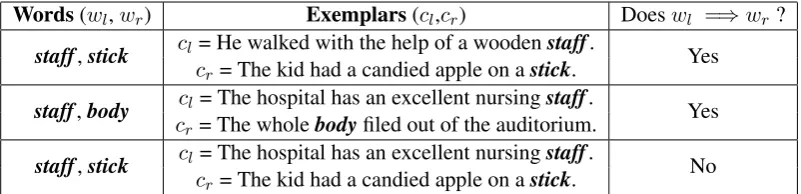
Words(wl,wr) Exemplars(cl,cr) Doeswl =⇒wr?
staff,stick clc= He walked with the help of a woodenstaff. Yes
r= The kid had a candied apple on astick.
staff,body ccl= The hospital has an excellent nursingstaff. Yes
r= The wholebodyfiled out of the auditorium.
staff,stick clc= The hospital has an excellent nursingstaff. No
[image:2.595.99.500.62.159.2]r= The kid had a candied apple on astick.
Table 1: Examples of the context-aware hypernymy detection task
2 Detecting Hypernymy in Context 2.1 Task Definition
We frame hypernymy detection in context as a bi-nary classification task. Each example consists of a 4-tuple(wl, wr, cl, cr), wherewl andwr are
word types, andcl andcr are sentences which
il-lustrate each word usage. The example is treated as positive if wl =⇒ wr, given the meaning of
each word exemplified by the contexts, and nega-tive otherwise, as can be seen in Table1.
As mentioned in Section 1, hypernymy is only one specific case of lexical entailment. The nature of entailment relations captured out-of-context can be broader depending on the test beds consid-ered2. These relations can include synonymy,
hypernymy, some meronymy relations, and also cause-effect relations.
2.2 Motivation
The need to study hypernymy detection in con-text is important due to several reasons. First, many downstream tasks which might benefit from detecting hypernyms will have words appearing in specific contexts. Second, existing definitions (and, by extension, annotations) of lexical entail-ment do not explicitly or consistently address pol-ysemy. For instance, the substitutional definition for entailment by Zhitomirsky-Geffet and Dagan
(2009) asks the reader to think of a natural sen-tence that provides the missing context to the two words being considered, thus constraining the pos-sible senses of the two words. On the other hand,
Turney and Mohammad (2013) propose a rela-tional definition, inviting the reader to imagine a semantic relation that connects the two words and constrains their possible senses. In contrast, we propose to detect hypernymy between word mean-ings described by specific contexts.
2We refer the reader to Turney and Mohammad(2013)
andShwartz et al.(2017) for comprehensive surveys of super-vised and unsupersuper-vised methods for the out-of-context task.
Lexical entailment or hypernymy in context is also different from recognizing textual entailment (RTE). RTE (Dagan et al., 2006, 2013) involves detecting entailment relations between sentences, while hypernymy is a relation between words. Ad-ditionally, the two contexts cl andcr in our task
can be very different, unlike in textual entailment, where the premise and hypothesis are usually re-lated. For instance, the first example in Table1 il-lustrates a scenario where the hypernymy relation holds betweenstaff andstick, but there is no en-tailment relationship between the two sentences. On the other hand, the sentence ”Children smile and wave at the camera.” entails ”There are chil-dren present.”, but there is no meaningful hyper-nymy relationship between words in the two sen-tences.
Finally, the proposed task is also related to, but different from word sense disambiguation (WSD). Unlike WSD, this task eschews an explicit sense inventory, instead relying on the provided contexts to decide the specific relation between the words. This might provide a more natural way to think about word senses for (untrained) human annota-tors (Erk et al., 2013). WSD can in principle be used as a preprocessing step to address hypernymy detection in context, but it is not required. Also, WSD remains a challenging task (Moro and Nav-igli, 2015) and it might introduce errors early in the preprocessing pipeline.
2.3 WHIC : A Dataset for Lexical Entailment in Context
Word : Study
Example : he knocked on the door of the study
Word : Study
Example : he made several studies before the final painting
Word : Room
[image:3.595.96.516.64.142.2]Example : the rooms were small but comfortable WordExample : Drawing : he did complicated pen-and-ink drawings
Figure 1: Sample dataset creation process based on two synsets of the wordstudy. The green/solid lines indicate positive examples, while the red/dashed lines indicate negative examples
Existing datasets for lexical entailment (Baroni and Lenci, 2011;Baroni et al., 2012; Kotlerman et al., 2010) have driven progress on the out of context task only, and are therefore insensitive to context changes. In addition, they include a variety of negative examples without controlling for entailment direction. For instance, Baroni and Lenci (2011) use cohyponyms and random words as negative examples. Since cohyponyms are words that share a common hypernym (for ex-ample,salsaandtangoare cohyponymys with re-spect todance), hypernymy does not hold between them in any direction. On the other hand, ran-dom examples (also used byBaroni et al.(2012)) are likely to be detected using symmetric seman-tic similarity rather than asymmetric hypernymy detection.
Shwartz and Dagan(2016) recently introduced CONTEXT-PPDB, a dataset for fine-grained
lexi-cal inference in context. This dataset consists of word pairs along with a pair of sentential con-texts, with a label indicating the semantic rela-tion between the two words in the given contexts. However, since CONTEXT-PPDB only consists of
~3700 sentence pairs, it provides only a smaller number of annotated examples per relation, mak-ing it difficult to train large supervised models on (we return to this dataset in Section5).
We address these gaps by introducing, WHIC,
a large dataset automatically derived from Word-Net (Fellbaum,1998). WordNet groups synonyms intosynsetsand defines semantic relations such as hypernymy and meronymy between these synsets. Most synsets are further accompanied by one or more short sentences illustrating the use of the members of the synset. WHIC uses these example
sentences as context for the words, and the hyper-nymy relations to draw candidate word pairs. The process starts from a seed list of wordsW and pro-ceeds as follows (see Figure1) :
1. For all word typesw∈W obtain synsetsSw.
2. For each synset i ∈ Sw, pick a hypernym
synset si
h, with a corresponding word form
wi
h. Also obtainci andcih which are
exam-ple sentences corresponding towiandwi h
re-spectively - (wi, wi
h, ci, cih) serves as a
posi-tive example. Repeat this process for all hy-pernyms (solid/green arrows in Figure1). 3. Permute the positive examples to get
neg-ative examples. From (wi, wi
h, ci, cih) and
(wj, wj
h, cj, cjh), generate negative examples
(wi, wj
h, ci, cjh) and (wj, whi, cj, cih) (longer
dashed/red arrows in Figure1).
4. Flipthe positive examples to generate nega-tive examples. From (wi, wi
h, ci, cih) generate
the negative example (wi
h, wi, cih, ci) (shorter
dashed/red arrows in Figure1).
We run this process using the 9000 most fre-quent words from Wikipedia asW (after filtering the top 1000 as stopwords). This yields a total of 5239 positive examples, 12303 negative examples from Step 3, and 5239 negative examples from Step 4.
WHIC satisfies the desiderata outlined above.
The dataset has a well-defined focus, since we only pick hypernym-hyponym pairs. The nega-tive examples generated in Steps 3 and 4 require discriminating between different word senses and entailment directions. Finally, with over 22000 examples distributed over 6000 word pairs, the dataset is large enough to train large supervised models. We define a 70/5/25 train/dev/test split, and ensure that each set contains different word pairs, to avoid memorization and overfitting (Levy et al.,2015).
3 Representing Words and their Contexts for Entailment
How can we construct representations of the meaning of target wordswl andwr, and their
the river bank
0.3 0.6 -0.1
1.5 -2.5 0
-1 0.2 1.8
cl,mean 0.27 -0.57 0.57
-1 -2.5 -0.1
1.5 0.6 1.8
Cl
cl,min
cl,max (wl)
}
-1 0.2 1.8bank ⊙
wl,mean -0.27 -1.14 1.03
1 -5.0 -0.18
-1.5 0.12 3.24
wl,min
[image:4.595.77.287.61.210.2]wl,max
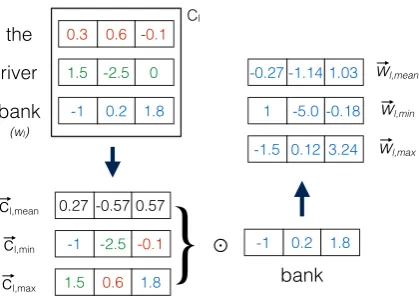
Figure 2: Constructing word-in-context represen-tations for “bank”, in the context “the river bank”. indicates element-wise multiplication.
We will construct representations forcl, andcr,
and create context-aware representations for wl
andwrby “masking” their word embeddings with
the embeddings for cl and cr (Section 3.3). We
compare two approaches to representingclandcr.
The first (Section3.1) builds on standard represen-tations for word types, which have proven useful for detecting lexical entailment and other seman-tic relations out of context (Baroni et al., 2012;
Kruszewski and Baroni, 2015; Vylomova et al.,
2016; Turney and Mohammad, 2013). The sec-ond approach (Section3.2) uses a recurrent neural model to embed words and contexts in the same space, allowing direct comparisons between them.
3.1 Creating Context Representations from Word Type Representations
Given an example (wl, wr, cl, cr), let ~wl and ~wr
refer to the context-agnostic representations ofwl
and wr, and let Cl and Cr represent the
matri-ces obtained by row-wise stacking of the context-agnostic representations of words incl andcr
re-spectively.
Following Thater et al. (2011); Erk and Pad´o
(2008), we apply a filter to word type represen-tations to highlight the salient dimensions of the exemplar context, emphasizing relevant dimen-sions and downplaying unimportant ones. How-ever, while prior work represents context by aver-aging word vectors, we propose richer represen-tations that better capture the salient geometrical properties of the exemplar context that might get lost by averaging.
We construct fixed length representations for the contextsclandcrby running convolutional
fil-ters overClandCr. Specifically, we calculate the
column-wise maximum, minimum and the mean over the matrices Cl and Cr, as done by Tang et al. (2014) for supervised sentiment classifica-tion. This yields threed-dimensional vectors forcl
(~cl,max,~cl,min,~cl,mean), and threed-dimensional
vectors for cr (~cr,max,~cr,min,~cr,mean).
Comput-ing the maximum and minimum across all vec-tor dimensions captures the exterior surface of the “instance manifold” (the volume in embedding space within which all words in the instance re-side), while the mean summarizes the density per-dimension within the manifold (Hovy,2015).
3.2 LSTM-based Context Representations: Context2Vec
An alternative approach to contextualizing word representations is to directly compare the repre-sentations of words with reprerepre-sentations of con-texts. This can be done using Context2Vec ( Mela-mud et al., 2016), a neural model that, given a target word and its sentential context, embeds both the word and the context in the same low-dimensional space using a BiLSTM, with the objective of having the context predict the tar-get word via a log-linear model. This model approaches the state-of-the-art on lexical sub-stitution, sentence completion, and supervised word sense disambiguation. For each example (wl, wr, cl, cr), we extract the word type
repre-sentations ~wl,c2v and ~wl,c2v from Context2Vec,
as well as the context representations~cl,c2v, and
~cr,c2v.
3.3 Context-aware Masked Representations
Given these two methods to learn representations for words and their contexts, we also learn context aware word representations for the target words. We transform initial context-agnostic representa-tions for target word types by taking an element-wise product of the word type vectors with vectors representing the context.
Specifically, for the context representations learned in Section 3.1, we take an element-wise product of the word type vectors (w~∗) with
(~c∗,max,~c∗,min,~c∗,mean) where ∗ ∈ {l, r}. This
yields threed-dimensional vectors forwl(~wl,max,
~wl,min, ~wl,mean), and three for wr (~wr,max,
~wr,min, ~wr,mean). We refer to our final
word-in-context representations forwl andwr as ~wl,mask
concatenation of ~wl,max, ~wl,min, ~wl,mean, and
~wr,maskis also similarly constructed.
For the word and context representations ob-tained from Context2Vec (Section 3.2), we cre-ate the context-aware representations ~wl,c2v,mask
by vector multiplication between ~wl,c2vand~cl,c2v.
We also obtain ~wr,c2v,masksimilarly.
4 Comparing Words and Contexts for Entailment
Given the word, context, and word-in-context rep-resentations described above, we predict entail-ment via supervised classification.
Our classifier is theHypernymy-Feature detec-tor (Roller and Erk, 2016), which is the current state-of-the-art supervised model for detecting hy-pernymy on several datasets. This model aims to overcome the shortcomings of previous supervised hypernymy detection models, which used linear classifiers on top of concatenation of the two vec-tors representing the target words. These models only captured notions of prototypicality without modeling the interactions between the two words; that is, they guessed that (animal, sofa) is a pos-itive example becauseanimal looks like a hyper-nym (Levy et al.,2015).
Instead, the H-Feature detector model trains a linear classifier using concatenation, as described above, and then removes this prototypical infor-mation from the word vectors by projecting them on a hyperplane orthogonal to the separating hy-perplane learned by the linear classifier. By re-peating this process, one can learn multiple classi-fiers, each of which increases the models represen-tational power. In each iterationi, four features are extracted to represent the word pair, based on the current representations of the word pair(~x, ~y)and the hyperplane~pilearned in the current iteration :
1. The similarity between~xand the hyperplane, ~x.~pi
2. The similarity between~yand the hyperplane, ~y.~pi
3. The similarity between the two words,~x.~y 4. The similarity between the difference of the
two words, and the hyperplane,(~y−~x).~pi
Features 1 and 2 capture similarities like the one included in the concatenation classifier. The third feature aims to overcome the shortcomings of the concatenation model by directly modeling
the similarities between the two target words. Fi-nally, the fourth feature captures the distributional inclusion hypothesis (Geffet and Dagan,2005) – if wordvis a hypernym ofu, then the set of features ofu are included in the set of features ofv – by intuitively capturing whetheryincludesx(Roller et al.,2014).
5 Experimental Set-up
Tasks In addition to WHIC, we evaluate
our context-aware representations on CONTEXT
-PPDB. As mentioned in Section2.3, CONTEXT
-PPDB is a dataset for fine-grained lexical infer-ence in context that captures other semantic rela-tions beyond hypernymy. It has been created us-ing 375 word pairs from a subset of the English Paraphrase Database (Ganitkevitch et al., 2013;
Pavlick et al., 2015). These word pairs are semi-automatically labeled with semantic relations out-of-context.Shwartz and Dagan(2016) augmented them with examples of word usage in context, and re-annotated the word pairs given the extra con-textual information. The final dataset consists of 3750 words/contexts tuples with a corresponding semantic label, one of which is entailment.
All our experiments are with the default train/dev/test splits on both datasets.
Contextualized Word Representations To ob-tain the Context2Vec representations, we use an existing 600-dimensional model trained on ukWaC (Ferraresi et al., 2006). We use 600 di-mensional GloVe embeddings trained on the same corpus to create ~wl, ~wr,Cl, andCr, and allow for
a controlled comparison with Context2Vec. Con-text2Vec representations are significantly more ex-pensive to train: Melamud et al. (2016) indicate that training requires ~30 hours on a Tesla K80 GPU, while the GloVe embeddings can be trained on the exact same amount of data in less than 7 hours on a CPU.
Supervised Lexical Entailment Classifier We use an SVM with an RBF kernel for WHIC and
Logistic Regression for CONTEXT-PPDB as
im-plemented in Scikit-Learn 3 as our classifiers, to
allow for exact comparisons with past work on CONTEXT-PPDB. We use default parameters,
ex-cept for adding class weights in the WHIC
exper-iments to account for the unbalanced data. For WHIC we use features derived from the H-Feature
model described in Section 4. For CONTEXT
-PPDB we simply concatenate the representations and use them directly as the features. We evaluate the predictions using F1 score.
6 Experiments on WHIC
In our first set of experiments, we evaluate the two models described in Section3on WHIC under a
variety of combinations.
6.1 Overall Results
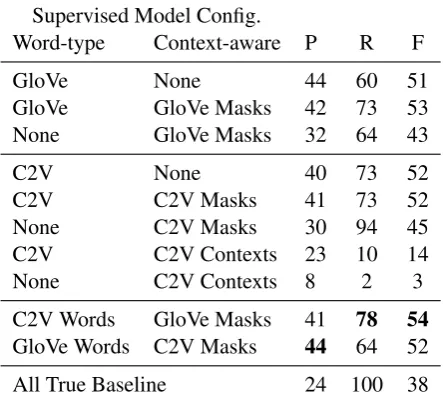
Results are summarized in Table 2. Supervised models4 outperform the baseline that always
pre-dict that hypernymy holds (“All True Baseline”) by up to 16 F-score points. Context-aware mod-els outperform context-agnostic modmod-els by up to 3 points5. GloVe and Context2Vec
mod-els yield similar F1, both when used as word type representations alone, and when combined with masked representations. However, GloVe and Context2Vec representations capture comple-mentary information: GloVe yields slightly bet-ter precision while Context2Vec models yield significantly better recall. The best perfor-mance overall is obtained by a hybrid model that uses word-type representations from Context2Vec and masked context-aware representations derived from GloVe.
Additionally using Context2Vec vectors di-rectly (~cl,c2v,~cr,c2v) performs much worse than
us-ing them as masks (~wl,c2v,mask,~cr,c2v,mask). This
highlights the benefit of using context to influence the word type representation rather than to directly compare word and context representations.
Finally, there is no benefit in using the context-aware masked representations without the word type representations: using just the masked rep-resentations by themselves does worse than using them in combination with the word type represen-tations.
Overall, the scores in Table2highlight the chal-lenging nature of WHIC, and leave scope for
improvement with potentially better models for context-aware representations.
4We also tried two unsupervised context-agnostic
base-lines using cosine similarity and balAPinc (Kotlerman et al.,
2010) but they trivially predicted all pairs as entailing
5A statistically significant difference withp <0.01under
the McNemar’s test (McNemar,1947)
Supervised Model Config.
Word-type Context-aware P R F
GloVe None 44 60 51
GloVe GloVe Masks 42 73 53
None GloVe Masks 32 64 43
C2V None 40 73 52
C2V C2V Masks 41 73 52
None C2V Masks 30 94 45
C2V C2V Contexts 23 10 14
None C2V Contexts 8 2 3
C2V Words GloVe Masks 41 78 54
GloVe Words C2V Masks 44 64 52
[image:6.595.307.529.65.265.2]All True Baseline 24 100 38
Table 2: Results on WHIC. a) Word type
indi-cates (GloVe or Context2Vec (C2V)) H-Features extracted from context-agnostic representations. b) Context aware indicates H-Features extracted from the context-aware representations described in Section3.
6.2 Sensitivity to context
To determine the sensitivity of our models to con-text changes, we evaluate on the balanced sub-set of WHIC comprised of positive examples and
negative examples created by permuting contexts in Step 3 of the dataset creation process. We an-alyze the predictions using a modified version of precision, recall and F-score, defined as the pre-cision, recall, and F1-score calculated over each (wl,wr) word pair, and then averaged over all word
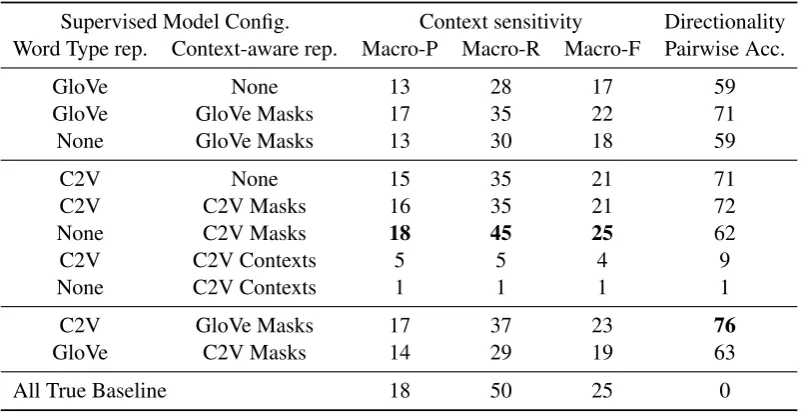
pairs. We call these measures the Macro-P/R/F1. Table 3 shows that context-aware representa-tions generally improve performance on all three metrics, but the gain is larger on recall. Again we observe that models using Context2Vec word types and masks have a better Macro-R than the corresponding GloVe models. Overall, the masked representations obtained from Context2Vec per-form the best on these metrics, closely followed by the overall best model that uses the Context2Vec word type representations and the masked repre-sentations from GloVe.
Finally, note that the all-true baseline surpris-ingly does as well as the best context-aware model on this metric. However, it cannot detect the direc-tion of hypernymy (Secdirec-tion6.3), and the structure of WHIC allows us to distinguish these two
Supervised Model Config. Context sensitivity Directionality Word Type rep. Context-aware rep. Macro-P Macro-R Macro-F Pairwise Acc.
GloVe None 13 28 17 59
GloVe GloVe Masks 17 35 22 71
None GloVe Masks 13 30 18 59
C2V None 15 35 21 71
C2V C2V Masks 16 35 21 72
None C2V Masks 18 45 25 62
C2V C2V Contexts 5 5 4 9
None C2V Contexts 1 1 1 1
C2V GloVe Masks 17 37 23 76
GloVe C2V Masks 14 29 19 63
[image:7.595.99.500.62.270.2]All True Baseline 18 50 25 0
Table 3: Macro-P/R/F1 and Pairwise accuracy, are intended to capture context-awareness (Section6.2) and directionality-discrimination abilities (Section6.3) of the models, respectively.
6.3 Sensitivity to Entailment Direction
Next, we evaluate to what extent the models cap-ture the direction of hypernymy using the balanced subset of WHIC that consists of all positive
exam-ples and flipped negative examexam-ples generated in Step 4 in the dataset creation process. We mea-sure directionality by looking at the fraction of pairs ((wl, wr, cl, cr),(wr, wl, cr, cl)) where both
examples are correctly labeled, i.e. the former is labeled as =⇒ and the latter as =6⇒. We call this metric the pairwise accuracy.
As seen in Table 3, the best pairwise accu-racy is again obtained by the hybrid model using word type representations from Context2Vec and the masked representations from GloVe. Overall Context2Vec models do a better job at capturing directionality than GloVe.
6.4 Nature of Contextualized Masks
We also hypothesized that masked contextual-ized representations based on the full volume of the context usingminandmax operations (Sec-tion3.1) better capture salient context dimensions than the more usual vector averaging approach. We test this hypothesis empirically by replacing masked word-in-context representations ~wl,mask
and ~wr,mask by two other ways to capture context.
In the first method, we use the mean of the con-texts(~cl,mean,~cr,mean). In the second method, we
use(~wl,mean, ~wr,mean), i.e. the masked
represen-tations calculated by using only the mean of the context, and not themaxandmin.
Table 4 shows that our preferred method out-performs the two alternatives on WHIC, with our
proposed representations outperforming the other methods by 3 F1 points. Additionally, this in-crease in performance also comes with significant improvement in detection of asymmetric relations.
6.5 Summary
Overall, both Context2Vec and Glove representa-tions improve performance over context-agnostic baselines. Using masking to contextualize word type representations works better than just us-ing the context representations as is. The best performing model is a hybrid model that uses word type representations from Context2Vec and masked representations from GloVe. Analysis en-abled by the structure of the dataset shows that all masked representations are sensitive to changes in meaning indicated by glosses from distinct Word-Net synsets. However, the more expensive Con-text2Vec representations do a better job at recall and direction of hypernymy.
7 CONTEXT-PPDB
We now experiment on CONTEXT-PPDB to test
the ability of contextualized representations to capture semantic relations beyond hypernymy, to aid future work on recognizing other contextual-ized relationships.
Dataset Representations P R F Context sensitivity Directionality
WHIC
~cl,mean,~cr,mean 45 59 51 17 58
~wl,mean,~wr,mean 43 62 51 18 61
[image:8.595.115.482.65.128.2]~wl,mask,~wr,mask 42 73 53 22 71
Table 4: Impact of masks on WHIC measured by Precision (P), Recall (R), F-Measure (F), context
sen-sitivity (Macro-F1) and directionality (Pairwise accuracy). Replacing our contextualized representations by a mean representation of the context, or a contextualized representation based only on the mean, leads to drops in performance.
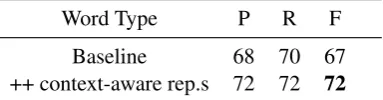
Word Type P R F
Baseline 68 70 67
++ context-aware rep.s 72 72 72
Table 5: Results on CONTEXT-PPDB. Baseline
indicates the previous state of the art result on this dataset (Shwartz and Dagan,2016)
well as similarity scores between words and con-texts. The PPDB features notably include scores for likelihood of context-agnostic entailment la-bels, distributional similarities, and probabilities of the word pair being paraphrases, among other scores. Additionally, word representation fea-tures are used: given two word/context pairs (wx, cx, wy, cy), GloVe vectors are used to
repre-sentwxandwy, as well as words incxandcy, and
are used to extract the following feature, which capture the most salient word/context similarities between the two pairs :
{max
w∈cyw~x·~w,maxw∈cxw~y·~w,w∈maxcx,w0∈cy~w·
~ w0}
We augment this system with contextualized word representations. We use the GloVe based masked representations, as they can be obtained with a negligible computation cost in addition the features already included in the baseline, and as the labels denote a mix of directional and non-directional relations. This remarkably yields an improvement ~5 F1 points compared to the previ-ous state-of-the-art (Table5). Breaking down re-sults per label (Table6) shows an increase of 8 F1 points for the entailment class. This improvement again stems from a large increase in recall, mir-roring the behavior observed on WHIC. The
di-verse “other-related” category also benefits from context-aware representations.
Label Baseline ++ Context-aware Rep.s
Equivalence 76 76
Entailment 79 87
Alternation 55 55
Other-related 12 28
Independent 77 78
Table 6: Performance of the baseline and augmented model on all semantic relations in CONTEXT-PPDB measured using per-class F1
8 Related Work
WordNet and lexical entailment The “is-a” hi-erarchy of WordNet (Fellbaum,1998) is a promi-nent source of information for unsupervised de-tection of hypernymy and entailment (Harabagiu and Moldovan,1998;Shwartz et al.,2015), as well as a source of various datasets (Baroni and Lenci,
2011;Baroni et al., 2012). WHIC is inspired by
the latter line of work, except that we extract ex-emplar contexts from WordNet in addition to rela-tions between words.
[image:8.595.86.278.214.264.2]of using an element-wise multiplication to apply a context mask to word type representations. The nature of the context representation varies: Erk and Pad´o (2008) use inverse selectional prefer-ences; Thater et al. (2010) combine a first order co-occurrence based representation for the context with a second order representation for the target,
Thater et al.(2011) rely on syntactic dependencies to define context. Apidianaki (2016) shows that bag-of-word context representation within a small context window works as well as syntactic defini-tions of context for ranking paraphrases in context. Our use of convolution is motivated by success of similar models on sentence classification tasks.
Tang et al.(2014) uses convolution over embed-ding matrices for unigrams, bigrams, and trigrams, whileHovy(2015) uses just unigrams. However, all these works use the resulting representations to predict properties of the sentence (e.g., sentiment), rather than to contextualize target word represen-tations.
In-context lexical semantic tasks Besides en-tailment, other lexical semantic tasks studied in context include lexical substitution (McCarthy and Navigli, 2007) and cross-lingual lexical substitu-tion (Mihalcea et al., 2010). The focus of these tasks and their related datasets is on synonymy and translation equivalence, since they require one to predict substitutes for a target word instance, which preserve its meaning in a given sentential context. On the other hand, the focus of this work and WHIC is on detecting more fine-grained
rela-tions via lexical entailment. Another related task is that of paraphrase ranking (Apidianaki,2016). The work byApidianaki(2016) is also notable be-cause of their successful use of models of word-meaning in context from Thater et al. (2011), which is closely related to our work.
9 Conclusion
We introduced WHIC, a dataset to evaluate
lexi-cal entailment in context, providing exemplar sen-tences to ground the meaning of words being considered for entailment, and challenging exam-ples designed to capture entailment direction ac-curately.
We showed that supervised models developed for context-agnostic lexical entailment can address the context-aware task to some extent, when re-placing word representations with a contextual-ized version. We compared two contextualcontextual-ized
representations including (1) a simple context-aware representation based on the geometry of word embeddings, and (2) Context2Vec, a more expensive BiLSTM-based model that yields repre-sentations of words and their context in the same space. Both improve performance over context-agnostic models, and have complementary prop-erties: models using Context2Vec are more accu-rate at discriminating the direction of entailment. They also have a better recall when measured us-ing metrics designed to test sensitivity to context. Finally, we also showed that contextualized repre-sentations can improve detection of other semantic relations in context.
While encouraging, the performance of mod-els considered leave substantial room for improve-ment. For instance, it remains to be seen whether richer features for the supervised models and richer context representations can improve sensi-tivity to context, and whether the nuances of the task can be better captured with annotations on a graded scale, following previous work on word meaning in context (Erk et al.,2013).
Acknowledgements
The authors thank the anonymous reviewers for their comments, as well as the members of the CLIP lab at UMD and Mona Diab for many con-versations which helped shape this paper. We also thank Vered Shwartz for help with data and code for CONTEXT-PPDB, and Stephen Roller for help
with the H-Feature detector code.
References
Marianna Apidianaki. 2016. Vector-space models for PPDB paraphrase ranking in context. In
Proceed-ings of EMNLP 2016. Austin, TX, USA, pages
2028–2034.
Marco Baroni, Raffaella Bernardi, Ngoc-Quynh Do, and Chung-chieh Shan. 2012. Entailment above the word level in distributional seman-tics. In Proceedings of EACL 2012. pages 23–32. http://dl.acm.org/citation.cfm?id=2380822.
Marco Baroni and Alessandro Lenci. 2011. How we BLESSed distributional semantic
evaluation. In Proceedings of the GEMS
2011 Workshop on GEometrical Models of
Natural Language Semantics. pages 1–10.
http://dl.acm.org/citation.cfm?id=2140490.2140491. Ido Dagan, Oren Glickman, and Bernardo Magnini.
2006. The PASCAL Recognising Textual
International Conference on Machine Learning Challenges: Evaluating Predictive Uncertainty Vi-sual Object Classification, and Recognizing Textual
Entailment. Springer-Verlag, Southampton, UK,
MLCW’05, pages 177–190.
Ido Dagan, Dan Roth, Mark Sammons, and Fabio Mas-simo Zanzotto. 2013. Recognizing Textual
Entail-ment: Models and Applications. Morgan &
Clay-pool Publishers.
Georgiana Dinu and Mirella Lapata. 2010. Mea-suring Distributional Similarity in Context. In
Proceedings of EMNLP 2010. Cambridge, MA,
USA, pages 1162–1172. http://eprints.pascal-network.org/archive/00008156/.
Georgiana Dinu, Stefan Thater, and S¨oren Laue. 2012. A comparison of models of word meaning in con-text. In Proceedings of NAACL-HLT 2012. pages 611–615.
Katrin Erk, Diana McCarthy, and Nicholas Gaylord. 2013. Measuring Word Meaning in Context.
Com-putational Linguistics39(3).
Katrin Erk and Sebastian Pad´o. 2008. A struc-tured vector space model for word meaning in context. In Proceedings of EMNLP 2010. Honolulu, HA, USA, October, pages 897–906. https://doi.org/10.3115/1613715.1613831.
Christiane Fellbaum, editor. 1998. WordNet: An
Elec-tronic Lexical Database. MIT Press.
Adriano Ferraresi, Eros Zanchetta, Marco Baroni, and Silvia Bernardini. 2006. Introducing and evaluating ukWaC , a very large web-derived corpus of English.
InProceedings of the 4th Web as Corpus Workshop.
Juri Ganitkevitch, Benjamin Van Durme,
and Chris Callison-Burch. 2013. PPDB
: The Paraphrase Database. Proceedings
of NAACL-HLT 2013 (June):758—-764.
http://cs.jhu.edu/ ccb/publications/ppdb.pdf.
Maayan Geffet and Ido Dagan. 2005. The Distribu-tional Inclusion Hypotheses and Lexical Entailment.
InProceedings of ACL 2005. Ann Arbor, MI, June,
pages 107–114.
Sanda Harabagiu and Andrew Hickl. 2006.
Methods for Using Textual Entailment
in Open-Domain Question Answering.
Proceedings of ACL (July):905–912.
https://doi.org/10.3115/1220175.1220289.
Sanda Harabagiu and Dan Moldovan. 1998. Knowl-edge processing on an extended wordnet. WordNet:
An electronic lexical database305:381–405.
Dirk Hovy. 2015. Demographic Factors Improve Clas-sification Performance. In Proceedings of
ACL-IJCNLP 2015. Beijing, China, pages 752–762.
Lili Kotlerman, Ido Dagan, Idan Szpektor, and Maayan Zhitomirsky-Geffet. 2010. Directional Distributional Similarity for Lexical Inference.
Natural Language Engineering 16(4):359–389.
https://doi.org/10.1017/S1351324910000124. German Kruszewski and Marco Baroni. 2015.
Deriv-ing Boolean structures from distributional vectors.
Transactions of ACL3:375–388.
Omer Levy, Steffen Remus, Chris Biemann, and Ido Dagan. 2015. Do Supervised Distributional Meth-ods Really Learn Lexical Inference Relations? In
NAACL HLT 2015. pages 970–976.
Diana McCarthy and Roberto Navigli. 2007. SemEval-2007 Task 10: English Lexical Substitution Task.
In Proceedings of SEMEVAL 2007. pages 48–53.
https://doi.org/10.1007/s10579-009-9084-1. Quinn McNemar. 1947. Note on the sampling error
of the difference between correlated proportions or percentages. Psychometrika12(2):153–157. Oren Melamud, Jacob Goldberger, and Ido Dagan.
2016. context2vec: Learning Generic Context Em-bedding with Bidirectional LSTM. InProceedings
of CoNLL 2016. Berlin, Germany, pages 51–61.
Rada Mihalcea, Ravi Sinha, and Diana McCarthy. 2010. SemEval-2010 Task 2: Cross-Lingual Lexi-cal Substitution. InProceedings of SemEval 2010
(ACL 2010). Uppsala, Sweden, July, pages 9–14.
Andrea Moro and Roberto Navigli. 2015. Semeval-2015 task 13: Multilingual all-words sense disam-biguation and entity linking. Proc. of SemEval-2015
.
Ellie Pavlick, Pushpendre Rastogi, Juri Ganitkevitch, Benjamin Van Durme, and Chris Callison-Burch. 2015. PPDB 2.0: Better paraphrase ranking, fine-grained entailment relations, word embeddings, and style classification. Proceedings of ACL-IJCNLP 2015pages 425–430.
Jeffrey Pennington, Richard Socher, and
Christo-pher D Manning. 2014. GloVe: Global
Vec-tors for Word Representation. In Proceedings
of EMNLP 2014. Doha, Qatar, pages 1532–1543.
https://doi.org/10.3115/v1/D14-1162.
Joseph Reisinger and Raymond J Mooney. 2010. Multi-Prototype Vector-Space Models of Word Meaning. InProceedings of NAACL 2010. Los An-geles, CA, June, pages 109–117.
Stephen Roller and Katrin Erk. 2016. Relations such as Hypernymy: Identifying and Exploiting Hearst Patterns in Distributional Vectors for Lex-ical Entailment. Proceedings of EMNLP 2016
http://arxiv.org/abs/1605.05433.
Vered Shwartz and Ido Dagan. 2016. Adding Context to Semantic Data-Driven Paraphrasing. In
Proceed-ings of *SEM 2016. Berlin, Germany, pages 108–
113.
Vered Shwartz, Yoav Goldberg, and Ido Dagan. 2016. Improving Hypernymy Detection with an Integrated Pattern-based and Distributional Method. In
Pro-ceedings of ACL 2016.
Vered Shwartz, Omer Levy, Ido Dagan, and Jacob Goldberger. 2015. Learning to Exploit Structured Resources for Lexical Inference. In Proceedings
of CoNLL 2015. Beijing, China, pages 175–184.
http://www.aclweb.org/anthology/K15-1018. Vered Shwartz, Enrico Santus, and Dominik
Schlechtweg. 2017. Hypernyms under Siege: Linguistically-motivated Artillery for Hypernymy Detection. InProceedings of EACL 2017. Valencia, Spain.
Duyu Tang, Furu Wei, Nan Yang, Ming Zhou, Ting Liu, and Bing Qin. 2014. Learning Sentiment-Specific Word Embedding. In Proceedings of
ACL 2014. Baltimore, MD, USA, pages 1555–1565.
https://doi.org/10.3115/1220575.1220648.
Stefan Thater, Hagen Fuerstenau, and Manfred Pinkal. 2010. Contextualizing Semantic Representa-tions Using Syntactically Enriched Vector Mod-els. In Proceedings of ACL 2010. Uppsala, Swe-den, July, pages 948–957. http://eprints.pascal-network.org/archive/00008090/.
Stefan Thater, Hagen F¨urstenau, and Manfred Pinkal. 2011. Word Meaning in Context : A Simple and Effective Vector Model. InProceedings of IJCNLP 2011. Chiang Mai, Thailand, pages 1134–1143. Peter Turney and Saif Mohammad. 2013. Experiments
with three approaches to recognizing lexical entail-ment. Natural Language Engineering 1(1):1–42. https://doi.org/10.1017/S1351324913000387. Ekaterina Vylomova, Laura Rimell, Trevor Cohn, and
Timothy Baldwin. 2016. Take and Took, Gaggle and Goose, Book and Read: Evaluating the Utility of Vector Differences for Lexical Relation Learning. In
Proceedings of ACL 2016. Berlin, Germany, pages
1671–1682.
Maayan Zhitomirsky-Geffet and Ido Dagan. 2009. Bootstrapping Distributional Feature Vector Quality.