
37
Computational Syntax-Semantics Interface with Type-Theory of
Acyclic Recursion for Underspecified Semantics
Roussanka Loukanova Stockholm University
Abstract
The paper provides a technique for algorithmic syntax-semantics interface in computational grammar with underspecified semantic representations of human language. The technique is intro-duced for expressions that contain NP quantifiers, by using computational, generalised Constraint-Based Lexicalised Grammar (GCBLG) that represents major, common syntactic characteristics of a variety of approaches to formal grammar and natural language processing (NLP). Our solution can be realised by any of the grammar formalisms in the CBLG class, e.g., Head-Driven Phrase Structure Grammar (HPSG), Lexical Functional Grammar (LFG), Categorial Grammar (CG). The type-theory of acyclic recursion Lλ
ar, provides facility for representing major semantic ambiguities, as
under-specification, at the object level of the formal language ofLλ
ar, without recourse of meta-language
variables. Specific semantic representations can be obtained by instantiations of underspecifiedLλ
ar
-terms, in context. These are subject to constraints provided by a newly introduced feature-structure description of syntax-semantics interface in GCBLG.
1
Introduction
Ambiguity permeates human language, in all of its manifestations, by interdependences, across lexicon, syntax, semantics, discourse, context, etc. Alternative interpretations may persist even when specific context and discourse resolve or discard some specific instances in syntax and semantics. We present computational grammar that integrates lexicon, syntax, types, constraints, and semantics. The formal fa-cilities of the grammar have components that integrate syntactic constructions with semantic representa-tions. The syntax-semantic interface, internally in the grammar, handles some ambiguities as phenomena of underspecification in human language.
We employ a computational grammar, which we call Generalised Constraint-Based Lexicalised Grammar (GCBLG). The formal system GCBLG uses feature-value descriptions and constraints in a grammar with a hierarchy of dependent types, which covers lexicon, phrasal structures, and semantic representations. In GCBLG, for the syntax, we use feature-value descriptions, similar to that in Sag et al. (2003), which are presented formally in Loukanova (2017a) as a class of formal languages designating mathematical structures of functional domains of linguistics information. GCBLG is a generalisation from major lexical and syntactic facilities of frameworks in the class of Constraint-Based Lexicalist Grammar (CBLG) approaches. To some extend, this is reminiscence of Vijay-Shanker and Weir (1994). We lift the idea of extending classic formal grammars to cover semantic representations with semantic underspecification via syntax-semantics interface within computational grammar.
The grammar rules and constraints in GCBLG, in syntax and lexicon, carry semantic representations. The formal language of the semantic representations is a specialised feature-value encoding of terms of the formal language of acyclic recursionLλ
ar, see Moschovakis (2006).
2
Overview of Moschovakis Type-Theory of Acyclic Recursion
2.1 Syntax ofLλ ar
TypesLλ
aris the smallest set defined recursively, e.g., by presenting the rules in Backus-Naur form:
τ ::=e|t|s|(τ →τ) (Types)
Typed Vocabulary ofLλ
ar: For each typeτ ∈Types,Lλarhas typed constants, and variables. ConstantsK: a denumerable (e.g., finite) set,Kτ ={c0τ, . . . ,cτk},K =
S
τKτ
Pure variablesPV: a denumerable set: PVτ ={v0,v1, . . .};PV=SτPVτ
Recursion (memory) variablesRV: a denumerable set:RVτ ={r0,r1, . . .};RV=SτRVτ
The sets of constants and variables of both kinds are mutually distinct: K 6=RV6=PV.
Terms of Lλ
ar: The set of the terms of Lλar isTerms = ∪τ∈TypesTermsτ, where for everyτ ∈ Types,
the terms inTermsτare defined recursively as follows:
• Constants: Ifc∈Kτ, thenc∈Termsτ, denoted byc:τ andcτ
• Variables: Ifx∈PVτ∪RVτ, thenx∈Termsτ, denoted byx:τ andxτ
• Application Terms: If A ∈ Terms(σ→τ) and B ∈ Termsσ, then A(B) ∈ Termsτ, denoted by
A(B) :τ and[A(B)]τ
• λ-abstraction terms: Ifx ∈ PVσ, and A ∈ Termsτ, then λ(x)(A) ∈ Terms(σ→τ), denoted by
λ(x)(A) : (σ→τ)and[λ(x)(A)](σ→τ)
• Recursion terms:For anyn≥0, ifAi ∈Termsσi (i= 0, . . . , n) andpi ∈RVσi(i= 1, . . . , n) are
such thatp1, . . . , pnare pairwise different, and the sequence{p1 :=A1, . . . , pn:=An}satisfies
the Acyclicity Constraint, i.e., it isacyclic, thenA0 where{p1 :=A1, . . . , pn:=An} ∈Termsσ0.
The type assignment of the recursion term is denoted by:
A0where{p1:=A1, . . . , pn:=An}:σ0 (1a)
[A0where{p1:=A1, . . . , pn:=An}]σ0 (1b)
Acyclicity Constraint (AC): the sequence of assignments{p1 :=A1, . . . , pn:=An}isacycliciff
there is a functionrank:{p1, . . . , pn} −→Nsuch that, for allpi, pj ∈ {p1, . . . , pn},
ifpj occurs freely inAithenrank(pj)<rank(pi) (2)
We use the meta-symbol≡for identity between expressions, e.g.,E1 ≡E2, and in abbreviations.
The setsFreeV(A)and BoundV(A), respectively of the free and bound variables of a termA, are defined by structural recursion, in the usual way, with the exception of the recursion terms. For any given recursion termA ≡ [A0where{p1 := A1, . . . , pn := An}], all occurrences ofp1, . . . , pn ∈ RVinA
are bound, and all other free (bound) occurrences of variables (constants) in A0, . . . , An are also free
(bound) inA.
The reduction calculus ofLλ
arhas a set of reduction rules that reduce eachLλar-termAto its unique,
up to congruence, canonical formcf(A), i.e.,A⇒cf(A). Informally, for everyA, B∈Terms:
A≈B iff (1)AandB are proper terms and their denotations are equal and computed by the same algorithm determined bycf(A)andcf(B); (2) or,AandB are immediate, andAandB have the same denotations.
See Moschovakis (2006) and Loukanova (2016, 2019, 2018), for details on the denotational and algorithmic semantics ofLλ
ar. For the first representation of semantic underspecification with the theory
3
Underspecified Terms and Universal Syntax
Definition 1(UnderspecifiedLλ
ar-Terms). For anyA∈Terms, we callAanunderspecified term, in case
FreeV(A)∩RV6=∅, i.e., whenAhas free occurrences of recursion variables; otherwiseAisspecified.
We represent some of the semantic ambiguities of natural language sentences by rendering them into underspecifiedLλ
ar-terms. In this paper, we consider a class of typical ambiguous sentences, which
have different scope readings, due to occurrences of multiple quantifier NPs in them. For any such sentence Φ, direct representation of alternative readings, by a set of different Lλ
ar-terms, is available,
e.g.,Φ −−−→render Ai,i = 1, . . . , n, for some n≥ 1. Without any specific context, all of these alternative
readings can be potentially viable. Instead of rendering Φinto the set of these specific terms, e.g., by some (syntactic or other) analyses, we renderΦinto a single, underspecified termAthat represents the set of the alternatives. When context information is available, e.g., by data driven methods, individual or all Ai can be derived from A. That can be done by instantiating the free recursion variables ofA,
and thus instantiating A, via expandingA by adding recursion assignments that bind its free recursion variables. We impose constraints over the free recursion variables FreeV(A)∩ RV, e.g., due to the syntactic structure ofA, via syntax-semantic analysis, to prevent undesirable alternative instantiations and denotational interpretations denA(A)(g).
Informally, we can restrict the instantiations ofAby constraints over possible bindings of recursion variables that occur in A. For any given A, R ∈ Termsand p ∈ RV, the relation(R rBind p) holds betweenRandpinA, whenRrecursively bindspinA, via a sequence of recursion assignments and/or byλ-abstraction across recursion assignments. Thus,rBindprovidesspecification relationbetween un-derspecified and specifiedLλ
ar-terms. The formal treatment ofrBind, which is not in the subject of this
paper, is based on the binding relation introduced in Loukanova (2017b). Here, we focus on the technique of rendering natural language expressions into underspecified terms, via syntax-semantics interface.
For example, the terms in (3d)–(3f) render the sentence “Fido barks”, via unordered, i.e., abstract, universal syntax. (3c) renders the verb “barks”, which is of lexical typeverbin the lexicon, to theLλ
ar
-termTb.Tbhas in itswhere-assignment, the termbarks : (ee→et), which is not a constant, but a complex
term that caries information about time in relation to possible, underspecified time of potential utterance, see Loukanova (2011b). While the termTb :etis of sentential type, it is unsaturated because it has a free
recursion variablepthat fills the argument slot ofb, and which is without any constraint over it, regarding possible binding ofp.
- NP word in lexicon; semantically specified:
[Fido]NP −−−→render Ti ≡iwhere{i:=fido}:ee (3a)
- V lexeme in lexicon; rendered to a constant; semantically specified:
[bark]V −−−→render Tlex(ee→−etb) ≡bark : (ee→et) (3b)
- Inflected V word in lexicon; semantically underspecified term carrying information about time; unsat-urated forp∈FreeV(Tet
b); it becomes constrained VP in the sentence analysis:
[barks]V −−−→render Tbet≡b(p)where{b:=barks}:et (3c) - Sentence: universal, unordered syntax with SynSem; semantically underspecified; SynSem constrained:
{[Fido]NP,[barks]VP}S render
−−−→T1 ≡b(p)where{i:=fido, b:=barks}:et
such that{(irBindp)} (3d)
- Universal, unordered syntax with SynSem; semantically specified by the SynSem constraint:
{[Fido]NP,[barks]VP}S render
−−−→Tuniv1 ≡b(p)where{p:=i, i:=fido, b:=barks} (3e)
- Semantically specified by the SynSem constraint; reduced chain assignments:
{[Fido]NP,[barks]VP}S render
- Surface ordered syntax with SynSem; semantically specified by the SynSem constraint:
{[Fido]NP,[barks]VP}S render
−−−→T ≡Tuniv≡b(p)where{p:=fido, b:=barks} (3g)
An alternative syntax-semantics analysis of the same sentence “Fido barks”, can be obtained by us-ing a λ-term[T′
b](ee
→et) rendering a VP like “barks”, as in (4), the type of which, via λ(x)-abstraction,
reflects that it is of a functional type. This analysis results in the same term for rendering the sentence, as in (3g), but with different intermediate reductions of the canonical forms. The analysis uses interme-diate steps withγ∗-reduction, or, alternatively, γ-reduction, introduced in Loukanova (2019, 2018) for
canonical formscfγ* andcfγ, correspondingly. These reduction extensions of the classic reduction from
Moschovakis (2006), provide computational simplifications in many cases, like this one.
- Inflected V word of type verb in lexicon; p′ ∈ FreeV(T′
b), p
′(x) designates an actant; semantically
underspecified:
[barks]VP render −−−→[T′
b](ee
→et) ≡[λ(x)(b(p′
(x)))where{b:=barks}] : (ee→et) (4)
In (5a)–(5e), we present stages of syntax-semantics analysis, of a sentence with one quantifier NP and an intransitive verb, via unordered, i.e., abstract, universal syntax-semantics interface. (5b) renders the verb “barks”, which is of lexical typeverb(a subtype of the typeword) in the lexicon, to theLλ
ar-term
Tb. The termTb has in itswhere-assignment, the termbarks : (ee → et), which is not a constant, but a
complex term that caries information about time in relation to possible time of a potential utterance, see Loukanova (2011b). While the termTb : etis of sentential type, it is unsaturated because it has a free
recursion variablepthat fills the argument slot ofb, and which is without any constraint over it, regarding possible binding ofp. The syntactic structure of the sentence saturates the syntactic argument of the VP,
[barks]VP, with the subject NP, e.g.,[every dog]NP.
- NP phrase, in grammar with SynSem; semantically specified:
[Every, dog]NP−−−→render [K]((ee→et)→et)
≡[Q(d)]((ee→et)→et) where{Q:=every, d:=dog} (5a)
- Inflected V word in lexicon; semantically underspecified term carrying information about time; unsat-urated forp∈FreeV(Tet
b); it becomes constrained VP in the sentence analysis:
[barks]VP−−−→render [Tb]˜t≡b(p)where{b(˜e→˜t):=barks(˜e→˜t)}: ˜t (5b)
- Sentence: universal, unordered syntax with SynSem; semantically underspecified; SynSem constrained:
{[Every dog]NP,[barks]VP}S render
−−−→[T]˜t≡iwhere{
k:=Q(d), Q:=every, d:=dog,
h:=b(p), b:=barks}
such that{(krBindp)}
(5c)
- Universal, unordered syntax with SynSem; semantically specified by SynSem constraint:
process
−−−−→[T]˜t≡iwhere{i:=k(λ(x)(h(x)))≈k(h),
k:=Q(d), Q:=every, d:=dog,
h:=λ(x)(b(p′
(x))), p′
:=λ(x)(x), b:=barks}
such that{(krBindp′
)}
(5d)
- Surface ordered syntax with SynSem; semantically specified by the SynSem constraint:
{[Every dog]NP[barks]VP}S render
−−−→[T]˜t≡iwhere{i:=k(λ(x)(h(x)))≈k(h),
k:=Q(d), Q:=every, d:=dog,
h:=λ(x)(b(p′
(x))), p′
:=λ(x)(x), b:=barks}
such that{(krBindp′
)}
Note that the tree structures of the syntactic analyses in Sect. 6 have unordered daughters, and in essence, these are three demential graphs.
4
Syntax-Semantics Interface in GCBLG by the Type-Theory of Acyclic
Recursion
A formal background on generalised GCBLG is given in Loukanova (2017a). We use a formal feature-value language for type-theoretical descriptions of computational syntax of human language. Sag et al. (2003) is a detailed introduction to formal grammar of human language, by providing and using theo-retical linguistics. In this version of generalised GCBLG, semantic representations of human language expressions, are provided byLλ
ar-terms of the formal language of acyclic recursionLλar, by using
feature-value structures, via the technique introduced in Loukanova (2011a). Here, we provide two of the major grammatical rules of GCBLG, enhanced with semantic representation, and a new, additional feature-value description on constraints over semantic representations, via syntax-semantics interface. For this, we introduce a new featureSYNSEMof typesynsem, with values of typelist-of(propositions).
The analysed natural language expressions are rendered intoLλ
ar-terms, in canonical forms, by using
feature-value representations of the recursion terms, according to the following rule:
Rendering syntactic structures intoLλ
ar-terms: Assume that a natural language expressionE is
analysed by GCBLG as a feature-value description F(A). Assume that, in F(A), the value of the featureT-HEADis aLλar-termA0, and the value of the featureWHEREis a sequence−→p :=−→A ofwhere
-assignments. Then,E −−−→render A0 where{ −→p :=
− →
A}. The value of the featureL-TYPEis theLλ
ar-type of
A0. We use recursion variables to designate the rendering terms in the feature-value descriptions, which
can be used in the combined terms.
The rules HSR and HCR1 take as inputs expressions that have semantic representations in canonical forms and generate phrases with semantic representations that are in canonical forms too. The values of
T-HEADand WHEREof the left hand side of the rules are determined by: the semantic typesT1 andT2
of the daughter nodes; the values ofT-HEADandWHEREin the daughters’ feature structures on the right hand side; and the definition of the canonical formcf(A)of each termA.
Head Specifier Rule (HSR): (6)
phrase
SYN
VAL
h
SPRh i
i
SYNSEM
h
append(2, R′
)i
SEM
L-TYPE T
TERM
TERM-RVL
T-HEADA0
WHEREU
−→ 1
SEM
L-TYPE T1
TERM
TERM-RVL1
T-HEADA1,0
WHEREU1
H
SYN
VAL
"
SPR h1L1i COMPS h i
#
SYNSEM
h
2append(L1rBindp, R)
i
SEM
L-TYPE T2
TERM
"
T-HEADA2,0[p]
WHEREU2[p]
#
Head Complement Rule (HCR1): (7)
phrase
SYN
VAL
h
COMPS a
i
SYNSEM
h
append(2, R′
)i
SEM
L-TYPE T
TERM
TERM-RVL
T-HEADA0
WHEREU
−→ H
SYN
VAL
COMPS
FIRST
1L1
REST a
h
listi
SYNSEM
h
2append(L1rBindp, R)
i
SEM
L-TYPE T2
TERM
"
T-HEADA2,0[p]
WHEREU2[p]
#
1
SEM
L-TYPE T1
TERM
TERM-RVL1
T-HEADA1,0
WHEREU1
In both rules (6)–(7),p∈RV,A2,0[p],U2[p]indicate thatpmay fill up some argument slots in some of
the sub-terms, and the following cases can be realised:
Case1:Ti ≡(σ→τ)andTj ≡σ, fori, j∈ {1,2}andi6=j, T ≡τ
There are two sub-cases, (8) and (9), for the term[A0 where U]in (6)–(7):
(1) ifAj,0is immediate, then:
A0 ≡Ai,0(Aj,0)andU ≡append(U1, U2) (8)
(2) otherwise, i.e., ifAj,0is proper, then:
A0 ≡Ai,0(q0)andU ≡append({q0:=Aj,0},append(U1, U2)) (9)
Case2:T2 : ˜t; andT1 : ((ee→et)→et)orT1: ((ee→et)→((ee→et)→et))
The binding constraints in the value of the featureSYNSEM provide suitable terms for A0 and U,
by combining the parts Aj,0, Uj, for j = 1,2, and adding new constraints, as needed. The detailed
specifications use the definition of the relationrBind.
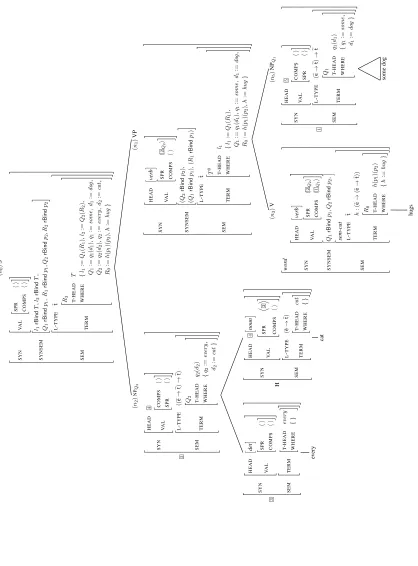
Case2 covers expressions such as NPs, VPs, and sentences S, where some argument slots are bound by sub-terms of the renderings of NP quantifiers, via recursion variables. The technique is exemplified by the analysis of the sentence “Every cat hugs some dog”, which represents a general pattern for multiple quantifier scopes. It is presented in Fig. 3.
5
Scope Underspecification and Specification
Scope Underspecification: The feature-value structural description given in Fig. 3 is a pattern of one of
the possible ways to represent multiple semantic scopes of quantification. The syntax-semantics interface is provided by the HSR and HCR1 rules of GCBLG, while the formal calculi ofLλ
ar, provides terms for
algorithmic semantics. A sentence that has occurrences of multiple quantifier NPs can be rendered into a singleLλ
ar-term that represents the multiple possibilities simultaneously. It is underspecified, by having
constrained free recursion variables filling up the argument slots that are bound by the corresponding NPs.
Scope Specification: The binding relation rBind inLλar provides a syntax-semantics facility to
con-strain the possible bindings in specific scopes, via restricting free recursion variables occurring in an underspecified term. An underspecified term can be expanded into specified terms only if they satisfy
therBind-constraints. Thus, constraints expressed byrBindalso restrict the possible interpretations of
the free recursion variables. For instance, the semantic rendering in Fig. 3 can be expanded into specified semantic representation, which has to satisfy the constraints imposed by the structural combinations. Fig. (4) presents one of the available possibilities to instantiate the free recursion variables, i.e., to bind them by the corresponding NP quantifiers.
6
Grammar Analyses with Syntax-Semantics Interface in GCBLG
In this section, we provide several analyses of typical sentences with head verbs taking NPs as their syntactic, and corresponding semantic, arguments. We exemplify the classes of intransitive and transitive head verbs having NP subjects and single NP complements.
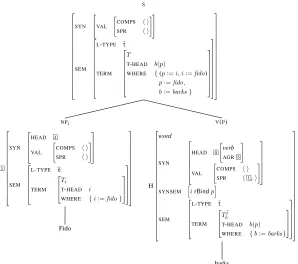
Note that in the analysis in Fig. 1, we do not render the NP that is a proper name into a term of a generalised quantifier, since that would introduce unnecessary complexity in the analysis of expressions of this kind. Furthermore, the term [Tb]˜t that renders the VP is as in (5b). Optionally, we can use a
λ-abstraction term[T′
b](ee
→et), and then, the sentence gets rendered to an algorithmically equivalent term
by theγ∗-reduction calculus ofLλ
ar, see Loukanova (2019, 2018).
In Fig. 2, we present a syntax-semantics analysis of a sentence with a single quantifier NP, in the subject position of the intransitive V. Optionally, we can use aλ-abstraction term[T′
b](ee
→et), resulting in
an algorithmically equivalent term for the sentence, by theγ∗-reduction calculus ofLλ
S SYN VAL "
COMPS h i
SPR h i # SEM
L-TYPE ˜t
TERM T
T-HEAD b(p)
WHERE {(p:=i,i:=fido)
p:=fido, b:=barks}
NPi 1 SYN HEAD 4 VAL "
COMPS h i
SPR h i # SEM
L-TYPE ee
TERM
Ti
T-HEAD i
WHERE {i:=fido} Fido
V(P)
H word SYN HEAD 0 " verb AGR3 # VAL "
COMPS h i
SPR h1ii # SYNSEM h irBindpi
SEM
L-TYPE ˜t
TERM
Tet
b
T-HEAD b(p)
[image:7.595.154.452.74.338.2]WHERE {b:=barks} barks
Figure 1: A Proper Name as the Specifier of an Intransitive Verb
S SYNSEM h
irBindp′,QrBindp′i
SEM
L-TYPE ˜t
TERM T
T-HEAD i
WHERE {i:=Q(λ(x)(h(x)))≈Q(h),
Q:=q(d),
q:=some,d:=dog,
h:=λ(x)(b(p′
(x))),
p′:=λ(x)(x),
b:=barks}
NPQ 1 SYN HEAD 4 VAL "
COMPS h i
SPR h i # SEM
L-TYPE (ee→et)→et
TERM Q0 T-HEAD q(d)
WHERE {q:=some,
d:=dog} 2 SYN HEAD h deti VAL "
SPR h i
COMPS h i # SEM
L-TYPE ((ee→et)→((ee→et)→et))
TERM
q0
T-HEAD some
WHERE { } some H SYN HEAD 4 h nouni VAL SPR D 2 E
COMPS h i SEM
L-TYPE (˜e→˜t)
TERM
d0 T-HEAD dog
WHERE { } dog
V(P)
H word SYN HEAD 0 " verb AGR3 # VAL "
COMPS h i
SPR h1ii # SYNSEM h QrBindpi
SEM
L-TYPE ˜t b: (˜e→˜t)
TERM
Tb
T-HEAD b(p)
WHERE {b:=barks} barks
[image:7.595.90.519.379.748.2]In Fig. 3, we present a syntax-semantics analysis of a sentence with two quantifier NPs, in subject and compliment positions of the head verb V. In Fig. 4, we present its specification to one of the alternative scope distributions. In it, we have specified the VP at the intermediate level of the analysis, in the node marked by(n1)VP. Pragmatically, it is more viable for this node to be underspecified as it is in 3, and
the specification is at the node (n0) S, at the sentence level, e.g., when disambiguating information is
available at that level.
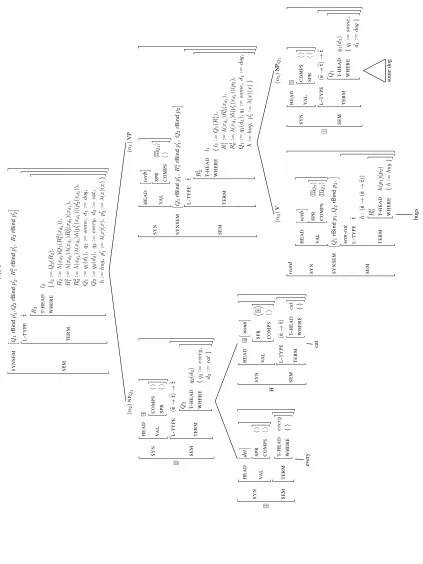
In Fig. 5, we present an optional analysis of the same sentence, by rendering the head verb to aλ -term, which is congruent toλ(xd2)λ(xd1)h(p
′
1(xd1))(p
′
2(xd2)). In such a case, there is a correspondence
between the syntactic and semantic saturation types of the V and VP expressions. But, the term that renders the sentence at the node(n0)S, is not algorithmically equivalent to the one in Fig. 3, and naturally
reflect on the algorithmic steps that are used during the analyses for filling up arguments. Similarly, the specification terms corresponding to these two options are not algorithmically equivalent.
7
Conclusions and Future Work
We have presented how the formal language of the theory of acyclic recursion Lλ
ar can be used for
se-mantic representations of natural language via syntax-sese-mantics interface in computational grammar. We have introduced the technique by generalised GCBLG that employs feature-value descriptions. GCBLG is type theoretical by its hierarchy of constraints, which are of dependent types, for the syntactic com-positions. The feature-value descriptions embed semantic representations by the higher-orderLλ
ar-terms.
We have focused on two of the major grammar rules for saturation of syntactic and semantic arguments, for underspecified semantic representations of multiple quantifier scopes. A sentence that has two (or more) quantifier NPs, with ambiguous semantic scopes, can be rendered into a single, underspecified
Lλ
ar-termA. The key idea is thatAhas free recursion variables saturating arguments that can be bound
by corresponding quantifier NPs in alternative orders. The phrasal rules of GCBLG introduce restrictions over possible bindings via recursion assignments in syntax-semantics interface.
We foresee extending and implementing the technique for computational syntax-semantics interface in lexical and phrasal structures, for broader grammatical constructions.
References
Bresnan, J. (2001). Lexical-Functional Syntax. Oxford: Blackwell Publishers.
Dalrymple, M. (2001). Lexical Functional Grammar, Volume 34 ofSyntax and Semantics. New York: Academic Press.
Joshi, A. K. (1987). An introduction to tree adjoining grammars. Mathematics of Language 1, 87–115.
Joshi, A. K., L. S. Levy, and M. Takahashi (1975, February). Tree adjunct grammars. J. Comput. Syst. Sci. 10(1), 136–163.
Kroeger, P. (2004). Analyzing Syntax: A Lexical-Functional Approach. Cambridge: Cambridge Univer-sity Press.
Loukanova, R. (2007, August). Typed Lambda Language of Acyclic Recursion and Scope Underspec-ification. In R. Muskens (Ed.),Workshop on New Directions in Type-theoretic Grammars, ESSLLI 2007, Dublin, Ireland, pp. 73–89. The Association for Logic, Language and Information.
( n0
)
S
S
Y
N
V
A L " S P R h i C O M P S h i # S Y N S E M
" l1
rB in d T , l2 rB in d T , Q1 rB in d p1 , R1 rB in d p1 ,Q 2 rB in d p2 ,R 2 rB in d p2 # S E M
L
-T Y P E ˜t T E R M
R
3 T -H E A D T W H E R E { l1 := Q1 ( R1 ) , l2 := Q2 ( R2 ) , Q1 := q1 ( d1 ) , q1 := so m e , d1 := d og , Q2 := q2 ( d2 ) , q2 := e v e ry , d2 := ca t , R0 := h ( p1 )( p2 ) , h := h u g } ( n2 ) N PQ 2 2
S
Y
N
H
E A D 4 V A L " C O M P S h i S P R h i # S E M
L
-T Y P E (( e e →
et)→ et)
T
E
R
M
Q
2 T -H E A D q2 ( d2 ) W H E R E { q2 := e v e ry , d2 := ca t } 3
S
Y
N
H
E
A
D
h det
i V A L " S P R h i C O M P S h i # S E M
T
E R M " T -H E A D e v e ry W H E R E { } # ev er y H
S
Y
N
H
E A D 4 h n o u n i V A L
S
P R D 3 E C O M P S h i S E M
L
-T Y P E (˜ e →
˜t)
T E R M " T -H E A D ca t W H E R E { } # ca t ( n1 ) V P
S
Y
N
H
E A D h ve rb i V A L " S P R h 2Q 2 i C O M P S h i # S Y N S E M " ( Q2 rB in d p2 ) , ( Q1 rB in d p1 ) , ( R1 rB in d p1 ) # S E M
L
-T Y P E ˜t T E R M
T
0 T -H E A D l1 W H E R E { l1 := Q1 ( R1 ) , Q1 := q1 ( d1 ) , q1 := so m e , d1 := d og , R0 := h ( p1 )( p2 ) , h := h u g } ( n3 ) V
w
o
rd
S
Y
N
H
E A D h ve rb i V A L " S P R h 2Q 2 i C O M P S h 1Q 1 i # S Y N S E M h Q 1 rB in d p1 ,Q 2 rB in d p2 , i S E M
se
m -c a t L -T Y P E
˜t h:
(˜ e → (˜ e →
˜t))
T
E
R
M
R
0 T -H E A D h ( p1 )( p2 ) W H E R E { h := h u g } h u g s ( n5 ) N PQ 1 1
S
Y
N
H
E A D 5 V A L " C O M P S h i S P R h i # S E M
L
-T Y P E ( e e →
et)
→ et T E R M
Q
[image:9.595.79.497.162.728.2]( n0
)
S
S
Y N S E M h Q 1 rB in d p
′,Q1
2
rB
in
d
p
′,2
R
2 1rB
in
d
p
′,1
R2 rB in d p ′2 i S E M
L
-T Y P E ˜t T E R M
R
3 T -H E A D l2 W H E R E { l2 := Q2 ( R2 ) , R2 := λ ( xd 2 ) Q1 ( R
2 1(
xd
2
))
,
R
2 1:=
λ ( xd 2 ) λ ( xd 1 ) R
2 0(
xd 2 )( xd 1 ) , R
2 0:=
λ ( xd 2 ) λ ( xd 1 ) h ( p
′(1
xd
1
))
(
p
′(2
xd 2 )) , Q1 := q1 ( d1 ) , q1 := so m e , d1 := d og , Q2 := q2 ( d2 ) , q2 := e v e ry , d2 := ca t , h := h u g , p
′:=1
λ ( x )( x ) , p
′:=2
λ ( x )( x ) } ( n2 ) N PQ 2 2
S
Y
N
H
E A D 4 V A L " C O M P S h i S P R h i # S E M
L
-T Y P E ( e e →
et)
→ et T E R M
Q
2 T -H E A D q2 ( d2 ) W H E R E { q2 := e v e ry , d2 := ca t } 3
S
Y
N
H
E
A
D
h det
i V A L " S P R h i C O M P S h i # S E M
T
E R M " T -H E A D e v e ry W H E R E { } # ev er y H
S
Y
N
H
E A D 4 h n o u n i V A L
S
P R D 3 E C O M P S h i S E M
L
-T Y P E (˜ e →
˜t)
T E R M " T -H E A D ca t W H E R E { } # ca t ( n1 ) V P
S
Y
N
H
E A D h ve rb i V A L " S P R h 2Q 2 i C O M P S h i # S Y N S E M h Q 1 rB in d p
′,1
R
1 1rB
in
d
p
′,1
Q2 rB in d p2 i S E M
L
-T Y P E ˜t T E R M
R
1 2 T -H E A D l1 W H E R E { l1 := Q1 ( R
1 1)
,
R
1 1:=
λ ( xd 1 ) R
1 0(
xd
1
)
,
R
1 0:=
λ ( xd 1 ) h ( p
′(x1 d1 )) ( p2 ) , Q1 := q1 ( d1 ) , q1 := so m e , d1 := d og , h := h u g , p
′:=1
λ ( x )( x ) } ( n3 ) V
w
o
rd
S
Y
N
H
E A D h ve rb i V A L " S P R h 2Q 2 i C O M P S h 1Q 1 i # S Y N S E M h Q 1 rB in d p1 ,Q 2 rB in d p2 , i S E M
se
m -c a t L -T Y P E
˜t h:
(˜ e → (˜ e →
˜t))
T
E
R
M
R
0 0 T -H E A D h ( p1 )( p2 ) W H E R E { h := h u g } h u g s ( n5 ) N PQ 1 1
S
Y
N
H
E A D 5 V A L " C O M P S h i S P R h i # S E M
L
-T Y P E ( e e →
et)
→ et T E R M
Q
[image:10.595.77.500.157.721.2]( n0
)
S
S
Y
N
V
A L " S P R h i C O M P S h i # S Y N S E M
" l1
rB in d T , l2 rB in d T , Q1 rB in d p1 , R1 rB in d p1 ,Q 2 rB in d p2 ,R 2 rB in d p2 # S E M
L
-T Y P E ˜t T E R M
R
3 T -H E A D T W H E R E { l1 := Q1 ( R1 ) , l2 := Q2 ( R2 ) , Q1 := q1 ( d1 ) , q1 := so m e , d1 := d og , Q2 := q2 ( d2 ) , q2 := e v e ry , d2 := ca t , R
2 0:=
λ ( xd 2 ) λ ( xd 1 ) h ( p
′(1
xd
1
))
(
p
′(2
xd 2 )) , h := h u g } ( n2 ) N PQ 2 2
S
Y
N
H
E A D 4 V A L " C O M P S h i S P R h i # S E M
L
-T Y P E (( e e →
et)
→
et)
T
E
R
M
Q
2 T -H E A D q2 ( d2 ) W H E R E { q2 := e v e ry , d2 := ca t } 3
S
Y
N
H
E A D h d et i V A L " S P R h i C O M P S h i # S E M
T
E R M " T -H E A D e v e ry W H E R E { } # ev er y H
S
Y
N
H
E
A
D
4
h no
u n i V A L
S
P R D 3 E C O M P S h i S E M
L
-T Y P E (˜ e →
˜t)
T E R M " T -H E A D ca t W H E R E { } # ca t ( n1 ) V P
S
Y
N
H
E A D h ve rb i V A L " S P R h 2Q 2 i C O M P S h i # S Y N S E M " Q 2 rB in d p
′,2
l1 rB in d T1 , Q1 rB in d p
′,1
R1 rB in d p ′1 # S E M
L
-T Y P E (˜ e →
˜t)
T
E
R
M
T
′1 T -H E A D T1 W H E R E { l1 := Q1 ( R1 ) , Q1 := q1 ( d1 ) , q1 := so m e , d1 := d og , R
2 0:=
λ ( xd 2 ) λ ( xd 1 ) h ( p
′(1
xd
1
))
(
p
′(2
xd 2 )) h := h u g } ( n3 ) V
w
o
rd
S
Y
N
H
E A D h ve rb i V A L " S P R h 2Q 2 i C O M P S h 1Q 1 i # S Y N S E M h Q 1 rB in d p
′,Q1
2
rB
in
d
p
′,2
i
S
E
M
se
m -c a t L -T Y P E (˜ e → (˜ e →
˜t))
h : (˜ e → (˜ e →
˜t))
T
E
R
M
R
2 0 T -H E A D λ ( xd 2 ) λ ( xd 1 ) h ( p
′(1
xd
1
))
(
p
′(2
xd 2 )) W H E R E { h := h u g } h u g s ( n4 ) N PQ 1 1
S
Y
N
H
E A D 5 V A L " C O M P S h i S P R h i # S E M
L
-T Y P E ( e e →
et)
→ et T E R M
Q
Loukanova, R. (2011b). Syntax-Semantics Interface for Lexical Inflection with the Language of Acyclic Recursion. In G. Bel-Enguix, V. Dahl, and M. D. Jim´enez-L ´opez (Eds.),Biology, Computation and Linguistics — New Interdisciplinary Paradigms, Volume 228 ofFrontiers in Artificial Intelligence and Applications, pp. 215–236. Amsterdam; Berlin; Tokyo; Washington, DC: IOS Press.
Loukanova, R. (2016). Relationships between Specified and Underspecified Quantification by the The-ory of Acyclic Recursion. ADCAIJ: Advances in Distributed Computing and Artificial Intelligence Journal 5(4), 19–42.
Loukanova, R. (2017a). An Approach to Functional Formal Models of Constraint-Based Lexicalized Grammar (CBLG).Fundamenta Informaticae 152(4), 341–372.
Loukanova, R. (2017b). Binding Operators in Type-Theory of Algorithms for Algorithmic Binding of Functional Neuro-Receptors. In M. Ganzha, L. Maciaszek, and M. Paprzycki (Eds.),Proceedings of the 2017 Federated Conference on Computer Science and Information Systems, Volume 11 ofAnnals of Computer Science and Information Systems, pp. 57–66. Polish Information Processing Society.
Loukanova, R. (2018). γ-Reduction in Type Theory of Acyclic Recursion. to appear.
Loukanova, R. (2019). Gamma-star canonical forms in the type-theory of acyclic algorithms. In J. van den Herik and A. P. Rocha (Eds.), Agents and Artificial Intelligence, Cham, pp. 383–407. Springer International Publishing.
Moortgat, M. (1996). Categorial type logics. In J. van Benthem and A. ter Meulen (Eds.),Handbook of Logic and Language, pp. 93–177. Amsterdam: Elsevier.
Moschovakis, Y. N. (2006). A Logical Calculus of Meaning and Synonymy. Linguistics and Philoso-phy 29(1), 27–89.
Pollard, C. and I. A. Sag (1994). Head-Driven Phrase Structure Grammar. Chicago, IL: University of Chicago Press.
Ranta, A. (2011). Grammatical Framework: Programming with Multilingual Grammars. Stanford: CSLI Publications.
Sag, I. A., T. Wasow, and E. M. Bender (2003). Syntactic Theory: A Formal Introduction. Stanford, California: CSLI Publications.
![Bis(μ pyridinium 2 carboxylato κ2O:O′)bis[triaqua(sulfato κO)manganese(II)]](data:image/gif;base64,R0lGODlhAQABAIAAAP///wAAACH5BAEAAAAALAAAAAABAAEAAAICRAEAOw==)