JOURNAL OF FOREST SCIENCE, 62, 2016 (5): 211–222
doi: 10.17221/97/2015-JFS
The first contribution to the fauna of psocids (Insecta:
Psocoptera) in forests in the Drahanská vrchovina Hills
(Czech Republic)
D. Mazáč
Department of Forest Protection and Wildlife Management, Faculty of Forestry and Wood Technology, Mendel University in Brno, Brno, Czech Republic
ABSTRACT: Taxocenosis of psocids (Psocoptera) was studied in the territory of the Drahanská vrchovina Hills in the
Czech Republic. Representative research plots were selected in forest ecosystems with natural species composition and spatial structure (small-scale strictly protected areas) as well as in forest ecosystems with altered tree species composi-tion and spatial structure. Research was conducted in three altitudinal vegetacomposi-tion zones (AVZ): in 2nd communities of Fagi-querceta s. lat. (beech-oak forests), 3rdQuerci-fageta s. lat. (oak-beech forests) and 4thFageta abietis (beech forests with fir). Research plots are situated at altitudes ranging between 275 and 540 m a.s.l. In the 2013 growing season, totally 3,474 imagoes and 2,532 nymphs of 32 psocid species were collected. Of those, 748 imagoes of 25 psocid species were collected in Fagi-querceta. The occurrence of Caecilius burmeisteri, Caecilius flavidus and Graphopsocus cruciatus was eudominant. 2,194 imagoes of 23 psocid species were found in Querci-fageta, eudominant were there Caecilius flavidus and Caecilius burmeisteri. 532 imagoes of 18 psocid species were found in Fagetaabietis, eudominant were there: Caecilius flavidus, Peripsocus subfasciatus and Caecilius burmeisteri. In respect to the species composition, 3rd AVZ and 4th AVZ are similar to each other while 2nd AVZ is less similar.
Keywords: taxocenoses; ecology; forest ecosystems; altitudinal vegetation zones
Abbreviations: AVZ – altitudinal vegetation zone, 1st AVZ – oak (Querceta s. lat.), 2nd AVZ – beech-oak (Fagi-querceta s. lat.),
3rd AVZ – oak-beech (Querci-fageta s. lat.), 4th AVZ – beech (Fageta abietis s. lat.), 5th AVZ – fir-beech (Abieto-fageta s. lat.), 6th AVZ – spruce-beech (Piceti-fageta s. lat.), 7th AVZ – beech-spruce (Fageti-piceeta s. lat), 8th AVZ – spruce (Piceeta s. lat.), 9th AVZ – mountain pine (Pineta mugo s. lat.), COR – corticicolous, FOL – folicolous, FSC – forest site type complex, HOL – holarctic, PAL – palearctic, WPA – west palearctic
So far the animal component has been paid in-sufficient attention in the studies of forest ecosys-tems, with just a few exceptions. As pointed out by Holuša (2003a), studying animals and their com-munities faces numerous obstacles caused for exam-ple by the hidden way of the life of certain species, complexity of obtaining the study material, com-plicated, time-consuming and technically demand-ing determination and often incomplete knowledge of the autecology of some species. The purpose of studying animals is to find regularities in their spe-cies composition within ecosystems as well as direct and indirect relations between the animal and the plant component of the studied ecosystem. In
natu-ral ecosystems, plant and animal components are dynamically balanced (Míchal 1994).
In history, the animal component of ecosystems was studied in various units of the differentiation of natural conditions, from altitudinal vegetation zones (AVZs) to forest site type classification units of forest site type complexes (FSCs) or biogeocene type groups of the geobiocenological system. In the context of altitudinal vegetation zones, the ex-istence of relations between numerous groups of invertebrates and selected vertebrate groups was investigated. Stolina (1959) studied gradations of
Zeiraphera diniana and Choristoneura muriana,
Po-volný (1978) and PoPo-volný (1979) studied Lepi-doptera within AVZ. Scolytidae were studied by Zumr (1984). Horník (1976) compared Carabidae and Cicindelidae in AVZ with natural and altered tree composition. Šustek (1993, 2000) studied the occurrence of Carabidae in AVZ. In the context of complex biogeocenological research (i.e. continual research on the plant and the animal component) on the Smrk mountain in the Moravskoslezské Besky-dy Mountains, Roháčová (2001) counted Cara-bidae and Heteroptera, Boháč and Roháčová (2001) counted Staphylinidae, Kočárek and Roháčová (2001) counted Silphidae, Holecová and Roháčová (2001) counted Curculionidae and Holuša (2001) counted Psocoptera. Povolný (1983) characterized the structure of Calliphoridae in altitudinal vegetation zones.
Studies of the occurrence of psocid communi-ties in altitudinal vegetation zones have recently focused on the Carpathian Mountains. The relation between the vegetation zone and the occurrence of psocids was studied by Holuša (2013) in 3rd AVZ, i.e. communities of Querci-fageta s. lat., in 4th AVZ, i.e. communities of Fageta abietis s. lat. (Holuša 2012a), in 5th AVZ, i.e. communities of Abieti-fageta s. lat. (Holuša 2007a), in 6th AVZ, i.e. communities of Piceti-fageta s. lat. (Holuša 2011), in 7th AVZ, i.e. communities of Fagi-piceeta s. lat. and in 8th AVZ, i.e. communities of Piceeta s. lat. (Holuša 2007a), and other localities in the Carpathians – in the Moravsko-
slezské Beskydy Mts. in Mazák National Nature serve (Holuša 2003b), V Podolánkách Nature Re-serve (Holuša 2007b) and in the Oravské Beskydy Mountains in Slovakia (Holuša 2012b). The remain-ing biogeographical areas of the Czech Republic have been paid much less attention. The Drahanská vr-chovina Hills, with regard to biogeographical char-acteristics, is unique by its position at the boundary between Hercynicum and Pannonicum. This specific location preconditions the occurrence of character-istic animal as well as plant species and communities.
METHODS
This study uses vegetation zoning according to Plíva (1971). Characteristics and definition of vegetation tiers are used according to Holuša and Holuša (2008, 2010, 2011).
Altitudinal vegetation zones are units of the for-est site classification system (Plíva 1991) as well as of the biogeocenological system (Zlatník 1959, 1975, 1976). This work uses FSCs as basic units of the forest typology classification system. Forest types are grouped in FSCs according to their envi-ronmental relations and phytocenological similari-ties of the undergrowth.
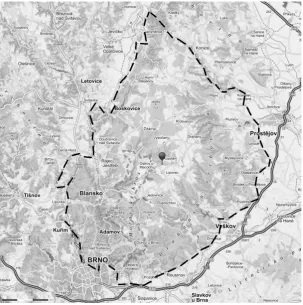
Study area (Fig. 1). From the viewpoint of the
regional geo-relief structure the research plots are situated in the subunits of the Adamovská
[image:2.595.64.368.453.759.2]vina Hills and the Moravian Karst, both forming parts of the Drahanská vrchovina Hills unit, a part of the Brněnská vrchovina Hills subsystem. The Adamovská vrchovina Hills are characterized by heterogeneous and varied topography. Its surface is built-up from a number of uplifted and sunken small blocks. Typical features of the hilly land in-clude a deep fault gap of the Svitava River with deeply incised meanders. The Moravian Karst dif-fers considerably from the neighbouring areas. The geological bedrock consists of igneous rocks later covered with limestone layers (Bína, Demek 2012).
The research plots are located in the Brno and the Macocha bioregions of Czech Republic, which are part of the Hercynian subprovince. In the Brno bioregion the rich geological substrate and rug-ged terrain increase the overall biological diversity (Culek 1996). The altitude of the research plots ranged from 275 to 540 m a.s.l. The plots are locat-ed in quads 6665, 6666, 6765 and 6766 of the faunal grid mapping (Pruner, Míka 1996).
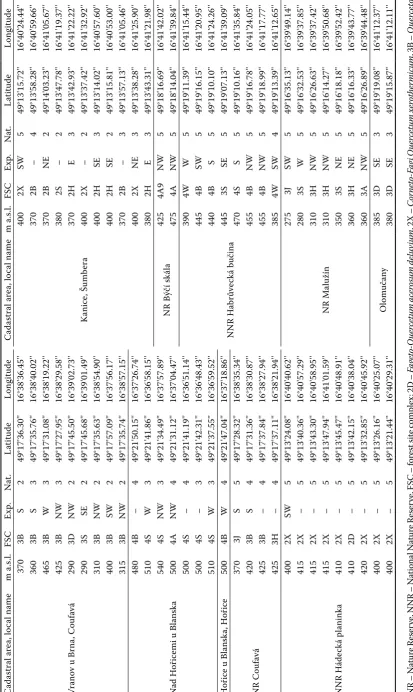
Research plots were stabilized in forest ecosystems occurring in the Drahanská vrchovina Hills. The plots were intended to represent a wide span of the degree of naturalness of forest stands (Fig. 2). The assess-ment of forest naturalness was based on classification according to the survey of the natural species com-position of woody plants pursuant to the forest site type classification by Macků (2012), natural forests – naturalness degrees 4 (“high”) and 5 (“very high”), non-natural forests – naturalness degrees 3 (“medi-um”) and 2 (“low”). Forests stands with a low degree of naturalness are characterized here by altered tree species composition and spatial structure, and con-sist mostly of Abiesalba monocultures in the 2nd AVZ – communities of Fagi-querceta s. lat. (partly also in 3rd AVZ) and by Picea abies and Pseudotsuga
men-ziesii monocultures in 2nd, 3rd and 4th AVZ. All these forests are commercial forests without exception (§ 9 of Act No. 289/1995 Coll.). Forest stands with a high degree of naturalness are represented by small-scale strictly protected areas, namely by nature reserves and national nature reserves. Some research plots are situated in the nature reserve of the Moravian Karst, a large-scale strictly protected area. The range of for-ests of the varying naturalness is complemented by forest research plots with medium degree of natural-ness. Such a range from low to high was achieved in all three AVZs.
The total number of plots amounted to 60, of which 20 are situated in the 2nd AVZ, 23 in the 3rd AVZ and 17 in the 4th AVZ.
The occurrence of psocids was studied within the research plots in individual layers of the forest
bio-geocenosis. During the collection, the greatest at-tention was focused on the synusia of woody plants and undergrowth. The occurrence of psocids on the ground surface, on stones and rocks was also ascertained. The psocid material was obtained from accessible branches, low trees and branches by knocking them off with a wooden bar 1.0 m long into a sweep net. The sweep net was of circu-lar shape with a diameter of 0.4 m, and 0.8 m long handle. Psocids were knocked off the branches at heights up to 3.0 or 3.5 m, depending on accessi-bility. The branches were knocked off at a length of about 1.0 to 1.5 m from their end. Each tree or shrub type in the research plots was knocked off separately. The undergrowth was swept with a sweep net of 0.4 m in diameter. Stubs, forest lit-ter, ground surface, stones and other objects were inspected visually. The knocked-off material was removed from the sweep net and psocids were sucked with an exhauster into a test tube and im-mediately fixed with 70% alcohol.
The material was collected from the plot centre in a spiral for each woody plant separately. One collec-tion included 50 strokes on more individuals of one woody plant species with 1 to 3 strokes per 1 m of the branch length. At sweeping, one collection rep-resents 50 sweeps, one sweep representing a sweep net pull in the vegetation storey at a length of 2.5 m. The collection was repeated twice at each plot for control, i.e. each woody plant (if possible) or vegeta-tion layer was subjected to 100 strokes.
The collection was performed from May to Sep-tember 2013. All research plots were visited twice in that period. The following scale of dominance was used to assess dominance: eudominant species more than 10%, dominant species 5–10%, subdomi-nant species 2–5%, recedent species 1–2%, subrece-dent species less than 1% (Losos et al. 1984). The collected psocid material will be deposited in the collections of Otakar Holuša and partly stored in the Beskyd Museum in Frýdek-Místek. The material was collected and determined by the author.
RESULTS AND DISCUSSION
Taxocenoses in the communities of Fagi-querceta s. lat. (2nd AVZ)
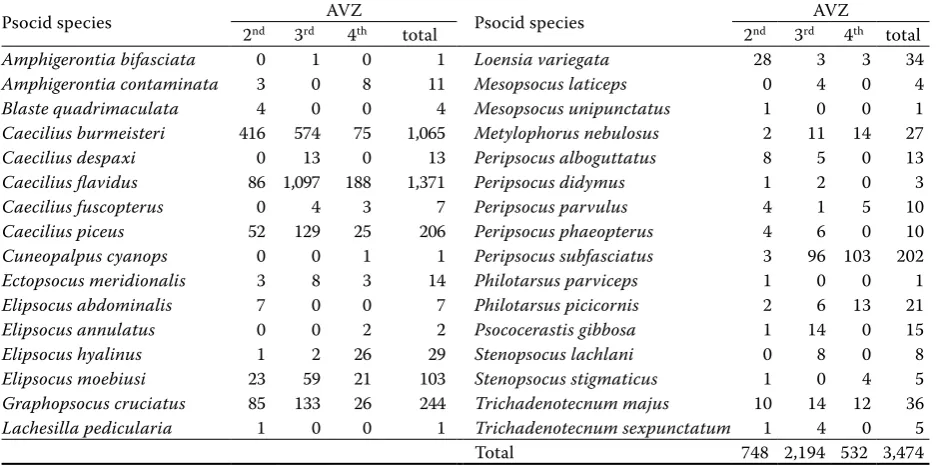
In the Drahanská vrchovina Hills, the total num-ber of collected psocid imagoes was 748 (25 species) (Table 1). In the forests with natural species com-position (naturalness degrees 4 and 5), eudominant species included Caecilius flavidus and Graphopso-cus cruciatus. Quercus robur and Quercuspetraea
yielded 40 imagoes (Table 2). The eudominant spe-cies were C. flavidus and G. cruciatus. Carpinus
betulus yielded 36 imagoes with the eudominance
of C. flavidus and G. cruciatus. In the forests of non-natural species composition (naturalness
de-grees 3 and 2), the detected eudominant species in-cluded Caeciliusburmeisteri and the dominant spe-cies were Caecilius piceus and G. cruciatus (Fig. 2).
P. abies yielded 40 imagoes. The eudominant species included G. cruciatus, Elipsocusmoebiusi, Trichade- notecnummajus, Elipsocus abdominalis and
Loen-sia variegata. The dominant species was
Peripso-cus subfasciatus. P. menziesii yielded 38 imagoes. A rich species composition was found (13 species) with the eudominant occurrence of C. burmeisteri
and E. moebiusi. The dominant species included
G. cruciatus, L. variegata, Peripsocusphaeopterus
and Peripsocusalboguttatus. A. alba yielded a high number of 178 imagoes with eudominant C. bur-Table 1. Abundance of psocids in altitudinal vegetation zones (AVZs), particularly in AVZs in the Drahanská vrchovina Hills
Psocid species 2nd 3rd AVZ4th total Psocid species 2nd 3rdAVZ4th total
Amphigerontia bifasciata 0 1 0 1 Loensia variegata 28 3 3 34
Amphigerontia contaminata 3 0 8 11 Mesopsocus laticeps 0 4 0 4
Blaste quadrimaculata 4 0 0 4 Mesopsocus unipunctatus 1 0 0 1
Caecilius burmeisteri 416 574 75 1,065 Metylophorus nebulosus 2 11 14 27
Caecilius despaxi 0 13 0 13 Peripsocus alboguttatus 8 5 0 13
Caecilius flavidus 86 1,097 188 1,371 Peripsocus didymus 1 2 0 3
Caecilius fuscopterus 0 4 3 7 Peripsocus parvulus 4 1 5 10
Caecilius piceus 52 129 25 206 Peripsocus phaeopterus 4 6 0 10
Cuneopalpus cyanops 0 0 1 1 Peripsocus subfasciatus 3 96 103 202
Ectopsocus meridionalis 3 8 3 14 Philotarsus parviceps 1 0 0 1
Elipsocus abdominalis 7 0 0 7 Philotarsus picicornis 2 6 13 21
Elipsocus annulatus 0 0 2 2 Psococerastis gibbosa 1 14 0 15
Elipsocus hyalinus 1 2 26 29 Stenopsocus lachlani 0 8 0 8
Elipsocus moebiusi 23 59 21 103 Stenopsocus stigmaticus 1 0 4 5
Graphopsocus cruciatus 85 133 26 244 Trichadenotecnum majus 10 14 12 36
Lachesilla pedicularia 1 0 0 1 Trichadenotecnum sexpunctatum 1 4 0 5
Total 748 2,194 532 3,474
2nd AVZ – beech-oak (Fagi-querceta s. lat.), 3nd AVZ – oak-beech (Querci-fageta s. lat.), 4th AVZ – beech-fir (Fageta abietis s. lat.)
0 50 100 150 200 250 300 350 400 450
Caecilius flavidus
cruciatus Caecilius burmeisteriCaecilius piceus
0 5 10 15 20 25 30
Loensia variegata Elipsocus hyalinus
Psococerastis gibbosa
Stenopsocus stigmaticus
Elipsocus moebiusi Peripsocus parvulus
Trichadenotecnum majus Elipsocus abdominalis
Amphigerontia contaminata
Blaste quadrimaculata Ectopsocus meridionalis Lachesilla pedicularia
Mesopsocus unipunctatus Metylophorus nebulosus Peripsocus alboguttatus
Peripsocus didymus
Peripsocus phaeopterus Peripsocus subfasciatus Philotarsus parviceps Philotarsus picicornis
Trichadenotecnum sexpunctatum
Natural (degree 5 and 4) Non-natural (degree 3 and 2)
Grapho-psocus
(p
[image:4.595.63.533.81.314.2]cs)
Fig. 2. Dominance of psocids in the Fagi-querceta s. lat (2nd AVZ) according to the degree of biotope naturalness (the diagram
[image:4.595.61.533.550.718.2]meisteri and C. piceus. The undergrowth yielded 26 imagoes with the eudominant occurrence of
C. flavidus, C. burmeisteri and G. cruciatus. The species with the highest occurrence in the 2nd AVZ was C. burmeisteri, in total 416 imagoes were collected.
Taxocenoses in the communities of Querci-fageta s. lat. (3rd AVZ)
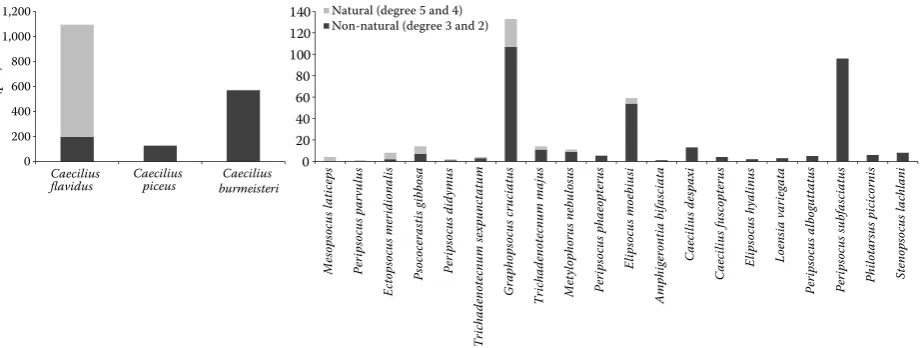
In the 3rd AVZ, the total number of psocid imagoes was 2,194 (23 species). Forests with natural species composition yielded the eudominant species C. fla-vidus (Fig. 3). Fagus sylvatica yielded 311 imagoes with the eudominant (92%) occurrence of C. flavidus.
Q. robur and Q. petraea yielded 217 imagoes, again with the eudominance of C. flavidus (82%) together with G. cruciatus. C. betulus yielded 253 imagoes, also with the eudominant (90%) occurrence of C. fla-vidus. Dominant species included G. cruciatus. Tilia
cordata yielded 313 imagoes with the eudominant
(92%) occurrence of C. flavidus. Eudominant species found in forests with altered tree species composition included C. burmeisteri, C. flavidus and C. piceus. Dominant species included G. cruciatus and P. subfas-ciatus. P. abies yielded 875 imagoes with the eudomi-nance of C. burmeisteri (63%) and C. piceus (Table 2). Dominant species included P. subfasciatus and
G. cruciatus. P. menziesii yielded 90 imagoes, eudo-minant species being E. moebiusi, C. burmeisteri and
P. subfasciatus. Dominant species included C. flavi-dus, T. majus and Psococerastis gibbosa. The under-growth yielded in total 90 imagoes with the eudomi-nant (98%) occurrence of C. flavidus.
The highest number of imagoes in the 3rd AVZ, i.e. communities of Querci-fageta s. lat., was
repre-sented by the species C. flavidus with a total num-ber of 1,097 specimens. In comparison with the research into psocid taxocenoses in the Moravian part of the Moravskoslezské Beskydy Mts. (Holuša 2001), the situation observed in the territory of the Drahanská vrchovina Hills differed in the absence of Philotarsus parviceps as well as in lower counts
of P. phaeopterus and dominant occurrence of
G. cruciatus. The same phenomenon was observed
as in the Moravskoslezské Beskydy Mts., i.e. the colonization of the allochthonous P. abies by many species at considerable abundance.
Taxocenoses in the communities of Fagetaabietis s. lat. (4th AVZ)
In the 4th AVZ, the total number of psocid ima-goes was 532 in 18 species. Forests with the natural species composition yielded the eudominant spe-cies C. flavidus and P. subfasciatus, and dominant
C. burmeisteri and G. cruciatus. F. sylvatica yielded 71 imagoes with the eudominant (89%) occurrence of C. flavidus. A. alba yielded 131 imagoes with the eudominant (74%) P. subfasciatus. Dominant spe-cies included C. burmeisteri. Forests with altered tree species composition included the following eudominant species: C. burmeisteri, C. piceus and
Philotarsuspicicornis. Dominant species were Me-tylophorusnebulosus, Elipsocushyalinus, T. majus
and E. moebiusi. P. abies yielded 194 imagoes with eudominant C. burmeisteri, E. hyalinus and C. pi-ceus. Dominant species were E. moebiusi, G. cru-ciatus, P. picicornis, T. majus and M. nebulosus.
The highest total number of imagoes (188) in the 4th AVZ was found in the species C. flavidus (Fig. 4). The occurrence of C. flavidus corresponds to the
T 0
200 400 600 800 1,000 1,200
0 20 40 60 80 100 120 140
Mesopsocus laticeps Peripsocus parvulus Ectopsocus meridionalis Psococerastis gibbosa
Peripsocus didymus
Trichadenotecnum sexpunctatum
Graphopsocus cruciatus Trichadenotecnum majus Metylophorus nebulosus Peripsocus phaeopterus
Elipsocus moebiusi
Amphigerontia bifasciata
Caecilius despaxi
Caecilius fuscopterus Elipsocus hyalinus
Loensia variegata
Peripsocus alboguttatus Peripsocus subfasciatus Philotarsus picicornis Stenopsocus lachlani
Natural (degree 5 and 4) Non-natural (degree 3 and 2)
Caecilius
flavidus Caecilius piceus burmeisteriCaecilius
(p
[image:5.595.71.532.55.229.2]cs)
Fig. 3. Dominance of psocids in the communities of Querci-fageta s. lat (3rd AVZ) according to the degree of biotope
Ta
ble 2. A
bund
anc
e of p
so
cid
s on tr
ee
s and under
gr
ow
th in altit
udinal ve ge ta tion zone s (A VZ s) Ps oc id sp ec ie s/ tr ee sp ec ie s AV Z Tot al 2 nd 3 rd 4 th brbr db dr hb hl jrb js jv b lp ptz sv tr po bo dg l jd sm smp bk db hb jd jl lp po bo dg l sm bk bz h db hb jd po sm Am ph igeronti a bif asci at a 1 1 Am ph igeronti a cont am inat a 1 2 8 11 Bl aste qu ad rimacu lat a 1 1 2 4 C ae ci liu s bu rmei ster i 1 5 6 16 134 232 22 1 2 1 2 13 555 12 63 1,065 C ae ci liu s de sp axi 1 12 13 C ae ci liu s flav id us 3 17 10 21 1 2 5 8 3 3 11 2 285 176 227 1 17 289 88 3 7 4 63 4 28 92 1 1,371 C ae ci liu s fu scopter us 4 1 2 7 C ae ci liu s piceu s 1 32 18 1 1 2 1 1 3 121 1 2 22 206 Cu ne op al pu s cya nop s 1 1 Ectop so cu s mer id iona lis 1 2 4 2 2 1 1 1 14 Elip so cu s ab do min ali s 1 1 5 7 Elip so cu s annu la tu s 2 2 Elip so cu s hy alinu s 1 2 26 29 Elip so cu s mo ebi us i 2 1 2 1 5 1 7 4 10 6 3 1 2 27 10 1 4 1 15 103 G ra phop so cu s cr uci atu s 5 23 1 9 8 1 4 3 2 3 1 3 6 12 4 14 27 14 10 2 6 60 2 1 1 6 3 13 244 La ch es ill a pe dicu la ri a 1 1 Lo en si a va rie gat a 2 3 4 19 1 2 3 34 M esop so cu s laticep s 1 3 4 M esop so cu s un ipu nct atu s 1 1 M et ylophor us nebu lo su s 1 1 1 1 2 5 2 4 10 27 Per ip so cu s al bog utt atu s 2 1 1 4 5 13 Per ip so cu s di dy mu s 1 1 1 3 Per ip so cu s pa rv ulu s 1 1 2 1 3 2 10 Per ip so cu s phae opter us 2 2 1 3 2 10 Per ip so cu s su bf asci atu s 1 2 1 4 12 79 3 97 3 202 Ph ilo tar su s pa rv icep s 1 1 Ph ilo tar su s picicor ni s 1 1 1 5 1 12 21 Pso co cer asti s gi bbos a 1 4 1 3 5 1 15 Stenop so cu s la ch la ni 8 8 Stenop so cu s sti gmaticu s 1 1 1 2 5 Tr ichadenote c-nu m ma ju s 1 1 1 1 6 1 1 1 1 1 6 3 1 11 36 Tr ichadenote c-nu m se xpu n-ct atu m 1 1 2 1 5 Tot al 8 40 13 36 10 4 6 14 3 0 8 2 26 9 38 178 296 57 311 217 253 5 21 313 90 19 90 875 71 1 5 31 131 100 193 Tot al/A VZ 748 2,194 532 3,474 the ver tic al d as h-and-d
ot line div
ide
s na
tural and alt
er ed tr ee sp ec ie s c om po sition w ithin e ac h A VZ 2
nd A
VZ – b
ee ch-o ak ( Fa gi-quercet a s. l at .), 3
nd A
VZ – o
ak -b ee ch ( Q uerci-f aget a s. l at .), 4
th A
VZ – b
ee ch-fir ( Fa get a a bieti s s. l at
.), bk –
Fa gu s s ylvatic a , b o – Pi nu s s ylve str is
, brbr –
Euon ym us ver ruco su s
, db –
Q uercu s ro bu r and Q uercu s p etr ae a , dg l – Pseudot su ga men zie sii
, dr –
C
or
nu
s ma
s
, hb –
C ar pi nu s b etu lu s
, hl –
Cr at ae gu s monog yna
, jd –
Abie
s
alb
a
, jrb –
Sor bu s to rmin ali s , js – Fr axi nu s e xcel sior , jv b – Acer c am pe stre
, lp –
Ti
lia cord
at
a
, ptz –
Li gu str um v ul ga re
, sm –
Pice a a bie s , sm p – Pice a pu ngen s , s v – C or nu s sa nqu ine a
, tr –
Pr
unu
s a
vium
, p
o – under
gr
ow
Ta
ble 2. A
bund
anc
e of p
so
cid
s on tr
ee
s and under
gr
ow
th in altit
udinal ve ge ta tion zone s (A VZ s) Ps oc id sp ec ie s/ tr ee sp ec ie s AV Z Tot al 2 nd 3 rd 4 th brbr db dr hb hl jrb js jv b lp ptz sv tr po bo dg l jd sm smp bk db hb jd jl lp po bo dg l sm bk bz h db hb jd po sm Am ph igeronti a bif asci at a 1 1 Am ph igeronti a cont am inat a 1 2 8 11 Bl aste qu ad rimacu lat a 1 1 2 4 C ae ci liu s bu rmei ster i 1 5 6 16 134 232 22 1 2 1 2 13 555 12 63 1,065 C ae ci liu s de sp axi 1 12 13 C ae ci liu s flav id us 3 17 10 21 1 2 5 8 3 3 11 2 285 176 227 1 17 289 88 3 7 4 63 4 28 92 1 1,371 C ae ci liu s fu scopter us 4 1 2 7 C ae ci liu s piceu s 1 32 18 1 1 2 1 1 3 121 1 2 22 206 Cu ne op al pu s cya nop s 1 1 Ectop so cu s mer id iona lis 1 2 4 2 2 1 1 1 14 Elip so cu s ab do min ali s 1 1 5 7 Elip so cu s annu la tu s 2 2 Elip so cu s hy alinu s 1 2 26 29 Elip so cu s mo ebi us i 2 1 2 1 5 1 7 4 10 6 3 1 2 27 10 1 4 1 15 103 G ra phop so cu s cr uci atu s 5 23 1 9 8 1 4 3 2 3 1 3 6 12 4 14 27 14 10 2 6 60 2 1 1 6 3 13 244 La ch es ill a pe dicu la ri a 1 1 Lo en si a va rie gat a 2 3 4 19 1 2 3 34 M esop so cu s laticep s 1 3 4 M esop so cu s un ipu nct atu s 1 1 M et ylophor us nebu lo su s 1 1 1 1 2 5 2 4 10 27 Per ip so cu s al bog utt atu s 2 1 1 4 5 13 Per ip so cu s di dy mu s 1 1 1 3 Per ip so cu s pa rv ulu s 1 1 2 1 3 2 10 Per ip so cu s phae opter us 2 2 1 3 2 10 Per ip so cu s su bf asci atu s 1 2 1 4 12 79 3 97 3 202 Ph ilo tar su s pa rv icep s 1 1 Ph ilo tar su s picicor ni s 1 1 1 5 1 12 21 Pso co cer asti s gi bbos a 1 4 1 3 5 1 15 Stenop so cu s la ch la ni 8 8 Stenop so cu s sti gmaticu s 1 1 1 2 5 Tr ichadenote c-nu m ma ju s 1 1 1 1 6 1 1 1 1 1 6 3 1 11 36 Tr ichadenote c-nu m se xpu n-ct atu m 1 1 2 1 5 Tot al 8 40 13 36 10 4 6 14 3 0 8 2 26 9 38 178 296 57 311 217 253 5 21 313 90 19 90 875 71 1 5 31 131 100 193 Tot al/A VZ 748 2,194 532 3,474 the ver tic al d as h-and-d
ot line div
ide
s na
tural and alt
er ed tr ee sp ec ie s c om po sition w ithin e ac h A VZ 2
nd A
VZ – b
ee ch-o ak ( Fa gi-quercet a s. l at .), 3
nd A
VZ – o
ak -b ee ch ( Q uerci-f aget a s. l at .), 4
th A
VZ – b
ee ch-fir ( Fa get a a bieti s s. l at
.), bk –
Fa gu s s ylvatic a , b o – Pi nu s s ylve str is
, brbr –
Euon ym us ver ruco su s
, db –
Q uercu s ro bu r and Q uercu s p etr ae a , dg l – Pseudot su ga men zie sii
, dr –
C
or
nu
s ma
s
, hb –
C ar pi nu s b etu lu s
, hl –
Cr at ae gu s monog yna
, jd –
Abie
s
alb
a
, jrb –
Sor bu s to rmin ali s , js – Fr axi nu s e xcel sior , jv b – Acer c am pe stre
, lp –
Ti
lia cord
at
a
, ptz –
Li gu str um v ul ga re
, sm –
Pice a a bie s , sm p – Pice a pu ngen s , s v – C or nu s sa nqu ine a
, tr –
Pr
unu
s a
vium
, p
o – under
gr
ow
situation observed in the Moravian part of the Moravskoslezské Beskydy Mts. (Holuša 2001). Un-like the Moravskoslezské Beskydy Mts., the Drahan-ská vrchovina Hills showed lower counts of E. moe-biusi and Mesopsocus unipunctatus in the natural biogeocenosis. E. moebiusi dominated on allochtho-nous woody plants.
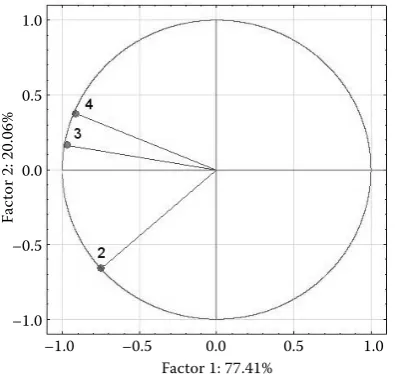
The similarity of altitudinal vegetation zones was examined with the help of the principal compo-nent analysis (Fig. 5). It follows from the analysis that 3rd AVZ and 4th AVZ are similar with regard to psocid taxocenoses. Considerable similarity is given by beech communities naturally occurring in both AVZs. Dissimilarity of the 2nd AVZ has two reasons. The first of them is the extreme character of the sites predetermined by the occurrence of FSC 2X ( Cor-neto-Fagi Quercetum xerothermicum) (Table 3). The main edificators are thermophilic shrubs and plants
such as Dictamnus albus, Brachypodium pinnatum
etc. Research plots in the 2nd AVZ also include forest stands on azonal xerothermophilous sites. The sec-ond important reason for the impaired similarity is the absence of beech communities.
Comments on the significant psocid species Caeciliusidae
Caecilius flavidus (Stephens, 1836)
HOL; FOL – on trees, fallen leaves, sometimes also on the vegetation and forest litter
The species is eudominant in the Drahanská vr-chovina Hills in 2nd, 3rd and 4th AVZ (Table 1), and is represented on a majority of tree species, F. sylvatica
yielded the highest numbers. In 2nd AVZ, the number was lower due to the absence of beech trees but the species was also found on a majority of tree species. Considerable occurrence was also found in the un-dergrowth. This was the most frequent species occur-ring in the area. On Králický Sněžník Mt. eudominant occurrence was observed in 4th and 6th AVZ (Gol, Holuša 2011). Research in the Moravskoslezské Beskydy Mts. (Holuša 2001, 2003a) revealed the abundant occurrence of C. flavidus in 5th and 6th AVZ, mainly on F. sylvatica.
Caecilius burmeisteri (Brauer, 1876)
HOL; FOL – this species prefers coniferous trees, occasionally also inhabiting broadleaves
The species is eudominant in the Drahanská vr-chovina Hills in 2nd, 3rd and 4th AVZ (Table 1), and was found exclusively on conifers, especially on
P. abies and A. alba (Table 2). Research in the Mo-ravskoslezské Beskydy Mts. (Holuša 2001, 2003a) and on Králický Sněžník Mt. (Gol, Holuša 2011) 0
20 40 60 80 100 120 140 160 180 200
Ca
ec
ili
us
fl
av
id
us
Pe
rip
so
cu
s s
ub
fa
sciat
us
G
ra
ph
op
so
cu
s c
ru
ci
at
us
El
ip
so
cu
s h
ya
lin
us
Ca
ec
ili
us
b
ur
m
ei
st
er
i 0
5 10 15 20 25
St
en
op
so
cu
s s
tig
m
at
ic
us
Ca
ec
ili
us
fu
sc
op
te
ru
s
El
ip
so
cu
s a
nn
ul
at
us
Ect
op
so
cu
s m
er
id
io
na
lis
El
ip
so
cu
s m
oe
bi
us
i
Pe
rip
so
cu
s parv
ul
us
Amph
ig
er
on
tia
co
nt
am
in
at
a
Tr
ic
ha
de
no
te
cn
um
m
aj
us
Lo
en
sia
va
rie
gata
Ca
ec
ili
us
p
ic
eu
s
M
et
yl
op
ho
ru
s n
ebu
lo
su
s
Ph
ilo
ta
rs
us
p
ic
ic
or
ni
s
Cu
ne
op
alp
us
cy
an
op
s
Natural (degree 5 and 4) Non-natural (degree 3 and 2)
(p
[image:8.595.68.533.55.220.2]cs)
Fig. 4. Graphical representation of the occurrence of psocids in the communities of Fagetaabietis s. lat. (4th AVZ)
ac-cording to the degree of biotope naturalness (the diagram on the left with eudominant and dominant species occurrence, the remaining species on the right)
Fig. 5. Similarity of psocid taxocenoses according to the altitudinal vegetation zones by using the PCA analysis in STATISTICA (Version 12, 2013)
–1.0 –0.5 0.0 0.5 1.0 Factor 1: 77.41%
1.0
0.5
0.0
–0.5
–1.0
Fac
[image:8.595.77.275.524.711.2]Ta
ble 3. D
es
cr
iption of r
es
ear
ch plot
s in t
he Drahans ká v rc hov ina Hill s C ad astral ar ea , lo cal name m a .s.l. FS C Exp . N at . La tit ude Long itude C ad astral ar ea , lo cal name m a .s.l. FS C Exp . N at . La tit ude Long itude
Vranov u Br
na , Couf av á 370 3B S 2 49°17'36.30'' 16°38'36.45'' Kanic e, Š umb era 400 2X SW 5 49°13'15.72'' 16°40'24.44'' 360 3B S 3 49°17'35.76'' 16°38'40.02'' 370 2B – 4 49°13'58.28'' 16°40'59.66'' 465 3B W 3 49°17'31.08'' 16°38'19.22'' 370 2B NE 2 49°14'03.23'' 16°41'05.67'' 425 3B NW 3 49°17'27.95'' 16°38'29.58'' 380 2S – 2 49°13'47.78'' 16°41'19.37'' 290 3D NW 2 49°17'45.50'' 16°39'02.73'' 370 2H E 3 49°13'42.93'' 16°41'22.22'' 290 3S SE 2 49°17'45.68'' 16°39'01.49'' 400 2X – 2 49°13'37.42'' 16°41'32.92'' 310 3B NW 2 49°17'35.63'' 16°38'54.90'' 400 2H SE 3 49°13'14.02'' 16°40'57.60'' 400 3B SW 2 49°17'57.09'' 16°37'56.17'' 400 2H SE 2 49°13'15.81'' 16°40'53.00'' 315 3B NW 2 49°17'35.74'' 16°38'57.15'' 370 2B – 3 49°13'57.13'' 16°41'05.46'' N ad H oř ic
emi u Bl
ans ka 480 4B – 4 49°21'50.15'' 16°37'26.74'' 400 2X NE 3 49°13'38.28'' 16°41'25.90'' 510 4S W 3 49°21'41.86'' 16°36'58.15'' 380 2H E 3 49°13'43.31'' 16°41'21.98'' 540 4S NW 3 49°21'34.49'' 16°37'57.89'' N R Býč í s kál a 425 4A9 NW 5 49°18'16.69'' 16°41'42.02'' 500 4A NW 4 49°21'31.12'' 16°37'04.47'' 475 4A NW 5 49°18'14.04'' 16°41'39.84'' 500 4S – 4 49°21'41.19'' 16°36'51.14'' N N R H abr ůve ck á buč ina 390 4W W 5 49°19'11.39'' 16°41'15.44'' 500 4S – 3 49°21'42.31'' 16°36'48.43'' 445 4B SW 5 49°19'16.15'' 16°41'20.95'' 510 4S W 3 49°21'37.55'' 16°36'59.52'' 440 4B S 5 49°19'10.10'' 16°41'24.26'' H oř ic
e u Bl
ans ka , H oř ic e 500 4B W 4 49°21'47.04'' 16°37'18.86'' 445 3S SE 5 49°19'07.13'' 16°41'39.09'' N R Couf av á 370 3J S 5 49°17'28.32'' 16°38'35.34'' 470 4S S 5 49°19'10.16'' 16°41'35.84'' 420 3B S 4 49°17'31.36'' 16°38'30.87'' 455 4B NW 5 49°19'16.78'' 16°41'24.05'' 425 3B – 4 49°17'37.84'' 16°38'27.94'' 455 4B NW 5 49°19'18.99'' 16°41'17.77'' 425 3H – 4 49°17'37.11'' 16°38'21.94'' 385 4W SW 4 49°19'13.39'' 16°41'12.65'' N N R H áde ck á pl anink a 400 2X SW 5 49°13'24.08'' 16°40'40.62'' N R Malu žín 275 3J SW 5 49°16'35.13'' 16°39'49.14'' 415 2X – 5 49°13'40.36'' 16°40'57.29'' 280 3S W 5 49°16'32.53'' 16°39'37.85'' 415 2X – 5 49°13'43.30'' 16°40'58.95'' 310 3H NW 5 49°16'26.63'' 16°39'37.42'' 415 2X – 5 49°13'47.94'' 16°41'01.59'' 310 3H NW 5 49°16'14.27'' 16°39'50.68'' 410 2X – 5 49°13'45.47'' 16°40'48.91'' 350 3S NE 5 49°16'18.18'' 16°39'52.42'' 410 2D – 5 49°13'42.15'' 16°40'38.04'' 360 3H NE 5 49°16'16.33'' 16°39'43.77'' 420 2X – 5 49°13'32.85'' 16°40'45.92'' 360 3A NW 5 49°16'26.89'' 16°39'44.48'' 400 2X – 5 49°13'26.16'' 16°40'25.07'' Olom uč an y 385 3D SE 3 49°19'19.08'' 16°41'12.37'' 400 2X – 5 49°13'21.44'' 16°40'29.31'' 380 3D SE 3 49°19'15.87'' 16°41'12.11'' N
R – N
at ur e Re ser ve, N N
R – N
ational N at ur e Re ser ve, FS
C – f
or
est sit
e c
om
ple
x: 2D –
Fa geto -Q uercetu m acero su m del uv iu m
, 2X –
C or neto -Fa gi Q uercetu m xerother m icu m
, 3B –
Q uerceto -Fa getu m eutroph icu m
, 3D –
Q uerceto -Fa getu m acero su m elu vium
, 3H –
Q uerceto -Fa getu m i lli mero su m troph icu m
, 3S –
Q uerceto -Fa getu m me sotroph icu m
, 4A –
Fa getu m l apido su m acidoph ilu m
, 4B –
Fa
getu
m eutroph
icu
m
, 4H –
Fa getu m i lli mero su m troph icu m
, 4S –
Fa getu m me sotroph icu m , E
xp. – ge
og ra phic e xp osur e, N at
. – na
turalne
ss de
gr
revealed the occurrence of C. burmeisteri on P. abies, and only sporadic occurrence in higher AVZs and on
F. sylvatica. Individually, the species occurred on oth-er tree species and in the undoth-ergrowth. The second most frequent species occurring in the area.
Caecilius piceus (Kolbe, 1882)
WPA; FOL – this species exclusively inhabits co-niferous trees; occasionally it appears also on broad-leaves, vegetation and coniferous litter
In the Drahanská vrchovina Hills, it is dominant in 2nd, 3rd and 4th AVZ (Table 1), occurring mostly on co-niferous trees, namely on P. abies and A. alba. Indi-vidual occurrence was recorded also on the other tree species and in the undergrowth (Table 2).
Peripsocidae
Peripsocus subfasciatus (Rambur, 1842)
HOL – probably missing in the Mediterranean; KOR – both on live and dry branches of conifers, less on broadleaves
Eudominant occurrence in the Drahanská vrchovi-na Hills was observed in 4th AVZ on P. abies, subdom-inant occurrence in 3rd AVZ also on P. abies (Table 2). Individual occurrences on the other tree species were recorded in 2nd AVZ. The species occurred mainly in younger spruce stands (growth stages of small pole and pole timber).
Stenopsocidae
Graphopsocus cruciatus (Linnaeus, 1768)
PAL; FOL – on deciduous trees and shrubs, partly also on coniferous trees and in the undergrowth storey
Dominant occurrence in the Drahanská vrchovina Hills in 2nd and 3rd AVZ; the species occurs on both broadleaved and coniferous trees. Subdominant oc-currence was recorded in 4th AVZ on both broad-leaves and conifers.
Elipsocidae
Elipsocus moebiusi (Tetens, 1891)
PAL; COR – tree and shrub branches, shed leaves Subdominant occurrence in the Drahanská vrcho-vina Hills in 2nd, 3rd and 4th AVZ, mainly on the repre-sented coniferous tree species, especially in the lower, dry parts of crowns of younger coniferous stands at the growth stage of small-pole and pole timber.
Psocidae
Loensia variegata (Latreille, 1799)
WPA; COR – living on live and dry branches of both broadleaves and conifers, also on shrub branches and occasionally on stones
In the Drahanská vrchovina Hills subdominant oc-currence was observed in 2nd AVZ, more on conifers. Higher numbers were found on solitary coniferous trees. Individual occurrence on conifers was recorded in 3rd and 4th AVZ.
Trichadenotecnum majus (Kolbe, 1880)
HOL; COR – on both broadleaves and conifers,
al-ways preferring shaded biotopes with higher relative humidity
Recedent occurrence in the Drahanská vrcho-vina Hills was recorded in 2nd, 3rd and 4th AVZ. In 2nd and 3rd AVZ, the highest occurrence was on conifers, and only individual occurrence was observed on broadleaves. In 4th AVZ, the spe-cies occurred only on coniferous trees (Table 2). The observed occurrence of psocid taxocenoses in the research plots of the Drahanská vrchovina Hills can be compared with the results of research done mainly in the Moravskoslezské Beskydy Mts. and Podbeskydská pahorkatina Hills (com-pare Holuša 2003a). The only exception is the 2nd AVZ, which does not occur in these regions. As shown in Figs 2–4, psocid species occurring in the individual AVZs depend on particular woody plants – on broadleaved tree species (Quercus sp.,
F. sylvatica, C. betulus etc.) in natural forests, and usually on conifers (mainly P. abies, A. alba and
P. menziesii) in non-natural forests. In the central part of the diagram, there are species occurring in both natural forests and in forests with altered tree species composition. Exactly these species can be used for the bioindication of forest sites. These species are not bound to a particular woody plant, group of woody plants or other components of the phytocenosis but rather to macroclimate.
2nd AVZ exhibited important species occurring in both natural and non-natural forests with al-tered tree species composition – C. flavidus, G. cru-ciatus, E. moebiusi, Peripsocus parvulus, T. majus,
E. abdominalis.
The 3rd AVZ exhibited important species occur-ring in both natural and non-natural forests with altered tree species composition, mainly C. flavi-dus, Ectopsocus meridionalis, P. gibbosa,
Peripso-cus didymus and Trichadenotecnum sexpunctatum.
Another interesting species occurring in the psocid taxocenoses was Caecilius despaxi. This species is found in the communities of psocids occurring in the Moravskoslezské Beskydy Mts. only from the 5th AVZ, in which the altitudinal vegetation zone considerably differs from the 4th AVZ. C. despaxi is described as a “companion” to forests with P. abies
Pineta mugo (Holuša 2003a). The species was found in 13 imago specimens in 3rd AVZ while no occur-rence was observed in the other AVZs. Similarly like in 4th AVZ of the Moravskoslezské Beskydy Mts., the allochthonous character of P. abies was confirmed also in 3rd AVZ of the Drahanská vrchovina Hills due to very low counts of C. despaxi in stands with altered tree species composition as compared with the den-sity in stands with the natural occurrence of P. abies. The occurrence of Stenopsocus lachlani, which was found in eight individuals in stands with altered tree species composition is worth noticing. The species is characterized in the Moravskoslezské Beskydy Mts. as accompanying P. abies with eudominant and dom-inant occurrence from 3rd AVZ, to which it descends from higher AVZs (Holuša 2003a). Similarly like in
C. despaxi, its low abundance may be explained by the occurrence of allochthonous P. abies.
The species found in 4th AVZ and occurring both in forest stands with the natural species composi-tion and in altered forest stands included G. cru-ciatus, E. hyalinus, E. meridionalis, E. moebiusi and
P. parvulus. Interesting was the occurrence of
Stenop-socus stigmaticus because the research in the
Mo-ravskoslezské Beskydy Mts. indicated its attendance mainly in floodplain biogeocenoses, in water-logged sites. No occurrence was reported in other AVZs (Holuša 2003a). In the Drahanská vrchovina Hills, the species occurred in 4 specimens in 4th AVZ (plus 1 specimen in 2nd AVZ). The species was found in for-est stands with unaltered tree species composition.
CONCLUSIONS
The purpose of the study was to establish the struc-ture of the taxocenoses of a model group of psocids in forest ecosystems of the Drahanská vrchovina Hills. The main intention was to determine the abundance of populations and the psocid species composition in the individual AVZs and on individual tree species. The objectives included a comparison of the species composition of psocid taxocenoses in forest stands with the natural species composition and in altered forest stands and in the Drahanská vrchovina Hills with the situation recorded in the Moravskoslez-ské Beskydy Mts. Results of one-year research were processed into the occurrence of psocids in natural, close to natural and non-natural forest biogeoceno-ses. Bioindicative properties of psocids were already proved by the core study from the area of the Moravs-koslezské Beskydy Mts. (Holuša 2003a). Subsequent studies in the same territory confirmed these bio-indicative properties and the relation of psocids to
AVZs was described (Holuša 2007a, 2011, 2012a, 2013).
In the 2013 growing season, the total number of psocid imagoes found in the area of interest was 3,474. The number covered 33 species, which is more than 25% of the total number of species known in the Czech Republic. Species dominance was evaluated for the respective study areas, veg-etation zones and tree species. The most frequent species was C. flavidus, dominating on F. sylvatica,
Q. robur, C. betulus and T. cordata, i.e. in forest ecosystems with the natural species composition corresponding to the 2nd, 3rd and 4th AVZ. The spe-cies is often denoted a “companion of beech” in forest ecosystems. A species dominant in altered biogeocenoses mainly composed of P. abies mono-cultures was C. burmeisteri. This species is usu-ally bound to coniferous stands. Another species bound to conifers and occurring in abundance in these stands was P. subfasciatus. As to the occur-rence of the psocid species, the most important are those found in forest ecosystems with a high degree of naturalness and at the same time in forest eco-systems with a low degree of naturalness.
References
Bína J., Demek J. (2012): Z nížin do hor: geomorfologické jednotky České republiky. Prague, Academia: 343. Culek M. (1996): Biogeografické členění České republiky.
Prague, Enigma: 347.
Boháč J., Roháčová M. (2001): Společenstva drabčíkovitých (Coleoptera: Staphylinidae) Přírodní rezervace Smrk v Moravskoslezských Beskydech. Práce a studie Muzea Beskyd, 11: 53–65.
Gol J., Holuša O. (2011): Struktura taxocenóz pisivek (Insecta: Psocoptera) v lesních geobiocenózách v oblasti Králického Sněžníku. Acta Musei Beskidensis, 3: 71–84.
Holecová M., Roháčová M. (2001): Druhové zastúpenie nosáčikovitých (Coleoptera, Curculionidae) v epigeóne horského lesa (Moravskoslezské Beskydy, Česká republika). Práce a studie Muzea Beskyd, 11: 75–82.
Holuša O. (2001): Příspěvek k poznání fauny pisivek (Insecta: Psocoptera) přírodní rezervace Smrk (Beskydský bioregion, Česká republika). Práce a studie Muzea Beskyd, 11: 83–97. Holuša O. (2003a): Vegetační stupňovitost a její bioindikace pomocí řádu pisivek (Insecta: Psocoptera). [Ph.D. Thesis.] Brno, Mendel University in Brno: 258.
forests in the Western Carpathian Mts. Journal of Forest Science, 53 (Special Issue): 3–10.
Holuša O. (2007b): Příspěvek k poznání fauny pisivek (Insecta: Psocoptera) Přírodní rezervace V Podolánkách v Moravsko-slezských Beskydech (Beskydský bioregion, Česká republika). Práce a studie Muzea Beskyd, 19: 127–141.
Holuša O. (2011): Psocid taxocenoses structure and diversity (Insecta: Psocoptera) in the forest ecosystems of the Piceeti -fageta s. lat. zone in the Western Carpathian Mts. Acta Universitatis Agriculturae et Silviculturae Mendelianae Brunensis, 59: 95–103.
Holuša O. (2012a): Structure and diversity of psocid taxocenoses (Insecta: Psocoptera) in the forest ecosystems of the Fageta abietis s. lat. zone in the Western Carpathian Mts. Acta Universitatis Agriculturae et Silviculturae Mendelianae Brunensis, 60: 51–60.
Holuša O. (2012b): Taxocenoses of psocids (Insecta: Psocoptera) in the forest ecosystems of the Babia hora Mt. and the Pilsko Mt. in the Oravské Beskydy Mts. (Slovakia). Acta Universitatis Agri-culturae et SilviAgri-culturae Mendelianae Brunensis, 60: 117–128. Holuša O. (2013): Psocid taxocenoses (Insecta: Psocoptera) in
the forest ecosystems of the Querci-fageta s. lat. zone in the Western Carpathian Mts. and Polonic subprovincy. Acta Universitatis Agriculturae et Silviculturae Mendelianae Brunensis, 61: 637–646.
Holuša O., Holuša J. (2008): Characteristics of 3rd (Querci -fageta s. lat.) and 4th (Fageta (abietis) s. lat.) vegetation tiers of north-eastern Moravia and Silesia (Czech Republic). Journal of Forest Science, 54: 439–451.
Holuša O., Holuša J. (2010): Characteristics of 5th (Abieti-fageta s. lat.) and 6th (Picei-fageta s. lat.) vegetation tiers of north-eastern Moravia and Silesia (Czech Republic). Acta Musei Beskydensis, 2: 49–62.
Holuša O., Holuša J. (2011): Characteristics of 7th (Fageti -piceeta s. lat.), 8th (Piceeta s. lat.) and 9th (Pineta mugo s. lat.) vegetation tiers of northeastern Moravia and Silesia (Czech Republic). Acta Musei Beskidensis, 3: 1–15.
Horník S. (1976): Některé geosystémové vztahy na příkladu vegetační stupňovitosti Středomoravských Karpat a geo-biocenóz lužního lesa Dyjskosvrateckého úvalu. Reports of Geographical Institute of the Czech Academy of Science (Brno), 13: 84–90.
Kočárek P., Roháčová M. (2001): Mrchožroutovití brouci (Coleoptera: Silphidae) v ekosystému horského lesa (Morav-skoslezské Beskydy, Česká republika). Práce a studie Muzea Beskyd, 11: 67–74.
Králíček M., Povolný D. (1978): Versuch einer Charakteristik der Lepidopterensynusien als primärer Konsumenten in den Veg-etationsstufen der Tschechoslowakei. Věstník Československé společnosti zoologické, 52: 273–288.
Losos B. et al. (1984): Ekologie živočichů. Prague, SPN: 320.
Macků J. (2012): Methodology for establishing of forest stands. Acta Universitatis Agriculturae et Silviculturae Mendelianae Brunensis, 60: 161–165.
Míchal I. (1994): Ekologická stabilita. Brno, Veronica: 275. Plíva K. (1971): Typologický systém ÚHÚL. Brandýs nad Labem,
Institute for Forest Economy in Brandýs nad Labem: 90. Plíva K. (1991): Funkčně integrované lesní hospodářství. 1 –
Přírodní podmínky v lesním plánování. Brandýs nad Labem, Institute for Forest Economy in Brandýs nad Labem: 263. Povolný D. (1979): Einiges über die Faltersynusien von
Vegetationsstufen in Mitteleuropa. In: Gerstmeier R. (ed.): Verhandlungen des VII. Internationales Symposium über Entomofaunistik in Mitteleuropa. Verhandlungen, Leningrad, Sept 19–24, 1977: 271–273.
Povolný D. (1983): Zur Struktur von Sarcophagiden-Aggre-gationen als einer Modellgruppe in den Vegetationsstufen Mitteleuropas (Diptera). In: Kaszab Z. (ed.): Verhandlungen des X. International Symposium über Entomofaunistik in Mitteleuropa (SEEC), Budapest, Aug 15–20, 1983: 22–25. Pruner L., Míka P. (1996): Seznam obcí a jejich částí v České
republice s čísly mapových polí pro síťové mapování fauny. Klapalekiana, 32 (Suppl.): 1–115.
Roháčová M. (2001): Entomocenózy Přírodní rezervace Smrk (Moravskoslezské Beskydy) na příkladě střevlíkovitých (Co-leoptera: Carabidae) a ploštic (Heteroptera). Práce a studie Muzea Beskyd, 11: 23–51.
Stolina M. (1959): Vzťah hmyzu k rastlinným spoločenstvám v typologických jednotkách. Časopis Československé společ-nosti entomologické, 56: 213–220.
Šustek Z. (1993): Využitie Zlatníkovej geobiocenologickej kla-sifikácie při štúdiu rozšírenia bystruškovitých (Coleoptera, Carabidae). In: Štykar J. (ed.): Geobiocenologický výzkum lesů, výsledky a aplikace poznatků. Sborník referátů ze sym-pózia k 90. výročí narození Prof. Aloise Zlatníka, Brno: 59–63. Šustek Z. (2000): Spoločenstvá bystruškovitých (Coleoptera,
Carabidae) a ich využitie jako doplnkovej charakteristiky geobiocenologických jednotiek: problémy a stav poznania. In: Štykar J., Čermák P. (eds): Geobiocenologická typizace krajiny a její aplikace. Brno, Mendel University in Brno: 18–30. Zlatník A. (1959): Přehled slovenských lesů podle skupin lesních
typů. Spisy vědecké laboratoře biocenologie a typologie lesa No. 3. Brno, University of Agriculture in Brno: 1–159. Zlatník A. (1975): Ekologie krajiny a geobiocenologie. Brno,
University of Agriculture in Brno: 172.
Zlatník A. (1976): Lesnická fytocenologie. Prague, SZN: 495. Zumr V. (1984): Prostorové rozmístění kůrovců (Coleoptera,
Scolytidae) na smrku ztepilém (Picea excelsa Link) a jejich indiference podle lesních vegetačních stupňů. Lesnictví, 30: 509–522.
Received for publication October 20, 2015 Accepted after corrections April 27, 2016
Corresponding author: